Although it’s holiday season for some, it’s time once more for another Saturday update of activity at the Open Journal of Astrophysics. Since the last update we have published a further four papers, bringing the number in Volume 9 (2026) to 167 and the total so far published by OJAp up to 615.
I continue to include the posts made on our Mastodon account (on Fediscience); these announcements also show the DOI for each paper.
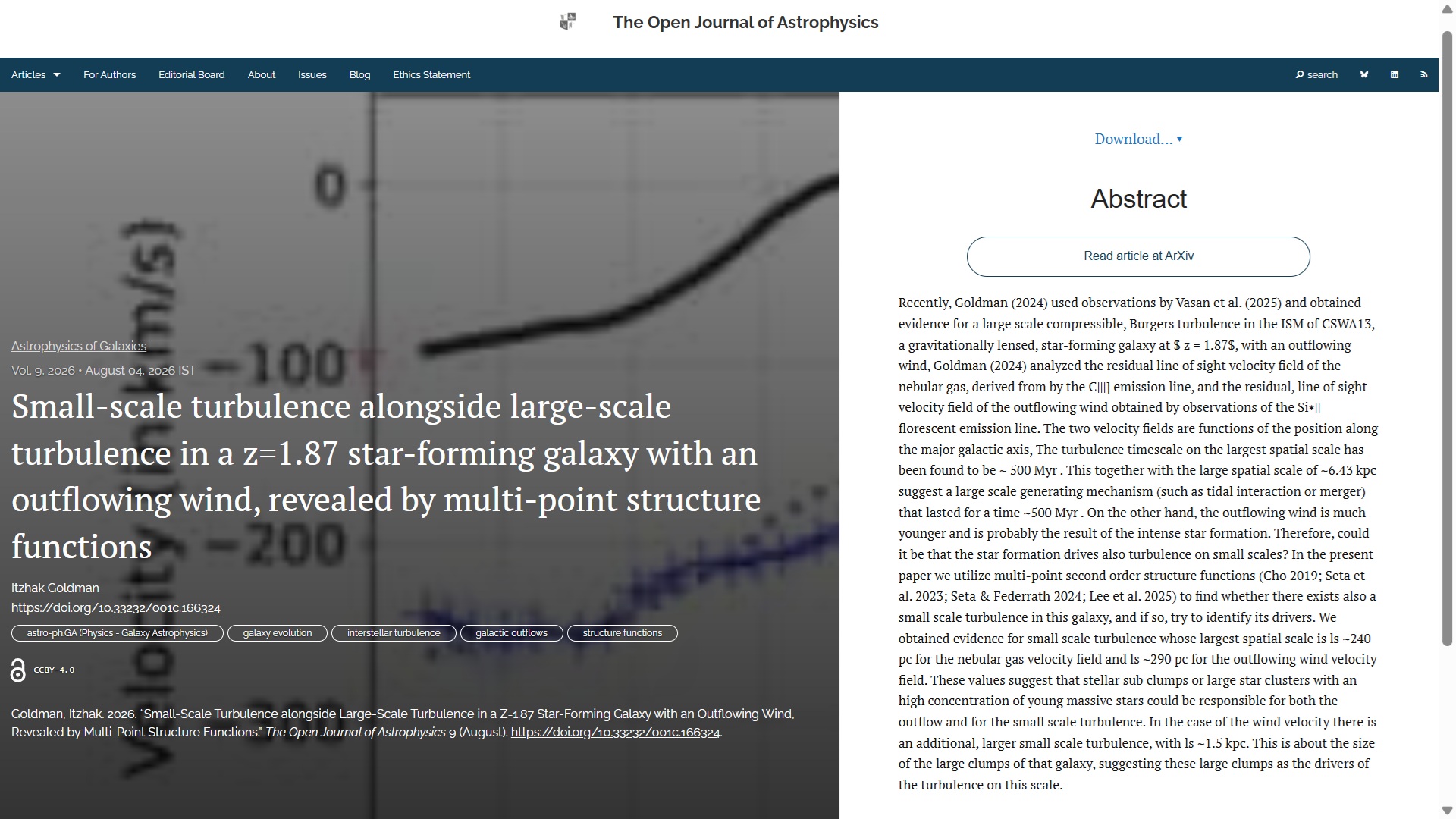
New Publication at the Open Journal of Astrophysics: "Small-scale turbulence alongside large-scale turbulence in a z=1.87 star-forming galaxy with an outflowing wind, revealed by multi-point structure functions" by Itzhak Goldman (Afeka College, Israel)
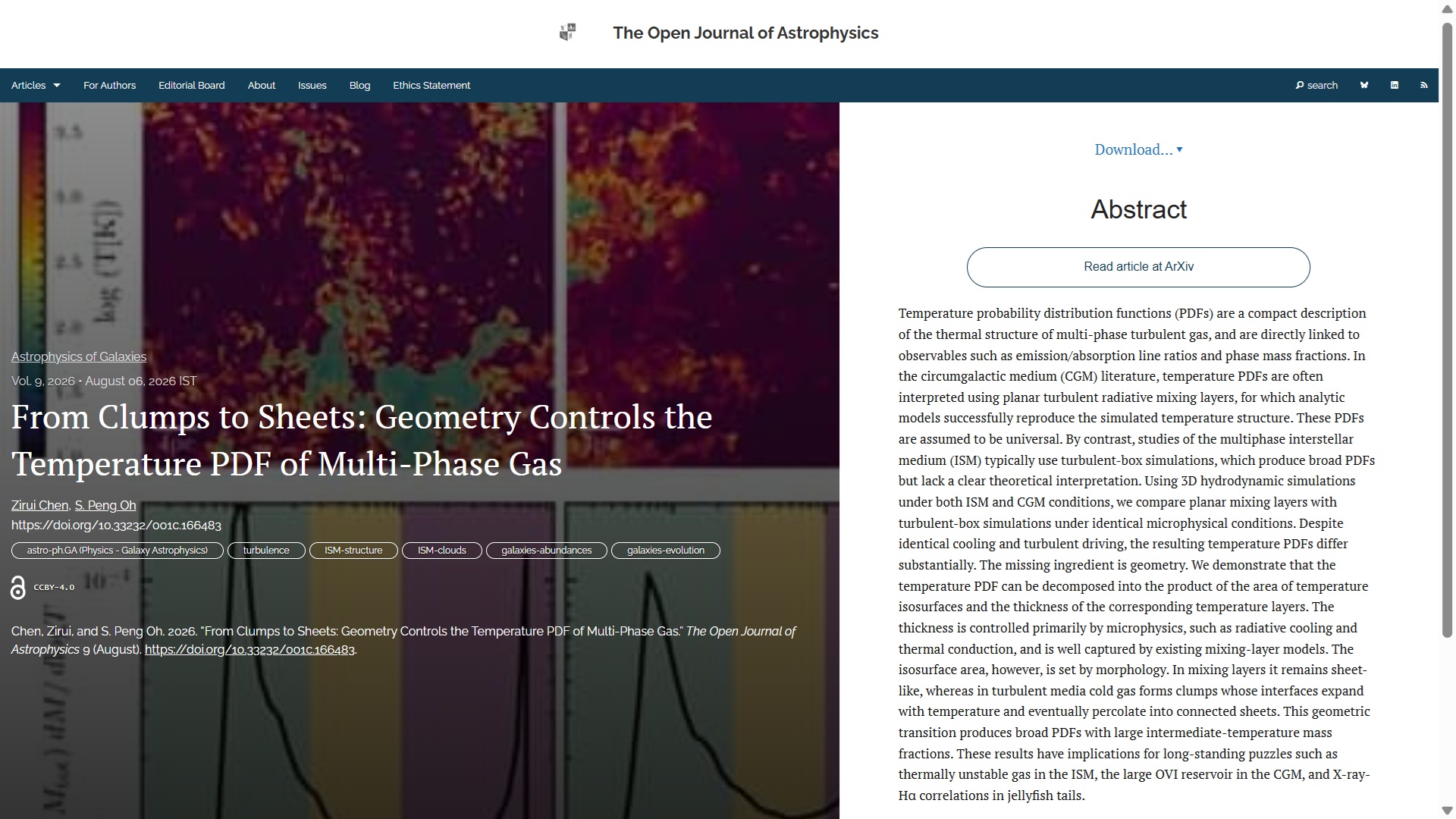
The second paper for this week, published on Thursday 6th August in the folder Astrophysics of Galaxies, is “From Clumps to Sheets: Geometry Controls the Temperature PDF of Multi-Phase Gas” by Zirui Chen and S. Peng Oh (UC Santa Barbara, USA). This study uses 3D hydrodynamic simulations to show that the temperature probability distribution functions (PDFs) of multi-phase turbulent gas differ significantly under interstellar medium (ISM) and circumgalactic medium (CGM) conditions.
The overlay looks like this:
The official version of the paper can be found on arXiv here and the Fediverse announcement here:
New Publication at the Open Journal of Astrophysics: "From Clumps to Sheets: Geometry Controls the Temperature PDF of Multi-Phase Gas" by Zirui Chen and S. Peng Oh (UC Santa Barbara, USA)
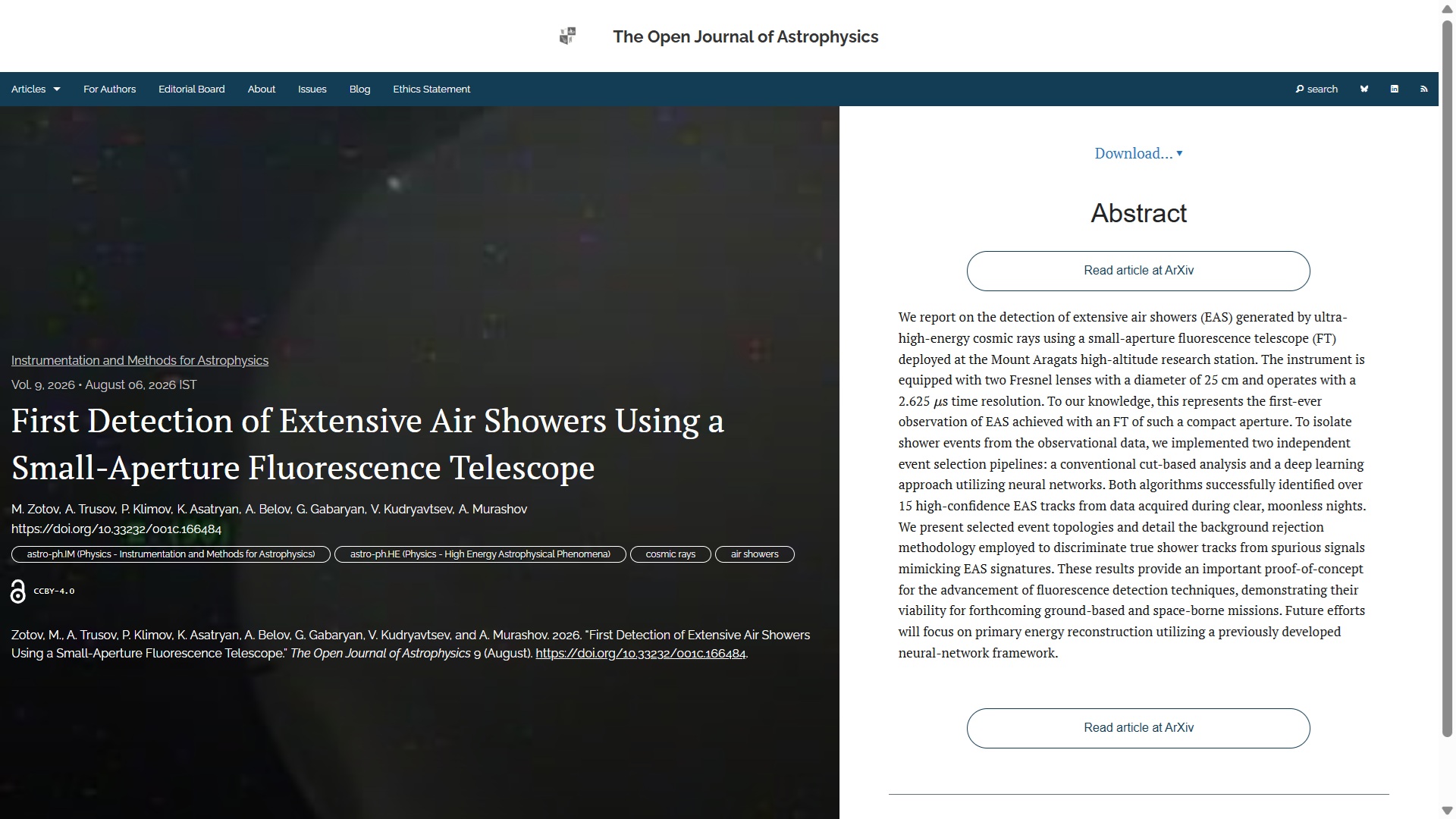
New Publication at the Open Journal of Astrophysics: "First Detection of Extensive Air Showers Using a Small-Aperture Fluorescence Telescope" by M. Zotov (M.V. Lomonosov Moscow State University, Russia) and 7 others based in Russia and Armenia
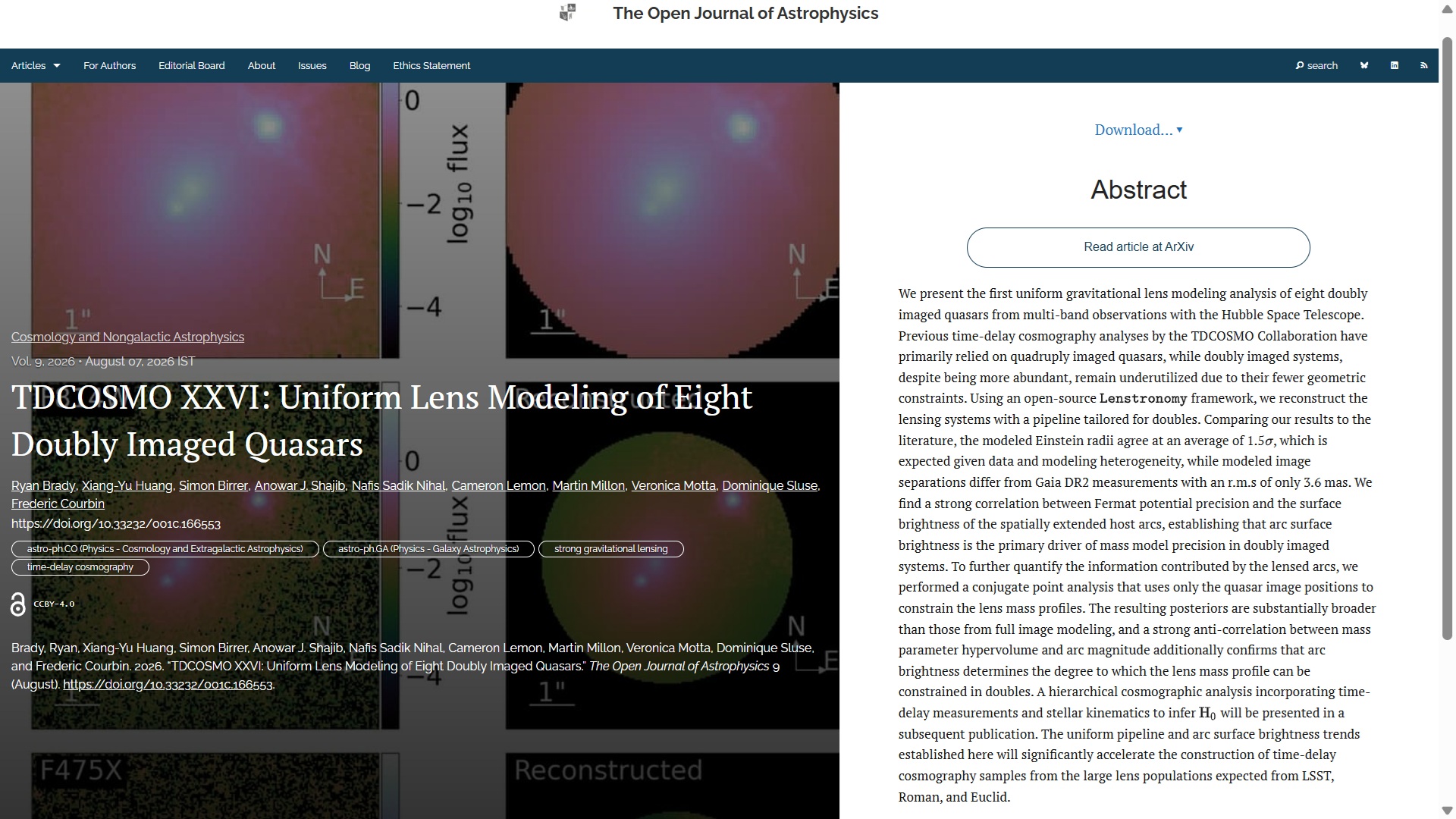
The fourth and final paper of the week was published on Friday 7th August in the folder Cosmology and Nongalactic Astrophysics: “TDCOSMO XXVI: Uniform Lens Modeling of Eight Doubly Imaged Quasars“, by Ryan Brady (Stony Brook University, USA) and 9 others based all around the world, presents a new method for analyzing doubly imaged quasars using the Hubble Space Telescope, revealing that arc surface brightness is key to precision in mass model measurements.
The overlay is here:
The officially-accepted version of the paper can be found on arXiv here and the Fediverse announcement here:
New Publication at the Copen Journal of Astrophysics: "TDCOSMO XXVI: Uniform Lens Modeling of Eight Doubly Imaged Quasars" by Ryan Brady (Stony Brook University, USA) and 9 others based around the world.
That’s all for this week. We have about a dozen more papers accepted and waiting for the authors to put the final version on arXiv, which they will presumably do when they’re back from holiday. I’ll do an update next weekend and we’ll see!
Back home to Maynooth, just in time for another Saturday update of activity at the Open Journal of Astrophysics. Since the last update we have published a further nine papers, bringing the number in Volume 9 (2026) to 145 and the total so far published by OJAp up to 593.
I will continue to include the posts made on our Mastodon account (on Fediscience); these announcements also show the DOI for each paper.
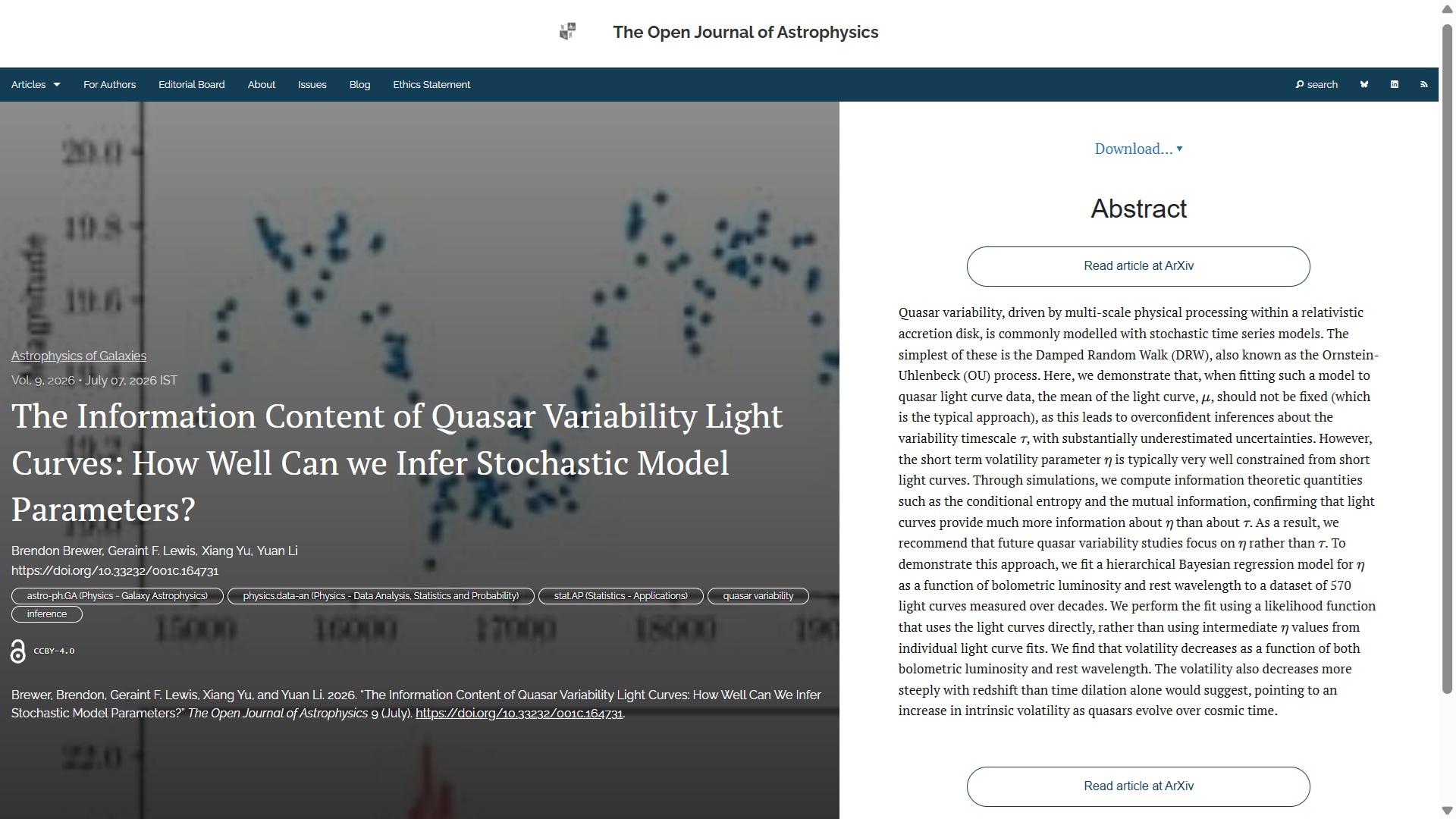
The first paper to report this week, published on Tuesday 7th July, is “The Information Content of Quasar Variability Light Curves: How Well Can we Infer Stochastic Model Parameters?” by Brendon Brewer (U. Auckland, NZ), Geraint F. Lewis (U. Sydney, AU), Xiang Yu & Yuan Li (Auckland). Published in the folder Astrophysics of Galaxies, this study suggests that quasar variability studies should focus on the short term volatility parameter, as it’s more informative than the variability timescale. Volatility decreases with redshift suggesting intrinsic effects.
The overlay for this paper is here
You can find the officially accepted version on arXiv here and the announcement on Fediverse here:
New Publication at the Open Journal of Astrophysics: "The Information Content of Quasar Variability Light Curves: How Well Can we Infer Stochastic Model Parameters?" by Brendon Brewer (U. Auckland, NZ), Geraint F. Lewis (U. Sydney, AU), Xiang Yu & Yuan Li (Auckland)
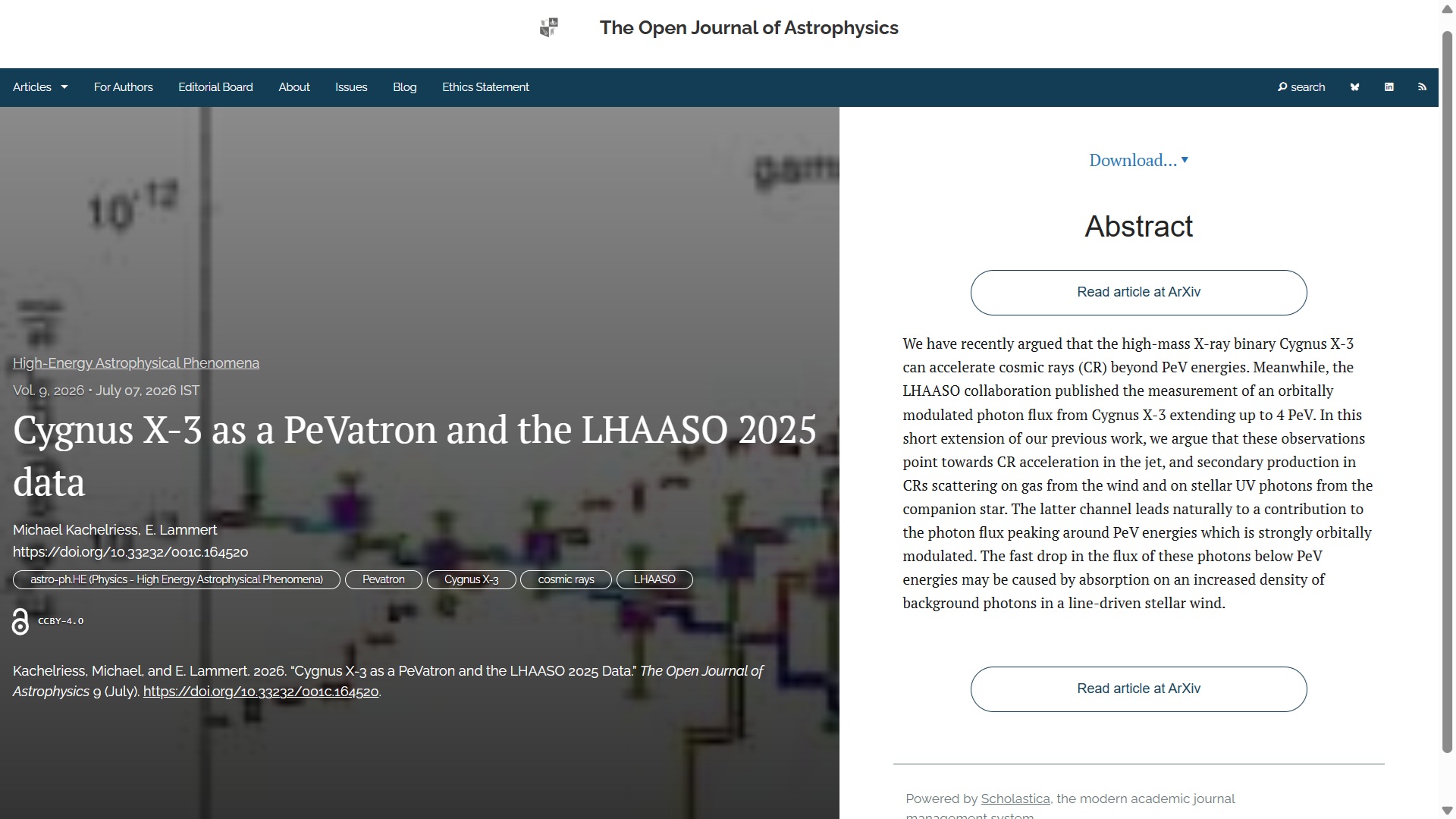
The second paper for this week, also published on Tuesday 7th July, but in the folder High-Energy Astrophysical Phenomena, is “Cygnus X-3 as a PeVatron and the LHAASO 2025 data” by Michael Kachelriess & E. Lammert (NTNU, Trondheim, Norway). This paper suggests that the high-mass X-ray binary Cygnus X-3 can accelerate cosmic rays beyond PeV energies, contributing to a photon flux peaking around PeV energies.
The overlay looks like this:
The official version of the paper can be found on arXiv here and the Fediverse announcement here:
New Publication at the Open Journal of Astrophysics: "Cygnus X-3 as a PeVatron and the LHAASO 2025 data" by Michael Kachelriess & E. Lammert (NTNU, Trondheim, Norway)
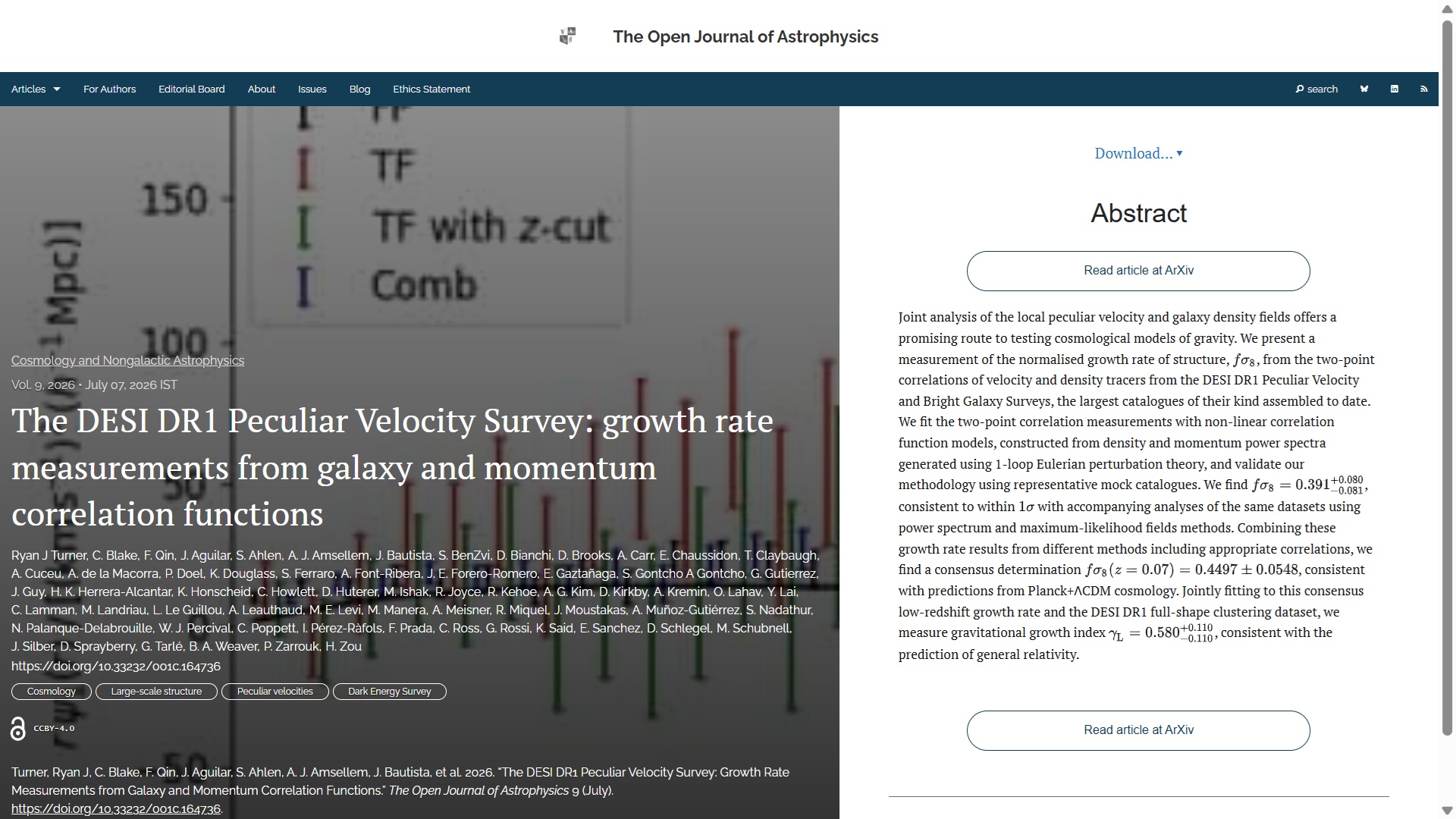
New Publication at the Open Journal of Astrophysics: "The DESI DR1 Peculiar Velocity Survey: growth rate measurements from galaxy and momentum correlation functions" by Ryan J Turner (Swinburne Institute of Technology, Australia) and 63 others from around the world.
New Publication at the Open Journal of Astrophysics: "On the effective spin-mass ratio relation of binary black hole mergers that evolved in isolation" by Sambaran Banerjee (Helmholtz-Instituts für Strahlen und Kernphysik, Germany) and Aleksandra Olejak (MPA Garching, Germany)
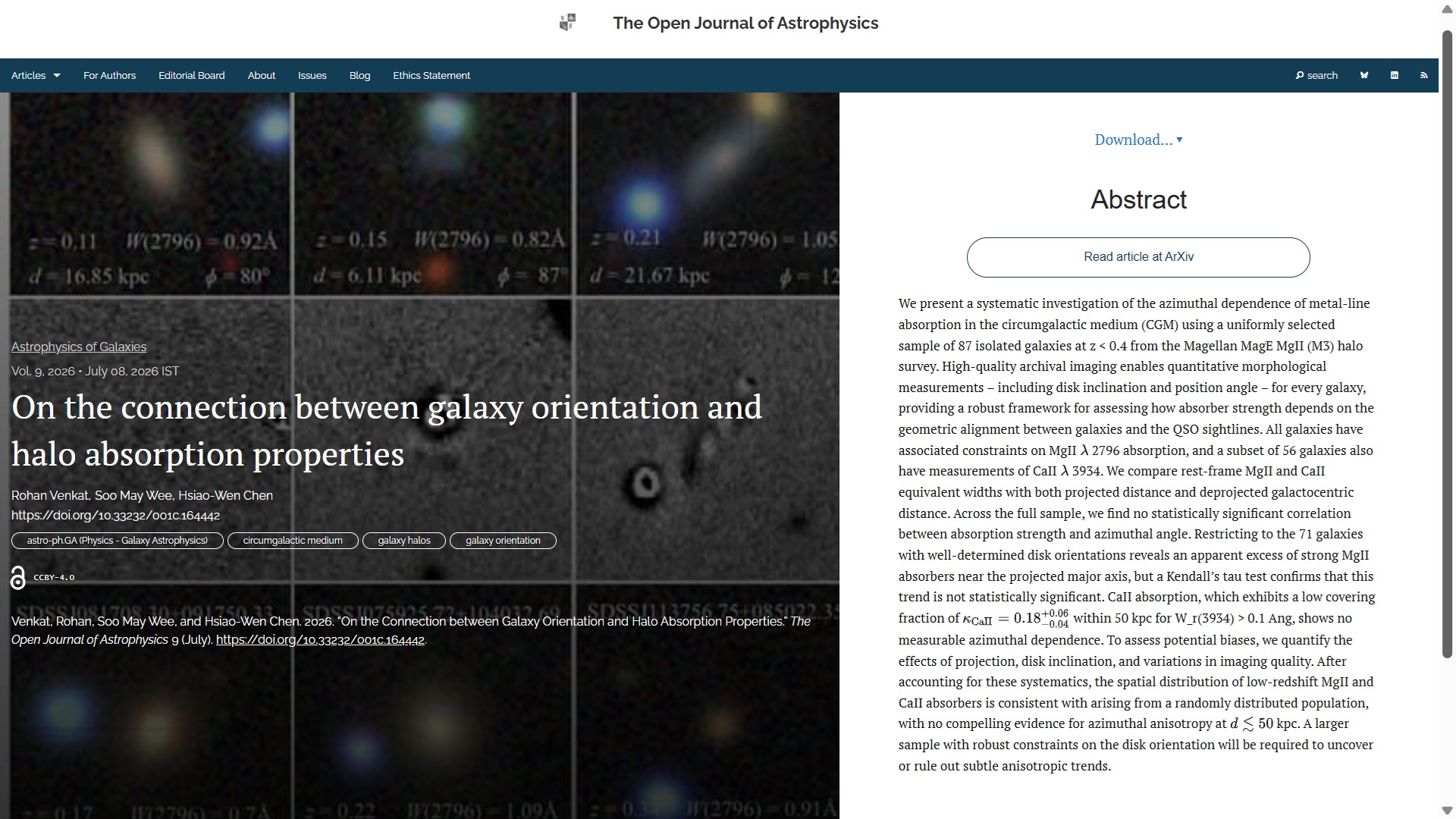
The fifth paper of the week, also published on Wednesday 8th July but in the folder Astrophysics of Galaxies, is “On the connection between galaxy orientation and halo absorption properties” by Rohan Venkat, Soo May Wee, and Hsiao-Wen Chen (U. Chicago, USA). This article investigates the azimuthal dependence of metal-line absorption in the circumgalactic medium of 87 isolated galaxies. The results show no significant correlation between absorption strength and azimuthal angle.
The overlay for this one is here:
You can read the final version of this one on arXiv here and the Mastodon announcement is here:
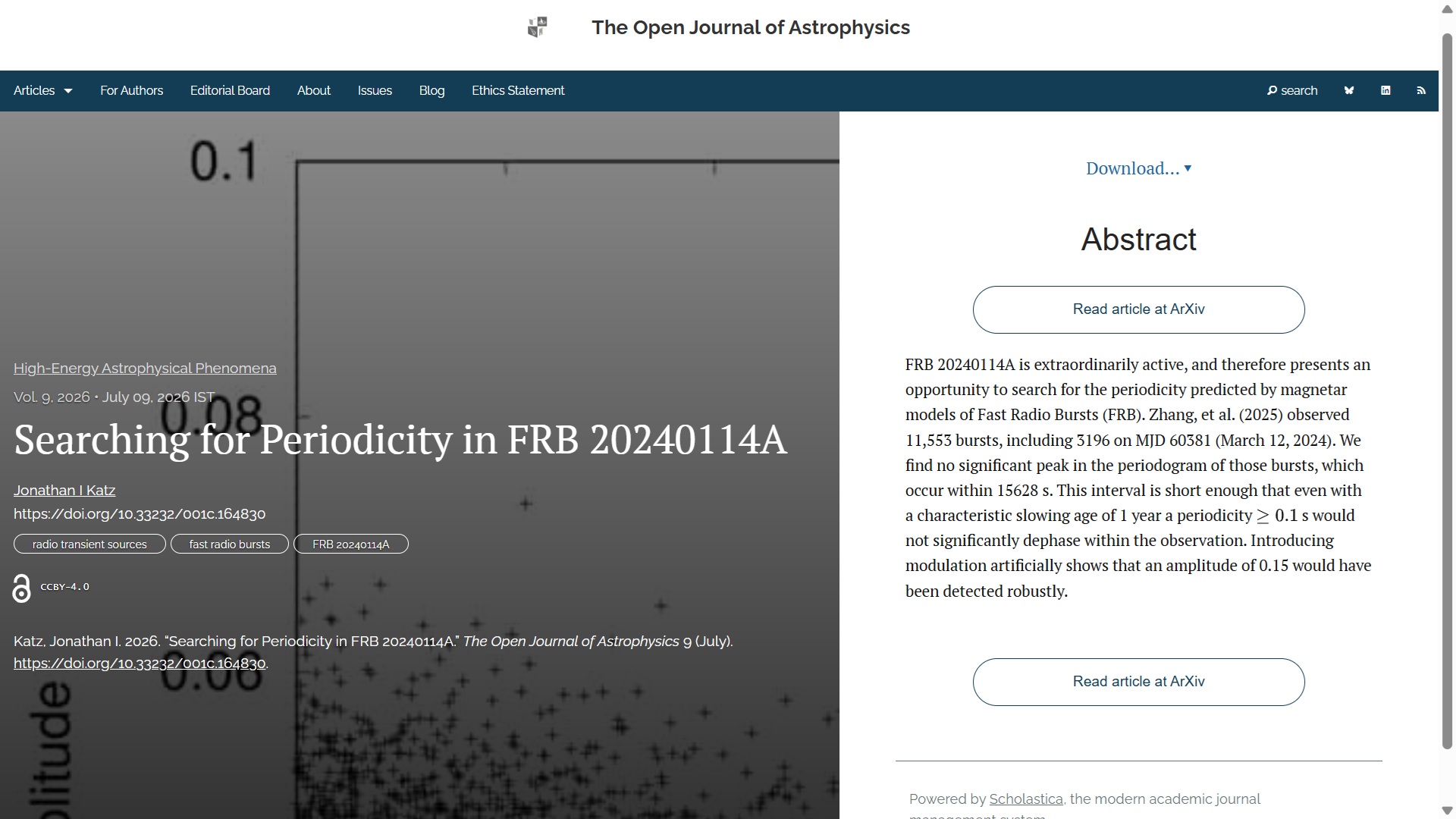
The sixth paper of this week is “Searching for Periodicity in FRB 20240114A” by Jonathan I Katz (Washington U., USA). This was published on Thursday 9th July in the folder High-Energy Astrophysical Phenomena. The study described in this paper observed FRB 20240114A, an active Fast Radio Burst, but found no significant periodicity in its bursts, contradicting magnetar models predictions.
The overlay for this one is here:
You can find the final accepted version on arXiv here and the Mastodon announcement is here:
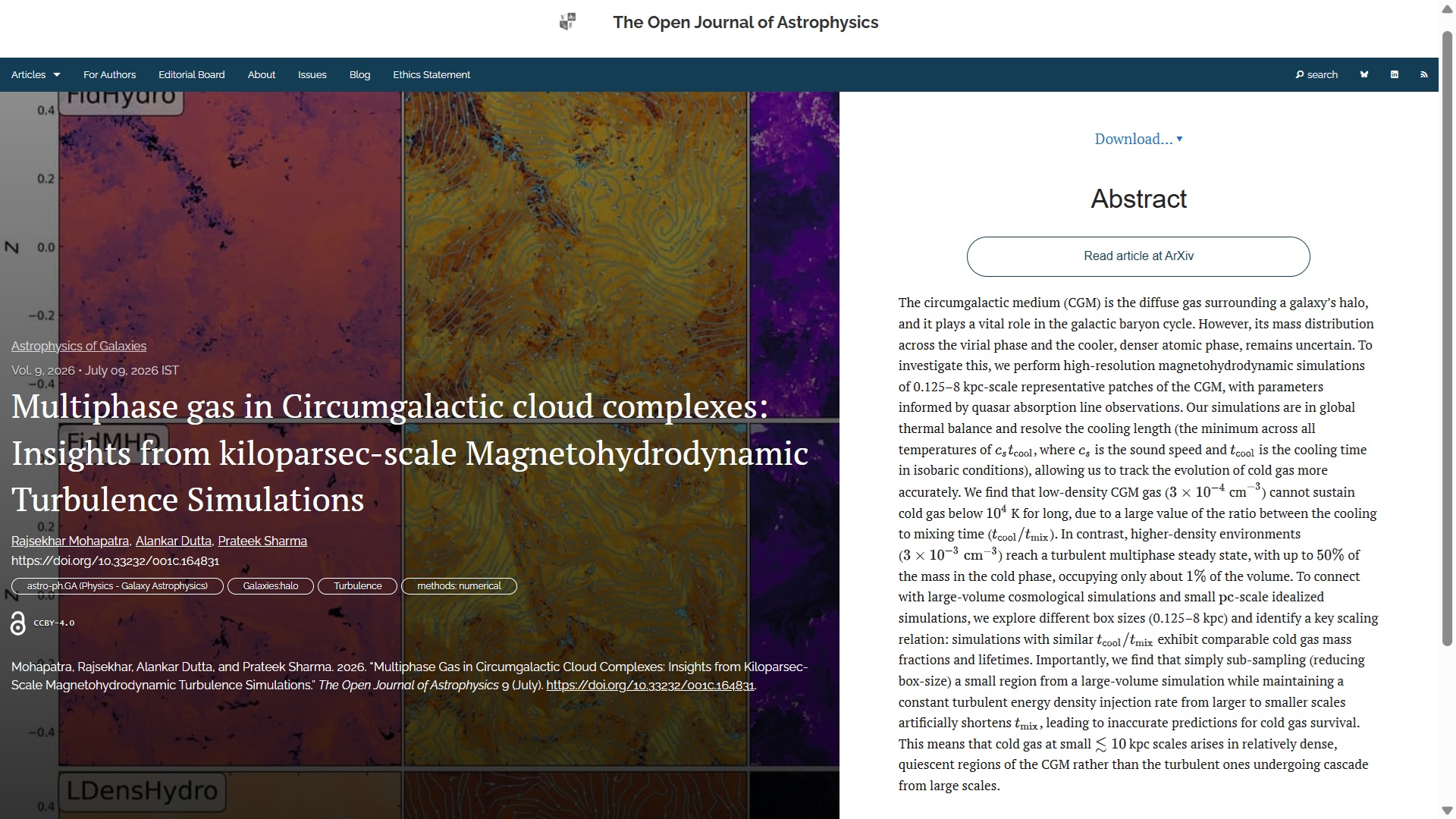
The seventh article for this week is “Multiphase gas in Circumgalactic cloud complexes: Insights from kiloparsec-scale Magnetohydrodynamic Turbulence Simulations” by Rajsekhar Mohapatra (Princeton U., USA), Alankar Dutta (MPA Garching, Germany) and Prateek Sharma (Indian Institute of Science, Bangalore). This -paper was also published on Thursday 9th July, in the folder Astrophysics of Galaxies. This paper uses high-resolution simulations to investigate the mass distribution of the circumgalactic medium (CGM), a diffuse gas surrounding a galaxy’s halo with small-scale clumps of cold gas forming in quiescent regions.
The overlay for this one is here:
You can find the final accepted version of this one on arXiv here and the Mastodon announcement is here:
New Publication at the Open Journal of Astrophysics: "Multiphase gas in Circumgalactic cloud complexes: Insights from kiloparsec-scale Magnetohydrodynamic Turbulence Simulations" by Rajsekhar Mohapatra (Princeton U., USA), Alankar Dutta (MPA Garching, Germany) and Prateek Sharma (Indian Institute of Science, Bangalore)
The (penultimate) eighth article for this week is “Line-of-sight shear in SLACS strong lenses I: shear and mass model parametrisations” by Natalie B. Hogg (U. Cambridge, UK), Daniel Johnson (U. Montpellier, France), Anowar J. Shajib (U. Chicago, USA) and Julien Larena (Montpellier). This was also published on Thursday 9th July, but in the folder Cosmology and Nongalactic Astrophysics. This article studies models of 23 strong gravitational lenses to measure line-of-sight shear for the first time, providing potential new constraints on cosmological parameters.
The overlay for this one is here:
You can find the final accepted version on arXiv here and the Mastodon announcement is here:
New Publication at the Open Journal of Astrophysics: "Line-of-sight shear in SLACS strong lenses I: shear and mass model parametrisations" by Natalie B. Hogg (U. Cambridge, UK), Daniel Johnson (U. Montpellier, France), Anowar J. Shajib (U. Chicago, USA) and Julien Larena (Montpellier)
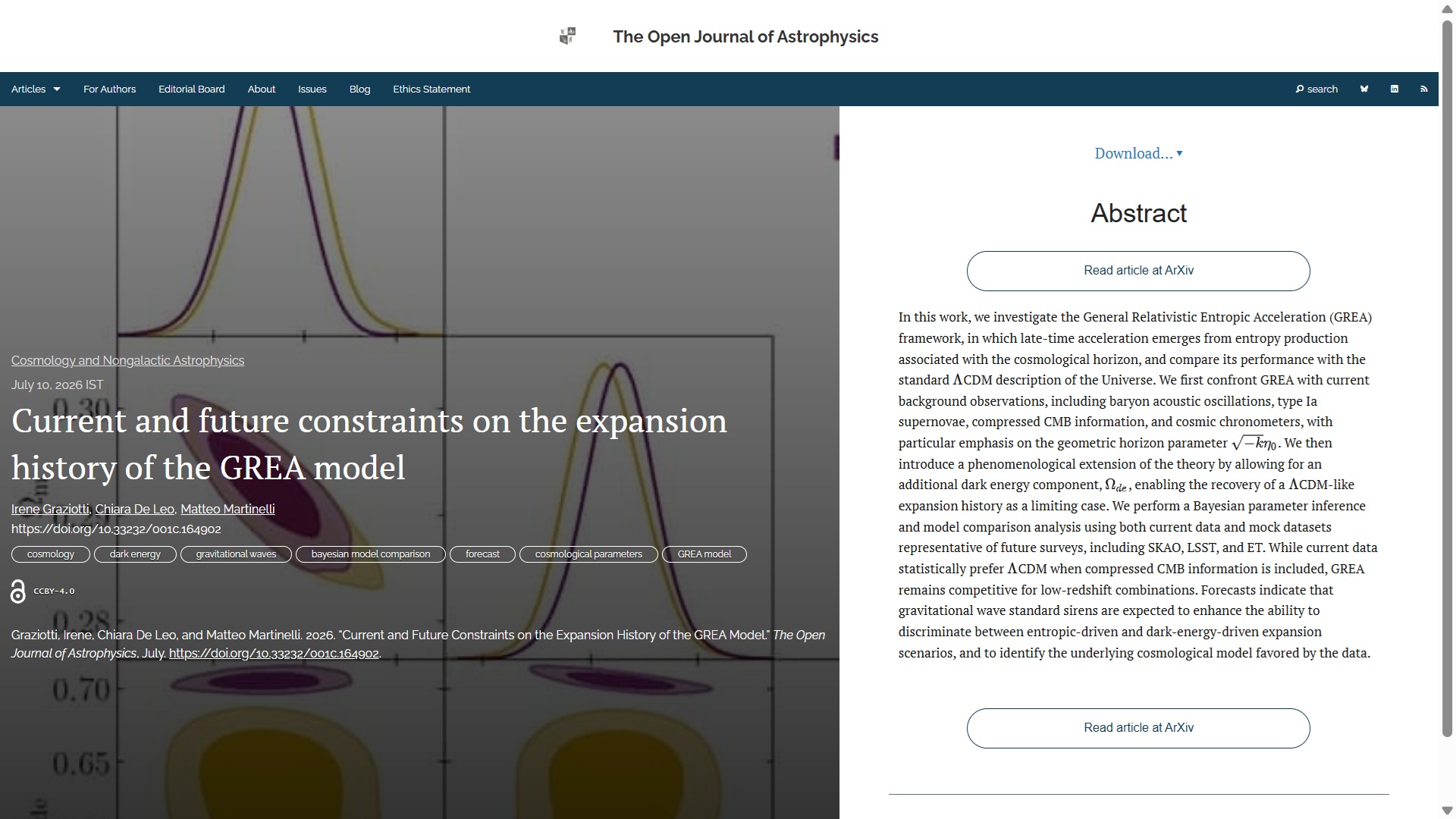
The ninth and last article for this week is “Current and future constraints on the expansion history of the GREA model” by Irene Graziotti (INAF-Osservatorio Astronomico di Capodimonte, Italy), Chiara De Leo (Sapienza University of Rome, Italy) and Matteo Martinelli (INAF-Osservatorio Astronomico di Roma, Italy). This study explores the General Relativistic Entropic Acceleration (GREA) framework, comparing it to the standard description of the universe. Current data favors the standard model, but GREA remains competitive.
The overlay for this one is here:
You can find the officially-accepted version on arXiv here and the Mastodon announcement here:
New Publication at the Open Journal of Astrophysics: "Current and future constraints on the expansion history of the GREA model" by Irene Graziotti (INAF-Osservatorio Astronomico di Capodimonte, Italy), Chiara De Leo (Sapienza University of Rome, Italy) and Matteo Martinelli (INAF-Osservatorio Astronomico di Roma, Italy)
As you can see, it has been a bumper week, especially when you consider that there was no arXiv mailing om Monday July 6th owing to the July 4th holiday in the USA. I should have known this would happen while I was travelling!
It’s Saturday once again, so time for another update of activity at the Open Journal of Astrophysics. Since the last update we have published a further six papers, bringing the number in Volume 9 (2026) to 110 and the total so far published by OJAp up to 558.
I will continue to include the posts made on our Mastodon account (on Fediscience); these announcements also show the DOI for each paper.
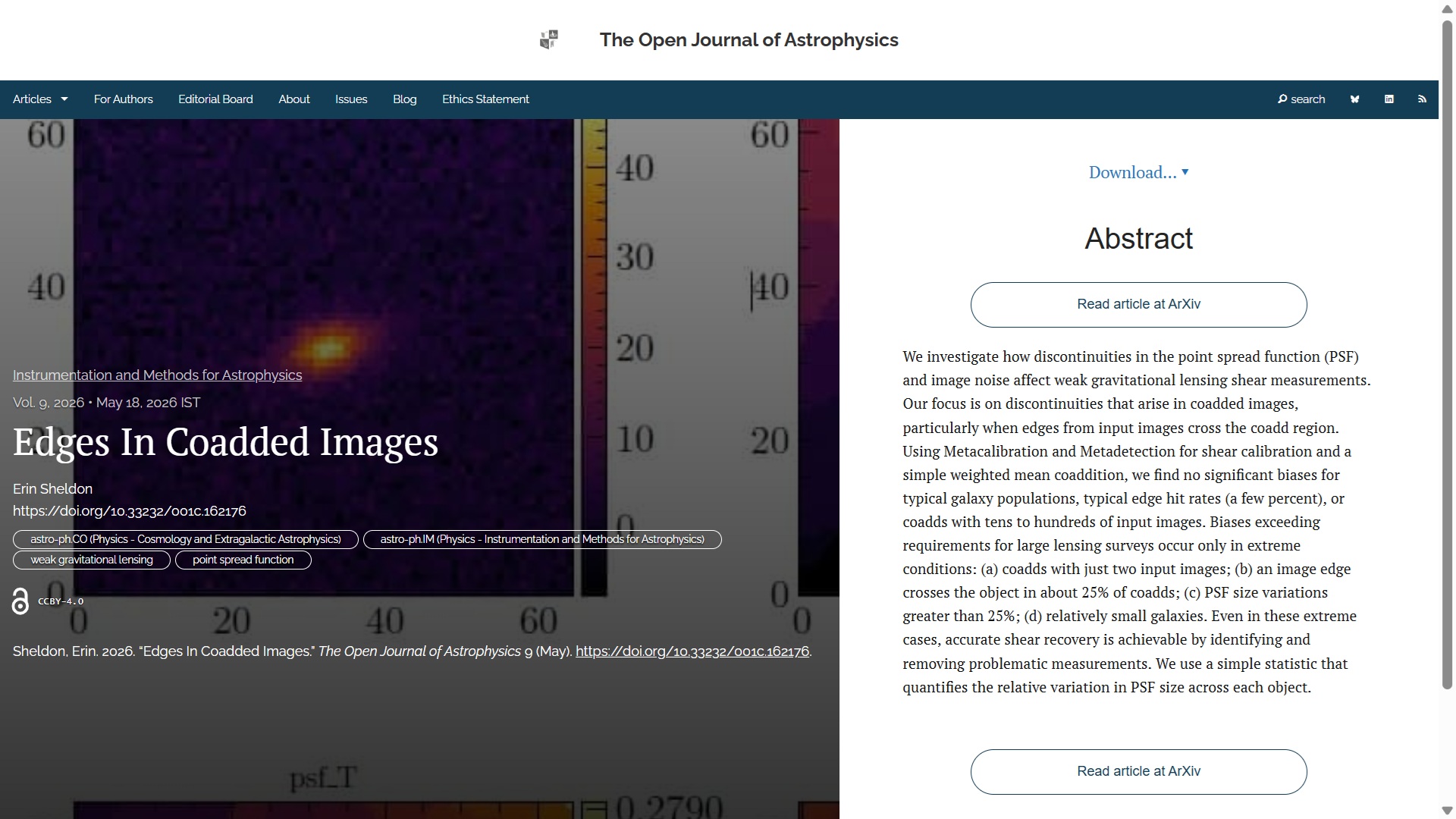
The first paper to report this week, published on Monday 18th May in the folder Instrumentation and Methods for Astrophysics is “Edges In Coadded Images” by Erin Sheldon (Brookhaven National Laboratory, USA). This paper describes a study exploring how image discontinuities and noise impact weak gravitational lensing measurements, finding no significant biases under typical conditions. Biases occur only in extreme cases, but can be mitigated.
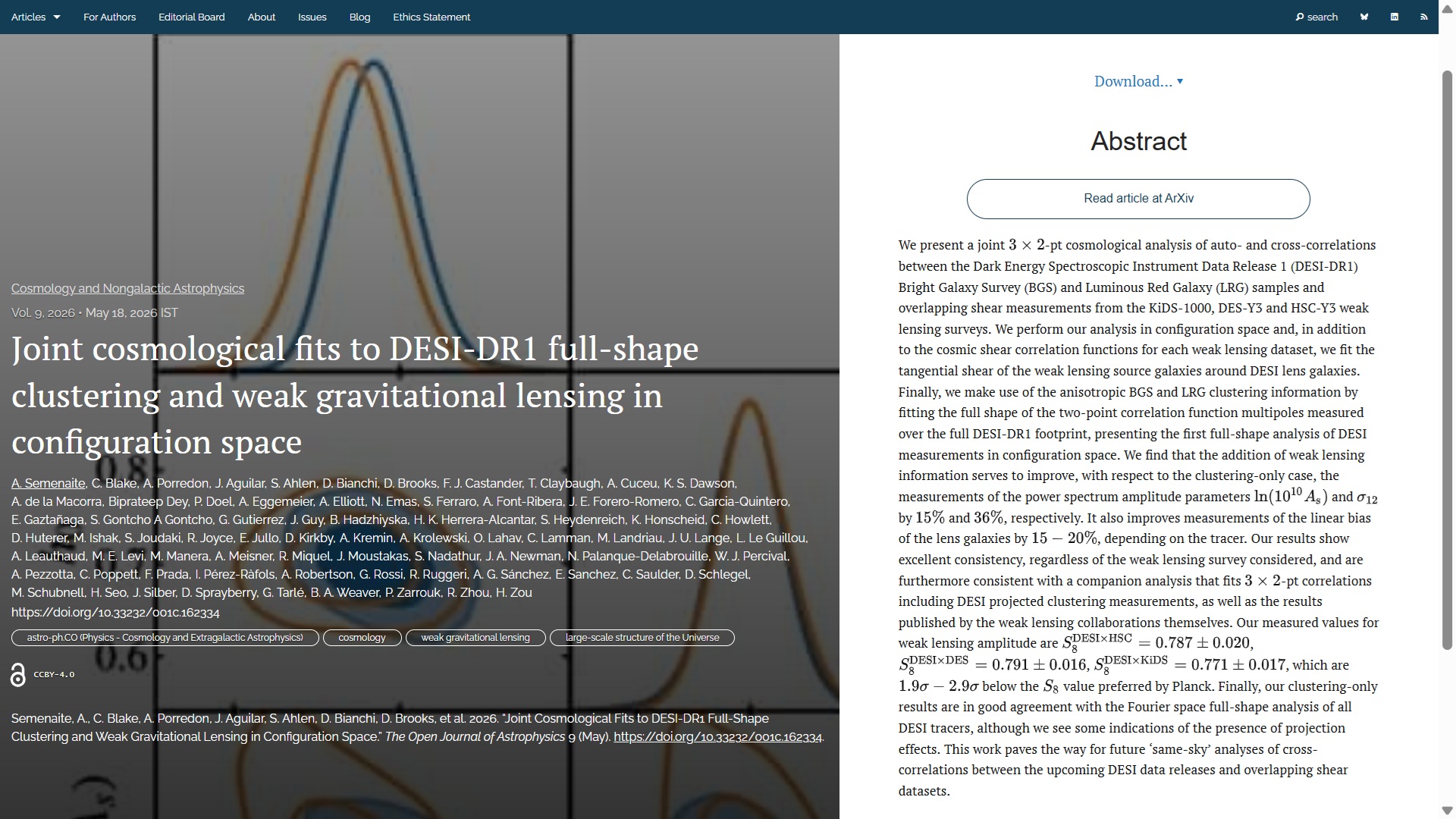
The overlay for this paper is here
You can find the officially accepted version on arXiv here and the announcement on Fediverse here:
New Publication at the Open Journal of Astrophysics: "Joint cosmological fits to DESI-DR1 full-shape clustering and weak gravitational lensing in configuration space " by A. Semenaite (Swinburne Institute of Technology, Australia) and 72 others from all round the world.
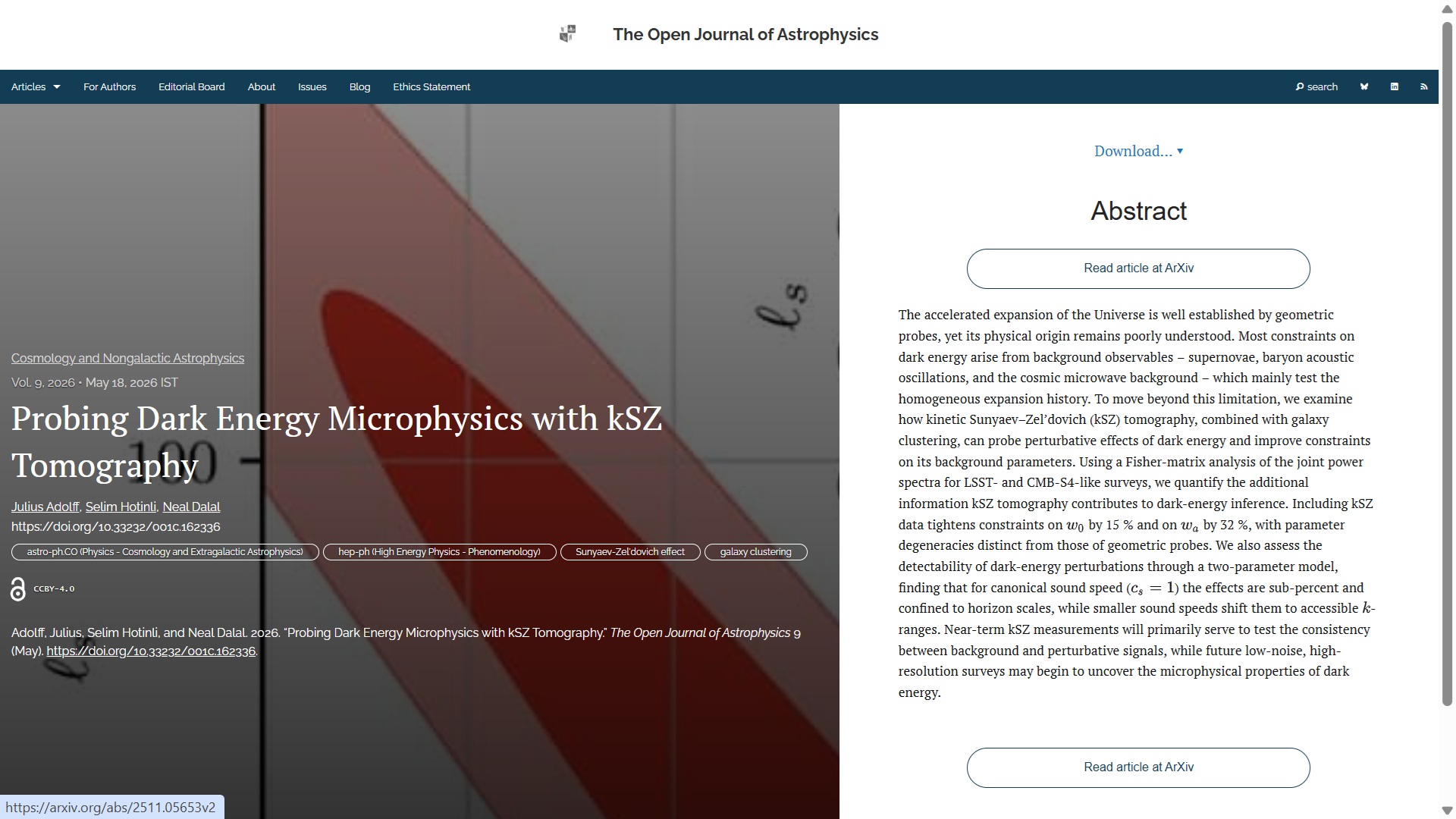
Next one up, the third paper of the week, and the third published on Monday 18th May, and in the folder Cosmology and Nongalactic Astrophysics is “Probing Dark Energy Microphysics with kSZ Tomography” by Julius Adolff, Selim Hotinli and Neal Dalal (all of the Perimeter Institute, Canada). This paper explores how kinetic Sunyaev-Zel’dovich tomography and galaxy clustering can enhance our understanding of dark energy and its effects, potentially revealing its microphysical properties in future surveys.
The overlay for this one is here:
The final, accepted version can be found on arXiv here and the Mastodon announcement is here:
New Publication at the Open Journal of Astrophysics: "Probing Dark Energy Microphysics with kSZ Tomography" by Julius Adolff, Selim Hotinli and Neal Dalal (Perimeter Institute, Canada)
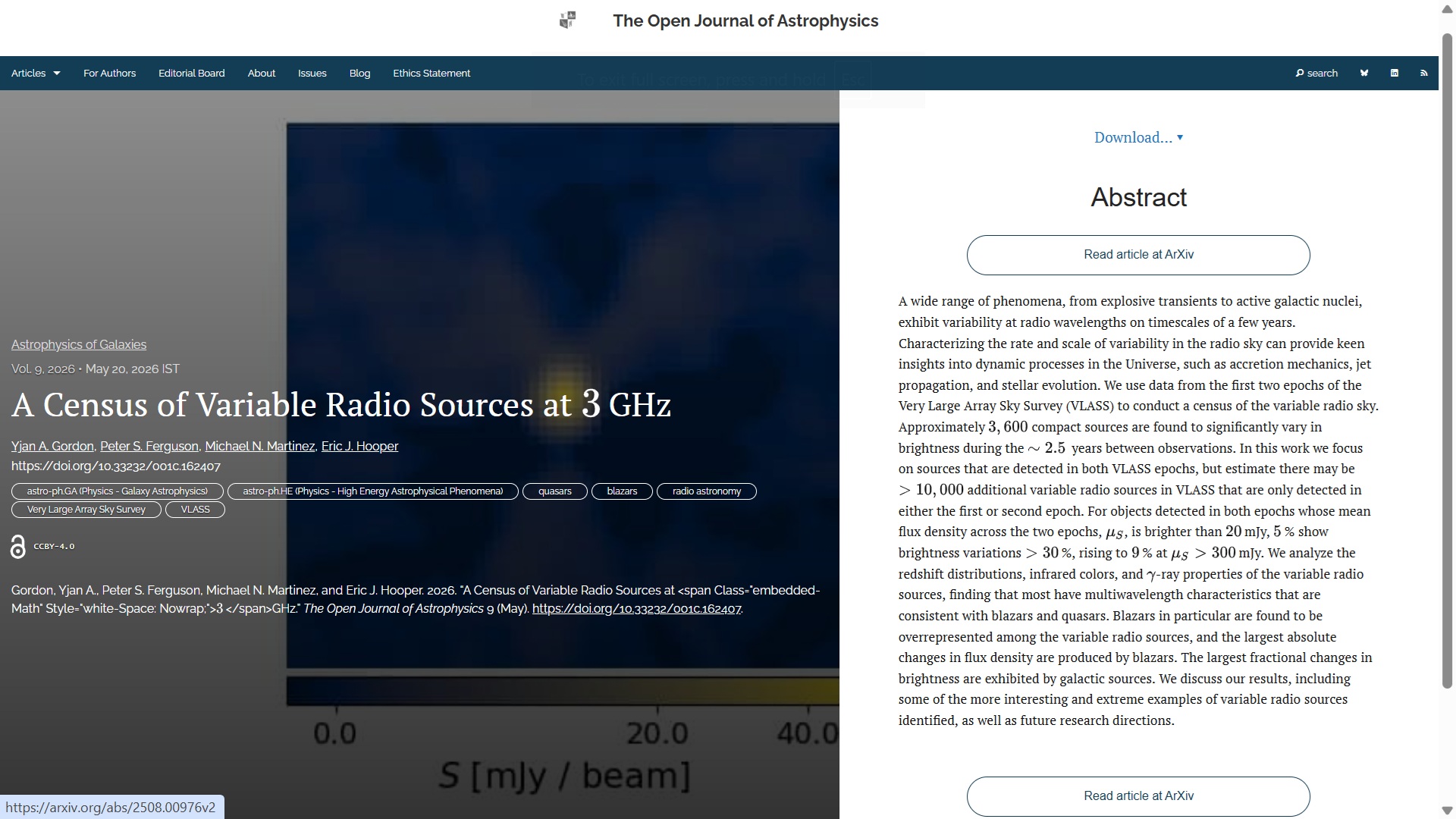
The fourth paper this week, published on Wednesday May 20th is “A Census of Variable Radio Sources at 3 GHz” by Yjan A. Gordon, Peter S. Ferguson, Michael N. Martinez and Eric J. Hooper (all of the University of Wisconsin, USA). This article, published in the folder Astrophysics of Galaxies, uses data from the Very Large Array Sky Survey to analyze variability in the radio sky, finding most changes consistent with blazars and quasars.
The overlay is here:
The officially accepted version can be found on arXiv here and here is the Mastodon announcement:
New Publication at the Open Journal of Astrophysics: "A Census of Variable Radio Sources at 3 GHz" by Yjan A. Gordon, Peter S. Ferguson, Michael N. Martinez & Eric J. Hooper (U. Wisconsin, USA)
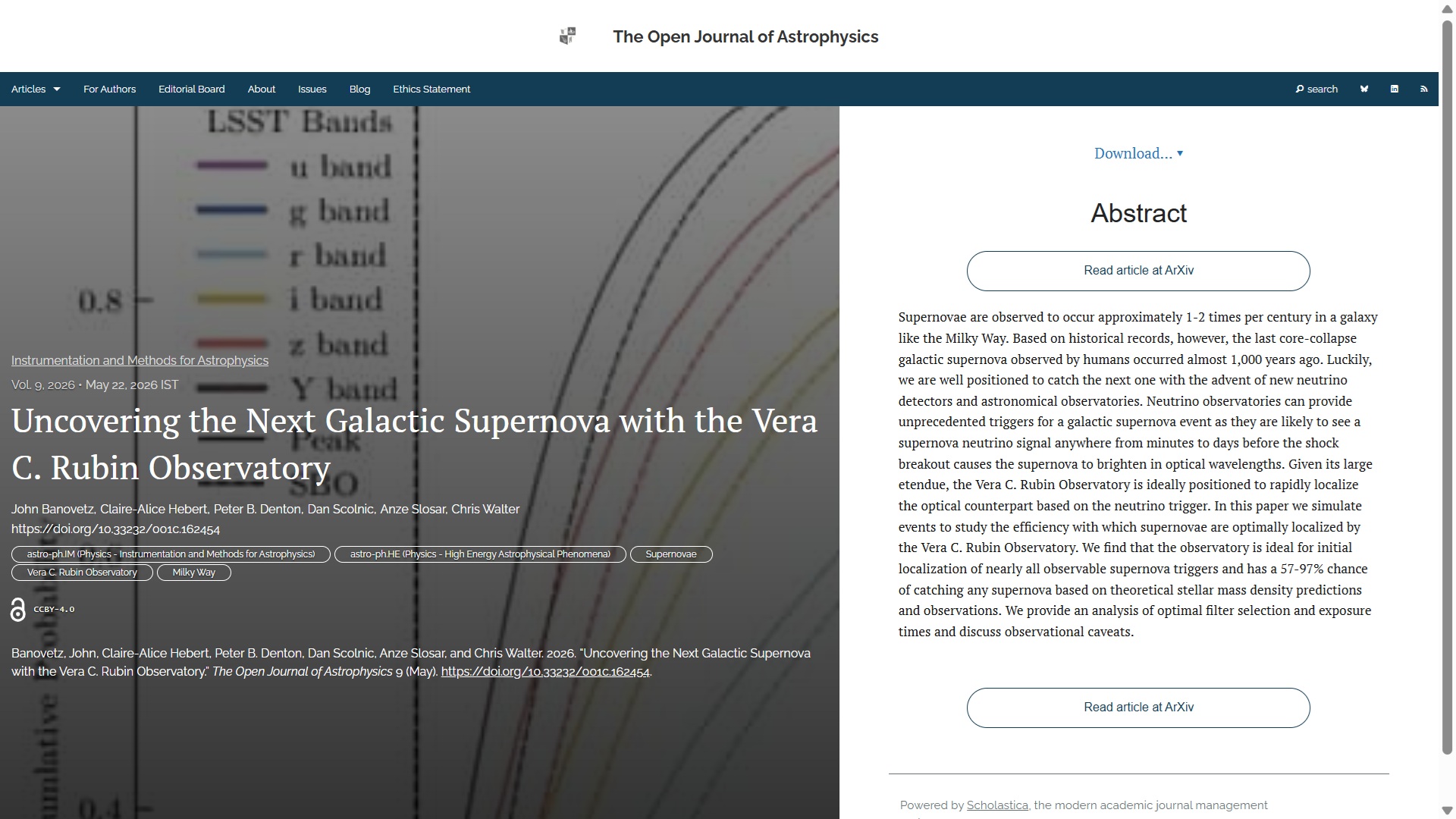
The fifth article of this week was published on Friday 22nd May in the folder Instrumentation and Methods for Astrophysics. The title is “Uncovering the Next Galactic Supernova with the Vera C. Rubin Observatory” by John Banovetz (Lawrence Berkeley Lab., USA), Claire-Alice Hebert & Peter B. Denton (Brookhaven National Lab., USA), Dan Scolnic (Duke University, USA), Anze Slosar (Brookhaven) and Chris Walter (Duke). The paper presents a study simulating how effectively the Vera C. Rubin Observatory can localize supernovae using neutrino triggers, finding a 57-97% success rate based on stellar mass density predictions.
The overlay is here:
You can find the authorized version of this paper on arXiv here and the Fediverse announcement is here:
New Publlication at the Open Journal of Astrophysics: "Uncovering the Next Galactic Supernova with the Vera C. Rubin Observatory" by John Banovetz (Lawrence Berkeley Lab., USA), Claire-Alice Hebert & Peter B. Denton (Brookhaven National Lab., USA) , Dan Scolnic (Duke U., USA) , Anze Slosar (Brookhaven), and Chris Walter (Duke)
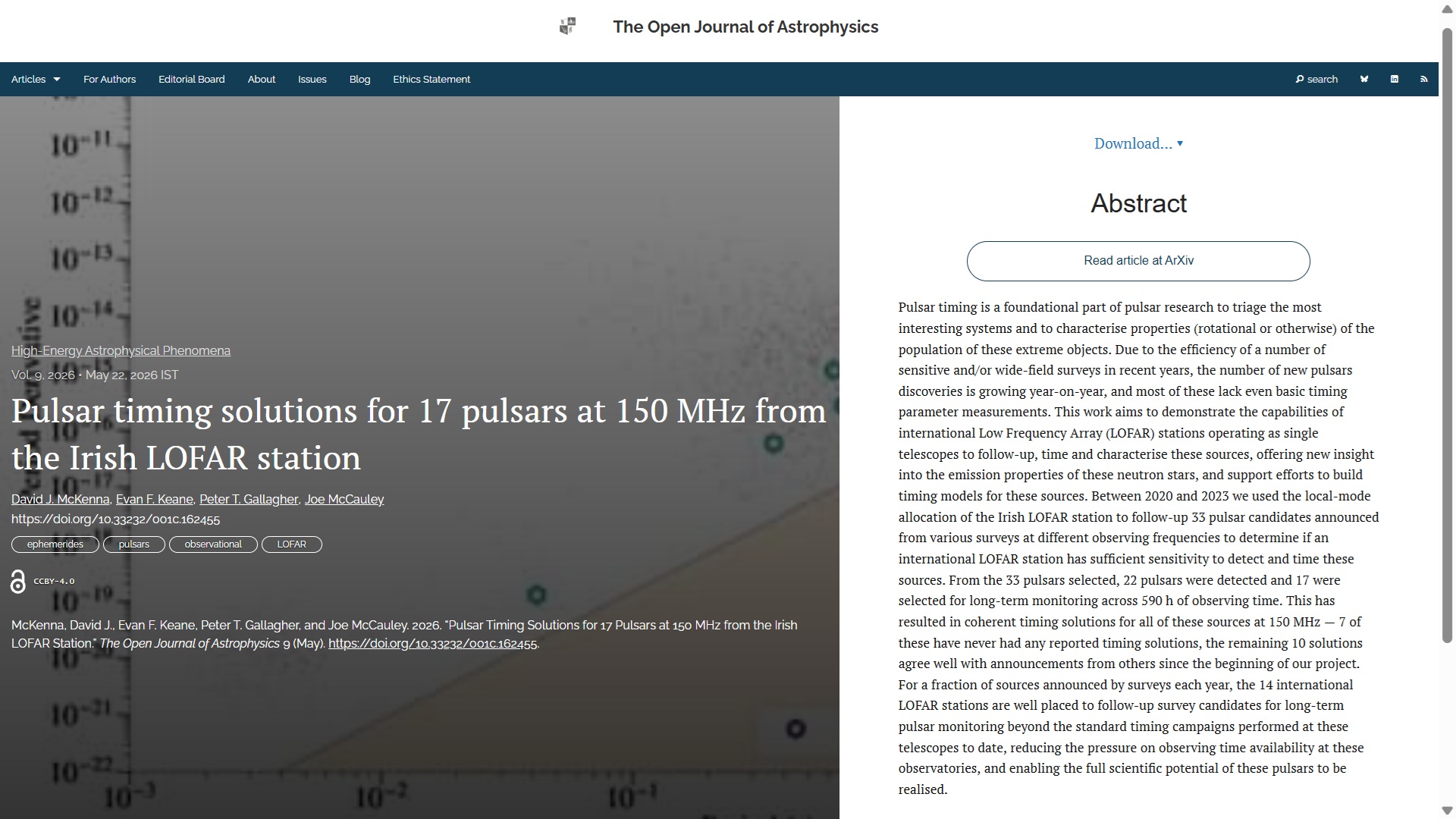
Last, but by no means least, this week we have “Pulsar timing solutions for 17 pulsars at 150 MHz from the Irish LOFAR station” by David J. McKenna (ASTRON, The Netherlands), Evan F. Keane (Trinity College Dublin, Ireland), Peter T. Gallagher (DIAS, Ireland) and Joe McCauley (Trinity). This was published on Friday 22nd May in the folder High-Energy Astrophysical Phenomena. It presents a demonstration of the use of international Low Frequency Array (LOFAR) stations in tracking and characterizing pulsars, providing new insights into these neutron stars’ emission properties.
The overlay for this one is here:
You can find the authorized version of this paper on arXiv here and the Fediverse announcement is here:
New Publication at the Open Journal of Astrophysics: "Pulsar timing solutions for 17 pulsars at 150 MHz from the Irish LOFAR station" by David J. McKenna (ASTRON, The Netherlands), Evan F. Keane (Trinity College Dublin, Ireland), Peter T. Gallagher (DIAS, Ireland) and Joe McCauley (Trinity)
It’s Saturday once more, so it’s time for another update of activity at the Open Journal of Astrophysics. Since the last update we have published a further eight papers, bringing the number in Volume 9 (2026) to 59 and the total so far published by OJAp up to 507. We passed the 500 mark on Monday, and the week was also notable because we once again published at least one paper each working day.
I will continue to include the posts made on our Mastodon account (on Fediscience) to encourage you to visit it. Mastodon is a really excellent service, and a more than adequate replacement for X/Twitter (which nobody should be using); these announcements also show the DOI for each paper.
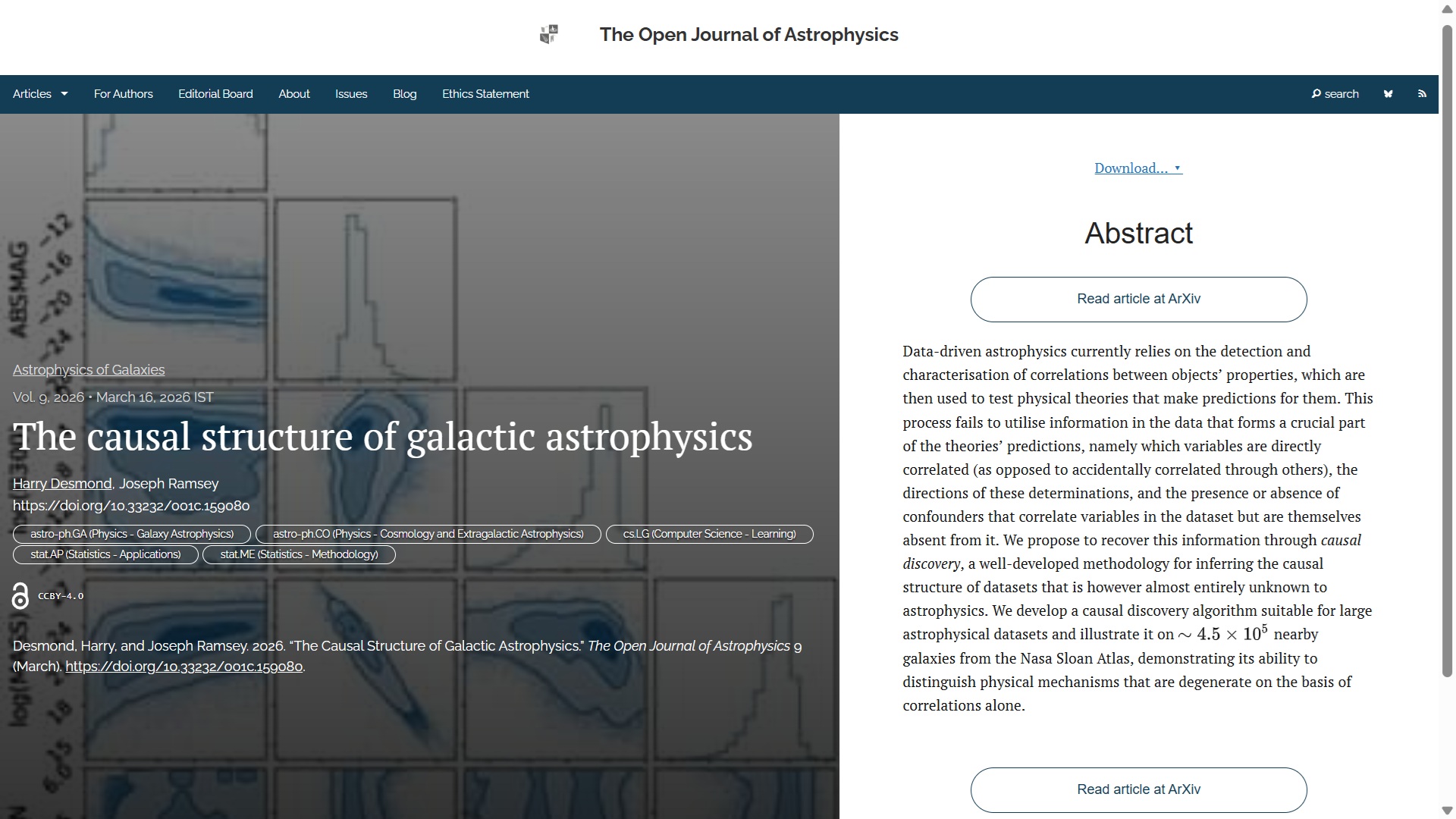
The first paper to report this week is our 500th publication. The title is “The causal structure of galactic astrophysics” and the authors are Harry Desmond (U. Portsmouth, UK) and Joseph Ramsey (Carnegie Mellon U., USA). This paper was published on Monday March 16th 2026 in the folder Astrophysics of Galaxies. It proposes using causal discovery, a method for inferring data structure, to better utilize information in astrophysical data, demonstrated through an algorithm applied to a large galaxy dataset.
The overlay is here:
You can find the officially accepted version on arXiv here and the announcement on Fediverse here:
New Publication at the Open Journal of Astrophysics: "The causal structure of galactic astrophysics" by Harry Desmond (U. Portsmouth, UK) and Joseph Ramsey (Carnegie Mellon U., USA)
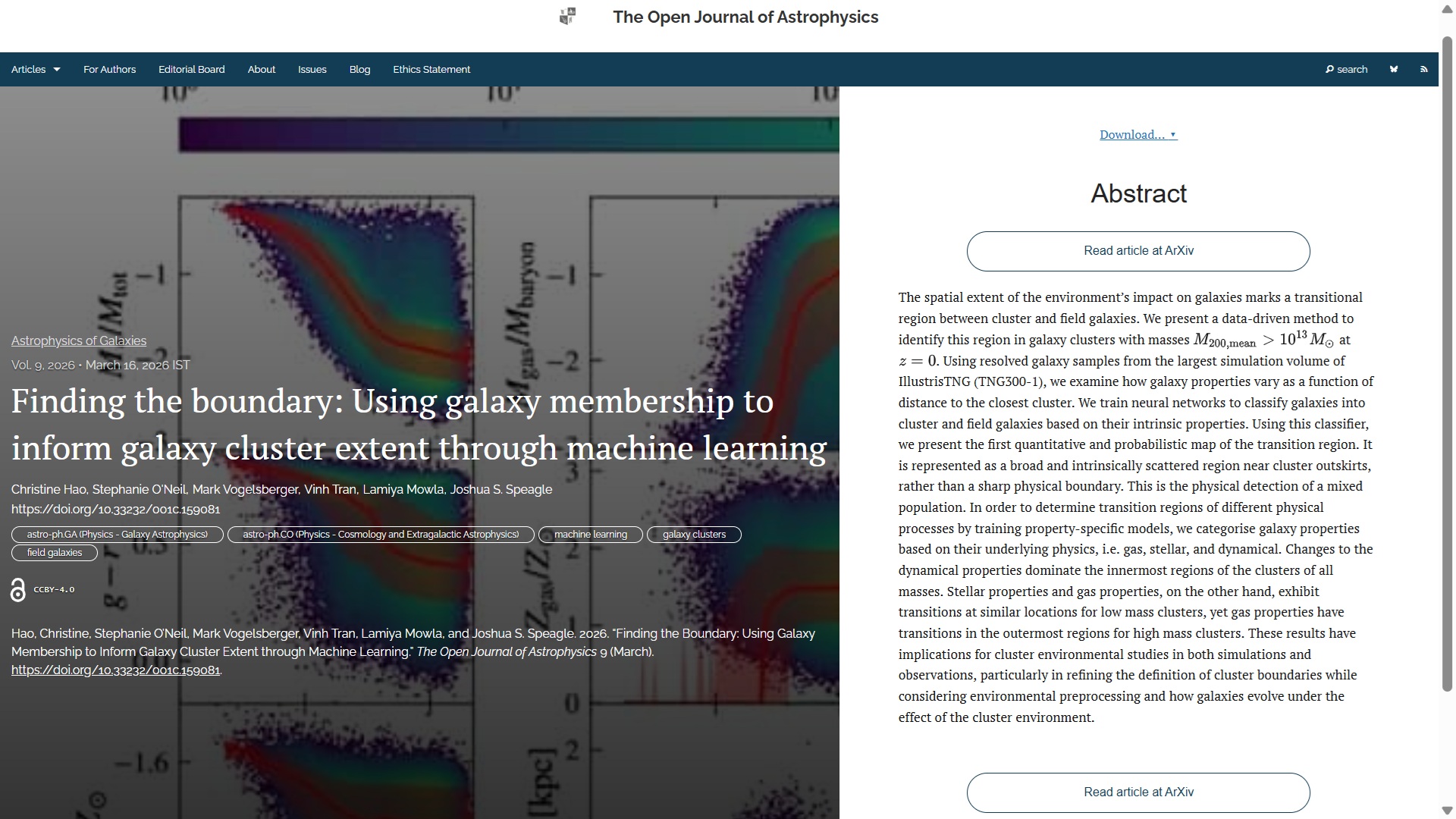
The second paper for this week, also published on March 16th in the folder Astrophysics of Galaxies, is “Finding the boundary: Using galaxy membership to inform galaxy cluster extent through machine learning” by Christine Hao, Stephanie O’Neil, Mark Vogelsberger, & Vinh Tran (MIT, USA), Lamiya Mowla (Wellesley College, USA) and Joshua S. Speagle (U. Toronto, Canada). This study uses neural networks and simulations to identify and map the transitional region between cluster and field galaxies, revealing it as a scattered area rather than a sharp boundary.
The overlay for this one is here:
The official version of the paper can be found on arXiv here and the Fediverse announcement here:
New Publication at the Open Journal of Astrophysics: "Finding the boundary: Using galaxy membership to inform galaxy cluster extent through machine learning" by Christine Hao, Stephanie O'Neil, Mark Vogelsberger, & Vinh Tran (MIT, USA), Lamiya Mowla (Wellesley College, USA) and Joshua S. Speagle (U. Toronto, Canada)
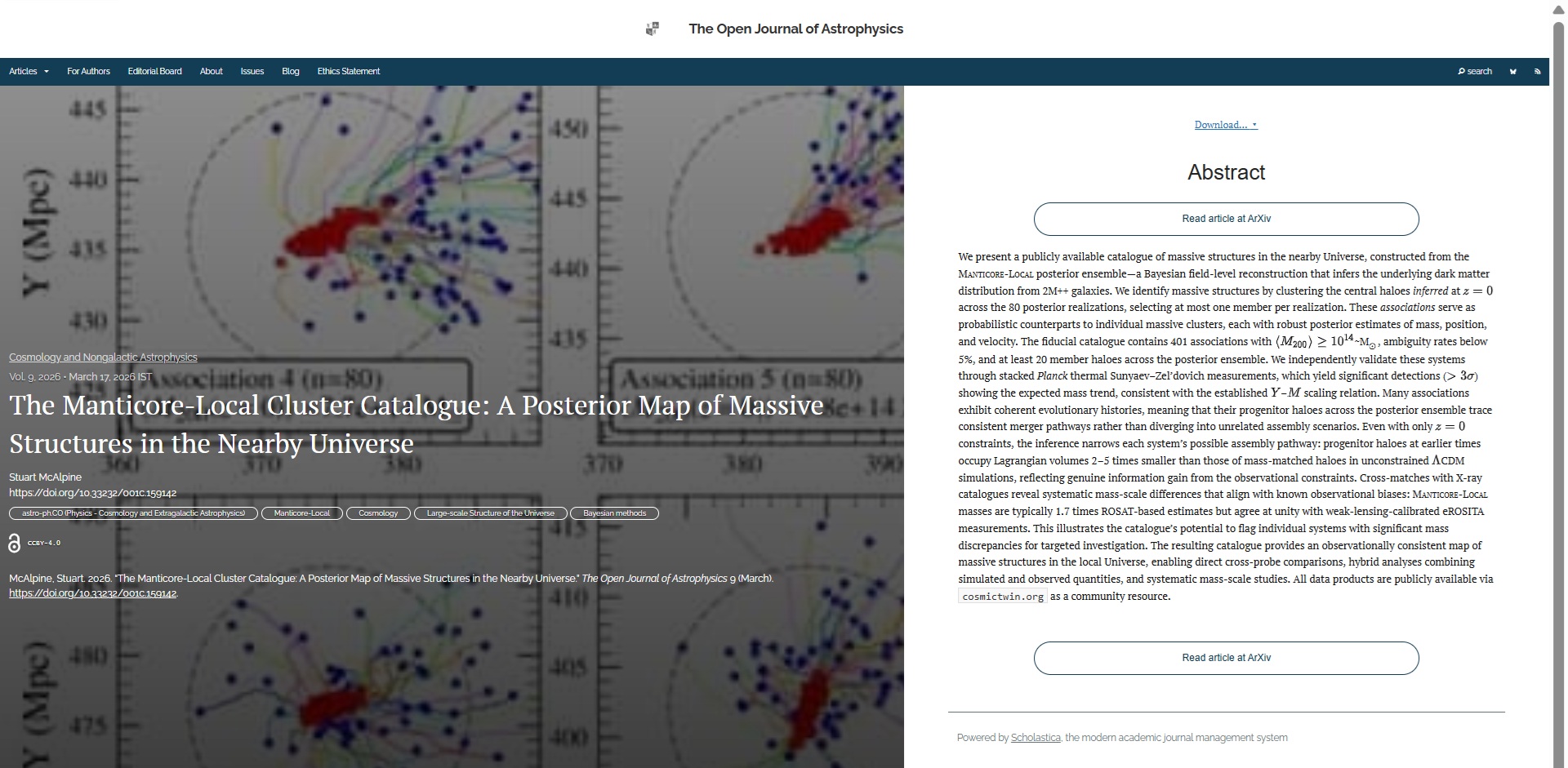
New Publication at the Open Journal of Astrophysics: "The Manticore-Local Cluster Catalogue: A Posterior Map of Massive Structures in the Nearby Universe" by Stuart McAlpine (Oskar Klein Centre, Stockholm U., Sweden)
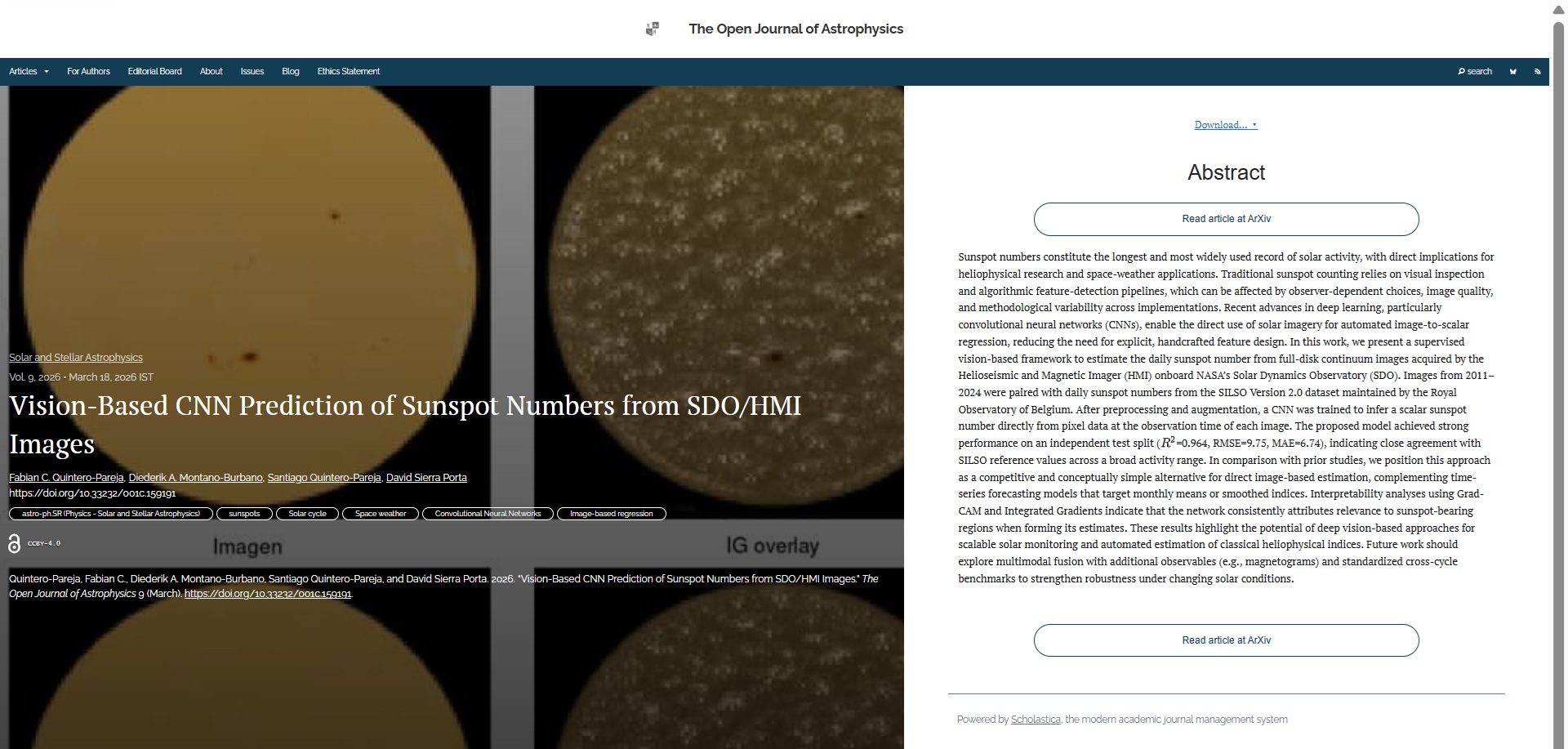
The fourth paper this week, published on 18th March 2026 in the folder Solar and Stellar Astrophysics is “Vision-Based CNN Prediction of Sunspot Numbers from SDO/HMI Images” by Fabian C. Quintero-Pareja, Diederik A. Montano-Burbano, Santiago Quintero-Pareja & David Sierra Porta (Universidad Tecnológica de Bolívar, Colombia). This article describes a deep learning framework that uses convolutional neural networks to estimate daily sunspot numbers from solar images, offering a scalable and accurate method for solar monitoring.
The overlay is here:
The finally accepted version of this paper can be found here and the Mastodon announcement is here:
New Publication at the Open Journal of Astrophysics: "Vision-Based CNN Prediction of Sunspot Numbers from SDO/HMI Images" by Fabian C. Quintero-Pareja, Diederik A. Montano-Burbano, Santiago Quintero-Pareja & David Sierra Porta (Universidad Tecnológica de Bolívar, Colombia)
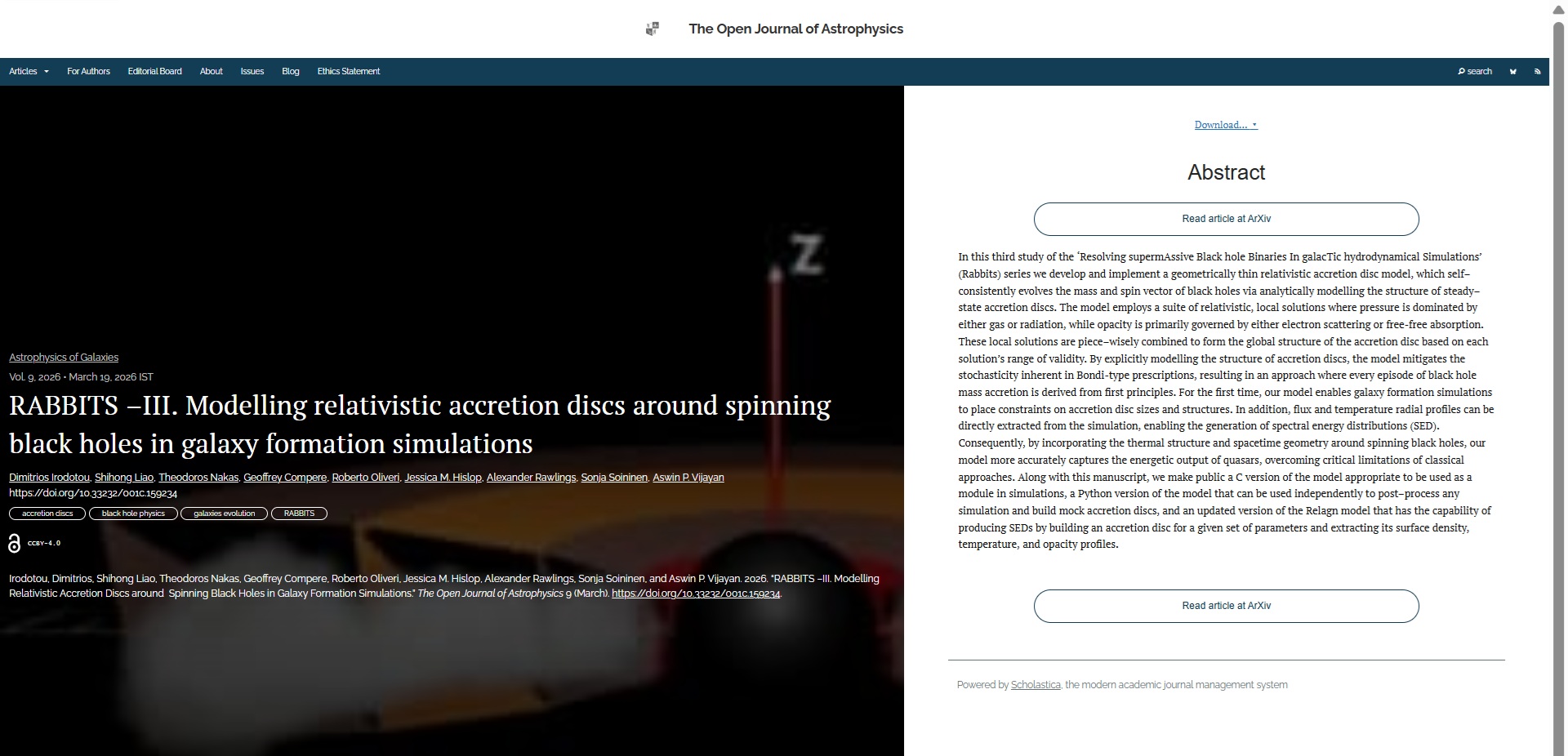
New Publication at the Open Journal of Astrophysics: "RABBITS –III. Modelling relativistic accretion discs around spinning black holes in galaxy formation simulations" by Dimitrios Irodotou (ICR, London) and 8 others based in China, Korea, Belgium, France, Finland and the UK.
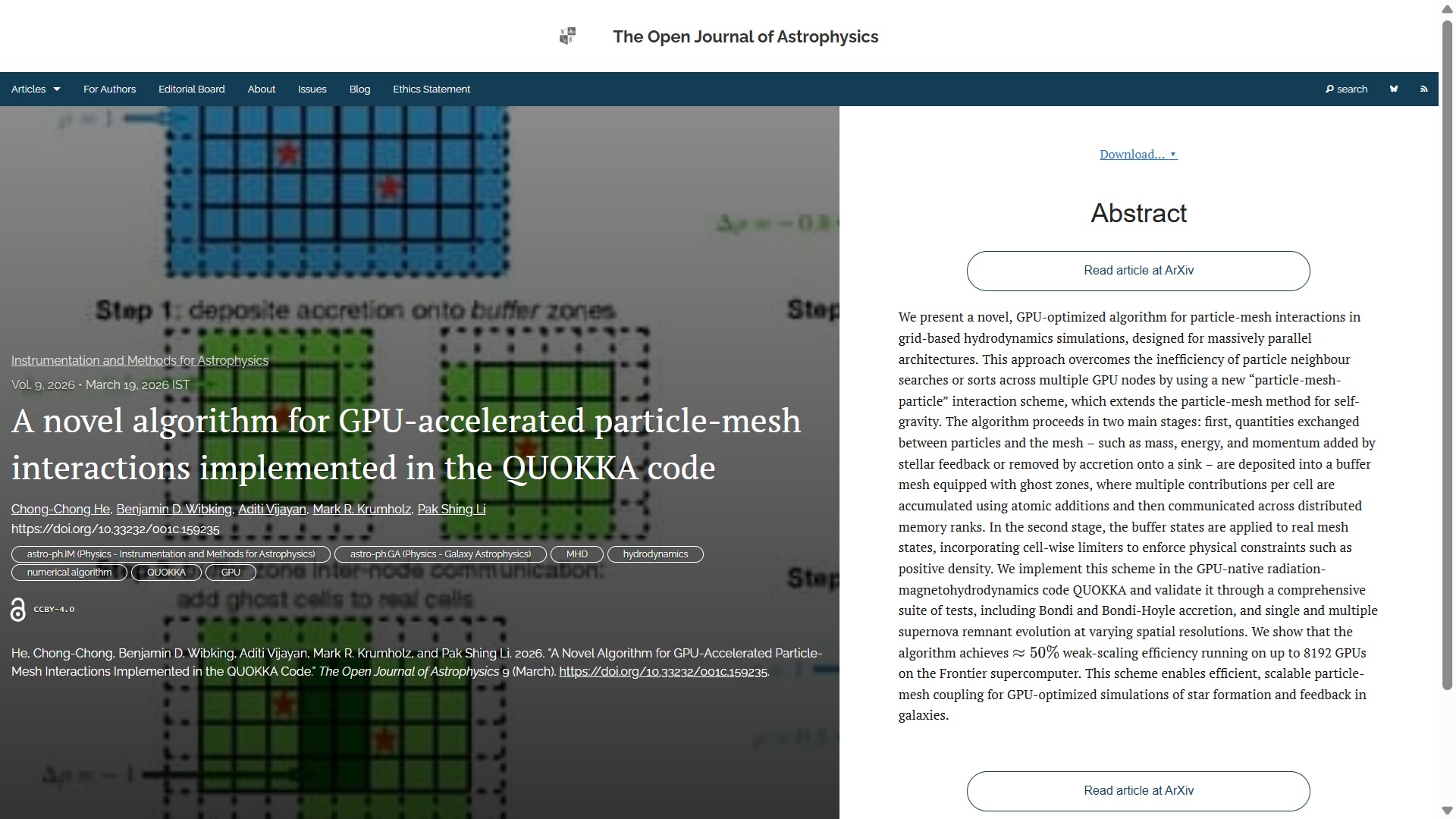
The sixth paper this week is “A novel algorithm for GPU-accelerated particle-mesh interactions implemented in the QUOKKA code” by Chong-Chong He (Australia National University), Benjamin D. Wibking (Michigan State U., USA), Aditi Vijayan (ANU), Mark R. Krumholz (ANU) and Pak Shing Li (Shanghai Astronomical Observatory, China). This was published on Thursday 19th March in the folder Instrumentation and Methods for Astrophysics. The article introduces a GPU-optimized algorithm for particle-mesh interactions in hydrodynamics simulations, improving efficiency and scalability in simulations of star formation and feedback in galaxies.
The overlay is here:
The officially accepted version of this paper can be found on arXiv here, and the Mastodon announcement is here:
New Publication at the Open Journal of Astrophysics: "A novel algorithm for GPU-accelerated particle-mesh interactions implemented in the QUOKKA code" by Chong-Chong He (Australia National University), Benjamin D. Wibking Michigan State U., USA), Aditi Vijayan (ANU), Mark R. Krumholz (ANU) and Pak Shing Li (Shanghai Astronomical Observatory, China)
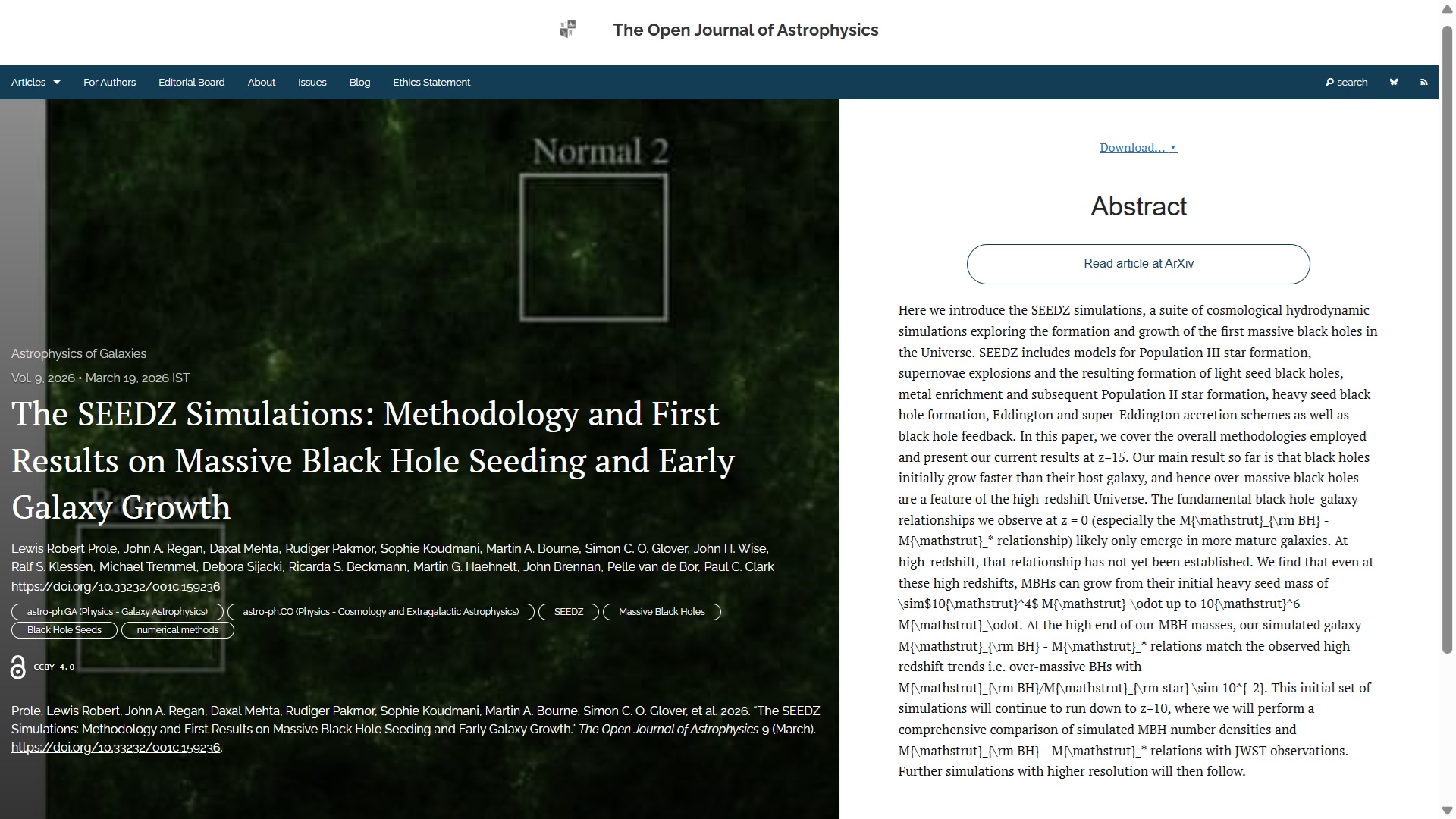
The penultimate, seventh, paper for this week is “The SEEDZ Simulations: Methodology and First Results on Massive Black Hole Seeding and Early Galaxy Growth” by Lewis Prole (NUI Maynooth, Ireland) and 15 others based in Ireland, Germany and the UK. This paper was also published on Thursday March 19th 2026 in the folder Astrophysics of Galaxies. Ir presents the SEEDZ simulations, studying the formation and growth of the universe’s first massive black holes, finding that these black holes initially grow faster than their host galaxies.
The overlay for this one is here:
The official version of this paper can be found here. This is the Mastodon announcement:
New Publication at the Open Journal of Astrophysics: "The SEEDZ Simulations: Methodology and First Results on Massive Black Hole Seeding and Early Galaxy Growth" by Lewis Prole (NUI Maynooth, Ireland) and 15 others based in Ireland, Germany and the UK.
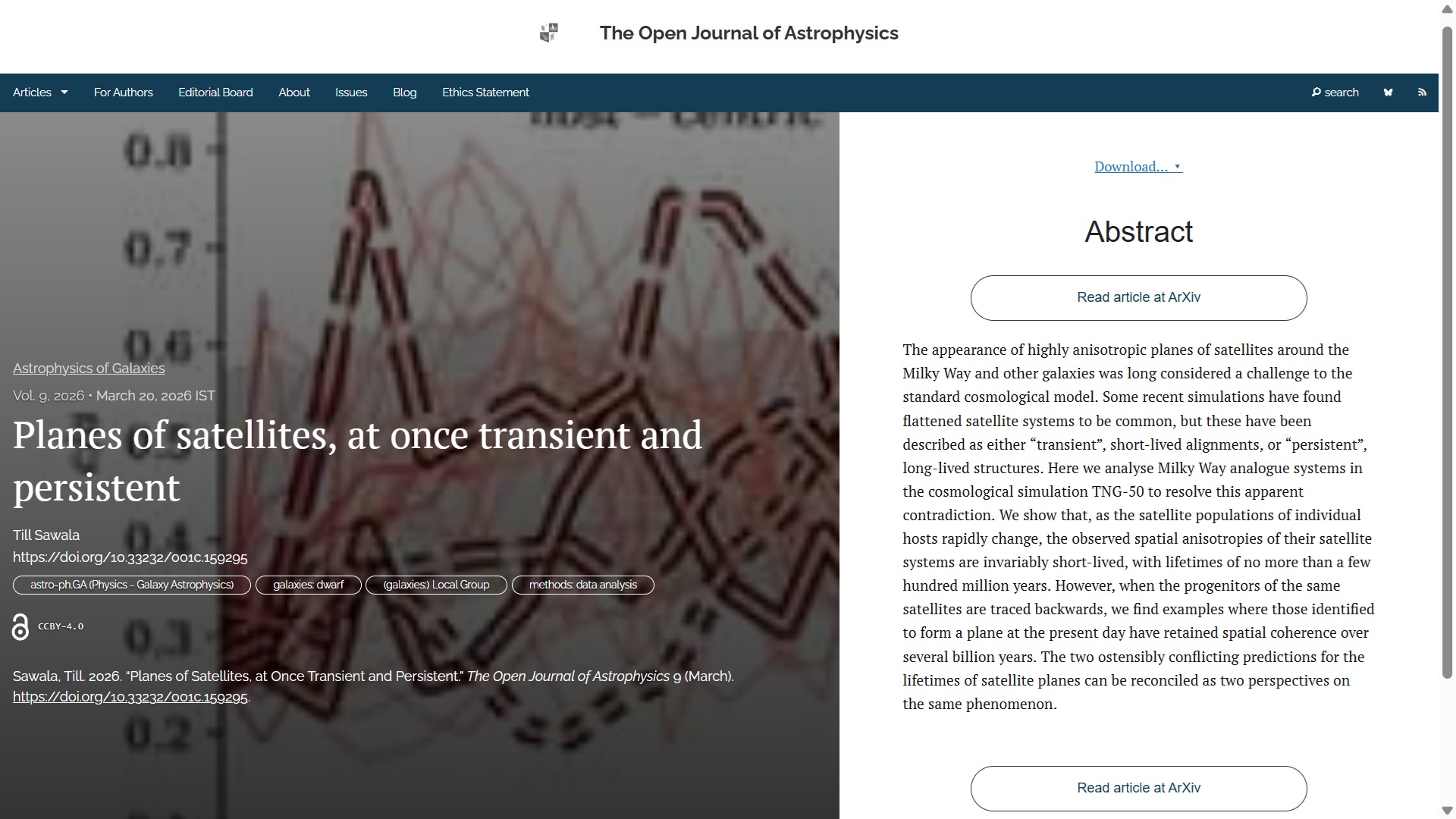
And finally for this week, published yesterday (Friday 20th March 2026) in the folder Astrophysics of Galaxies, we have “Planes of satellites, at once transient and persistent” by Till Sawala (University of Helsinki, Finland). This study resolves the contradiction in the lifespan of satellite systems around galaxies, showing they are short-lived but maintain spatial coherence over billions of years.
Here is the overlay for this one:
The officially accepted version can be found on arXiv here and the Mastodon announcement is here:
New Publication at the Open Journal of Astrophysics: "Planes of satellites, at once transient and persistent" by Till Sawala (University of Helsinki, Finland)
And that concludes the update for this week. Will we keep the rate up next week? Tune in next Saturday to find out!
P.S. Thank you once again to the many people who have responded to the latest call for editors. The Editorial Board has grown substantially over the last few weeks – an up-to-date version can be found here – and there are still some people waiting to get onboard, so please bear with me!
Once again it’s time for a summary of the week’s new papers at the Open Journal of Astrophysics. Since the last update we have published three new papers, which brings the number in Volume 8 (2025) up to 125, and the total so far published by OJAp up to 360.
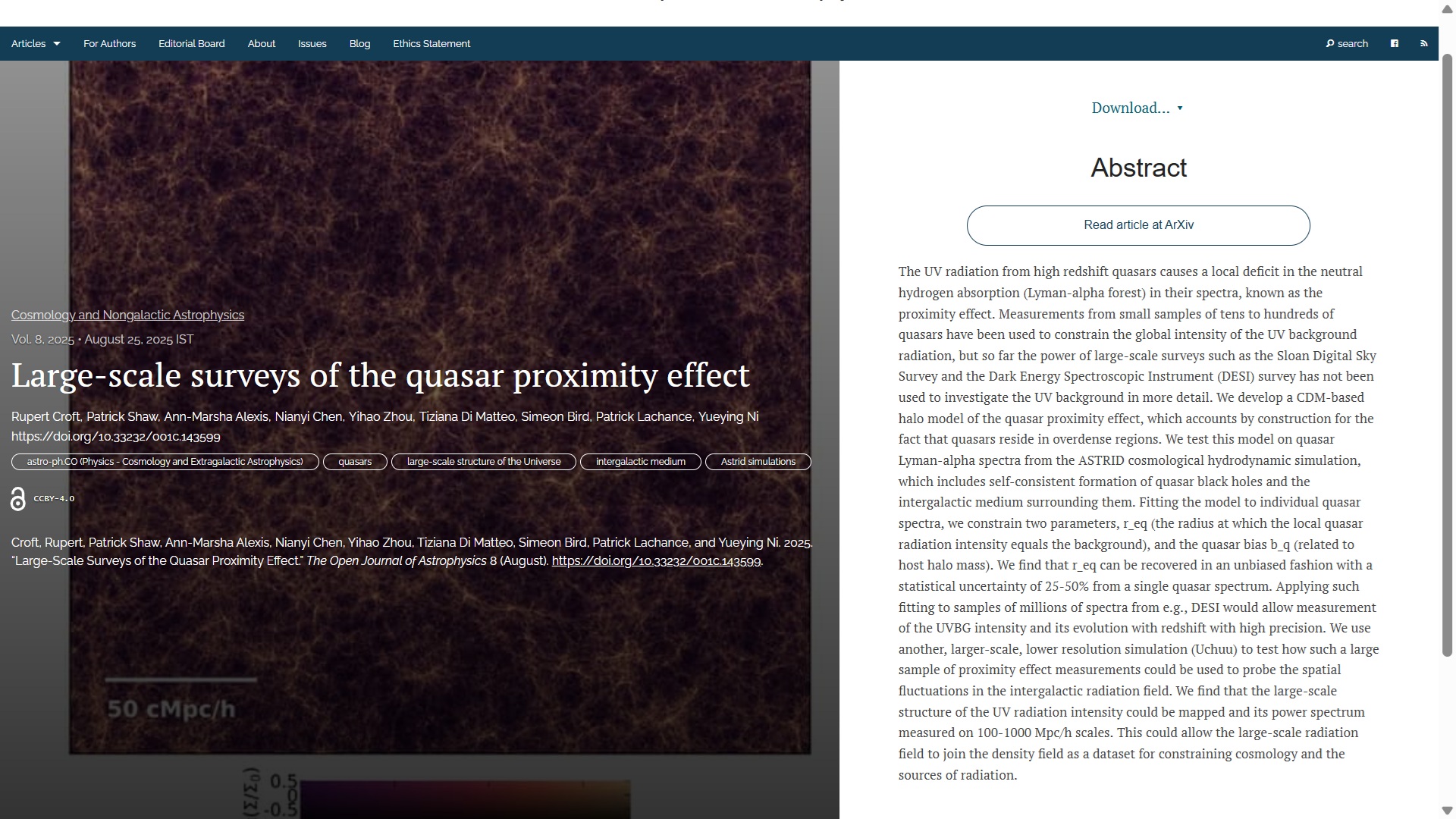
The first paper to report this week is “Large-scale surveys of the quasar proximity effect” by Rupert Croft, Patrick Shaw & Ann-Marsha Alexis (Carnegie Mellon University; CMU), Nianyi Chen (Princeton), Yihao Zhou & Tiziana Di Matteo (CMU), Simeon Bird (UC Riverside), Patrick Lachance (CMU), and Yueying Ni (Harvard). This paper was published on Monday 25th August in the folder Cosmology and NonGalactic Astrophysics. It presents a CDM-based halo model of the quasar proximity effect, tested on quasar Lyman-alpha spectra from the ASTRID cosmological simulation, including self-consistent formation of quasar black holes and the intergalactic medium.
The overlay is here:
You can make this larger by clicking on it, as you can with all the overlays below. The officially accepted version of this paper can be found on the arXiv here.
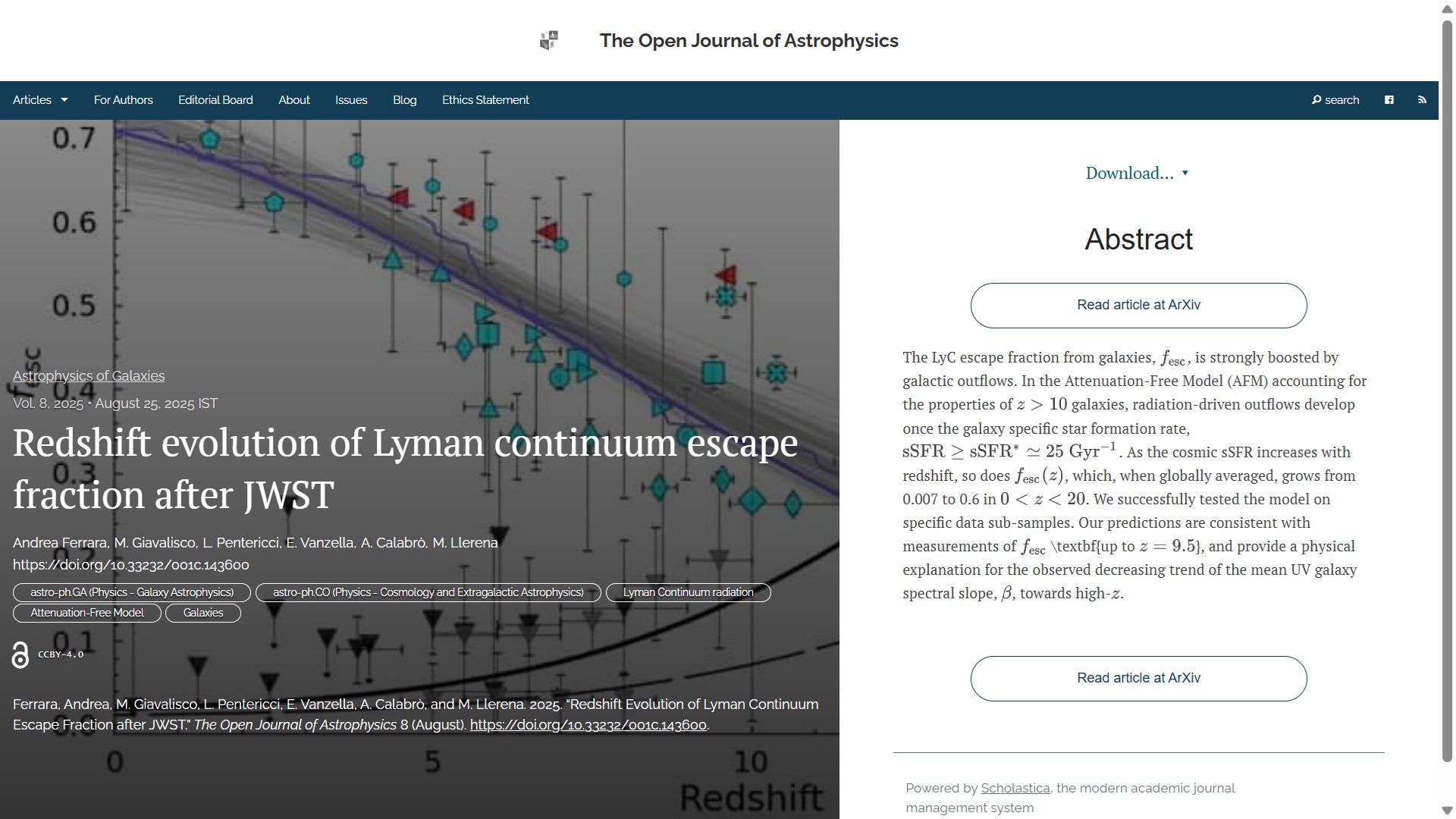
The second paper this week, also published on Monday 25th August, but in the folder Astrophysics of Galaxies, is “Redshift evolution of Lyman continuum escape fraction after JWST” by Andrea Ferrara (Pisa), M. Giavalisco (UMass Amherst), L. Pentericci (Rome), E. Vanzella (Bologna), A. Calabrò (Rome) and M. Llerena (Rome). This paper is about the Attenuation-Free Model (AFM) for galaxies, in which radiation-driven outflows develop once the galaxy specific star formation rate exceeds a certain level, which is tested on data with positive results. The overlay is here:
You can find the officially accepted version on arXiv here.
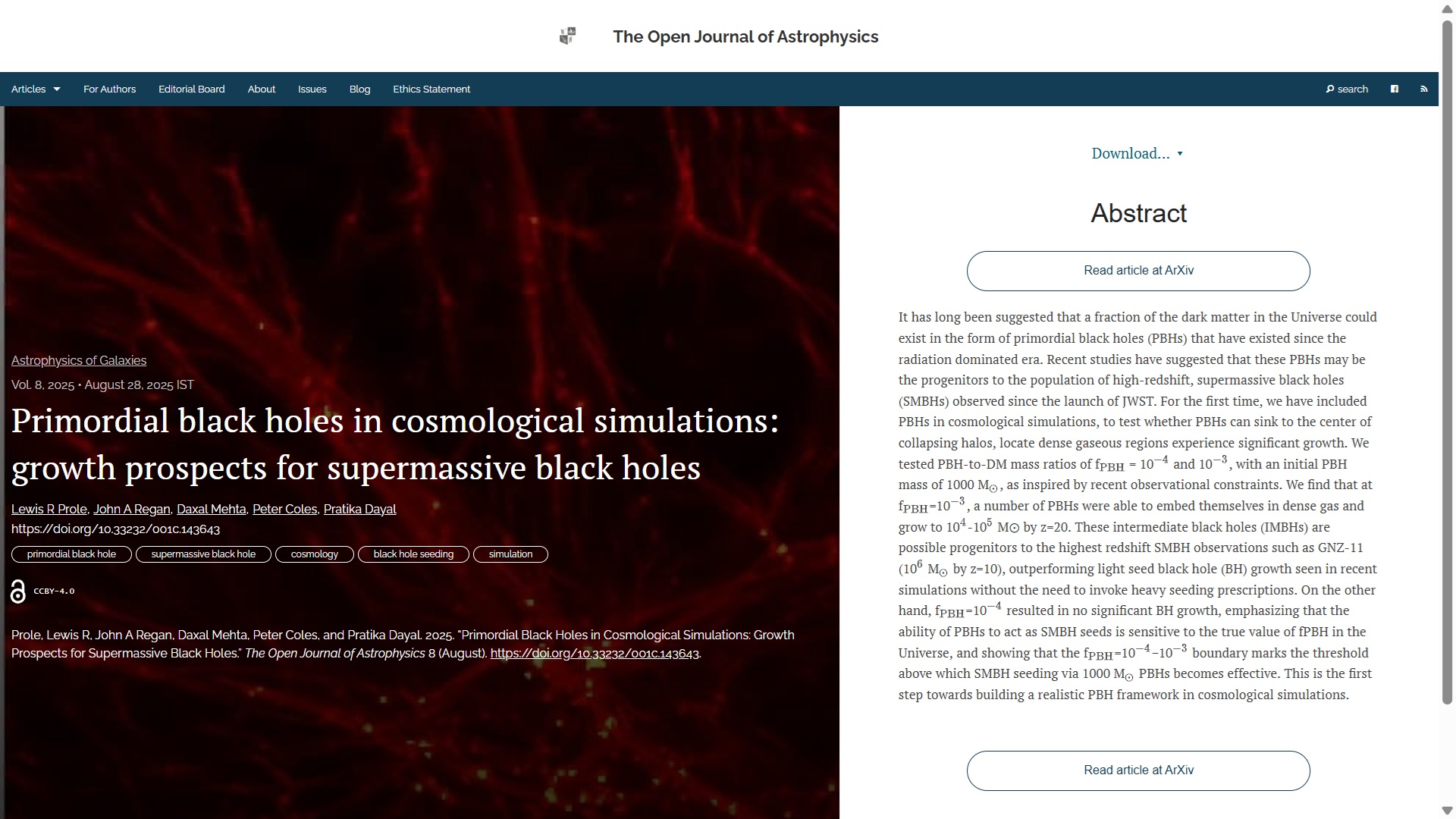
The third and final paper this week is “Primordial black holes in cosmological simulations: growth prospects for supermassive black holes” by Lewis R Prole, John A Regan, Daxal Mehta & Peter Coles (National University of Ireland, Maynooth) and Pratika Dayal (Groningen, NL). This one was published in Astrophysics of Galaxies folder on Thursday 28th August 2025. You can read more about this paper here: basically it studies the growth of primordial black holes in the early Universe using numerical simulations, with implications for the subsequent formation of massive black holes.
The overlay is here:
You can find the officially accepted version of this one on arXiv here.
And that’s all the papers for this week. It’s still a bit slow as we emerge from the summer vacations, but I expect things will start to pick up from now on.
It’s time once again for the usual update of papers published at the Open Journal of Astrophysics which I do every Saturday. Since the last update we have published two new papers, which brings the number in Volume 8 (2025) up to 116, and the total so far published by OJAp up to 351. The summer lull we always expected is now upon us, so this will be a shorter post than we have had of late.
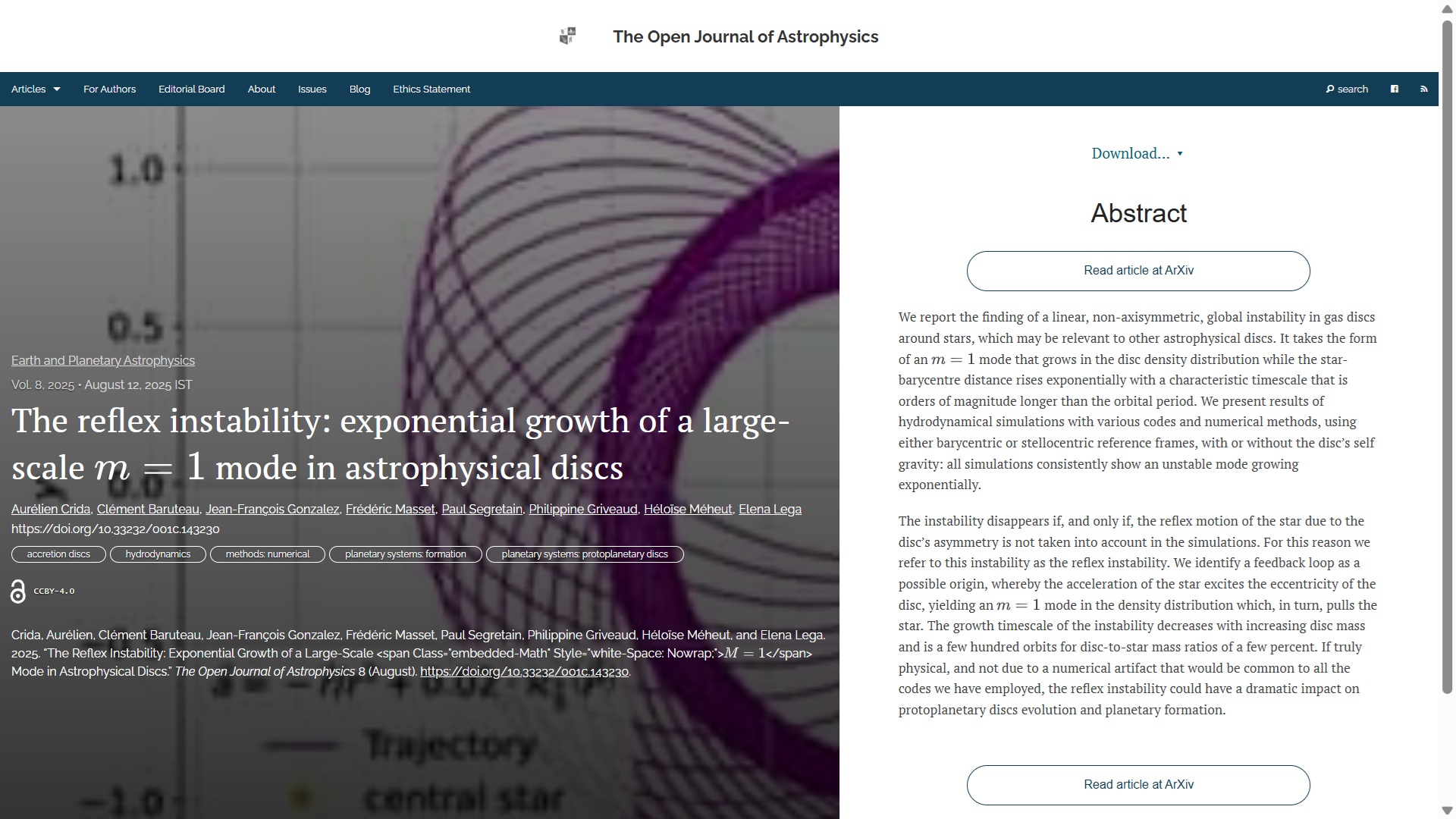
The first paper to report this week is “The reflex instability: exponential growth of a large-scale mode in astrophysical discs” by Aurélien Crida (Université Côte d’Azur, France), Clément Baruteau (Université de Toulouse, France), Jean-François Gonzalez (Universite Claude Bernard Lyon 1, France), Frédéric Masset (Universidad Nacional Autonoma de México) and Paul Segretain, Philippine Griveaud, Héloïse Méheut & Elena Lega (Université Côte d’Azur). This paper was published on Tuesday August 12th 2025 in the folder marked “Earth and Planetary Astrophysics“. It discusses a exponentially-growing instability in gas discs around stars caused by the motion of the central star in response to the disc.
The overlay – which you can make larger by clicking on it – is here:
You can find the officially accepted version on arXiv here.
It’s Saturday morning so, once again, it’s time for an update of papers published at the Open Journal of Astrophysics. Since the last update we have published four new papers, which brings the number in Volume 8 (2025) up to 114, and the total so far published by OJAp up to 349.
The papers published this week, with their overlays, are as follows. You can click on the images of the overlays to make them larger should you wish to do so.
The first paper to report is “Caught in the Act of Quenching? – A Population of Post-Starburst Ultra-Diffuse Galaxies” by Loraine Sandoval Ascencio & M. C. Cooper (UC Irvine), Dennis Zaritsky, Richard Donnerstein & Donghyeon J. Khim (U. Arizona) and Devontae C. Baxter (UC San Diego). This paper was puvblished on Monday 4th August and is in the folder marked Astrophysics of Galaxies. It discusses a sample of Ultra-Diffuse Galaxies (UDGs) found to be post-starburst galaxies through spectroscopic analysis analysis of candidates selected from the Systematically Measuring Ultra-Diffuse Galaxies (SMUDGes) program.
The overlay is here:
The officially-accepted version can be found on arXiv here.
The fourth, and final, paper of the week, also published on Thursday 7th August, is “ASASSN-24fw: An 8-month long, 4.1 mag, optically achromatic and polarized dimming event” by Raquel Forés-Toribio (Ohio State University) and 22 others based in the USA, Austria, Chile and Australia. It is published in the folder Solar and Stellar Astrophysics, and it presents an observational study of an unusual dimming event likely to have been caused by eclipsing of a binary system by a dusty disk.
Here is the overlay:
You can find the officially-accepted version on arXiv here.
And that’s all the papers for this week. I’ll do another update next Saturday.
P.S. For those of you who missed the post I did earlier in the week, I have been looking at the accounts for the Open Journal of Astrophysics and can confirm that the cost to us per paper is less than $30 and will reduce with scale. We expect to publish around 180 papers in 2025 for which the total cost incurred by OJAp will be around $5000. Obviously if we increase by a factor, say, ten then that amount would become significant so we are taking steps to secure additional funding in the event that happens.
It’s Saturday morning again, and it’s the start of a new month, so it’s time for an update of papers published at the Open Journal of Astrophysics. Since the last update we have published five new papers, which brings the number in Volume 8 (2025) up to 110, and the total so far published by OJAp up to 345. I expect we’ll the total number we published last year (120) sometime this month. I predict that by the end of this year we will have published around 180 papers in Volume 8 and around 400 altogether.
The papers published this week, with their overlays, are as follows. You can click on the images of the overlays to make them larger should you wish to do so.
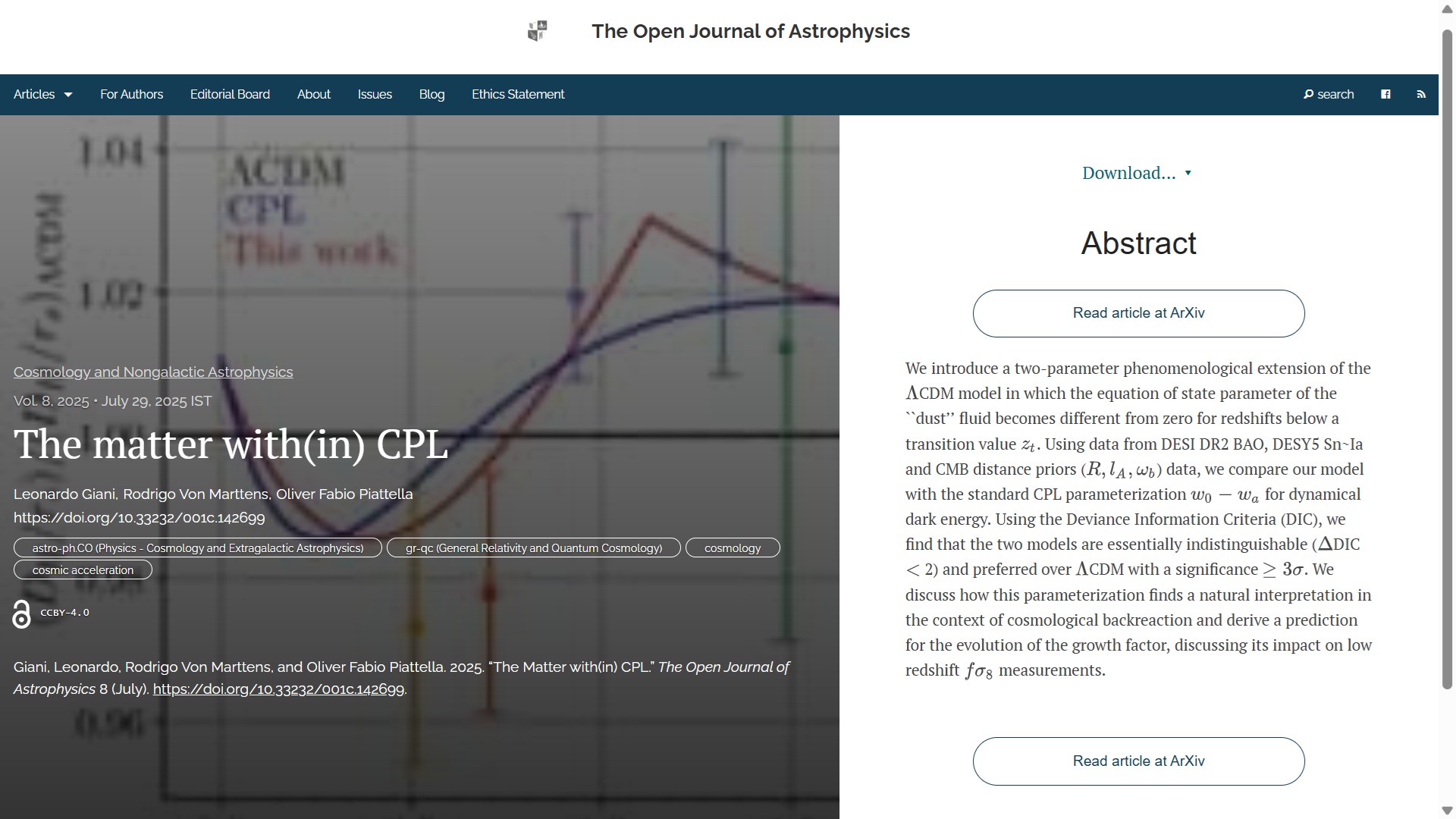
The first paper to report is “The matter with(in) CPL” by Leonardo Giani (U. Queensland, Australia), Rodrigo Von Marttens (Universidade Federal da Bahia, Brazil) and Oliver Fabio Piattella (Universita degli Studi dell’Insubria, Italy). This was published on Monday 29th July 2025 in the folder Cosmology and Nongalactic Astrophysics. This article presents a new parameterization of the standard model and its implications for the interpretation of cosmological observations.
The overlay is here:
The officially-accepted version can be found on arXiv here.
The second paper of the week, published on Tuesday 30th July in the folder Instrumentation and Methods for Astrophysics, is “An automated method for finding the most distant quasars” by Lena Lenz, Daniel Mortlock, Boris Leistedt & Rhys Barnett (Imperial College London, UK) and Paul C. Hewett (U. Cambridge, UK)”. This paper presents an automated, reproduceable and objective high-redshift quasar selection pipeline, tested on simulations and real data from the Sloan Digital Sky Survey (SDSS) and UKIRT Infrared Deep Sky Survey (UKIDSS). The overlay is here:
You can find the officially accepted version of the paper on arXiv here.
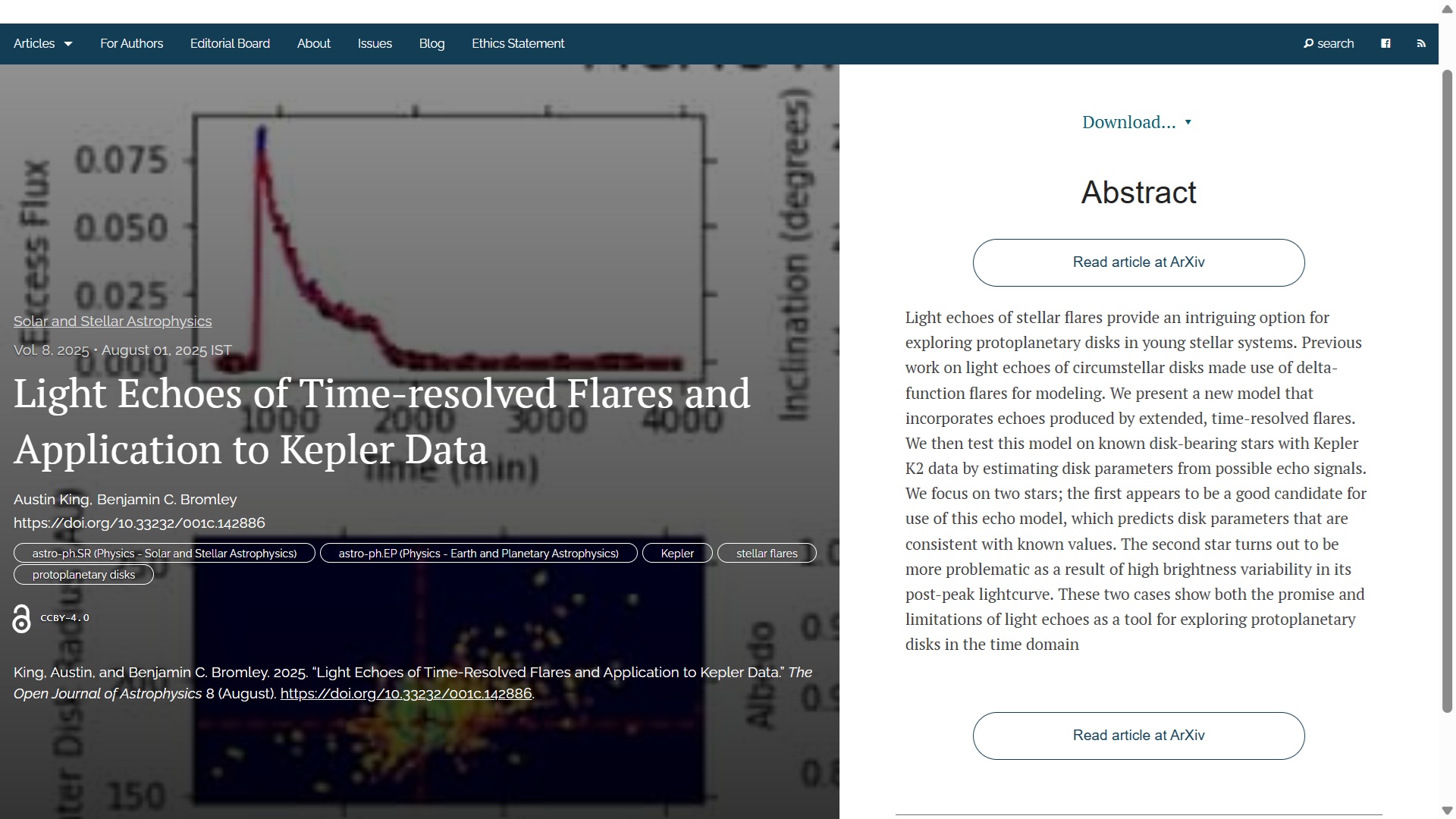
The fourth paper of the week, also published on Friday 1st August, is “Light Echoes of Time-resolved Flares and Application to Kepler Data” by Austin King and Benjamin C. Bromley (University of Utah, USA). This describes a new model for circumstellar disks that incorporates echoes produced by extended, time-resolved flares. It is published in the folder Solar and Stellar Astrophysics. Here is the overlay:
You can find the officially-accepted version on arXiv here.
The fifth and final article published this week, also published on Friday 1st August, is “Wide Binaries from Gaia DR3 : testing GR vs MOND with realistic triple modelling” by Charalambos Pittordis, Will Sutherland and Paul Shepherd (Queen Mary, University of London, UK). This presents a test for modified gravity from a sample of wide-binary stars from Gaia DR3, finding that (unmodified) Newtonian gravity provides a better fit to the data. It is in the folder Astrophysics of Galaxies.
The overlay is here:
You can find the officially-accepted version on arXiv here.
And that’s all the papers for this week. I’ll do another update next Saturday.
It may be the Easter holiday weekend, but it’s still time for the weekly Saturday morning update of papers published at the Open Journal of Astrophysics. Since the last update we have published five new papers, which brings the number in Volume 8 (2025) up to 42 and the total so far published by OJAp up to 277.
In chronological order of publication, the five papers published this week, with their overlays, are as follows. You can click on the images of the overlays to make them larger should you wish to do so.
The first paper to report is “Galaxy Clustering with LSST: Effects of Number Count Bias from Blending” by Benjamin Levine (Stony Brook, NY), Javier Sánchez (STScI, MD), Chihway Chang (Chicago, IL) Anja von der Linden (Stony Brook), Eboni Collins (Dillard, LA), Eric Gawiser (Rutgers, NJ), Katarzyna Krzyżańska (Cornell, NY), Boris Leistedt (Imperial College, UK) on behalf of the LSST Dark Energy Science Collaboration.
This presents a simulation-based study of the effect of source overlaps (blending) on galaxy counts expected for the Vera C. Rubin Legacy Survey of Space and Time (LSST). The paper is in the folder Cosmology and NonGalactic Astrophysics and was published on Monday 14th April 2025. The overlay is here:
You can find the officially-accepted version of the paper on arXiv here.
The second paper to announce, published onTuesday 15th April 2025, “Rapid, strongly magnetized accretion in the zero-net-vertical-flux shearing box” by Jonathan Squire (Otago, New Zealand), Eliot Quataert (Princeton, USA) & Philip F. Hopkins (Caltech, USA). This paper presents a numerical study of turbulence in a flux shearing box, with discussion of the implications of the results for global accretion disk models and simulations thereof. It was published in the folder High-Energy Astrophysical Phenomena and the overlay is here:
You can read the officially accepted version of this paper on arXiv here.
The official published version can be found on the arXiv here.
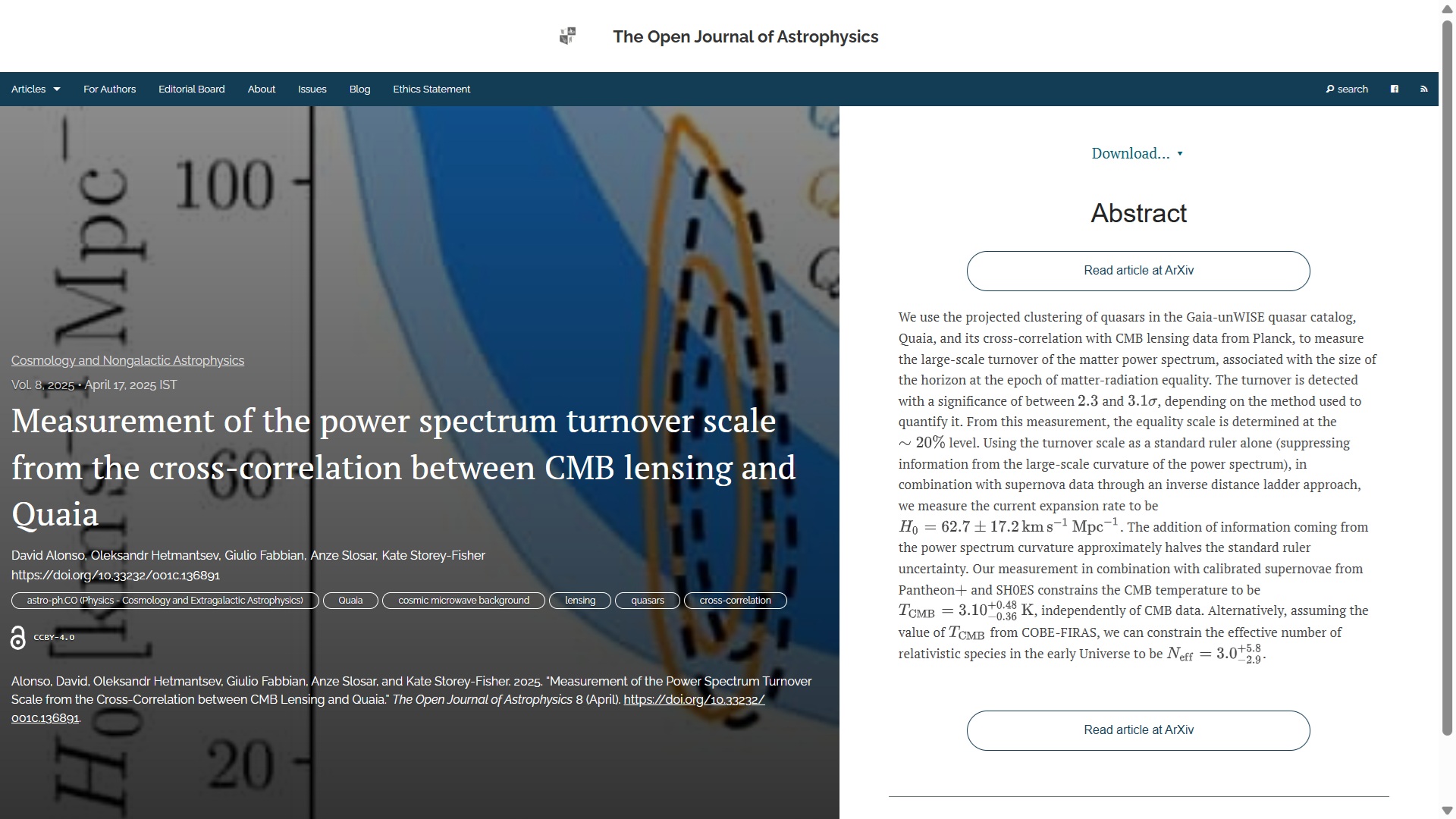
The last paper of the five published this week is “Measurement of the power spectrum turnover scale from the cross-correlation between CMB lensing and Quaia” by David Alonso (Oxford, UK), Oleksandr Hetmantsev (Kyiv, Ukraine), Giulio Fabbian (Cambridge, UK), Anze Slosar (Brookhaven National Laboratory, USA) and Kate Storey-Fisher (Stanford, USA). This is a discussion of using the spatial correlations of quasars and their cross-correlations with cosmic microwave background lensing data to measure a feature corresponding to the matter-radiation equality scale with consequences for cosmological parameter estimation. It was published on Thursday 17th April 2025 in the folder Cosmology and NonGalactic Astrophysics.
The overlay is here:
You can find the officially accepted version on arXiv here.
That’s all the papers for this week. I’ll just add a couple of things.
One is that, although there have been weeks before in which we have published five or more papers, we still haven’t managed to have a week on which we’ve published a paper on every weekday. This week we had two on Wednesday 16th but didn’t have any yesterday (Friday).
The second is that tt has been a while since I last posted a breakdown of the running costs here at the Open Journal of Astrophysics. Today I received an email from Scholastica, our service provider, reminding me our costs will go up shortly (from 22nd April). In the interest of transparency I am passing this information on here.
The new prices will be as follows:
Peer Review System annual cost will be $425/year (was $350/year) plus $10 per submission (no change)
OA Publishing Platform annual cost will be $1,499/year (was $1,399/year)
Last year we published 120 papers with about 250 submissions. We’re a bit ahead of that this year, so I estimate that our next year’s costs will be a bit less than $5000. That’s still less than the typical APC for a single paper at many journals.
It’s Saturday morning, so once again it’s time for an update of papers published at the Open Journal of Astrophysics. There were no papers to report last week but since the last update we have published four new papers, which brings the number in Volume 8 (2025) up to 11 and the total so far published by OJAp up to 246.
In chronological order of publication, the four papers published this week, with their overlays, are as follows. You can click on the images of the overlays to make them larger should you wish to do so.
First one up is “A halo model approach for mock catalogs of time-variable strong gravitational lenses” by Katsuya T. Abe & Masamune Oguri (Chiba U, Japan), Simon Birrer & Narayan Khadka (Stony Brook, USA), Philip J. Marshall (Stanford, USA), Cameron Lemon (Stockholm U., Sweden), Anupreeta More (IUCAA, India), and the LSST Dark Energy Science Collaboration. It was published on 27th January 2025 in the folder marked Cosmology and NonGalactic Astrophysics. The paper discusses how to generate mock catalogs of strongly lensed QSOs and Supernovae on galaxy-, group-, and cluster-scales based on a halo model that incorporates dark matter halos, galaxies, and subhalos.
You can find the officially accepted version of this paper on arXiv here.
Here is a screen grab of the overlay, which includes the abstract:You can find the officially accepted version of the paper on the arXiv here.
The third paper to announce, published on 29th January 2025 in the folder Cosmology and NonGalactic Astrophysics, is “A Heavy Seed Black Hole Mass Function at High Redshift – Prospects for LISA” by Joe McCaffrey & John Regan (Maynooth U., Ireland), Britton Smith (Edinburgh U., UK), John Wise (Georgia Institute of Technology, USA), Brian O’Shea (Michigan State U., USA) and Michael Norman (University of California, San Diego). This is a numerical study of the growth rates of massive black holes in the early Universe and implications for their detection via gravitational wave emission.
You can see the overlay here:
The accepted version of this paper can be found on the arXiv here.
The views presented here are personal and not necessarily those of my employer (or anyone else for that matter).
Feel free to comment on any of the posts on this blog but comments may be moderated; anonymous comments and any considered by me to be vexatious and/or abusive and/or defamatory will not be accepted. I do not necessarily endorse, support, sanction, encourage, verify or agree with the opinions or statements of any information or other content in the comments on this site and do not in any way guarantee their accuracy or reliability.