Weekly Update from the Open Journal of Astrophysics 25/07/2026
It’s time once more for another Saturday update of activity at the Open Journal of Astrophysics. Since the last update we have published a further nine papers, bringing the number in Volume 9 (2026) to 160 and the total so far published by OJAp up to 608.
I will continue to include the posts made on our Mastodon account (on Fediscience); these announcements also show the DOI for each paper.
The first paper to report this week was published on Tuesday 21st July in the folder Cosmology and Nongalactic Astrophysics. The title is “Characterization of the Polarization Beam Response of SPT-3G Using Point Sources” by Tijmen de Haan (Institute of Particle and Nuclear Studies, Ibaraki, Japan) and an international cast of 101 others. This study presents measurements of the South Pole Telescope’s polarized beam response, indicating minimal sidelobe depolarization. The findings suggest potential explanations for frequency-dependent residuals in power spectrum analysis.
The overlay for this paper is here
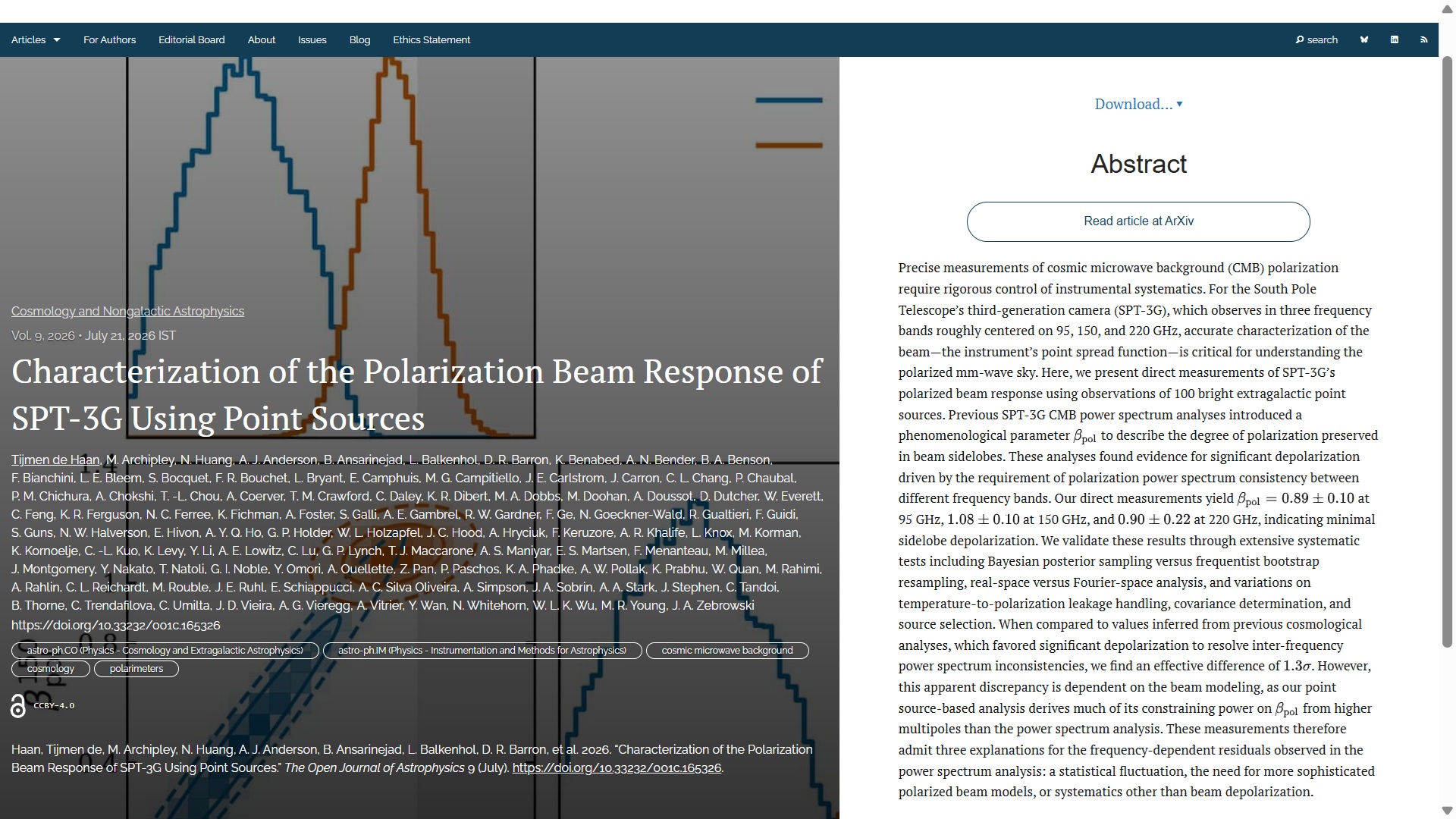
You can find the officially accepted version on arXiv here and the announcement on Fediverse here:

The second paper for this week, also published on Tuesday 21st July but in the folder Earth and Planetary Astrophysics is: “Exploring TRAPPIST-1 Climate States with an Energy Balance Model” by Jacob Haqq-Misra (Blue Marble Space, USA). The study uses a modified HEXTOR energy balance model to predict climate states of terrestrial planets orbiting low-mass stars, suggesting partial to complete ice cover for TRAPPIST-1 e and f.Abstractfor Exploring TRAPPIST-1 Climate States with an Energy Balance Model.
The overlay looks like this:
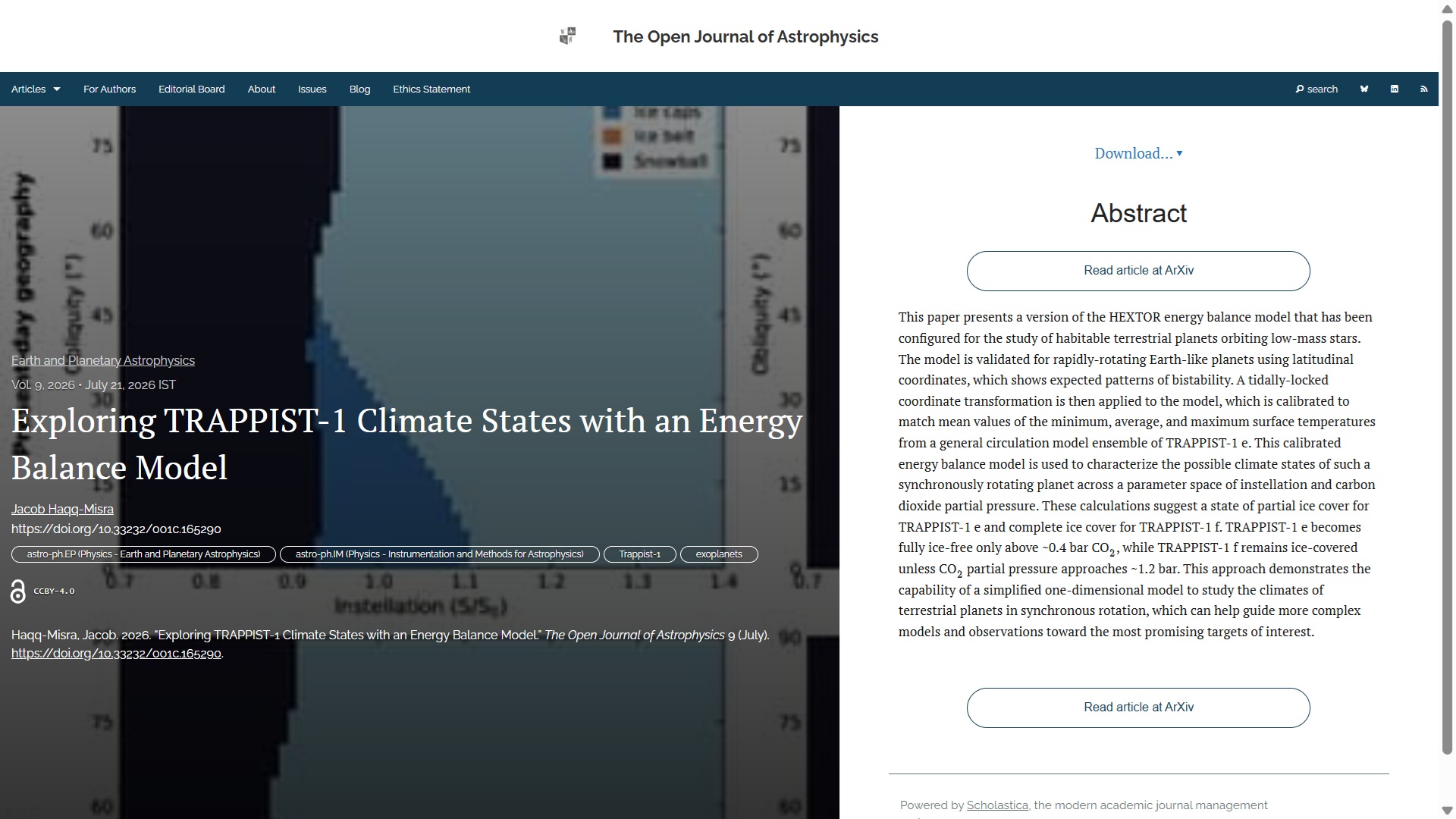
The official version of the paper can be found on arXiv here and the Fediverse announcement here:
The third paper of the week, also published on Tuesday 21st July, but in the folder Astrophysics of Galaxies is “A first systematic study of [OIII] 88μm at z>8: two luminous oxygen lines and a powerful ionized outflow in the first 600 million years” by Hiddo Algera (Institute of Astronomy and Astrophysics, Taipei, Taiwan) and 37 others from all around the world. This paper presents deep observations of four UV-bright, gravitationally lensed galaxies, revealing an ionized outflow in one and highlighting the diagnostic power of [O III]88 μm in studying galaxies in the early Universe.
The overlay for this one is here:
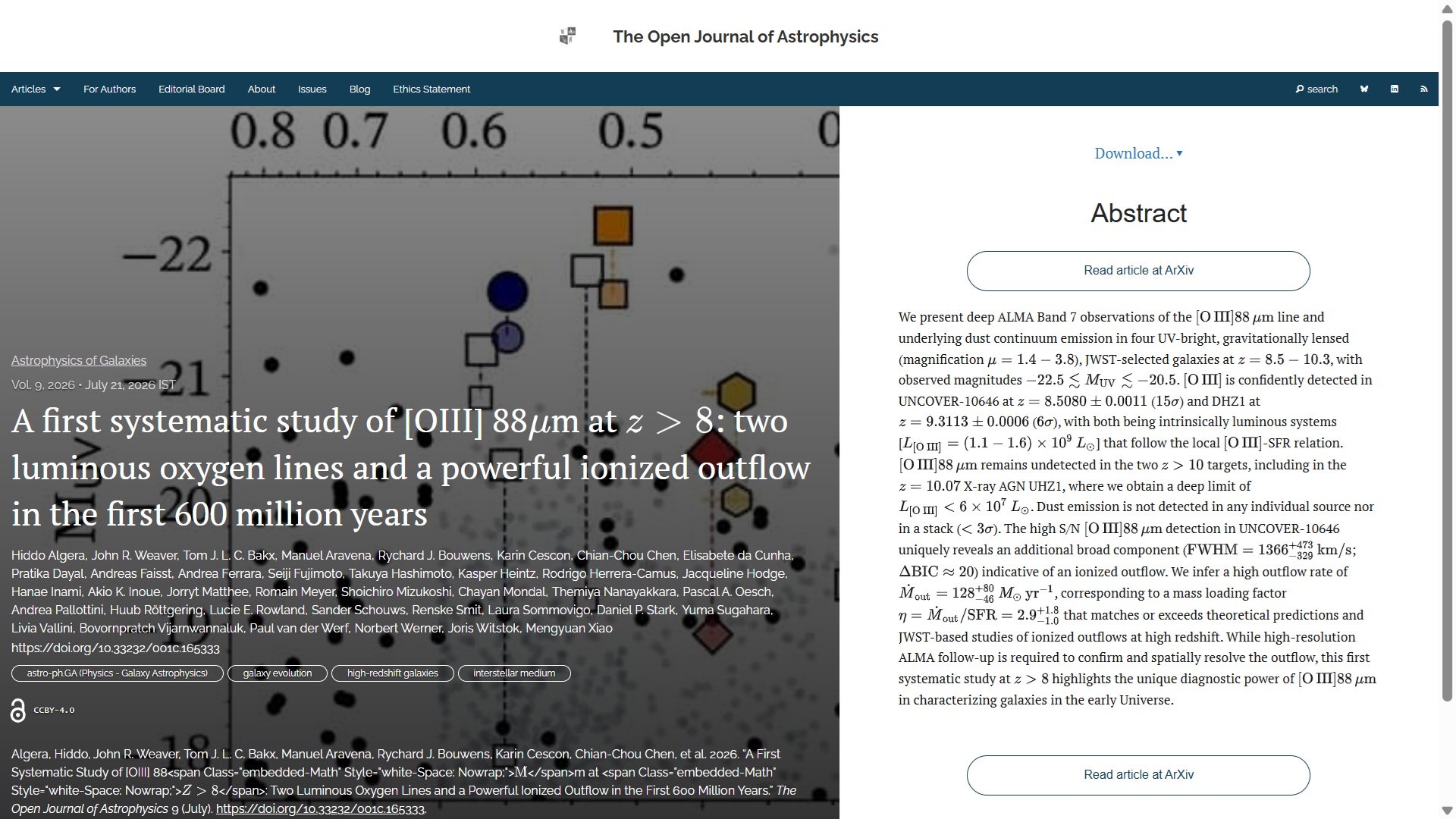
The final, accepted version can be found on arXiv here and the Mastodon announcement is here:
The fourth paper of the week, published on Thursday 23rd July in the folder Astrophysics of Galaxies, is “Mapping CO Ice in a Star-Forming Filament in the 3 kpc Arm with JWST” by Savannah Gramze (U. Florida, USA) and 16 others based all around the world. This paper shows that JWST observations and ALMA Band 3 data reveal that 50-88% of CO gas in a star-forming filament is locked in ice; corrections are needed for mass measurements in such systems.
The overlay for this one is here:
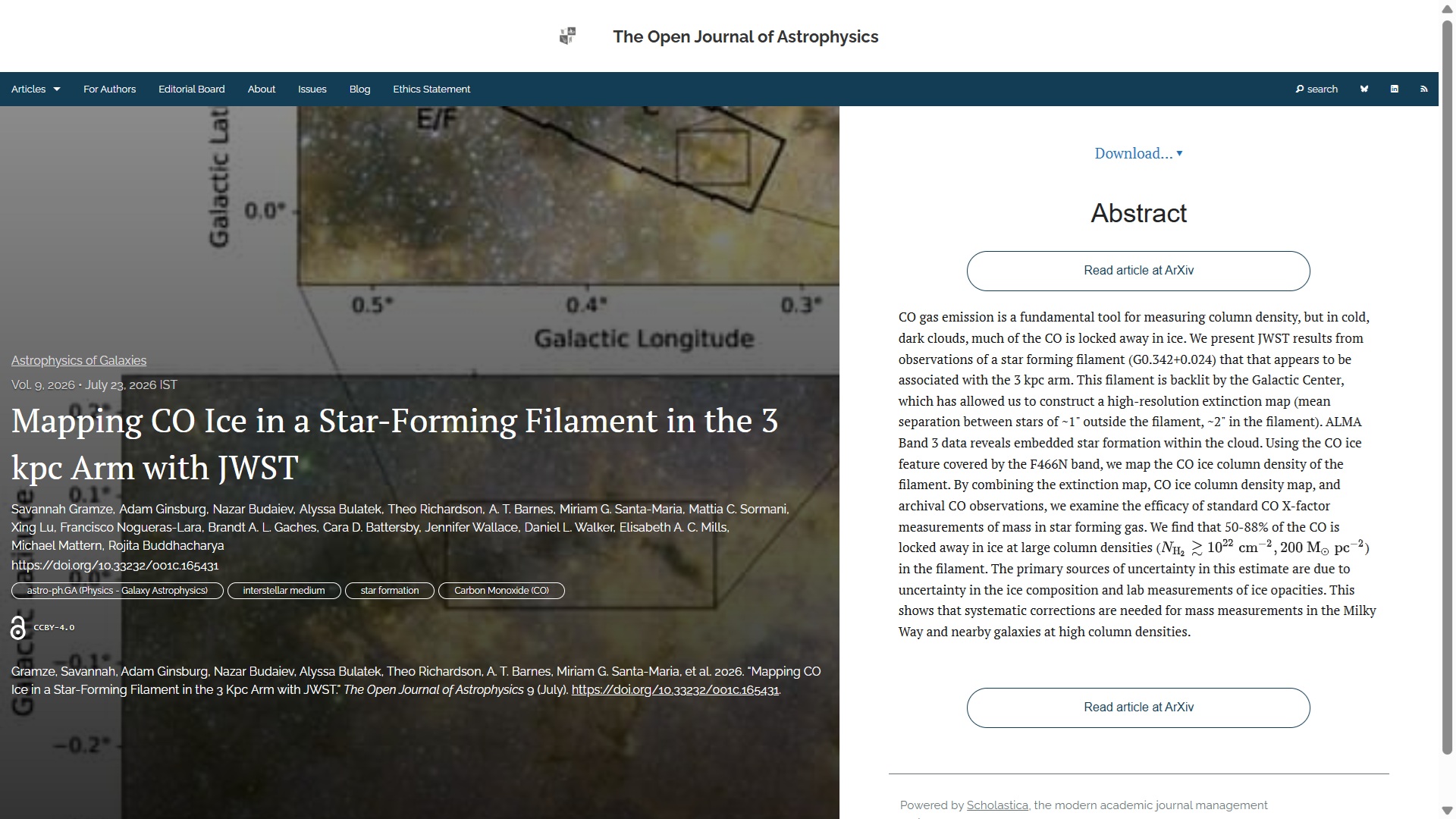
You can read the final version of this one on arXiv here and the Mastodon announcement is here:
The fifth paper of the week, also published on Thursday 23rd July but in the folder High-Energy Astrophysical Phenomena, is “Viscously Spreading Accretion Disks around Black Holes: Implications for TDEs, LFBOTs and other Transients“. This article presents a time-dependent model of accretion disks around black holes, explaining late-time emission in tidal disruption events and luminous fast blue optical transients and future detectability of such events.
The overlay for this one is here:
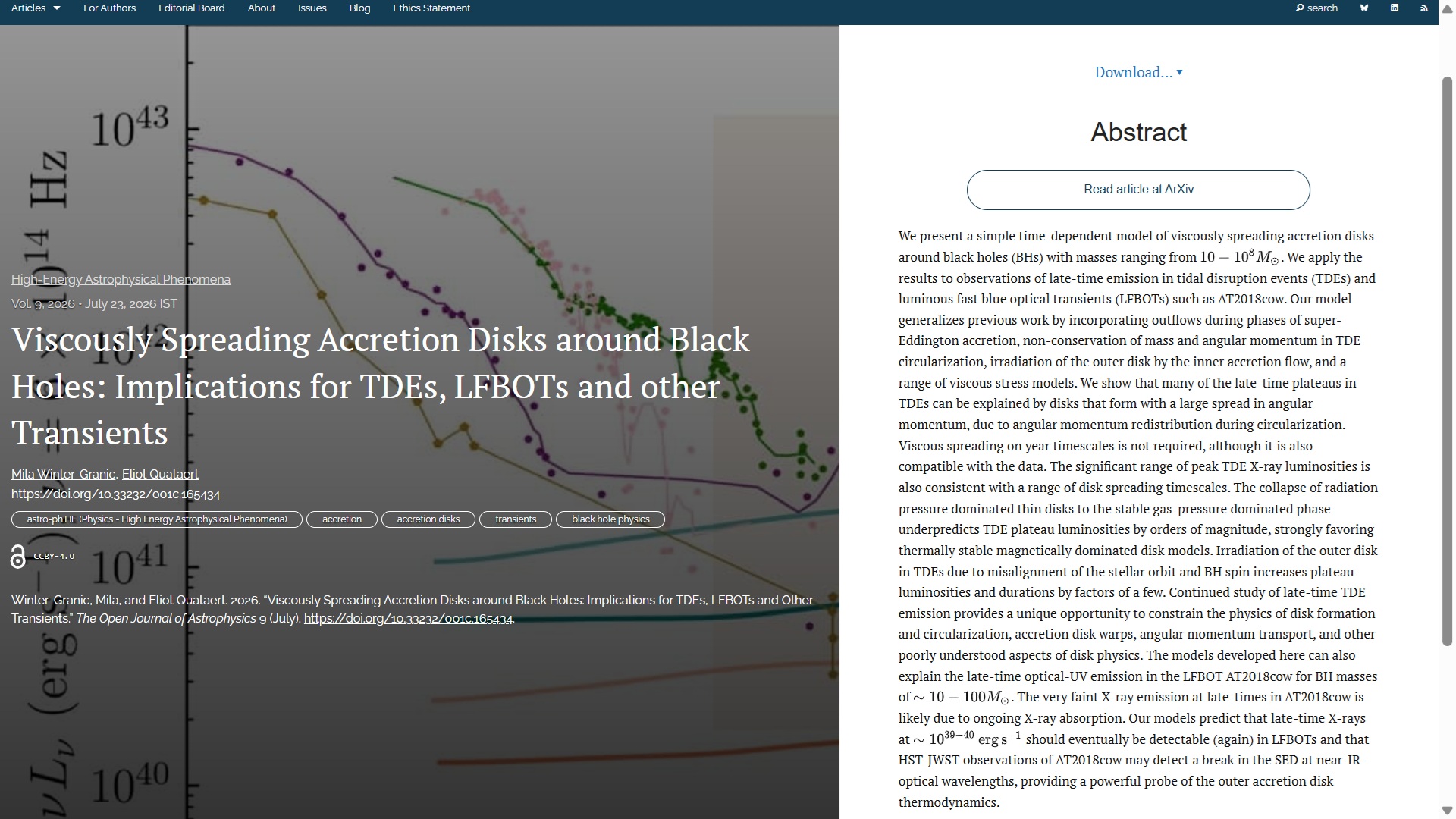
You can read the final version of this one on arXiv here and the Mastodon announcement is here:
The sixth paper of this week is “Characterising the response of an International LOFAR Station” by Letizia Vincetti (Trinity Collge Dublin, Ireland) and 9 others based in Ireland, USA, The Netherlands and Sweden. This was also published on Thursday July 23rd and is in the folder Instrumentation and Methods for Astrophysics. The article presents an investigation of the performance and calibration challenges of phased-array radio interferometers, using the Irish LOFAR station as a case study, highlighting the importance of accurate beam modelling, etc.
The overlay for this one is here:
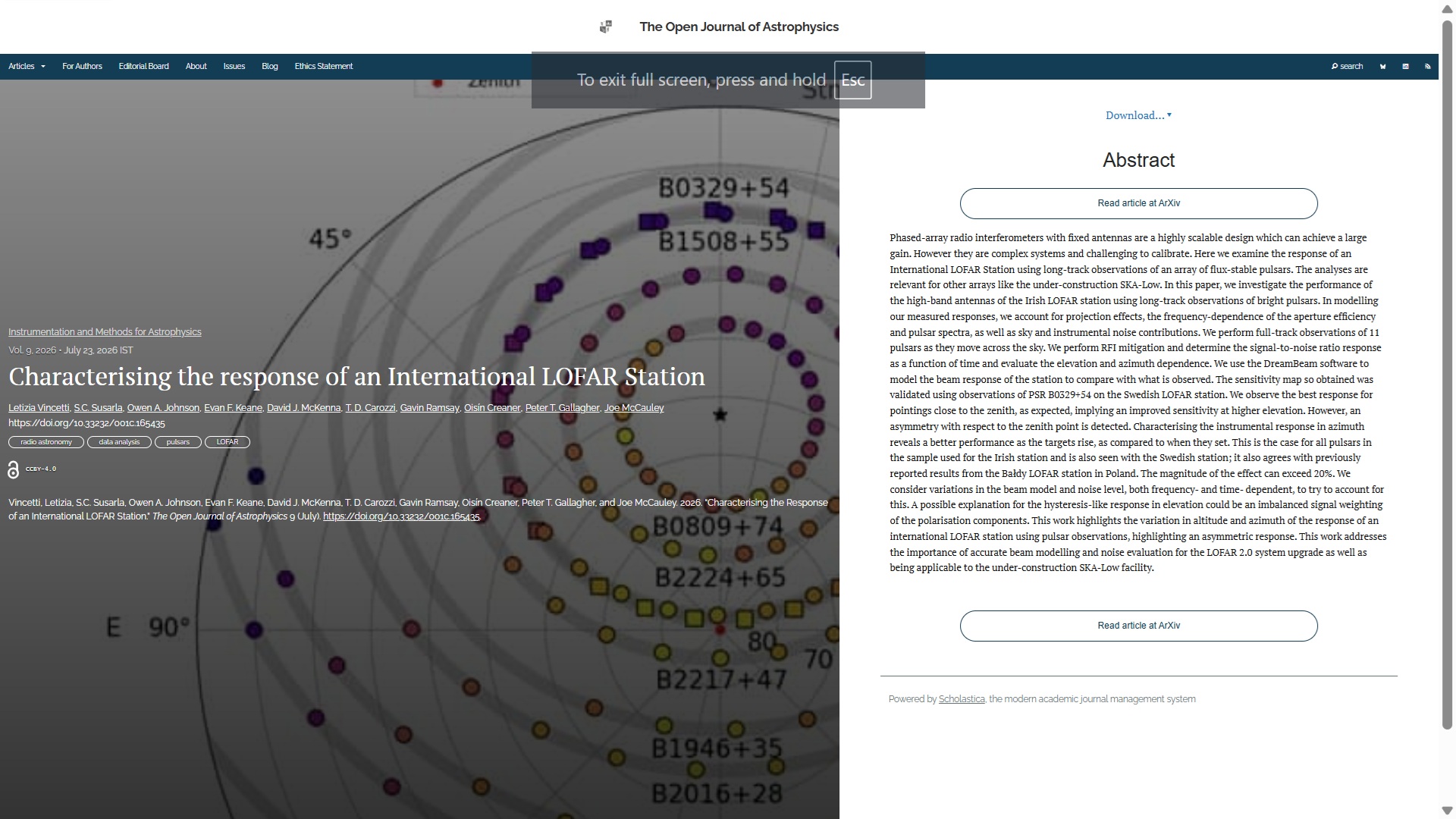
You can find the final accepted version on arXiv here and the Mastodon announcement is here:
The seventh paper of this week is “Exo Skryer: A JAX-accelerated sub-stellar atmospheric retrieval framework” by Elspeth K.H. Lee (U. Bern, Switzerland). Published on Friday 24th July in the folder Earth and Planetary Astrophysics, this article introduces “Exo Skryer”, a new, efficient framework for exoplanet and brown dwarf atmospheric research, capable of handling large data sets and complex models.
The overlay for this one is here:
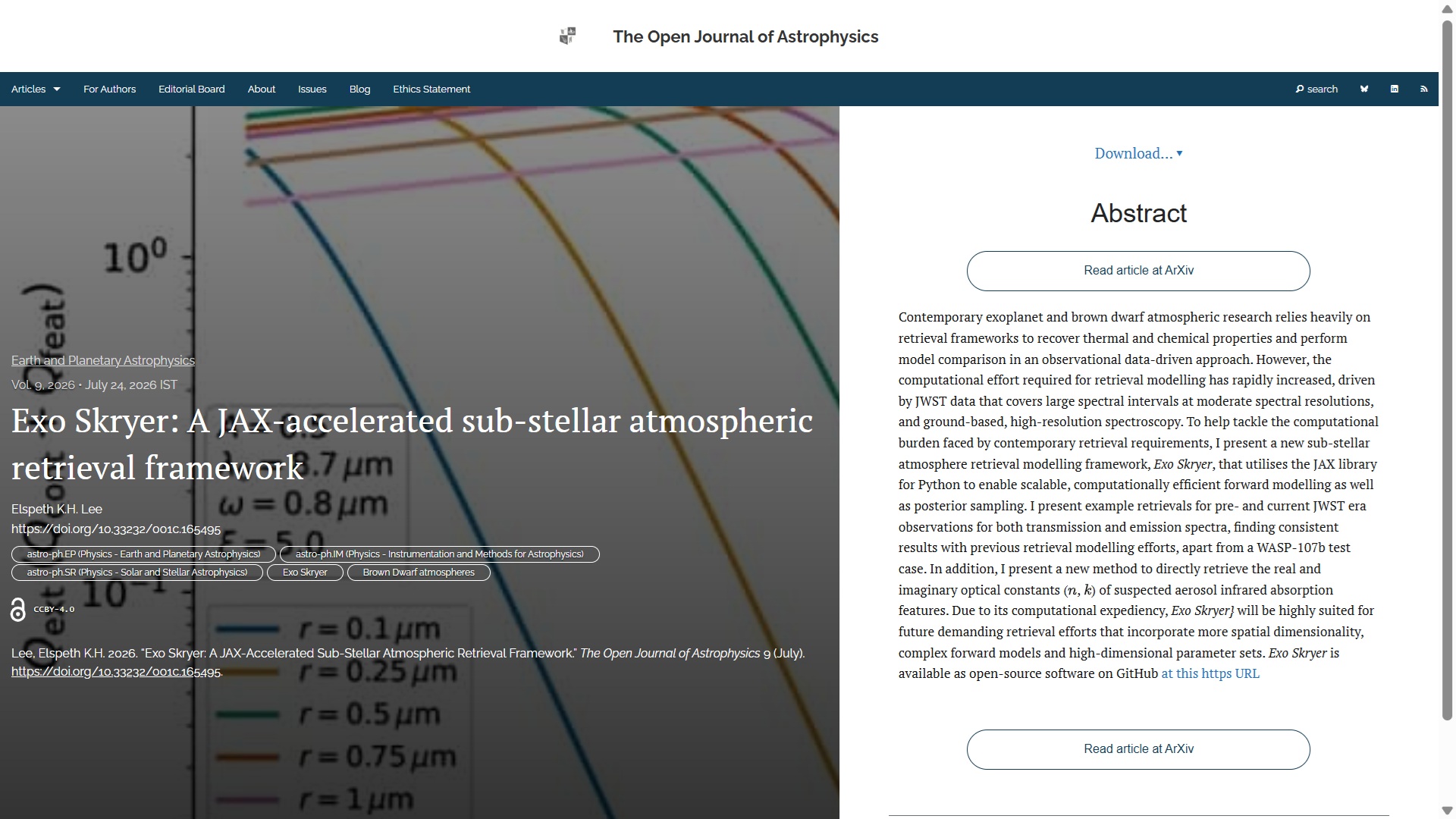
You can find the final accepted version on arXiv here and the Mastodon announcement is here:
The (penultimate) eighth paper of this week is “GCR Spectra Reconstructed with Neutron Monitor Yield Function and Artificial Neural Networks: Comparison of Two Methods” by Stepan A. Siruk (Moscow Engineering Physics Institute MEPhI, Russia) and four others, all based in Russia. Published on Friday 24th July in the folder Instrumentation and Methods for Astrophysics, this article presents a framework using artificial neural networks and neutron monitors to reconstruct cosmic-ray energy spectra, providing data even in the absence of direct satellite observations.
The overlay for this one is here:
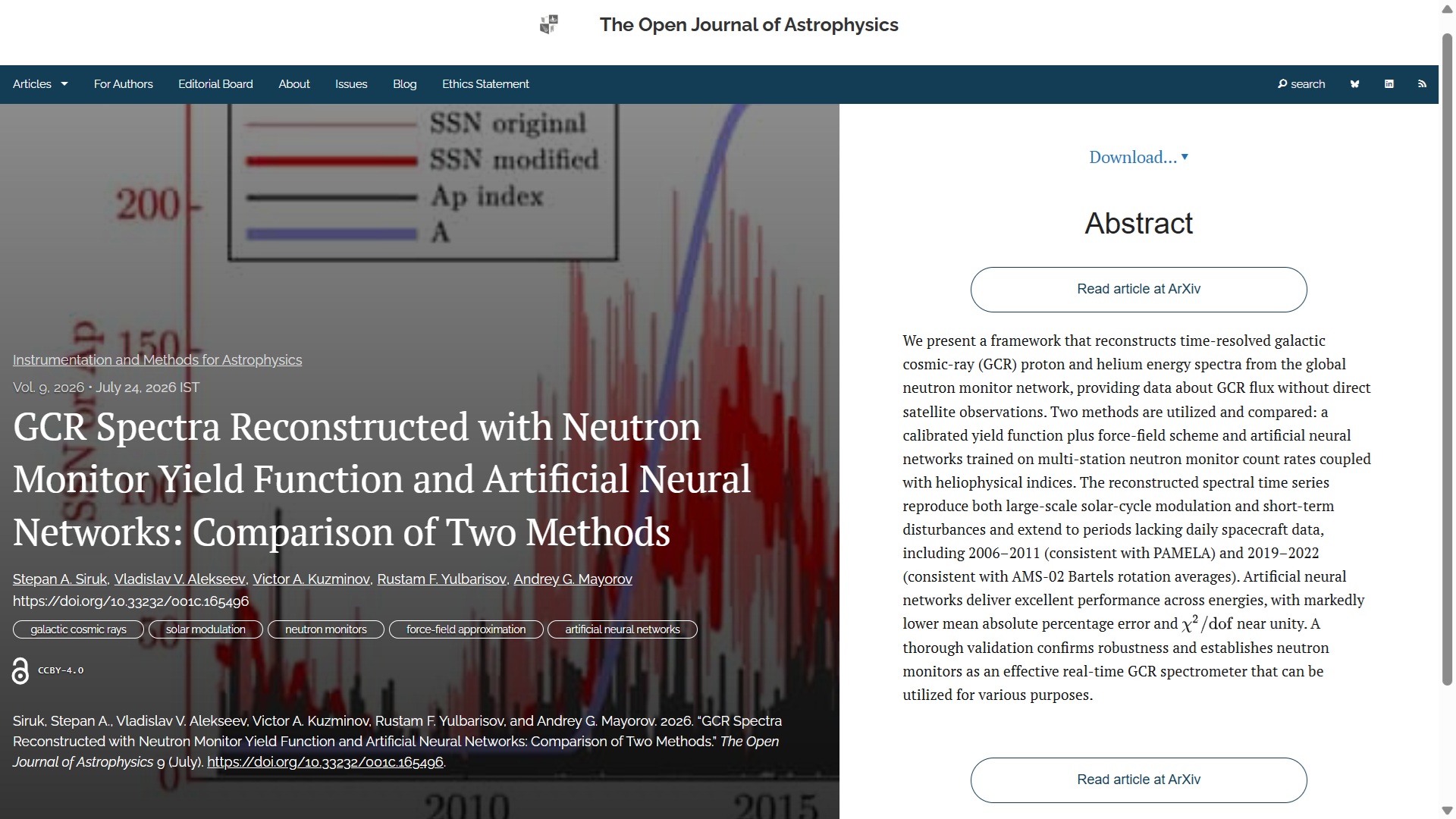
You can find the final accepted version on arXiv here and the Mastodon announcement is here:
And finally for this week we have “The failed failed-supernova scenario of M31-2014-DS1” by Noam Soker (Technion, Israel), a paper which challenges the failed-supernova theory for the fading of the yellow supergiant event M31-2014-DS1, suggesting it requires unlikely parameters and supports an alternative scenario involving violent binary interaction. This was published on Friday 24th July in the folder High-Energy Astrophysical Phenomena.
The overlay for this one is here:
You can find the final accepted version on arXiv here and the Mastodon announcement is here:
And that concludes the update of this week’s business. As it was foretold, the total number of publications at OJAp has now passed the 600 mark, and the likely number for 2026 is around 300. We published a paper in five of the six astro-ph categories this week, but still haven’t had a week when we’ve published a full house with at least one in all six…


August 1, 2026 at 10:43 am
[…] once more for another Saturday update of activity at the Open Journal of Astrophysics. Since the last update we have published a further three papers, bringing the number in Volume 9 (2026) to 163 and the […]