Although it’s holiday season for some, it’s time once more for another Saturday update of activity at the Open Journal of Astrophysics. Since the last update we have published a further four papers, bringing the number in Volume 9 (2026) to 167 and the total so far published by OJAp up to 615.
I continue to include the posts made on our Mastodon account (on Fediscience); these announcements also show the DOI for each paper.
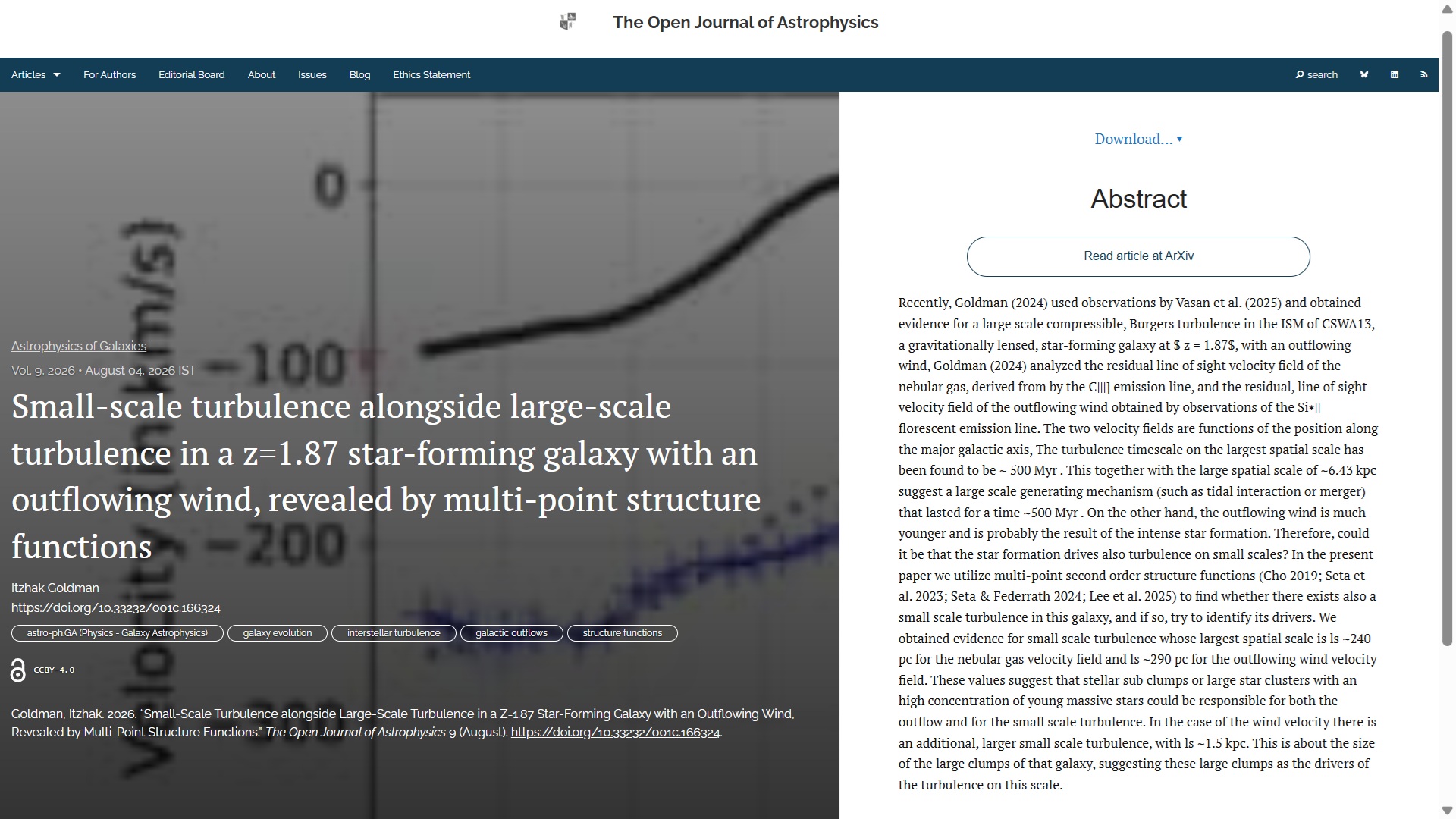
New Publication at the Open Journal of Astrophysics: "Small-scale turbulence alongside large-scale turbulence in a z=1.87 star-forming galaxy with an outflowing wind, revealed by multi-point structure functions" by Itzhak Goldman (Afeka College, Israel)
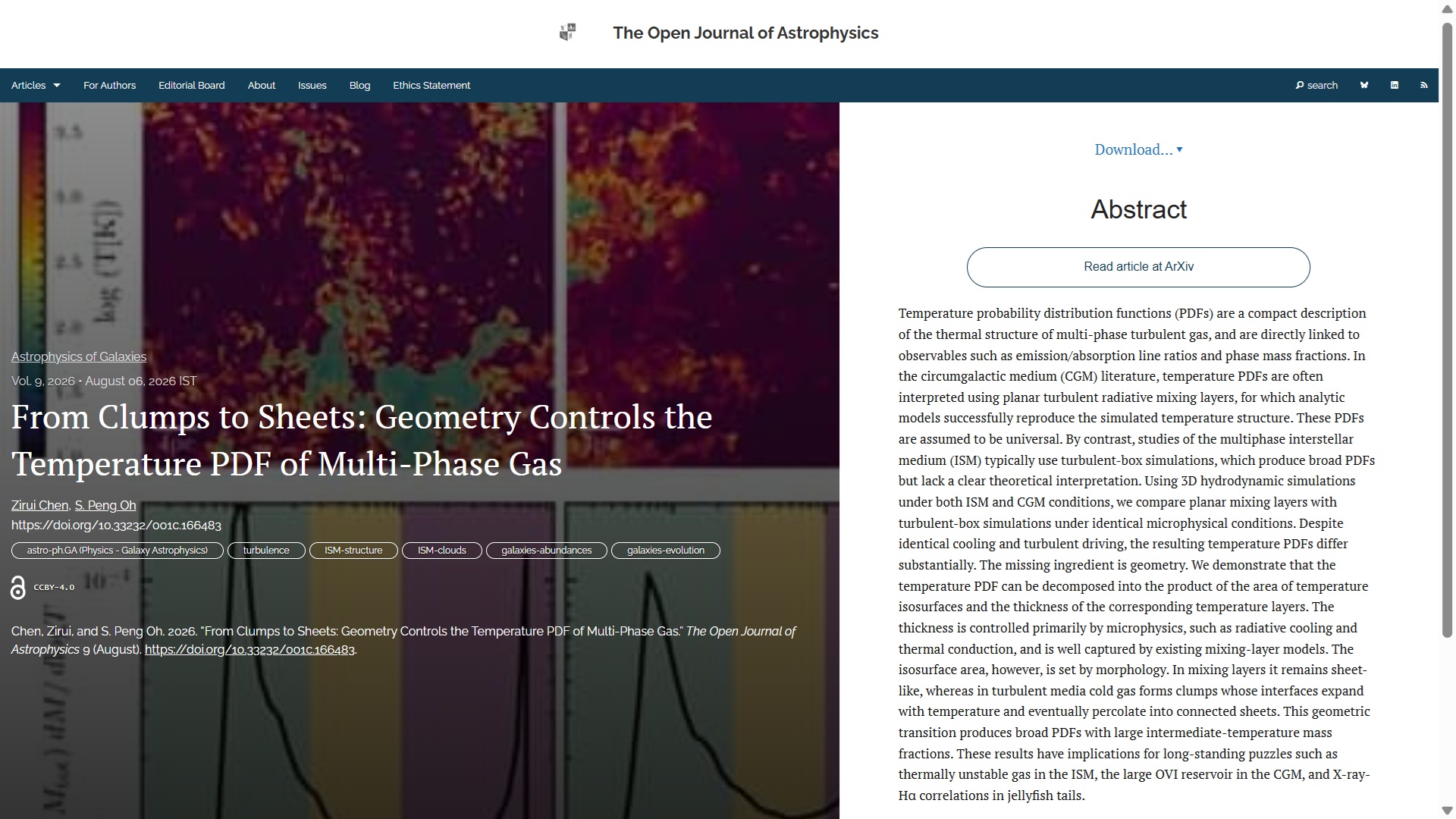
The second paper for this week, published on Thursday 6th August in the folder Astrophysics of Galaxies, is “From Clumps to Sheets: Geometry Controls the Temperature PDF of Multi-Phase Gas” by Zirui Chen and S. Peng Oh (UC Santa Barbara, USA). This study uses 3D hydrodynamic simulations to show that the temperature probability distribution functions (PDFs) of multi-phase turbulent gas differ significantly under interstellar medium (ISM) and circumgalactic medium (CGM) conditions.
The overlay looks like this:
The official version of the paper can be found on arXiv here and the Fediverse announcement here:
New Publication at the Open Journal of Astrophysics: "From Clumps to Sheets: Geometry Controls the Temperature PDF of Multi-Phase Gas" by Zirui Chen and S. Peng Oh (UC Santa Barbara, USA)
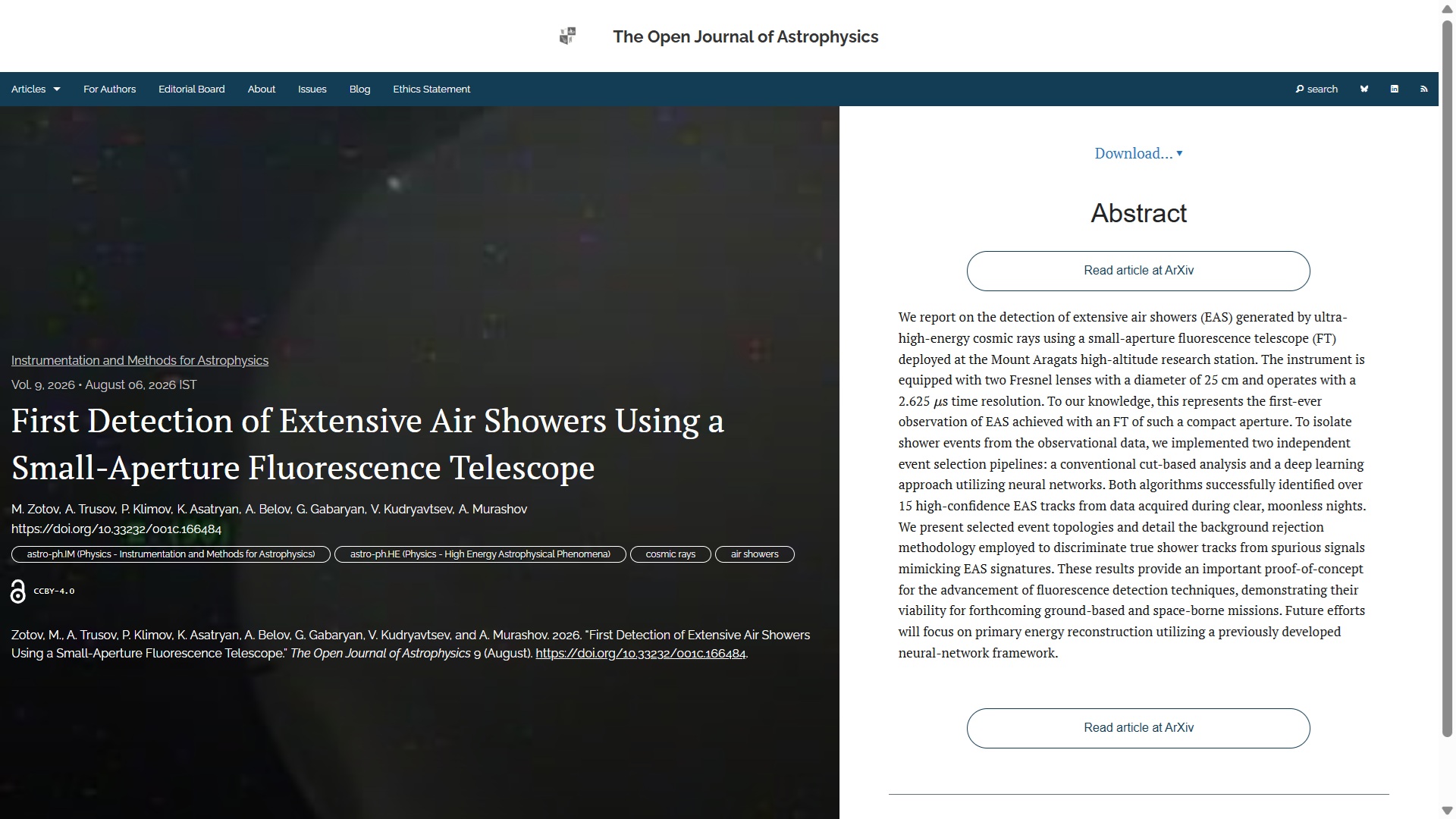
New Publication at the Open Journal of Astrophysics: "First Detection of Extensive Air Showers Using a Small-Aperture Fluorescence Telescope" by M. Zotov (M.V. Lomonosov Moscow State University, Russia) and 7 others based in Russia and Armenia
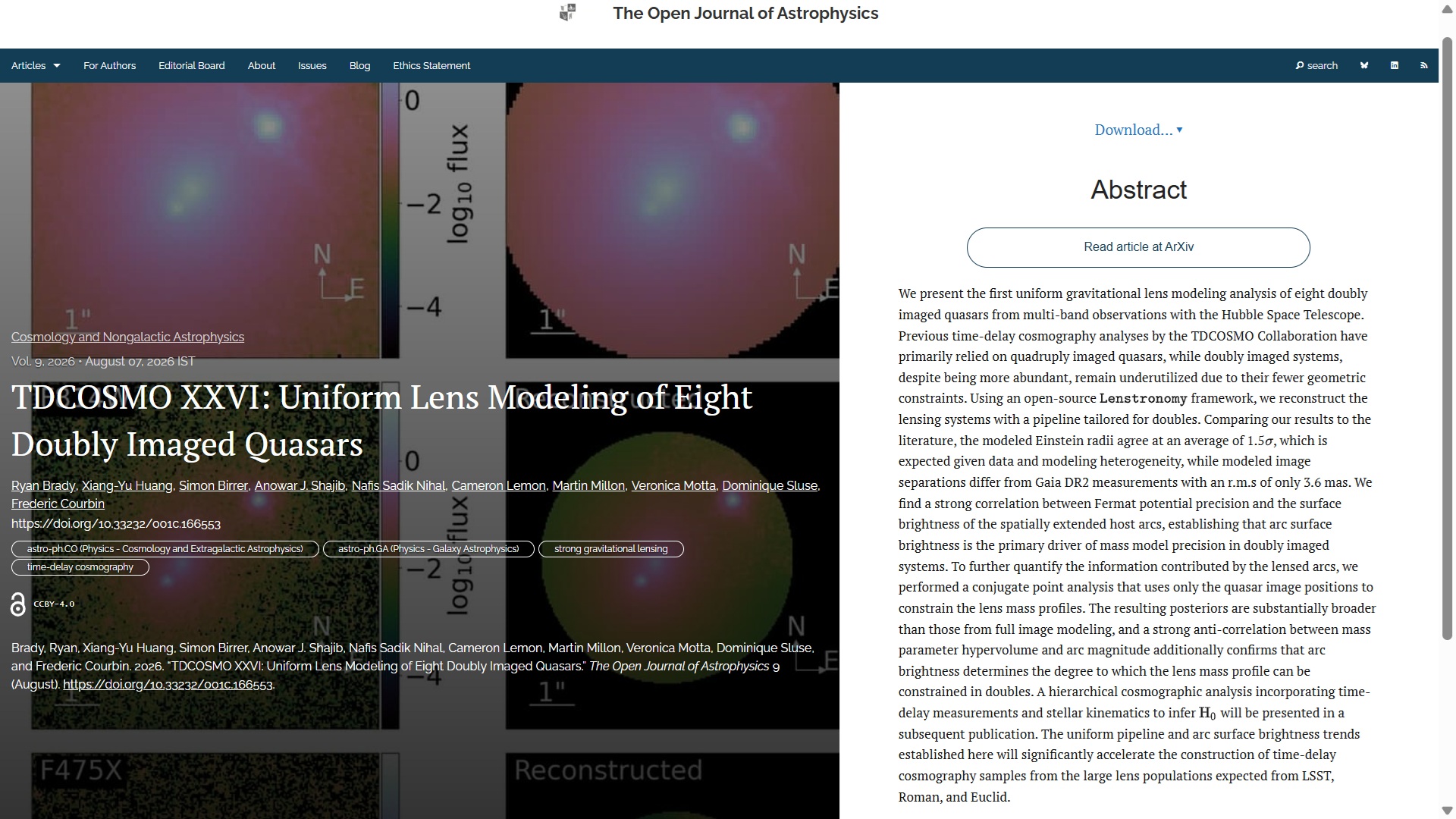
The fourth and final paper of the week was published on Friday 7th August in the folder Cosmology and Nongalactic Astrophysics: “TDCOSMO XXVI: Uniform Lens Modeling of Eight Doubly Imaged Quasars“, by Ryan Brady (Stony Brook University, USA) and 9 others based all around the world, presents a new method for analyzing doubly imaged quasars using the Hubble Space Telescope, revealing that arc surface brightness is key to precision in mass model measurements.
The overlay is here:
The officially-accepted version of the paper can be found on arXiv here and the Fediverse announcement here:
New Publication at the Copen Journal of Astrophysics: "TDCOSMO XXVI: Uniform Lens Modeling of Eight Doubly Imaged Quasars" by Ryan Brady (Stony Brook University, USA) and 9 others based around the world.
That’s all for this week. We have about a dozen more papers accepted and waiting for the authors to put the final version on arXiv, which they will presumably do when they’re back from holiday. I’ll do an update next weekend and we’ll see!
It’s time once more for another Saturday update of activity at the Open Journal of Astrophysics. Since the last update we have published a further three papers, bringing the number in Volume 9 (2026) to 163 and the total so far published by OJAp up to 611.
I continue to include the posts made on our Mastodon account (on Fediscience); these announcements also show the DOI for each paper.
The first paper to report this week was published on Tuesday 28th July in the folder Cosmology and Nongalactic Astrophysics. “The Origins of the Bulk Flow” by Richard Watkins & Trajan Clark (Willamett U., USA) and Hume A Feldman (U. Kansas, USA) analyzes the origin of large-scale bulk flow using the CosmicFlows-4 catalog, finding that it is largely influenced by structures beyond 200 h-1 Mpc, challenging previous assumptions.
The overlay for this paper is here
You can find the officially accepted version on arXiv here and the announcement on Fediverse here:
New Publication at the Open Journal of Astrophysics: "The Origins of the Bulk Flow" by Richard Watkins & Trajan Clark (Willamett U., USA) and Hume A Feldman (U. Kansas, USA).
The second paper for this week, also published on Tuesday 28th July in the folder Cosmology and Nongalactic Astrophysics is: “Enhancing weak lensing redshift distribution characterization by optimizing the Dark Energy Survey Self-Organizing Map Photo-z method” by A. Campos (Carnegie Mellon U., USA) and the DES collaboration (113 authors). This study improves the Self-Organizing Map methodology for estimating redshift distribution in galaxies, notably reducing overlap between redshift bins, in preparation for the Dark Energy Survey Year 6 data.Abstractfor Enhancing weak lensing redshift distribution characterization by optimizing the Dark Energy Survey Self-Organizing Map Photo-z method.
The overlay looks like this:
The official version of the paper can be found on arXiv here and the Fediverse announcement here:
New Publication at the Open Journal of Astrophysics: "Enhancing weak lensing redshift distribution characterization by optimizing the Dark Energy Survey Self-Organizing Map Photo-z method" by A. Campos (Carnegie Mellon U., USA) and the DES collaboration (113 authors)
New Publication at the Open Journal of Astrophysics: "The Ray Tracing Sampler: Bayesian Sampling of Neural Networks for Everyone" by Peter Behroozi (U. Arizona, USA)
It’s time once more for another Saturday update of activity at the Open Journal of Astrophysics. Since the last update we have published a further nine papers, bringing the number in Volume 9 (2026) to 160 and the total so far published by OJAp up to 608.
I will continue to include the posts made on our Mastodon account (on Fediscience); these announcements also show the DOI for each paper.
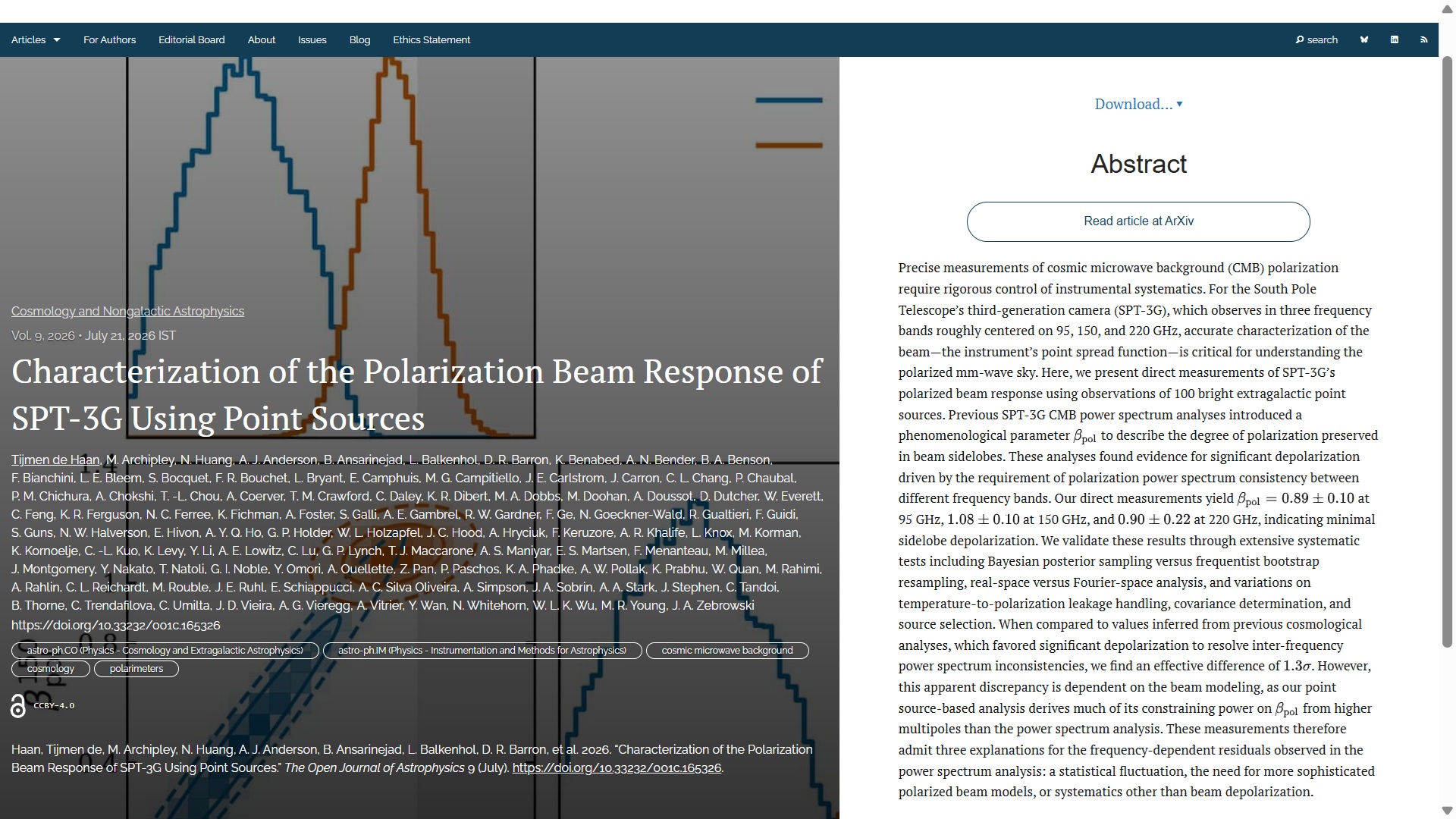
The first paper to report this week was published on Tuesday 21st July in the folder Cosmology and Nongalactic Astrophysics. The title is “Characterization of the Polarization Beam Response of SPT-3G Using Point Sources” by Tijmen de Haan (Institute of Particle and Nuclear Studies, Ibaraki, Japan) and an international cast of 101 others. This study presents measurements of the South Pole Telescope’s polarized beam response, indicating minimal sidelobe depolarization. The findings suggest potential explanations for frequency-dependent residuals in power spectrum analysis.
The overlay for this paper is here
You can find the officially accepted version on arXiv here and the announcement on Fediverse here:
New Publication at the Open Journal of Astrophysics: "Characterization of the Polarization Beam Response of SPT-3G Using Point Sources" by Tijmen de Haan (Institute of Particle and Nuclear Studies, Ibaraki, Japan) and 101 others from around the world
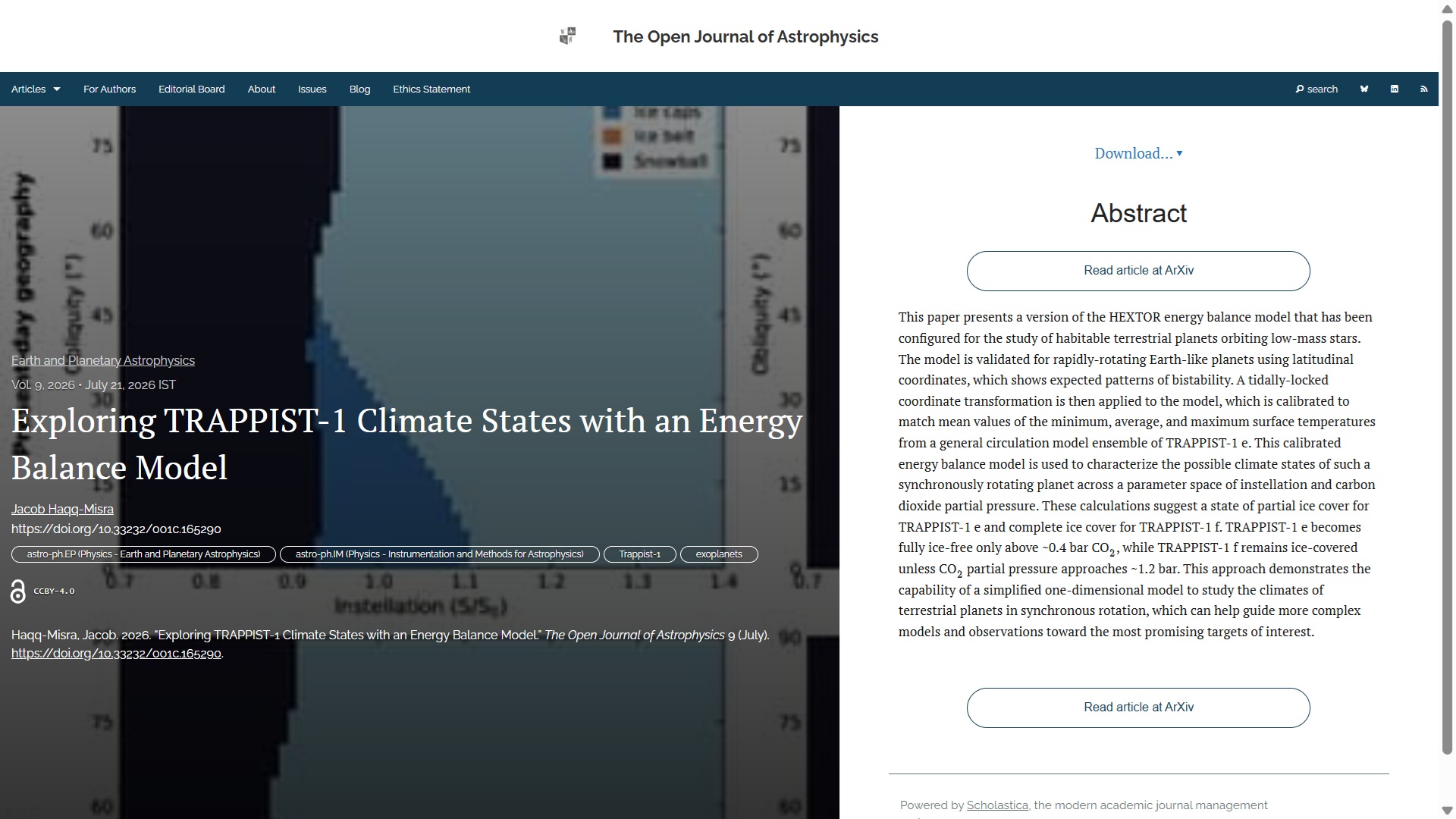
The second paper for this week, also published on Tuesday 21st July but in the folder Earth and Planetary Astrophysics is: “Exploring TRAPPIST-1 Climate States with an Energy Balance Model” by Jacob Haqq-Misra (Blue Marble Space, USA). The study uses a modified HEXTOR energy balance model to predict climate states of terrestrial planets orbiting low-mass stars, suggesting partial to complete ice cover for TRAPPIST-1 e and f.Abstractfor Exploring TRAPPIST-1 Climate States with an Energy Balance Model.
The overlay looks like this:
The official version of the paper can be found on arXiv here and the Fediverse announcement here:
New Publication at the Open Journal of Astrophysics: "Exploring TRAPPIST-1 Climate States with an Energy Balance Model" by Jacob Haqq-Misra (Blue Marble Space, USA)
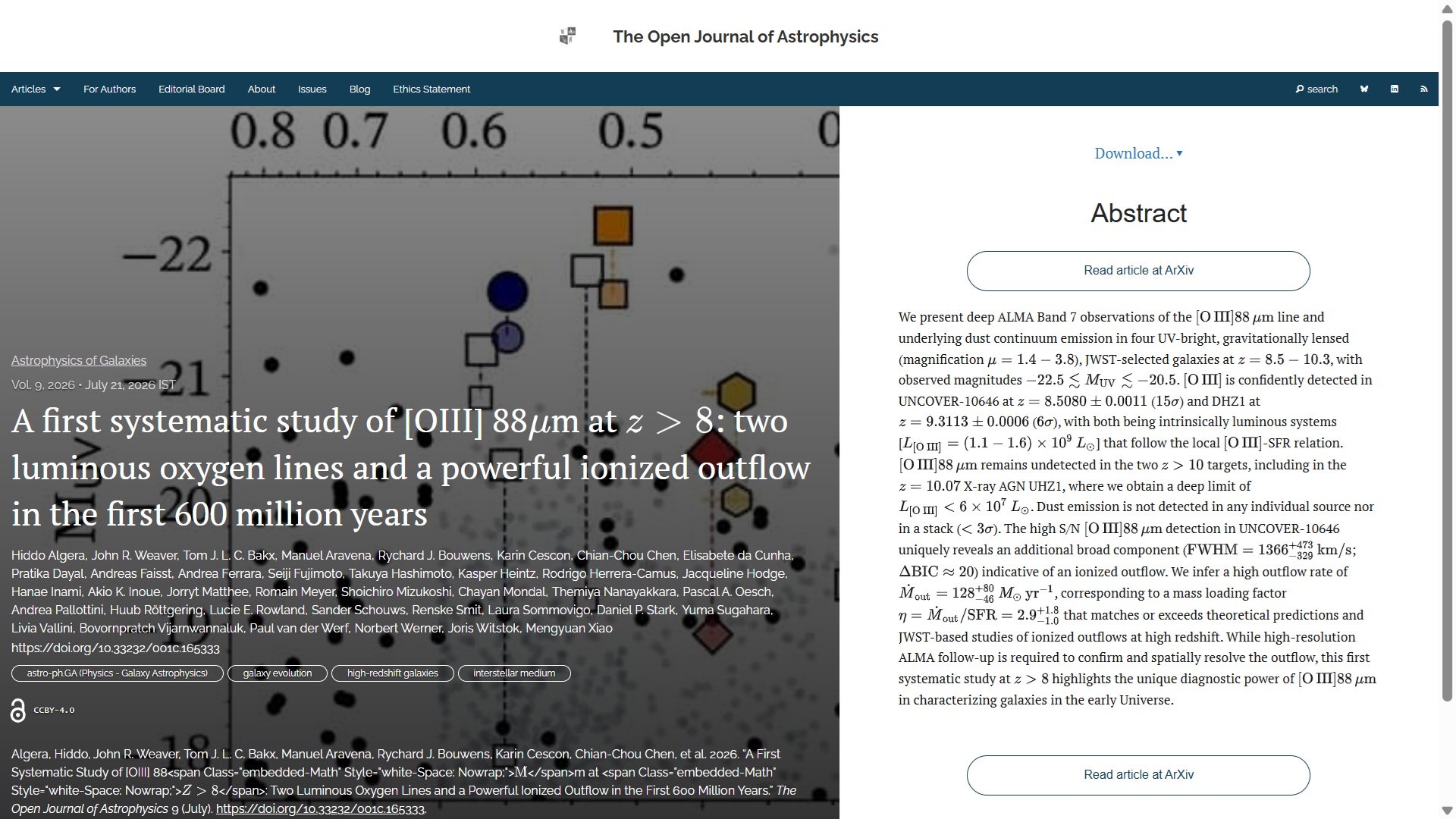
New Publication at the Open Journal of Astrophysics: "A first systematic study of [OIII] 88μm at z>8: two luminous oxygen lines and a powerful ionized outflow in the first 600 million years" by Hiddo Algera (Institute of Astronomy and Astrophysics, Taipei, Taiwan) and 37 others from all around the world.
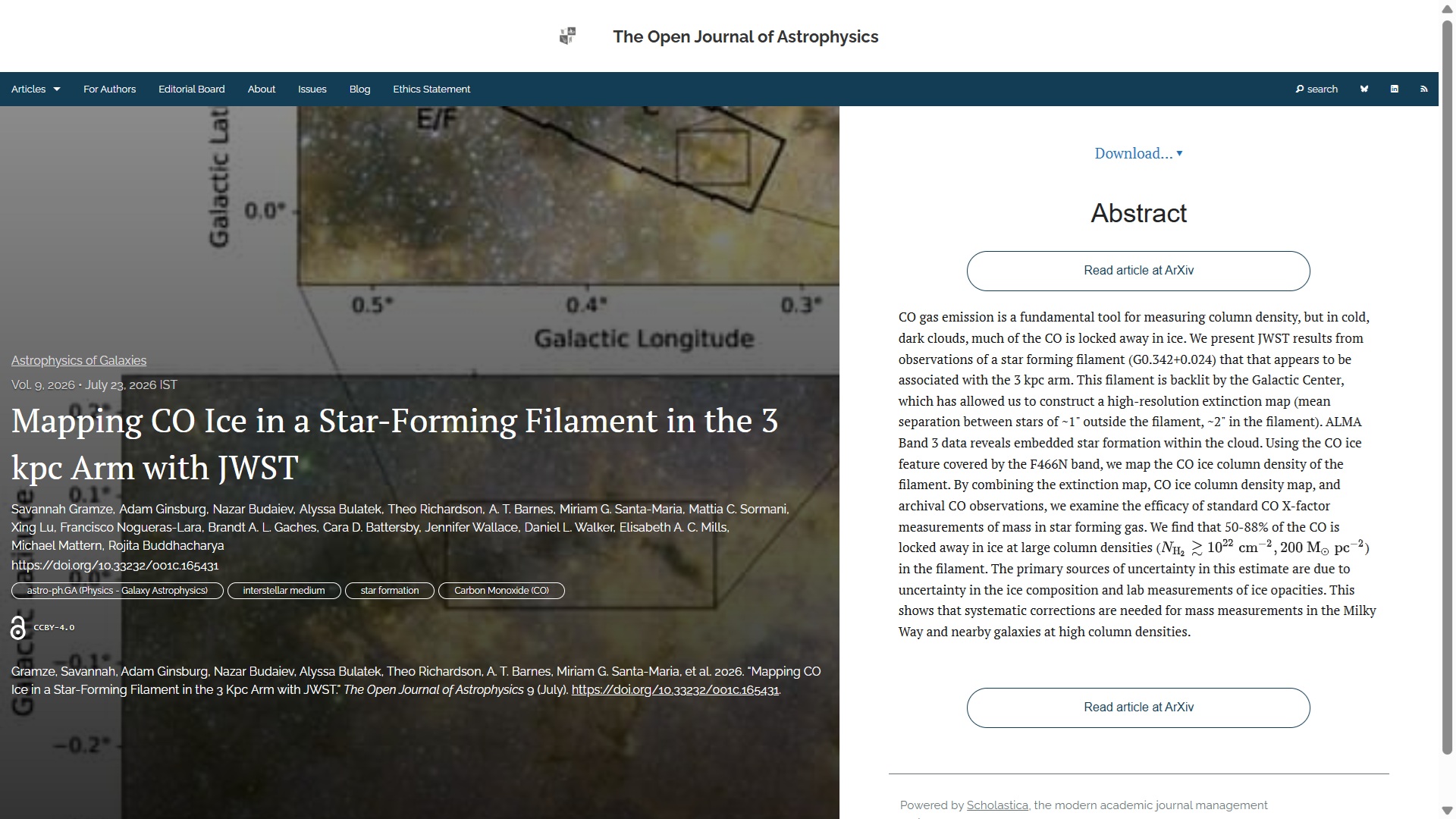
The fourth paper of the week, published on Thursday 23rd July in the folder Astrophysics of Galaxies, is “Mapping CO Ice in a Star-Forming Filament in the 3 kpc Arm with JWST” by Savannah Gramze (U. Florida, USA) and 16 others based all around the world. This paper shows that JWST observations and ALMA Band 3 data reveal that 50-88% of CO gas in a star-forming filament is locked in ice; corrections are needed for mass measurements in such systems.
The overlay for this one is here:
You can read the final version of this one on arXiv here and the Mastodon announcement is here:
New Publication at the Open Journal of Astrophysics: "Mapping CO Ice in a Star-Forming Filament in the 3 kpc Arm with JWST" by Savannah Gramze (U. Florida, USA) and 16 others based all around the world.
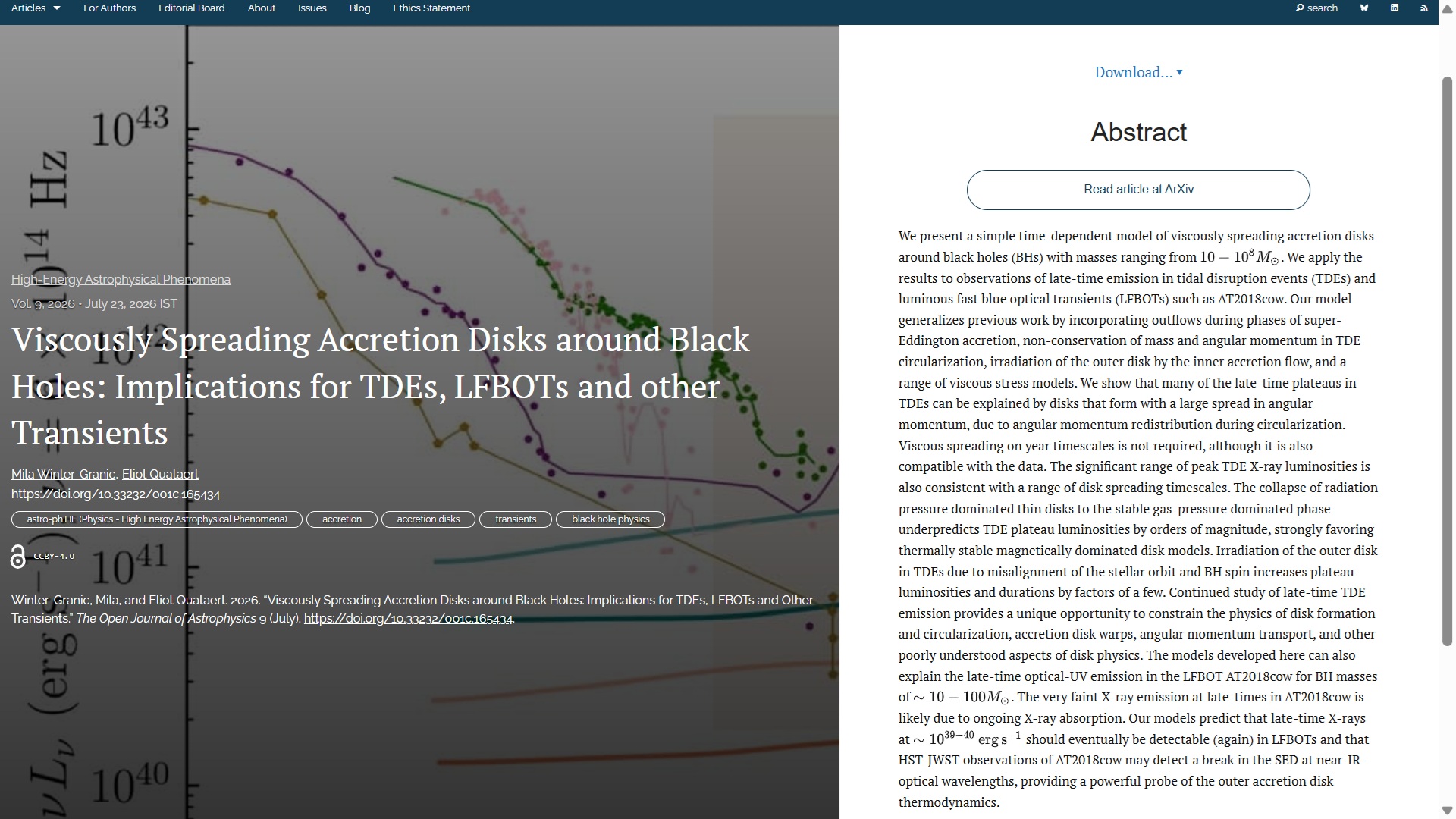
New Publication at the Open Journal of Astrophysics: "Viscously Spreading Accretion Disks around Black Holes: Implications for TDEs, LFBOTs and other Transients" by Mila Winter-Granic and Eliot Quataert (Princeton University, USA)
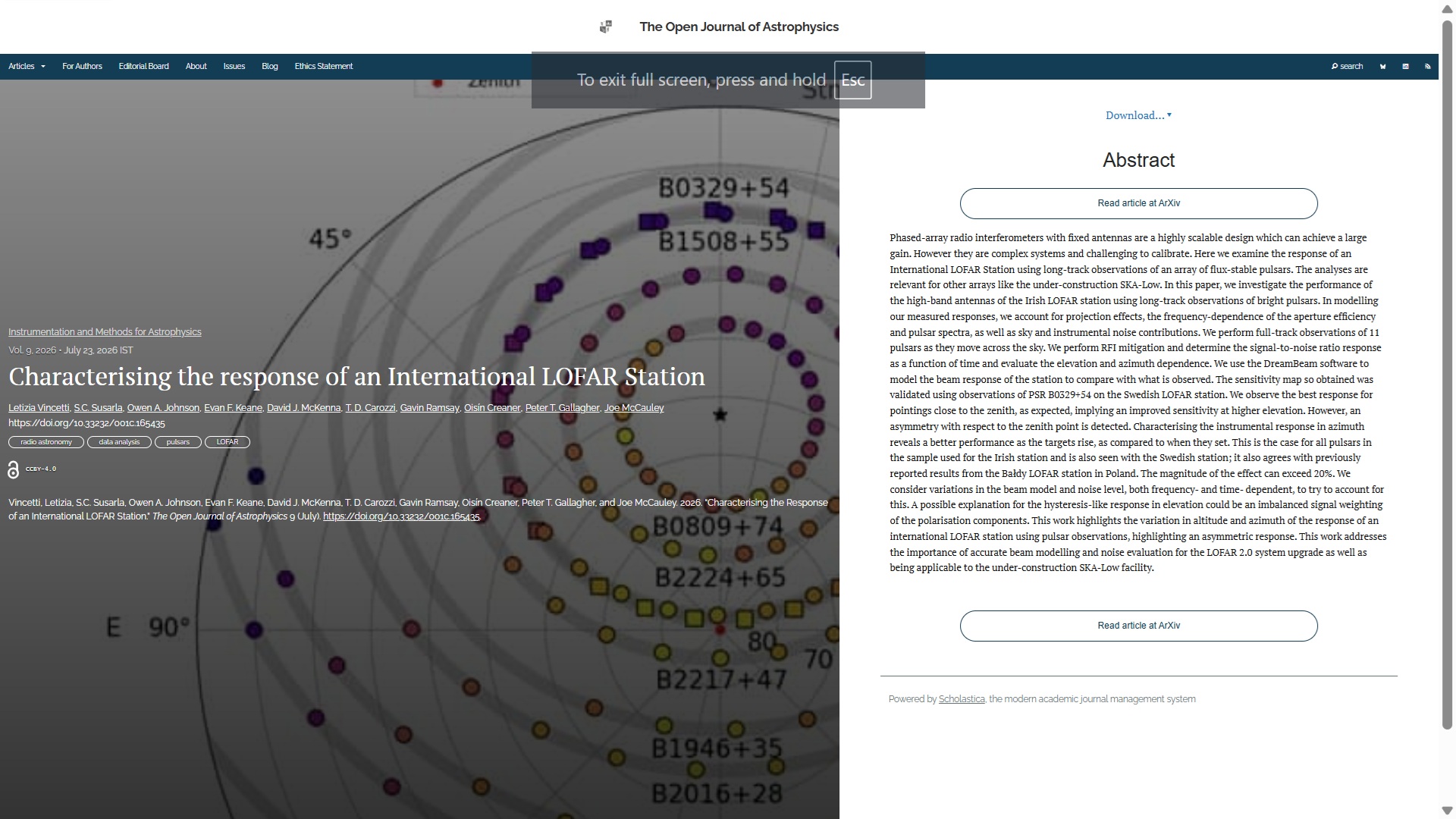
The sixth paper of this week is “Characterising the response of an International LOFAR Station” by Letizia Vincetti (Trinity Collge Dublin, Ireland) and 9 others based in Ireland, USA, The Netherlands and Sweden. This was also published on Thursday July 23rd and is in the folder Instrumentation and Methods for Astrophysics. The article presents an investigation of the performance and calibration challenges of phased-array radio interferometers, using the Irish LOFAR station as a case study, highlighting the importance of accurate beam modelling, etc.
The overlay for this one is here:
You can find the final accepted version on arXiv here and the Mastodon announcement is here:
New Publication at the Open Journal of Astrophysics: "Characterising the response of an International LOFAR Station" by Letizia Vincetti (Trinity Collge Dublin, Ireland) and 9 others based in Ireland, USA, The Netherlands and Sweden
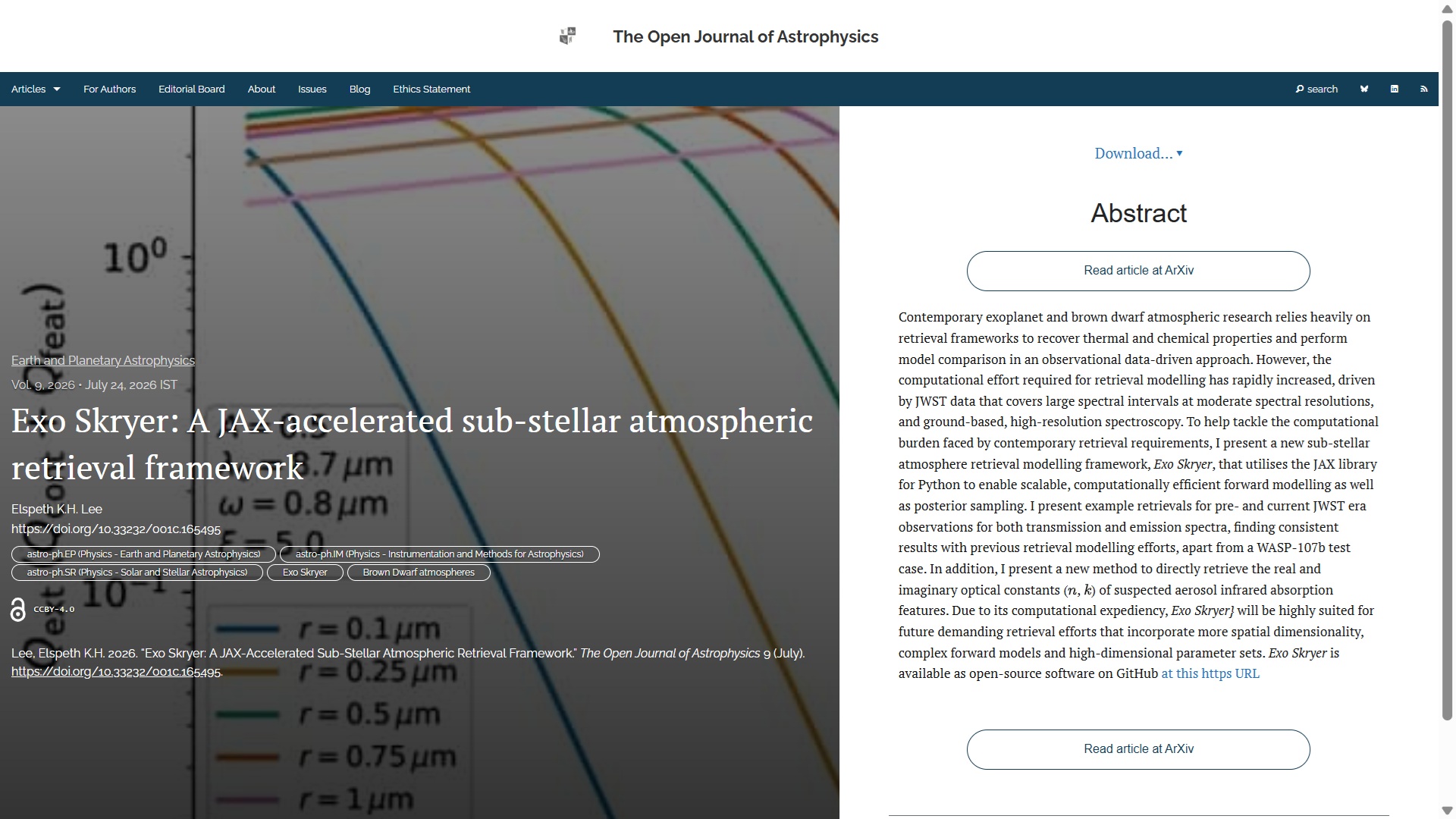
New Publication at the Open Journal of Astrophysics: "Exo Skryer: A JAX-accelerated sub-stellar atmospheric retrieval framework" by Elspeth K.H. Lee (U. Bern, Switzerland)
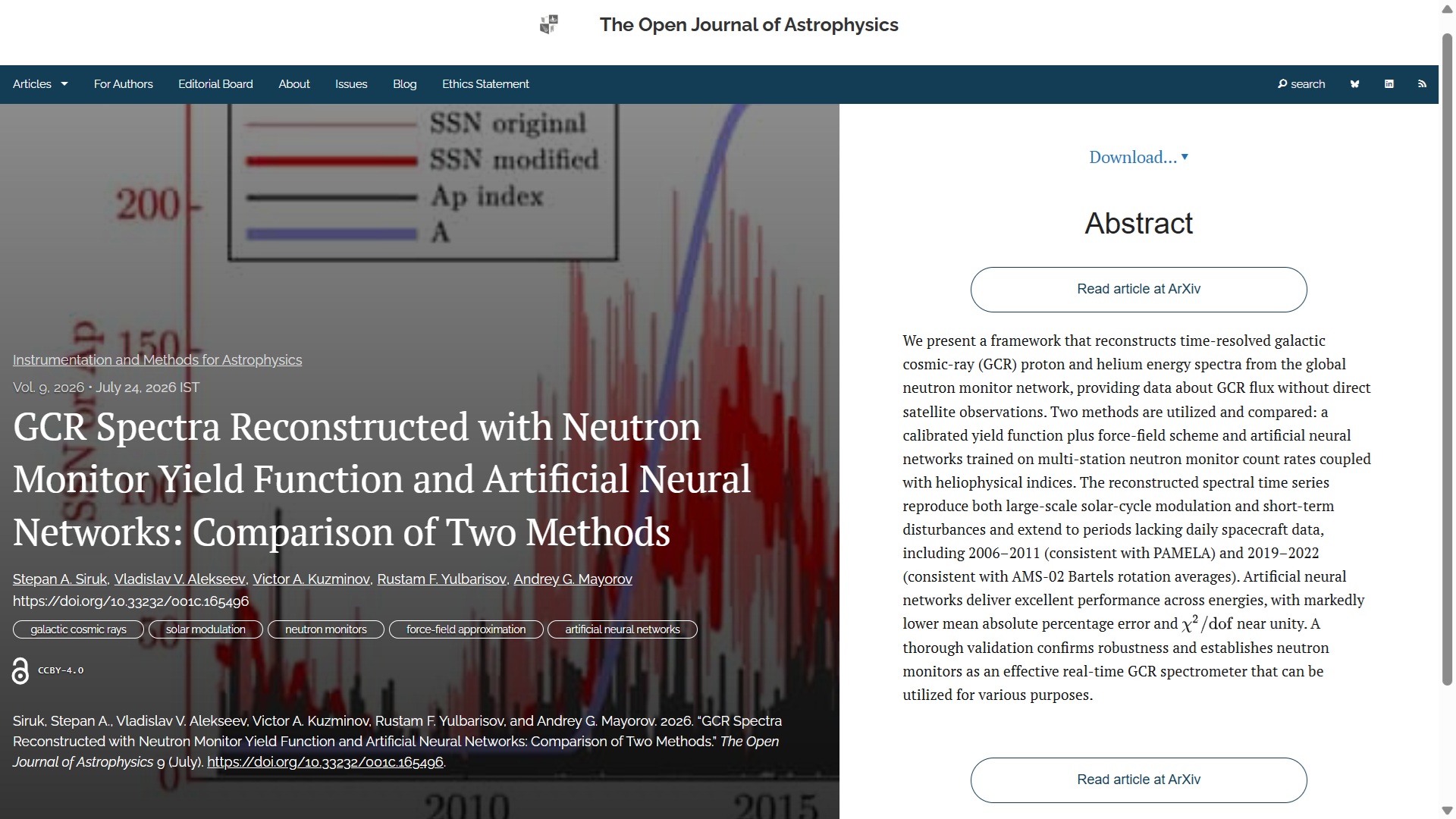
New Publication at the Open Journal of Astrophysics: "GCR Spectra Reconstructed with Neutron Monitor Yield Function and Artificial Neural Networks: Comparison of Two Methods" by Stepan A. Siruk (Moscow Engineering Physics Institute MEPhI, Russia) and four others based in Russia
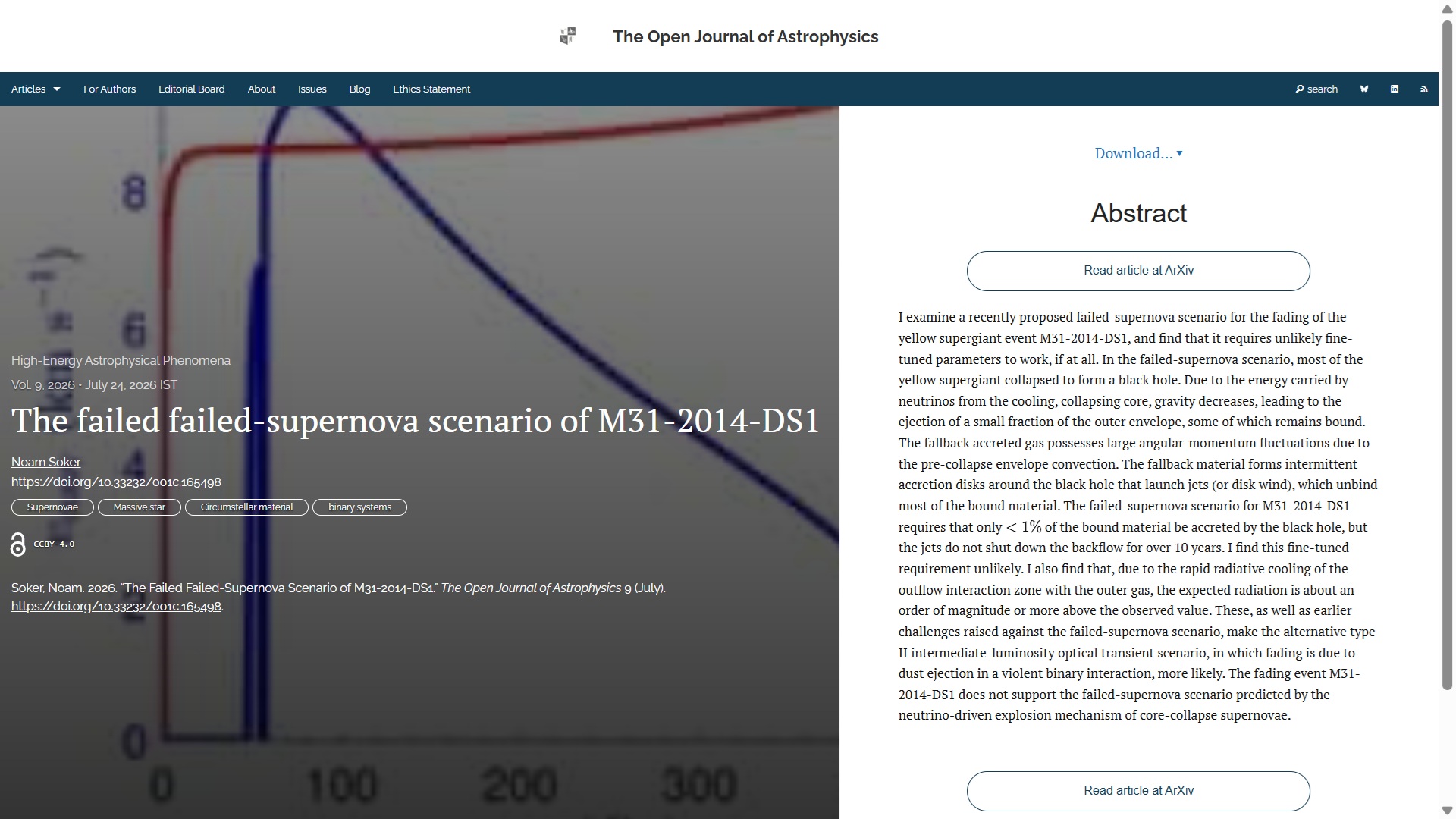
And finally for this week we have “The failed failed-supernova scenario of M31-2014-DS1” by Noam Soker (Technion, Israel), a paper which challenges the failed-supernova theory for the fading of the yellow supergiant event M31-2014-DS1, suggesting it requires unlikely parameters and supports an alternative scenario involving violent binary interaction. This was published on Friday 24th July in the folder High-Energy Astrophysical Phenomena.
The overlay for this one is here:
You can find the final accepted version on arXiv here and the Mastodon announcement is here:
And that concludes the update of this week’s business. As it was foretold, the total number of publications at OJAp has now passed the 600 mark, and the likely number for 2026 is around 300. We published a paper in five of the six astro-ph categories this week, but still haven’t had a week when we’ve published a full house with at least one in all six…
We have a visiting speaker for a colloquium this afternoon in the form of Dr Martin Rey, formerly of Oxford University and now a lecturer at the University of Bath. Last night at dinner I learned that he has a YouTube channel called Cosmic Rey (geddit?) so I thought I’d share one of the videos here.
The paper relating to this video can be found on the arXiv here.
The views presented here are personal and not necessarily those of my employer (or anyone else for that matter).
Feel free to comment on any of the posts on this blog but comments may be moderated; anonymous comments and any considered by me to be vexatious and/or abusive and/or defamatory will not be accepted. I do not necessarily endorse, support, sanction, encourage, verify or agree with the opinions or statements of any information or other content in the comments on this site and do not in any way guarantee their accuracy or reliability.




 In the Dark