Archive for accretion disks

Weekly Update from the Open Journal of Astrophysics 25/07/2026

Posted in OJAp Papers, Open Access, The Universe and Stuff with tags , , , , , , , , , , , , , , , , , , , , , , , , , , , , , , , , , , , , on July 25, 2026 by telescoper

It’s time once more for another Saturday update of activity at the Open Journal of Astrophysics. Since the last update we have published a further nine papers, bringing the number in Volume 9 (2026) to 160 and the total so far published by OJAp up to 608.

I will continue to include the posts made on our Mastodon account (on Fediscience); these announcements also show the DOI for each paper.

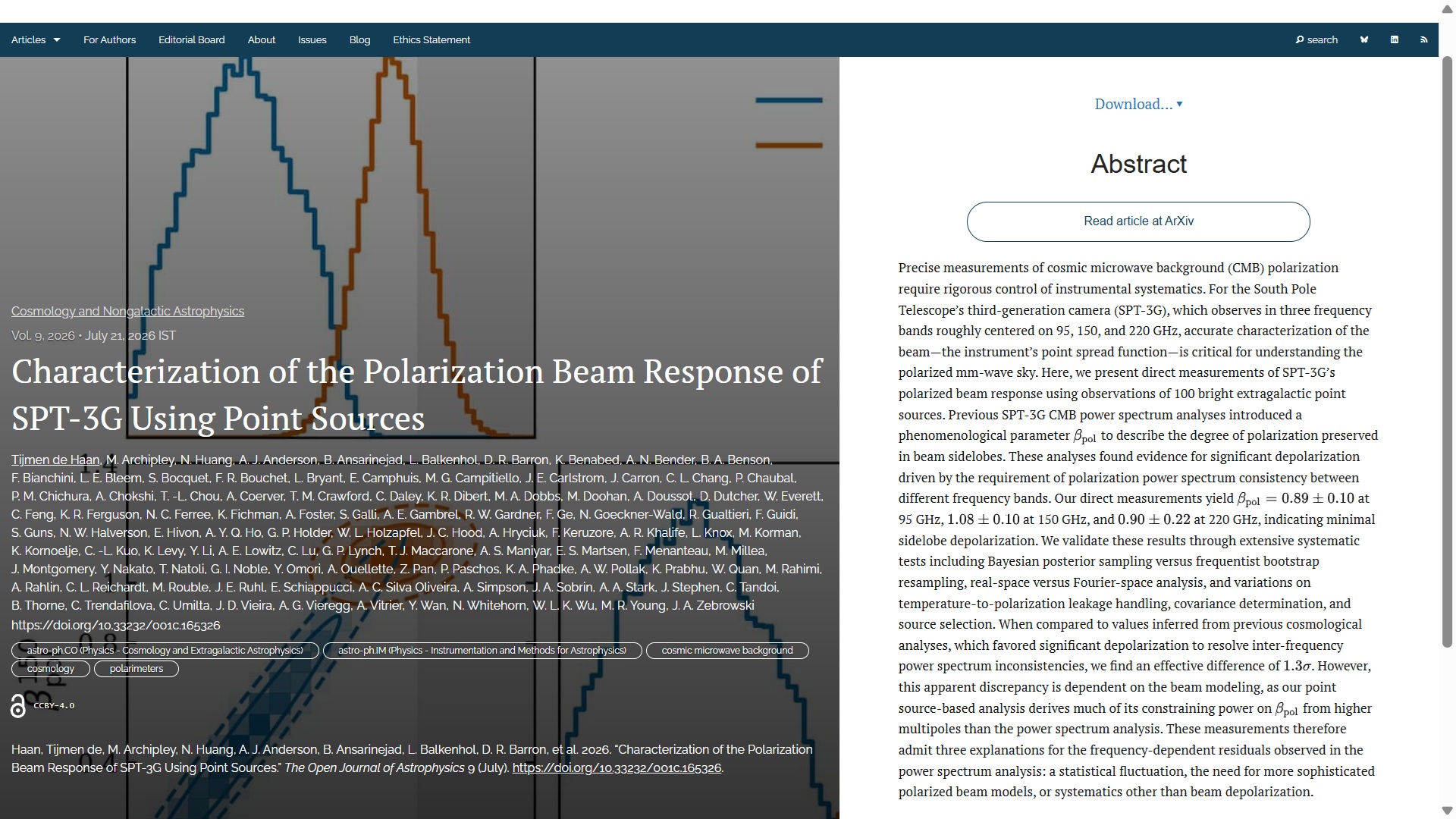
The first paper to report this week was published on Tuesday 21st July in the folder Cosmology and Nongalactic Astrophysics. The title is “Characterization of the Polarization Beam Response of SPT-3G Using Point Sources” by Tijmen de Haan (Institute of Particle and Nuclear Studies, Ibaraki, Japan) and an international cast of 101 others. This study presents measurements of the South Pole Telescope’s polarized beam response, indicating minimal sidelobe depolarization. The findings suggest potential explanations for frequency-dependent residuals in power spectrum analysis.

The overlay for this paper is here
You can find the officially accepted version on arXiv here and the announcement on Fediverse here:

Open Journal of Astrophysics

New Publication at the Open Journal of Astrophysics: "Characterization of the Polarization Beam Response of SPT-3G Using Point Sources" by Tijmen de Haan (Institute of Particle and Nuclear Studies, Ibaraki, Japan) and 101 others from around the world

doi.org/10.33232/001c.165326

July 21, 2026, 7:02 am 1 boosts 1 favorites

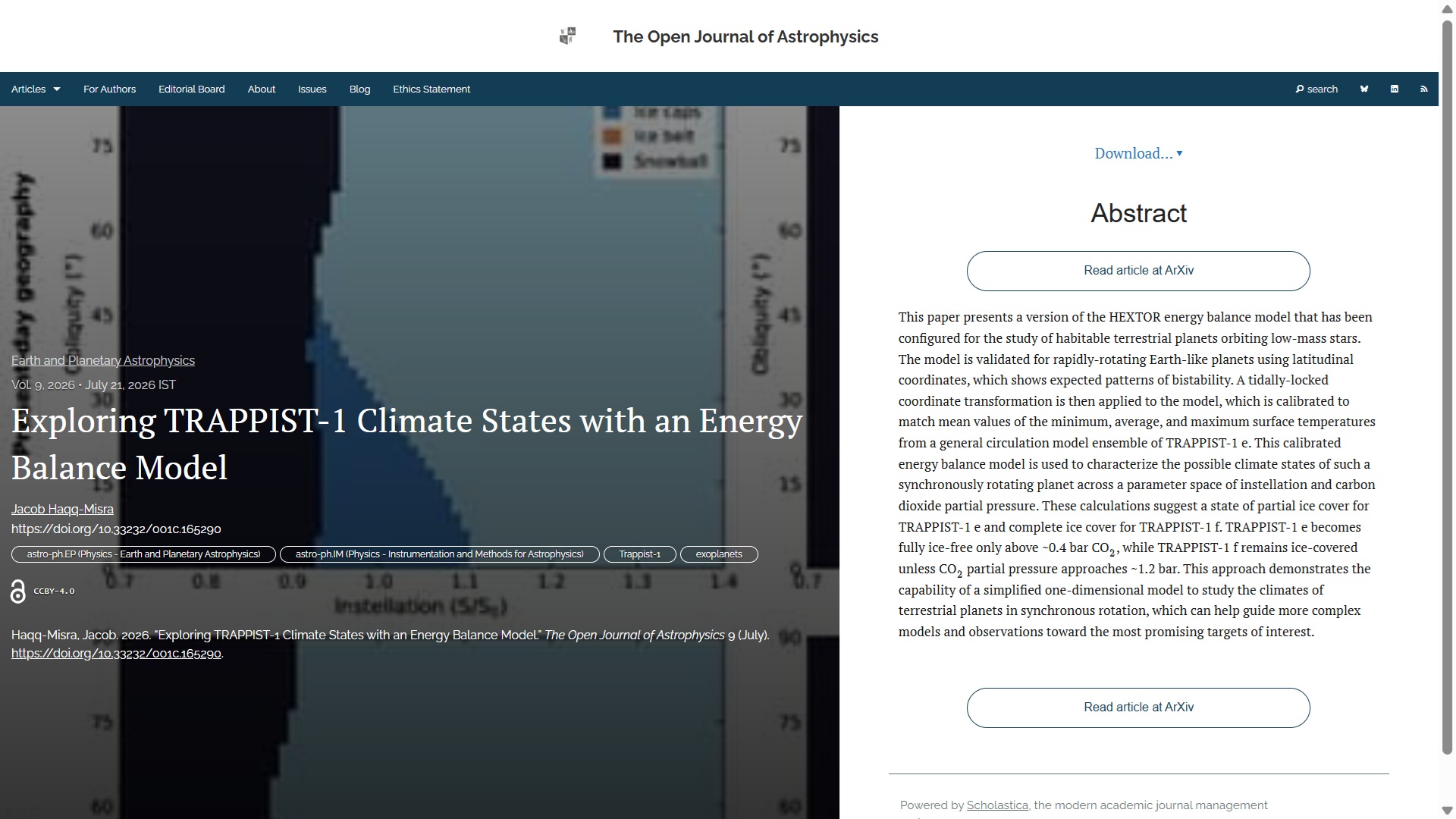
The second paper for this week, also published on Tuesday 21st July but in the folder Earth and Planetary Astrophysics is: “Exploring TRAPPIST-1 Climate States with an Energy Balance Model” by Jacob Haqq-Misra (Blue Marble Space, USA). The study uses a modified HEXTOR energy balance model to predict climate states of terrestrial planets orbiting low-mass stars, suggesting partial to complete ice cover for TRAPPIST-1 e and f.Abstractfor Exploring TRAPPIST-1 Climate States with an Energy Balance Model.

The overlay looks like this:
The official version of the paper can be found on arXiv here and the Fediverse announcement here:

Open Journal of Astrophysics

New Publication at the Open Journal of Astrophysics: "Exploring TRAPPIST-1 Climate States with an Energy Balance Model" by Jacob Haqq-Misra (Blue Marble Space, USA)

doi.org/10.33232/001c.165290

July 21, 2026, 7:38 am 2 boosts 1 favorites

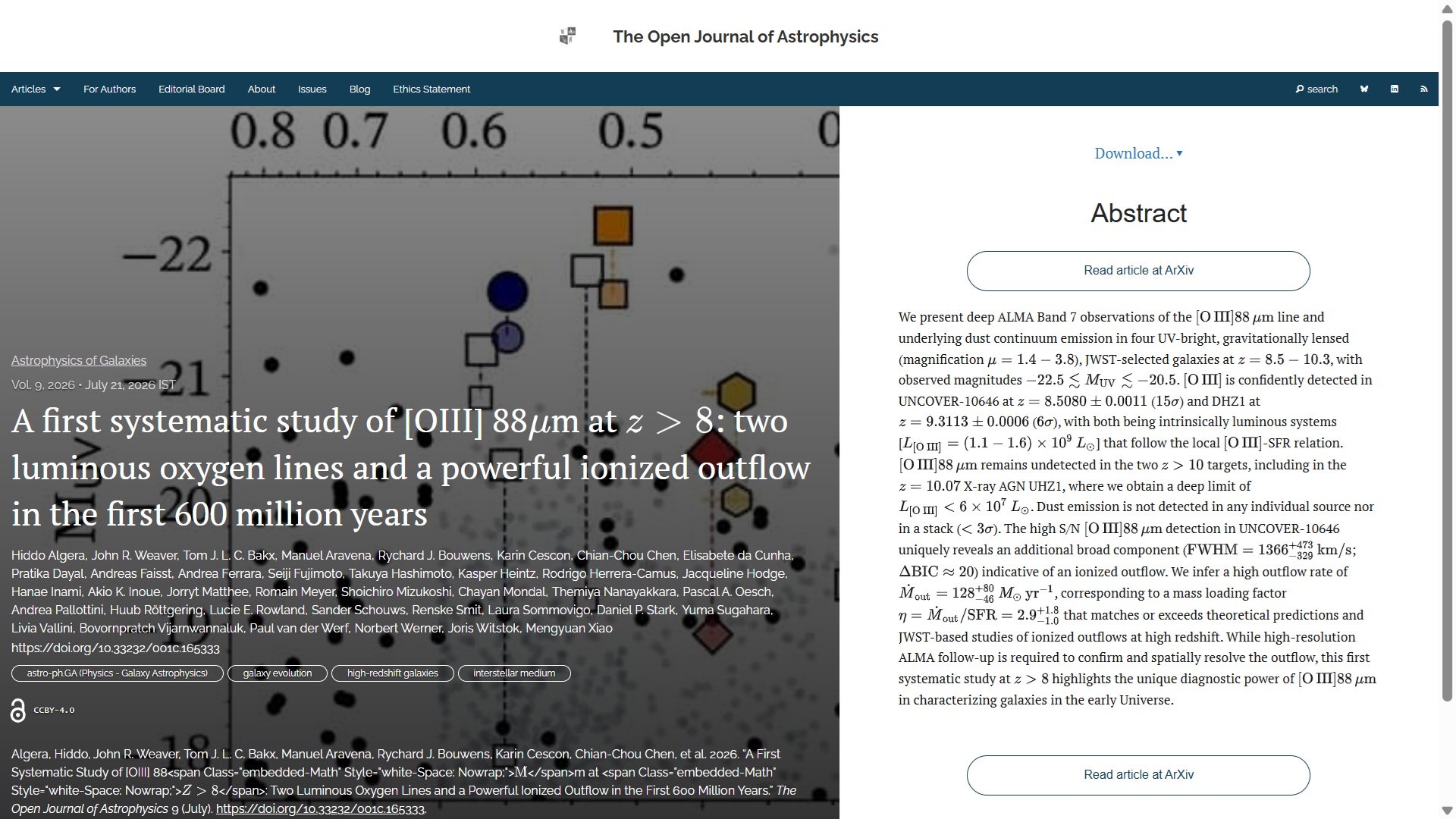
The third paper of the week, also published on Tuesday 21st July, but in the folder Astrophysics of Galaxies is “A first systematic study of [OIII] 88μm at z>8: two luminous oxygen lines and a powerful ionized outflow in the first 600 million years” by Hiddo Algera (Institute of Astronomy and Astrophysics, Taipei, Taiwan) and 37 others from all around the world. This paper presents deep observations of four UV-bright, gravitationally lensed galaxies, revealing an ionized outflow in one and highlighting the diagnostic power of [O III]88 μm in studying galaxies in the early Universe.

The overlay for this one is here:
The final, accepted version can be found on arXiv here and the Mastodon announcement is here:

Open Journal of Astrophysics

New Publication at the Open Journal of Astrophysics: "A first systematic study of [OIII] 88μm at z>8: two luminous oxygen lines and a powerful ionized outflow in the first 600 million years" by Hiddo Algera (Institute of Astronomy and Astrophysics, Taipei, Taiwan) and 37 others from all around the world.

doi.org/10.33232/001c.165333

July 21, 2026, 7:52 am 1 boosts 1 favorites

The fourth paper of the week, published on Thursday 23rd July in the folder Astrophysics of Galaxies, is “Mapping CO Ice in a Star-Forming Filament in the 3 kpc Arm with JWST” by Savannah Gramze (U. Florida, USA) and 16 others based all around the world. This paper shows that JWST observations and ALMA Band 3 data reveal that 50-88% of CO gas in a star-forming filament is locked in ice; corrections are needed for mass measurements in such systems.

The overlay for this one is here:
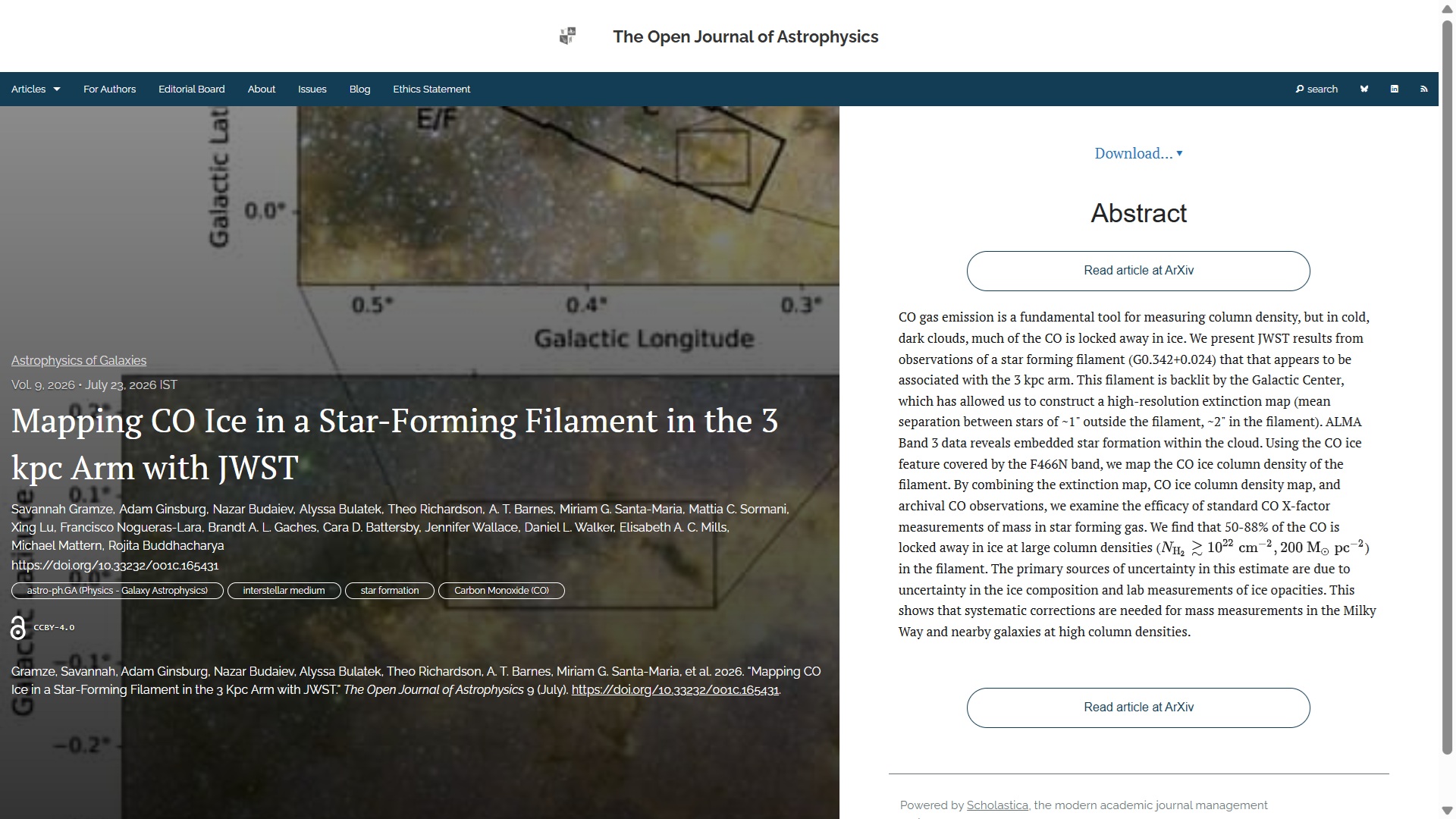
You can read the final version of this one on arXiv here and the Mastodon announcement is here:

Open Journal of Astrophysics

New Publication at the Open Journal of Astrophysics: "Mapping CO Ice in a Star-Forming Filament in the 3 kpc Arm with JWST" by Savannah Gramze (U. Florida, USA) and 16 others based all around the world.

doi.org/10.33232/001c.165431

July 23, 2026, 7:08 am 1 boosts 0 favorites

The fifth paper of the week, also published on Thursday 23rd July but in the folder High-Energy Astrophysical Phenomena, is “Viscously Spreading Accretion Disks around Black Holes: Implications for TDEs, LFBOTs and other Transients“. This article presents a time-dependent model of accretion disks around black holes, explaining late-time emission in tidal disruption events and luminous fast blue optical transients and future detectability of such events.

The overlay for this one is here:
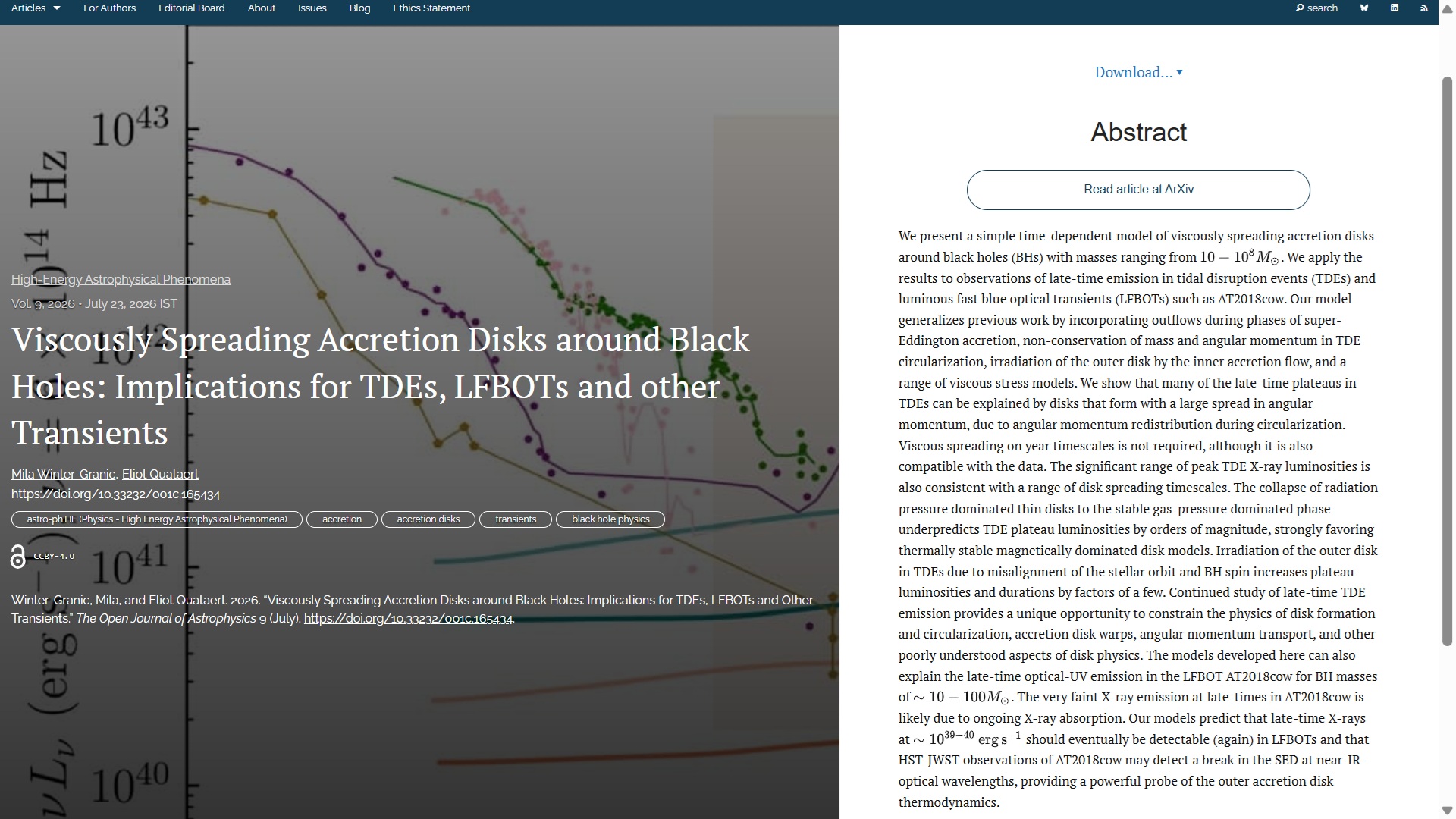
You can read the final version of this one on arXiv here and the Mastodon announcement is here:

Open Journal of Astrophysics

New Publication at the Open Journal of Astrophysics: "Viscously Spreading Accretion Disks around Black Holes: Implications for TDEs, LFBOTs and other Transients" by Mila Winter-Granic and Eliot Quataert (Princeton University, USA)

doi.org/10.33232/001c.165434

July 23, 2026, 7:20 am 1 boosts 0 favorites

The sixth paper of this week is “Characterising the response of an International LOFAR Station” by Letizia Vincetti (Trinity Collge Dublin, Ireland) and 9 others based in Ireland, USA, The Netherlands and Sweden. This was also published on Thursday July 23rd and is in the folder Instrumentation and Methods for Astrophysics. The article presents an investigation of the performance and calibration challenges of phased-array radio interferometers, using the Irish LOFAR station as a case study, highlighting the importance of accurate beam modelling, etc.

The overlay for this one is here:
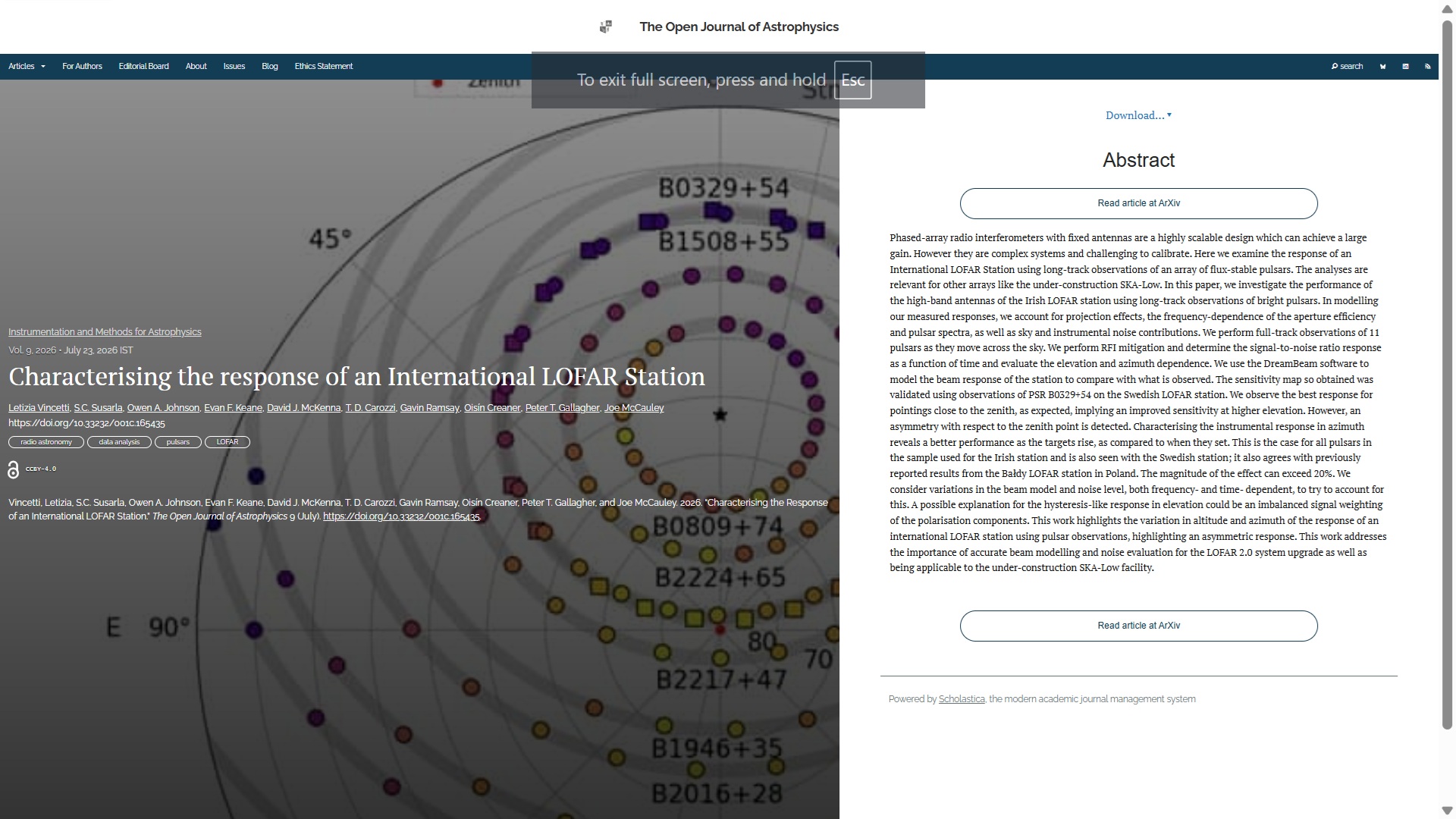
You can find the final accepted version on arXiv here and the Mastodon announcement is here:

Open Journal of Astrophysics

New Publication at the Open Journal of Astrophysics: "Characterising the response of an International LOFAR Station" by Letizia Vincetti (Trinity Collge Dublin, Ireland) and 9 others based in Ireland, USA, The Netherlands and Sweden

doi.org/10.33232/001c.165435

July 23, 2026, 7:34 am 1 boosts 0 favorites

The seventh paper of this week is “Exo Skryer: A JAX-accelerated sub-stellar atmospheric retrieval framework” by Elspeth K.H. Lee (U. Bern, Switzerland). Published on Friday 24th July in the folder Earth and Planetary Astrophysics, this article introduces “Exo Skryer”, a new, efficient framework for exoplanet and brown dwarf atmospheric research, capable of handling large data sets and complex models.

The overlay for this one is here:
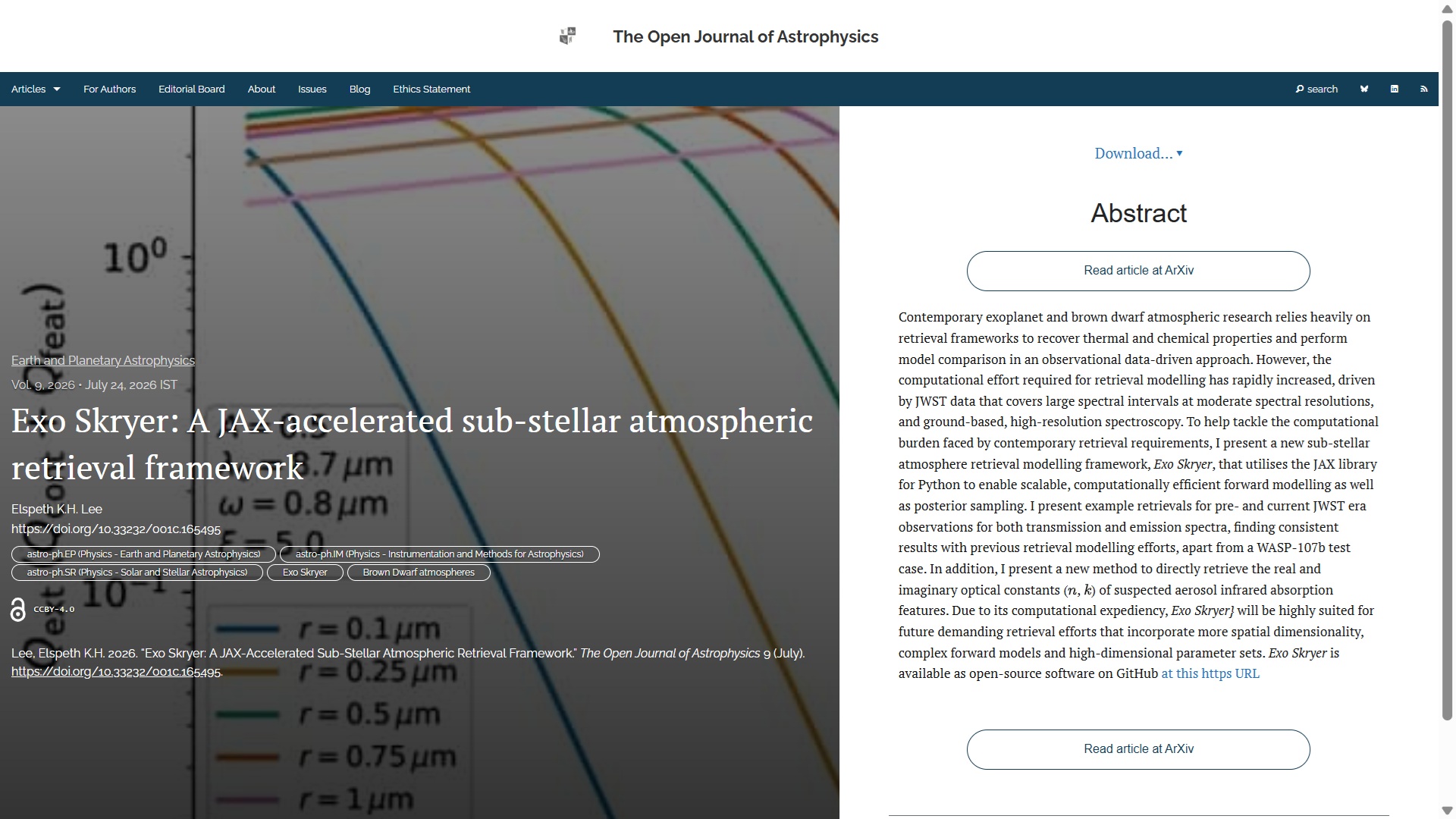
You can find the final accepted version on arXiv here and the Mastodon announcement is here:

Open Journal of Astrophysics

New Publication at the Open Journal of Astrophysics: "Exo Skryer: A JAX-accelerated sub-stellar atmospheric retrieval framework" by Elspeth K.H. Lee (U. Bern, Switzerland)

doi.org/10.33232/001c.165495

July 24, 2026, 8:29 am 0 boosts 1 favorites

The (penultimate) eighth paper of this week is “GCR Spectra Reconstructed with Neutron Monitor Yield Function and Artificial Neural Networks: Comparison of Two Methods” by Stepan A. Siruk (Moscow Engineering Physics Institute MEPhI, Russia) and four others, all based in Russia. Published on Friday 24th July in the folder Instrumentation and Methods for Astrophysics, this article presents a framework using artificial neural networks and neutron monitors to reconstruct cosmic-ray energy spectra, providing data even in the absence of direct satellite observations.

The overlay for this one is here:
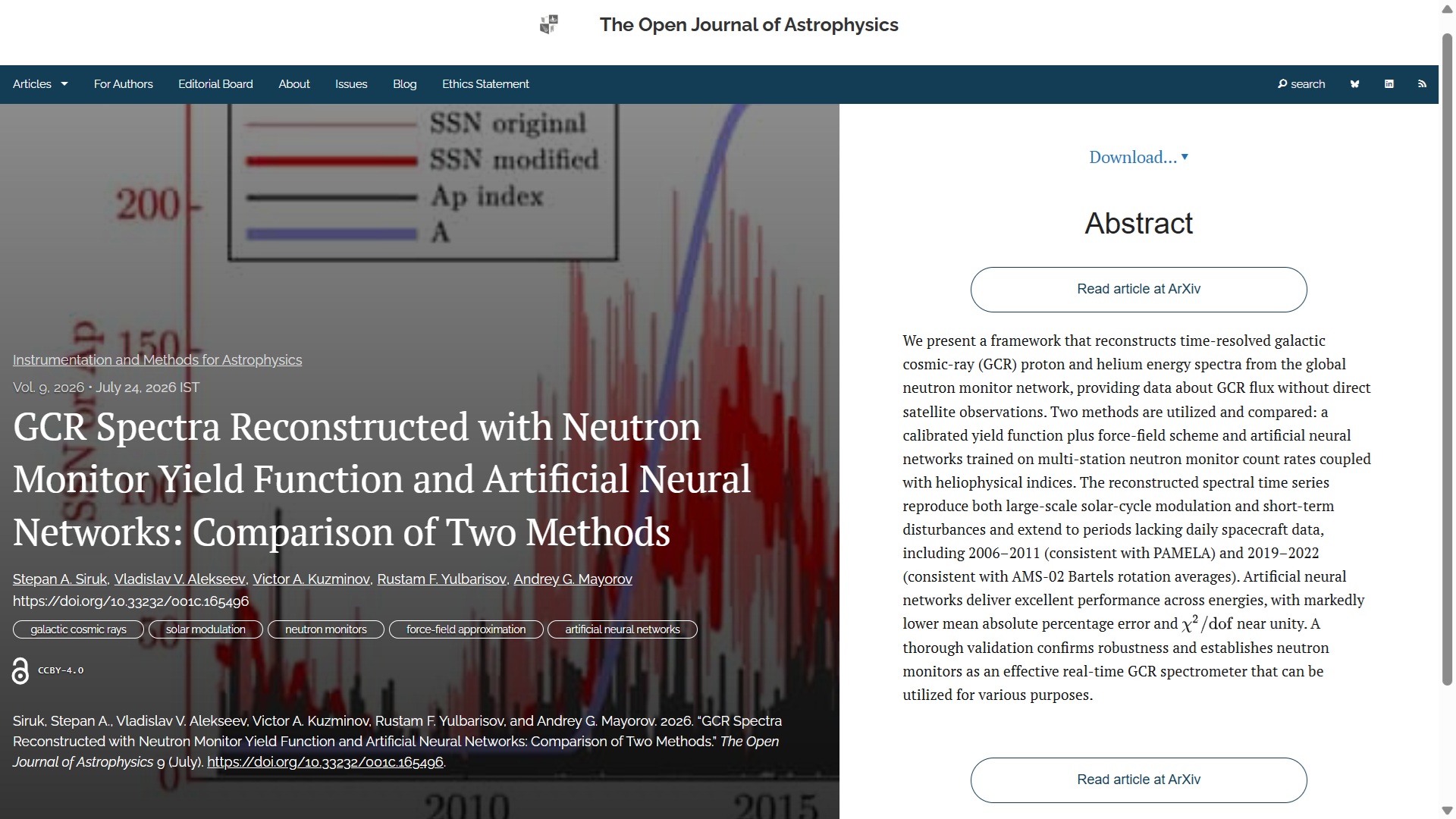
You can find the final accepted version on arXiv here and the Mastodon announcement is here:

Open Journal of Astrophysics

New Publication at the Open Journal of Astrophysics: "GCR Spectra Reconstructed with Neutron Monitor Yield Function and Artificial Neural Networks: Comparison of Two Methods" by Stepan A. Siruk (Moscow Engineering Physics Institute MEPhI, Russia) and four others based in Russia

doi.org/10.33232/001c.165496

July 24, 2026, 8:38 am 1 boosts 2 favorites

And finally for this week we have “The failed failed-supernova scenario of M31-2014-DS1” by Noam Soker (Technion, Israel), a paper which challenges the failed-supernova theory for the fading of the yellow supergiant event M31-2014-DS1, suggesting it requires unlikely parameters and supports an alternative scenario involving violent binary interaction. This was published on Friday 24th July in the folder High-Energy Astrophysical Phenomena.

The overlay for this one is here:
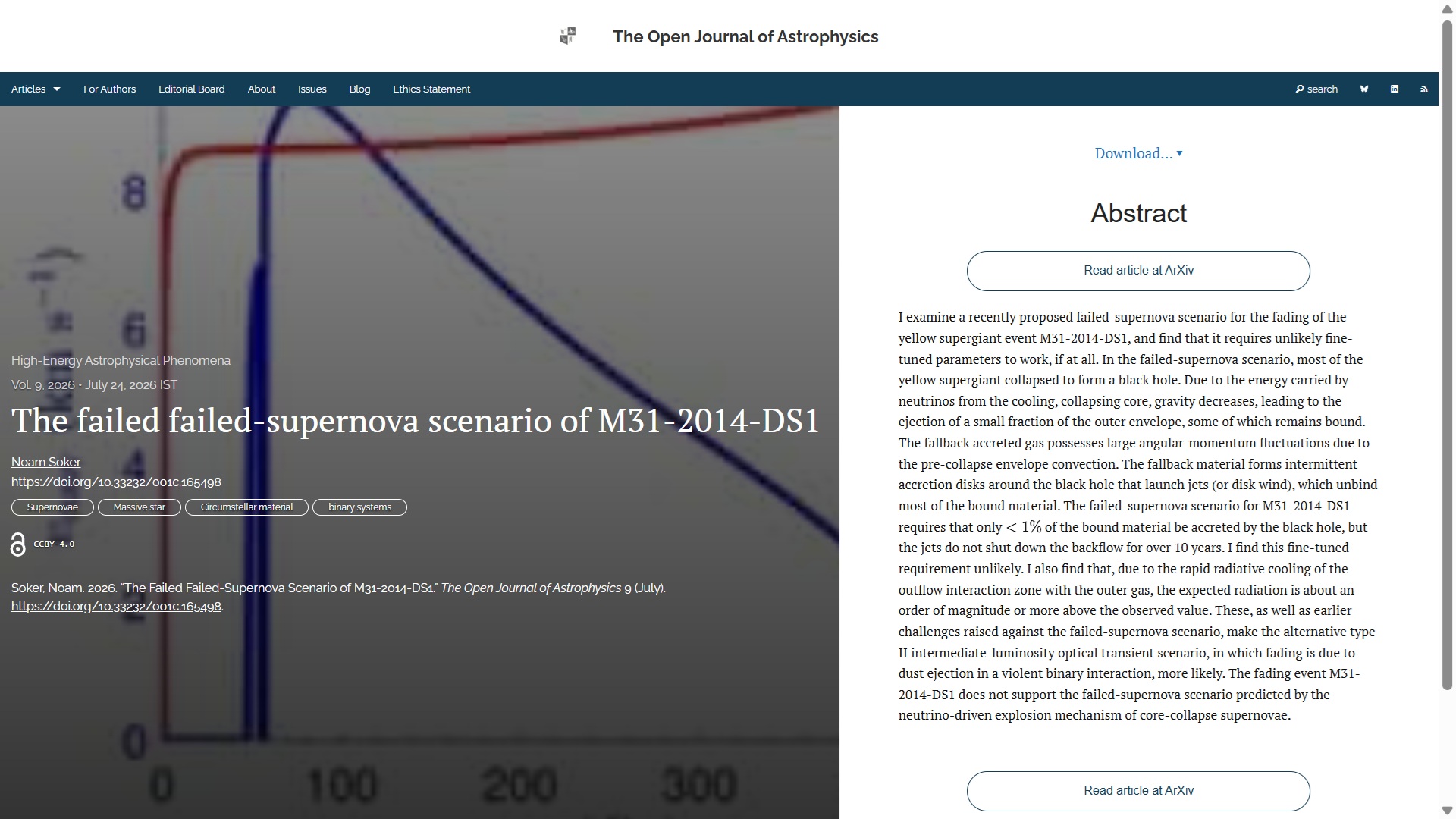
You can find the final accepted version on arXiv here and the Mastodon announcement is here:

Open Journal of Astrophysics

New Publication at the Open Journal of Astrophysics: "The failed failed-supernova scenario of M31-2014-DS1" by Noam Soker (Technion, Israel)

doi.org/10.33232/001c.165498

July 24, 2026, 8:47 am 0 boosts 2 favorites

And that concludes the update of this week’s business. As it was foretold, the total number of publications at OJAp has now passed the 600 mark, and the likely number for 2026 is around 300. We published a paper in five of the six astro-ph categories this week, but still haven’t had a week when we’ve published a full house with at least one in all six…
Weekly Update from the Open Journal of Astrophysics 04/07/2026

Posted in OJAp Papers, Open Access, The Universe and Stuff with tags , , , , , , , , , , , , , , , , , , , , , , , , , , , , , , on July 4, 2026 by telescoper

It’s Saturday again so it’s time for another update of activity at the Open Journal of Astrophysics. Since the last update we have published a further seven papers, bringing the number in Volume 9 (2026) to 136 and the total so far published by OJAp up to 584.

I will continue to include the posts made on our Mastodon account (on Fediscience); these announcements also show the DOI for each paper.

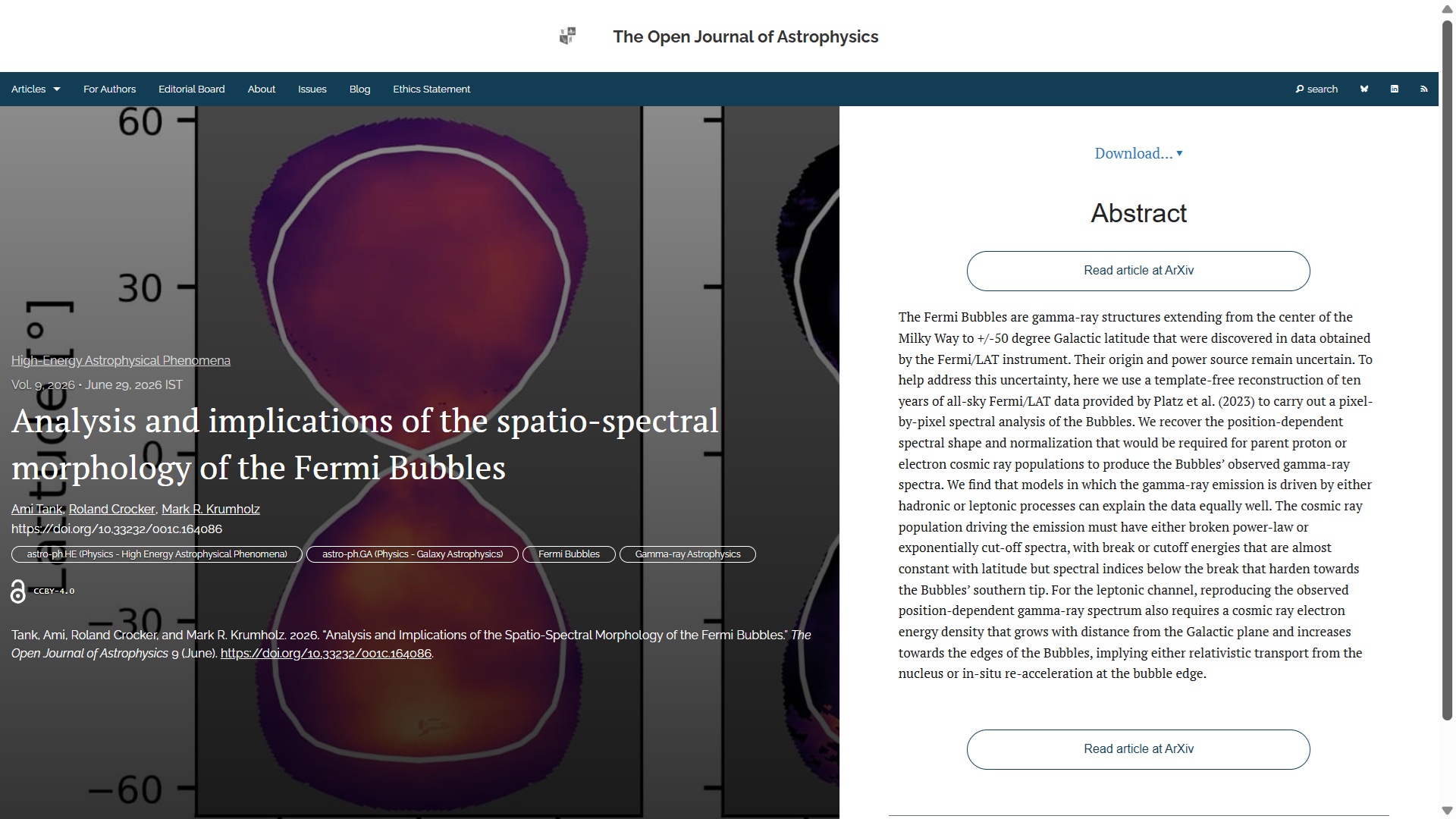
The first paper to report this week, published on Monday 29th June, is “Analysis and implications of the spatio-spectral morphology of the Fermi Bubbles” by Ami Tank (Indian Institute of Technology) and Roland Crocker & Mark R. Krumholz (Australian National University). Published in the folder High-Energy Astrophysical Phenomena, this paper presents an analysis of the gamma-ray structures of Fermi Bubbles in the Milky Way using a decade of data. The research suggests either hadronic or leptonic processes can explain the data.

The overlay for this paper is here

You can find the officially accepted version on arXiv here and the announcement on Fediverse here:

Open Journal of Astrophysics

New Publication at the Open Journal of Astrophysics: "Analysis and implications of the spatio-spectral morphology of the Fermi Bubbles" by Ami Tank (Indian Institute of Technology) and Roland Crocker & Mark R. Krumholz (Australian National University)

doi.org/10.33232/001c.164086

June 29, 2026, 5:30 am 1 boosts 2 favorites

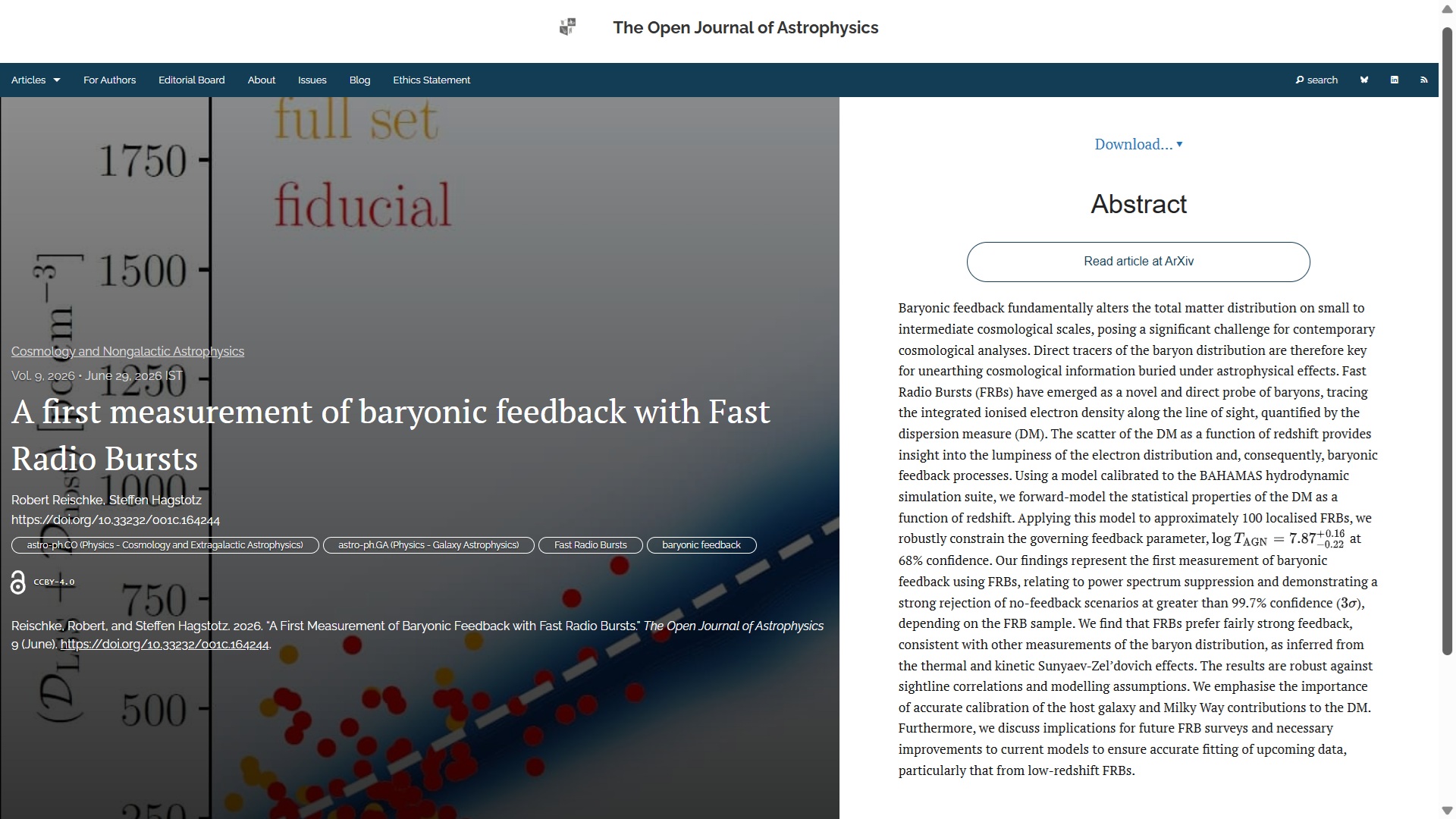
The second paper for this week, also published on Monday 29th June, but in the folder Cosmology and Nongalactic Astrophysics, is “A first measurement of baryonic feedback with Fast Radio Bursts” by Robert Reischke (Universität Bonn, Germany) and Steffen Hagstotz (Ludwig-Maximilians Universität München, Germany). This paper argues that Fast Radio Bursts (FRBs) provide a new method to trace baryon distribution and feedback in the cosmos, offering insights into matter distribution and rejecting no-feedback scenarios with high confidence.

The overlay looks like this:

The official version of the paper can be found on arXiv here and the Fediverse announcement here:

Open Journal of Astrophysics

New Publication at the Open Journal of Astrophysics: "A first measurement of baryonic feedback with Fast Radio Bursts" by Robert Reischke (Universität Bonn, Germany) and Steffen Hagstotz (Ludwig-Maximilians Universität München, Germany)

doi.org/10.33232/001c.164244

June 29, 2026, 5:50 am 2 boosts 2 favorites

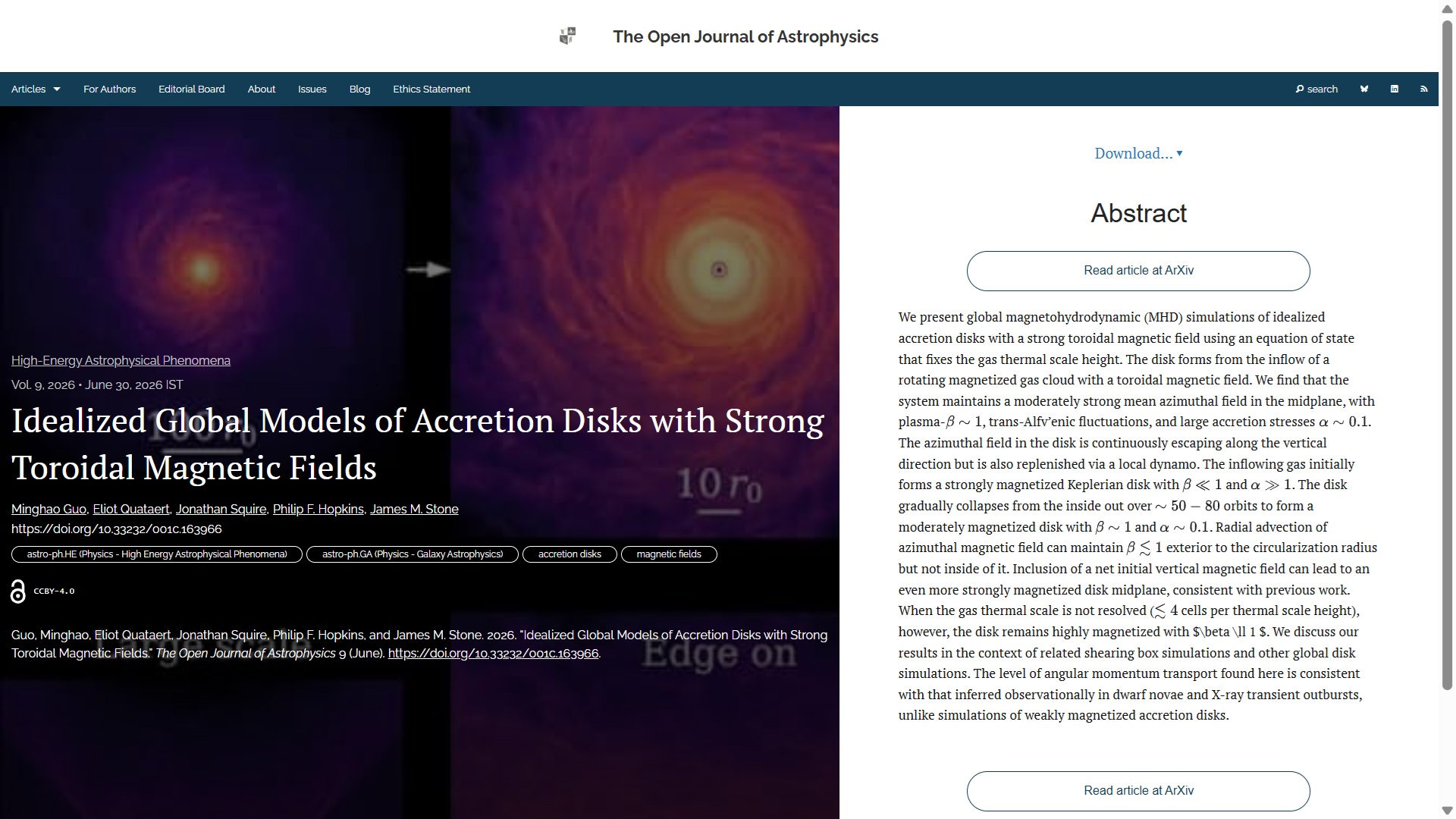
The third paper of the week, published on Tuesday 30th June in the folder High-Energy Astrophysical Phenomena, is “Idealized Global Models of Accretion Disks with Strong Toroidal Magnetic Fields” by Minghao Guo & Eliot Quataert (Princeton U., USA), Jonathan Squire (U. Otago, NZ), Philip F. Hopkins (Caltech, USA) and James M. Stone (Princeton). This study uses global magnetohydrodynamic simulations to explore the behavior of idealized accretion disks with strong toroidal magnetic fields, finding that these systems maintain a moderately strong mean azimuthal field.

The overlay for this one is here:

The final, accepted version can be found on arXiv here and the Mastodon announcement is here:

Open Journal of Astrophysics

New Publication at the Open Journal of Astrophysics: "Idealized Global Models of Accretion Disks with Strong Toroidal Magnetic Fields" by Minghao Guo & Eliot Quataert (Princeton U., USA), Jonathan Squire (U. Otago, NZ), Philip F. Hopkins (Caltech, USA) and James M. Stone (Princeton)

doi.org/10.33232/001c.163966

June 30, 2026, 6:32 am 1 boosts 3 favorites

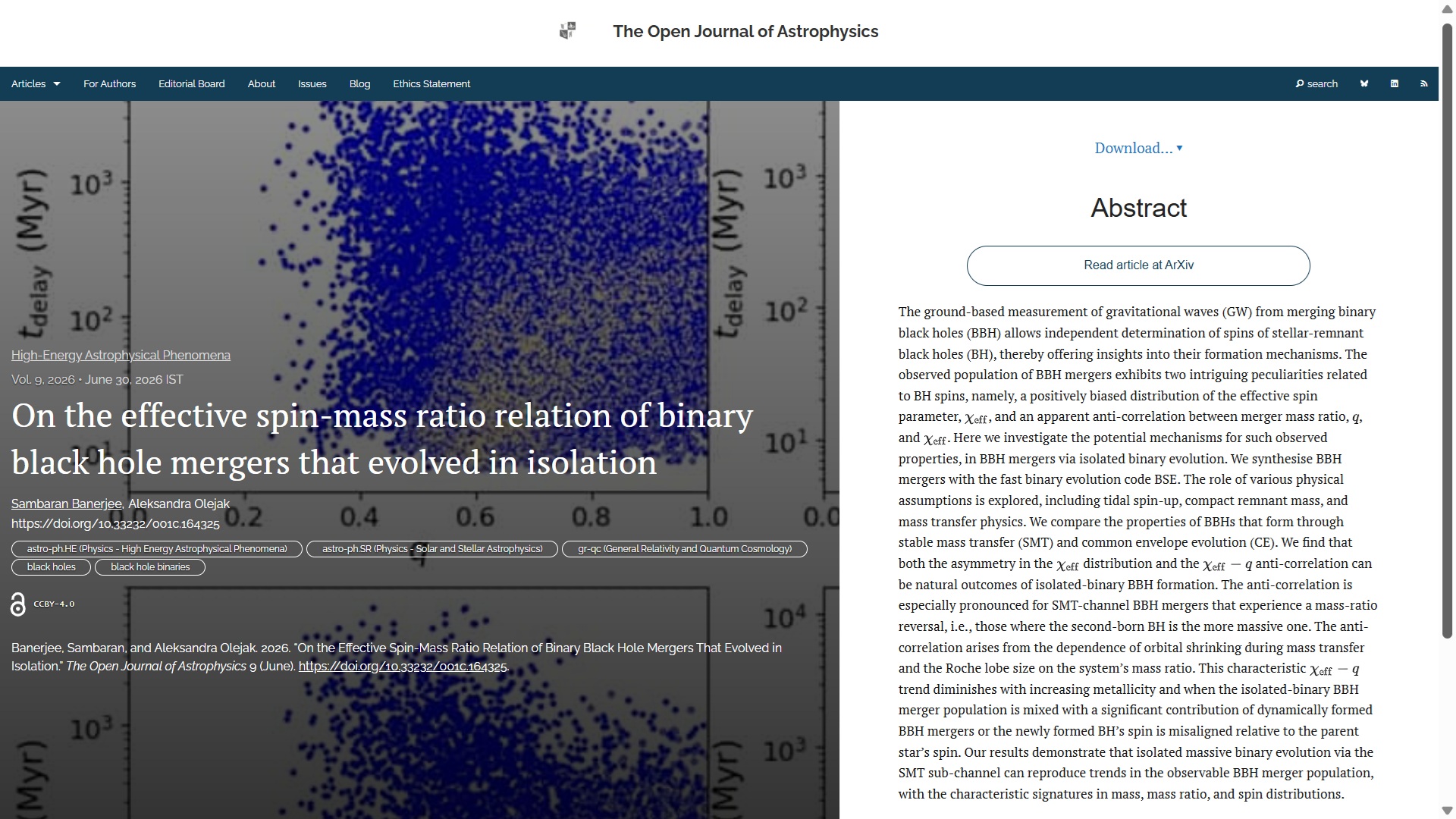
The fourth paper of the week, published on Tuesday 30th June in the folder High-Energy Astrophysical Phenomena, is “On the effective spin-mass ratio relation of binary black hole mergers that evolved in isolation” by Sambaran Banerjee (Helmholtz-Instituts für Strahlen und Kernphysik, Germany) and Aleksandra Olejak (MPA Garching, Germany). This study explores mechanisms of binary black hole mergers and finds that certain spin and mass ratio trends can be naturally explained by isolated binary evolution. The overlay for this one is here:

You can read the final version of this one on arXiv here and the Mastodon announcement is here:

Open Journal of Astrophysics

New Publication at the Open Journal of Astrophysics: "On the effective spin-mass ratio relation of binary black hole mergers that evolved in isolation" by Sambaran Banerjee (Helmholtz-Instituts für Strahlen und Kernphysik, Germany) and Aleksandra Olejak (MPA Garching, Germany)

doi.org/10.33232/001c.164325

June 30, 2026, 7:16 am 1 boosts 1 favorites

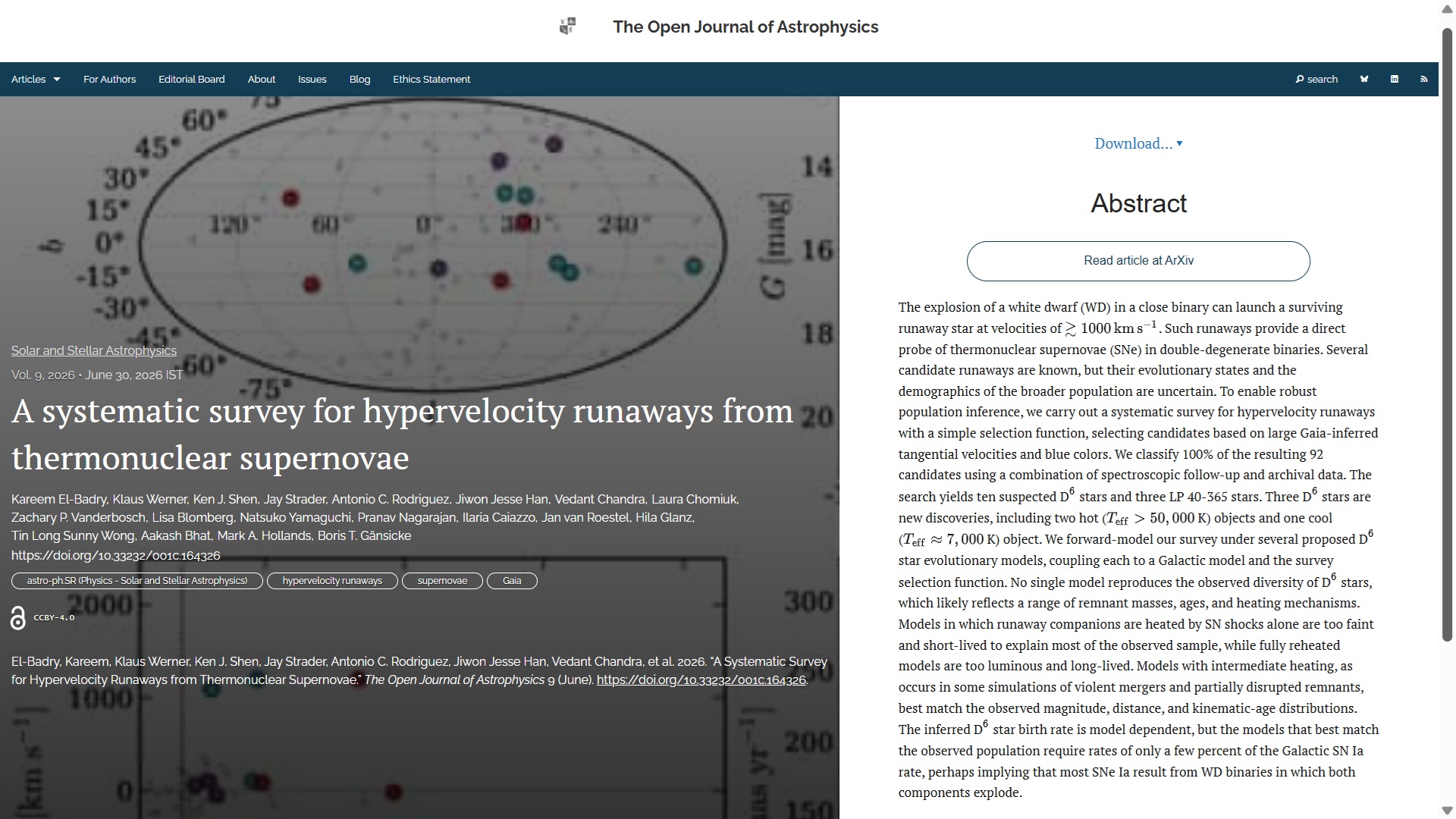
The fifth paper of the week, also published on Tuesday 30th June but in the folder Solar and Stellar Astrophysics is “A systematic survey for hypervelocity runaways from thermonuclear supernovae” by Kareem El-Badry (Caltech, USA), and 18 others based in the USA, Germany, Austria and the UK. This paper presents a systematic survey of hypervelocity runaways, resulting from white dwarf explosions in binary systems. The findings suggest a diversity of remnant masses, ages, and heating mechanisms, challenging theoretical models.

The overlay for this one is here:

You can read the final version of this one on arXiv here and the Mastodon announcement is here:

Open Journal of Astrophysics

New Publication at the Open Journal of Astrophysics: "A systematic survey for hypervelocity runaways from thermonuclear supernovae" by Kareem El-Badry (Caltech, USA), and 18 others based in the USA, Germany, Austria and the UK.

doi.org/10.33232/001c.164326

June 30, 2026, 7:33 am 2 boosts 2 favorites

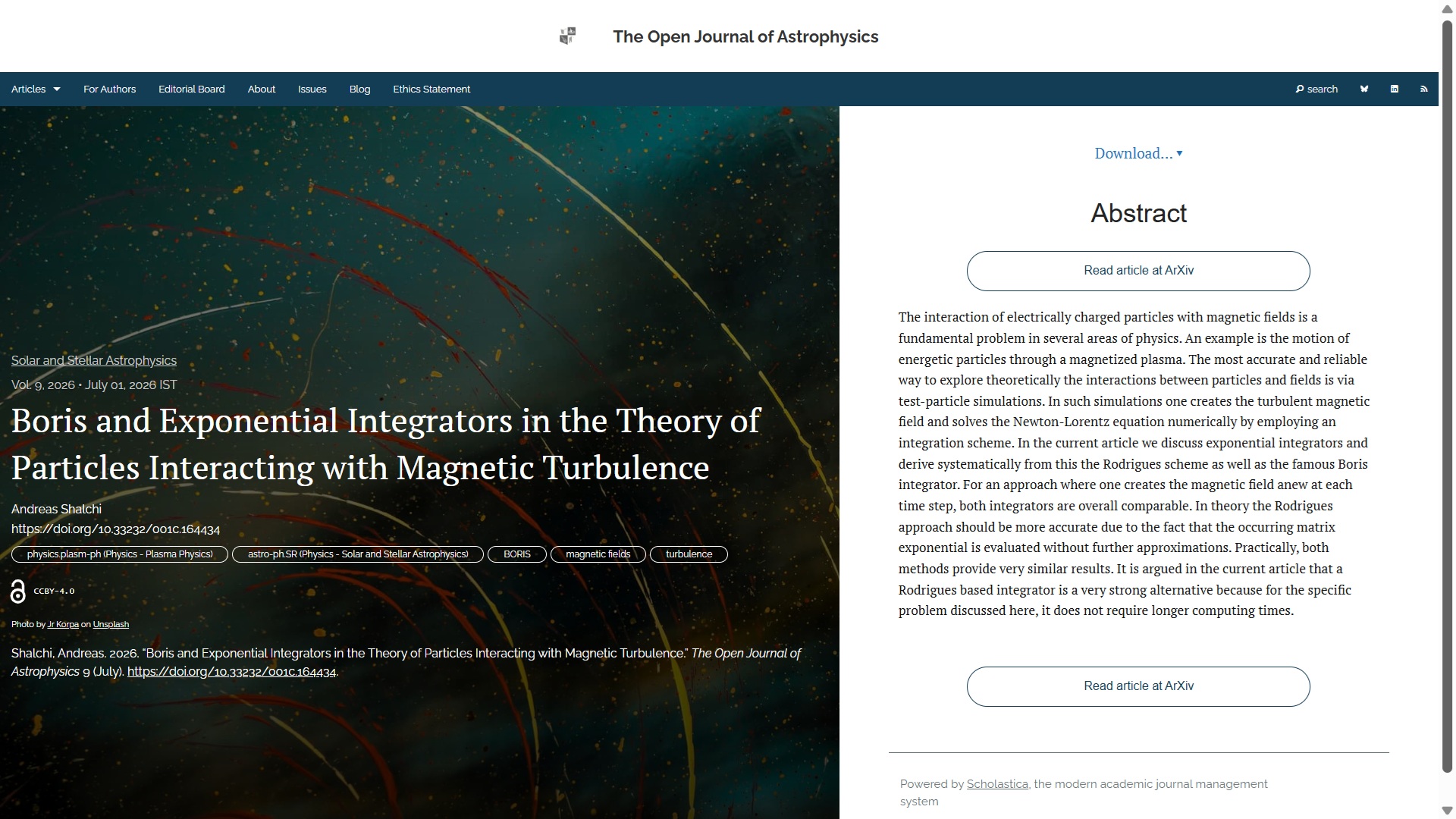
The sixth and penultimate paper of this week is “Boris and Exponential Integrators in the Theory of Particles Interacting with Magnetic Turbulence” by Andreas Shalchi (U. Manitoba, Canada). This was published on Wednesday 1st July, in the folder Solar and Stellar Astrophysics (it is posted in the plasma physics section of aXiv but cross-listed in solar and stellar astrophysics). The study compares the Rodrigues and Boris integrators in test-particle simulations of charged particles interacting with magnetic fields, finding both methods yield similar results.

The overlay for this one is here:

You can find the final accepted version on arXiv here and the Mastodon announcement is here:

Open Journal of Astrophysics

New Publication at the Open Journal of Astrophysics: "Boris and Exponential Integrators in the Theory of Particles Interacting with Magnetic Turbulence" by Andreas Shalchi (U. Manitoba, Canada)

doi.org/10.33232/001c.164434

July 1, 2026, 5:42 am 1 boosts 0 favorites

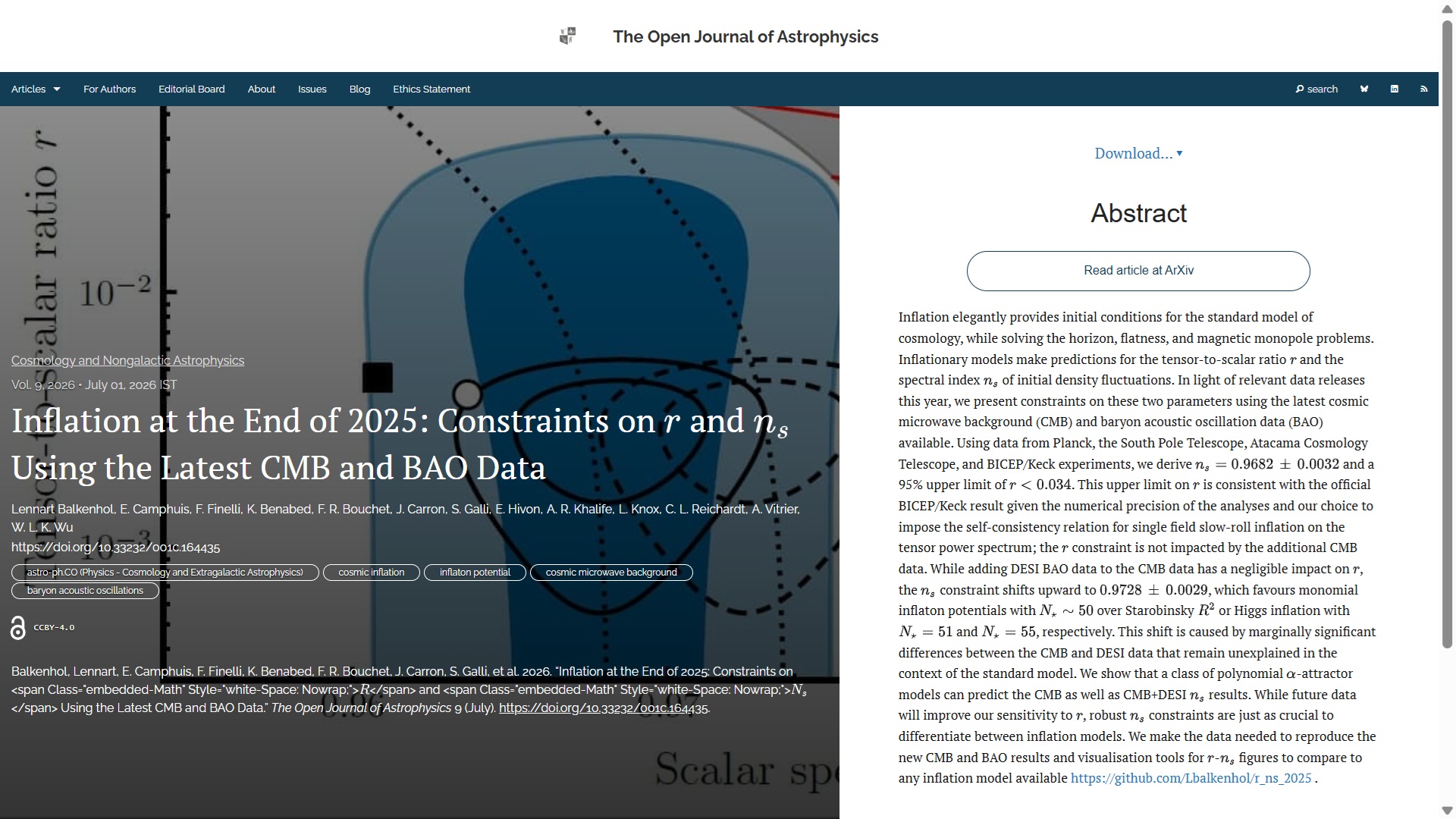
The seventh and final paper for this week is “Inflation at the End of 2025: Constraints on $r$ and $n_S$ using the Latest CMB and BAO Data” by Lennart Balkenhol (Institut d’Astrophysique de Paris, France) and 12 others based in France, Italy, Switzerland, UK, USA and Australia. This was also published on Wednesday 1st July, in the folder Cosmology and Nongalactic Astrophysics. This study presents constraints on parameters of inflationary models in cosmology, using the latest cosmic microwave background and baryon acoustic oscillation data. The findings help differentiate between inflation models.

The overlay for this one is here:

You can find the final accepted version of this one on arXiv here and the Mastodon announcement is here:

Open Journal of Astrophysics

New Publication at the Open Journal of Astrophysics: "Inflation at the End of 2025: Constraints on $r$ and $n_S$ using the Latest CMB and BAO Data" by Lennart Balkenhol (Institut d’Astrophysique de Paris, France) and 12 others based in France, Italy, Switzerland, UK, USA and Australia.

doi.org/10.33232/001c.164435

July 1, 2026, 6:37 am 2 boosts 1 favorites

And that concludes this week’s update. We’re starting to catch up on the backlog generated in June. At just past the halfway point of the year, which is where we are, we’re on 136 papers, which suggests a total around 272 for the year.

Weekly Update from the Open Journal of Astrophysics – 11/04/2026

Posted in OJAp Papers, Open Access, The Universe and Stuff with tags , , , , , , , , , , , , , , , , , , , , , , , , , , , , , on April 11, 2026 by telescoper

With permission, I have time for yet another Saturday morning update of activity at the Open Journal of Astrophysics. Since the last update we have published a further five papers, bringing the number in Volume 9 (2026) to 76 and the total so far published by OJAp up to 524.

I will continue to include the posts made on our Mastodon account (on Fediscience) to encourage you to visit it. Mastodon is a really excellent service, and a more than adequate replacement for X/Twitter (which nobody should be using); these announcements also show the DOI for each paper.

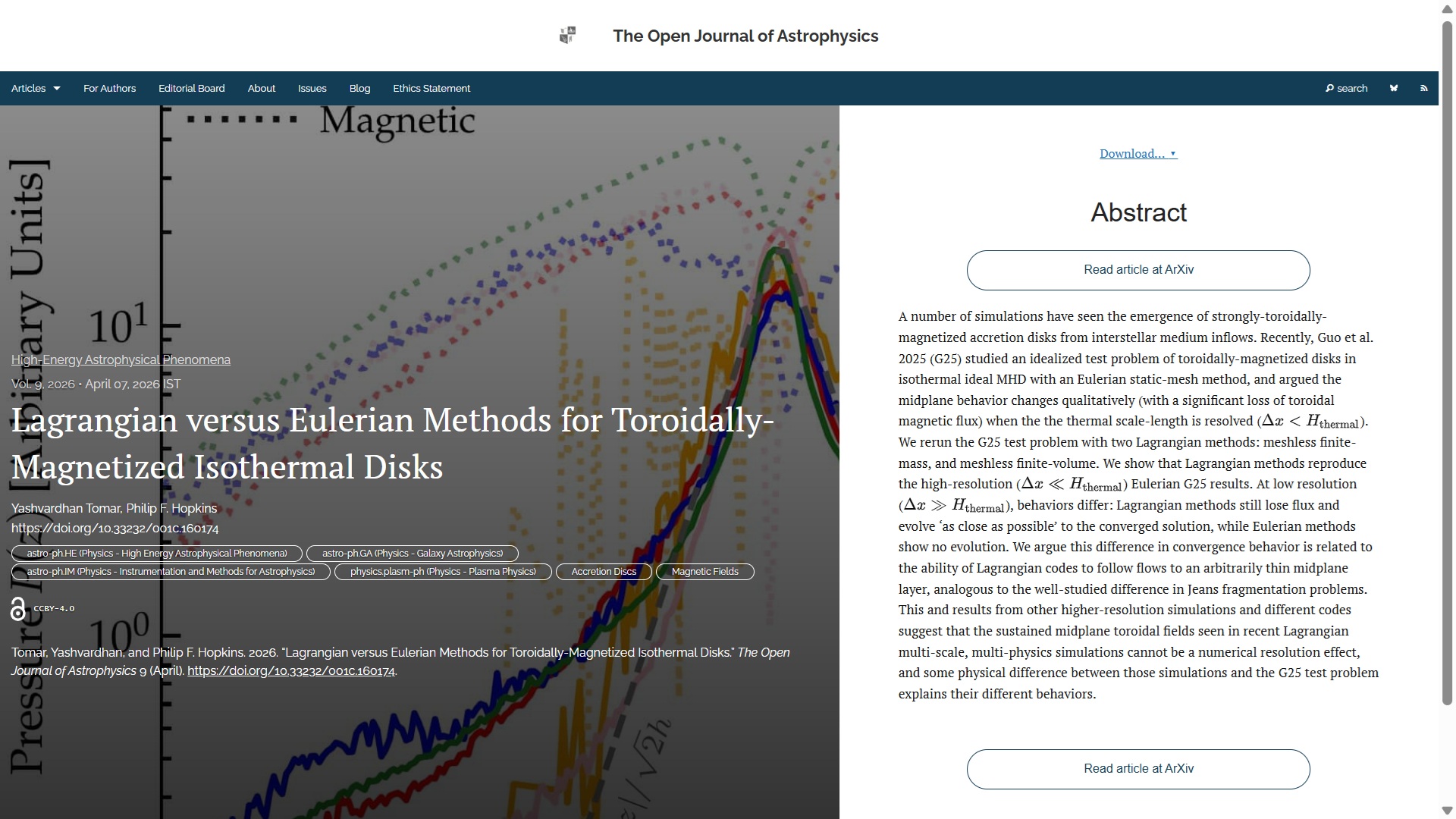
The first paper to report this week is “Lagrangian versus Eulerian Methods for Toroidally-Magnetized Isothermal Disks” by Yashvardhan Tomar and Philip F. Hopkins (California Institute of Technology, USA). This study re-evaluates previous research on toroidally-magnetized disks, using two Lagrangian methods. The results suggest that sustained midplane toroidal fields in recent simulations are not a numerical artefact. It was published on Tuesday April 7th 2026 in the folder High-Energy Astrophysical Phenomena.

The overlay is here:

You can find the officially accepted version on arXiv here and the announcement on Fediverse here:

Open Journal of Astrophysics

New Publication at the Open Journal of Astrophysics: "Lagrangian versus Eulerian Methods for Toroidally-Magnetized Isothermal Disks" by Yashvardhan Tomar and Philip F. Hopkins (Caltech, USA)

doi.org/10.33232/001c.160174

April 7, 2026, 8:07 am 1 boosts 1 favorites

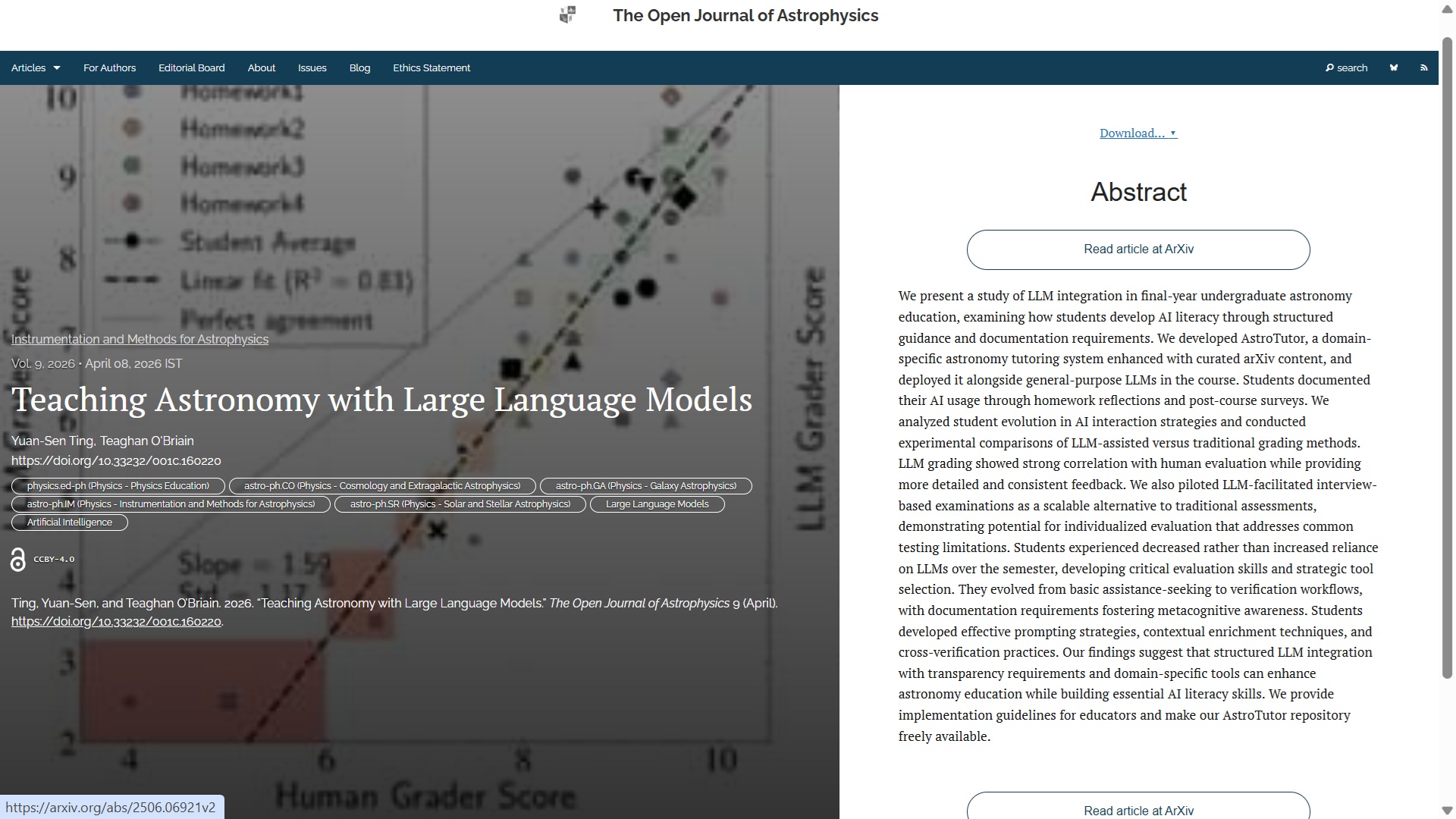
The second paper for this week, published on Wednesday 8th Apil in the folder Instrumentation and Methods for Astrophysics, is “Teaching Astronomy with Large Language Models” by Yuan-Sen Ting and Teaghan O’Briain (Ohio State University, USA). The paper introduces AstroTutor, an AI-enhanced astronomy tutoring system, to improve undergraduate astronomy education and AI literacy. It found that structured AI integration can enhance learning and critical evaluation skills. The primary classification on arXiv for this paper is physics.ed-ph but it is cross-listed on astro-ph which qualifies it for consideration.

The overlay for this one is here:

The official version of the paper can be found on arXiv here and the Fediverse announcement here:

Open Journal of Astrophysics

New Publication at the Open Journal of Astrophysics: "Teaching Astronomy with Large Language Models" by Yuan-Sen Ting and Teaghan O'Briain (Ohio State University, USA)

doi.org/10.33232/001c.160220

April 8, 2026, 8:42 am 0 boosts 2 favorites

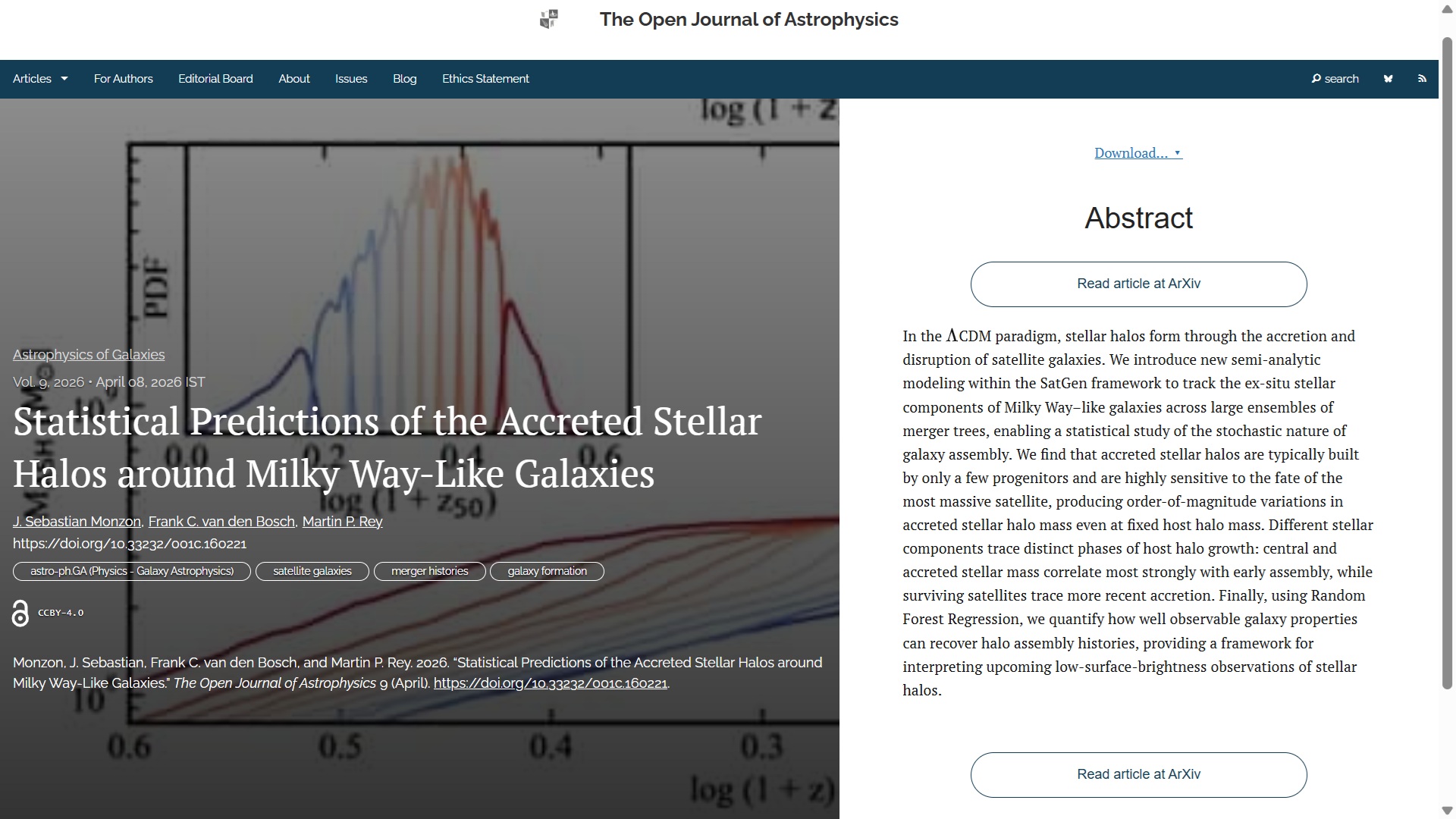
Next one up, the third paper of the week, also published on Wednesday 8th April, is “Statistical Predictions of the Accreted Stellar Halos around Milky Way-Like Galaxies” by J. Sebastian Monzon & Frank C. van den Bosch (Yale University, USA) and Martin P. Rey (University of Bath, UK). This one was published in the section Astrophysics of Galaxies; it describes new model to track formation of stellar halos in Milky Way-like galaxies, revealing their sensitivity to the fate of the largest satellite and whether accretion is early or late.

The overlay for this one is here:

The final, accepted version can be found on arXiv here and the Mastodon announcement is here:

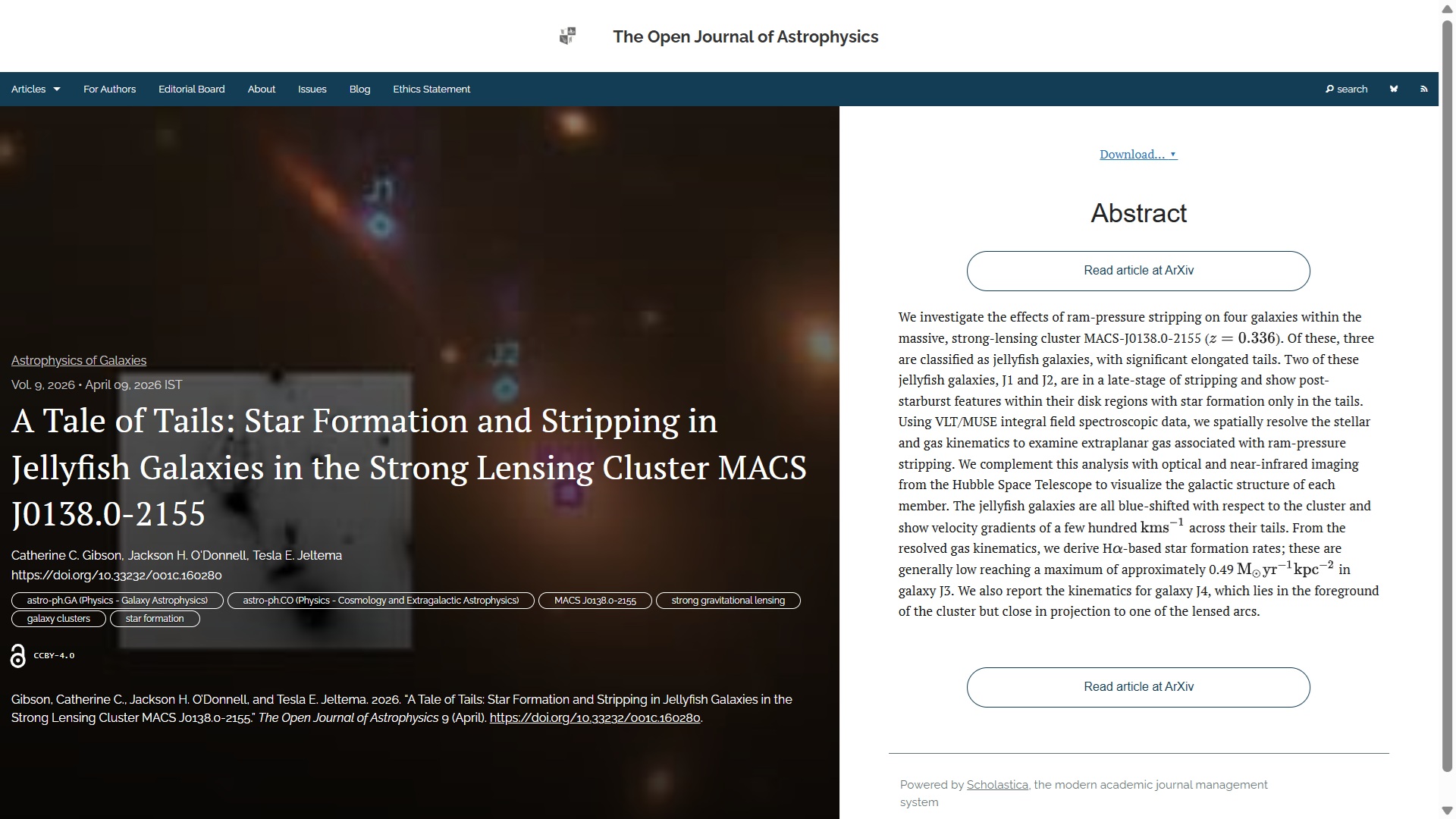
The fourth paper this week, published on Thursday 9th April is “A Tale of Tails: Star Formation and Stripping in Jellyfish Galaxies in the Strong Lensing Cluster MACS J0138.0-2155” by Catherine C. Gibson, Jackson H. O’Donnell and Tesla E. Jeltema (UC Santa Cruz, USA). This investigates the effects of ram-pressure stripping on four galaxies, focusing on their stellar and gas kinematics, star formation rates, and galactic structure and is published in the folder marked Astrophysics of Galaxies.

The overlay is here:

The finally accepted version of this paper can be found here and the Mastodon announcement is here:

Open Journal of Astrophysics

New Publication at the Open Journal of Astrophysics: "A Tale of Tails: Star Formation and Stripping in Jellyfish Galaxies in the Strong Lensing Cluster MACS J0138.0-2155" by Catherine C. Gibson, Jackson H. O'Donnell and Tesla E. Jeltema (UC Santa Cruz, USA)

doi.org/10.33232/001c.160280

April 9, 2026, 9:45 am 1 boosts 0 favorites

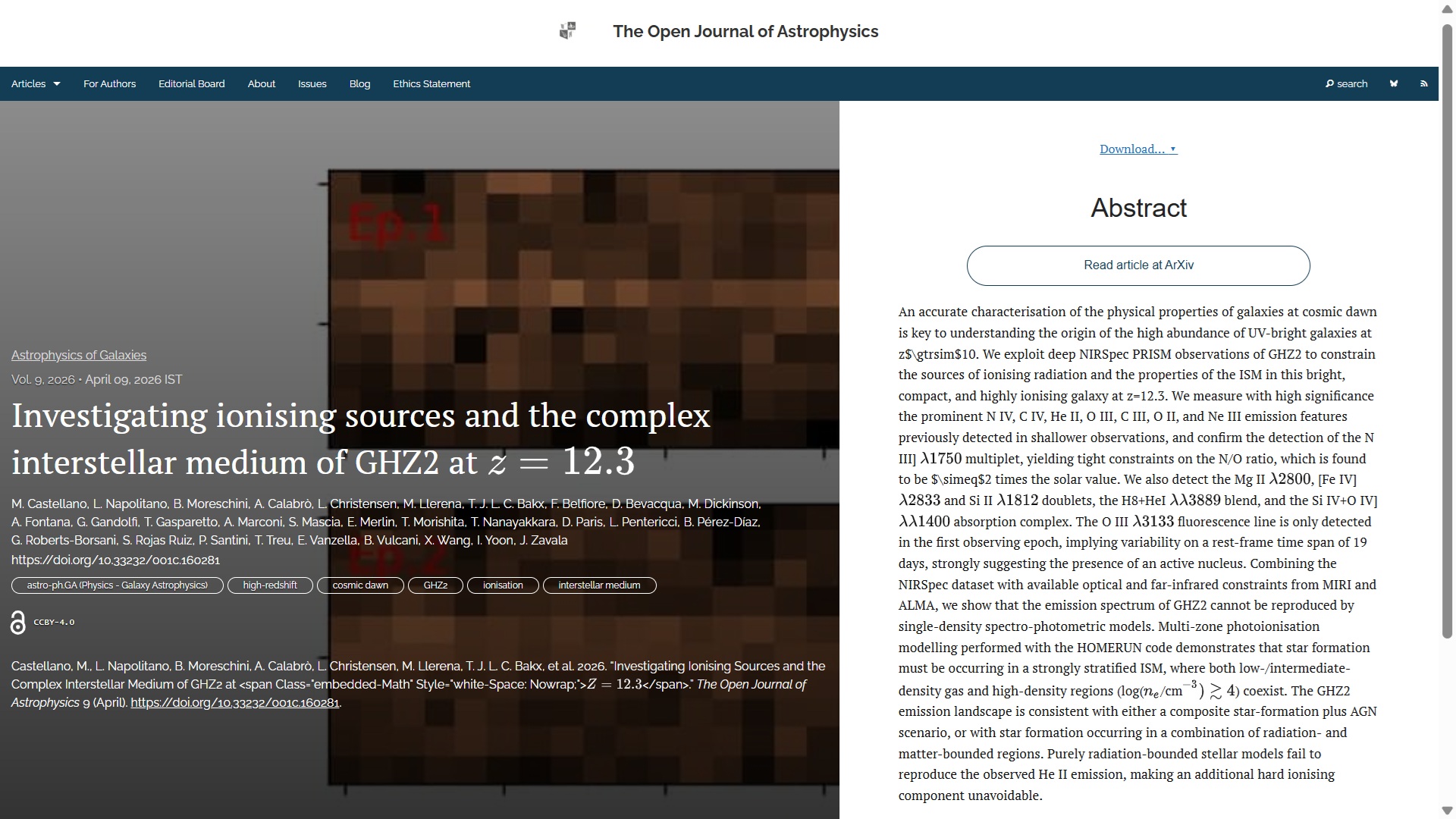
The fifth and final paper for this week is “Investigating ionising sources and the complex interstellar medium of GHZ2 at z=12.3” by M. Castellano (INAF Osservatorio Astronomico di Roma, Italy) and 29 others based all around the world. This was also published on Thursday 9th April in the folder Astrophysics of Galaxies. The paper uses deep observations of galaxy GHZ2 to explore the sources of ionising radiation and interstellar medium properties at cosmic dawn. Findings suggest a stratified environment and a hard ionising radiation component.

The overlay for this one is here:

The officially-accepted version of this one can be found on arXiv here and the Mastodon announcement is here

Open Journal of Astrophysics

New Publication at the Open Journal of Astrophysics: "Investigating ionising sources and the complex interstellar medium of GHZ2 at z=12.3" by M. Castellano (INAF Osservatorio Astronomico di Roma, Italy) and 29 others based around the world.

doi.org/10.33232/001c.160281

April 9, 2026, 10:21 am 2 boosts 0 favorites

That concludes this week’s update. I’ll do another one at the end of next week, when the Easter vacations will be over.

P.S. For those of you into LinkedIn, we now have a page there.

Weekly Update from the Open Journal of Astrophysics – 01/11/2025

Posted in OJAp Papers, Open Access, The Universe and Stuff with tags , , , , , , , , , , , on November 1, 2025 by telescoper

It’s time once again for the usual Saturday update of the week’s new papers at the Open Journal of Astrophysics (although a bit later in the day than usual). Since the last update we have published another two papers, which brings the number in Volume 8 (2025) up to 163, and the total so far published by OJAp up to 398.

The first paper this week is “Instability and vertical eccentricity variation in global hydrodynamic disk simulations” by Janosz W Dewberry (U. Mass. Amherst, USA), Henrik N. Latter and Gordon I. Ogilvie (U. Cambridge, UK) and Sebastien Fromang (U. Paris Saclay, France). This article was published in the folder Solar and Stellar Astrophysics on Tuesday 28th October 2025; it discusses the instabilities and eccentricity variations generated in numerical hydrodynamic simulations of accretion disks.

The overlay is here:

You can find the officially accepted version on arXiv here.

The Fediverse announcement is here:

Open Journal of Astrophysics

New Publication at the Open Journal of Astrophysics: "Instability and vertical eccentricity variation in global hydrodynamic disk simulations" by Janosz W Dewberry (U. Mass. Amherst, USA), Henrik N Latter and Gordon I Ogilvie (U. Cambridge, UK) & Sebastien Fromang (U. Paris Saclay, France)

doi.org/10.33232/001c.146332

October 28, 2025, 9:43 am 2 boosts 0 favorites

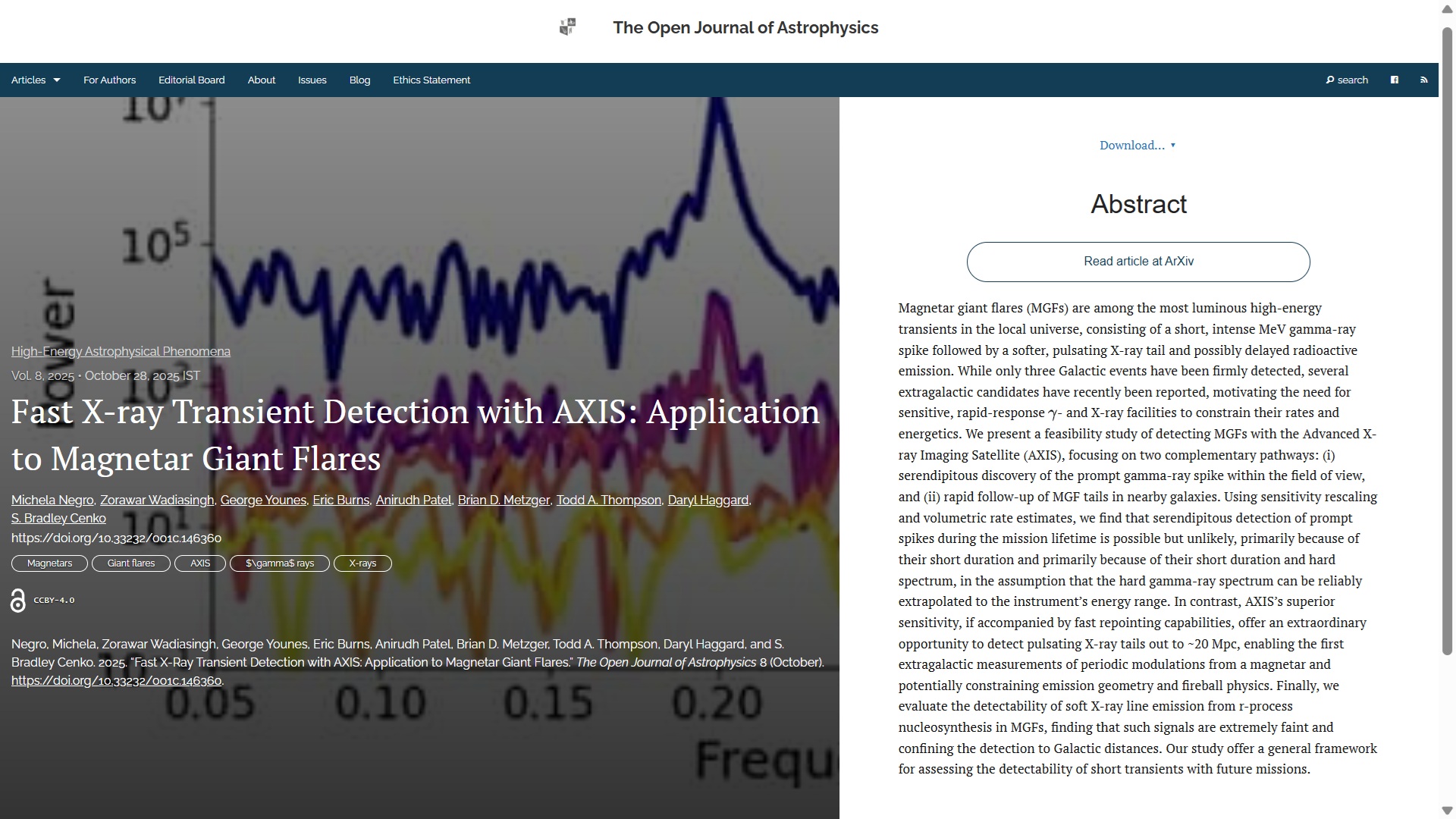
The second (and last) paper of the week is “Fast X-ray Transient Detection with AXIS: application to Magnetar Giant Flares” by Michela Negro (Louisiana State University, USA) and 8 others based in the USA and Canada. This one was also published on Tuesday 28th October, but in the folder High-Energy Astrophysical Phenomena. It presents a feasibility study of detecting Magnetar Giant Flares with the Advanced X-ray Imaging Satellite (AXIS). The overlay is here:

You can find the official version of this one on arXiv here. The announcement on Mastodon is here:

Open Journal of Astrophysics

New Publication at the Open Journal of Astrophysics: "Fast X-ray Transient Detection with AXIS: application to Magnetar Giant Flares" by Michela Negro (Louisiana State University, USA) and 8 others based in the USA and Canada

doi.org/10.33232/001c.146360

October 28, 2025, 10:02 am 1 boosts 1 favorites

It being a relatively slow week we didn’t reach the 400 mark as I thought we might, but we will probably get there next week. After 10 months of the year 2025, in which we have published 163 papers, a rough projection for the 2025 total is 195. We do have some extra papers up our sleeve, however, so we might well reach 200 for the year. We will find out soon enough!

Two New Publications at the Open Journal of Astrophysics

Posted in OJAp Papers, Open Access, The Universe and Stuff with tags , , , , , , , , , , , , on August 31, 2024 by telescoper

I am back in circulation after my little break and, since it’s Saturday, I will resume blogging with another report on activity at the  Open Journal of Astrophysics.  Since the last update we have published two more papers, taking  the count in Volume 7 (2024) up to 71 and the total published by OJAp up to 186.  We’ve still got a few in the pipeline waiting for the final versions to appear on arXiv so I expect we’ll reach the 200 mark fairly soon.

The first paper of the most recent pair, published on August 26th 2024,  is “Impact of lensing of gravitational waves on the observed distribution of neutron star masses”  by Sofia Canevarolo, Loek van Vonderen and Nora Elisa Chisari, all of Utrecht University in the Netherlands. This article presents a discussion of the bias in neutron star mass determinations caused by gravitational lensing of the gravitational waves they produceThe paper is in the folder marked Cosmology and NonGalactic Astrophysics.

Here is a screen grab of the overlay which includes the abstract:


You can click on the image of the overlay to make it larger should you wish to do so. You can find the officially accepted version of the paper on the arXiv here.

The second paper has the title “FORGE’d in FIRE III: The IMF in Quasar Accretion Disks from STARFORGE” and was published (in the early hours of the morning) on 29th August 2024. The authors, all based in the USA, are Philip F. Hopkins (Caltech), Michael Y. Grudic (Carnegie Observatories), Kyle Kremer (Caltech), Stella S. R. Offner (UT Austin), David Guszejnov (UT Austin) and Anna L. Rosen (UCSD). This paper, which is in the folder marked Astrophysics of Galaxies, presents a numerical study of star formation and the initial mass function in quasar accretion disks. The previous two papers in this series have also been published in the OJAp: you can find them here and here; images and movies related to this project can be found here.

Here is a screen grab of the overlay which includes the abstract:


You can click on the image of the overlay to make it larger should you wish to do so. You can find the officially accepted version of the paper on the arXiv here.

That concludes this week’s update. We still have quite a few papers in the pipeline after the summer lull so I expect I’ll have a larger update for you next week!

Three New Publications at the Open Journal of Astrophysics

Posted in OJAp Papers, The Universe and Stuff with tags , , , , , , , , , , , , , , , , on March 19, 2024 by telescoper

Now that I’m safely back in Barcelona it’s a time for a roundup of the latest business at the  Open Journal of Astrophysics. The latest batch of publications consists of three papers, taking the count in Volume 7 (2024) up to 20 and the total published by OJAp up to 135.

This time the papers are all related, have many authors in common, and have the same first author, Philip F. Hopkins of Caltech. In fact the second and third papers in this batch were accepted well before the first one, but it seemed to make much more sense to publish them together so I held those two back a bit and published all three on 14th March.

The three papers published, with their overlays, are as follows. You can click on the images of the overlays to make them larger should you wish to do so. You can read these publications directly on arXiv if you wish; you will find them here, here and here.

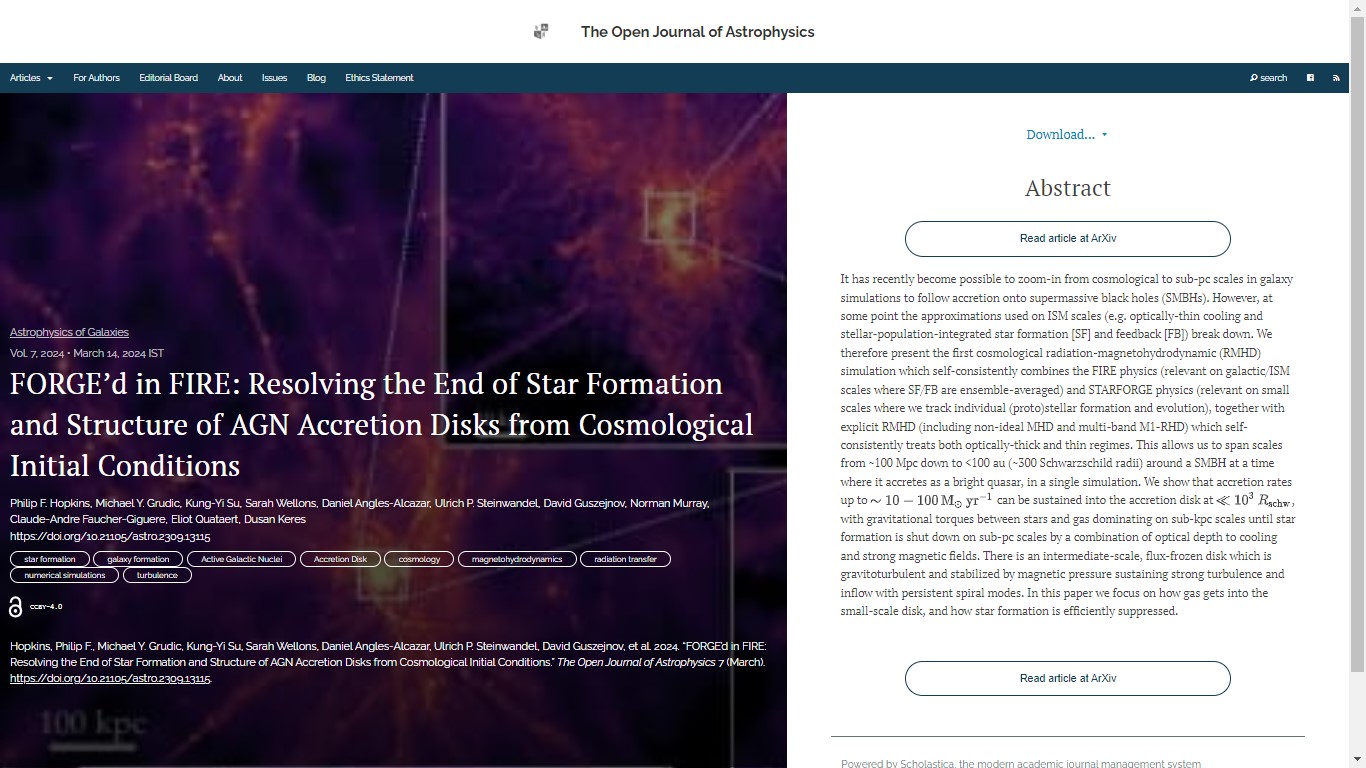
First one up is “FORGE’d in FIRE: Resolving the End of Star Formation and Structure of AGN Accretion Disks from Cosmological Initial Conditions” in which, using a full cosmological simulation, incorporating radiation and magnetohydrodynamics, the authors study the formation and structure of AGN accretion disks and their impact on star formation. This one is in the folder marked Astrophysics of Galaxies.

The authors (ten from the USA and one from Canada) are Philip F. Hopkins (Caltech), Michael Y. Grudic (Carnegie Observatories), Kung-Yi Su (Harvard), Sarah Wellons (Wesleyan University), Daniel Angles-Alcazar (University of Connecticut & Flatiron Institute), Ulrich P. Steinwandel (Flatiron Institute), David Guszejnov (University of Texas at Austin), Norman Murray (CITA, Toronto, Canada), Claude-Andre Faucher-Giguere (Northwestern University), Eliot Quataert (Princeton), and Dusan Keres (University of California, San Diego or UCSD for short).

Here is a screen grab of the overlay, which includes the abstract:


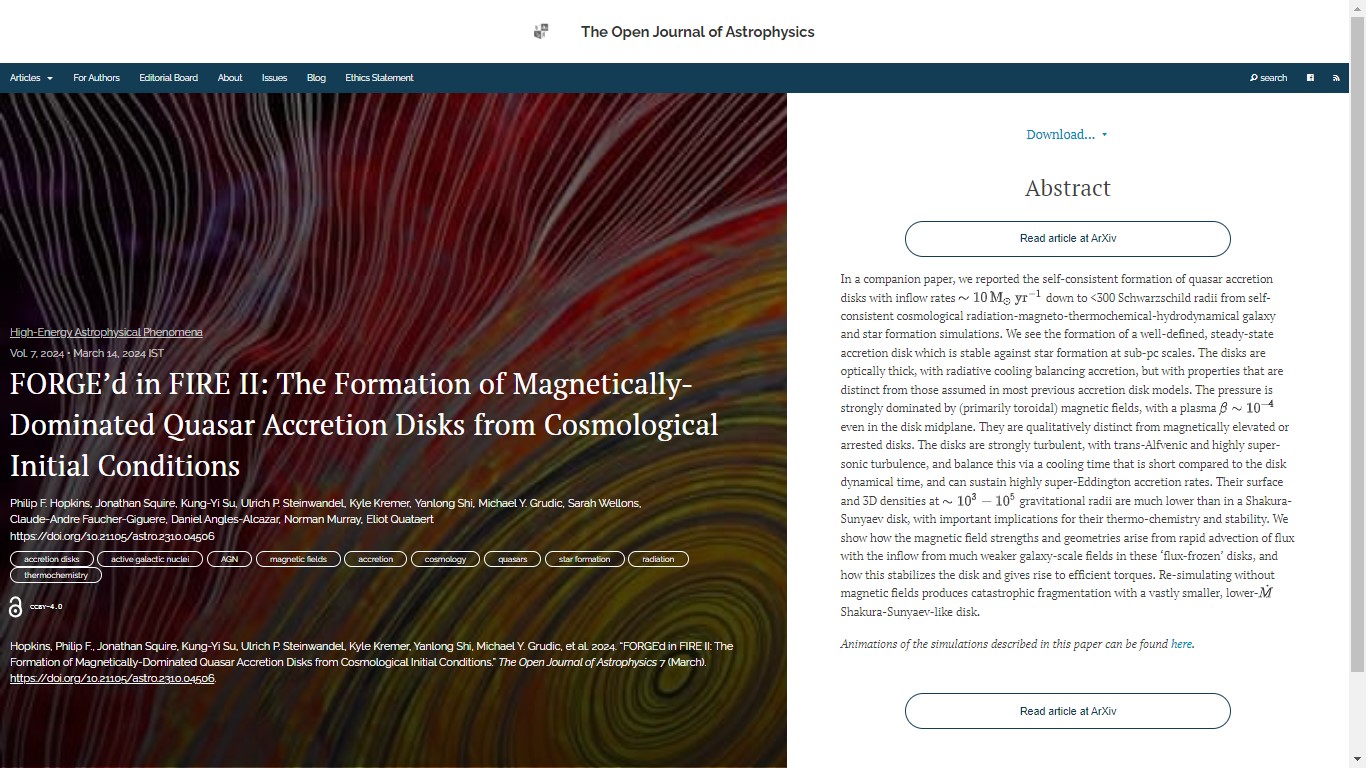
The second paper to announce is “FORGE’d in FIRE II: The Formation of Magnetically-Dominated Quasar Accretion Disks from Cosmological Initial Conditions” which is a study of the formation and properties of highly magnetized accretion disks using numerical simulations that include the effects of radiation, magnetic fields, thermochemistry, and star formation.

This one is in the folder High-Energy Astrophysical Phenomena. The authors (ten based in the USA, one fin Canada, and one in New Zealand) are Philip F. Hopkins, Jonathan Squire (University of Dunedin, New Zealand), Kung-Yi Su (Harvard), Ulrich P. Steinwandel (Flatiron Institute), Kyle Kremer (Caltech), Yanlong Shi (Caltech), Michael Y. Grudic (Carnegie Observatories), Sarah Wellons (Wesleyan University), Claude-Andre Faucher-Giguere (Northwestern University), Daniel Angles-Alcazar (University of Connecticut & Flatiron Institute), Norman Murray (CITA, Toronto), and Eliot Quataert (Princeton).


The last paper of this batch, also in the folder High-Energy Astrophysical Phenomena, is  entitled “An Analytic Model For Magnetically-Dominated Accretion Disks” and is closely related to the previous one; this particular paper presents an analytic similarity model for accretion disks that agrees remarkably well with the simulations in the previous one. Animations of the simulations referred to in both papers can be found here.

Here is the overlay:

The authors of this one are Philip F. Hopkins, Jonathan Squire, Eliot Quataert, Norman Murray, Kung-Yi Su, Ulrich P. Steinwandel, Kyle Kremer, Claude-Andre Faucher-Giguere, and Sarah Wellons. You can find all their affiliations above.
That’s all for now. More news in a week or so!