Archive for South Pole Telescope

Weekly Update from the Open Journal of Astrophysics 25/07/2026

Posted in OJAp Papers, Open Access, The Universe and Stuff with tags , , , , , , , , , , , , , , , , , , , , , , , , , , , , , , , , , , , , on July 25, 2026 by telescoper

It’s time once more for another Saturday update of activity at the Open Journal of Astrophysics. Since the last update we have published a further nine papers, bringing the number in Volume 9 (2026) to 160 and the total so far published by OJAp up to 608.

I will continue to include the posts made on our Mastodon account (on Fediscience); these announcements also show the DOI for each paper.

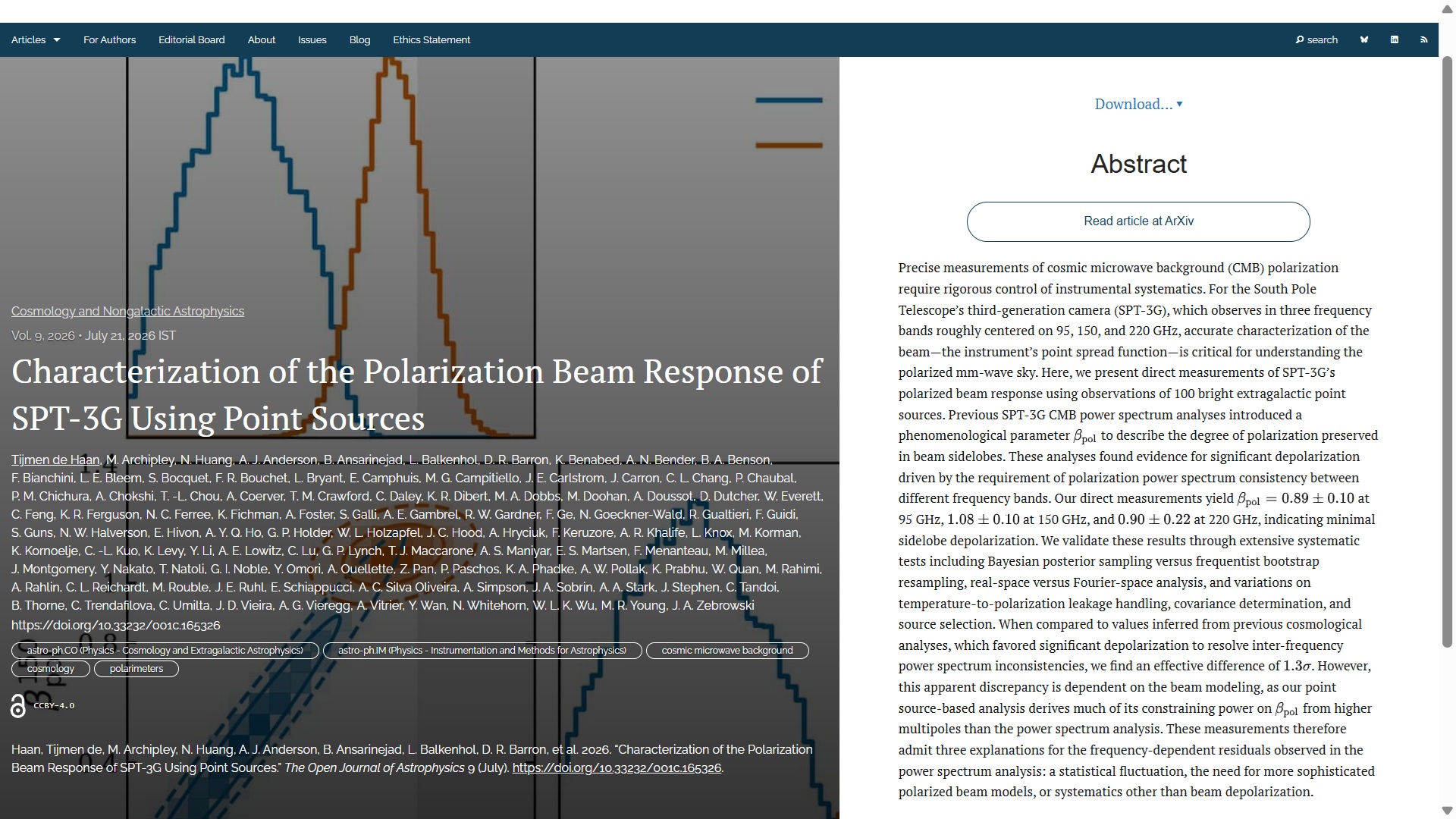
The first paper to report this week was published on Tuesday 21st July in the folder Cosmology and Nongalactic Astrophysics. The title is “Characterization of the Polarization Beam Response of SPT-3G Using Point Sources” by Tijmen de Haan (Institute of Particle and Nuclear Studies, Ibaraki, Japan) and an international cast of 101 others. This study presents measurements of the South Pole Telescope’s polarized beam response, indicating minimal sidelobe depolarization. The findings suggest potential explanations for frequency-dependent residuals in power spectrum analysis.

The overlay for this paper is here
You can find the officially accepted version on arXiv here and the announcement on Fediverse here:

Open Journal of Astrophysics

New Publication at the Open Journal of Astrophysics: "Characterization of the Polarization Beam Response of SPT-3G Using Point Sources" by Tijmen de Haan (Institute of Particle and Nuclear Studies, Ibaraki, Japan) and 101 others from around the world

doi.org/10.33232/001c.165326

July 21, 2026, 7:02 am 1 boosts 1 favorites

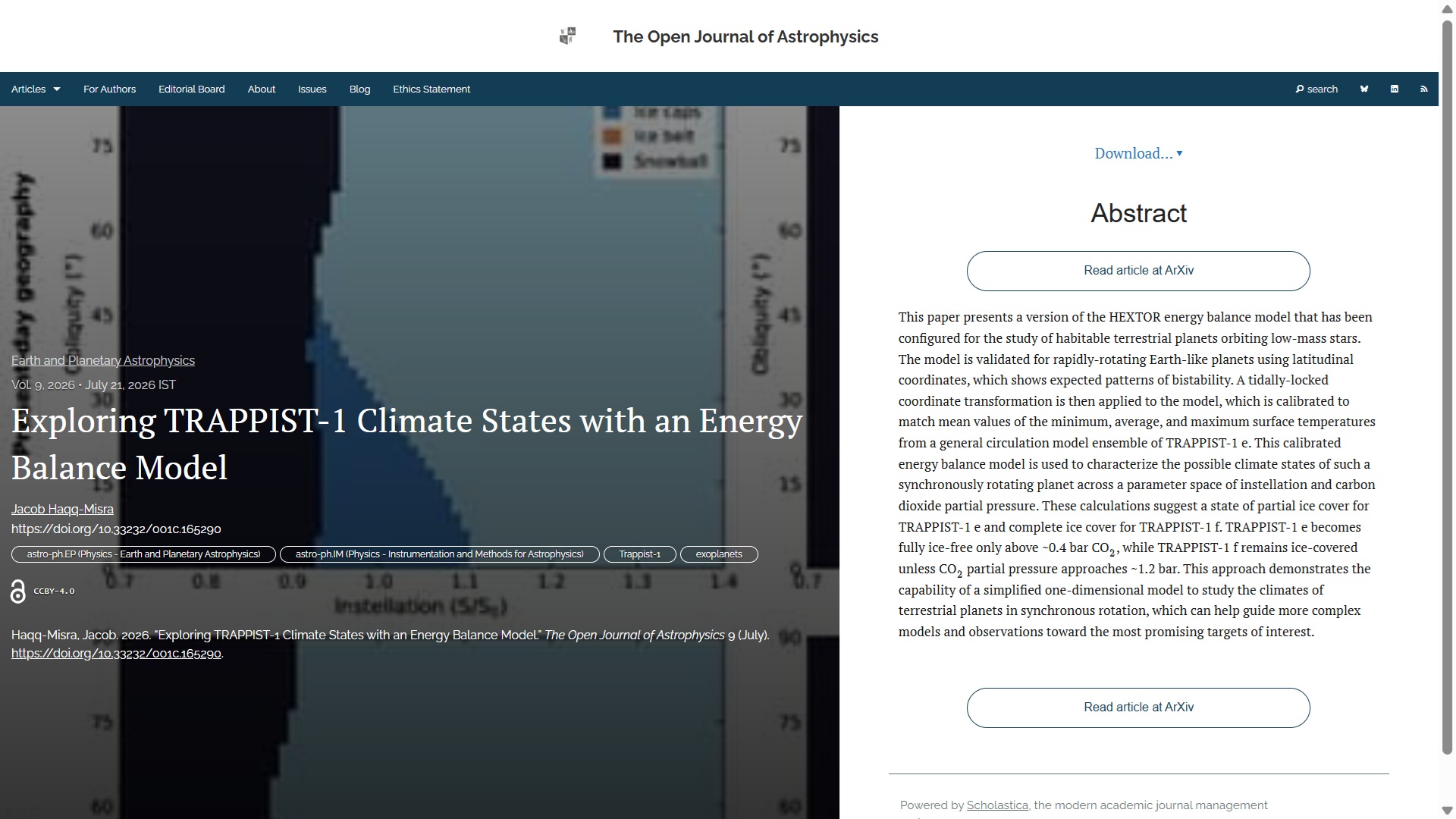
The second paper for this week, also published on Tuesday 21st July but in the folder Earth and Planetary Astrophysics is: “Exploring TRAPPIST-1 Climate States with an Energy Balance Model” by Jacob Haqq-Misra (Blue Marble Space, USA). The study uses a modified HEXTOR energy balance model to predict climate states of terrestrial planets orbiting low-mass stars, suggesting partial to complete ice cover for TRAPPIST-1 e and f.Abstractfor Exploring TRAPPIST-1 Climate States with an Energy Balance Model.

The overlay looks like this:
The official version of the paper can be found on arXiv here and the Fediverse announcement here:

Open Journal of Astrophysics

New Publication at the Open Journal of Astrophysics: "Exploring TRAPPIST-1 Climate States with an Energy Balance Model" by Jacob Haqq-Misra (Blue Marble Space, USA)

doi.org/10.33232/001c.165290

July 21, 2026, 7:38 am 2 boosts 1 favorites

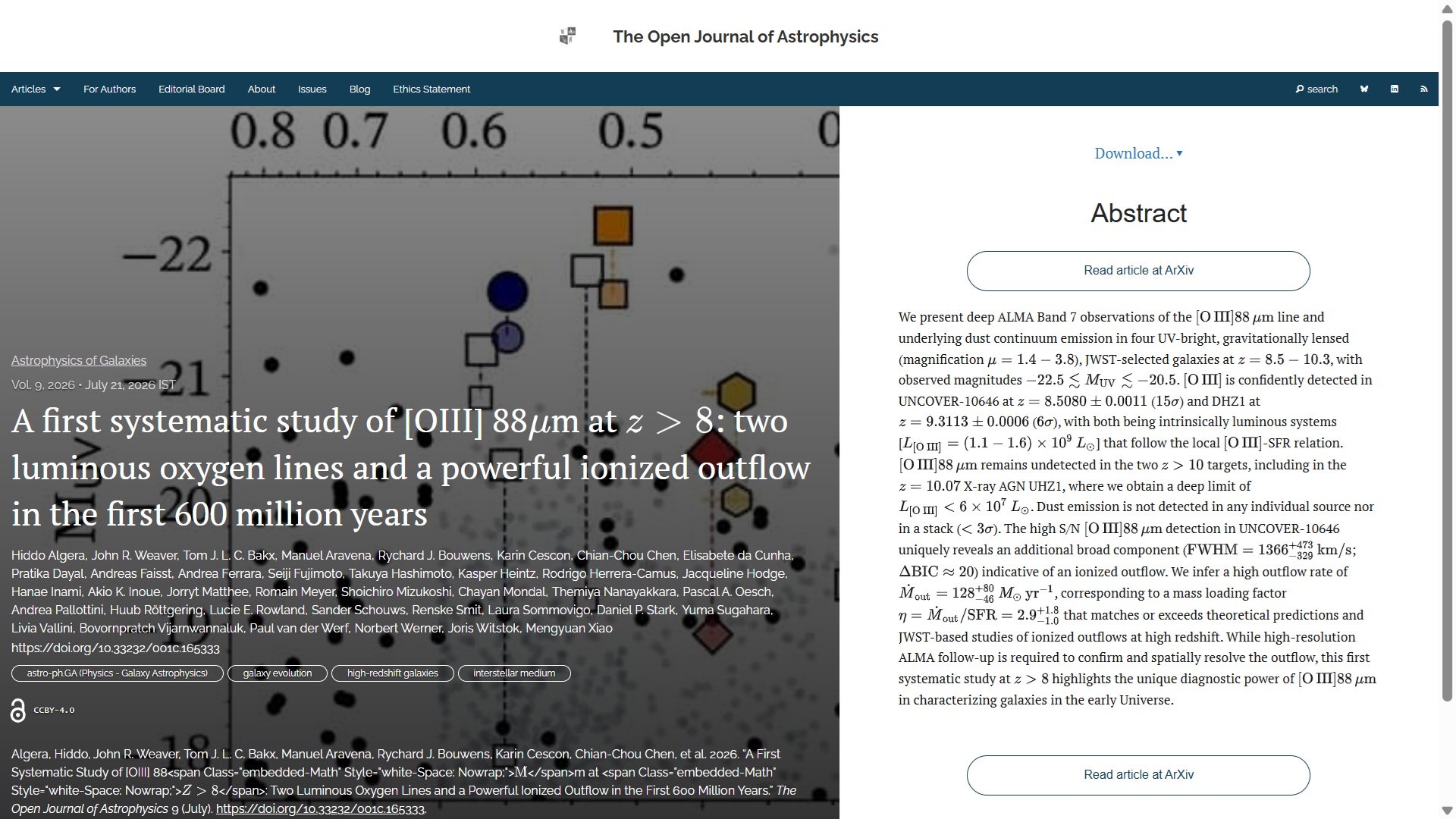
The third paper of the week, also published on Tuesday 21st July, but in the folder Astrophysics of Galaxies is “A first systematic study of [OIII] 88μm at z>8: two luminous oxygen lines and a powerful ionized outflow in the first 600 million years” by Hiddo Algera (Institute of Astronomy and Astrophysics, Taipei, Taiwan) and 37 others from all around the world. This paper presents deep observations of four UV-bright, gravitationally lensed galaxies, revealing an ionized outflow in one and highlighting the diagnostic power of [O III]88 μm in studying galaxies in the early Universe.

The overlay for this one is here:
The final, accepted version can be found on arXiv here and the Mastodon announcement is here:

Open Journal of Astrophysics

New Publication at the Open Journal of Astrophysics: "A first systematic study of [OIII] 88μm at z>8: two luminous oxygen lines and a powerful ionized outflow in the first 600 million years" by Hiddo Algera (Institute of Astronomy and Astrophysics, Taipei, Taiwan) and 37 others from all around the world.

doi.org/10.33232/001c.165333

July 21, 2026, 7:52 am 1 boosts 1 favorites

The fourth paper of the week, published on Thursday 23rd July in the folder Astrophysics of Galaxies, is “Mapping CO Ice in a Star-Forming Filament in the 3 kpc Arm with JWST” by Savannah Gramze (U. Florida, USA) and 16 others based all around the world. This paper shows that JWST observations and ALMA Band 3 data reveal that 50-88% of CO gas in a star-forming filament is locked in ice; corrections are needed for mass measurements in such systems.

The overlay for this one is here:
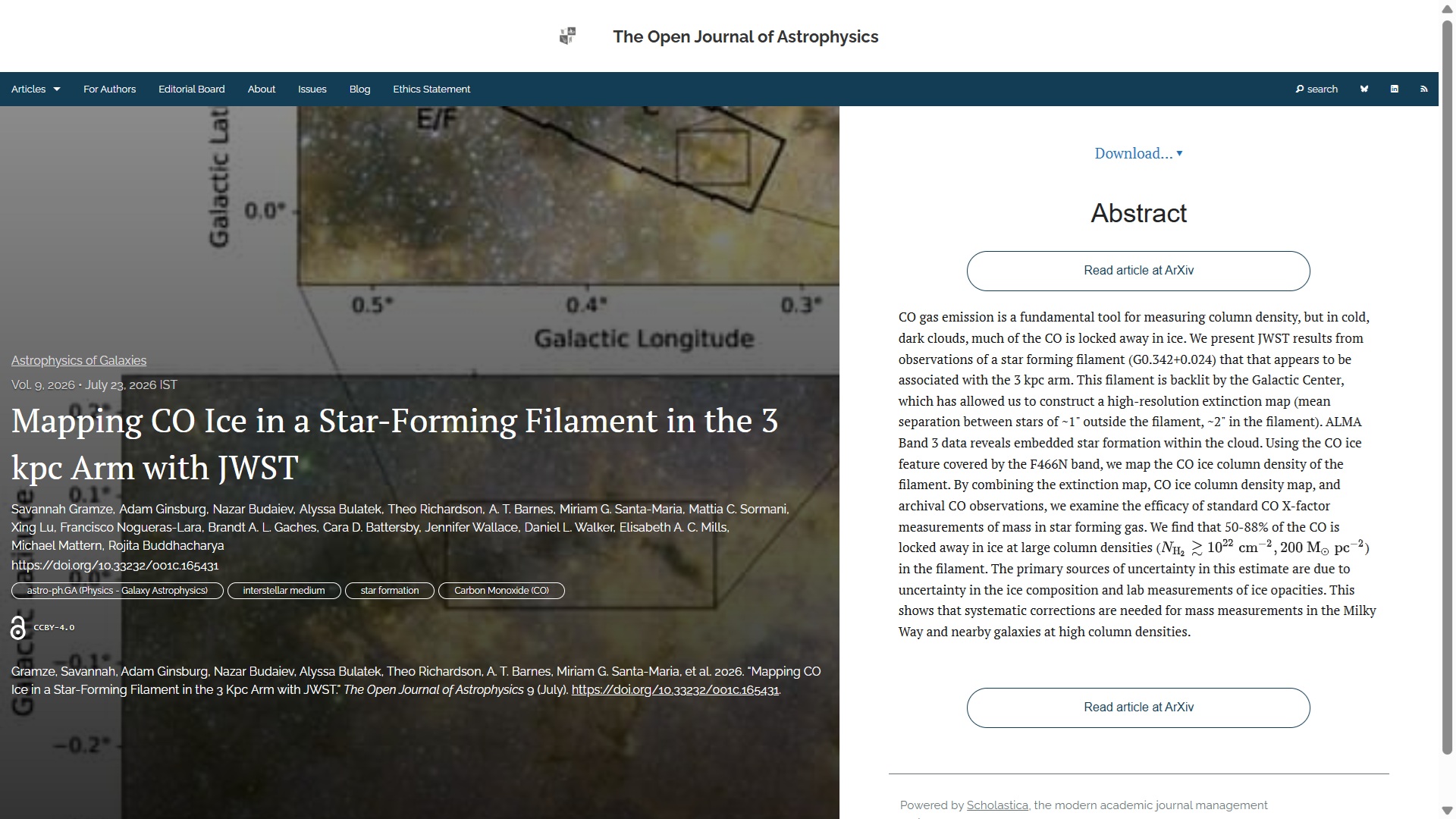
You can read the final version of this one on arXiv here and the Mastodon announcement is here:

Open Journal of Astrophysics

New Publication at the Open Journal of Astrophysics: "Mapping CO Ice in a Star-Forming Filament in the 3 kpc Arm with JWST" by Savannah Gramze (U. Florida, USA) and 16 others based all around the world.

doi.org/10.33232/001c.165431

July 23, 2026, 7:08 am 1 boosts 0 favorites

The fifth paper of the week, also published on Thursday 23rd July but in the folder High-Energy Astrophysical Phenomena, is “Viscously Spreading Accretion Disks around Black Holes: Implications for TDEs, LFBOTs and other Transients“. This article presents a time-dependent model of accretion disks around black holes, explaining late-time emission in tidal disruption events and luminous fast blue optical transients and future detectability of such events.

The overlay for this one is here:
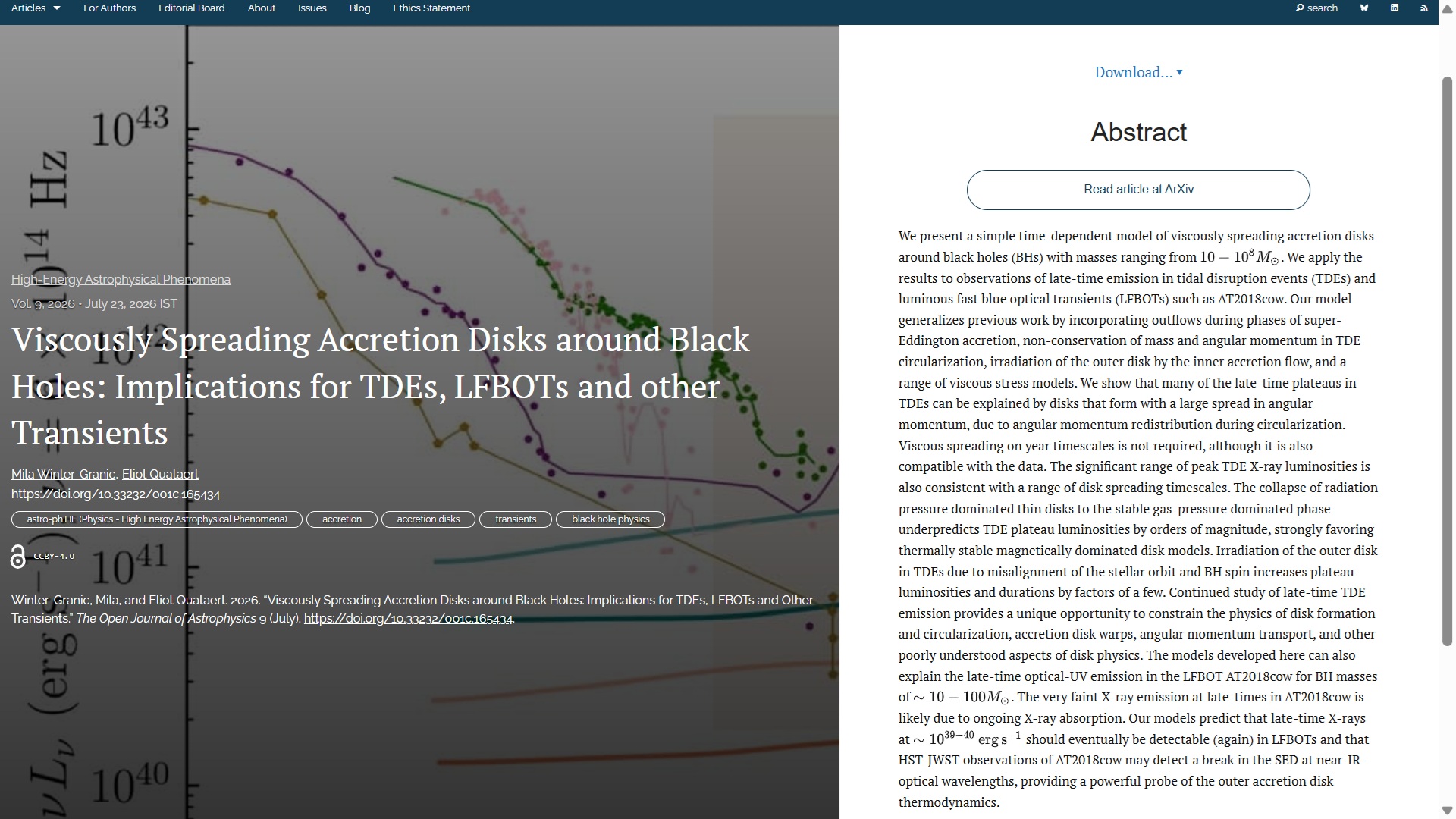
You can read the final version of this one on arXiv here and the Mastodon announcement is here:

Open Journal of Astrophysics

New Publication at the Open Journal of Astrophysics: "Viscously Spreading Accretion Disks around Black Holes: Implications for TDEs, LFBOTs and other Transients" by Mila Winter-Granic and Eliot Quataert (Princeton University, USA)

doi.org/10.33232/001c.165434

July 23, 2026, 7:20 am 1 boosts 0 favorites

The sixth paper of this week is “Characterising the response of an International LOFAR Station” by Letizia Vincetti (Trinity Collge Dublin, Ireland) and 9 others based in Ireland, USA, The Netherlands and Sweden. This was also published on Thursday July 23rd and is in the folder Instrumentation and Methods for Astrophysics. The article presents an investigation of the performance and calibration challenges of phased-array radio interferometers, using the Irish LOFAR station as a case study, highlighting the importance of accurate beam modelling, etc.

The overlay for this one is here:
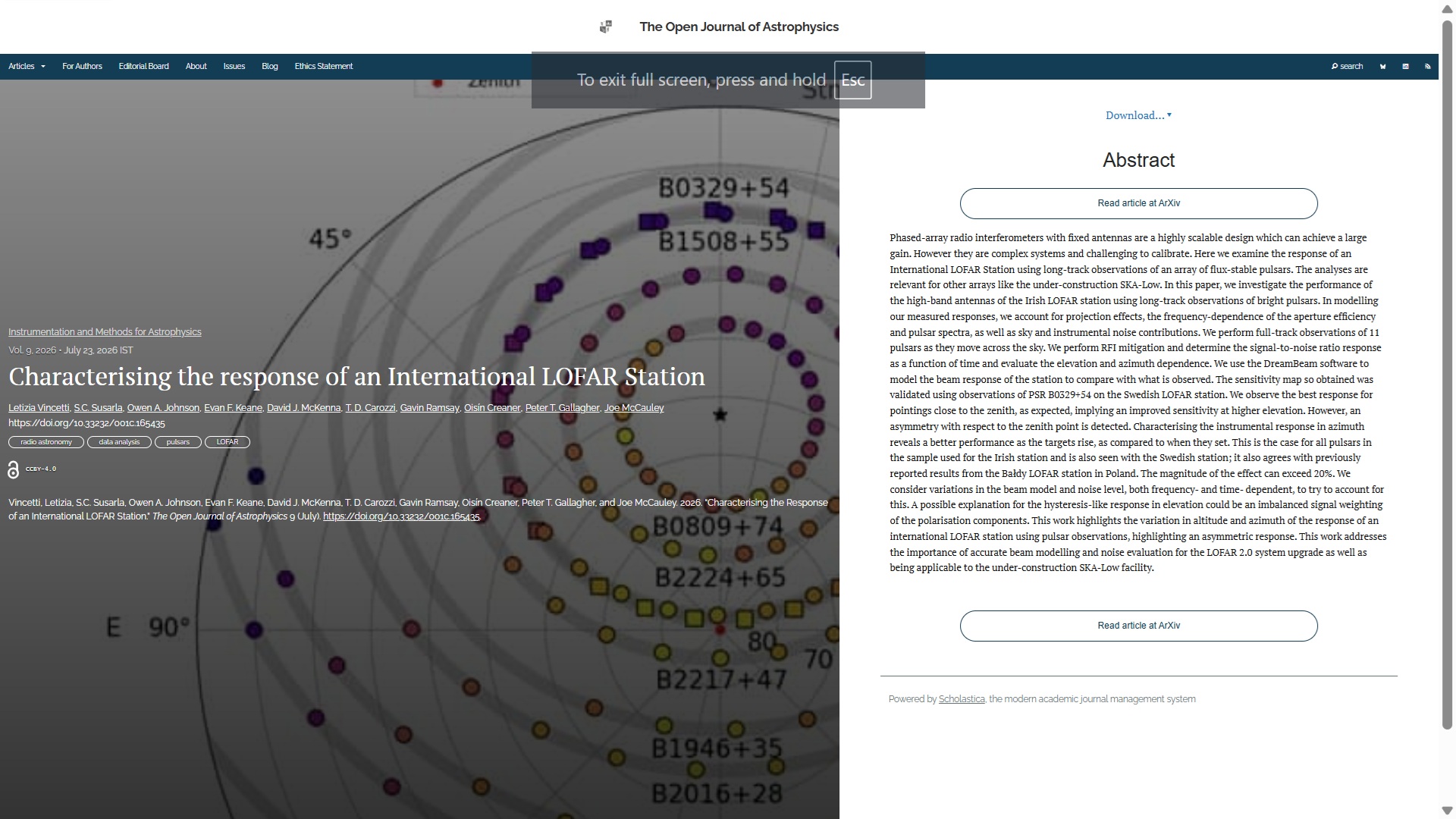
You can find the final accepted version on arXiv here and the Mastodon announcement is here:

Open Journal of Astrophysics

New Publication at the Open Journal of Astrophysics: "Characterising the response of an International LOFAR Station" by Letizia Vincetti (Trinity Collge Dublin, Ireland) and 9 others based in Ireland, USA, The Netherlands and Sweden

doi.org/10.33232/001c.165435

July 23, 2026, 7:34 am 1 boosts 0 favorites

The seventh paper of this week is “Exo Skryer: A JAX-accelerated sub-stellar atmospheric retrieval framework” by Elspeth K.H. Lee (U. Bern, Switzerland). Published on Friday 24th July in the folder Earth and Planetary Astrophysics, this article introduces “Exo Skryer”, a new, efficient framework for exoplanet and brown dwarf atmospheric research, capable of handling large data sets and complex models.

The overlay for this one is here:
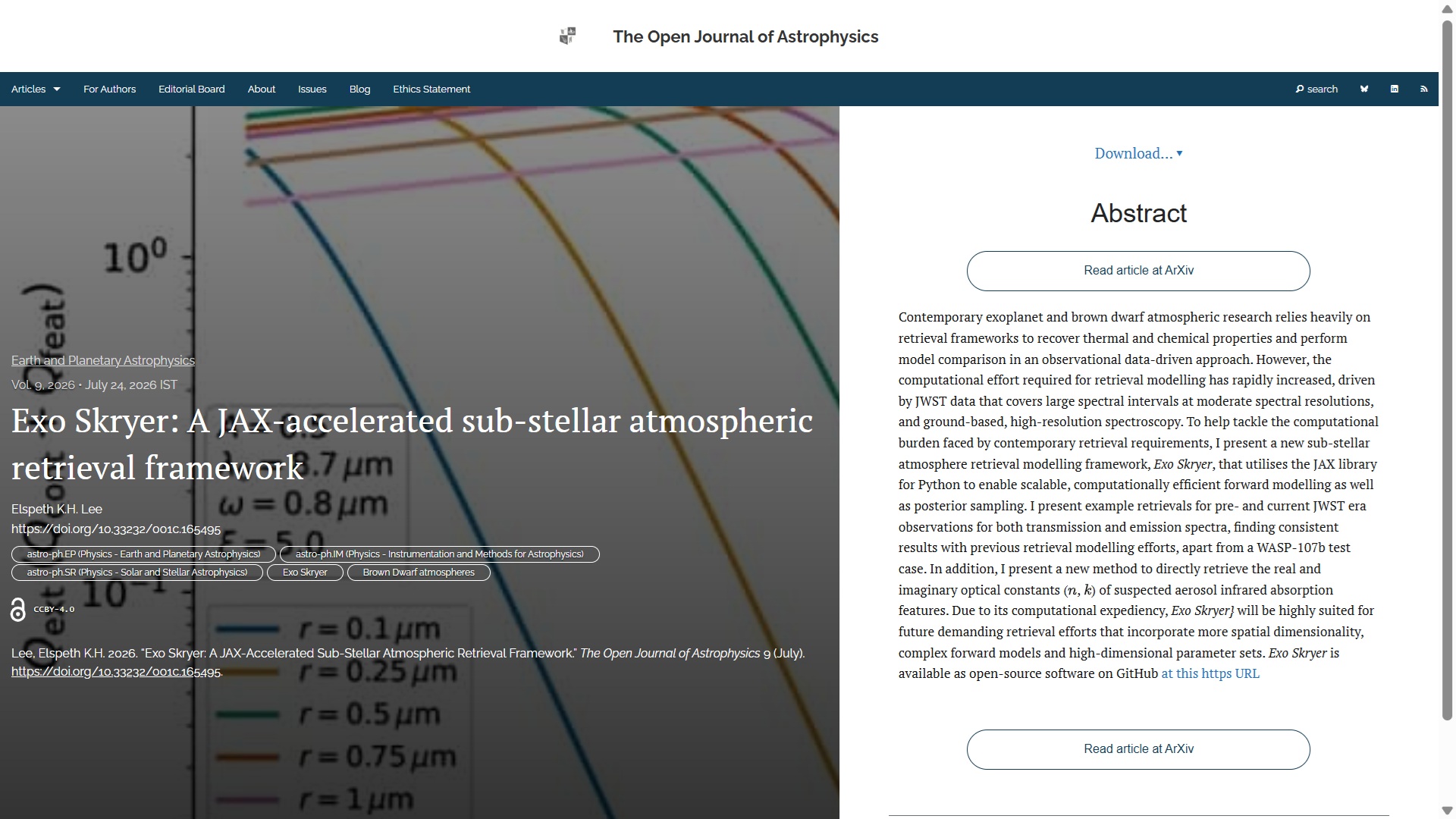
You can find the final accepted version on arXiv here and the Mastodon announcement is here:

Open Journal of Astrophysics

New Publication at the Open Journal of Astrophysics: "Exo Skryer: A JAX-accelerated sub-stellar atmospheric retrieval framework" by Elspeth K.H. Lee (U. Bern, Switzerland)

doi.org/10.33232/001c.165495

July 24, 2026, 8:29 am 0 boosts 1 favorites

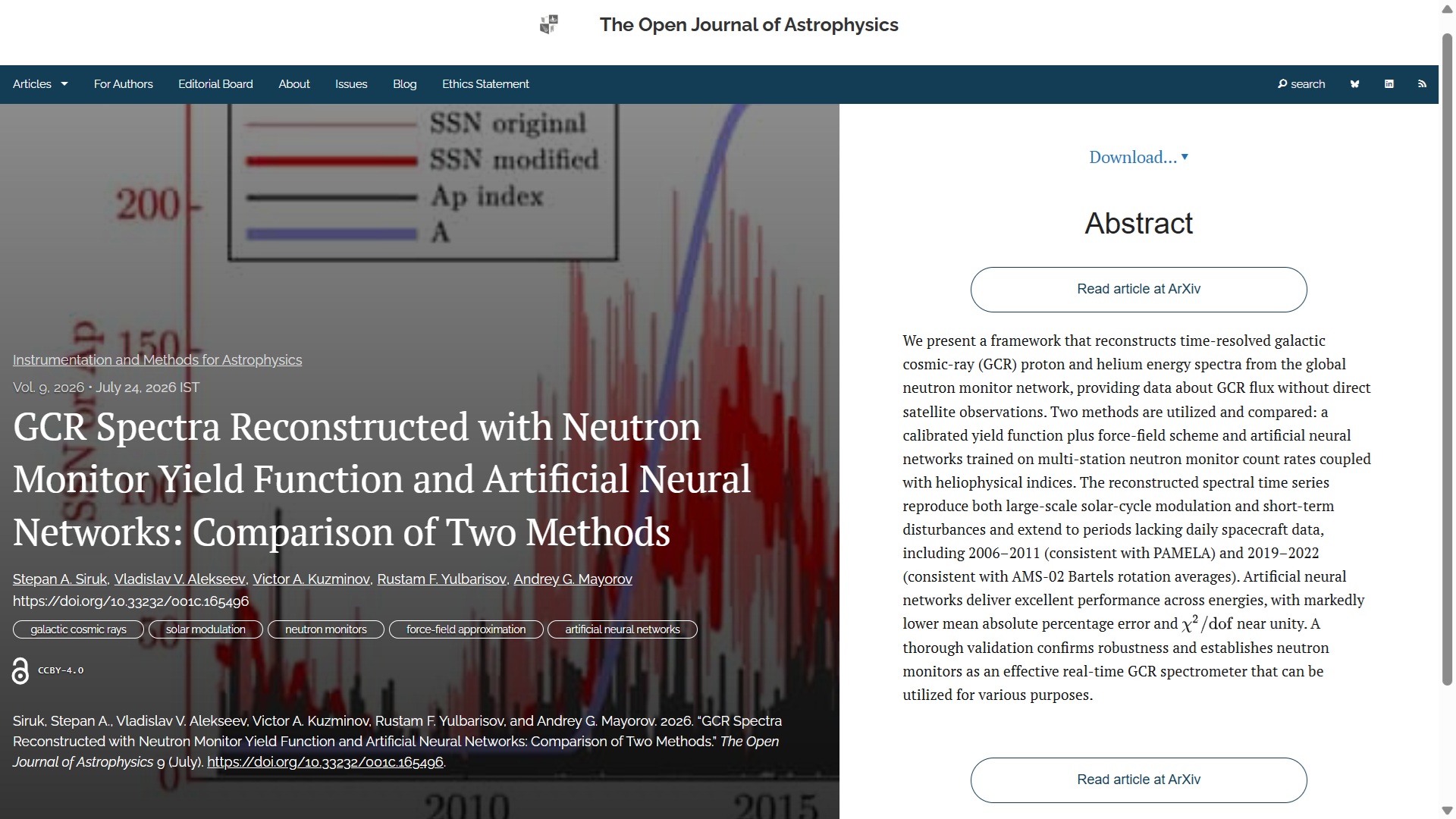
The (penultimate) eighth paper of this week is “GCR Spectra Reconstructed with Neutron Monitor Yield Function and Artificial Neural Networks: Comparison of Two Methods” by Stepan A. Siruk (Moscow Engineering Physics Institute MEPhI, Russia) and four others, all based in Russia. Published on Friday 24th July in the folder Instrumentation and Methods for Astrophysics, this article presents a framework using artificial neural networks and neutron monitors to reconstruct cosmic-ray energy spectra, providing data even in the absence of direct satellite observations.

The overlay for this one is here:
You can find the final accepted version on arXiv here and the Mastodon announcement is here:

Open Journal of Astrophysics

New Publication at the Open Journal of Astrophysics: "GCR Spectra Reconstructed with Neutron Monitor Yield Function and Artificial Neural Networks: Comparison of Two Methods" by Stepan A. Siruk (Moscow Engineering Physics Institute MEPhI, Russia) and four others based in Russia

doi.org/10.33232/001c.165496

July 24, 2026, 8:38 am 1 boosts 2 favorites

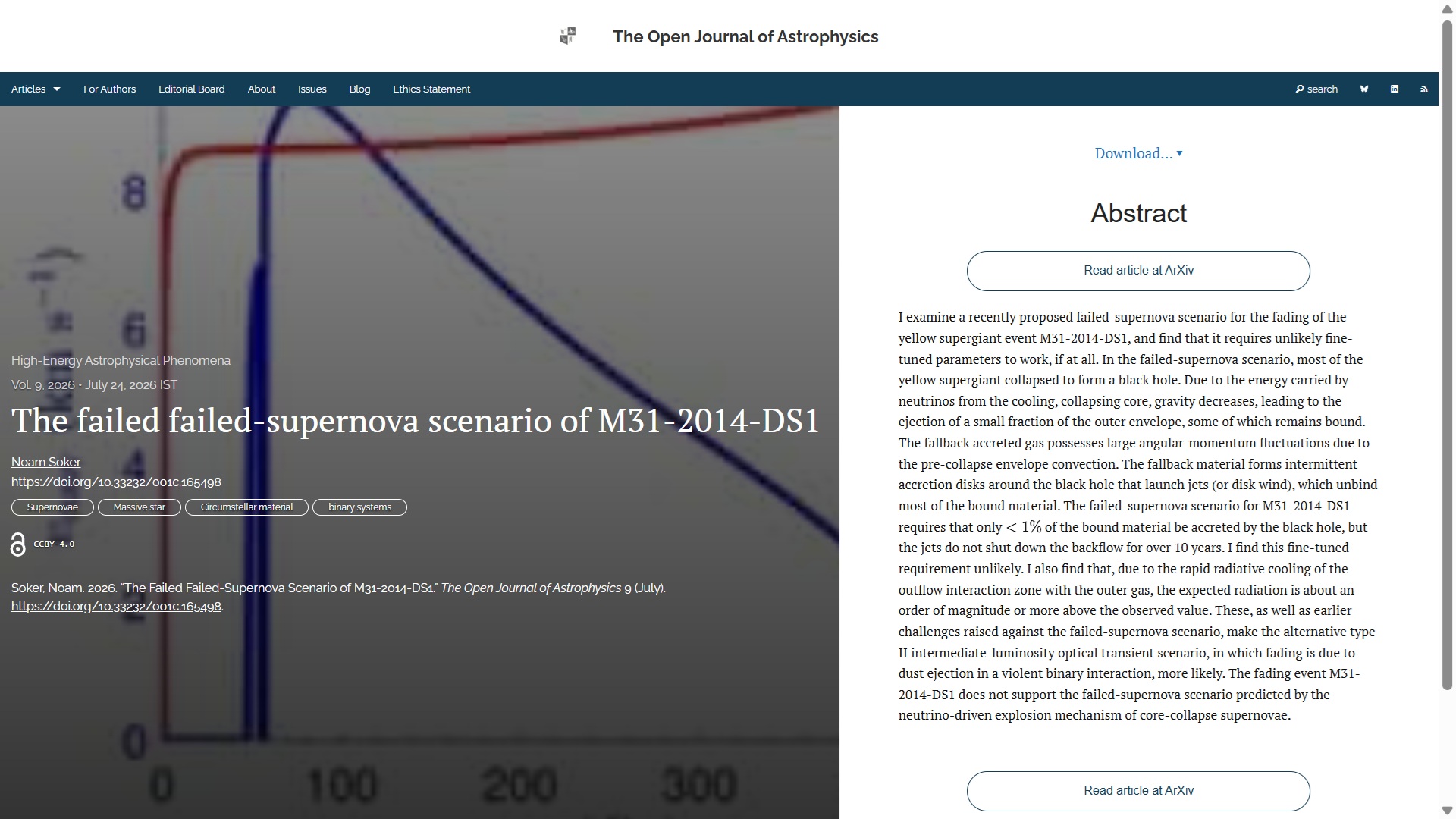
And finally for this week we have “The failed failed-supernova scenario of M31-2014-DS1” by Noam Soker (Technion, Israel), a paper which challenges the failed-supernova theory for the fading of the yellow supergiant event M31-2014-DS1, suggesting it requires unlikely parameters and supports an alternative scenario involving violent binary interaction. This was published on Friday 24th July in the folder High-Energy Astrophysical Phenomena.

The overlay for this one is here:
You can find the final accepted version on arXiv here and the Mastodon announcement is here:

Open Journal of Astrophysics

New Publication at the Open Journal of Astrophysics: "The failed failed-supernova scenario of M31-2014-DS1" by Noam Soker (Technion, Israel)

doi.org/10.33232/001c.165498

July 24, 2026, 8:47 am 0 boosts 2 favorites

And that concludes the update of this week’s business. As it was foretold, the total number of publications at OJAp has now passed the 600 mark, and the likely number for 2026 is around 300. We published a paper in five of the six astro-ph categories this week, but still haven’t had a week when we’ve published a full house with at least one in all six…
Latest Results from the South Pole Telescope

Posted in The Universe and Stuff with tags , , , , on December 13, 2022 by telescoper

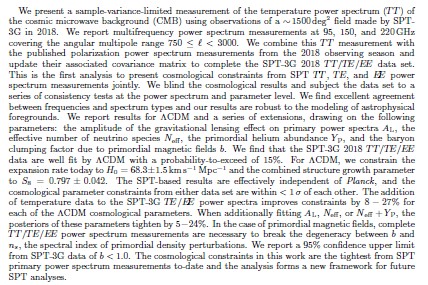
Just time for a quick post to point out the latest results from the South Pole Telescope (SPT) have now hit the arXiv. The measurements were made in 2018 but the outcome of a full analysis of temperature and polarization has only just appeared.

Here’s a grab of the abstract:

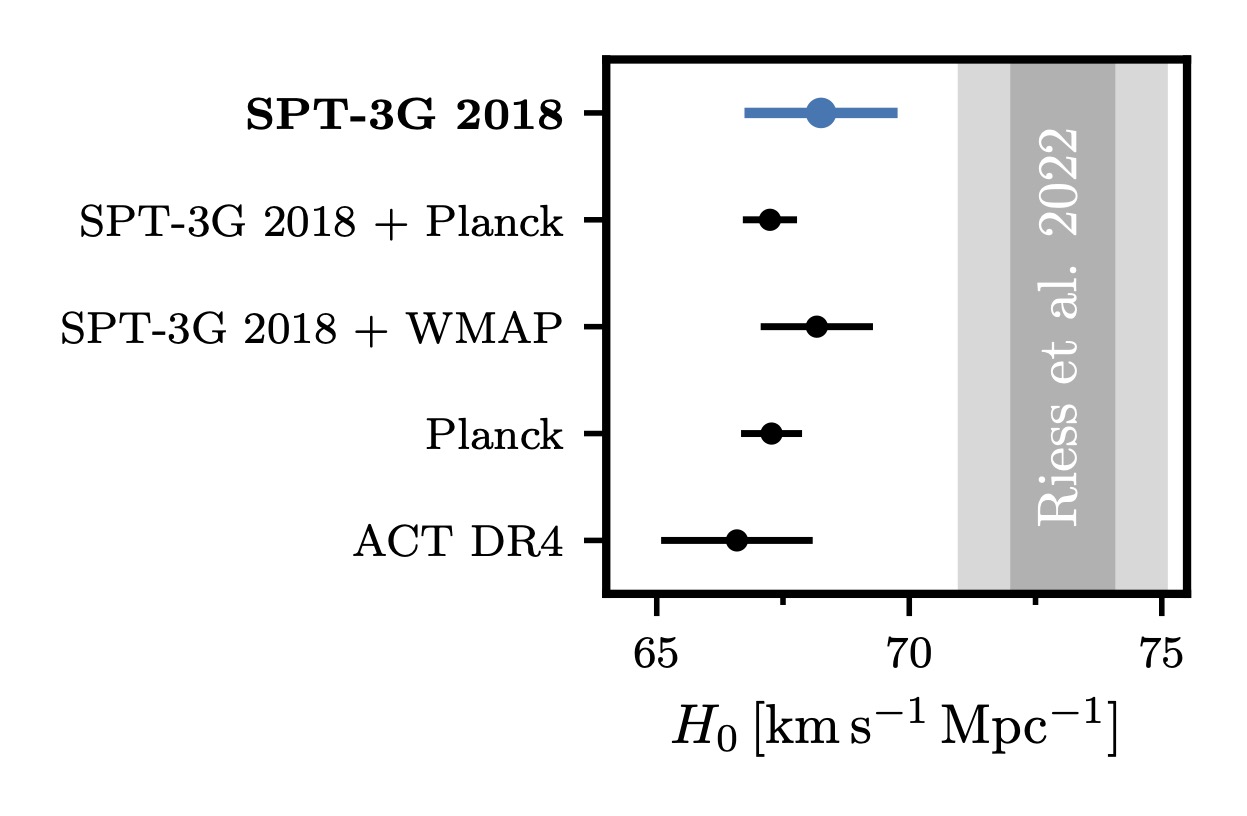
The key figures showing the constraints on the Hubble Constant H0 and the parameter S8 are shown here:

As you can see, the results from SPT-3G are consistent with the standard cosmological model and agree on H0 with Planck rather than the higher value obtained from local measurements. If you thought there was Hubble tension before this measurement, then you will still think so now!

Newsflash: Direct Detection of B-mode Polarization

Posted in The Universe and Stuff with tags , , , , , on July 23, 2013 by telescoper

I’m not meant to be blogging these days but I thought I’d break radio silence to draw attention to a new paper on the arXiv by Hanson et al. from SPTpol, an experiment which aims to measure the polarization of the cosmic microwave background using the South Pole Telescope. One of the main aims of experiments such as this is to measure the so-called “B-mode” of polarization (the “curl” component of the polarization signal, which possesses a handedness) because this holds the key to direct detection of a number of interesting cosmological phenomena such as the existence of primordial gravitational waves.  However, primordial effects aren’t  the only way to generate B-mode polarization. Other “foreground” effects can do the job too, especially gravitational lensing can also generate a signal of this form. These “late-time” effects have to be understood before the primordial contribution can be isolated.

Before today there was no direct measurement of B-mode polarization at all, primordial nor not.

The abstract basically says it all:

Gravitational lensing of the cosmic microwave background generates a curl pattern in the observed polarization. This “B-mode” signal provides a measure of the projected mass distribution over the entire observable Universe and also acts as a contaminant for the measurement of primordial gravity-wave signals. In this letter we present the first detection of gravitational lensing B modes, using first-season data from the polarization-sensitive receiver on the South Pole Telescope (SPTpol). We construct a template for the lensing B-mode signal by combining E-mode polarization measured by SPTpol with estimates of the lensing potential from a Herschel-SPIRE map of the cosmic infrared background. We compare this template to the B modes measured directly by SPTpol, finding a non-zero correlation at 7.7 sigma significance. The correlation has an amplitude and scale-dependence consistent with theoretical expectations, is robust with respect to analysis choices, and constitutes the first measurement of a powerful cosmological observable.

This measurement is not unexpected. Indeed, the B-mode contribution from lensing by the known distribution of galaxies can be calculated fairly straightforwardly because the physics is well understood; failure to find the expected signal would therefore have been somewhat embarrassing.  It’s a different story for the primordial B-mode because that depends strongly on what is going on in the very early universe, and that is much less certain. Although the new result doesn’t itself tell us anything new about the very early Universe it is definitely an important step on the way, and it’s a fairly safe prediction that there will be a great deal of activity and interest in CMB polarization over the next few years, including next year’s planned release of polarization data from Planck.

I’ll also note the use of Herschel-SPIRE images in tracing the galaxy images, in deference to my former colleagues in Cardiff who played a key role in developing that instrument!

SPT and the CMB

Posted in The Universe and Stuff with tags , , , , , , , , , on November 30, 2012 by telescoper

I’ve been remiss in not yet passing on news  from the South Pole Telescope, which has recently produced a number of breakthrough scientific results, including:  improved cosmological constraints from the SPT-SZ cluster survey (preprint here); a new catalogue of 224 SZ-selected cluster candidates from the first 720 square-degrees of the survey (preprint here); the first measurement of galaxy bias from the gravitational lensing of the CMB (preprint here); the first CMB-based constraint on the evolution of the ionized fraction during the epoch of reionization (preprint here); the most-significant detection of non-Gaussianity induced from the gravitational lensing of the CMB (preprint here); and the most precise measurement of the CMB damping tail and improved constraints on models of Inflation (preprint here).

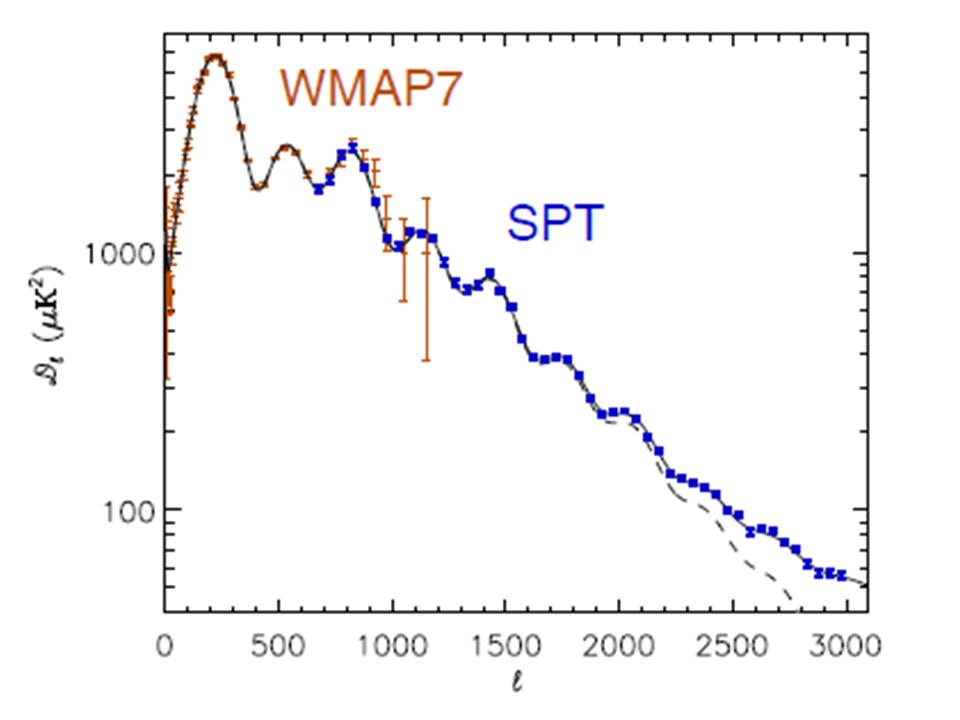
Here’s the graph that drew my eye (from this paper). It shows the (angular) power spectrum of the cosmic microwave for very high (angular) frequency spherical harmonics; the resolution of SPT allows it to probe finer details of the spectrum that WMAP (also shown, at lower l).

Slide1

This is an amazing graph, especially for oldies like me who remember being so impressed by the emergence of the first “acoustic peak” at around l=200 way back in the days of Boomerang and Maxima and gobsmacked by WMAP’s revelation of the second and third. Now there are at least six acoustic peaks, although of progressively lower amplitude. The attenuation of the CMB fluctuations at high frequencies is the result of diffusion damping – similar to the way high-frequency sound waves are attenuated when they pass through a diffusive medium (e.g. a gas).  The phenomenon in this case is usually called Silk Damping, as it was first worked out back in the 1960s by Joe Damping Silk.

Anyway, there’ll be a lot more CMB news early (?) next year from Planck which will demonstrate yet again that cosmic microwave background physics has certainly come a long way from pigeon shit