Archive for July, 2010

Blogging about Blogging

Posted in Biographical with tags , , , on July 19, 2010 by telescoper

Last week in London there was an event called Talkfest which was all about Science Blogging. I didn’t know anything about it until I started to see some tweets about it just before it happened. Apparently a few people I know went along and, by all accounts, it was quite an interesting evening. You could have knocked me down with a feather, however, when one of the invited panellists, particle physicist John Butterworth, mentioned this as his favourite “after-dinner” blog. If you don’t believe me here’s the evidence!

John is the chap with the microphone, and that’s my blog behind him. Unfortunately, the fact that I’d picked a Welsh title that day probably means he probably managed to convince the audience that I can speak Welsh which, in turn, probably means I’m going to get sued under the Trades Descriptions Act! I don’t know exactly what was meant by “after-dinner” blog, either. Perhaps its because it should only be read after the watershed. Anyway, it seems like it must have been a fun event judging by the other pictures and some of the chat that went on via Twitter (#talkfest)  afterwards.

I must say I was thrilled to bits to be mentioned in despatches in front of so many people who know a lot more about science blogging than I do. I’m not really plugged into the large online science community. All I do in that vein is write this. Just because I write a blog doesn’t mean I’m not a Luddite at heart! Anyway, I’m both flattered and grateful to Prof. Butterworth for his kind words. At least, I assume they were kind. If I’d been there I would have blushed.

Anyway, John’s own blog is very interesting and he followed up his dubious selection of favourite blog with a post of his own about the whys and wherefores of blogging. Imitation being the sincerest form of flattery I thought I’d follow his cue and do something in a similar vein. Actually I’ve been meaning to do something along these lines for a while.

I suppose the main issue to be addressed in  a sermon about blogging is “why?”. Lots of people have asked me why I have a blog and why I apparently spend so much time writing it. Well, for me, there are two answers. The first is just that I enjoy writing. I think because of that I’ve always been able to write stuff quite quickly and developed a little bit of a knack for it. When I started blogging – less than two years ago – I realised that it gave me the chance to write about things quite different from the usual themes I had yet tackled in publications. I’d written scientific papers, textbooks, lecture notes, popular books and newspaper articles before but most had   been quite strictly controlled by editors and were always related to my scientific work. In fact, I’d already written quite a lot of stuff that never made it into publications so as time as gone on and I’ve been short of blog fuel I’ve tended to throw some of these pieces on in addition to bits I write on the spur of the moment.

It was only after I’d been blogging quite a while that I started doing music and poetry items, entirely for my own amusement, like keeping a scrapbook, but if people actually enjoy things that I’ve put up that they’d never seen before then all the better. I know a lot of people think I’m a pretentious twat for posting about Opera and modern jazz – some have said as much to my face, in fact – but that’s what I like. There’s enough blogs about pop music, TV celebrities and computer games already, not that I’d be able to write about them. I’m flattered too by the fact that some of my music and other posts have been linked to wikipedia articles – and, no, I didn’t put them there!

The other reason I had for starting to blog is much more personal. I moved job to Cardiff in 2007, but I got caught up in the credit crunch and was unable to sell my old house for quite a while. I spent far too much time commuting from Nottingham to Cardiff and back for the weekends and got thoroughly depressed, a state of mind not helped by some other issues which I won’t go into. In the middle of this my father died. Though not entirely unexpected, I did have to take some time out to deal with it. He hadn’t left a will, and I had to sort out the legal side of things as well as dispose of his belongings and arrange the funeral. In the aftermath of all that I had pangs of nostalgia for my childhood in Newcastle and an urge to connect with all that through writing down some thoughts and memories. Many of my early posts on here were quite morbidly introspective and probably not much fun for anyone to read, but I found writing them quite cathartic, as indeed I’ve found other posts for different reasons.

Anyway, knowing my tendency to write bits and bobs and then forget about them, quite a few people had encouraged me to start writing a blog but I hadn’t done it because I didn’t know how to go about setting one up. Fortunately after a public talk I’d given, Phil Brown of the British Association for the Advancement of Science gave me a few pointers to getting started writing a blog. After finally managing to sell off the Nottingham house and after relocating fully to Cardiff, I got this thing going about 2 years ago.

So there you are.  That’s some of why and most of how I came to start writing this blog. I wish I could say I had a mission to change the world, but it’s really just partly a big exercise in self-indulgence and partly a piece of occupational therapy. I would add two things in my defence, though. One is that I think that among all the other stuff, I do a bit of public service on here. Any bits of news about funding, exciting or controversial science results and things I think my colleagues in Cardiff and elsewhere might find interesting tend to go on here and I do think that’s a useful thing to do. People in my own School sometimes find things first from reading here, which I think adds a healthy bit of transparency to the otherwise closed world of academic life. The other thing to say is that, contrary to popular opinion, I don’t actually spend a huge amount of time writing the blog. Much of it is recycled and the rest thrown together quite quickly. I’ve just reached 1000 words of this post, for example, and it’s taken me 25 minutes. I know it’s rubbish, but at least its fast…

..which reminds me. Was it Voltaire who apologized for not having time to write a short letter so he was sending a long one instead?

Aside from the other things I’ve mentioned, the comments section is the thing I enjoy best. It’s great when people take the time to correct my numerous errors, whether it’s an incorrect chord sequence from a Charlie Parker track or a mistake in interpretation of a cosmological result. I also enjoy watching the discussion threads veer off at all kinds of unexpected tangents. Of course the comments section does occasionally have its downside, but generally its a lot of fun.

I’ve kept a weather eye on the hit statistics for this blog since I started. Although they are highly erratic, varying between 300 and 3000,  I seem to have a steady baseline average of about 700 unique hits per day. That seems an awful lot to me, but I’ve nothing to compare it with so I don’t know whether it’s a lot for a personal blog. I do know who a few of the readers are, some because they comment regularly on here,  and some because they tell me they read it in emails or face-to-face. I thought at the start that the intersection of jazz, opera and astronomy was a set of very small measure indeed so I’d never get more than a handful of readers. I realise now that I was probably doing the wrong logical operation; I should have been thinking `OR’ rather than `AND’. Judging by the incoming links I probably get quite different people reading the different sorts of items.

I’d be interested to know how people read this and other blogs, actually. I post almost every day, but I’d be surprised if the same people visit every day or read the posts that often.

It’s strange to think that the tentacles of the internet sometimes reach out from the other side of the world, bringing someone here without me ever knowing who they are. Wheoever you are, and however you got here, please feel free to say hello through the comments. I’d love to know who you all are. But if you’d rather not, that’s fine. This blog is delivered in the electronic equivalent of a plain brown envelope.

Anyway, that’s more than enough introspection for one night. Reading it through I realise it sounds like a very long and very boring acceptance speech for some sort of award! Perhaps I should keep it for when I get into Pseud’s Corner. Still, it will have to do. I haven’t got an editor to rewrite it for me…

PS. I would have been great if the picture had featured this post instead of last week’s. That would really have suited the self-reference theme, although it would have violated causality constraints!
Verdi’s Requiem

Posted in Music with tags , , , , on July 18, 2010 by telescoper

Just back from this evening’s Welsh Prom at St David’s Hall which featured Verdi’s Requiem performed by the BBC National Orchestra of Wales, with the BBC National Chorus of Wales together with the Cardiff Ardwyn Singers and the Cardiff Polyphonic Choir.

I have to admit I must have had a senior moment or two about this because I bought two tickets a while ago but got it into my head that it was last Thursday night. When I looked at the tickets on Thursday, and discovered I’d screwed up,  it transpired the friend I was supposed to go with on Thursday couldn’t make it on Sunday. What a shambles. I think I should apply for home help!

Anyway, I’m glad I went because it’s a fabulous piece that you really have to hear live in order the experience its full effect. Living in Wales might tend  to make one a bit blasé about choral music, but there’s no escaping the awesome power of the massed voices during the famous Dies Irae sequences that return throughout the work, to the accompaniment of a booming bass drum sounding the last judgement. The first time you hear that live I guarantee you’ll be pinned back in your seat.

The latin mass for the dead has inspired some of the greatest music written by some of the greatest composers, but it also seems to bring out something very personal and different from each one. Fauré’s Requiem, for example, is full of a fragile, angelic beauty and it portrays death as joyous release from earthly torment. Verdi’s take is quite different. It’s quite varied, musically, alternately sombre, accepting, meditative and, yes, even joyous too. But you’re never far from the terrifying hammer blows of the Dies Irae; one senses that Verdi’s own view of death was one dominated by fear.

Some say the Verdi Requiem is overwrought, but I don’t think anyone will ever say this piece isn’t dramatic. It’s also full of great tunes and wonderful dramatic contrasts. Is it too melodramatic? That’s a matter of taste. I don’t think it’s melodramatic but it’s certainly operatic, and I certainly don’t mean that to be derogatory. Above all, it’s just very Verdi. And that’s certainly not derogatory either.

The four soloists were all excellent: Yvonne Howard (soprano), Ceri Williams (mezzo), Gwyn Hughes Jones (tenor) and Robert Hayward (bass) and the orchestra did all the right things under the baton of veteran conductor Owain Arwel Hughes.

I enjoyed the performance a lot, but left feeling a bit flat because St David’s Hall was only about 2/3 full. I always enjoy things more when there’s a full house as the atmosphere is always that bit more exciting. I’m not sure why it didn’t attract a better turnout – top price tickets were only £26. Perhaps it was because many classical music fans were listening to the main Prom in London, which this evening featured the great Placido Domingo as Simon Boccanegra?

I’ve never been to one of the Welsh proms before, and was interested to see that, like the Royal Albert Hall, St David’s also has promenaders standing just in front of the orchestra although they were not as numerous as in the Proms themselves.

The Curious Case of the Cat’s Nose

Posted in Columbo with tags , on July 17, 2010 by telescoper

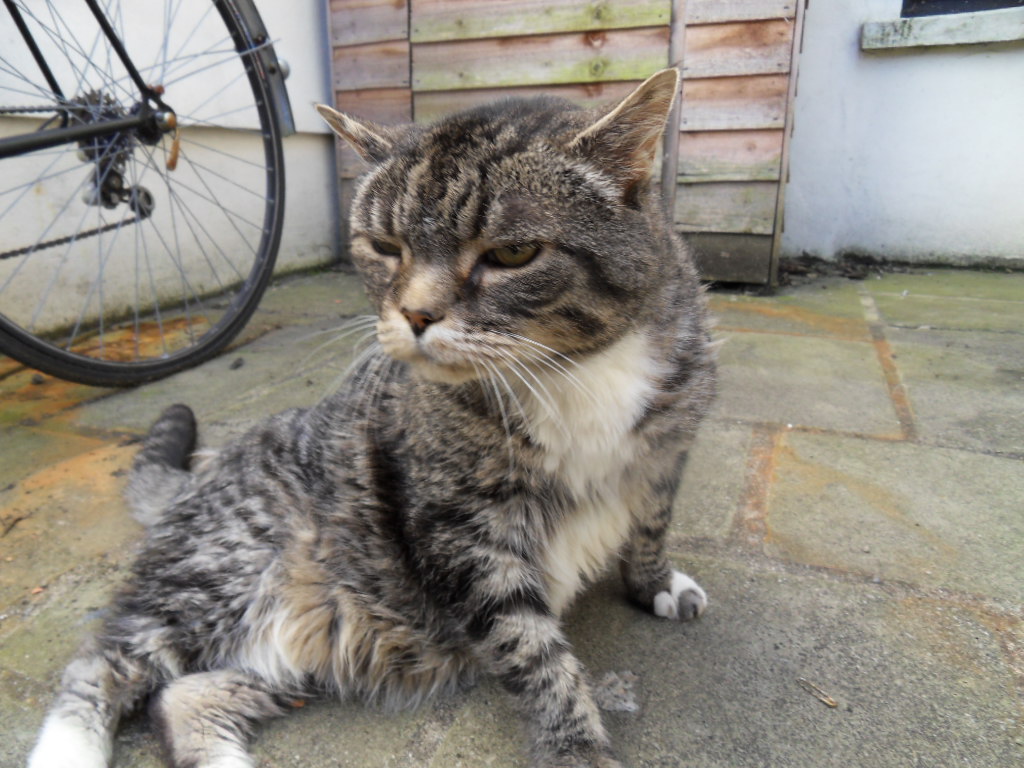
Another day, another feline emergency.

This morning I got up to feed my old moggy Columbo. As usual, he was out and about first thing in the morning, but as soon as I got downstairs he was there waiting for his grub. I put it down for him, gave him a dish of fresh water, and did the usual insulin jab.  He started to scoff the food. As usual, the combination of eating and purring produced a sound like a pig at a trough so I left him to it and proceeded to make a cup of tea.

A few seconds later, Columbo sneezed. Nothing particularly unusual about that so I didn’t pay much attention. While I was waiting for the kettle to boil, however, I noticed something strange. There was blood on the food in the cat’s bowl, and a fine spray of blood on the wall behind it. Columbo had resumed eating, and seemed fine, but there was clearly something very wrong.

As it happens, a trip to the vet’s was on my agenda for today because I needed more of Columbo’s Feline MD, food which is specially designed (and specially priced too, apparently) for diabetic cats. I also needed some more insulin and some more of the tablets he has for his arthritis. Never cheap, these trips to the vet. Since I was going to go anyway, I thought I’d take him in for a check up, and phoned to see whether they could fit in an appointment this morning, which they did.

After completing the not too easy task of persuading Columbo into his travel box, off I went to do the honours. Soon he was sitting on the vet’s table, looking right as rain and showing no ill-effects at all. He was even purring; he seems to like this vet more than any other he’s ever been to. Anyway, I told the (sceptical-looking) vet what happened and she gave him the once over. She said the blood could be a sign of something quite serious, but it could have happened for any number of trivial reasons. Not finding anything wrong in his mouth or nose, she asked me whether I had found anything strange in his dish when he had sneezed. In fact there had been a small piece of a blade of grass, which I’d thought slightly odd but hadn’t mentioned because I didn’t think it was relevant.

The vet smiled and said she thought that was probably it. She went on to explain that cats often eat grass in the summer, sometimes to help digestion but also sometimes to help them produce furballs. It’s not all that unusual for a small piece of grass – which can be quite sharp – to find its way into the cat’s nasal passages from its mouth and when it gets there it can cause a nosebleed. Since the offending grass had found its way out, the problem was probably over. I sighed with relief. Panic over. It must have been unpleasant for the old chap, but better out than in.

The vet mentioned that Columbo has pretty good teeth for a 16-year old cat, although he is missing one long incisor at the front. The end snapped off this ages ago, probably during a fight. It didn’t seem to cause him any problems at the time so the vet said it was best just to leave it. A year or two later, however, he began to experience dfficulty eating and the vet suggested it was probably the tooth causing the bother. He spent a day at the cat hospital and had it removed under a general anaesthetic. Sorted. The rest of his gnashers are in good nick, as he is wont to demonstrate on unsuspecting visitors.

I was a bit worried that he might have developed another dodgy fang or some other mouth problem. I’d be a bit nervous about subjecting him to a general anaesthetic at his current age, as the risk increases markedly for the more senior citizens of the feline world. Thankfully, that’s not an issue. Not for the time being anyway.

After we got back he spent the rest of the day on a rigorous programme of sleeping, interrupted only by an attempt to eat the Travel Supplement of my newspaper.

Nearly time for his supper. I hope this time it’s not to be sneezed at.

The Shoe Event Horizon

Posted in Education, Politics, Science Politics with tags , , , , , on July 16, 2010 by telescoper

After yesterday’s  satisfying and enjoyable graduation festivities, it’s back to reality today with a clutch of scary news items about future cuts.

Vince Cable, the coalition Minister responsible for Universities, has revealed plans for Higher Education that include introducing a graduate tax and encouraging the growth of private universities,  the latter to be introduced at the expense of some current institutions which are to be allowed to go bankrupt. You can find some discussion of his speech in the Times Higher as well as in the Guardian piece I linked to earlier.

The graduate tax isn’t a new idea, but it does seem rather strange to be suggesting it right now. The proposal won’t lead to any significant income for universities in the short term so presumably either the government or the institutions themselves will have to borrow until the cash starts to flow in. But I thought we were supposed to be cutting public borrowing?

In fact, it seems to me that the announcements made by Cable are little more than a ragbag of ill-considered uncosted measures likely to do little but cause alarm across the Higher Education sector. Perhaps he would have been wiser to have kept the Ministerial trap shut until he’d actually worked out whether any of the half-baked ideas he announced were worth thinking through properly, as some of them just might be.

Apart from anything else, Vince Cable’s dramatic U-turn on Higher Education funding shows that the LibDem contingent have now been completely subsumed by the dominant right-wing, pro-market political stance of the Conservatives. In other words, we now know there’s no reason ever to vote LibDem again; they’re Tories in all but name.

I hope this year’s new graduates realised how lucky they’ve been to get their education before universities turn into Discount Education Warehouses, although I cling to the hope that the Welsh and Scottish assemblies might take a stand against if some of the worst aspects of the ConDem policy look like becoming reality in England, where the Tories live.

Meanwhile, the Royal Society has submitted its, er, submission to the ongoing debate about research funding. The headline in an accompanying article from the Times – which you won’t be able to read unless you give money to the Evil Empire of Murdoch – suggests that it could be “game over” for British science if the suggested cuts go ahead. Paul Crowther has done his usual fabulously quick job of hacking his way through the documentary jungle to get to the juiciest quotes, including this one:

Short-term budget cuts will put our long-term prosperity at risk.. The UK should maintain its breadth of research .. a flat cash settlement will be painful but manegeable; a 10% cash cut will be damaging .. while a 20% cut will be irreversibly catastrophic for the future of UK science and economic growth.

I’m sorry if I’m introducing a note of pessimism here, but I think we’ll be very lucky indeed if the cuts are as small as 20%.

And finally, not unexpectedly, the news this week includes an announcement that university staff are to have their pensions reduced and/or deferred and will have to pay more for the privilege. Employee’s contributions to the USS scheme will increase from 6% to 7.5%. For new members the pension will not be based on their final salary, but on average earnings. This isn’t a surprise as it’s been clear for some time that USS was actuarially unsound, but it’s one more sign of the forthcoming squeeze on academics, those of them that don’t get made redundant anyway…

Looking around for a bit of good news, I could only manage this. If you’re worried about the future of UK universities and scientific research then consider how lucky you are that you’re not Italian. Owing to budget cuts imposed by the Berlusconi regime, several Italian institutions will no longer be able to pay scientists’ wages. Responding to this situation the Italian premier replied with all his usual tact and intelligence:

Why do we need to pay scientists when we make the best shoes in the world?

Fans of the late Douglas Adams will be reminded of the following passage from The Restaurant at the End of the Universe:

Many years ago this was a thriving, happy planet – people, cities, shops, a normal world. Except that on the high streets of these cities there were slightly more shoe shops than one might have thought necessary. And slowly, insidiously, the number of the shoe shops were increasing. It’s a well-known economic phenomenon but tragic to see it in operation, for the more shoe shops there were, the more shoes they had to make and the worse and more unwearable they became. And the worse they were to wear, the more people had to buy to keep themselves shod, and the more the shops proliferated, until the whole economy of the place passed what I believe is termed the Shoe Event Horizon, and it became no longer economically possible to build anything other than shoe shops. Result – collapse, ruin and famine.

I see that Big Brother isn’t the only dystopian vision to have become reality, but perhaps Douglas Adams should have called his book The Restaurant at the End of the University?

Nerth gwlad ei gwybodaeth

Posted in Education, Opera, Politics with tags , , , , , , on July 15, 2010 by telescoper

Once again the wheel of academic life has turned full circle. A year to the day since I blogged about the last graduation ceremony for the School of Physics & Astronomy at Cardiff University, here I am doing it again. Last night Cardiff experienced some of the heaviest rainfall I’ve seen for ages and I got a bit soggy on the way to St David’s Hall for this morning’s ceremony. Given that today is St Swithin’s Day this doesn’t bode well for the rest of the summer…

I confess it didn’t feel too comfortable sitting there on stage under the lights in a slightly damp suit, wearing a tie, and sporting mortarboard and gown but it went pretty well. Three Schools went through during the ceremony I attended: Earth & Ocean Sciences and Psychology as well as Physics & Astronomy.

We had by far the smallest group of graduands; the School of Psychology is particularly huge and is also notable for having such a small percentage of male graduates. In Physics & Astronomy we have about 20% female students whereas Psychology must be >95%. We often sit around at tea-time discussing how to persuade more girls to study Physics, but I wonder if anyone frets about how to get more boys to do Psychology?

It’s a very proud moment when the students you know receive their degrees. This year, in fact, produced the first set of BSc graduates that have completed their entire study period while I’ve been here since I only arrived three years ago.

It must be a nerve-wracking experience crossing the stage at St David’s Hall in front of your family and friends, especially in high heels as most of the girls did. I would have thought sensible shoes were a wiser option, but then what do I know?

If you want to see the ceremony you can do so by following this link. I’m in the front row on stage, to the right hand side, dressed in a blue gown and mortarboard but not visible on the cross-stage view.

The Honorary Fellowship presented during our ceremony was received by Professor Paul Harris, a distinguished psychologist. It’s worth mentioning that another such event earlier in the week saw the award of an Honorary Fellowship to Stephen Fry who has been involved in studies of bipolar disorder at the University. He tweeted regularly during his short visit to Cardiff, e.g.

Must say Cardiff is looking spankingly good in the late afternoon sunshine. Castle is gleaming, Town Hall glowing. Much to like here.

I’m sure the university press machine will make as much as they can of his comments. And why not? Cardiff does indeed have much to like. Even in the rain.

The ceremony ended on a high note or, in fact, on several.  Mary-Jean O’Doherty, a wonderful young Soprano from the Cardiff International Academy of Voice, gave us a fine rendition of the Queen of the Night’s  Act II aria from Mozart’s The Magic Flute. Die Hölle Rache kocht in meinem Herzen is a tremendously difficult coloratura piece featuring a barrage of stratospheric high notes. I thought it was tremendously brave to take that on, coming into it completely cold, but she did it fantastically well and it fair brought the house down. I note that the opera from which this aria was taken is featured in Welsh National Opera’s forthcoming autumn season, where it is sure to prove popular.

I’m pretty sure not many people in the audience knew the Opera or could understand German, however, because although the music is wonderful the lyrics aren’t entirely appropriate. The first line translates as “The Rage of Hell is boiling in my heart….”. Perhaps that was a subliminal response to the fact that the  Cardiff International Academy of Voice is closing later this year.

Anyway it was then back to the School for a lunch party – which was very nicely done, I think – and a speech of farewell from the Head of School ending with the award of prizes for students who had performed exceptionally well in their studies. I’m fortunate that the prize-winning student of the MPhys (4-year) cohort is staying on in Cardiff to do a PhD under my supervision.

Just in case any of the new graduates are reading this, let me add my congratulations to those of the Head of School and also repeat his encouragement to you to stay in touch. It’s always a delight when former students drop in for a chat, but if you can’t do that please do keep in touch on Facebook or the like.

I know the graduate job market is tough at the moment, but don’t be discouraged if you haven’t got anything sorted out yet. In the long run what you’ve learned will benefit you.  I’m sure I speak on behalf of everyone who has had the pleasure of teaching you over the last three or four years when I say that we wish you all the very best in your future careers.

PS. The title of this post in in Welsh. It translates as “A nation’s strength is in its learning”.

Lines on the non-Discovery of the Higgs Boson

Posted in Poetry, The Universe and Stuff with tags , , on July 14, 2010 by telescoper

In search of fame I spread around
A
rumour that the Higgs was found;
But now it’s clear
it wasn’t true,
My career has just gone down the loo.


(by Peter Coles, aged 47½)

Science versus Engineering?

Posted in Science Politics with tags , , , , , , on July 13, 2010 by telescoper

I suppose it was inevitable that there would be infighting as academics jostle for an increase intheir share of what is likely to be a diminishing level of research funding to be announced at the end of the ongoing Comprehensive Spending Review.  The first professional society to try to barge its way to the front of the queue appears to be the Royal Academy of Engineering, which has written to the Department of Business, Innovation and Skills (BIS) in terms that make it clear that they think egineering should prosper at the expense of research in fundamental physics.

To quote the RAEng:

we believe that research should be concentrated on activities from which a contribution to the economy, within the short to medium term, is foreseeable. I recognise that this calls for significant changes in practice but I see no alternative in the next decade. This may mean disinvesting in some areas in order properly to invest in others.

And where should the axe fall?

BIS should also consider the productivity of investment by discipline and then sub-discipline. Once the cost of facilities is taken into account it is evident that ‘Physics and Maths’ receive several times more expenditure per research active academic compared to those in ‘Engineering and Technology’. This ratio becomes significantly more extreme if the comparison is made between particle physics researchers and those in engineering and technology. Much of particle physics work is carried out at CERN and other overseas facilities and therefore makes a lower contribution to the intellectual infrastructure of the UK compared to other disciplines. Additionally, although particle physics research is important it makes only a modest contribution to the most important challenges facing society today, as compared with engineering and technology where almost all the research is directly or indirectly relevant to wealth creation.

Obviously whoever wrote this hasn’t heard of the World Wide Web, invented at CERN – precisely the place singled out for vitriol.

I couldn’t agree less with what the RAEng say in their submission to BIS, but instead of going on a rant here I’ll direct you to John Butterworth’s riposte, which says most of what I would want to say, but I would like to add one comment along the lines I’ve blogged about before.

The reason I think that the RAEng is precisely wrong is that I think the Treasury (on behalf of the taxpayer) should only be investing in research that wouldn’t otherwise be carried out. In other words, the state should fund academic esearch precisely because of its “blue sky” nature, not in spite of it.

Conversely, engineering and technology R&D should be funded primarily by the commercial sector precisely because it can yield short-term economic benefits. The decline of the UK’s engineering base has been caused by the failure of British companies to invest sufficiently in research, expecting instead that the Treasury should fund it and all they have to do is cash in later.

I’m not calling for the engineering and technology budgets to be cut – I don’t have such a blinkered view as the RAEng – but I would argue that a much greater share should be funded by private companies. This also goes for energy research. As Martin Rees pointed out in a recent Reith Lecture, the UK’s energy companies spend a pathetically small proportion of their huge profits on R&D. The politicians should be “persuading” industry to get invest more in the future development of their products rather than expecting the taxpayer to fund it. I agree that the UK economy needs “rebalancing” but part of the balance  is private companies need to develop a much stronger sense of the importance of R&D investment.

And, while I’m tut-tutting about the short-sighted self-interest displayed by the RAEng, let me add that, following the logic I’ve stated above,  I see a far stronger case for the state to support research in history and the arts than, e.g. engineering and computer science. I’d even argue that large commercial companies should think about sponsoring pure science in much the same way as they do with the performing art exhibitions and the Opera. We need as a society to learn to celebrate curiosity-driven research not only as a means to economic return (which it emphatically is) but also as something worth doing for its own sake.

Finally, and most depressingly of all, let me point out that the Chief Executive Officer of the Royal Academy of Engineering, Philip Greenish, sits on the Council of the Science and Technology Facilities Council, an organisation whose aims include

To promote and support, by any means, high-quality basic, strategic and applied research and related post-graduate training in astronomy, particle physics, space science and nuclear physics.

Clearly, he should either disown the statements produced by the RAEng or resign from STFC Council. Unless he was put there deliberately as part of the ongoing stitch-up of British physics. If that’s the case we all have the dole queue to look forward to.

Darkness

Posted in Poetry with tags , , on July 12, 2010 by telescoper

I’m too tired to write anything much tonight and,  to be  honest, a bit unsettled and disheartened by various things, some of which I wrote about over the weekend, soI thought I’d carry on in a cheery vein (?)  by posting this poem by Lord Byron. It’s quite a well-known piece which is  full of memorable phrases and it has a particularly wonderful ending that fits with the theme of this blog. Its apocalyptic tone is explained by the fact that it was written in 1816, during the aftermath of the eruption of Mount Tambora. This event threw up so much ash into the atmosphere that a pall of darkness descended across Europe and North America causing unusually cold summer weather, a great deal of alarm and bewilderment among the population and, of course, inspiration for the poet…

I had a dream, which was not all a dream.
The bright sun was extinguish’d, and the stars
Did wander darkling in the eternal space,
Rayless, and pathless, and the icy earth
Swung blind and blackening in the moonless air;
Morn came and went – and came, and brought no day,
And men forgot their passions in the dread
Of this their desolation; and all hearts
Were chill’d into a selfish prayer for light:
And they did live by watchfires – and the thrones,
The palaces of crowned kings – the huts,
The habitations of all things which dwell,
Were burnt for beacons; cities were consumed,
And men were gathered round their blazing homes
To look once more into each other’s face;
Happy were those who dwelt within the eye
Of the volcanos, and their mountain-torch:
A fearful hope was all the world contain’d;
Forests were set on fire – but hour by hour
They fell and faded – and the crackling trunks
Extinguish’d with a crash – and all was black.
The brows of men by the despairing light
Wore an unearthly aspect, as by fits
The flashes fell upon them; some lay down
And hid their eyes and wept; and some did rest
Their chins upon their clenched hands, and smiled;
And others hurried to and fro, and fed
Their funeral piles with fuel, and looked up
With mad disquietude on the dull sky,
The pall of a past world; and then again
With curses cast them down upon the dust,
And gnash’d their teeth and howl’d: the wild birds shriek’d,
And, terrified, did flutter on the ground,
And flap their useless wings; the wildest brutes
Came tame and tremulous; and vipers crawl’d
And twined themselves among the multitude,
Hissing, but stingless – they were slain for food.
And War, which for a moment was no more,
Did glut himself again; – a meal was bought
With blood, and each sate sullenly apart
Gorging himself in gloom: no love was left;
All earth was but one thought – and that was death,
Immediate and inglorious; and the pang
Of famine fed upon all entrails – men
Died, and their bones were tombless as their flesh;
The meagre by the meagre were devoured,
Even dogs assail’d their masters, all save one,
And he was faithful to a corse, and kept
The birds and beasts and famish’d men at bay,
Till hunger clung them, or the dropping dead
Lured their lank jaws; himself sought out no food,
But with a piteous and perpetual moan,
And a quick desolate cry, licking the hand
Which answered not with a caress – he died.
The crowd was famish’d by degrees; but two
Of an enormous city did survive,
And they were enemies: they met beside
The dying embers of an altar-place
Where had been heap’d a mass of holy things
For an unholy usage; they raked up,
And shivering scraped with their cold skeleton hands
The feeble ashes, and their feeble breath
Blew for a little life, and made a flame
Which was a mockery; then they lifted up
Their eyes as it grew lighter, and beheld
Each other’s aspects – saw, and shriek’d, and died –
Even of their mutual hideousness they died,
Unknowing who he was upon whose brow
Famine had written Fiend. The world was void,
The populous and the powerful – was a lump,
Seasonless, herbless, treeless, manless, lifeless –
A lump of death – a chaos of hard clay.
The rivers, lakes, and ocean all stood still,
And nothing stirred within their silent depths;
Ships sailorless lay rotting on the sea,
And their masts fell down piecemeal: as they dropp’d
They slept on the abyss without a surge –
The waves were dead; the tides were in their grave,
The moon their mistress had expir’d before;
The winds were withered in the stagnant air,
And the clouds perish’d; Darkness had no need
Of aid from them – She was the Universe.

“The Greatest Picture of the War”

Posted in Art with tags , , , , on July 11, 2010 by telescoper

This remarkable photograph was taken at 8.32am on 6th June 1944 on “Queen Red” beach, a sector in the centre-left of  Sword Area, during the early stages of the D-Day invasion. The precise location is near La Brèche, Hermanville-sur-Mer, Normandy. The shutter clicked just as the beach came under heavy artillery and mortar fire from powerful German divisions inland.

I came across a discussion of this image in today’s Observer and decided to post it here, simply because it’s such a great  composition. As the article describes, it consists of “a series of tableaux that look like quotations from religious art”.  The piece goes on

In the foreground and on the right are sappers of 84 Field Company Royal Engineers. Behind them, heavily laden medical orderlies of 8 Field Ambulance Royal Army Medical Corps (some of whom are treating wounded men) prepare to move off the beach. In the background, men of the 1st Battalion, the Suffolk Regiment and No 4 Army Commando swarm ashore from landing craft.

The sapper in the bottom left, looking directly into the camera, looks terrified, and his expression makes it seem like he’s trying to escape from the photograph; through his eyes we get a glimpse of the shocking reality of armed conflict, which is far from the romantic way it’s portrayed in the movies. His colleague, turning away from the lens, seems to be calling to the men behind, but the image of his head and upper body links with the more distant figures forming a dramatic arc that pulls you into the centre of the picture before veering off to the right. Each element of this  image tells its own story, but apart from one person in the foreground, all the faces are all hidden from view. I’m sure these anonymous figures were all just as frightened as the man in the foreground, but their individual identities are lost as they blend into graphic depiction of the monumental scale of the invasion. It’s a truly wonderful work of art, and a brilliant piece of storytelling, at the same level as an Old Master, but this is made all the more remarkable by the fact that the photographer was risking his life to take this picture.

This photograph, which was taken by Sergeant Jim Mapham of the Army Film and Photography Unit, was described by the US Press as “the greatest picture of the war”.

Jim Mapham was one of seven cameramen of the AFPU who went in on D-Day: Sgt Ian Grant, Sgt Christie, Sgt Norman Clague (killed), Sgt Desmond O’Neill (wounded), Sgt Billie Greenhalgh (wounded) and Sgt George Laws. Their work forms an extraordinary record of the invasion and is still widely used by the media – but rarely credited.

Robert Capa, the famous Hungarian photographer, was also on the beaches that morning, pinned down in the waves by enemy fire. But while he clambered on to a landing craft to get his pictures back to London, Sgt Mapham moved inland with the invasion force…

Jim Mapham survived the D-Day campaign and entered Germany with the army to document the fall of the Third Reich and the horrors of the Belsen concentration camp. He died in 1968. Until today I’d never heard of him. His name should be much more widely celebrated. I understand that the complete set of photographs he took on D-Day can be found in the Imperial War Museum‘s photographic archive.

As a final comment let me add that, contrary to popular myth, the landings at the Sword beaches were by no means a pushover. It’s true that the American forces, especially at Omaha beach, suffered heavier casualties on the actual landings – primarily because they failed to get their tanks and heavy artillery pieces ashore. However, the British troops at Sword were the only ones at any of the five landing areas to encounter strong German Panzer divisions on D-Day. The main assault force at Sword beach was the British 3rd Infantry Division and its primary objective on the day of the invasion was to capture the city of Caen. As it turned out, the fighting was so heavy that they didn’t manage to take Caen until almost a month after D-Day.

Astronomy Look-alikes, No. 34

Posted in Astronomy Lookalikes with tags , on July 11, 2010 by telescoper

I wonder if distinguished astrophysicist Uros Seljak and extinguished actor  Bela Lugosi might share a common ancestor from the region of Transylvania?

Bela Lugosi

Uros Seljak