Today has been a very frustrating day from the point of view of travel – apparently it’s too hot for trains to function – but at least that gave me time to read the book Invisible Rainbows by Dr Alfredo Carpineti (left). This is an engaging and nicely written tour of what we know (and don’t know) about the Universe organized by wavelength of electromagnetic radiation, from radio through microwaves and infrared, to ultraviolet and X-rays to gamma rays. All the wavebands outside the range of human perception, in fact.
What makes this book different from others that have taken the same general approach is that he builds that fairly conventional narrative around conversations with LGBTQIA+ scientists to demonstrate how diverse perspectives have contributed to the advancement of astronomy, astrophysics and cosmology.
There are even a couple of quotes from yours truly, but it’s not just for vanity’s sake that I’m very happy to see this book published. It’s very nicely written and offers a very new perspective on science as a human endeavour. This definitely the first astrophysics book I’ve seen with a dedication “For all the queer kids reaching for the stars”. I guess I was one of those once! The book is at times humorous, even cheeky, but always driven by a passion for astrophysics and the celebration of human diversity. I wish I had I time to read it before Pride Month, but I’m nevertheless very proud to have featured even in a tiny way in such a delightful book.
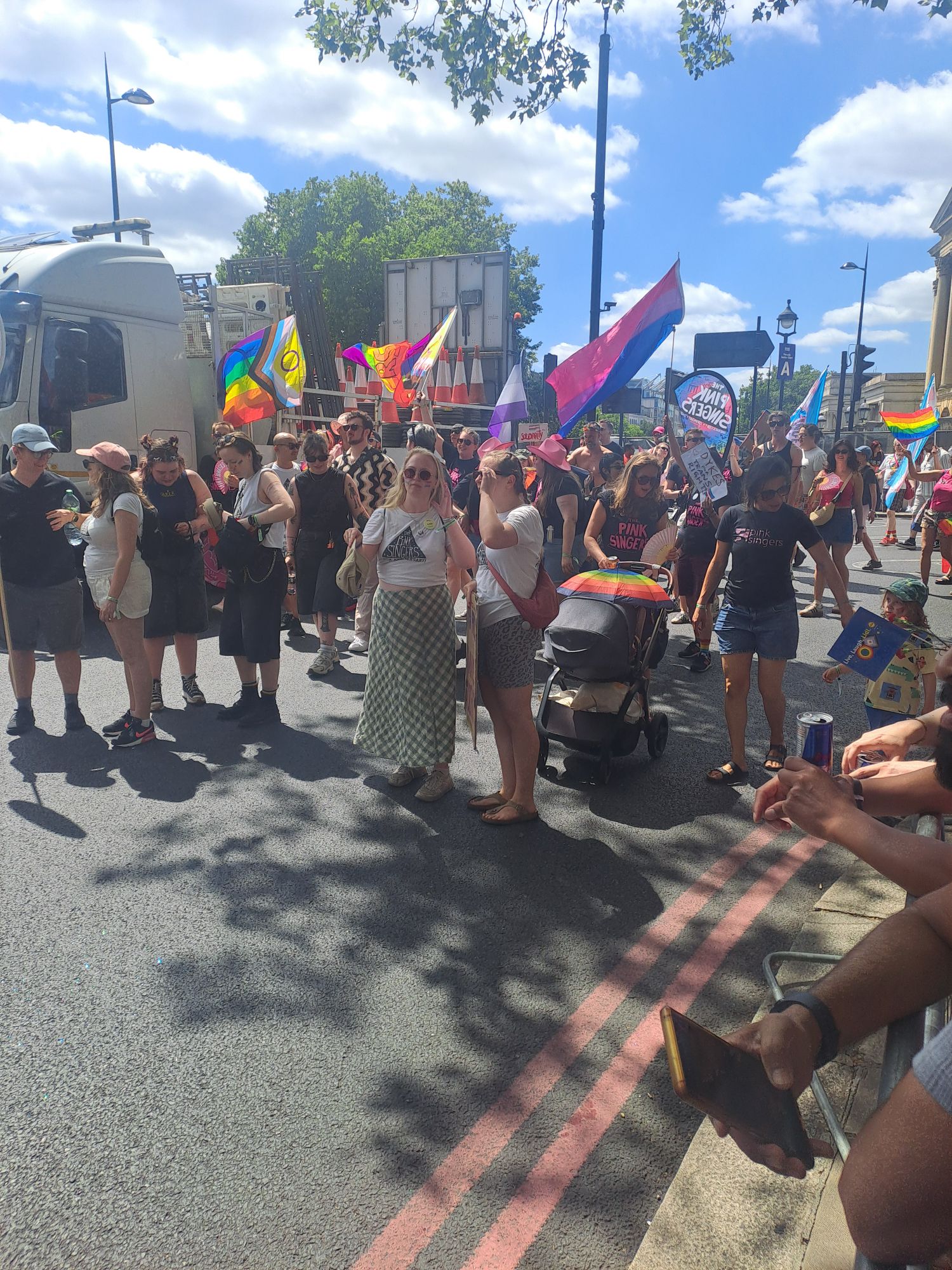
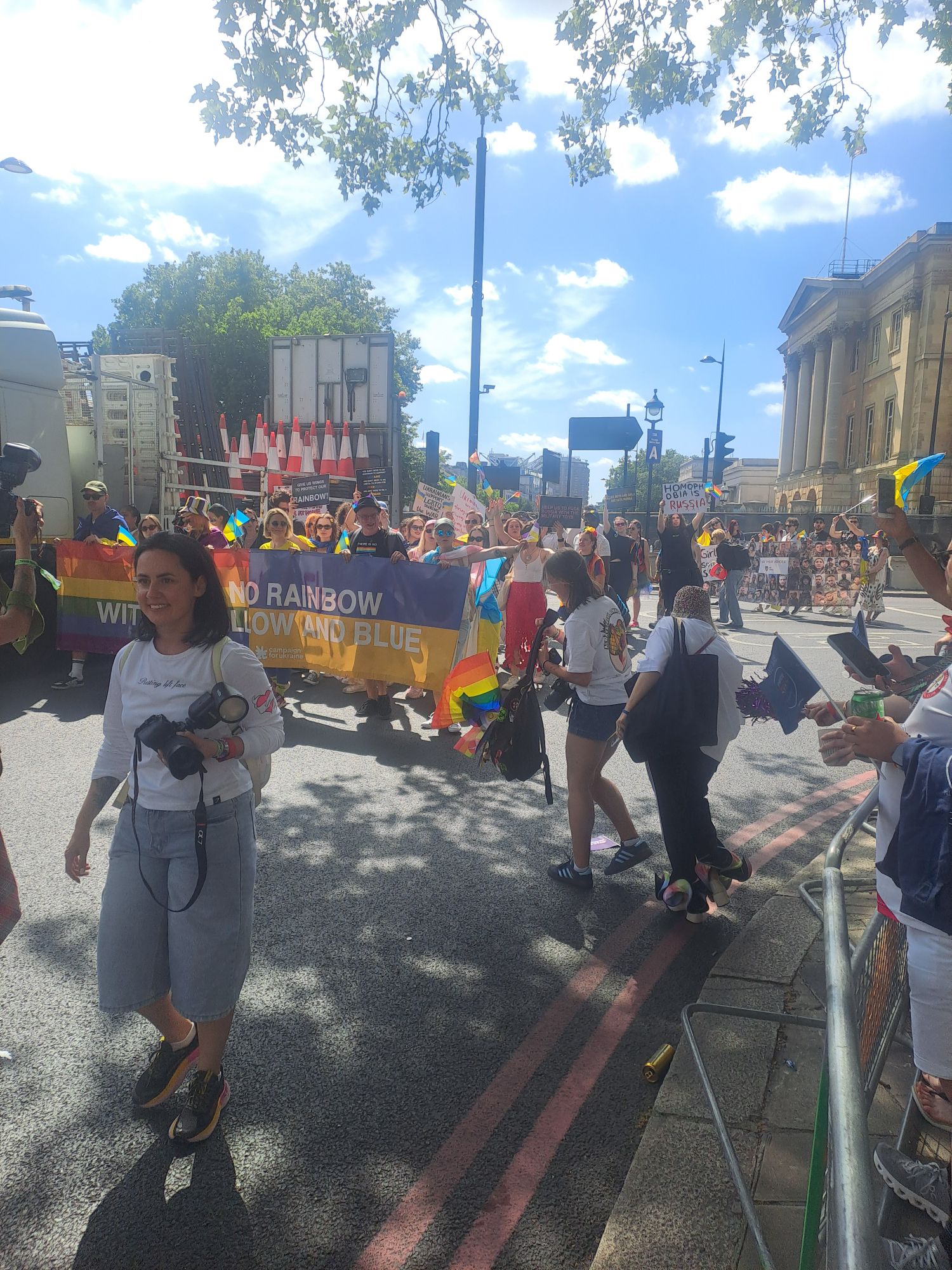
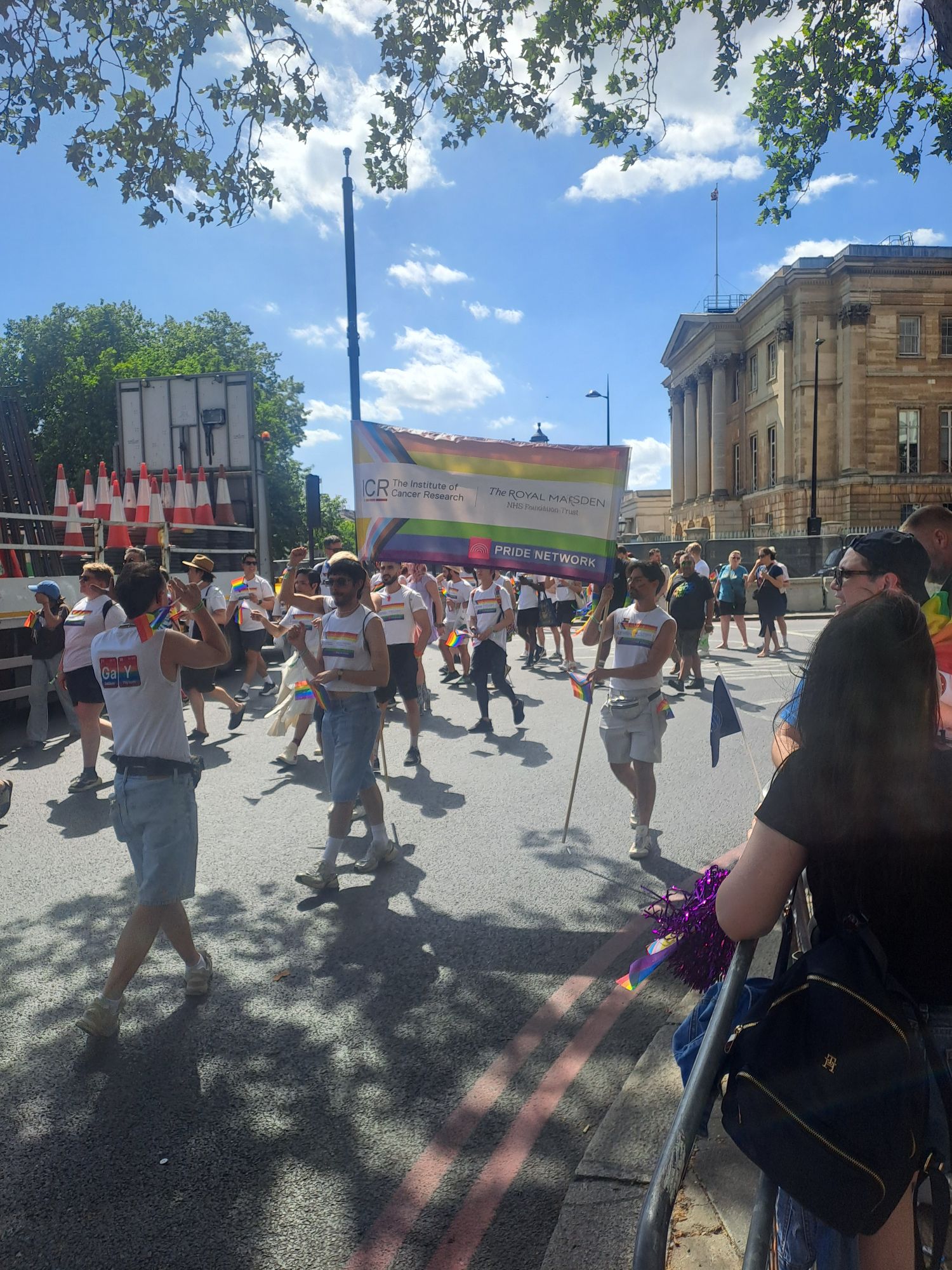
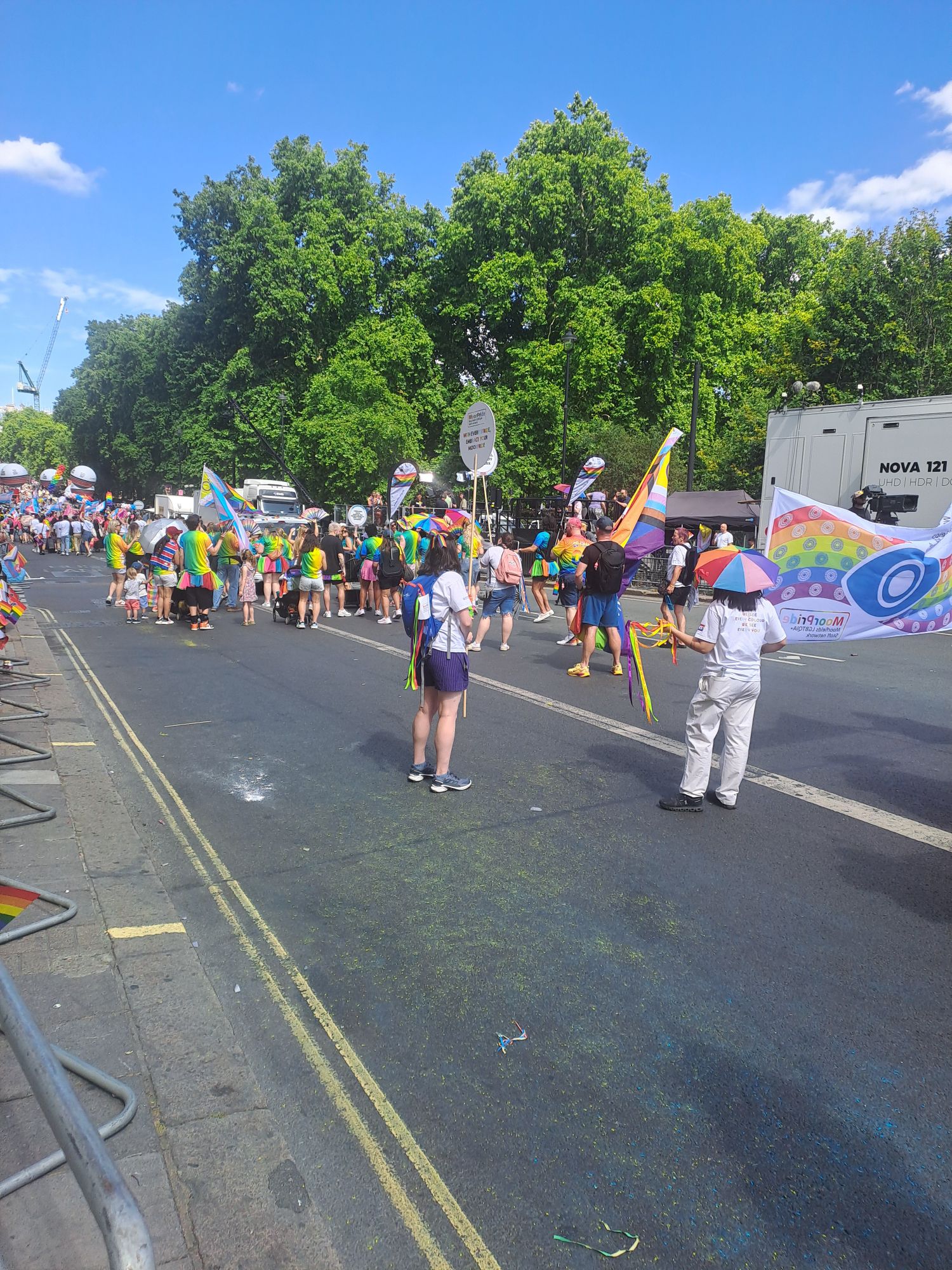
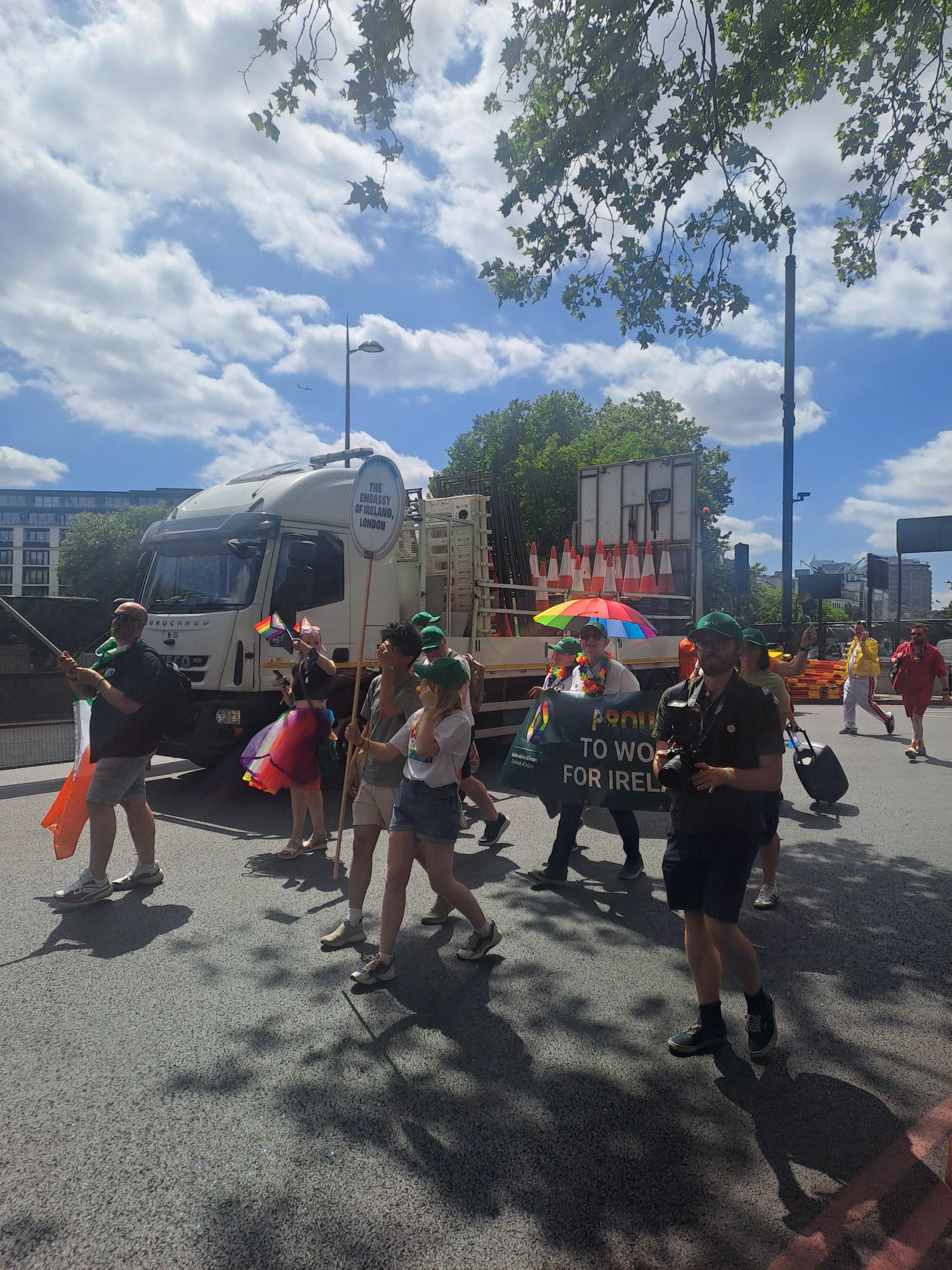
It’s been three days now since Pride in London and I think it’s time to post a few pictures to show I was actually there.
My partner took a bit of persuading to come along – he’s not out (for good reasons) and does not like the idea of having pictures on the internet. He detests social media too and, unusually for a person his age, has no instagram or tiktok or anything else.
He thought it would be hard to avoid being pictured. Anyway, we found a fairly unobtrusive spot and although he was a bit nervous at first he soon relaxed and started to enjoy it. Some people took pics of the crowds lining the route, but there was a convenient tree for him to hide behind. We stayed several hours, actually, and the parade was still passing our place at the end of Piccadilly when we left, so it must have been a very long parade.
A wonderful thing happened, halfway through our stay at the Parade: we held hands in public for the first time. That may not seem much but it meant a great deal to me. I often hear people saying that Pride is no longer needed, but remember that not everyone has an understanding family or grew up in an accepting environment. It’s taken two and a half years to get this far. It’s not the sort of “progress” that the “pride progress” flag is supposed to represesent, but it’s progress nonetheless.
I spent today in London, wandering about and visiting various locations I haven’t seen for a while, including the Science Museum (near where I’m staying) and Tate Modern (not near where I’m staying). The Science Museum has changed quite a bit since my last visit there many moons ago, but it still reminded me of Toby Esterhase’s description in Smiley’s People:
In the Science Museum, top floor. All those airplanes. Lot of kiddies eating crisps.
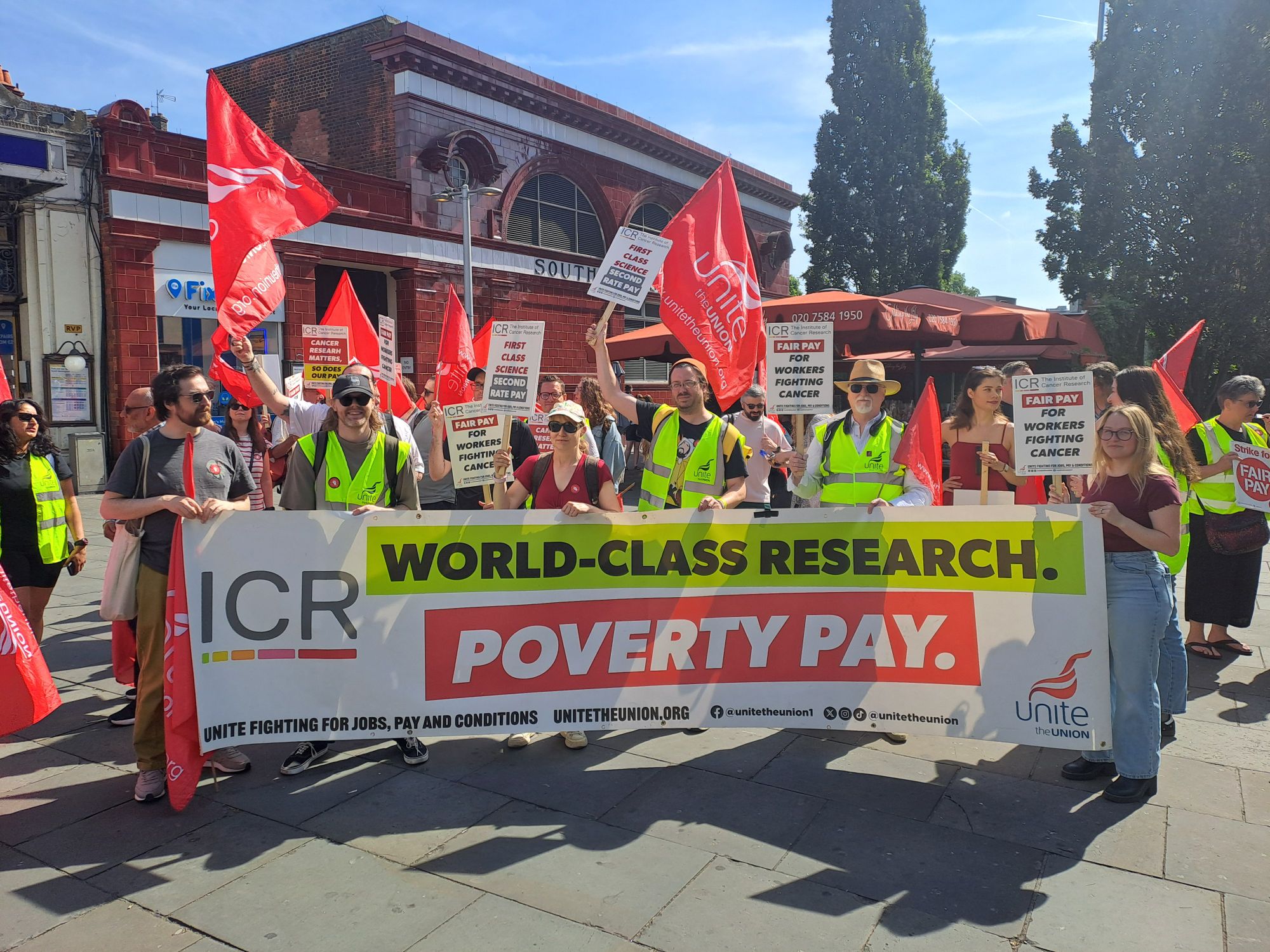
There was indeed a lot of kiddies, this being peak season for school trips, and the aeroplanes are still there. On the way from the Science Museum to Tate Modern, I bumped into some members of the union Unite from the Institute of Cancer Research who were at outside South Kensington tube station protesting about pay and conditions, and promised to send a message of solidarity on social media, which I hereby do.
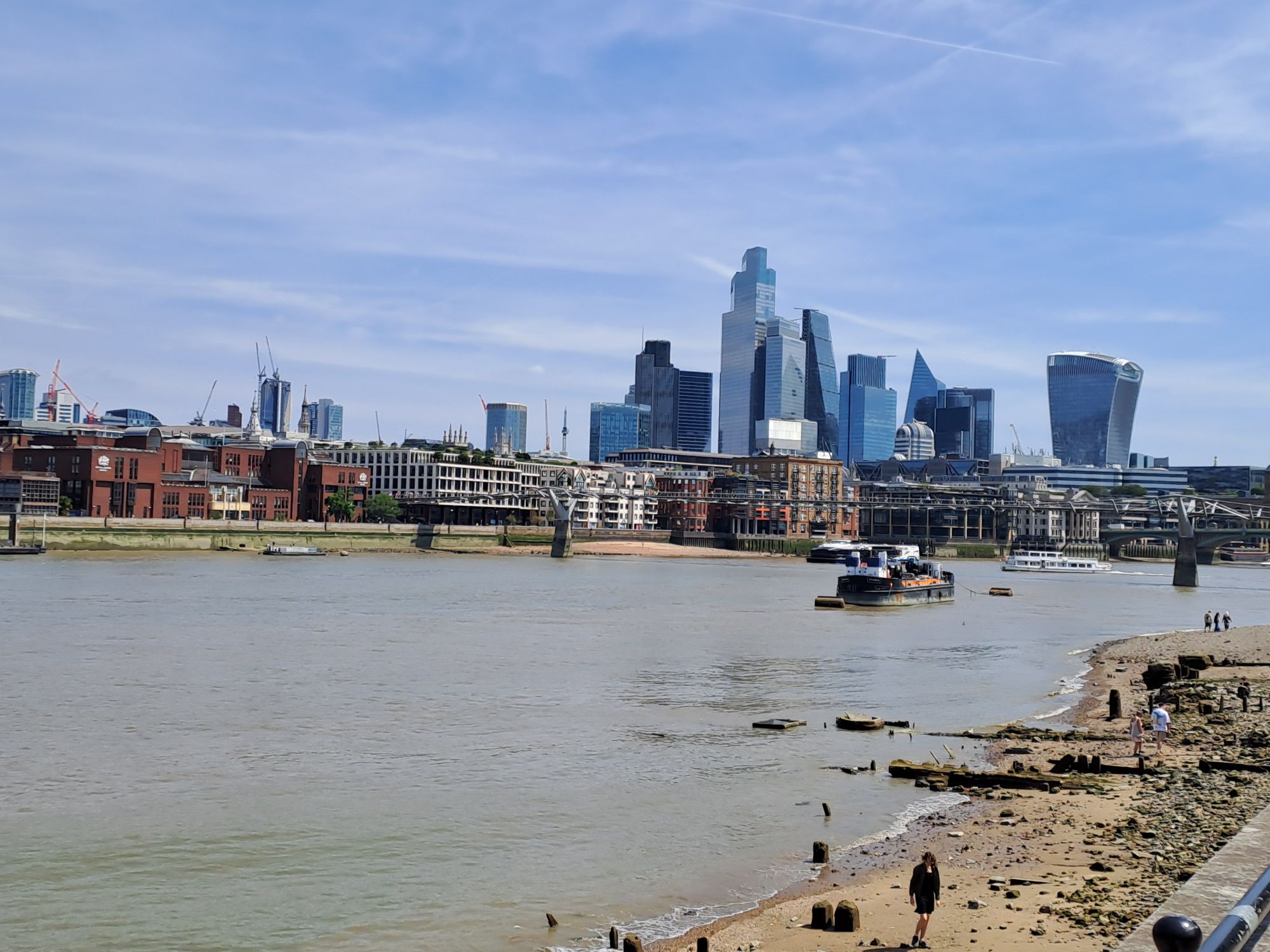
Unite MembersOn the way to Tate Modern
Tate Modern was really good, if also busy with a lot of kiddies. I particularly enjoyed The Tanks, in one of which there is an eerily lit exhibition of Giacometti scupltures and another an installation by Nora Chipaumire called Gadzi, which includes sculpted and audio elements between which you can sit or move around. One of the interesting things about installations like this is watching what other people do: some were sitting on the large loudspeakers playing the music, others moving around to experience changes in the sonic experience.
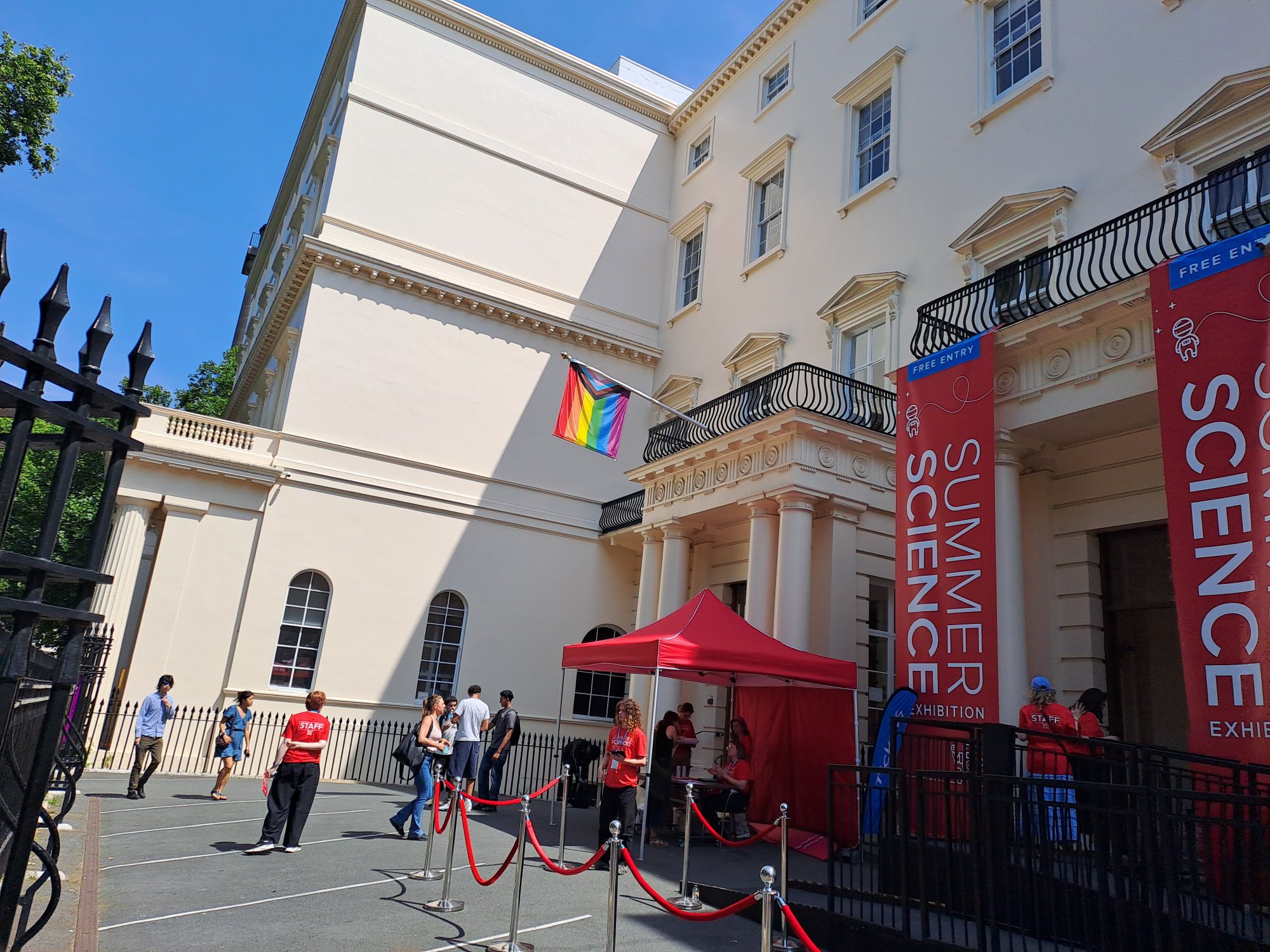
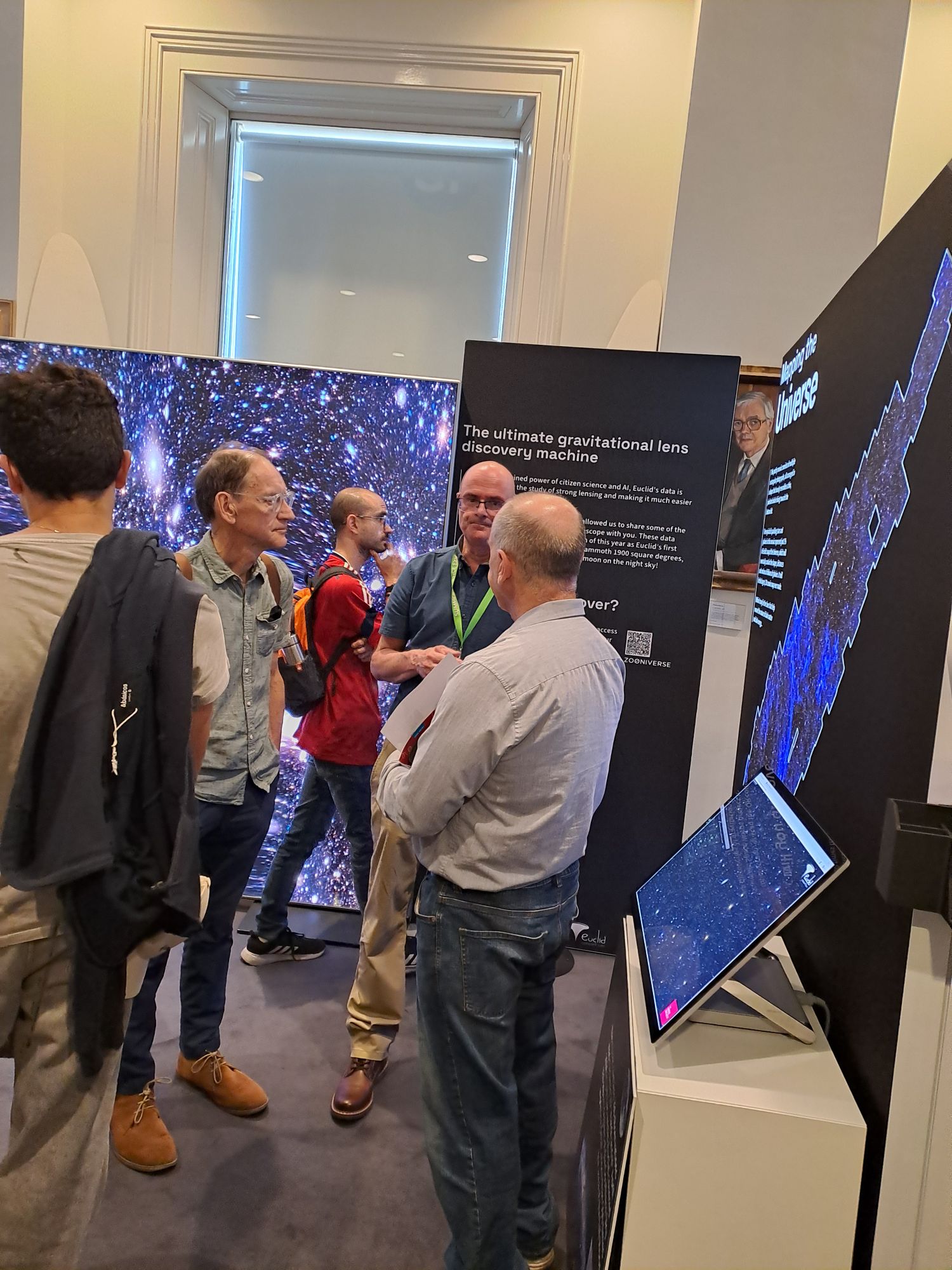
After Tate Modern I dropped in at the HQ of the Elon Musk Appreciation Society Royal Society in Carlton House Terrace. This is the time of year for the annual Summer Science Exhbition. Note the Pride Progress flag flying outside. Inside was another lot of kiddies but quite a few adults too. Out of the thirteen exhibits, three were directly relevant to my own science area: one from the Simons Observatory, one from Durham University about galaxy formation simulations, and also one from Euclid. Here is Andy Taylor from Edinburgh at the latter, explaining B-modes to visitors:
The Pride Progress flag reminds me to explain, as if you hadn’t realized, that tomorrow (4th July) is the day of the Pride in London parade. Having a meeting to attend this week and another thing to do in London next week, it proved impossible to resist staying over the weekend. Now I’ll have to finish this blog as I have to meet a certain person off the train who is coincidentally flying in especially tonight to stay with me for this very special weekend.
P.S. It was very warm today, and set to get even warmer going into next week…
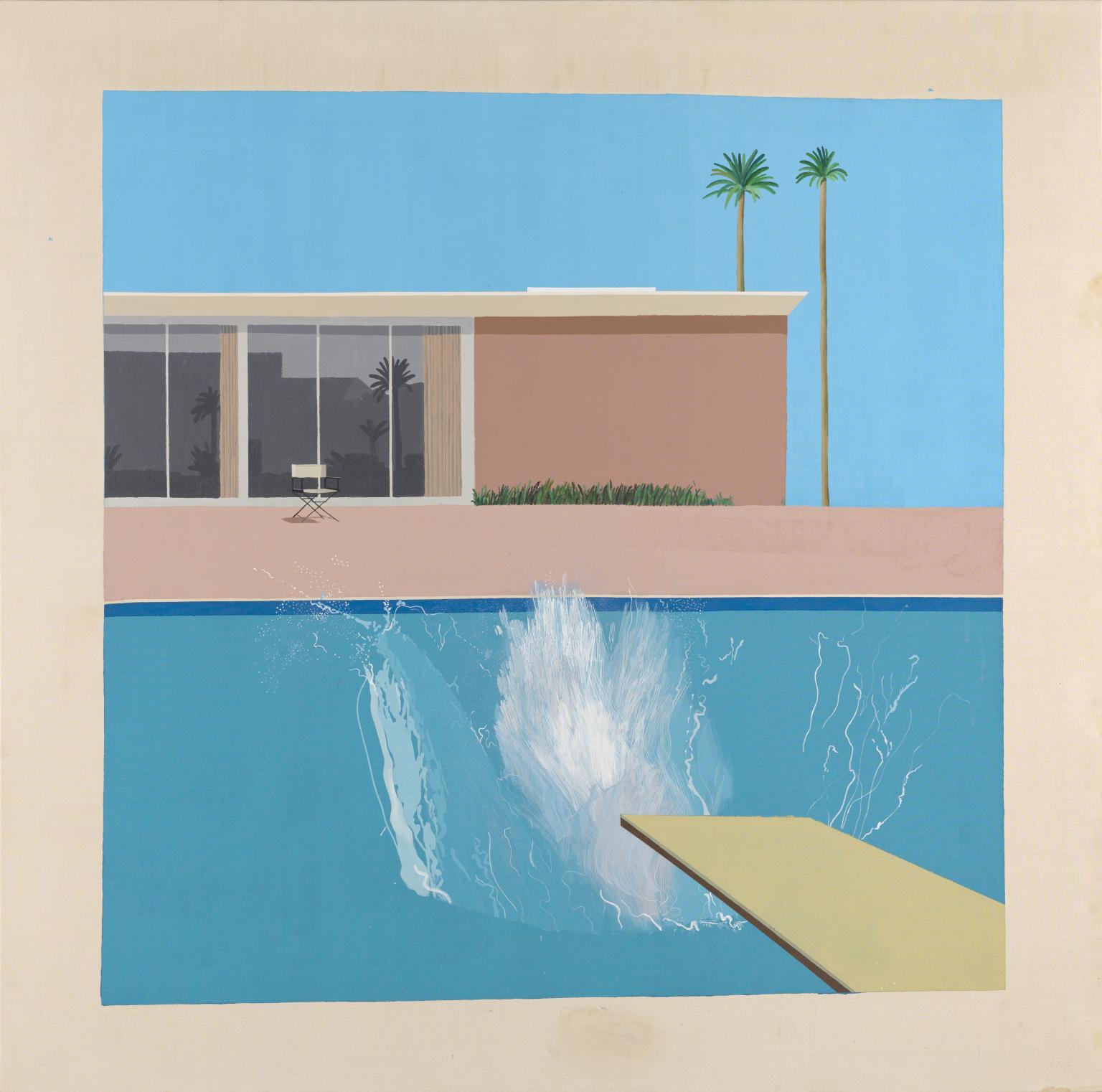
Today brought sad news of the death of artist David Hockney at the age of 88. Hockney was one of the leaders in the pop art movement, which involved assimilating and distilling ideas from popular culture and his career spanned painting, drawing, photography, printmaking and stage design. The last exhibition I saw by him consisted of wonderful drawings done on an IPad. That was about 15 years ago; he remained remarkably active and productive well into old age.
Throughout his career, Hockney’s work was often inspired by his fascination with light, especially its interplay with water, as well as his unique sense of space and unusual use of colour. His most famous early expressions of these were realised in California, where he became obsessed with the bright sunshine and the plethora of swimming pools.
As Hockney’s fame grew his work became very collectible, commanding huge prices at auction, so much of it ended up in private collections. This large-scale work, A Bigger Splash, painted in 1967, followed a smaller painting, The Splash (1966). The earlier work fetched around $30M at auction and is in a private collection, but A Bigger Splash can be seen at Tate Britain. The spare composition and distinctive palette are his instantly recognisable trademarks.
A Bigger Splash by David Hockney (1967, Acrylic on Canvas, 242.5 × 243.9 cm, Tate Britain, London)
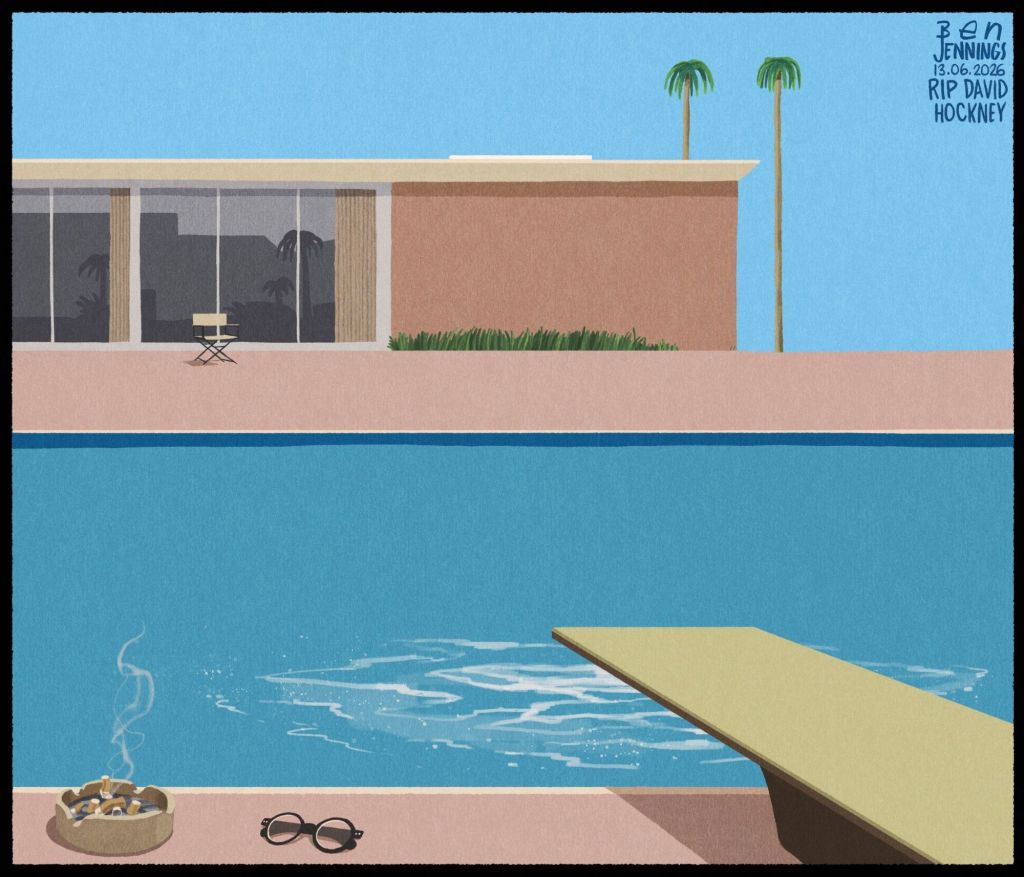
Update: here’s a very poignant cartoon by Ben Jennings.
I just watched a nice documentary programme on the Irish language channel TG4 in the series Scéalta Grá na h’Éireann (Ireland’s Greatest Loves). This one was about Lady Eleanor Charlotte Butler and the Honourable Sarah Ponsonby, often called The Ladies of Llangollen. The programme is available on the TG4 Player, actually, and it is possible I think to watch the whole thing anywhere in the world for free here. There’s also a little trailer on Youtube:
There’s an entire wikipedia page devoted to the Ladies of Llangollen, so there’s no need to reproduce it all here. However, for the sake of you who haven’t heard of them, they were. They were of Anglo-Irish extraction, both born in Ireland, and had been brought up just a few miles away from each other. They met in 1768 and immediately hit it off. They ran off together to avoid being forced into unwanted marriages, and moved to Wales in order to set up home at Plas Newydd, near Llangollen in Denbighshire, in 1780.
They lived together for the best part of 50 years in Plas Newydd, in relative seclusion, devoting their time to private studies of literature and languages and improving their estate, comprehensively redesigning the house in a Gothic style, and adding a superb garden. They did not actively socialise and town-dwellers of Llangollen seem to have regarded them as eccentrics, simply referring to them as “The Ladies”.
Gradually, their life attracted the interest of the outside world. Their house became a haven for all manner of visitors, mostly writers such as Wordsworth, Robert Southey, Shelley, Byron and Scott, but also the military leader Duke of Wellington and industrialist Josiah Wedgwood; aristocratic novelist Caroline Lamb, who was born a Ponsonby, came to visit too. Even travellers from continental Europe had heard of the couple and came to visit them, for instance Prince Hermann von Pückler-Muskau, the German nobleman and landscape designer who wrote admiringly about them.
The story of the “romantic friendship” between these two ladies is both charming and moving, but it’s also fascinating to learn how their lifestyle was accepted and even celebrated by wider society. One might have thought their relationship would have been regarded as scandalous by their contemporaries, rather than being widely admired as it turned out to be. One is tempted to assume that their “marriage” had a sexual dimension, which it may well have done, but it could have been a platonic, yet still romantic, friendship. As far as I’m concerned, that doesn’t really matter; what I find inspiring about them is that they dared to be different.
Anyway, here is the beautiful sonnet that William Wordsworth wrote after meeting the Ladies of Llangollen in 1824, although I believe the Ladies took exception to the description of their magnificent house as a “low-roofed cot”!
A stream, to mingle with your favourite Dee, Along the vale of meditation flows; So styled by those fierce Britons, pleased to see In Nature's face the expression of repose; Or haply there some pious hermit chose To live and die, the peace of heaven his aim; To whom the wild sequestered region owes At this late day, its sanctifying name. Glyn Cafaillgaroch, in the Cambrian tongue, In ours, the Vale of Friendship, let 'this' spot Be named; where, faithful to a low-roofed Cot, On Deva's banks, ye have abode so long; Sisters in love, a love allowed to climb, Even on this earth, above the reach of Time!
Today, 1st June, has been (and indeed continues to be for a few hours) the June Bank Holiday (Lá Saoire i mí Mheitheamh) in Ireland. It is the equivalent of the usual May Bank Holiday in the UK in that both have their origin in the old festival of Whitsuntide (or Pentecost) which falls on the 7th Sunday after Easter. Because the date of Easter moves around in the calendar so does Whit Sunday, but it is usually in late May or early June. Pentecost was actually on Sunday 24th May this year. Here in Ireland the Bank Holiday is always on the first Monday in June whereas on the other side of the Irish Sea it is on the last Monday in May. This year the weather was better last Monday, but you can’t have everything.
Although I’m only at beginners’ level in Irish, the phrase Lá Saoire i mí Mheitheamh gives me another chance to bore you about it. It’s actually quite a straightforward phrase until you reach the last word. “Lá” means “day” and “Saoire” means “leave” or “vacation” so “Lá Saoire” means “holiday”; “i” is a prepositional pronoun meaning “in” and “mí” means “month”. So far so good.
The word for June, however, is Meitheamh (at least when it is in the nominative singular case). Irish is an inflected language, which means that words change form according to their grammatical function. As an Indo-European language, Irish is distantly related to Latin which has six grammatical cases for nouns (actually seven if you count the rarely used locative case). Irish has only four cases – there’s no ablative and, curiously, no distinction between nominative and accusative. That leaves nominative, dative, genitive, and vocative. The dative – used after simple prepositions – is only rarely distinct from the nominative so basically the ones you have to learn are the genitive and the vocative.
In Latin cases are indicated by changes to the end of a word, but in Irish they involve initial mutations. In the example of “mí Mheitheamh” meaning “month of June”, requiring the genitive form of “June”, the initial consonant “M” undergoes lenition (softening) to sound more like a “v”. In old Irish texts this would be indicated by a dot over the M but in modern orthography it is indicated by writing an “h” after the consonant. This is called a séimhiú (pronounced “shay-voo” ). Note the softened m in the middle of that word too but it’s not a mutation – it’s just part of the regular spelling of the word, as is the -mh at the end of Meitheamh. There’s also a softened “t” in the middle of Meitheamh which makes it vrtually disappear in pronunciation. Meitheamh is thus pronounced something like “Meh-hiv” whereas “Mheitheamh” is something like “Veh-hiv”.
As well as being Lá Saoire i mí Mheitheamh, today is also the start of Pride Month, so let me take the opportunity to say Bród sona daoibh a chairde!
Today, 1st December, is World Aids Day, which is dedicated to raising awareness of the AIDS pandemic caused by the spread of HIV infection, mourning those who have died of the disease, and showing solidarity with those living with HIV. In my case it’s also a day for remembering how lucky I have been.
Here’s me just about to leave the house this morning with my red ribbon.
Just a quick post to point out that today is LGBTQIA+ STEM Day, which aims to celebrate to celebrate the work of LGBTQIA+ people in science, technology, engineering, and mathematics (STEM), but also to highlight the barriers still facing us.
This also provides an opportunity for me to send my best wishes to all LGBTQIA+ staff and students at Maynooth and around the world! As far as I know, my Employer is not marking this occasion. This surprises me as it is not unknown for them to engage in pinkwashing from time to time, whenever it suits them for some reason.
P.S. I’m reminded that it was 22 years ago today that Section 28 was finally repealed in England and Wales. With reactionary fforces around the world attacking our hard-won rights, it is important that we cling on to what we’ve got.
Today is National Poetry Day in the UK and Ireland but, instead of posting a poem like I usually do on this occasion, I thought I’d do a bit of reflecting on Shakespeare’s Sonnets. What prompted this is an article in the Times Literary Supplement I mentioned in a post on Monday. The cover picture shows a newly-discovered miniature by Nicholas Hilliard that is claimed to be of Henry Wriothesley, 3rd Earl of Southampton, and patron of William Shakespeare:
On the 20th May 1609, a collection of 154 Sonnets by William Shakespeare was published, which arguably represents at least as high a level of literary achievement as his plays. The “Master Mistress” in the title of the TLS article is a reference to Sonnet No. 20 in the collection, published on 20th May 1609, of 154 Sonnets by William Shakespeare, which arguably represents at least as high a level of literary achievement as his plays. Here is Sonnet No. 20 in the form usually printed nowadays:
A woman’s face with nature’s own hand painted, Hast thou the master mistress of my passion, A woman’s gentle heart but not acquainted With shifting change as is false women’s fashion, An eye more bright than theirs, less false in rolling: Gilding the object whereupon it gazeth, A man in hue all hues in his controlling, Which steals men’s eyes and women’s souls amazeth. And for a woman wert thou first created, Till nature as she wrought thee fell a-doting, And by addition me of thee defeated, By adding one thing to my purpose nothing. But since she pricked thee out for women’s pleasure, Mine be thy love and thy love’s use their treasure.
The somewhat androgynous facial appearance of Henry Wriothesley – seen in other portraits – has led some to suggest that the above Sonnet was addressed to him. Others think that the poem was addressed to a young male actor (a “boy player“) who played female roles on the stage, as was usual in Shakespeare’s time. It was illegal for women to perform on stage until 1660.
The dedication in the First Folio edition of the Sonnets, published in 1609, is shown on the left. The initials “T.T.” are accepted to stand for the name of the publisher Thomas Thorpe but the identity of “Mr. W.H.” is unknown. Of course “W.H.” is a reversal of the “H.W. ” that could be Henry Wriothesley, but would the publisher really use “Mr” to refer to a member of the nobility? Another curiosity is the prevalence of full stops, which is more characteristic of inscriptions carved in stone than on printed pages.
The First Folio edition was the only edition of the Sonnets published in Shakespeare’s lifetime and the circumstances of its publication remain uncertain to this day and not only because of identity of “Mr W.H.” For example, if it was authorised by Shakespeare, why did Shakespeare himself not write the dedication? Some have argued that it must have been published posthumously, so Shakespeare must have been dead in 1609, whereas most sources say he died in 1616.
Most of the poems (126 out of 154) contain poetic statements of love for a young man, often called the “Fair Youth”. However, there is also a group of sonnets addressed to the poet’s mistress, an anonymous “dark lady”, which are far much more sexual in content than those addressed to the “Fair Youth”. The usual interpretation of this is that the poet’s love for the boy was purely Platonic rather than sexual in nature. If Mr W.H. was a boy player then he would have been very young indeed, i.e. 13-17 years old…
Anyway, it was certainly a physical attraction: verse after verse speaks of the young man’s beauty. The first group of sonnets even encourage him to get married and have children so his beauty can continue and not die with his death. Sonnet 20 laments that the youth is not a woman, suggesting that this ruled out any sexual contact. These early poems seem to suggest a slightly distant relationship between the two as if they didn’t really know each other well. However, as the collection goes on the poems become more and more intimate and it’s hard for me to accept that there wasn’t some sort of involvement between the two. Although homosexual relationships were not officially tolerated in 17th Century England, they were not all that rare especially in the theatrical circles in which Shakespeare worked.
Oscar Wilde wrote a story called “A Portrait of Mr. W.H.” which suggests he is a young actor by the name of “Will Hughes”. The main evidence for this is Sonnet 20.
Look at the First Folio version:
The initial capital and emphasis of “Hews” seen in line 7 is very unusual and suggests that it is a joke (one of many in this poem), in the form of a pun on the preceding “hew”. It is suggested that “Hews” is actually “Hughes”. Ingenious, but I’m not convinced. There were many other meanings of “hew” in use in Shakespeare’s time; it was a variant spelling of “ewe” for example.
We’ll probably never know who Mr W.H. was – presumably not Smith – or indeed what was the real nature of his relationship to Shakespeare but we do not need to know that to read and enjoy the poems.
I do have a fundamental misgiving, though, about the assumption that the “Onlie begetter” of these sonnets means the person to whom they are addressed, or who inspired them. That assumption entirely disregards the “Dark Lady” sequence. There are at least two addressees so neither can be the only begetter, if that is what begetter is supposed to mean.
I think it more likely Mr W.H., whoever he was, is the person who caused the collection to be created and/or published, perhaps by sponsoring the First Folio. It’s also possible that these poems may have been commissioned over the years by Mr. W.H. and/or others – experts think they were written over a period of at least 16 years – and only published together at much later date. It is indeed said that some of verses were circulated in private well before they were published, though they may perhaps have been edited or otherwise tidied up for the 1609 edition. Perhaps Shakespeare supplemented his income by writing sonnets to order?
This line of thought also took me to another question: why does everyone assume that all 126 of the “Fair Youth” sonnets are about the same person? That person is never named and only occasionally described. Some of the 126 are thematically linked, but overall it is a collection rather than a sequence. Some are humorous and some are very serious indeed. Some are downright cryptic. I think it quite possible, especially if the poems really were written over a period of 16 years, that they not all addressed to the same individual. Once you accept the evident truth that there is more than one recipient, then why not more than two?
Some have taken this even further and asked: do we really know that all 154 sonnets were written by the same person? The same question is asked about Shakespeare’s work generally. Was there really one person behind his plays, or were they collaborative efforts.
Finally, I wonder for what purpose these sonnets were written. Were they actually sent to the addressee(s) as expressions of love, like letters, or were they private meditations, like one might write in a journal?
I don’t suppose we’ll ever really know the answers to these questions, but I find it fascinating that the origin of such a famous collection is enshrouded in so many mysteries! I promise to post more of them here in due course.
While writing yesterday’s post about the evolution of languages, and the importance of genetic information in reconstructing the story thereof, I was reminded of a post I wrote a while ago about the peculiarities of my own genome, a listing of which I have on a CD-ROM at home. There’s not as much data involved as you might think: it’s effectively only about 800 MB.
Anyway, to cut a long story short, it turns out that I have the CCR5-Δ32 genetic mutation. Not only that, I have it twice over, in that I have two copies (homozygotes). I must therefore have inherited it from both parents. This mutation confers virtually complete immunity from HIV-1 infection.
The above graphic shows that more than 10% of the population in Northern Europe has this mutation in just one allele (i.e. they are heterozygotic). To get an estimate of how many have the form on two alleles (i.e. homozygotic) form you can just square that number, so around 1% or more.
It is thought that the CCR5-Δ32 mutation occurred in a single individual in Scandinavia around 1,000 years ago. When I wrote that post I tacitly assumed that it had propagated passively, i.e. without any particular selection, to the modern era. That it reached 10% of the population starting from just one individual surprised me, but I let it pass.
More recently, I came across a paper about how advances in genetics have impacted epidemiological studies. In the abstract it shows that my assumption was probably incorrect.
Algorithms of molecular evolutionary theory suggested that the CCR5-Δ32 mutation occurred but once in the last millennium and rose by strong selective pressure relatively recently to a ~10% allele frequency in Europeans.
It goes on to say this:
Several lines of evidence support the hypothesis that CCR5-Δ32 was selected due to its protective influence to resist Yersinia pestis, the agent of the Black Death/bubonic plague of the 14th century.
I didn’t mention in yesterday’s post that evidence of the plague bacillus is found in a significant number of prehistoric human remains and this almost certainly played a role in the ebb and flow of populations. In the context of CCR5-∆32, however it seems that it may have been advantageous to carry it long before the arrival of HIV/AIDS. That might account for it reaching the relatively high level that it did.
Among the downsides, however, as the article explains, are an increased risk for encephalomyelitis and death when infected with the West Nile virus. Hopefully further cohort studies of people with this mutation will help elucidate its effect on other diseases.
By the way, in contrast to most people I know, I have still never had Covid-19…
The views presented here are personal and not necessarily those of my employer (or anyone else for that matter).
Feel free to comment on any of the posts on this blog but comments may be moderated; anonymous comments and any considered by me to be vexatious and/or abusive and/or defamatory will not be accepted. I do not necessarily endorse, support, sanction, encourage, verify or agree with the opinions or statements of any information or other content in the comments on this site and do not in any way guarantee their accuracy or reliability.