Archive for October, 2010

Thatcher’s Final Victory?

Posted in History, Politics, Science Politics with tags , , , on October 16, 2010 by telescoper

Next Wednesday (20th October) we will hear the outcome of the Comprehensive Spending Review, and what it means for the scale of the cuts to UK public spending in each of the government departments. After that the detailed breakdown of cuts within each Ministry will gradually be revealed. Some news has already leaked out, of course. The Browne Report published last week almost certainly heralds huge cuts in the state subsidy to the UK University sector, with the cost of Higher Education consequently shifting from the taxpayer to the student. On top of that, and despite the best efforts of the Science is Vital campaign, it seems highly likely that there will be a steep decrease in investment in scientific research – both through the Research Councils and through the research component of Higher Education funding. On the other hand, the defence budget appears to have been spared the worst of the hatchet, with the Trident nuclear submarine programme set to go ahead (with a price tag around £25 billion) and two new aircraft carriers to be built at a cost of £5.5 billion (although it is not clear there will actually be any aircraft to operate from them).

Obviously, knowledge and learning are less important to the future of this country than the ability to fight pointless wars against invented enemies. Morover, we already spend more than most competitor economies on defence as a fraction of GDP, and less on  universities and science. How did we end up with such distorted priorities?

On top of these cuts we have to contend with a draconian cap on immigration. New restrictions on visas for non-EU citizens will make it much harder for British universities to recruit overseas students and staff. The new rules give exemptions only to those coming to the UK to take up highly paid jobs, such as professional footballers. Postdoctoral researchers and university lecturers don’t get paid enough to register as economically relevant, so many fewer will be able to enter this country. While these restrictions may satisfy xenophobic Daily Mail readers, they promise to damage the University sector almost as much as the funding cuts, as a significant fraction of the best staff in UK science departments are from outside the EU (including the two winners of the 2010 Nobel Prize for Physics).

All this sounds depressingly familiar to those of us who lived through the various Thatcher governments and their successors. In fact, looking at the following graph (which I nicked from Andy Lawrence’s blog, but which comes from a document produced by the Royal Society) you’ll see the steady reduction in science investment under previous Conservative governments

I know I’m not alone in interpreting these cuts as not being about the need to secure the country’s finances. The UK’s public debt as a fraction of GDP is rising, of course, and something needs to be done about it. But this graph shows the actual situation:


Serious? Yes, but not sufficient to justify the carnage we’re about to experience.

What is going on is that the parlous state of the UK’s finances is being used as a pretext to resume the Thatcherite attack on the welfare state through a campaign of privatisations and closures so that wealthy Tory voters can get richer at the expense of ordinary working people.

No doubt there will be people reading this who really think that cutting back state expenditure is a good thing, and even I agree with that to some extent. However, there is a part of Thatcher’s legacy that is actually the root of the problem and it represents a fundamental inconsistency of the Thatcher project. Unless it is tackled, the cut-and-burn route will not lead to a sustainable economy, but will take this country into inexorable decline.

The nub of the matter is the Invasion of the Bean Counters into every aspect of public life. The breakdown of trust between government and the public sector that ushered in Margaret Thatcher’s victory in the 1979 General Election has led to a huge increase in red tape involved in the assessment, regulation and general suffocation of public services. As the Thatcher project continued through John Major’s, and, yes, Tony Blair and Gordon Brown’s governments (Blair was undoubtedly a Thatcherite) any rises in public spending went not into providing better services but in a vast and unwieldly machinery of regulation. Now it matters less whether the public sector does things well. What matters is that they tick the boxes imposed by civil service mandarins. This mentality has led to a proliferation of overpaid administrators in the National Health Service, schools are hamstrung by the rigid constraints of the National Curriculum, the Police spend more time filling in forms than they do investigating crime, and the number of staff employed in university administration has increased at the expense of teaching and learning.

You might say that this is all the fault of New Labour, but I don’t think that’s right; the suffocation of the UK’s public sector began with Thatcher and it began as a direct result of the Winter of Discontent (a re-run of which seems eminently possible). The reason why a succession of right-wing governments have failed to get a grip on public spending is that they’ve all been run by control freaks and have pumped money into wasteful self-serving bureaucracies.

Britain has turned into a version of Golgafrincham, with the “useless third” now in the position of wielding the axe over those few remaining things in the UK which are actually pretty good.

Apparently, Margaret Thatcher is not in very good health and may not live much longer. I won’t mourn her passing. In Thatcher’s time in office, this country took giant steps towards becoming a police state. She encouraged xenophobia and intolerance, and spawned the generation of small-minded money-grabbing lizards who now occupy the Government benches. As Britain turns into a wilderness of cashable things once more, it looks like she might be set for her final victory.

Share/Bookmark


Tower of Song

Posted in Music with tags , on October 16, 2010 by telescoper


Well my friends are gone and my hair is grey
I ache in the places where I used to play
And I’m crazy for love but I’m not coming on
I’m just paying my rent every day
In the Tower of Song

I said to Hank Williams: how lonely does it get?
Hank Williams hasn’t answered yet
But I hear him coughing all night long
A hundred floors above me
In the Tower of Song

I was born like this, I had no choice
I was born with the gift of a golden voice
And twenty-seven angels from the great beyond
They tied me to this table right here
In the Tower of Song

So you can stick your little pins in that voodoo doll
I’m very sorry, baby, doesn’t look like me at all
I’m standing by the window where the light is strong
Ah they don’t let a woman kill you
Not in the Tower of Song

Now you can say that I’ve grown bitter but of this you may be sure
The rich have got their channels in the bedrooms of the poor
And theres a mighty judgement coming, but I may be wrong
You see, you hear these funny voices
In the Tower of Song

I see you standing on the other side
I don’t know how the river got so wide
I loved you baby, way back when
And all the bridges are burning that we might have crossed
But I feel so close to everything that we lost
Well never have to lose it again

Now I bid you farewell, I dont know when Ill be back
There moving us tomorrow to that tower down the track
But you’ll be hearing from me baby, long after I’m gone
I’ll be speaking to you sweetly
From a window in the Tower of Song

Yeah my friends are gone and my hair is grey
I ache in the places where I used to play
And I’m crazy for love but Im not coming on
I’m just paying my rent every day
Oh in the Tower of Song


Share/Bookmark

Has your MP signed EDM 767?

Posted in Politics, Science Politics with tags , on October 15, 2010 by telescoper

One of the interesting curiosities of the British parliamentary system is the Early Day Motion (EDM), which is a brief motion to be debated at an unspecified date in the future. Few of them ever get debated and they remain open for signature throughout a parliamentary session.

Early Day Motion 767 relates to the Science is Vital Campaign. It was tabled on 16th September 2010 and the text is as follows:

That this House notes the UK’s proud history of excellence in science and engineering, whereby it produces over 10 per cent. of global scientific output with just one per cent. of global population; believes that continued investment in research is vital in order to meet the technological and social challenges of the 21st century, and to continue to attract high-tech industries to invest in the UK; further believes that large cuts to science funding are a false economy, due to evidence that research investment fuels economic growth; further notes the increased investment in science by the UK’s international competitors, such as the USA, France and Germany; further believes that investment in research and development is vital to help rebalancethe economy towards hi-tech manufacturing and away from over-reliance on financial services; recognises the work of the Science is Vital coalition and the Campaign for Science and Engineering in arguing that the UK should seek to retain its role as a world leader in these fields; and calls on the Government to safeguard the UK’s scientific excellence by providing a research investment strategy which builds on the success of UK science and engineering.

(The rules require that at EDM be a single sentence, but often, as in this case, the sentences are somewhat lengthy.)

It was tabled by Julian Hippert, and has so far attracted 81 signatures, which is good going for such things.  The following MPs have signed EDM 767.

Is yours among them?

If not, I think you know what to do….

Huppert, Julian
Onwurah, Chi
Morris, David
Bottomley, Peter
Wright, Simon
Mulholland, Greg
Sanders, Adrian
Smith, Robert
Hughes, Simon
Jackson, Glenda
Jamieson, Cathy
Kaufman, Gerald
Kennedy, Charles
Lucas, Caroline
Cunningham, Jim
Cunningham, Tony
Dobbin, Jim
Doherty, Pat
Field, Frank
Foster, Don
Gapes, Mike
George, Andrew
Abbott, Diane
Hamilton, Fabian
Twigg, Stephen
Anderson, David
Hodgson, Sharon
Burt, Lorely
Johnson, Diana R
Leech, John
Soulsby, Peter
McGovern, Jim
Morden, Jessica
Williams, Stephen
Gilmore, Sheila
Hames, Duncan
Alexander, Heidi
Berger, Luciana
Henderson, Gordon
Hunt, Tristram
Lloyd, Stephen
McKinnell, Catherine
Mearns, Ian
Metcalfe, Stephen
Fovargue, Yvonne
Morrice, Graeme
Mowat, David
Murray, Ian
Reid, Alan
Hopkins, Kelvin
Osborne, Sandra
Brennan, Kevin
Campbell, Menzies
Caton, Martin
Clarke, Tom
Connarty, Michael
Donaldson, Jeffrey
Francis, Hywel
Hancock, Mike
Beith, Alan
Watson, Tom
Williams, Roger
Slaughter, Andy
Green, Kate
Creasy, Stella
Swales, Ian
Lazarowicz, Mark
McCrea, Dr William
Campbell, Ronnie
Corbyn, Jeremy
Ellman, Louise
Flynn, Paul
Vaz, Keith
Williams, Hywel
Banks, Gordon
Horwood, Martin
Sharma, Virendra
Chapman, Jenny
Blenkinsop, Tom
Dromey, Jack
Morris, Grahame M

UPDATE: The following 11 have signed since yesterday:

Meale, Alan
Brake, Tom
Brooke, Annette
Brown, Russell
Dowd, Jim
Main, Anne
O’Donnell, Fiona
Blomfield, Paul
Sarwar, Anas
Vaz, Valerie
Dakin, Nic


Share/Bookmark

STFC Budget 2010-11

Posted in Finance, Science Politics with tags , , on October 14, 2010 by telescoper

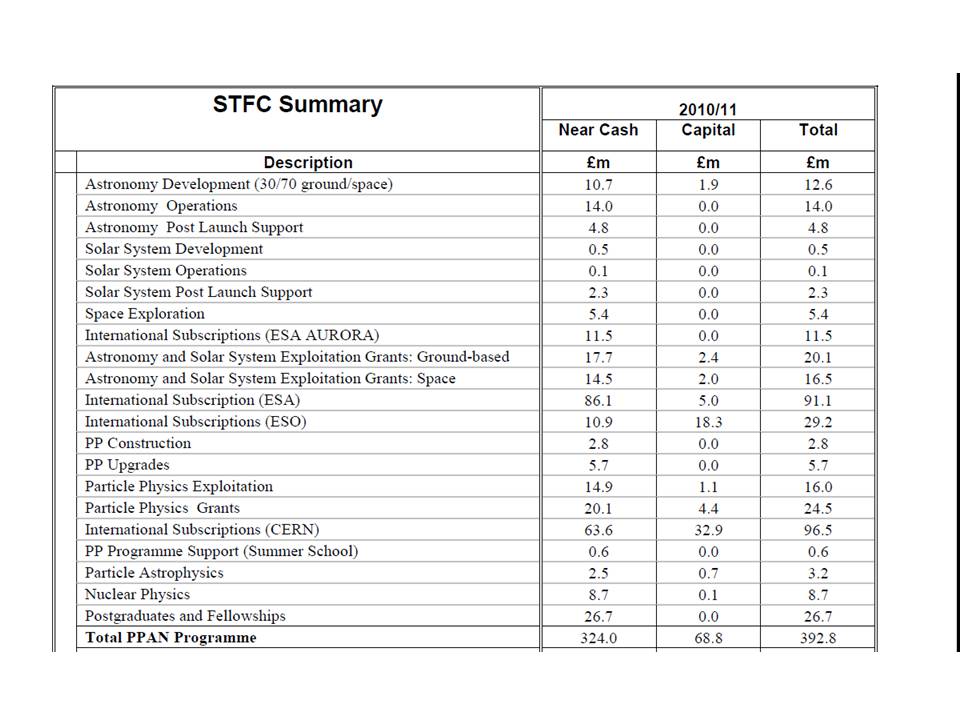
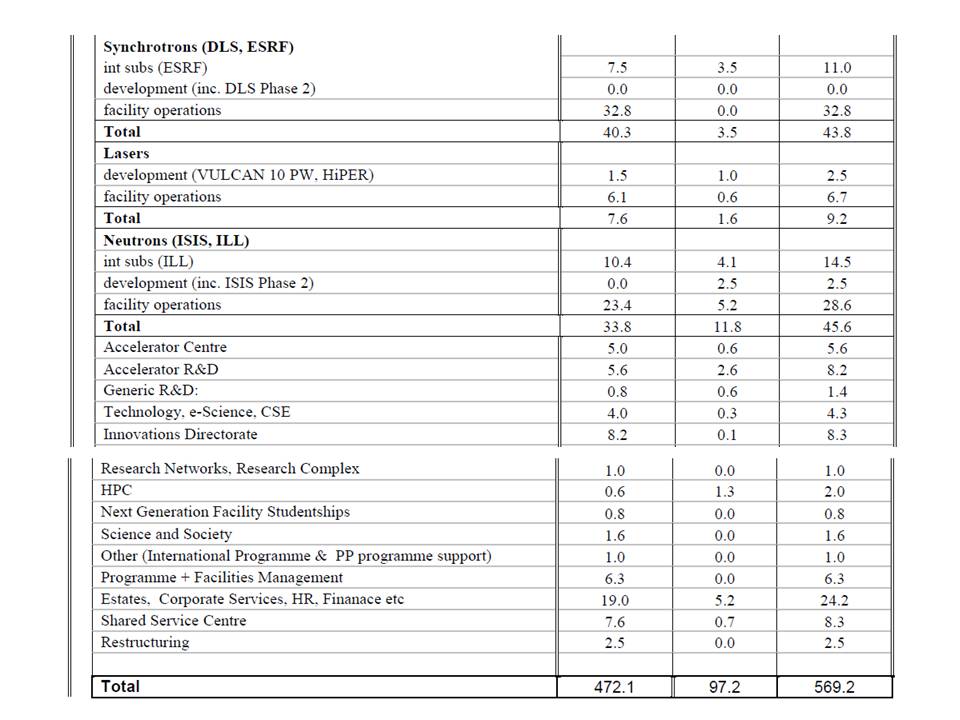
Just a quick post to point out that the Science and Technology Facilities Council have released a reasonably complete breakdown of their current budget. I’m sure many readers working in astronomy and particle physics will find it interesting reading, though others will probably find it incredibly boring.

Here it is, for easy reference, in bits, generated by a clumsy cut-and-paste-technique wholly unbefitting the hi-tech nature of STFC, starting with the PPAN Programme:

and now the rest

For those of you not up with the accounting lingo, “near cash” means assets investments and other things that could in principle be exchanged for cash in a relatively short period of time.

These are, of course, the figures before the impending cuts take place….

There’s a much more legible version of the whole thing here.


Share/Bookmark

The Normal Heart (reblog)

Posted in Uncategorized on October 14, 2010 by telescoper

I thought I’d re-post this poem by WH Auden which I put up about a year ago on the anniversary of the outbreak of World War 2. We’re in a different kind of struggle now, but his words are no less apt for that.

It’s now exactly 70 years since the start of World War Two, as it was on this date in 1939 that Germany invaded Poland. On hearing the news, WH Auden composed this poem. Although the poet himself grew to dislike it, it became one of his most famous poems and has many resonances still in today’s world. September 1st, 1939 I sit in one of the dives On Fifty-second Street Uncertain and afraid As the clever hopes expire Of a low dishonest decade: Wav … Read More

via In the Dark

The Browne Stuff

Posted in Education, Finance, Politics with tags , , on October 13, 2010 by telescoper

I’m basically in purdah this week, shuttling to and fro between Cardiff and Swindon on the business of the STFC Astronomy Grants Panel. However, I couldn’t resist a brief early morning post about yesterday’s news about the report on higher education funding by Lord Browne. I haven’t had time to read the report in full, so won’t comment in detail on it, but a few things did strike me from what I’ve picked up from the media. Perhaps others will add their views through the comments box.

  • For a start it’s quite amusing how far wide of the mark most of the rumour-mongering about the report’s recommendations has been. In fact the proposals are far more radical than had been touted.
  • The suggestion of lifting the cap on fees entirely, and allowing universities to decide how much to charge for tuition, will delight the so-called “elite” universities, but will alarm those (like me) who worry about the impact on students from poorer backgrounds. Most difficult, however, as far as I’m concerned will be the impact on middle-grade universities who won’t know where to pitch themselves in the free market that such a move would create. We know that Oxbridge will be able to get away with charging pretty much whatever they like, and many of the former polytechnics will clearly go for the budget end of the market, but in between there will be tricky decisions to make.
  • The increased fee is to be offset by a cut of a whopping 80% (from £3.5bn to £0.8bn) in the teaching grant to English universities. A cut of this scale may well mean that some courses do not receive any direct contribution from the taxpayer at all (the so-called “unit of resouce”). If this goes ahead it will undoubtedly lead to course closures across the country. Although I would oppose a blanket cut of this scale, I’m not against the idea of withdrawing support from Mickey Mouse courses and concentrating it on important subjects.
  • It seems likely, and indeed there are already signs, that full implementation of the Browne proposals will be politically difficult for the ConDem coalition.  In fact, unless some of the recommendations are diluted, this may well lead to a full-scale revolt. We’ll have to wait and see.
  • Vince Cable has endorsed the report, despite his own party’s previous opposition to raising tuition fees. Any resisual respect I had for him is going down the plughole very rapidly indeed.
  • Finally, I’ll just point out that, even if they are fully implemented, the draconian cuts to English higher education funding are not necessarily going to be replicated here in Wales (or in Scotland or Northern Ireland). The Welsh Assembly has issued a statement on the Browne report, but clearly doesn’t know what to do about it. If they make good decisions now, Welsh universities could prosper by bucking the English trend, but if they get it wrong….

Anyway, that’s all for this am. Got a train to catch!


Share/Bookmark

O World of Many Worlds

Posted in Poetry, The Universe and Stuff with tags , , on October 12, 2010 by telescoper

You probably don’t associate the poet Wilfred Owen (1893-1918) with cosmology or astrophysics, as his poems were almost exclusively about the horror of war. This one, however,  which was begun in 1913, before the First World War broke out – Owen himself enlisted in 1915 –  will surely strike several chords with those interested in the use of the phrase Many Worlds in other contexts, and it also contains a number of astronomical references.

O World of many worlds, O life of lives,
What centre hast thou? Where am I?
O whither is it thy fierce onrush drives?
Fight I, or drift; or stand; or fly?

The loud machinery spins, points work in touch;
Wheels whirl in systems, zone in zone.
Myself having sometime moved with such,
Would strike a centre of mine own.

Lend hand, O Fate, for I am down, am lost!
Fainting by violence of the Dance…
Ah thanks, I stand – the floor is crossed,
And I am where but few advance.

I see men far below me where they swarm…
(Haply above me – be it so!
Does space to compass-points conform,
And can we say a star stands high or low?)

Not more complex the millions of the stars
Than are the hearts of mortal brothers;
As far remote as Neptune from small Mars
Is one man’s nature from another’s.

But all hold course unalterably fixed;
They follow destinies foreplanned:
I envy not these lives in their faith unmixed,
I would not step with such a band.

To be a meteor, fast, eccentric, lone,
Lawless; in passage through all spheres,
Warning the earth of wider ways unknown
And rousing men with heavenly fears…

This is the track reserved for my endeavour;
Spanless the erring way I wend.
Blackness of darkness is my meed for ever?
And barren plunging without end?

O glorious fear! Those other wandering souls
High burning through that outer bourne
Are lights unto themselves. Fair aureoles
Self-radiated these are worn.

And when in after times those stars return
And strike once more earth’s horizon,
They gather many satellites astern,
For they are greater than this system’s Sun.


Share/Bookmark

Astronomy Look-alikes, No. 41

Posted in Astronomy Lookalikes with tags , , , on October 11, 2010 by telescoper

Not a lot of people know that the late great British astrophysicist Sir Fred Hoyle was in fact born in Royston Vasey and has many famous relatives from the same place.

Edward Tattsyrup

Sir Fred Hoyle

A Brush with Columbo

Posted in Columbo with tags , on October 10, 2010 by telescoper

I bumped into a few people I haven’t seen for a while at the rally yesterday, and quite a number of them told me off for not posting more updates about my old moggy, Columbo. Suitably chastened, I decided to put up a couple of snaps today. I was actually away Friday night and most of Saturday so had had to arrange for Columbo to be looked after by a professional catsitter so he could get his insulin jabs on Friday night and Saturday morning. Although the catsitter I use is very reliable, I always worry a little bit when I’m not there as I think he gets a little bit lonely.

As a treat for him, I stopped in a shop and bought him a bit of fish before I got on the train in Paddington. It was very cheap because they were about to close but I’m sure Columbo didn’t know that. Two and a half hours later when I got home it had certainly started to pong a bit, but that merely served to drive Columbo wild with anticipation.

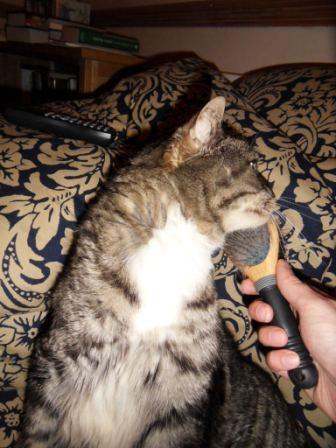
I gave him his insulin as he scoffed the fish, sounding more like a pig than a cat – the combination of eating and purring noises is not all that pleasant. After he was done and had established that there really wasn’t any more, he joined me on the sofa for his favourite after-dinner pastime: getting brushed. He loves getting the metal brush over his head and face and often grabs the thing himself just to do it that little bit better.

After a good going over he looked quite a lot smarter and adjourned to the floor for a sleep. I think he’d forgiven me for leaving him alone for so long because, unusually, he didn’t try to eat the newspaper as I did the Guardian crossword.

Science (still) is Vital

Posted in Politics, Science Politics with tags , , on October 9, 2010 by telescoper

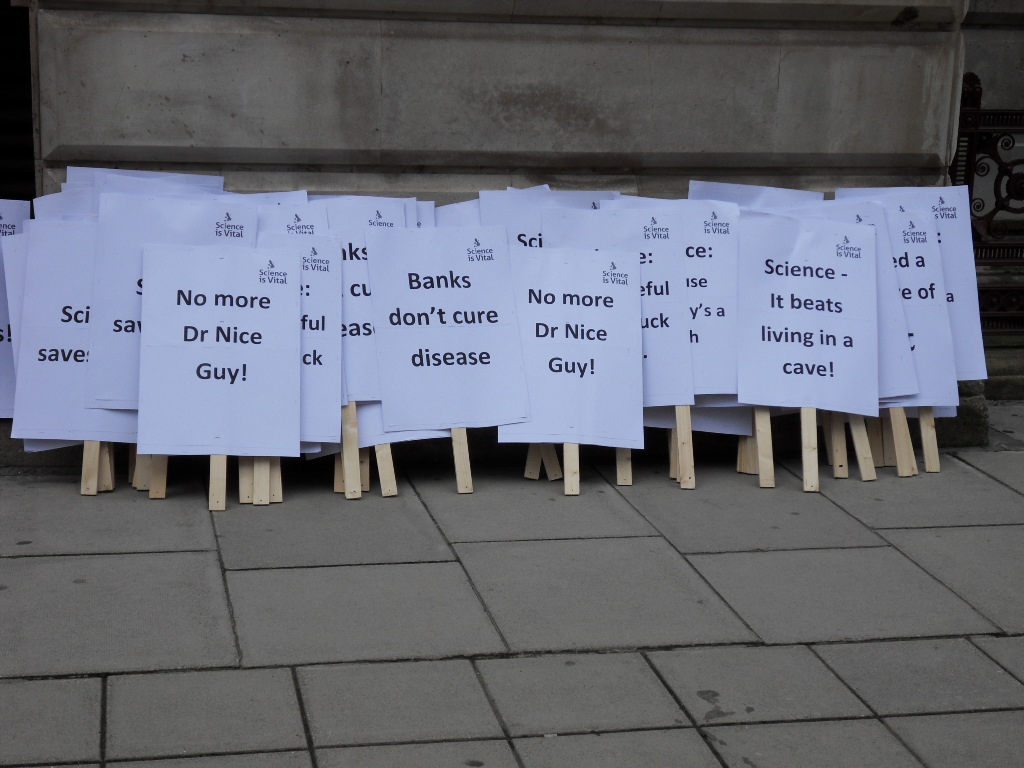
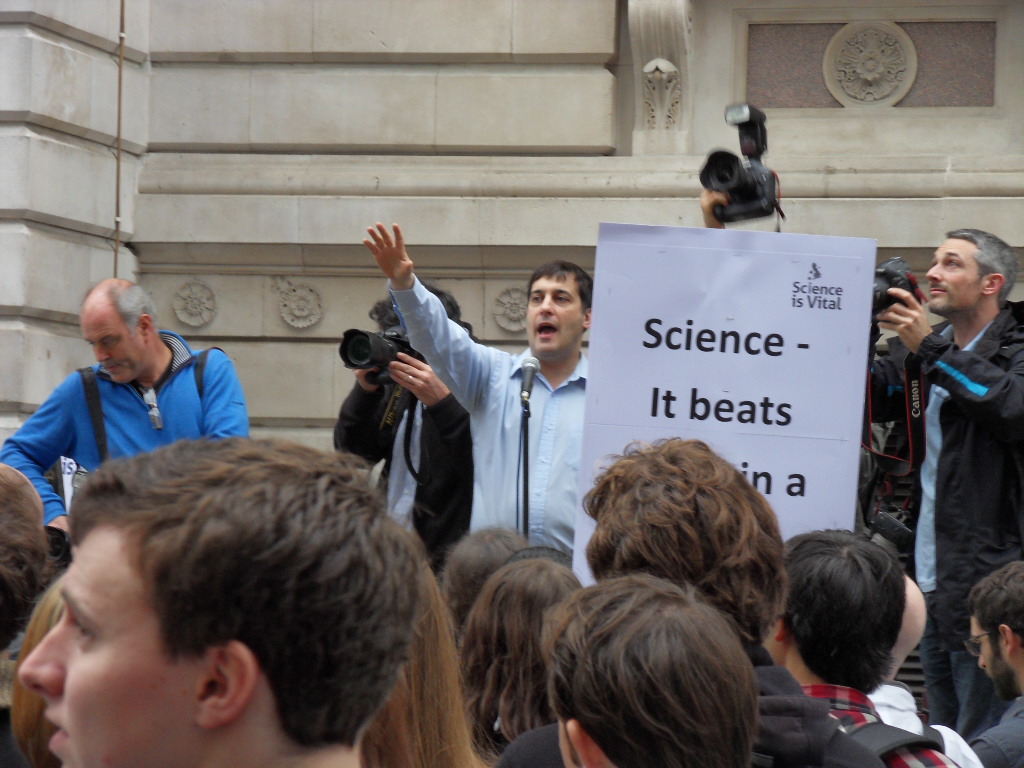
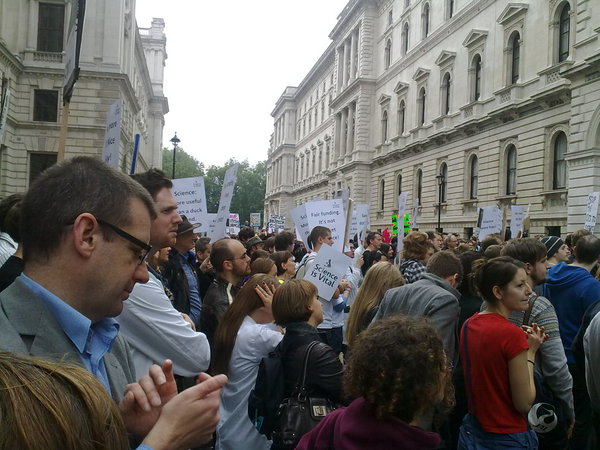
Just back from the Science is Vital rally in Whitehall, which was attended by an estimated 2000 people. I’m actually pretty tired after a late night in town following yesterday’s Royal Astronomical Society meeting and dinner at the Athenaeum after that, not to mention later events…

Anyway, I’m going to catch up with some quality Columbo time so I’ll just post a few snaps to prove I was there!

Just before the rally

A fellow astronomer, whose name I didn’t catch!

Rather unfortunate pose by Dr Evan Harris; he’s not a Nazi, honest!

Ben Goldacre, complete with anorak…

And here’s me in mid-tweet on the left of the picture, in front of the Treasury building and facing the Foreign & Commonwealth Office (to the right).

Picture taken by Paul Crowther


Many congratulations to those who organized the rally at such short notice, especially Jenny Rohn. The only thing I’d say here is that, although this was a truly inspiring and enjoyable occasion, if the campaign is going to make any lasting difference this must be the start not the finish…


Share/Bookmark