Archive for December, 2010

The Gaskell affair (via The e-Astronomer)

Posted in Uncategorized on December 21, 2010 by telescoper

I thought I’d reblog the following post from Andy Lawrence. I think it will be of interest to readers here because it relates to a very important issue. If you would like to read the full article please follow the link to Andy’s original post…

Yesterday I saw a Twitter link to  a New York Times article about an astronomer suing the University of Kentucky, claiming he was rejected as a job applicant because of his religious faith. This piqued my interest. When I got there I found it was someone I know reasonably well on a professional level – Martin Gaskell. Martin graduated from the Edinburgh astrophysics degree the year before me – 1975 – and is a well known AGN researcher. He is an i … Read More

via The e-Astronomer

The STFC Delivery Plan

Posted in Science Politics with tags , , , , , on December 20, 2010 by telescoper

Excuse the very quick and sketchy post on such an important topic, but I’ve got a lot of things to do before the dreaded Christmas lunch.

This morning the allocations of funding for the research councils were announced. The statement accompanying the ensuing Delivery Plan for the Science and Technology Facilities Council can be found here, while the plan itself is here. You’ll probably also want to read Paul Crowther’s analysis here.

Other research councils have also published their plans; you can find the one for EPSRC here.

The headline announcement reads:

After transferring responsibility for space science to the UK Space Agency, STFC’s overall baseline allocation for 2011-12 for resource funding (previously termed “near-cash”) is £377.5m rising to an allocation of £381.14m in 2014-15. This excludes administration which will be separately allocated. Our capital baseline allocation for 2011-12 is £91m, with an indicative allocation for the remainder of the spending review period reducing to £68m in 2014-15.

So not at all bad news for resource funding, but the implications of the capital cut are unclear (at least to me).

I haven’t had time to read the entire document, but did have a quick look at the crucial Appendix D which shows how each discipline is expected to fare:

  • Particle Physics expenditure will rise from £133M to £148M over 4 years
  • Astronomy expenditure will fall from £77M to £69M over the same period
  • Expenditure on Synchtron facilities (e.g. Diamond Light Source) will increase from £42M to £56M.

Within an approximately flat-cash settlement, therefore, Astronomy is a clear loser (although much of the cuts in expenditure relate to decisions already made, such as withdrawal from the Gemini Telescopes). Confusingly, much of the increase in Particle Physics expenditure relates to an increase in the CERN subscription, which I thought was supposed to be falling …

As far as I understand it, the plan also maintains grant funding at the current level (although it will move into the new consolidated grant system as quickly as this can be achieved).

Anyway, that’s all I’ve got time for right now, and comments/reactions/corrections/clarifications are very welcome through the box below.


Share/Bookmark

You didn’t ask, but I’ll tell you anyway…

Posted in History, Politics with tags , , , , , , , , on December 19, 2010 by telescoper

I just chanced across the news that the United States Senate has voted to repeal the policy of “Don’t ask, don’t tell”. This silly rule required gay servicemen and women to conceal their sexual orientation or risk being kicked out of the services. It was always an awful compromise and I’m glad to see it has been scrapped.

One of the arguments used against allowing gay people to be open about their sexuality while in the armed forces was that this would be “bad for morale”. I’m not quite sure why, but that’s what people say. Perhaps what it means is that a lot of straight military personnel are deeply prejudiced and that it would be bad for morale to have that prejudice challenged.

Until 2000, the United Kingdom’s Ministry of Defence imposed an outright ban on lesbian and gay people serving in the armed forces. However, in 1999 the European Court of Human Rights ruled that ban illegal. Now, at least officially, the MoD has a much more open and inclusive policy. One regularly sees official representation at Gay Pride marches and so on. Indeed, in 2008, General Sir Richard Dannatt, Chief of the General Staff, said in a speech that

respect for gays, lesbian, bi-sexual and transsexual officers and soldiers was now “a command responsibility” and was vital for “operational effectiveness”

It would have been hard to imagine even ten years ago that a senior officer in the British Army would make such a statement. I’m sure openly gay soldiers still have a pretty tough time in the army, but we’re heading in the right direction. Times have changed.

But all this is perhaps not as new as you might think.

I’m now going to bore you with a bit of history that might surprise you. The elite division of the Theban army in the 4th Century BC was an outfit called the Sacred Band of Thebes. This consisted of about 300 men, hand-picked for their courage and fighting skill. Or not so much 300 men, but 150 same-sex (male) couples; this was the legendary Army of Lovers. Obviously there wasn’t any need for “don’t ask, don’t tell” in ancient Thebes.

The inspiration for this special unit derived from Plato who, in the Symposium, said

And if there were only some way of contriving that a state or an army should be made up of lovers and their beloved, they would be the very best governors of their own city, abstaining from all dishonour, and emulating one another in honour; and when fighting at each other’s side, although a mere handful, they would overcome the world. For what lover would not choose rather to be seen by all mankind than by his beloved, either when abandoning his post or throwing away his arms? He would be ready to die a thousand deaths rather than endure this. Or who would desert his beloved or fail him in the hour of danger?

Initially the members of the Sacred Band were scattered among the rest of the soldiers, in order to raise morale (!), but later on they were all united in a single fighting division, the “special forces” of the Theban army. They were responsible for several famous victories, including the Battle of Leuctra which established Theban independence from Spartan rule.

But brave and steadfast though they were, they eventually met an adversary that even they couldn’t withstand. At the Battle of Chaeronea in 338 BC they fought an army led by Philip II of Macedonia one of whose generals was his son, a young man by the name of Alexander. The Macedonian army had a new infantry tactic that gave it the edge over all armies of its age. This was the phalanx, a large but tightly bunched and highly disciplined group of soldiers with interlocking shields and bristling with spears, which was impervious to cavalry and archery alike. A few years later when Alexander became King of Macedonia and set off on his journey to Greatness, the phalanx continued to be the mainstay of his army and it allowed him to defeat huge forces at least five or six times the size of his own.

At Chaeronea the fearsome phalanx made mincemeat of the rank and file of the Theban army. In the face of the Macedonian onslaught, the Sacred Band stood its ground to the last, but their resistance was futile. At the end of the battle, their corpses were found piled one on top of the other. They hadn’t given an inch, but all had died where they had stood. The Army of Lovers was no more.

In about 300 BC the citizens of Thebes erected a memorial to the Sacred Band where they had been buried, with full military honours, by Philip II’s soldiers, at the spot where they had fallen. When this was excavated in 1890, 254 skeletons were found, neatly arranged in rows.

The point I’m trying to make with this bit of ancient history is that our attitudes to sexuality are not built in. They’re all formed by social conventions. In fact, bisexuality was quite normal in Ancient Greece, so nobody had any reason to think of homosexuality as some kind of “otherness” that could be a focus of discrimination. Alexander the Great himself had relationships with both men and women and, although he was clearly a megalomaniac and not at all a nice person, he was undeniably rather good at being a soldier.

There’s therefore no reason why gays and lesbians shouldn’t serve with distinction in the army, or anywhere else for that matter. The problem’s not with them, but with the rest of you.

Share/Bookmark

Pontcanna Fields with Snow, Mist and Sunset

Posted in Uncategorized with tags , on December 18, 2010 by telescoper

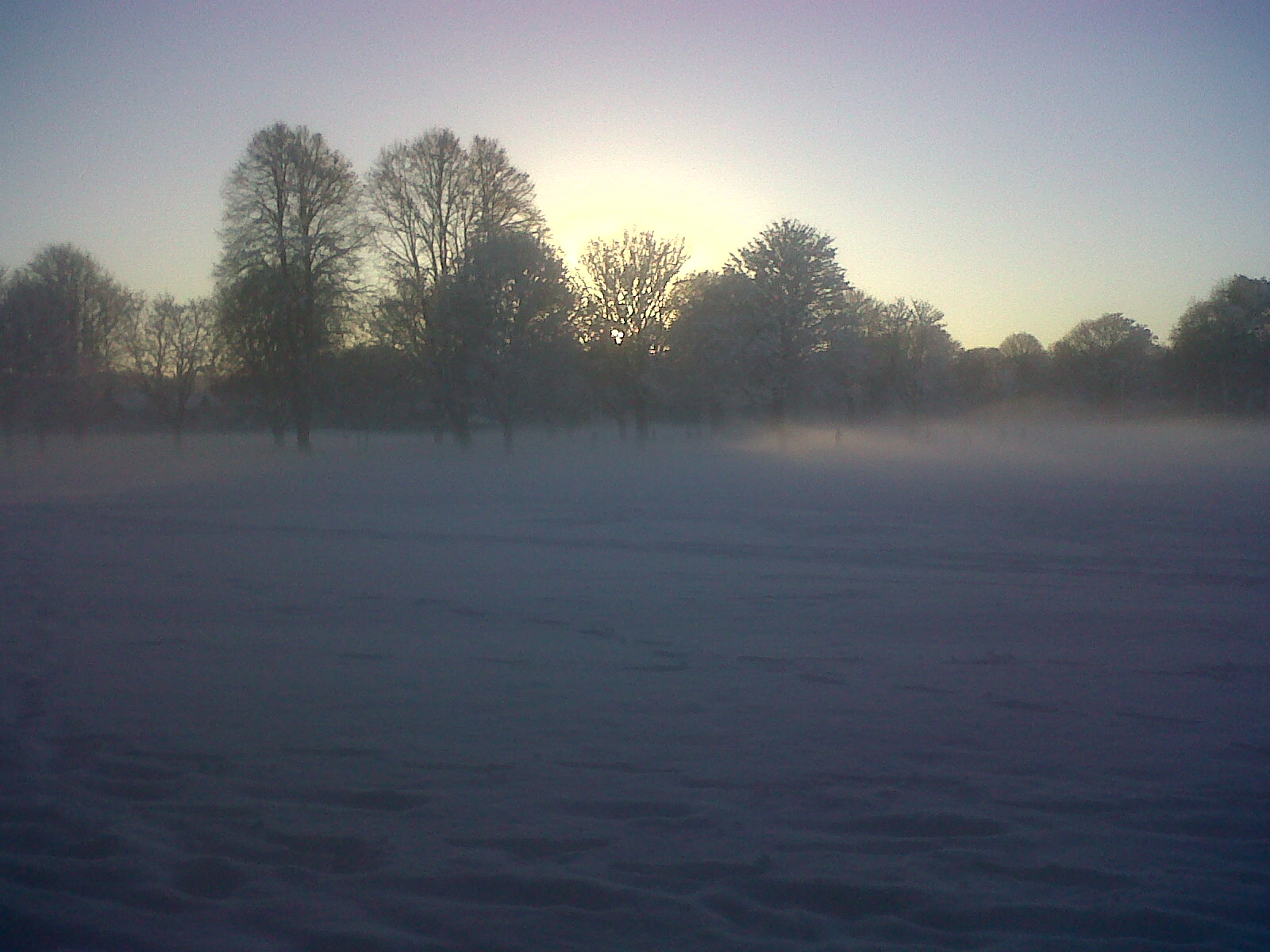
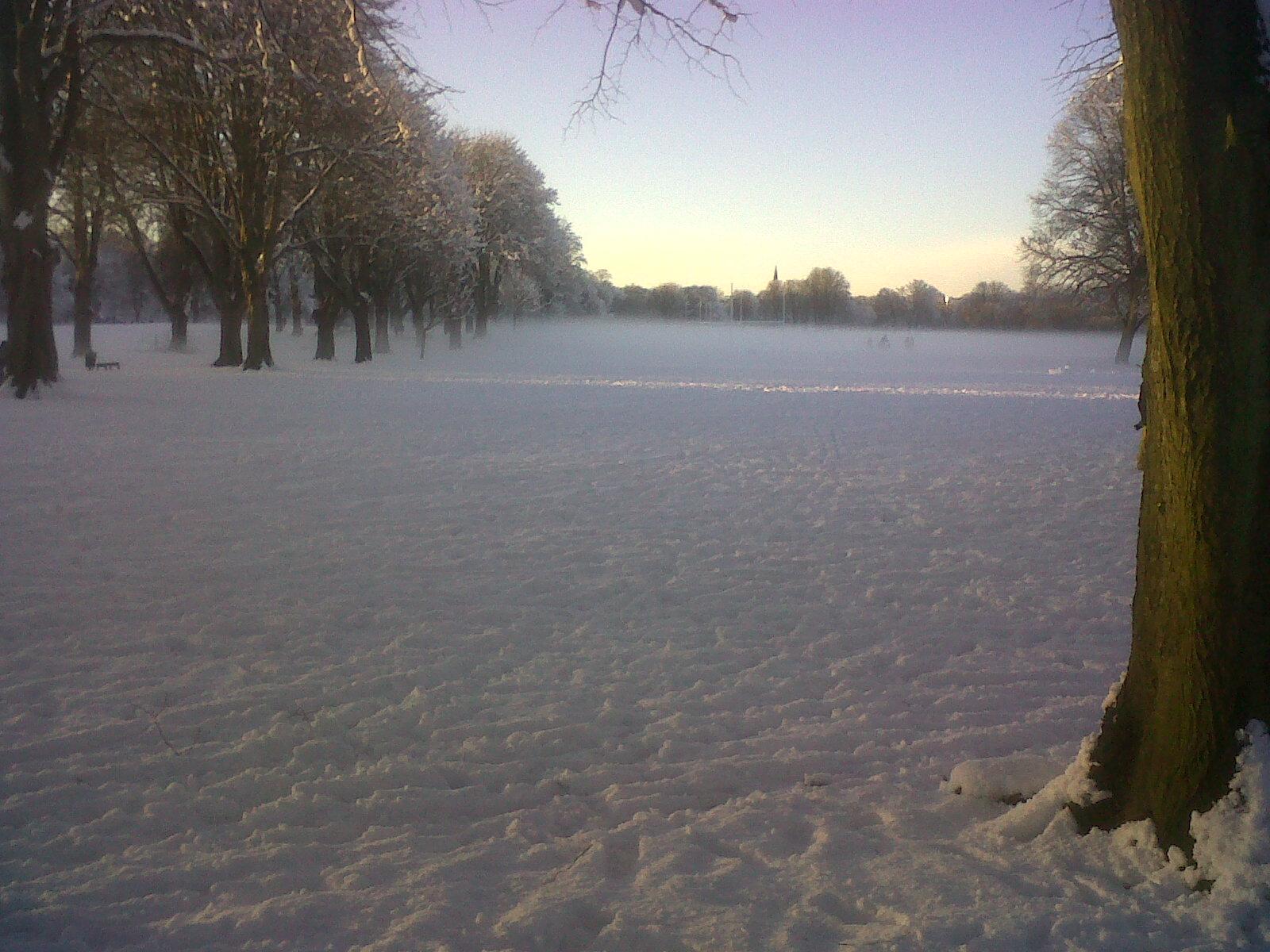
Just back from a shopping expedition during which I walked through the snowbound Pontcanna Fields. Fog was rising above the snow just as the sun was setting, creating some stunning lighting effects. Unfortunately I only had my Blackberry with me so I couldn’t take any really high quality pics, but these should give you an idea.

This first is looking North towards Llandaff Cathedral whose spire you can just see in the distance:

The second gives you a better view of the mist..

…and these two are of the sun setting behind the trees to the west:


Share/Bookmark

Term’s Ending

Posted in Biographical on December 18, 2010 by telescoper

Well there we are. After a clutch of meetings and the ritual handings-in of interim project reports by students, as of yesterday teaching term is now officially over. Most of the students left yesterday afternoon (to try to beat the inclement weather) and most of the rest will be departing this weekend. A merry Christmas to one and all.

Now we have a week until Christmas itself, and then a break until 10th January when teaching resumes. The first week back is “guided study week” and is immediately followed by examinations. Teaching proper doesn’t start again until Monday 31st January, so those of us who won’t have exams to mark (yay!) will have a relatively gentle reintroduction to termly life.

Monday 20th December is our departmental Christmas lunch – a notoriously boozy affair which usually wipes out the whole afternoon and usually involves senior members of staff disgracing themselves – but after that I think there should be time to finish a couple of papers that have been waiting on my desk for quite a while, awaiting revisions and responses to referees. I am also supposed to give a talk at a meeting of the Wales Institute of Mathematical and Computational Sciences (on Tuesday), if I can find out where it is.

I’m going to see my folks in the Frozen North for Christmas itself, or at least I’m going to try. The way things are at the moment it’s not looking hopeful. Snow fell overnight in Cardiff at an even greater rate than English wickets in Perth and I’d say there was a good six inches of the stuff on the pavements when I went to get the paper this morning. Still, there’s a week for it to clear so hopefully things improve before I actually have to travel anywhere.

The day after Boxing Day I’ll be back here in Cardiff ,trying to get on with some writing, with a short pause for New Year. Holidays are the best time to get some proper work done, and I’m looking forward to finishing off a book project I’ve been working on for ages. I doubt if I’ll have time to blog much until the new term starts, but we’ll see how much I need a displacement activity.

I was hoping to be able to pass on news about the funding situation for STFC, which I was expecting to hear about yesterday, but apparently the latest rumour is that no announcements will be made until next week at the earliest. The final Astronomy Grants Panel plenary session, at which we should wrap up this year’s recommendations, now isn’t going to take place until 25th January which means a lot of people are going to have a long anxious wait. It’s hardly a satisfactory situation, but there you have it.


Share/Bookmark

Ma Crepe Suzette

Posted in Uncategorized with tags on December 17, 2010 by telescoper

While I’m in a festive mood, here’s a party piece to end all party pieces. It’s a tribute to French language and culture, performed by the sublime Kenneth Williams.


Share/Bookmark

A Child’s Christmas in Wales

Posted in Literature with tags , on December 17, 2010 by telescoper

There are only two kinds of people in the world: those who have heard Dylan Thomas reading his wonderfully lyrical short story A Child’s Christmas in Wales; and those who haven’t. I’ve heard it hundreds of times, like a favourite piece of music. Technically it’s a prose work, but it’s prose that’s so close to poetry that it really defies categorisation. Either way, the language certainly has a musical quality, and the author’s voice brings it to life in a way nobody else has ever been able to. It’s also shot through with flashes of a dry offbeat humour that tickle my fancy any time of the year. Christmas is near, and the snow is being shaken out of whitewash buckets down the sky as I write, so I thought it would be a good time to share it. I think it’s magical.


Share/Bookmark

Spare me the Passive Voice!

Posted in Education with tags , , , , , on December 16, 2010 by telescoper

I’ve felt a mini-rant brewing for a few days now, as I’ve been reading through some of the interim reports my project students have written. I usually quite enjoy reading these, in fact. They’re not too long and I’m usually pretty impressed with how the students have set about the sometimes tricky things I’ve asked them to do. One pair, for example, is reanalysing the measurements made at the 1919 Eclipse expedition that I blogged about here, which is not only interesting from a historical point of view but which also poses an interesting challenge for budding data analysts.

So it’s not the fact that I have to read these things that annoys me, but the strange way students write them, i.e. almost entirely in the passive voice, e.g. “The experiment was calibrated using a phlogiston normalisation widget…”.

I accept that people disagree about whether the passive voice is good style or not. Some journals actively encourage the passive voice while others go the opposite way entirely . I’m not completely opposed to it, in fact, but I think it’s only useful either when the recipient of the action described in the sentence is more important than the agent, or when the agent is unknown or irrelevant. There’s nothing wrong with “My car has been stolen” (passive voice) since you would not be expected to know who stole it. On the other hand “My Hamster has been eaten by Freddy Starr” would not make a very good headline.

The point is that the construction of a statement in the passive voice in English is essentially periphrastic in that it almost inevitably involves some form of circumlocution – either using more words than necessary to express the meaning or being deliberately evasive by introducing ambiguity. Both of these failings should be avoided in scientific writing.

Apparently our laboratory instructors tell students to write their reports in the passive voice as a matter of course. I think this is just wrong. In a laboratory report the student should describe what he or she did. Saying what “was done” often leaves the statement open to the interpretation that somebody else did it. The whole point of a laboratory report is surely for the students to describe their own actions. “We calibrated the experiment..” is definitely to be preferred to the form I gave above.

Sometimes it is appropriate to use the passive voice because it is the correct grammatical construction in the circumstances. Sometimes also the text just seems to work better that way too. But having to read an entire document written in the passive voice drives me to distraction. It’s clumsy and dull.

In scientific papers, things are a little bit different but I still think using the active voice makes them easier to read and less likely to be ambiguous. In the introduction to a journal paper it’s quite acceptable to discuss the background to your work in the passive voice, e.g. “it is now generally accepted that…” but when describing what you and your co-authors have done it’s much better to use the active voice. “We observed ABC1234 using the Unfeasibly Large Telescope..” is, to my mind, much better than “Observations of ABC1234 were made using..”.

Reading back over this post I notice that I have jumped fairly freely between active and passive voice, thus demonstrating that I don’t have a dogmatic objection to its use. What I’m arguing is that it shouldn’t be the default, that’s all.

My guess is that a majority of experimental scientists won’t agree with this opinion, but a majority of astronomers and theoreticians will.

This guess will now be tested using a poll…


Share/Bookmark

Science funding can’t be democratic if education isn’t

Posted in Politics with tags , , , on December 15, 2010 by telescoper

An opinion piece in New Scientist by Dan Hind (who apparently has a new book out) just caught my eye, and I couldn’t resist a quick comment.

The piece makes some good points. One is that much current science funding is actually nothing more than a direct subsidy for private industry. This troubles me. As I’ve blogged before, I think research that really is near-market shouldn’t be funded by the tax payer but by private investment by banks or venture capitalists. Publically funded science should be for speculative research that, regardless of whether it pays off commercially, is good from a cultural and intellectual perspective. I know I’m in a minority of my colleagues on this, but that’s what I think.

Where I disagree strongly with Dan Hind is the suggestion that science funding should be given

… to new bodies set up to allocate resources on the basis of a democratic vote. Scientists could apply to these bodies for funding and we could all have a say in what research is given support.

I can see that there are good intentions behind this suggestion, but in practice I think it would be a disaster. The problem is that the fraction of the general population that knows enough about science to make informed decisions about where to spend funding is just too small. That goes for the political establishment too.

If we left science funding to a democratic vote we’d be wasting vaulable taxpayer’s money on astrology, homeopathy and who knows what other kind of new age quackery. It’s true that the so-called experts get it wrong sometimes, but if left to the general public things would only get worse. I wish things were different, but this idea just wouldn’t work.

On the other hand, I don’t at all disagree with the motivation behind this suggestion. In an increasingly technologically-driven society, the gap between the few in and the many out of the know poses a grave threat to our existence as an open and inclusive democracy. The public needs to be better informed about science (as well as a great many other things). Two areas need attention.

In fields such as my own, astronomy, there’s a widespread culture of working very hard at outreach. This overarching term includes trying to get people interested in science and encouraging more kids to take it seriously at school and college, but also engaging directly with members of the public and institutions that represent them. Not all scientists take the same attitude, though, and we must try harder. Moves are being made to give more recognition to public engagement, but a drastic improvement is necessary if our aim is to make our society genuinely democratic.

But the biggest issue we have to confront is education. The quality of science education must improve, especially in state schools where pupils sometimes don’t have appropriately qualified teachers and so are unable to learn, e.g. physics, properly. The less wealthy are becoming systematically disenfranchised through their lack of access to the education they need to understand the complex issues relating to life in an advanced technological society.

If we improve school education, we may well get more graduates in STEM areas too although this government’s cuts to Higher Education make that unlikely. More science graduates would be good for many reasons, but I don’t think the greatest problem facing the UK is the lack of qualified scientists – it’s that too few ordinary citizens have even a vague understanding of what science is and how it works. They are therefore unable to participate in an informed way in discussions of some of the most important issues facing us in the 21st century.

We can’t expect everyone to be a science expert, but we do need higher levels of basic scientific literacy throughout our society. Unless this happens we will be increasingly vulnerable to manipulation by the dark forces of global capitalism via the media they control. You can see it happening already.


Share/Bookmark

Take a note from me…

Posted in Education with tags , , , , on December 14, 2010 by telescoper

Having just given a lecture on probability and statistics to our first-year postgraduate students I thought I’d indulge in a bit of reflective practice (as the jargon goes) and make a few quick comments on teaching to see if I can generate some reaction. Part of the reason for doing this is that while I was munching my coffee and drinking my toast this morning – I’m never very coordinated first thing – I noticed an interesting post by a student on a blog  that somehow wound up referring some traffic to one of my old posts about lecture notes.

I won’t repeat the entire content of my earlier discussion, but one of the main points I made was about how inefficient many students are at taking notes during lectures, so much so that the effort of copying things onto paper must surely prevent them absorbing the intellectual content of the lecture.

I dealt with this problem when I was an undergraduate by learning to write very quickly without looking at the paper as I did so. That way I didn’t waste time moving my head to and fro between paper and screen or blackboard. Of course, the notes I produced using this method weren’t exactly aesthetically pleasing, but my handwriting is awful at the best of times so that didn’t make much difference to me. I always wrote my notes up more neatly after the lecture anyway. But the great advantage was that I could write down everything in real time without this interfering with my ability to listen to what the lecturer was saying.

An alternative to this approach is to learn shorthand, or invent your own form of abbreviated language. This approach is, however, unlikely to help you take down mathematical equations quickly…

My experience nowadays is that students aren’t used to taking notes like this, so they struggle to cope with the old-fashioned chalk-and-talk style of teaching that some lecturers still prefer. That’s probably because they get much less practice at school than my generation. Most of my school education was done via the blackboard..

Nowadays,  most lecturers use more “modern” methods than this. Many lecture using powerpoint, and often they give copies of the slides to students. Others give out complete sets of printed notes before, during, or after lectures. That’s all very well, I think, but what are the students supposed to be doing during the lecture if you do that? Listen, of course, but if there is to be a long-term benefit they should take notes too.

Even if I hand out copies of slides or other notes, I always encourage my students to make their own independent set of notes, as complete as possible. I don’t mean copying down what they see on the screen and what they may have on paper already, but trying to write down what I say as I say it. I don’t think many take that advice, which means much of the spoken illustrations and explanations I give don’t find their way into any long term record of the lecture.

And if the lecturer just reads out the printed notes, adding nothing by way of illustration or explanation, then the audience is bound to get bored very quickly.

My argument, then, is that regardless of what technology the lecturer uses, whether he/she gives out printed notes or not, then if the students can’t take notes accurately and efficiently then lecturing is a complete waste of time.

I like lecturing, because I like talking about physics and astronomy, but as I’ve got older I’ve become less convinced that lectures play a useful role in actually teaching anything. I think we should use lectures more sparingly, relying more on problem-based learning to instil proper understanding. When we do give lectures, they should focus much more on stimulating interest by being entertaining and thought-provoking. They should not be for the routine transmission of information, which is far too often the default.

Next year we’ll rolling out a new set of courses here in the School of Physics & Astronomy at Cardiff University. The express intent of this is to pare down the amount of material lectured to create more space for other types of activity, especially more exercise classes for problem-based learning. The only way to really learn physics is by doing it.

I’m not saying we should scrap lectures altogether. At the very least they have the advantage of giving the students a shared experience, which is good for networking and building a group identity. Some students probably get a lot out of lectures anyway, perhaps more than I did when I was their age. But different people benefit from different styles of teaching, so we need to move away from lecturing as the default option.

I don’t think I ever learned very much about physics from lectures, but I’m nevertheless glad I learned out how to take notes the way I did because I find it useful in all kinds of situations. Note-taking is a transferable skill, but it’s also a dying art.


Share/Bookmark