Archive for January, 2011

The Travellers and the Rest

Posted in Biographical with tags , , , , , , , , , , on January 15, 2011 by telescoper

Yesterday’s journey to the Big Smoke wasn’t as bad as it might have been, although it was a bit frustrating at times. The train was diverted through Bath to avoid flooding near Bristol, which added about 20 minutes to the journey time. That was expected, so didn’t cause any major anxiety. After the rather scenic detour we found ourselves back in familiar territory on the Cardiff-London line, Swindon. I never thought I’d see the day when I was pleased to arrive at Swindon! However, my pleasure soon evaporated when we sat on the platform at Swindon without moving, and with no announcements or information or explanation, for another 15 minutes. Obviously 25 minutes late just wasn’t late enough for First Great Western, so they had to hold the train to enhance further their record of unpunctuality. In the end we arrived at Paddington 40 minutes late. Not good.

I still got to the meeting in time for a quick cup of tea before the afternoon’s proceedings. Straight away there was some great news. The President of the RAS, Prof. Roger Davies, announced the recipients of this year’s medals and awards and among them was Cardiff’s own Matt Griffin, who receives the Jackson-Gwilt Medal.  According to the RAS website

The Jackson-Gwilt Medal is available for award annually for the invention, improvement or development of astronomical instrumentation or techniques; for achievement in observational astronomy; or for achievement in research in the history of astronomy.

Matt Griffin’s citation reads as follows:

This year’s winner is Professor Matt Griffin of the University of Cardiff, for his work on instrumentation for astronomy in the submillimetre waveband, the region of the electromagnetic spectrum between the far-infrared and microwave wavebands.

Matt Griffin is one of a select group of scientists that helped establish a UK lead in the technical development of instrumentation for submillimetre astronomy. He has been involved in most submillimetre instrument projects over the last three decades, including the Spectral and Photometric Imaging Receiver (SPIRE) camera on Herschel. Matt led a diverse international team to bring this project to fruition, encompassing 18 institutions on three different continents.

SPIRE represents a step change in capability. With the ground-based SCUBA camera, 20 nights of observing led to the detection of 5 galaxies at submillimetre wavelengths. With SPIRE, 6000 galaxies can be detected in 8 hours.

Matt Griffin thus receives the Jackson-Gwilt Medal for in particular his outstandingly successful work on SPIRE, an instrument that is transforming submillimetre astronomy.

Heartiest congratulations to Matt and, of course, to the rest of this year’s awardees!

After the RAS meeting it was time for dinner. Owing to a muddle with bookings The Athenaeum wasn’t available for this month’s RAS Club dinner so we dined instead in the unfamiliar surroundings of The Travellers Club, which is actually next door at 106 Pall Mall.Given the trials and tribulations of travelling with First Great Western, perhaps I should apply for honorary membership?

The room we had was smaller than usual, but cosy, and the staff were very friendly. The dinner wasn’t marvellous but as always there was no shortage of interesting conversation, some of it even relating to astronomy! I got grilled by a few people about what’s going on with STFC new consolidated grants system. I told everyone who asked everything I know about it, which didn’t break any confidentiality because I don’t know anything at all.

The table service was a bit slower than at the Athenaeum so it was quite late by the time we got onto the club business. The January dinner is the “Parish” dinner at which new members and, if necessary, new officers are elected by an amusingly arcane process. A few members had to leave  to catch trains before the business was completed but I stayed to the end at about 10.00pm,  placing (perhaps unjustified) confidence in  the 10.45 train from Paddington actually existing and getting there in time to get it.

I did get to Paddington in good time, and the train hadn’t been cancelled, but it was a bit late leaving.  It then apparently developed an unspecified “mechanical fault” which made for slow running. I got into Cardiff about 25 minutes late. No diversions on the way back – presumably the floods had subsided. Perhaps there’s an excuse for the chaos ensuing from the floods, but poor maintenance is surely entirely the fault of the train company.  Not a good day for First Great Western, especially when they’ve raised their already exorbitant fares for the new year..

Oh, and one other thing that’s not at all connected with anything else. As I walked back through Sophia Gardens from the station to my house in Pontcanna about quarter to two in the morning, I saw a fox hurtling across the path in front of me then vanishing into the trees. When I lived in Beeston (a suburb of Nottingham) I saw foxes very regularly, often in my own garden. Likewise even when I lived in Bethnal Green, in the East End of London. I was  quite surprised when I moved to my house in Cardiff, right next to Pontcanna Fields and Bute Park, that no foxes were to be seen despite the apparently more promising surroundings. I’ve now lived here for two and a half years and this is the first one I’ve ever spotted. I wonder why there are so few foxes in this area?

Share/Bookmark

Flooding into London

Posted in Biographical with tags , , , , , , on January 14, 2011 by telescoper

A brave bunch of hardy Cardiff  University astronomers are heading into London today for a meeting of the Royal Astronimical Society in London which celebrates the first year of science from the Herschel Space Observatory. This wouldn’t normally constitute too arduous a trip, but it turns out after the last couple of days torrential rain in Wales and the South-West of England, there is flooding on the line at Sodding Chipbury Chipping Sodbury which has sent the railway network into one of its regular episodes of chaos. Half the trains from Cardiff to London are cancelled, and the other half diverted all round the houses so they will take at least an extra half-hour to reach their destination at Paddington.

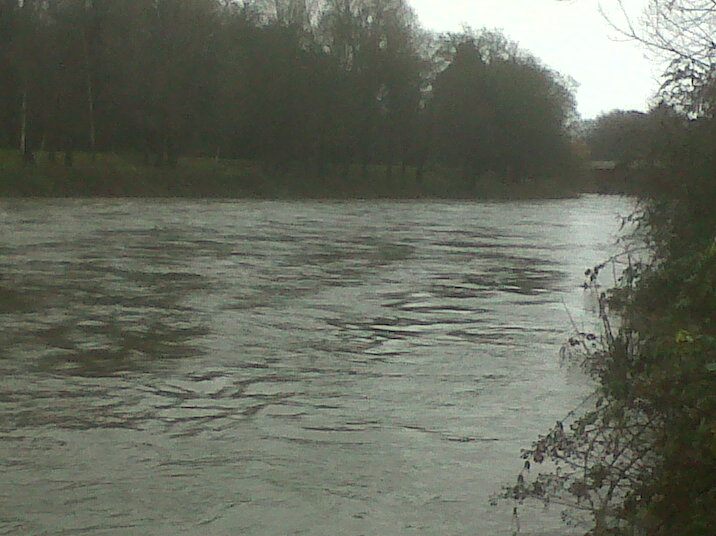
There isn’t any flooding actually in Cardiff, but the River Taff, which hibernated peacefully through the recent snowy period, has now sprung back into life and seems to be in an angry mood. I took these snaps yesterday as I walked into work, so you can see the water level is high enough to submerge some of the riverside shrubs and trees, but not high enough (yet) to threaten the embankments.

At times like this the Taff is more than a little scary, not so much because of the way it looks but because of the sound of it growling along down to Cardiff Bay, carrying the occasional car tyre and traffic cone with it.

I suppose this is small potatoes compared to the terrible floods in Australia, Brazil and elsewhere in the world, but it is quite exasperating, especially since it happens so regularly yet still catches the train companies completely unawares.

Anyway, I don’t know if the first wave of Cardiff folk managed to get to London in time for the start of the meeting. I had a couple of things to do this morning so decided to go later, even though that meant missing some of the talks that are closer to my own interests. I did think about cancelling my trip entirely, but decided in the end to give it a go. I hope I make it there at least in time for dinner at the RAS Club.

But then there’s the question of what time I’ll get  home tonight…


Share/Bookmark

Mud Wrestling and Microwaves

Posted in The Universe and Stuff with tags , , , on January 13, 2011 by telescoper

Reading through an interesting blog post about the new results from Planck by the ever-reliable Jonathan Amos (the BBC’s very own “spaceman”), I was reminded of a comment I heard made by Martin Rees (now Lord Rees) many years ago.

The remark concerned the difference between cosmology and astrophysics. Cosmology, said Lord Rees, especially the part of it that concerns the very early Universe, involves abstract mathematical concepts, difficult yet logical reasoning and the ability to see deep things in complicated spatial patterns. In that respect it’s rather like chess. Astrophysics, on the other hand, which is not at all elegant and has so many messy complications that it is sometimes difficult even to work out what is going on or what the rules are, is more like mud wrestling.

The following image, which I borrowed from Jonathan Amos’ piece, explains why I was reminded of this and why some cosmologists are having to abandon chess for mud wrestling, at least for the time being. The picture shows the nine individual frequency maps (spanning the range from 30 GHz to 857 GHz) obtained by Planck.

What we cosmologists really want to see is a pristine map of the cosmic microwave background, the black-body radiation that pervades the entire Universe. It’s black body form means that it would have the same brightness temperature across all frequencies, and would also be statistically homogeneous (i.e. looking roughly the same all across the sky).

What you actually see is a mess. There are strong contributions from the disk of our own Galaxy, some of it extending quite a way above and below the plane of the Milky Way. You can also see complicated residuals produced by the way Planck scans the sky. On top of that there is radiation from individual sources within our Galaxy, other Galaxies and even clusters of Galaxies (which I mentioned a couple of days ago). These “contaminants” constitute valuable raw material for astronomers of various sorts, but for cosmologists they are an unwanted nuisance. Unfortunately, there is no other way to reach the jewels of the CMB than by hacking through this daunting jungle of foregrounds and instrumental artefacts.

Looking at the picture might induce one of two reactions. One would be to assume that there’s no way that all the crud can be removed with sufficient accuracy and precision to do cosmology with what’s left. Another is  to appreciate how well cosmologists have done with previous datasets, especially WMAP, have confidence that they’ll solve the numerous problems associated with the Planck data, but understand why  will take another two years of high-powered data analysis by a very large number of very bright people to extract cosmological results from Planck.

There might be gold at the end of the pipeline, but until then it’s going to be mud, glorious mud…


Share/Bookmark

SDSS-III and the Cosmic Web

Posted in The Universe and Stuff with tags , , , , , on January 12, 2011 by telescoper

It’s typical, isn’t it? You wait weeks for an interesting astronomical result to blog about and then two come along together…

Another international conference I’m not at is the 217th Meeting of the American Astronomical Society in the fine city of Seattle, which yesterday saw the release of some wonderful things produced by SDSS-III, the third incarnation of the Sloan Digital Sky Survey. There’s a nice article about it in the Guardian, followed by the usual bizarre selection of comments from the public.

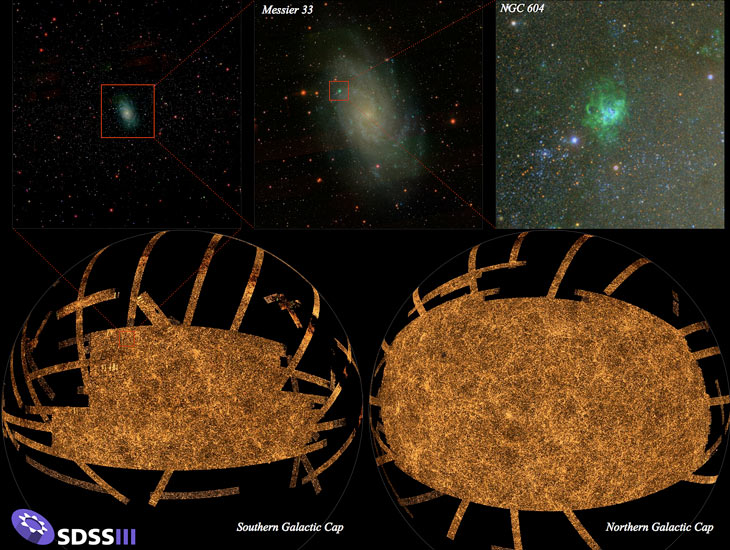
I particularly liked the following picture of the cosmic web of galaxies, clusters and filaments that pervades the Universe on scales of hundreds of millions of lightyears, although it looks to me like a poor quality imitation of a Jackson Pollock action painting:

The above image contains about 500 million galaxies, which represents an enormous advance in the quest to map the local structure of the Universe in as much detail as possible. It will also improve still further the precision with which cosmologists can analyse the statistical properties of the pattern of galaxy clustering.

The above represents only a part (about one third) of the overall survey; the following graphic shows how much of the sky has been mapped. It also represents only the imaging data, not the spectroscopic information and other information which is needed to analyse the galaxy distribution in full detail.

There’s also a short video zooming out from one galaxy to the whole Shebang.

The universe is a big place.


Share/Bookmark

First Science from Planck

Posted in The Universe and Stuff with tags , , , , , , , , , on January 11, 2011 by telescoper

It’s been quite a long wait for results to emerge from the Planck satellite, which was launched in May 2009, but today the first science results have at last been released. These aren’t to do with the cosmological aspects of the mission – those will have to wait another two years – but things we cosmologists tend to think of as “foregrounds”, although they are of great astrophysical interest in themselves.

For an overview, with lots of pretty pictures,  see the European Space Agency’s Planck site and the UK Planck outreach site; you can also watch this morning’s press briefing in full here.

A repository of all 25 science papers can be found here and there’ll no doubt be a deluge of them on the arXiv tomorrow.

A few of my Cardiff colleagues are currently in Paris living it up at the junket working hard at the serious scientific conference at which these results are being discussed. I, on the other hand, not being one of the in-crowd, am back here in Cardiff, only have a short window in between meetings, project vivas and postgraduate lectures  to comment on the new data. I’m also sure there’ll be a huge amount of interest in the professional media and in the blogosphere for some time to come. I’ll therefore just mention a couple of things that struck me immediately as I went quickly through the papers while I was eating my sandwich; the following was cobbled together from the associated ESA press release.

The first concerns the so-called  ‘anomalous microwave emission’ (aka Foreground X) , which is a diffuse glow most strongly associated with the dense, dusty regions of our Galaxy. Its origin has been a puzzle for decades, but data collected by Planck seem to confirm the theory that it comes from rapidly spinning dust grains. Identifying the source of this emission will help Planck scientists remove foreground contamination which much greater precision, enabling them to construct much cleaner maps of the cosmic microwave background and thus, among other things, perhaps clarify the nature of the various apparent anomalies present in current cosmological data sets.

Here’s a nice composite image of a region of anomalous emission, alongside individual maps derived from low-frequency radio observations as well as two of the Planck channels (left).

Credits: ESA/Planck Collaboration

The colour composite of the Rho Ophiuchus molecular cloud highlights the correlation between the anomalous microwave emission, most likely due to miniature spinning dust grains observed at 30 GHz (shown here in red), and the thermal dust emission, observed at 857 GHz (shown here in green). The complex structure of knots and filaments, visible in this cloud of gas and dust, represents striking evidence for the ongoing processes of star formation. The composite image (right) is based on three individual maps (left) taken at 0.4 GHz from Haslam et al. (1982) and at 30 GHz and 857 GHz by Planck, respectively. The size of the image is about 5 degrees on a side, which is about 10 times the apparent diameter of the full Moon.

The second of the many other exciting results presented today that I wanted to mention is a release of new data on clusters of galaxies – the largest structures in the Universe, each containing hundreds or even thousands of galaxies. Owing to the Sunyaev-Zel’dovich Effect these show up in the Planck data as compact regions of lower temperature in the cosmic microwave background. By surveying the whole sky, Planck stands the best chance of finding the most massive examples of these clusters. They are rare and their number is a sensitive probe of the kind of Universe we live in, how fast it is expanding, and how much matter it contains.

Credits: ESA/Planck Collaboration; XMM-Newton image: ESA

This image shows one of the newly discovered superclusters of galaxies, PLCK G214.6+37.0, detected by Planck and confirmed by XMM-Newton. This is the first supercluster to be discovered through its Sunyaev-Zel’dovich effect. The effect is the name for the cluster’s silhouette against the cosmic microwave background radiation. Combined with other observations, the Sunyaev-Zel’dovich effect allows astronomers to measure properties such as the temperature and density of the cluster’s hot gas where the galaxies are embedded. The right panel shows the X-ray image of the supercluster obtained with XMM-Newton, which reveals that three galaxy clusters comprise this supercluster. The bright orange blob in the left panel shows the Sunyaev-Zel’dovich image of the supercluster, obtained by Planck. The X-ray contours are also superimposed on the Planck image.

UPDATES: For other early perspectives on the early release results, see the blogs of Andrew Jaffe and Stuart Lowe; as usual, Jonathan Amos has done a very quick and well-written news piece for the BBC.


Share/Bookmark

Extraordinary Rendition

Posted in Music, Opera with tags , , , , on January 10, 2011 by telescoper

BBC Radio 3 is now well into its celebration of the Genius of Mozart, which involves playing every note he wrote over 12 days. I’m a devout admirer of Mozart, but I’m not sure that uninterrupted diet like this is actually a good idea. It is in danger of doing something that I wouldn’t previously have thought possible – making me bored of Mozart.

I’m a firm believer that you should just an artist, composer, musician (or scientist, for that matter) by his or her best work and by that reckoning Mozart is among the greatest of them all. But I have to say among the glorious masterpieces there’s also quite a lot of quite dull stuff. Take the symphonies, for example. Mozart wrote his First Symphony when he was only 8 years old. That fact on its own makes the work worth listening to. However, in my humble opinion, you can fast forward through at least twenty of the following compositions before finding one that’s really worth listening to, and even further before you find the really brilliant ones.

I’m not saying that the lesser works of Mozart shouldn’t be played. In a balanced programme, contrasted with works by other composers, they are interesting to listen to. It’s good to hear the rarely performed works from time to time, if only to understand why they are rarely performed. However, with only Mozart on offer day after day the effect is only to lessen the impact of the great works by surrounding them with hour after hour of lower quality music. I don’t think the BBC has done the Mozart legacy any favours by revealing that he actually wrote too much music, a lot of it not particularly good.

After that, I’m about to duck back down below the parapet but before I do, I thought I’d make my contribution to the ongoing Mozartfest with a piece from my favourite Mozart opera, The Magic Flute, in a version that’s itself very rarely heard. Fortunately. This is what Florence Foster Jenkins – the opera singer to end all opera singers – did with Der Hölle Rache kocht in meinem Herzen. For some reason Sony admits to owning the copyright of this, so you’ll have to click through to Youtube to hear it in its full glory.


Share/Bookmark

In a Mood

Posted in Jazz with tags , , , on January 9, 2011 by telescoper

Back to work tomorrow, and I’ve got quite a lot to sort out before we start back so I’ll be in the office this afternoon. No time for anything of any great consequence, therefore, so I thought I’d post this bit of music which some of you might find amusing and/or enjoyable.

I think I’ve written on this blog before that mathematical theorems and physical laws often have the wrong name associated with them. So it is with famous tunes. I’m in the mood to point this one out. The following track, called Tar Paper Stomp, was recorded by Wingy Manone and his Orchestra in 1930. The tune features a well-known riff that formed the basis of a much more famous and commercially successful recording made in 1939. In fact Glen Miller‘s hit was a second-order copy; he got the theme from a tune called Hot and Anxious recorded by Fletcher Henderson‘s Orchestra in 1931. There’s some debate who actually wrote it first – Fletcher Henderson’s brother Horace claimed to have done so – but Wingy Manone did receive an out-of-court cash settlement in return for not pursuing a copyright claim.

Anyway, in case you were wondering “Wingy” Manone’s nickname derived from the fact that he lost his right arm when he was run over by a streetcar as a child. Thereafter he wore a prosthetic limb, hence the name. It sounds a bit cruel, but he didn’t seem to object. In fact he was an extrovert showman, singer, comedian and all-round entertainer as well as a fine trumpeter. It can’t be that easy to play the trumpet with only one working hand – he seems to have used his prosthetic arm just for support, fingering the valves and holding the horn with his left. His style was firmly rooted in Dixieland; it may be a bit rough around the edges, occasionally downright raucous, but he certainly could play with a lot of gusto – his solo on this track is hugely enjoyable. In fact, I think this track makes Glen Miller’s In the Mood sound like a wet weekend in Stevenage.

I don’t have a personnel listing for this recording, but the tenor saxophonist sounds to me a lot like Bud Freeman. Although Benny Goodman played with Manone’s band around 1930 the clarinettist doesn’t sound like him to me. Could it have been Frank Teschmacher?


Share/Bookmark

Mock Examination

Posted in Bute Park on January 8, 2011 by telescoper

Regular readers (both of them) will know I’m Professor of Theoretical Astrophysics at Cardiff University. With the undergraduate mid-year exam period coming up shortly, I was thinking of posting something to help the students with their revision of my specialist topic. Based on an appropriate syllabus for this subject inferred from rigorous study of the content of this blog, a friend of mine (who should remain nameless, but is called Anton) suggested the following examination questions.

Feel free to suggest others through the comments box!

CARDIFF UNIVERSITY FINAL YEAR EXAMINATION IN PHYSICS

Option: Theoretical Astrophysics.

Time allowed: 2 hours.

Answer all questions, in full. No credit will be given for partial answers, numerical or grammatical errors, spelling mistakes or any other variety of underachievement.

1. “England’s victorious Ashes series in 2005 was more meritorious than retaining the Ashes in 2010/11.” Discuss.

2. Was Charlie Parker a greater saxophonist than Miles Davis was a trumpeter?

3. Compose a 15 × 15 cryptic crossword using only astrophysical terms.

4. You hear that Bute Park is to be turned into an airport. Write a model letter of complaint to Cardiff City Council.

5. Discuss the influence of Mahler’s awareness of his own mortality on his later Lieder.

6. You have 10 minutes on Google to find a US TV soap star lookalike for Prof. Coles. (Marks will be awarded automatically by a Bayesian image comparison routine.)

7. Compose a Pindarian ode protesting about governmental priorities in science funding.


Share/Bookmark

Ashes Victory

Posted in Cricket, Poetry with tags , , , , , on January 7, 2011 by telescoper

Well, there you have it. England’s cricketers finally won the final Test of the Ashes series in Sydney by an innings and 83 runs, to win the series outright. It has been a wonderful performance by the England team down under which has warmed the cold English (and Welsh) winter.

Commiserations to Australian cricket fans. Their team just wasn’t as good as England, with bat or ball. They have a lot of rebuilding to do, but you can be sure they’ll be back challenging for the Ashes again before long.

I thought I’d put up a poem to celebrate. This one is called The Game and was written by John Groves. It represents an idyllic view of what many English crickets fans surely regard as the match of any season – the Lord’s Test – which we can now look forward to with relish in the summer. However, I chose this poem for this occasion primarily because of the final couplet which takes us far beyond the boundaries of St John’s Wood.

A painter’s sky over Lord’s.
A gentle zephyr, blowing without brace,
The crowd engaged in all that joy affords
And England batting with admired grace.
The sun ablaze, an unforgiving pitch,
A bowler with a patriotic itch,
A ticking scoreboard and a close-run thing,
A resolute gull, high on a drowsy wing.

Though one team triumph, victory’s all the same:
The winner is the beauty of the game.


Share/Bookmark

Epiphany

Posted in Cricket, Football, Literature with tags , , , on January 6, 2011 by telescoper

So here we are then, it’s “officially” the last day of Christmas.

Last night was Twelfth Night, traditionally marked by an evening of festive merrymaking. And so it came to pass, as I sat with a cup of Ovaltine watching TV highlight’s of the third day’s play in the final Ashes Test in Sydney followed by Match of the Day, featuring coverage of Newcastle’s 5-0 thrashing of West Ham.

Today, 6th January, is Epiphany which traditionally marks the arrival of the three Magi and the presentation of their gifts to the baby Jesus. As far as I’m aware there’s no actual evidence that this actually happened on January 6th, but there you go. It’s a tradition nevertheless. In fact, I seem to remember that the Magi only appear in one of the four gospels (Matthew) and it doesn’t even specify that there were three of them..

Here in the United Kingdom, January 6th is when the holiday season really finishes, when Christmas trees and decorations come down, and when we’re allowed at last to stop eating Turkey curries. Some years ago I discovered that in other countries Epiphany is actually observed rather differently and is in fact one of the main events of the Christmas period. I only discovered this when I tried to arrange a meeting with Spanish and Italian representatives of an EU Network I was involved with on January 6th, only to be greeted with howls of protest. It actually makes sense, though, as presumably the exchanging of gifts at Christmas is supposed to commemorate the visit of the Magi. Why not, therefore, do it at Epiphany?

All this reminded me of the following (very famous) poem, called The Journey of the Magi , by T.S Eliot. I’m all out of gold, frankenstein and myrrh (whatever that is) – and I’m not a particularly wise man anyway – so I’ll offer this in lieu of a gift.

‘A cold coming we had of it,
Just the worst time of the year
For a journey, and such a journey:
The ways deep and the weather sharp,
The very dead of winter.’
And the camels galled, sore-footed, refractory,
Lying down in the melting snow.
There were times we regretted
The summer palaces on slopes, the terraces,
And the silken girls bringing sherbet.

Then the camel men cursing and grumbling
And running away, and wanting their liquor and women,
And the night-fires going out, and the lack of shelters,
And the cities hostile and the towns unfriendly
And the villages dirty and charging high prices:
A hard time we had of it.
At the end we preferred to travel all night,
Sleeping in snatches,
With the voices singing in our ears, saying
That this was all folly.

Then at dawn we came down to a temperate valley,
Wet, below the snow line, smelling of vegetation;
With a running stream and a water-mill beating the darkness,
And three trees on the low sky,
And an old white horse galloped in away in the meadow.
Then we came to a tavern with vine-leaves over the lintel,
Six hands at an open door dicing for pieces of silver,
And feet kicking the empty wine-skins.
But there was no imformation, and so we continued
And arrived at evening, not a moment too soon
Finding the place; it was (you may say) satisfactory.

All this was a long time ago, I remember,
And I would do it again, but set down
This set down
This: were we led all that way for
Birth or Death? There was a Birth, certainly,
We had evidence and no doubt. I had seen birth and death,
But had thought they were different; this Birth was
Hard and bitter agony for us, like Death, our death.
We returned to our places, these Kingdoms,
But no longer at ease here, in the old dispensation,
With an alien people clutching their gods.
I should be glad of another death.


Share/Bookmark