I agree wholeheartedly with Andy Lawrence on this, and since this is the first time this has ever happened I thought I’d mark the occasion by reblogging his post…
via The e-Astronomer

I agree wholeheartedly with Andy Lawrence on this, and since this is the first time this has ever happened I thought I’d mark the occasion by reblogging his post…
via The e-Astronomer
A job vacancy caught my eye this week, so I thought I’d pass it on (at no extra charge).
This is the long-awaited announcement of a much-needed vacancy as Chief Executioner Executive of the Science and Technology Facilities Council (STFC). The incumbent, Professor Keith Mason, will be leaving the job (although not until next year) and I’m sure his successor will be grateful for the fact that STFC has much less activity to manage now than it did four years ago. Indeed, if you download the further information you’ll find there’s so much talk of “management of change” and “new structures” that you wouldn’t have thought STFC had already existed for four years…
A notable requirement is that the successful candidate must have
…strong emotional intelligence, excellent listening skills; good relationship and influencing skills and the ability to reach out and build consensus and trust;
which will certainly make a change. The ability to “manage budgets” is apparently also necessary.
I gather special training is provided so the successful candidate can learn to read and write TreasurySpeak and that there is a substantial budget for travel. A luxurious office is provided in Swindon, but the Chief Executive is not required to visit it except on special occasions, such as when there is a celebration of the closure of a major national facility. The salary is “competitive”, although it doesn’t say with what.
But, seriously, it’s going to be a tough but vitally important job for UK Science so I hope someone of sufficient stature to take it on does emerge, poisoned chalice though it undoubtedly is. A rumour mill has already started, and I might open a book on the race if there are enough nominations through the comments box…
Today I’ve been preparing tomorrow’s particle physics lecture on the Cabibbo mechanism for quark mixing, which inspired me to go back to Paul Crowther’s guest post of a couple of days ago to present the data in a slightly different way.
The centrepiece of Paul’s post was the following graph which shows the distribution of two different bibliometric measures for the UK astronomical community. There is the h-index (which is the number h such that the author has h papers cited at least h times) and a normalised version of h in which each paper’s citations are divided by the number of authors of that paper before the index is formed; I call this index hnorm. The results are shown below:
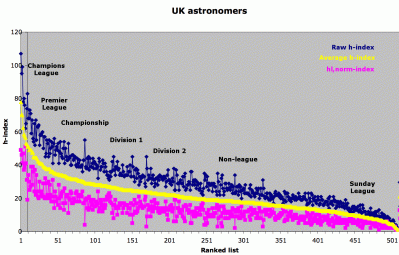
Generally speaking the two indices track each other fairly well, but there are clearly some individuals for whom they diverge. These correspond to researchers whose main mode of productivity is through large consortia and for whom h is correspondingly much larger than hnorm.
The “outliers” are more easily identified by forming the ratio
which is plotted in the graph below kindly provided by Paul Crowther.
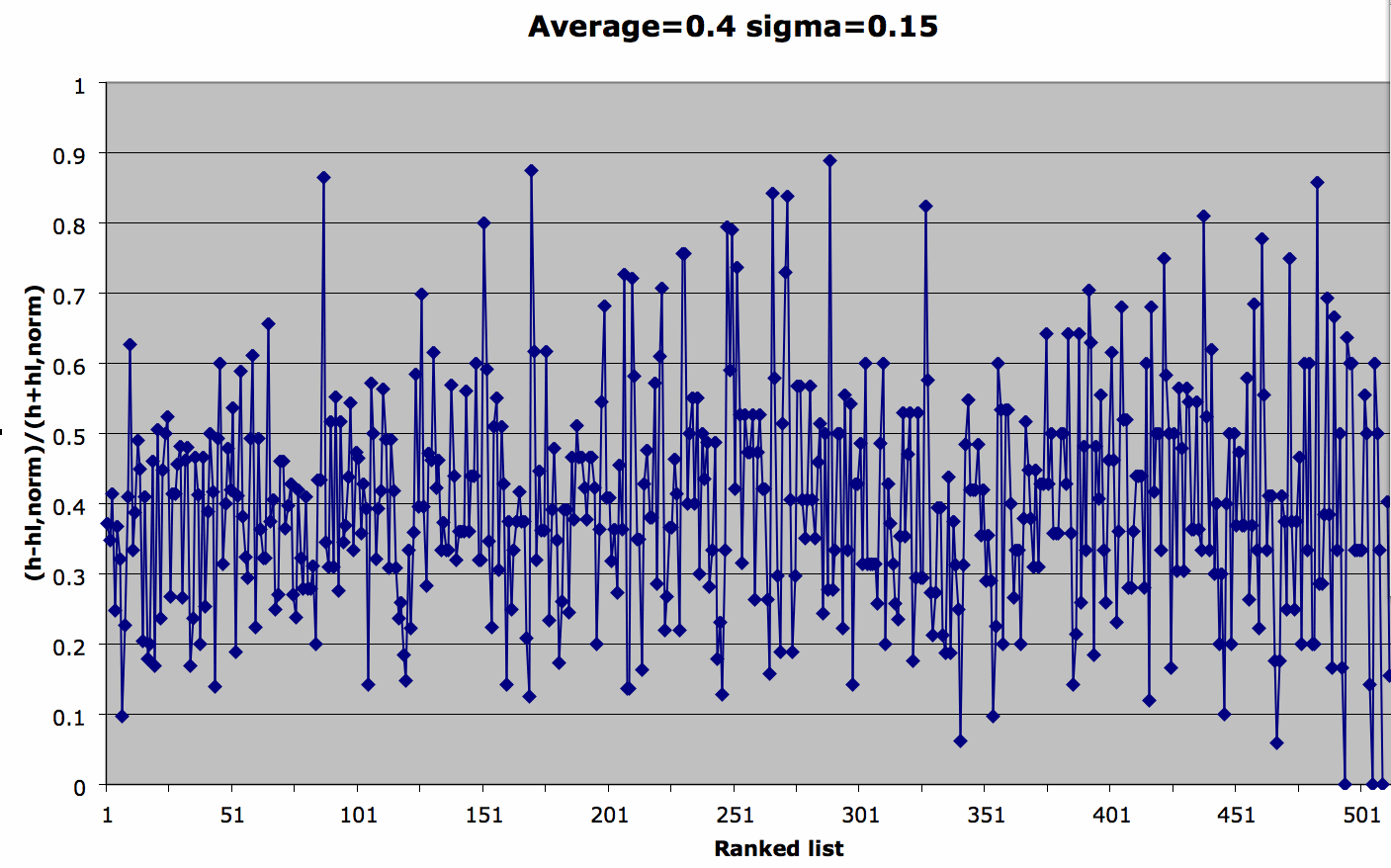
Notice that the “lurker index” 
If this were particle physics rather than astronomy the results wouldn’t be presented in terms of a ratio like
|output>=cos(θ) |solo>+sin(θ) |collaborator>
The angle θ gives a quantitative indication of an author’s inclination to lurk in other people’s publication lists. If θ=0 then the individual’s papers are going to be all single-author affairs with no question marks over attribution of impact. If θ=90° then the individual does primarily collaborative research – perhaps he/she is a good mixer? Most researchers lie somewhere between these two extremes.
I therefore suggest that we should measure bibliometric productivity and impact not just through one “amplitude”, say h, but by the addition of a mixing angle, i.e. the whole output should be summarised as (h,θ). One could estimate the relevant angle fairly straightforwardly as

but alternative definitions are possible and a more complete understanding of the underlying process is needed to make this more rigorous.
Stephen Hawking has a particularly small mixing angle (~5.7°); many members of the astronomical Premiership have much larger values of this parameter. The value of θ corresponding to the average value of
And here, courtesy of the ever-reliable Paul Crowther, is a graph of mixing angle versus raw h-index for the whole crowd shown in the above diagram.

P.S. If you thinking this application of mixing angle is daft, then you should read this post.
Another very busy and tiring day gave me no time to post anything until I got home this evening. Still, Ye Olde Blogge seems to be managing well these days without me. I’m going to have an early and largely blog-free night tonight, but I thought I’d share this with you before I slump onto the sofa. I heard this piece on the radio a few days ago. I usually wake up when my alarm clock turns the radio on. Sometimes the music doesn’t get me going straight away and I slumber on for a while. When this came on, however, I was mesmerised and couldn’t have gone back to sleep if I’d wanted to.
I’ve loved the music of Johann Sebastian Bach for a very long time, but a lot of his work is still new to me, as this piece was until very recently. It’s one of the trio sonatas for organ that he wrote relatively late in life, apparently to help his sons learn to play the organ. The trio sonata format usually involved two different solo instruments playing over a bass accompaniment called a continuo, but here all three parts are played on the organ by one musician. The result is absolutely beautiful, especially played as this recording on a lovely sounding organ.
I’ve listened to this piece repeatedly over the last week or so and every time I hear it I’m filled with a sense of euphoria. I think awesome is an understatement for such music as this.
PS. The pictures are of the town of Leipzig, which was Bach’s home for many years.
Once, on a hill in Wales, one summer’s day
I almost danced for what I thought was joy.
An hour or more I’d lain there on my back
Watching the clouds as I gazed dreaming up.
As I lay there I heard a skylark sing
A song so sweet it touched the edge of pain.
I dreamt my hair was one with all the leaves
And that my legs sent shoots into the earth.
Laughing awake, I lay there in the sun
And knew that there was nothing to be known.
Small wonder then that when I stood upright
I felt like dancing. Oh, I almost danced.
I almost danced for joy, I almost did.
But some do not, and there’s an end of it.
One night no doubt I shall lie down for good
And when I do perhaps I’ll dance at last.
Meanwhile I keep this memory of that day
I was an almost dancer, once, in Wales.
(by Robert Nye)
Here’s a contribution to the discussion of citation rates in Astronomy (see this blog passim) by the estimable Paul Crowther who in addition to being an astronomer also maintains an important page about issues relating to STFC funding.
–0–
At last week’s Sheffield astrophysics group journal club I gave a talk on astronomical bibliometrics, motivated in part by Stuart Lowe’s H-R diagram of astronomers blog entry from last year, and the subsequent Seattle AAS 217 poster with Alberto Conti. These combined various versions of google search results with numbers of ADS publications. The original one was by far the most fun.
The poster also included Hirsch’s h-index for Americal Astronomical Society members, which is defined as the number of papers cited at least h times. Conti and Lowe presented the top ten of AAS members, with Donald Schneider in pole position, courtesy of SDSS. Kevin Pimblett has recently compiled the h-index for (domestic) members of the Astronomical Society of Australia, topped by Ken Freeman and Jeremy Mould.
Even though many rightly treat bibliometrics with distain, these studies naturally got me curious about comparable UK statistics. The last attempt to look into this was by Alex Blustin for Astronomy and Geophysics in 2007, but he (perhaps wisely) kept his results anonymous. For the talk I put together my attempt at an equivalent UK top ten, including those working overseas. Mindful of the fact that scientists could achieve a high h-index through heavily cited papers with many coauthors, I also looked into using normalised citations from ADS for an alternative, so-called hl,norm-index. I gather there are a myriad of such indices but stuck with just these two.
Still, I worried that my UK top ten would only be objective if I were to put together a ranked list of the h-index for every UK-based astronomy academic. In fact, given the various pros and cons of the raw and hl,norm-indexes, I thought it best to use an average of these scores when ranking individual astronomers.
For my sample I looked through the astrophysics group web pages for each UK institution represented at the Astronomy Forum, including academics and senior fellows, but excluding emeritus staff where apparent. I also tried to add cosmology, solar physics, planetary science and gravitational wave groups, producing a little over 500 in total. Refereed ADS citations were used to calculate the h-index and hl,norm-index for each academic, taking care to avoid citations to academics with the same surname and initial wherever possible. The results are presented in the chart.

Andy Fabian, George Efstathiou and Carlos Frenk occupy the top three spots for UK astronomy. Beyond these, and although no great football fan, I’d like to use a footballing analogy to rate other academics, with the top ten worthy of a hypothetical Champions League. Others within this illustrious group include John Peacock, Rob Kennicutt and Stephen Hawking.
If these few are the creme de la creme, I figured that others within the top 40 could be likened to Premier League teams, including our current RAS president Roger Davies, plus senior members of STFC committees and panels, including Andy Lawrence, Ian Smail and Andrew Liddle.
For the 60 or so others within the top 20 percent, I decided to continue the footballing analogy with reference to the Championship. At present these include Nial Tanvir, Matthew Bate, Steve Rawlings and Tom Marsh, although some will no doubt challenge for promotion to the Premier League in due course. The remainder of the top 40 per cent or so, forming the next two tiers, each again numbering about 60 academics, would then represent Leagues 1 and 2 – Divisons 3 and 4 from my youth – with Stephen Serjeant and Peter Coles, respectively, amongst their membership.
The majority of astronomers, starting close to the half-way point, represent my fantasy non-league teams, with many big names in the final third, in part due to a lower citation rate within certain sub-fields, notably solar and planetary studies. This week’s Times Higher Ed noted that molecular biology citation rates are 7 times higher than for mathematics, so comparisons across disciplines or sub-disciplines should be taken with a large pinch of salt.
It’s only the final 10 percent that could be thought of as Sunday League players. Still, many of these have a low h-index since they’re relatively young and so will rapidly progress through the leagues in due course, with some of the current star names dropping away once they retire. Others include those who have dedicated much of their careers to building high-impact instruments and so fall outside the mainstream criteria for jobbing astronomers.
This exercise isn’t intended to be taken too seriously by anyone, but finally to give a little international context i’ve carried out the same exercise for a few astronomers based outside the UK. Champions League players include Richard Ellis, Simon White, Jerry Ostriker, Michel Mayor and Reinhard Genzel, with Mike Dopita, Pierro Madau, Simon Lilly, Mario Livio and Rolf Kudritzki in the Premier League, so my ball-park league divisions seem to work out reasonably well beyond these shores.
Oh, I did include myself but am too modest to say which league I currently reside in…
Just a brief post today, I think, in order to tie up a few loose ends from this week.
For reasons that I really don’t understand my blog suddenly became very popular on Thursday (31st March), attracting nearly 5000 hits in a day. That’s nearly four times my current daily average and a couple of thousand more than my previous busiest day. So this week I had my busiest day, last week was my busiest week, and last month was my busiest month. I guess it’s all downhill from here.
I couldn’t figure out what happened to cause all this interest, as not all the hits were on any specific article and no particular search terms were used to find this blog, at least not that I could figure out. I presume that it was my sarcastic take on Wonders of the Universe that was behind it. At any rate that was the post that generated the deluge of abusive comments that my spam filter caught.
Anyway, other items of relevant news are that two new members of Staff joined the School of Physics & Astronomy yesterday (April 1st; no, seriously…) and there are a couple more expected to join soon. It’s nice to have a few new faces around the place, and I’m sure they’ll all be bringing new ideas about research and teaching to the physics side of the School.
A week or so ago I passed on some pretty disappointing news about the funding climate here in Welsh universities. More details emerged this week about what this means for individual institutions; you can find the full list of allocations here (PDF). The figures don’t tally with those in the newspaper article I referred to in the previous post which was presumably inaccurate.
The picture isn’t as bad as I feared but, with a total cut of about 5% (in cash terms) across the sector it could hardly be described as good, especially when inflation is running about 5% on top of that. My employer, Cardiff University, has done slightly better than average, with a cut of only 3% in cash.
However – and it’s really delightful to be able to pass on some good news for once – the School of Physics & Astronomy has just been awarded a pretty large increase in its quota of undergraduate students. This is excellent, as I’ve previously reported that we have had a huge surge in applications this year. We’ll have to work hard to squeeze the extra bodies into laboratories, tutorials and even lecture theatres, but the income they will generate should help us carry out the strategic plans we have developed, perhaps bringing in even more new members of staff.
I’m still a bit grumpy, though, as our teaching terms has another two weeks to run, while some lucky bastards have finished already and are now on their Easter holidays…
It seems timely to use the medium of this blog to pass on some important news from the Science and Technology Facilities Council (STFC) to those who might find it useful.
This week saw the unveiling of a brand new STFC scheme to be called the Ernest Rutherford Fellowships. These will be in some respects similar to the previous Advanced Fellowships in that each Fellowship will last for five years with 12 being offered by STFC each year, and will cover the salary costs of the holder for that period. An important new element, however, is that holders of these Fellowships will be able to bid for “significant additional funds to support their research”.
The announcement of this new programme is sure to be warmly welcomed by the scientific community because the previous Advanced Fellowships have been a stepping stone to an academic career for many a budding scientist (including myself, in fact). There will however be some restrictions on eligibility that did not apply to previous schemes.
The first new restriction is to bring the scheme into line with the attitudes of Ernest Rutherford, in whose honour the new fellowships are to be named. One of the most frequently-quoted remarks by Rutherford is the following:
Don’t let me catch anyone talking about the Universe in my department
Obviously therefore it has proved necessary to close the scheme to astronomers and cosmologists. This shouldn’t prove too much of a problem, however, as the STFC press statement by John Le Mesurier makes it clear that the only notable recipients of Advanced Fellowships in the past are actually particle physicists:
Previous recipients of Advanced Fellowships include Professor Brian Cox who has done much to popularise/demystify physics through his recent TV series, Professor Ruth Gregory who was awarded the IoP Maxwell Medal for outstanding contributions to theoretical, mathematical or computational physics in 2006; and Professor Brian Foster who was awarded the IoP Born medal (for outstanding contributions to physics) in 2003.
The second new rule is intended to control the number of applications in order to make the selection of the recipients of these Elite Fellowships more manageable. The criteria applied to the previous Advanced Fellowship programme were very flexible, with the result that each round typically generated well over a hundred applications. This made the relevant Panel’s task extremely difficult. STFC has therefore decided to impose a restriction on the age seniority of the candidates in order to streamline the process.
To be eligible for an Ernest Rutherford Fellowship, candidates must have completed their PhD between 5 years 11 months and 30 days and 6 years of the date of application. This is in addition to the usual requirement of being a white heterosexual male. According to rigorous investigations by STFC staff, this reduces the pool of potential applicants substantially. To one, actually.
The successful candidate (Dr Jamie B’Stard of Oxbridge University) will be eligible to bid for, and be given on the nod, additional ring-fenced funding to support those things that an Elite Fellow needs, both to carry out their research and to feel generally superior to everyone else (e.g. private jet, fleet of Rolls-Royce motor cars, and gold-plated taps in their private lavatory). Never in the history of British science will a physicist have been so generously endowed. The new scheme will allow science to compete in prestige and public acclaim with other forms of employment, such as in the banking sector.
To liberate the funds needed for this initiative it has inevitably proved necessary to make savings elsewhere in the STFC programme. After minutes of arduous deliberation it was decided, as usual, to pay for it by top-slicing the budget for research grants (this time by 95%). Unfortunately this means that no grants will be available for any other research within the STFC remit. However, as a gesture of goodwill, the Chief Executive of STFC has given the instruction that the remaining 5% of the now defunct grants line will be distributed to universities to help cover the cost of making all existing PDRAs redundant.
I hope this clarifies the situation.


 In the Dark