Archive for January, 2012

Away to Swansea

Posted in The Universe and Stuff with tags , , , , on January 11, 2012 by telescoper

Just time for a quick post this evening, primarily to make a note of an enjoyable event that took place this afternoon. I long since gave up keeping a proper journal so the old blog will have to play that role.

Today a small group of cosmologists from the School of Physics & Astronomy at Cardiff University made the short trip to Swansea to meet with members of the Physics department there. The idea of the meeting was to explore the possibilites of future research collaboration. For historical reasons there is a pretty strong separation in Wales between research in Particle Physics and Astronomy/Astrophysics; Swansea does the former and Cardiff does the latter. However, cosmology is an area in which there are possible overlaps between some of the – primarily theoretical – research going on at Swansea into, e.g., Quantum Gravity and what we do in Cardiff, e.g. inflationary cosmology.

Anyway we decided to get together for an afternoon of talks by members of both departments to see if anything emerged as potential research topics. In fact, a couple of interesting ideas were discussed and although the main focus of research differs substantially in the two institutions we’re definitely going to get together again to follow up these ideas.

Although I’ve been in Cardiff since 2007, I’d never visited Swansea University before which, considering that it’s only an hour away by train, is admittedly a bit pathetic. In fact I think it’s quite weird the two departments don’t collaborate more in other areas too. I’m certainly very keen to see more joint activities than we have now, so hopefully this is a move in that direction.

Anyway, I’d like to thank Graham Shore at Swansea for hosting us this afternoon and I very much look forward to the planned return leg which will be held in Cardiff in a couple of months.

The Messenger

Posted in Poetry with tags , , on January 11, 2012 by telescoper

The thing, he said, would come in the night at three
From the old churchyard on the hill below;
But crouching by an oak fire’s wholesome glow,
I tried to tell myself it could not be.

Surely, I mused, it was pleasantry
Devised by one who did not truly know
The Elder Sign, bequeathed from long ago,
That sets the fumbling forms of darkness free.

He had not meant it – no – but still I lit
Another lamp as starry Leo climbed
Out of the Seekonk, and a steeple chimed
Three – and the firelight faded, bit by bit.

Then at the door that cautious rattling came –
And the mad truth devoured me like a flame!

by Howard Phillips Lovecraft (1890-1937).


In a Physicist’s Mailbag…

Posted in Biographical, The Universe and Stuff with tags , , on January 10, 2012 by telescoper

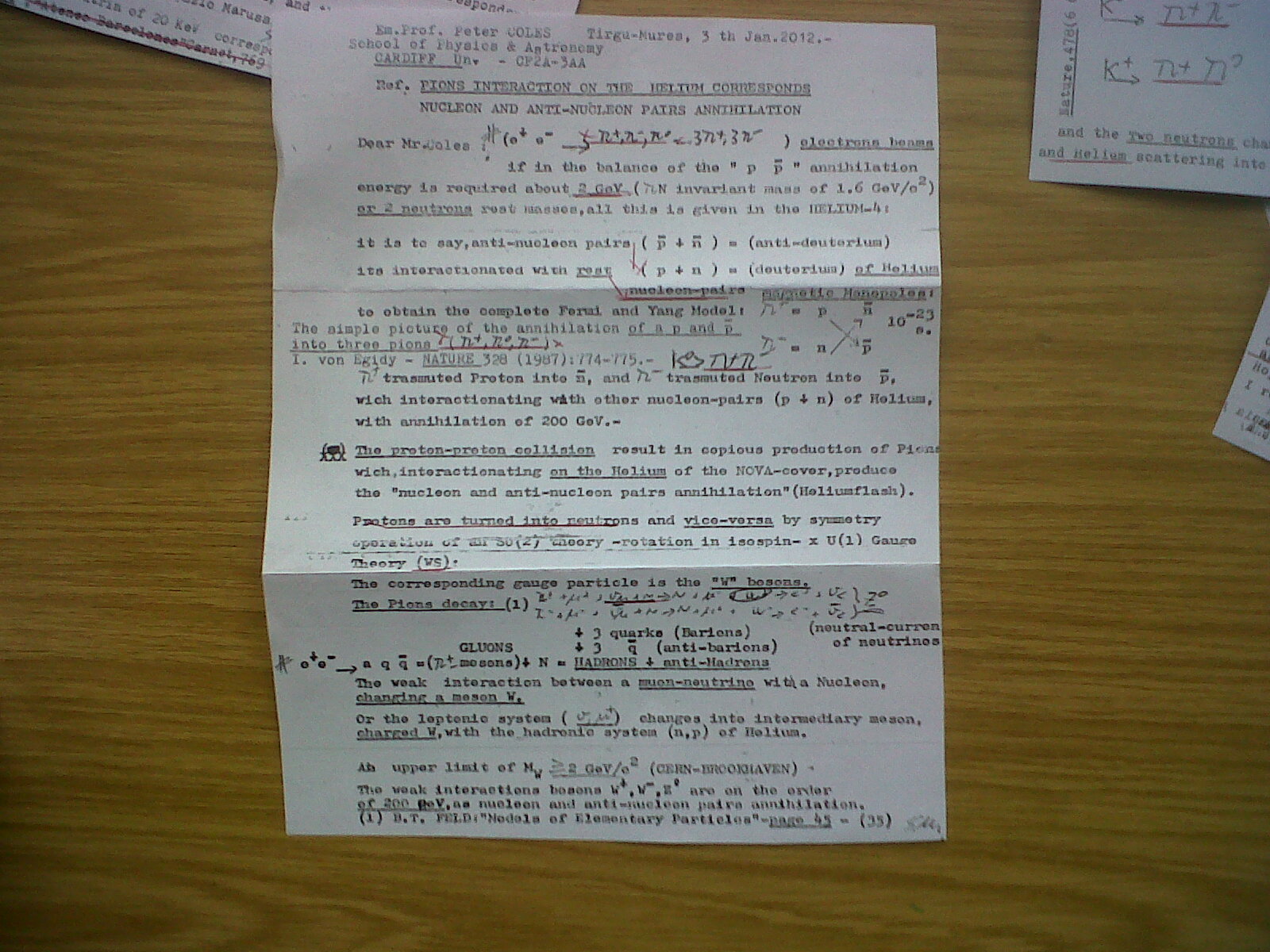
Among the delights (?) of being a scientist are those priceless pieces of unsolicited mail from members of the public. When I went to collect my mail this morning I found a prime example waiting in my pigeonhole. I knew what it was going to be like before I even opened it because the envelope was addressed (rather inaccurately) using an old-fashioned typewriter. Only a certain kind of person uses a typewriter these days.

I particularly enjoyed the “Emeritus Prof. ” bit. And Cardiff isn’t in “Engand”, by the way. Or even “England”.

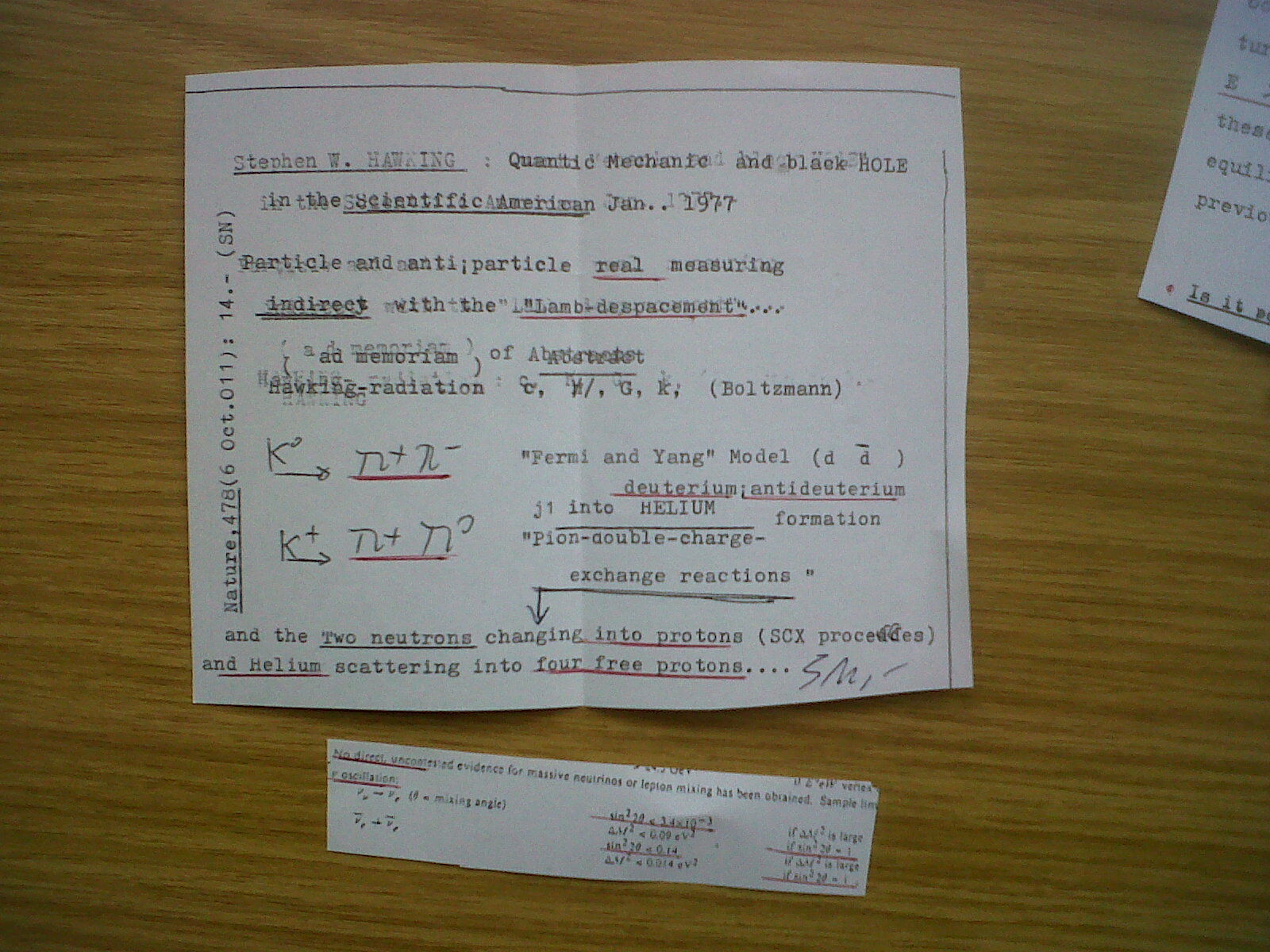
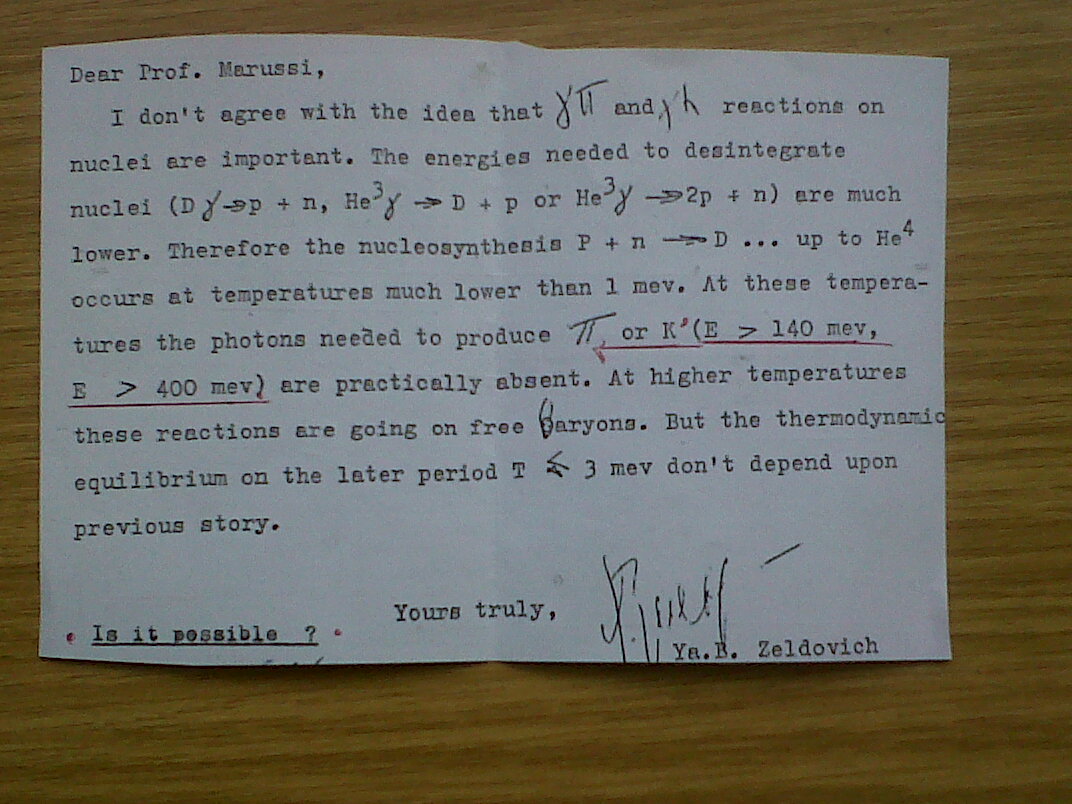
Inside were six pieces of paper – all of different sizes – on which fascinating things had been typed and later highlighted with red and black pens in order to enhance both their scientific and artistic impact.

I’m in the middle of a load  of project vivas today so haven’t had time to scan this masterpiece neatly, but it’s such a wonderful piece of correspondence that I couldn’t resist taking a few pictures of various elements for the edification of my vast readership. I think if you click on the images you might be able to read them more clearly but, if you do, I will not accept liability for the consequences.

Unfortunately I’m not sure whether I have them in the right order, as the logic that connects them together escapes me.

I have  a large collection of similar missives but, despite some obvious deficiencie, such as a lack of drawings,  this letter is one of the best and will now take pride of place in the bottom drawer of my filing cabinet. Perhaps one day I’ll write a book about them…

Holmes for the Bewildered

Posted in Literature, Television with tags , , , , on January 9, 2012 by telescoper

Being back to work full-time, now that the new teaching term has started, I find myself in a position to do quick lunchtime blog post while I eat my sandwich. I was going to blog about this topic last week, but thought I’d wait a week in case anything happened to change my negative opinion on this issue. I’m aware that I’m in a small minority and didn’t want to expose myself to public disapproval without due care and attention. Well, last night my opinion certainly changed, only it got even more negative. So now I’m going to take a deep breath, gird my loins, and state for the record my honestly-held opinion that the new BBC TV Series Sherlock is complete and utter tripe.

It’s not that I object to the idea of  placing Sir Arthur Conan Doyle’s great stories in a contemporary setting. Not at all. Sherlock Holmes is one of the most memorable creations in all of fiction and the plots – at least most of them – are so well constructed that the stories should be translatable into a contemporary setting quite easily. There have been so many “traditional” versions of  Sherlock Holmes that I welcome the attempt to do something different with the character.

Neither is it that I object to Sherlock Holmes being played for laughs. The character does indeed possess a great deal of comic potential, which  a number of other interpretations have exploited with a greater or lesser degree of success.

What has happened in this series, however, is that the original plots have been butchered to the point where they make no sense at all. Instead we just have a series of thinly related comedy sketches, with only feeble attempts to link them to a viable mystery story, like a duff combination of the worst bits of Jonathan Creek and The Fast Show.

Last night’s puerile Hound of the Baskervilles was especially dire in this respect. The original story – a full-length novel rather than a short story – is a genuinely intriguing mystery-thriller, laced with undertones of the supernatural, and full of memorable characters, including of course the fearsome Hound itself.

For reasons best known to themselves Forced to squeeze it into one hour, the producers of last night’s version of this classic tale abandoned most of the original plot and introduced a load of silly nonsense about werewolves and hallucinogenic fog and the CIA. The Holmes-Watson double-act was quite amusing – and some of the dialogue very witty – but the plot was so thin it just reminded me of Abbott and Costello meet the Wolfman and other such films I watched when I was a kid. I thought the first episode –  A Scandal in Belgravia – was bad enough, but last night’s episode was truly excruciating. I won’t be watching any more.

It’s a mystery to me why so many people seem to think this tosh is so good, but then I’m used to being in a minority of one. Perhaps if you watch a lot of TV your expectations are lowered so much by the constant stream of drivel that anything that even tries to be original – which Sherlock admittedly does – sends you into raptures?

No, dear critics, I don’t think Sherlock is “great TV” at all. In fact I think it’s dreadful.

There. I’ve said it.

She is what she is….

Posted in Music with tags , on January 8, 2012 by telescoper

..and, incredibly, she is 75 today!

Happy Birthday, Dame Shirley Bassey!

And on the basis that you can have too much of a good thing, here she is in 1966 singing Leonard Bernstein’s  lovely song Somewhere from West Side Story.

Hawking at 70

Posted in Books, Talks and Reviews, The Universe and Stuff with tags , , , , on January 8, 2012 by telescoper

Today is the 70th Birthday of renowned British theoretical physicist Stephen Hawking. His  immense contributions to physics, including but not restricted to cosmology, are remarkable in their own right, but  made even more emarkable that has done so much after having been stricken by such a debilitating disease when he was only in his twenties. Hawking’s is undoubtedly a brilliant and inspirational mind, but his courage and physical endurance in the face of difficulties that  others might have found unbearable provide inspiration far behond physics. I’d therefore like to add a genuine Many Happy Returns to Professor Stephen Hawking, and I hope he’s enjoying the celebratory conference and other events that have been laid on to mark this special occasion.

I have in the past gone on record, both on television and in print, as being not entirely positive about the “cult” that surrounds Stephen Hawking. I think a number of my colleagues find things I have said disrespectful and/or churlish. I do, however, stand by everything I’ve said. I do have enormous respect for Hawking the physicist, as well as deep admiration for his tenacity and fortitude, and have never said otherwise. I don’t, however, agree that Hawking is in the same category of revolutionary thinkers as Newton or Einstein, which is how he is often portrayed.

In fact  a poll of 100 theoretical physicists in 1999 came to exactly the same conclusion. The top ten in that list were:

  1.  Albert Einstein
  2. Isaac Newton
  3. James Clerk Maxwell
  4. Niels Bohr
  5. Werner Heisenberg
  6. Galileo Galilei
  7. Richard Feynman
  8. Paul Dirac
  9. Erwin Schrödinger
  10. Ernest Rutherford

The idea of a league table like this is of course a bit silly, but it does at least give some insight into the way physicists regard prominent figures in their subject. Hawking came way down the list, in fact, in 300th (equal) place. I don’t think it is disrespectful to Hawking to point this out. I’m not saying he isn’t a brilliant physicist. I’m just saying that there are a great many other brilliant physicists that no one outside physics has ever heard of.

It is interesting to speculate what would have happened if the list had been restricted to living physicists. I’d guess Hawking would be in the top ten, but I’m not at all sure where…

And before I get accused of jealousy about Stephen Hawking’s fame, let me make it absolutely clear that if Hawking is like a top Premiership footballer (which I think is an appropriate analogy), then I am definitely like someone kicking a ball around for a pub team on a Sunday morning (with a hangover). This gulf does not make me envious; it just makes me admire his ability all the more, just as trying to play football makes one realise exactly how good the top players really are.

Anyway, I had better wind this up because that sporting metaphor has just reminded me that there are some FA Cup ties on the TV this afternoon. I’ll therefore switch to a slightly different kind of hawking, i.e. trying to peddle a few copies of my book  Hawking and the Mind of God, which was published in 2000. Excuse the blatant self-promotion, but these are hard times!

Here is the jacket blurb:

Stephen Hawking has achieved a unique position in contemporary culture, combining eminence in the rarefied world of theoretical physics with the popular fame usually reserved for film stars and rock musicians. Yet Hawking’s technical work is so challenging, both in its conceptual scope and in its mathematical detail, that proper understanding of its significance lies beyond the grasp of all but a few specialists. How, then, did Hawking-the-scientist become Hawking-the-icon? Hawking’s theories often take him into the intellectual territory that has traditionally been the province of religion rather than science. He acknowledges this explicitly in the closing sentence of his bestseller, “A Brief History of Time”, where he says that his ultimate aim is the “know the Mind of God”. “Hawking and the Mind of God” examines the pseudo-religious connotations of some of the key themes in Hawking’s work, and how these shed light not only on the Hawking cult itself, but also on the wider issue of how scientists represent themselves in the media.

And you can take a peek at the inside here:

I’m your Man

Posted in Music with tags , on January 7, 2012 by telescoper

Impostor Syndrome

Posted in Biographical, Education with tags , , on January 6, 2012 by telescoper

I came across the phrase Impostor Syndrome the other day. As a phrase it was quite new to me, but the state of mind it describes is far from unfamiliar. Digging around to find out a bit more I chanced upon an article written by renowned MIT astrophysicist Ed Bertschinger who explains it thus:

Impostor Syndrome is the feeling of not deserving to be in the position you are, and of being afraid that advisors, instructors, or peers will come to realize that you are not as capable as you may seem. The effect can be harmful when it selectively reinforces negative messages and causes people to try less hard because they are convinced they are incompetent when they are not.

That someone as intelligent and capable as Ed Bertschinger could confess to having such feelings will surely help others counter the negative effects these self-doubts might have on their careers. In the piece he reveals figures that show that Impostor Syndrome is pretty commonplace in academia, though more prevalent among females than males. Sarah Kendrew has blogged about this from the perspective of a younger researcher.

Impostor Syndrome has certainly accompanied me all the way through my academic career. It started as early as the 11+ examination to get into the Royal Grammar School. I was quite a backward child when I was very young – I didn’t learn to speak until I was three – and assumed that taking the examination would be a waste of time and I would go to the local comprehensive along the rest of the kids. In fact, I passed, and got a scholarship without which I couldn’t have gone, but was convinced that I only got in because of some form of adminstrative error. During my first term at RGS I was overwhelmed by feelings of inferiority and struggled at almost every subject. I kept at it though and surprised both myself and my teachers by doing rather well in the examinations.

It was all very similar when I went to Cambridge. Nobody from my family had ever gone to university before, never mind Cambridge, and I assumed I’d fluked the entrance examination there as well. I took it for granted that everyone else was cleverer and better prepared than me, but I gradually realised that wasn’t true. Some were, of course, but I found that if I worked hard I could do OK. I admit I was a bit erratic as student, but I always thought it was better to be good at some things than average at everything. In parenthesis I’d say that I think the Cambridge style of examinations was kinder to people like me than the way things are done in most places now, in that it didn’t involve a straight average over papers.

The same pattern emerged when I began graduate studies at Sussex. I felt woefully unprepared to work in cosmology, especially since many of my supervisor’s other DPhil students had completed the fiendish Part III Maths at Cambridge before starting their postgraduate degree. I was fortunate in being given a problem that suited me – and I should say received excellent guidance and advice from my supervisor, John Barrow. Despite going through some frustrating periods when I thought I wasn’t going to get anywhere with my research, I completed in less than three years.

Thereafter I got postdoc position, an SERC Advanced Fellowship, a permanent position at Queen Mary, and then a Chair (at Nottingham) by the time I was 35. Looking back on all these successes the only thing I can attribute them to is outrageously good fortune. There are many cleverer people with far stronger technical skills than me who either took much longer to get a permanent job or who haven’t yet managed to do so. At times I marvel at my own good luck, at others I feel guilty about others who are clearly better than me but haven’t been so fortunate. I guess they probably resent people like me, but it’s best not to think of that.

If you compare yourself with others,
you may become vain or bitter,
for always there will be greater and lesser persons than yourself.

The bad thing about having feeling that you’re an impostor all the time is the constant fear that you’ll be found out and be subjected to all sorts of humiliation and, worse, that you’ll find someone relies on you for something that you’re unable to deliver. The latter is especially stress-inducing if you work a lot in collaborations.

However, there is a good side too.  I think a bit of self-doubt actually makes one a better person, in that knowing your own weaknesses helps appreciate better the qualities that others possess and instils a desire to help nurture the talents of  people around you, especially the younger ones.

When students ask me for advice about scientific careers I usually say the usual things: work hard, choose your problems wisely, make connections, believe in yourself. If I were being completely honest, however, I’d say that I really believe that the most important thing is to be lucky.

Ps. The wikipedia page on Impostor Syndrome also includes a reference to its converse, Dunning-Kruger Effect in which “incompetent people find it impossible to believe in their own incompetence”. I wonder if this might be even more prevalent in academia?

One Cigarette

Posted in Poetry with tags , , on January 6, 2012 by telescoper

No smoke without you, my fire.
After you left,
your cigarette glowed on in my ashtray
and sent up a long thread of such quiet grey
I smiled to wonder who would believe its signal
of so much love. One cigarette
in the non-smoker’s tray.
As the last spire
trembles up, a sudden draught
blows it winding into my face.
Is it smell, is it taste?
You are here again, and I am drunk on your tobacco lips.
Out with the light.
Let the smoke lie back in the dark.
Till I hear the very ash
sigh down among the flowers of brass
I’ll breathe, and long past midnight, your last kiss.

by Edwin Morgan (1920-2010)

Cosm(et)ology

Posted in The Universe and Stuff with tags , , , , on January 5, 2012 by telescoper

I’ve mentioned before that in some parts of the world, cosmology is likely to be confused with cosmetology. I now think cosmologists are missing a trick, and should in fact be borrowing terms from the world of cosmetics.

I suggested on Twitter that the Dark Energy responsible for making the Universe expand more rapidly should henceforth be known as Volumiser, a term which could also apply to the scalar field that drives cosmic inflation. I do think, however, that it might be better to think of inflation as an anti-wrinkle agent, as it smooths away any primordial irregularities.

Anyway, esteemed Nobel laureate and even more esteemed wine producer Brian Schmidt offered this contribution to show that someone has already had the idea…

I’m sure Quintessence isn’t the only example of physics that’s entirely made up, and no doubt you’ll be offering your own suggestions through the comments box…