Archive for August, 2012

The Racism of H.P. Lovecraft

Posted in Poetry with tags , , , on August 17, 2012 by telescoper

From time to time I’ve posted bits of poetry on this blog by H.P. Lovecraft, an author of fantasy, horror and science fiction stories that I discovered as a teenager and which made a big and lasting impression on me.

I never thought Lovecraft was a great writer, actually. At times his prose style is truly excruciating. But he was clearly a person with a remarkable imagination and he did write some genuinely frightening stories. He also had a big influence on many subsequent horror writers and film-makers.

It was only in later life that I started to read collections of his poetry, which is also uneven in quality but among which there are many gems. They’ve proved quite popular when I’ve posted them on here too, perhaps because quite a few of the followers of this blog also know Lovecraft’s stories.

But last night I came across this revolting poem, which reveals a side of H.P. Lovecraft’s character of which I was previously unaware.  Its charming title is On the Creation of Niggers:

When, long ago, the gods created Earth
In Jove’s fair image Man was shaped at birth.
The beasts for lesser parts were next designed;
Yet were they too remote from humankind.
To fill the gap, and join the rest to Man,
Th’Olympian host conceiv’d a clever plan.
A beast they wrought, in semi-human figure,
Filled it with vice, and called the thing a Nigger.

I don’t think any further comment is necessary.

You’re Driving Me Crazy

Posted in Jazz with tags , , , on August 16, 2012 by telescoper

At the end of a long, trying (and rather muggy) day what better than a bit of Cool Jazz from the West Coast of the US of A. This lovely track was recorded in 1957; it features singer Marilyn Moore, who clearly based her vocal style very closely on that of Billie Holiday, and an arrangement by tenor saxophonist Al Cohn who in turn based his style very closely on that of the great Lester Young. Come to think of it, Marilyn Moore and Al Cohn sound more like Billie Holliday and Lester Young than Billie Holliday and Lester Young ever managed to on any of the many great records they made together…

Open for Clearing in Physics and Astronomy

Posted in Education with tags , , , , , , , , on August 16, 2012 by telescoper

It being A-level results day, I thought I’d try a little experiment and use this blog to broadcast an unofficial announcement that, owing to additional government funding for high-achieving subjects, the School of Physics and Astronomy at Cardiff University is able to offer extra places on all undergraduate courses starting this September for suitably qualified students.

An institutional review of intake numbers by HEFCW (Higher Education Funding Council for Wales) resulted in the award of extra funded places for undergraduate entry in 2012. Of particular benefit are those STEM (science, technology, engineering and mathematics) subjects seen as strategically important by the UK government. Therefore, the School of Physics and Astronomy is pleased to announce acceptance of late UCAS applications from those candidates expected to achieve our entrance requirements.

Those current applicants who have already applied through the standard UCAS procedure and who have been offered places need not be concerned as these new places are IN ADDITION to those we were expecting to fill.

Applications can be made through Clearing on UCAS after discussions with the Admissions Team.

Course codes (for information)

BSc Physics (F300) and BSc Astrophysics (F511)

MPhys Physics (F303) and MPhys Astrophysics (F510)

BSc Physics with professional placement (F302)

BSc Theoretical and Computational Physics (F340)

BSc Physics with Medical Physics (F350)

Course enquiries can be made to Dr Carole Tucker, Undergraduate Admissions Tutor, via email to Physics-ug@cardiff.ac.uk or call the admissions teams on 029 2087 4144 / 6457.

Good luck!

A Martian Sends A Postcard Home

Posted in Poetry with tags , , on August 15, 2012 by telescoper

Caxtons are mechanical birds with many wings
and some are treasured for their markings –

they cause the eyes to melt
or the body to shriek without pain.

I have never seen one fly, but
sometimes they perch on the hand.

Mist is when the sky is tired of flight
and rests its soft machine on ground:

then the world is dim and bookish
like engravings under tissue paper.

Rain is when the earth is television.
It has the property of making colours darker.

Model T is a room with the lock inside –
a key is turned to free the world

for movement, so quick there is a film
to watch for anything missed.

But time is tied to the wrist
or kept in a box, ticking with impatience.

In homes, a haunted apparatus sleeps,
that snores when you pick it up.

If the ghost cries, they carry it
to their lips and soothe it to sleep

with sounds. And yet they wake it up
deliberately, by tickling with a finger.

Only the young are allowed to suffer
openly. Adults go to a punishment room

with water but nothing to eat.
They lock the door and suffer the noises

alone. No one is exempt
and everyone’s pain has a different smell.

At night when all the colours die,
they hide in pairs

and read about themselves –
in colour, with their eyelids shut.

by Craig Raine (b. 1944).

A Flight Through the Universe

Posted in The Universe and Stuff with tags , , on August 15, 2012 by telescoper

Today I’m taking a flight back from Copenhagen to London, a flight through a very small part of the Universe, so it seems apt to put it in perspective by posting this nice video produced on behalf of the the Sloan Digital Sky Survey. I’ve even had the nerve to copy the blurb:

This animated flight through the universe was made by Miguel Aragon of Johns Hopkins University with Mark Subbarao of the Adler Planetarium and Alex Szalay of Johns Hopkins. There are close to 400,000 galaxies in the animation, with images of the actual galaxies in these positions (or in some cases their near cousins in type) derived from the Sloan Digital Sky Survey (SDSS) Data Release 7. Vast as this slice of the universe seems, its most distant reach is to redshift 0.1, corresponding to roughly 1.3 billion light years from Earth. SDSS Data Release 9 from the Baryon Oscillation Spectroscopic Survey (BOSS), led by Berkeley Lab scientists, includes spectroscopic data for well over half a million galaxies at redshifts up to 0.8 – roughly 7 billion light years distant – and over a hundred thousand quasars to redshift 3.0 and beyond.

Click here for more information about BOSS and the latest data release.

The Impact X-Factor

Posted in Bad Statistics, Open Access with tags , , on August 14, 2012 by telescoper

Just time for a quick (yet still rather tardy) post to direct your attention to an excellent polemical piece by Stephen Curry pointing out the pointlessness of Journal Impact Factors. For those of you in blissful ignorance about the statistical aberration that is the JIF, it’s basically a measure of the average number of citations attracted by a paper published in a given journal. The idea is that if you publish a paper in a journal with a large JIF then it’s in among a number of papers that are highly cited and therefore presumably high quality. Using a form of Proof by Association, your paper must therefore be excellent too, hanging around with tall people being a tried-and-tested way of becoming tall.

I won’t repeat all Stephen Curry’s arguments as to why this is bollocks – read the piece for yourself – but one of the most important is that the distribution of citations per paper is extremely skewed, so the average is dragged upwards by a few papers with huge numbers of citations. As a consequence most papers published in a journal with a large JIF attract many fewer citations than the average. Moreover, modern bibliometric databases make it quite easy to extract citation information for individual papers, which is what is relevant if you’re trying to judge the quality impact of a particular piece of work, so why bother with the JIF at all?

I will however copy the summary, which is to the point:

So consider all that we know of impact factors and think on this: if you use impact factors you are statistically illiterate.

  • If you include journal impact factors in the list of publications in your cv, you are statistically illiterate.
  • If you are judging grant or promotion applications and find yourself scanning the applicant’s publications, checking off the impact factors, you are statistically illiterate.
  • If you publish a journal that trumpets its impact factor in adverts or emails, you are statistically illiterate. (If you trumpet that impact factor to three decimal places, there is little hope for you.)
  • If you see someone else using impact factors and make no attempt at correction, you connive at statistical illiteracy.

Statistical illiteracy is by no means as rare among scientists as we’d like to think, but at least I can say that I pay no attention whatsoever to Journal Impact Factors. In fact I don’t think many people in in astronomy or astrophysics use them at all. I’d be interested to hear from anyone who does.

I’d like to add a little coda to Stephen Curry’s argument. I’d say that if you publish a paper in a journal with a large JIF (e.g. Nature) but the paper turns out to attract very few citations then the paper should be penalised in a bibliometric analysis, rather like the handicap system used in horse racing or golf. If, despite the press hype and other tedious trumpetings associated with the publication of a Nature paper, the work still attracts negligible interest then it must really be a stinker and should be rated as such by grant panels, etc. Likewise if you publish a paper in a less impactful journal which nevertheless becomes a citation hit then it should be given extra kudos because it has gained recognition by quality alone.

Of course citation numbers don’t necessarily mean quality. Many excellent papers are slow burners from a bibliometric point of view. However, if a journal markets itself as being a vehicle for papers that are intended to attract large citation counts and a paper published there flops then I think it should attract a black mark. Hoist it on its own petard, as it were.

So I suggest papers be awarded an Impact X-Factor, based on the difference between its citation count and the JIF for the journal. For most papers this will of course be negative, which would serve their authors right for mentioning the Impact Factor in the first place.

PS. I chose the name “X-factor” as in the TV show precisely for its negative connotations.

Losing My Mind

Posted in Music with tags , on August 14, 2012 by telescoper

My word. Was this really back in 1989?

Two Lovely Bags

Posted in Uncategorized on August 13, 2012 by telescoper

I found this impressive pair the other day. I was actually looking for nuts….

Qualifying Standards

Posted in Biographical, Education, Sport with tags , , on August 13, 2012 by telescoper

Well, the Olympics are finally over. I have to say I didn’t see much of the games themselves, although I did catch Mo Farah’s excellent run in the 5000m final and afterwards reminding us all that one can be a great athlete as well as humble and likeable individual. I see that Team GB (and NI) have done remarkably well in landing a haul of 29 gold medals, well up on Beijing 2008.

Many of these were in sports I know nothing about (such as Keirin and Dressage, both of which sound to me like items of IKEA furniture) but I’m perfectly happy to accept that winning any Olympic Gold medal is a remarkable achievement and requires not just talent but dedication and hard work. I hope the success of Team GB inspires others with the thought that succeeding in doing what’s difficult can be rewarding in itself, whether or not it leads to personal wealth.

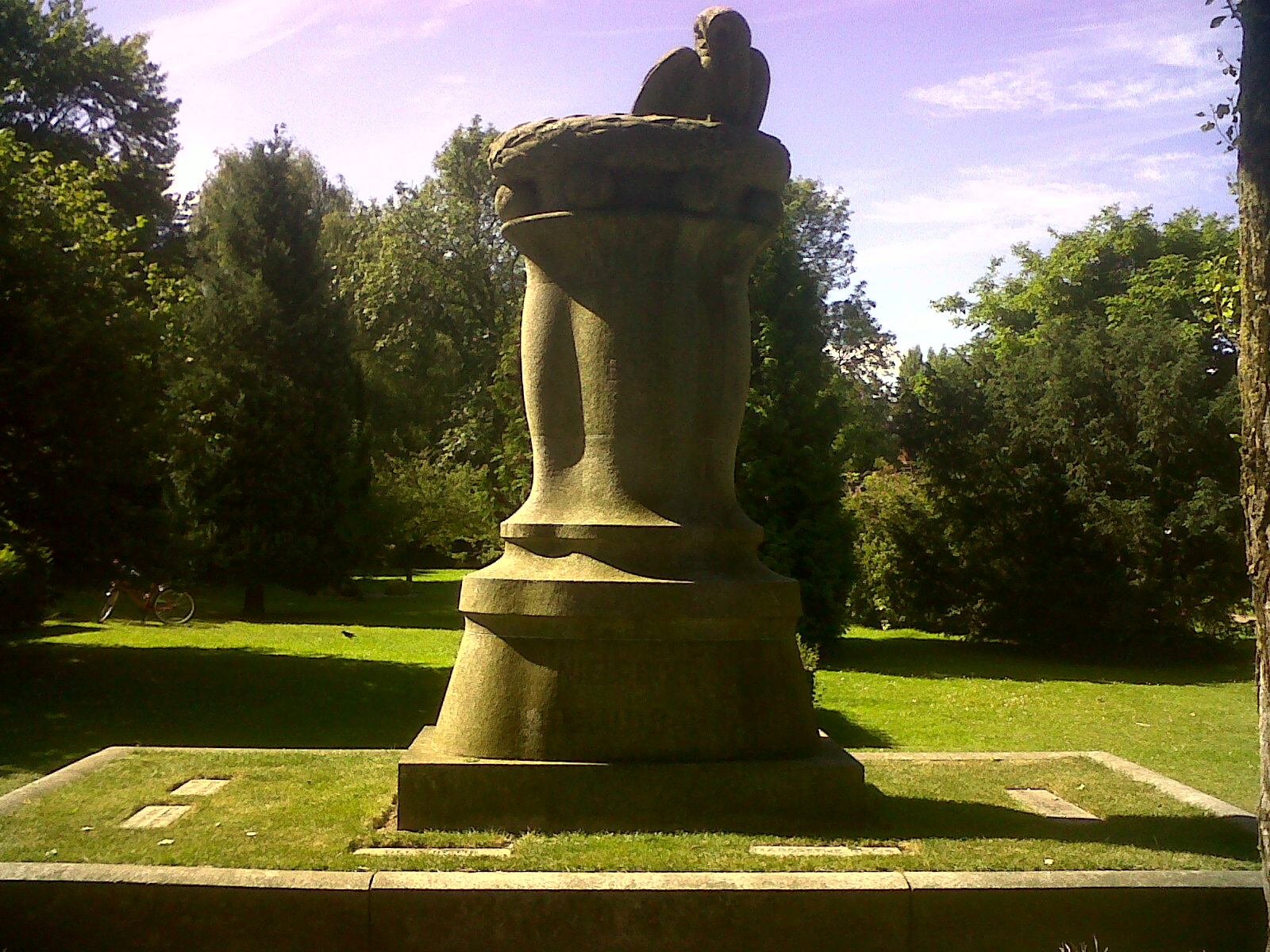
I have just a couple more days here in Copenhagen, where the weather has been lovely throughout my visit. Here’s a gratuitous picture of one of the city’s lovely parks in the sunshine:

I’m feeling a lot better for having been here for the last week or so. The people here have been so very kind and understanding. I have to admit, though, I’m a bit nervous about going back because: (a) I have more medical tests to go through before I start on a proper programme; (b) quite a big backlog has built up of things I have to do; and (c) I have to face the colleagues and students I’ve let down so badly over the last few weeks and try to find a way of making up for my dereliction of duty.

The next big thing when I get back to work will be admissions. On Thursday (16th August) the A-level examination results will be officially announced and the clearing system opens for business. Only then will we find out how many students we’ll have entering the first year in October. We think things have gone pretty well on the recruitment front, but you never know until you see the final numbers. Fingers crossed.

Anyway, with the results having been published, there’ll no doubt be the usual discussion in the newspapers about whether the Olympic Games were easier this year than they were in our day….

Grave Thoughts

Posted in Biographical, History, Jazz, Literature with tags , , , , , on August 12, 2012 by telescoper

It being a lovely day in Copenhagen yesterday I decided to go for a long walk. My destination was the famous Assistens Kirkegård which is in the Nørrebro district of the city. You might think that was a rather morbid choice of place to go for a stroll in the sunshine, but actually it’s not that way at all. It’s actually a rather beautiful place, a very large green space criss-crossed by tree-lined paths. We British have a much more reserved attitude to cemeteries than the Danes seem to have, at least judging by yesterday; joggers and cyclists pass through Assistens Cemetery at regular intervals, and many people were having picnics or just sunbathing between the gravestones.  And of course there were many tourists wandering around, myself included. I found this matter-of-fact attitude to the dead rather refreshing, actually.

Incidentally, I was also surprised to see a number of Jewish burials among the Christian ones. I don’t know if this happens in British graveyards.

Part of the attraction of Assistens Kirkegård – the name derives from the fact that it was originally an auxiliary burial place, outside the main city, designed to take some of the pressure off the smaller cemeteries in the inner areas – is the large number of famous people buried there.  The cemetery is extremely large (about 25 hectares), and the maps don’t show the locations of all the famous people laid to rest there, but I did find quite a few.

Here for example is the memorial to one of the most famous Danes of all, Hans Christian Andersen
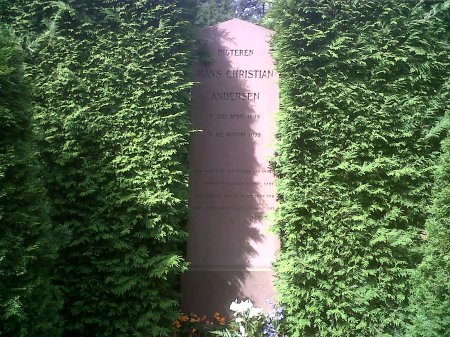
Going by the number of signposts pointing to it, this must be one of the most popular sites for visitors to the cemetery, along with the grave of the philosopher Søren Kierkegaard. One can also quite easily locate the memorial which marks the last resting place of Niels Bohr and various other members of his family:

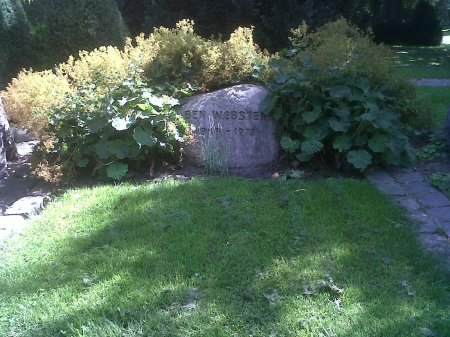
But it’s not only Danes that are buried here. There’s a corner of one plot occupied by a number of famous American Jazz musicians, including pianist Kenny Drew and, most famously of all, tenor saxophonist Ben Webster whose gravestone is rather small, but clearly very well tended, no doubt by a Danish jazz lover:
Unfortunately, I was unable to locate one of the graves I wanted to find, that of the great Heldentenor Lauritz Melchior. I was surprised to find his name was absent from the main index. I know he was cremated and his ashes buried there, and I even found a picture of his memorial on the net, but the cemetery is so large that without further clues I couldn’t find it. I’ll have to go back on a subsequent visit after doing a bit more research.

It’s very interesting that some of the smaller graves are extremely well-tended whereas many of the more opulent memorials are in a state of disrepair. My ambition is to be forgotten as quickly as possible after my death so the idea of anyone erecting some grandiose marble monument on my behalf fills me with horror, but I have to say I do find graveyards are strangely comforting places. Rich and poor, clever and stupid, ugly and beautiful; death comes to us all in the end. At least it’s very democratic.

And after about three hours strolling around in the cool shade of the trees in Assistens Kirkegård the thought did cross my mind there still seems to be plenty of room…