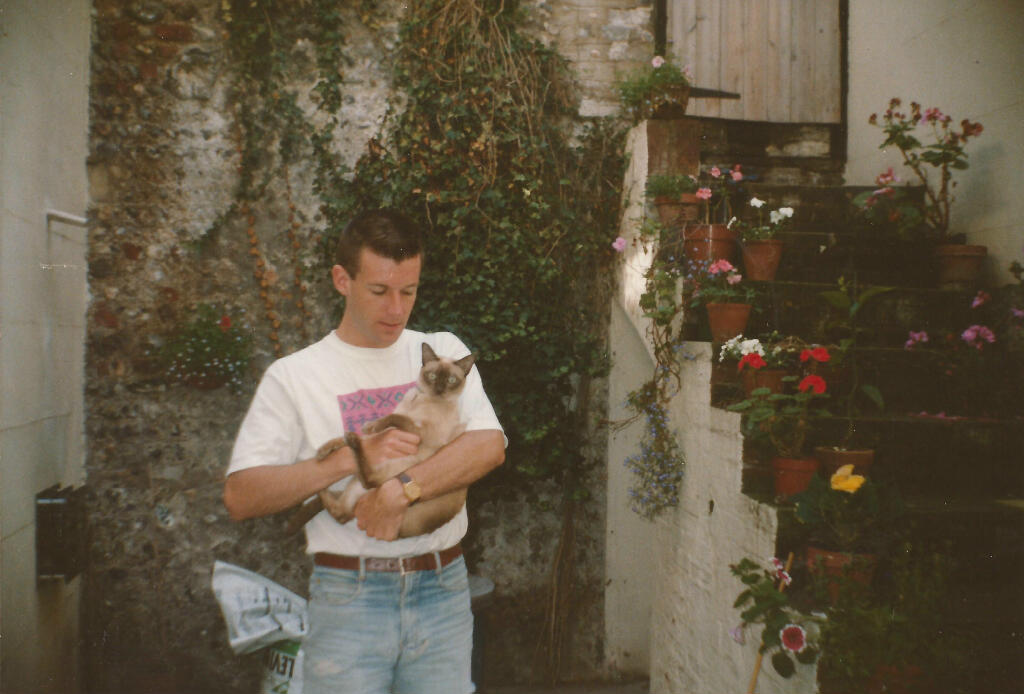
I chanced upon this old picture just now. It was taken in Brighton in 1989, and it shows me with Maurice, a gorgeous Burmese cat who was a resident of the basement flat in which I lodged for a while, in Montpelier Terrace. This photograph was taken in the little yard at the rear of the property, from which Maurice frequently tried to escape.
Burmese are wonderful cats, very talkative and full of personality, but their claws are like needles!
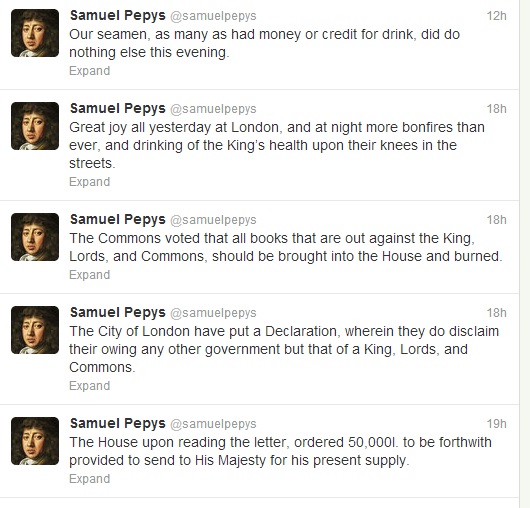
Twitter is much maligned by those who don’t use it, and I’d be the first to admit that it has several million downsides, but every now and again you come across something truly wonderful which makes it worthwhile putting up with the dross. Here’s an example. Some time ago, a nameless genius came up with the idea of tweeting excerpts from the Diaries of Samuel Pepys. Those of you on Twitter can follow Samuel Pepys by clicking here:
For those of you not familiar with Twitter, its main characteristic is that messages posted on it (“tweets”) are limited to 140 characters. To outsiders this seems to imply that all tweets are banal and pointless, but this is far from the case. The strict length limit forces a form of creativity that is both rare and wonderful. The stroke of genius in this case was to realize that the Pepys Diaries could be tweeted in chunks of the right size, in a manner that almost suggests they were designed for the purpose!
Pepys was a high-ranking naval administrator and Member of Parliament so he had detailed knowledge of the momentous political events of his period. He’s currently tweeting from May 1660 (near the start of the diaries), giving a vivid insight into the background to the Restoration of the Monarchy. Parliament should be recalled in a few days time, on May 8th…
Here is a selection of recent examples:
But it’s not just the fascinating political context that makes these tweets so interesting. They also give glimpses of everyday life in the 17th Century. Pepys was in poor health for much of his life, for example, and there are frequent references to various physicians and their quack remedies. He also manages to conjure up in just a few words the extraordinary atmosphere and energy of the London of the period, along with some of its excesses (especially drinking and fornication).
Following Pepys’ Twitter feed opens a window into 17th Century England, and what comes through it is both refreshing and illuminating. The reason I find this particularly delightful is something that I’ve blogged about before, so won’t repeat at length. I was a very late developer from an education point of view until I was helped with my reading and arithmetic by a wonderful old lady who lived next door. She encouraged me to read and, after a big struggle, I eventually got the hang of it. After a time I had caught up with the rest of the class in School and eventually managed to read just about every book the School had to offer, including the Diaries of Samuel Pepys which were for some reason on the shelves in Class 2 and which I was allowed to borrow. I don’t think anyone had read them before so nobody, including the teachers, knew how rude they were in places. The Restoration period was generally rather bawdy, and Pepys’ Diaries reflect that.
I had no idea at that time, of course, that less than ten years later I would be studying at Magdalene College, Cambridge, site of the Pepys Library where the orignal diaries are kept as well as the rest of Pepys’ own collection of rare books and music.
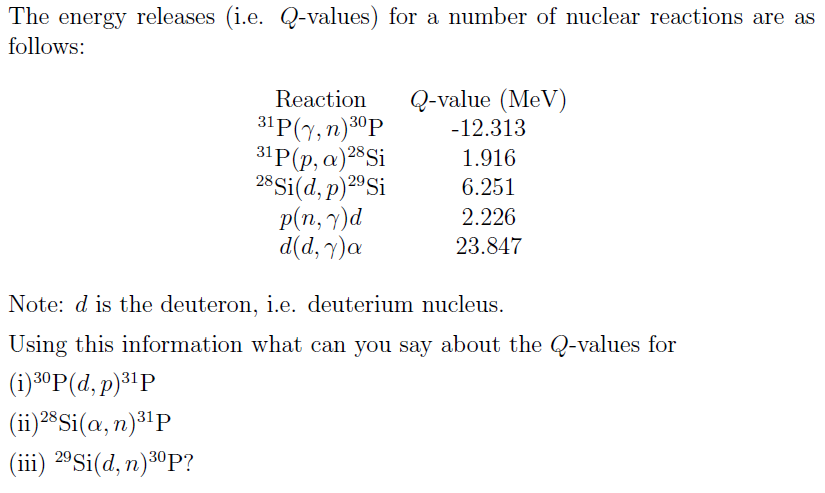
It’s been quite a while since I posted anything in the cute physics problems folder – mostly because the problems I’m generally dealing with these days are neither cute nor related to physics – but here’s one from an old course I used to teach on Nuclear and Particle Physics.
In the following the notation A(a,b)B means the reaction a+A→b+B and the you might want to look here for a definition of what a Q-value is. The Atomic Number of Phosphorus (P) is 15, and that of Silicon (Si) is 14. The question doesn’t require any complicated mathematics, or any knowledge of physics beyond A-level; the rest is up to your little grey cells!
This song was playing on the radio in the Bridge Cafe just now when I went to get a cup of coffee, thus providing me with another time warp experience. The Communards’ version of Don’t Leave Me This Way was a big hit way back in 1986 and I remember dancing to it many times in various Brighton clubs and discos; I was here at the University of Sussex then as a research student. Can that really have been 27 years ago? Sigh…
It’s another very busy day (as well as another lovely one) so I thought instead of sitting indoors this lunchtime writing a typically verbose blog item I’d just pick something out of my back catalogue and give it another airing because it deals with something that’s come up a couple of times recently.
This is the time of year when final-year students are drafting their project reports. Yesterday I was back in Cardiff giving feedback on two such articles. I usually quite enjoy reading these things, in fact. They’re not too long and I’m usually pretty impressed with how the students have set about the (sometimes quite tricky) things I’ve asked them to do for their project work. I think the project report is quite a challenge for UK physics students because they generally haven’t had much practice in putting together a lengthy piece of writing before or during their university course, so haven’t developed a style that they feel comfortable with and are often unfamiliar with various conventions (such as reference style, punctuation of equations, etc). Some of these are explained in quite a lot of detail in the instructions the students are given, of course, but we all know that only girls read instructions….
The thing that strikes me most forcibly about the strange way students write project reports is that they are nearly always phrased entirely in the passive voice, e.g.
The experiment was calibrated using a phlogiston normalisation widget….
I accept that people disagree about whether the passive voice is good style or not. Some journals actively encourage the passive voice while others go the opposite way entirely . I’m not completely opposed to it, in fact, but I think it’s only useful either when the recipient of the action described in the sentence is more important than the agent, or when the agent is unknown or irrelevant. There’s nothing wrong with “My car has been stolen” (passive voice) since you would not be expected to know who stole it. On the other hand “My Hamster has been eaten by Freddy Starr” would not make a very good headline.
The point is that the construction of a statement in the passive voice in English is essentially periphrastic, in that it almost inevitably involves some form of circumlocution – either using more words than necessary to express the meaning or being deliberately evasive by introducing ambiguity. Both of these failings should be avoided in scientific writing.
Apparently, laboratory instructors generally tell students to write their reports in the passive voice as a matter of course. I think this is just wrong. In a laboratory report the student should describe what he or she did. Saying what “was done” often leaves the statement open to the interpretation that somebody else did it. The whole point of a laboratory report is surely for the students to describe their own actions. “We calibrated the experiment..” or “I calibrated the experiment…” are definitely to be preferred to the form I gave above.
That brings me to the choice of pronoun in the active voice. One danger is that it can appear very bombastic, but that’s not necessarily the case. I don’t find anything particularly wrong in saying, e.g.
We improve upon the technique of Jones et al. (1848) by introducing a variable doofer in the MacGuffin control, thereby removing gremlins from the thingummy process.
But the main issue is whether to use the singular or plural form. It can be irritating to keep encountering “I did this..” and “I did that..” all the way through a journal paper, and I certainly would feel uncomfortable writing a piece like that in the first person singular. I think it feels less egotistical to use “we”, even if there is only one author (which is increasingly rare in any case). If it’s good enough for the Queen it’s good enough for me! However, I just looked “we” up in Chambers dictionary and found
..used when speaking patronizingly, esp to children, to mean `you’.
which wasn’t at all what I had in mind!
However in the case of a student project that I’m assessing I actually want to know what the particular student writing the report did, not what was done by person or persons unspecified or by a group of uncertain composition. So I encourage my students to put, e.g.,
I wrote a computer program in 6502 Assembly Language to solve the Humdinger equation using the Dingbat-Schnitzelgruber algorithm.
I also (sometimes) like “we” when there’s, e.g., a complicated mathematical derivation. Going line by line through a lengthy piece or difficult technical argument seems friendlier if you imagine that the reader is trying to do the calculation along with you as you write it:
if we differentiate the right hand side of equation (8), use the expression for x obtained in equation (97), expand y in a power-series and take away the number we first thought of we find…
The “we” isn’t necessarily an author with delusions of grandeur (or schizophrenia), but instead denotes a joint operation between author and reader.
Anyway, to resume the thread, it seems to me that sometimes it is appropriate to use the passive voice because it is the correct grammatical construction in the circumstances. Sometimes also the text just seems to work better that way too. But having to read an entire document written in the passive voice drives me to distraction. It’s clumsy and dull.
In scientific papers, things are a little bit different but I still think using the active voice makes them easier to read and less likely to be ambiguous. In the introduction to a journal paper it’s quite acceptable to discuss the background to your work in the passive voice, e.g. “it is now generally accepted that…” but when describing what you and your co-authors have done it’s much better to use the active voice. “We observed ABC1234 using the Unfeasibly Large Telescope..” is, to my mind, much better than “Observations of ABC1234 were made using..”.
Reading back over this post I notice that I have jumped fairly freely between active and passive voice, thus demonstrating that I don’t have a dogmatic objection to its use. What I’m arguing is that it shouldn’t be the default, that’s all.
My guess is that a majority of experimental scientists won’t agree with this opinion, but a majority of astronomers and theoreticians will.
This guess will now be tested by reactivating an old poll..
The views presented here are personal and not necessarily those of my employer (or anyone else for that matter).
Feel free to comment on any of the posts on this blog but comments may be moderated; anonymous comments and any considered by me to be vexatious and/or abusive and/or defamatory will not be accepted. I do not necessarily endorse, support, sanction, encourage, verify or agree with the opinions or statements of any information or other content in the comments on this site and do not in any way guarantee their accuracy or reliability.

 In the Dark