Archive for August, 2013

The Expanding University

Posted in Biographical, Education, The Universe and Stuff with tags , , , on August 10, 2013 by telescoper

Well, I’m a bit busy today – despite the fact that it’s a weekend – so I’m just going to take the opportunity post here  a news item from my employer which has already been posted on the University of Sussex website. 

–o–

The School of Mathematical and Physical Sciences (MPS) will have 63 academics at the start of the 2013-14 academic year – an increase of 58 per cent from February, when only 40 were in post.

The expansion follows a very successful few years for the School, during which the number of students starting degrees in Physics and Astronomy at Sussex has grown almost threefold.

The department has also climbed to 5th in The Times Good University Guide 2013 and Mathematics was ranked in the top 10 for academic support in the 2012 National Student Survey (NSS).

From September, Physics and Astronomy will have 40 academics, up from 25 in February. There are 12 new posts as well as three replacements, including the arrival in February of Professor Peter Coles, who replaced the late Professor David Axon as Head of School.

Mathematics is increasing from 15 academics to 23, with five of these arrivals being new positions. In particular, three new professors will join the Department this year.

Professor Coles says that overseeing this expansion has been his main focus since returning to Sussex. He says: “When I arrived, plans were already under way to get new people in and I knew this had to be my priority in my first few months as Head of MPS.

“We had an incredibly high calibre of applicants for all the posts and, in many cases, have been able to appoint more than one person. For one of the posts in Astronomy, the shortlist was so strong that we have actually appointed four excellent academics in that area. We couldn’t miss that opportunity.

“Our three  new chairs in Mathematics are joining us from Denmark, Greece and Italy, bolstering the School’s international outlook.

“We have been strategic in our appointments to encourage growth into new areas for us, such as probability and stochastic modelling on the Mathematics side, and materials-based experimental research on the Physics side. We anticipate further strategic expansion in these areas in the near future.

“These appointments also represent a step towards more interdisciplinarity and better crossover between the two departments within the School, and indeed with other schools such as Life Sciences, developing still further the University’s traditional strength in interdisciplinary research.

“And, most importantly of all, students in MPS will benefit from more study choices and smaller class sizes.”

A Sussex Alumna

Posted in Biographical, Television, The Universe and Stuff with tags , , , , on August 9, 2013 by telescoper

I had a very nice meeting this morning with Sir Harry Kroto, who is back in the UK for the summer. We chatted about a number of exciting things going on at Sussex University and beyond, in the middle of which I remembered a film featuring my former  PhD Student from Nottingham days, Emma King. The film was part of a series about young scientists made by the Vega Science Trust (which Harry set up) and it was originally broadcast on BBC 2 as part of The Learning Zone.

Emma is a graduate of the Department of Physics & Astronomy at Sussex University. As an undergraduate at the University of Sussex she made history when she became the first woman to win the top prize at the Science, Engineering and Technology Student of the Year award despite tests at school which showed that Emma was not only slightly dyslexic, but that also had very poor arithmetic skills and she says “a nearly non-existent visual memory.” None of that stopped her completing her PhD thesis (on magnetic fields in cosmology) in 2006.

p.s. After completing her PhD, Emma changed career and now runs this outdoor event venue.

The Dark Side of the REF

Posted in Finance, Science Politics with tags , , , , , , , , on August 8, 2013 by telescoper

There’s a disturbing story in the latest Times Higher which argues that the University of Leicester has apparently reneged on a promise that non-submission to the forthcoming (2014)  Research Excellence Framework (REF) would not have negative career consequences. They have now said that except in exceptional circumstances, non-submitted academics will either be moved to a teaching-only contract (where there is a vacancy and they can demonstrate teaching excellence), or have their performance “managed”, with the threat of sacking if they don’t meet the specified targets.  I’d heard rumours of this on the grapevine (i.e. Twitter) before the Times Higher story was published. It’s very worrying to have it confirmed, as it raises all kinds of questions about what might happen in departments that turn out to have disappointing REF results .

There are (at least) two possible reasons for non-inclusion of the outputs of a researcher and it is important to distinguish between them. One is that the researcher hasn’t enough high-quality outputs to submit. In the absence of individual extenuating circumstances, researchers are expected to submit four “outputs” (in my discipline that means “research papers”) for assessment. That’s a pretty minimal level of productivity, actually;  such a number per year is a reasonable average for an active researcher in my field.  A person employed on a contract that specifies their duties as Teaching and Research may therefore be under-performing  if they can’t produce four papers over the period 2008-2013. I think some form of performance management  may be justifiable in this case, but the primary aim should be to help the individual rather than show them the door. We all have fallow periods in research, and it’s not appropriate to rush to sack anyone who experiences a lean time.   Andrew Wiles would have been considered `inactive’ had there been a REF in 1992 as he hadn’t published anything for years. Then he produced a proof of Fermat’s Last Theorem. Some things just take time.

A second reason for excluding researcher from the REF is that the institution concerned may be making a tactical submission. As the Times Higher article explains:

The memo suggests that academics would be spared repercussions if, among other reasons, the number of individuals submitted is “constrained” by the volume of case studies their department intends to enter to demonstrate research impact.

Institutions must submit one case study for every 10 scholars entered.

Maria Nedeva, professor of science and innovation dynamics and policy at Manchester Business School, said the tactic of deciding how many academics to submit based on impact case study numbers was “rife”.

(Incidentally, the second paragraph is not quite right. The number of case studies required depends on the number of staff submitted as follows: for fewer than 15 staff , TWO case studies;  for 15-24.99 staff it is THREE case studies – and then for each additional ten members of staff entered a further case study is required.)

e case study for every scholars included plus one, i.e. forThe statement at the end of the quote there is in line with my experience too.  The point is that the REF is not just a means of allocating relatively small amounts of so-called `QR’ research funding . Indeed, it remains entirely possible that no funding at all will be allocated following the 2014 exercise. The thinking then is that the number of staff submitted is largely irrelevant; all that will count is league table position.

This by no means the only example of the dangers that lurk when you take league tables too seriously.

If a department is required to submit, say, four impact cases if all staff are included in the REF submission, but only has three viable ones, it would not be unreasonable to submit fewer staff because their overall would be dragged down by a poor impact case even if the output quality of all staff is high.  There will certainly be highly active researchers in UK institutions, including many who hold sizable external research grants, whose outputs are not submitted to the REF. As the article points out, it would be very wrong for managers to penalize scholars who have been excluded because of this sort of game-playing. That’s certainly not going to happen in the School of Mathematical and Physical Sciences at Sussex University.  Not while I’m Head of School, anyway.

Moreover, even researchers whose “outputs” are not selected may still contribute to the “Environment” and/or “Impact” sections so they still, in a very real sense, do participate in their department’s REF submission.

My opinion? All this silliness could easily have been avoided by requiring all staff in all units of assessment to be submitted by all departments. You know, like would have happened if the system were actually designed to identify and reward research excellence. Instead, it’s yet another example of a bureaucratic machine that’s become entirely self-serving. It exists simply because it exists.  Research would be much better off without it.

Duet for Violin and Subatomic Particles

Posted in Music, The Universe and Stuff with tags , , , on August 8, 2013 by telescoper

I received an email this morning about this video and thought I’d post the clip here. This short documentary is about the performance of the composition Cloud Chamber (“Duet for violin and subatomic particles”) in San Francisco at the California Academy of Sciences in Golden Gate Park. The video was produced by Patrick Haynes, Adam Behrmann and Chris Whitmore, and features commentaries from , e.g., Hitoshi Murayama, Professor of Physics at Berkeley and Director of the Institute of Physics and Mathematics of the Universe at the University of Tokyo (the commentaries start at 16:10). It is introduced by Professor JoAnne L. Hewitt, Head of Theoretical Physics at SLAC National Accelerator Laboratory, Stanford University. There’s a longer description on the Youtube page if you’re interested in learning more about this interesting project.

An Integral Appendix

Posted in Biographical, Cute Problems, The Universe and Stuff with tags , , , , , , on August 7, 2013 by telescoper

After the conference dinner at the Ripples in the Cosmos meeting in Durham I attended recently, a group of us adjourned to the Castle bar for a drink or several. I ended up chatting to one of the locals, Richard Bower, mainly on the subject of beards. I suppose you could call it a chinwag. Only later on did  we get onto the subject of a paper we had both worked on a while ago. It was with some alarm that I later realized that the paper concerned was actually published twenty years ago. Sigh. Where did all that time go?

Anyway, Richard and I both remembered having a great time working on that paper which turned out to be a nice one, although it didn’t exactly set the world on fire in terms of citations. This paper was written before the standard “concordance” (LCDM) cosmology was firmly established and theorists were groping around for ways of reconciling observations of the CMB from the COBE satellite with large-scale structure in the galaxy distribution as well as the properties of individual galaxies. The (then) standard model (CDM with no Lambda) struggled to satisfy the observational constraints, so in typical theorists fashion we tried to think of a way to rescue it. The idea we came up with was “cooperative galaxy formation”, as explained in the abstract:

We consider a model in which galaxy formation occurs at high peaks of the mass density field, as in the standard picture for biased galaxy formation, but is further enhanced by the presence of nearby galaxies. This modification is accomplished by assuming the threshold for galaxy formation to be modulated by large-scale density fluctuations rather than to be spatially invariant. We show that even a weak modulation can produce significant large-scale clustering. In a universe dominated by cold dark matter, a 2 percent – 3 percent modulation on a scale exceeding 10/h Mpc produces enough additional clustering to fit the angular correlation function of the APM galaxy survey. We discuss several astrophysical mechanisms for which there are observational indications that cooperative effects could occur on the scale required.

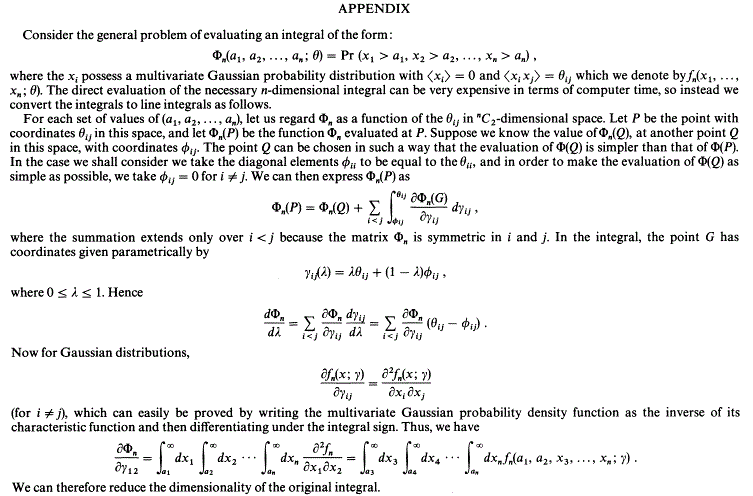
I have to say that Richard did most of the actual work on this paper, though all four authors did spend a lot of time discussing whether the idea was viable in principle and, if so, how we should implement it mathematically. In the end, my contribution was pretty much limited to the Appendix, which you can click to make it larger if you’re interested.

t2png

As is often the case in work of this kind, everything boiled down to evaluating numerically a rather nasty integral. Coincidentally, I’d come across a similar problem in a totally different context a few years previously when I was working on my thesis and therefore just happened to know the neat trick described in the paper.

Two things struck me looking back on this after being reminded of it over that beer. One is that a typical modern laptop is powerful enough to evaluate the original integral without undue difficulty, so if this paper had been written nowadays we wouldn’t have bothered trying anything clever; my Appendix would probably not have been written. The other thing is that I sometimes hear colleagues bemoaning physics students’ lack of mathematical “problem-solving” ability, claiming that if students haven’t seen the problem before they don’t know what to do. The problem with that complaint is that it ignores the fact that many problems are the same as things you’ve solved before, if only you look at them in the right way. Problem solving is never going to be entirely about “pattern-matching” – some imagination and/or initiative is going to required sometimes- but you’d be surprised how many apparently intractable problems can be teased into a form to which standard methods can be applied. Don’t take this advice too far, though. There’s an old saying that goes “To a man who’s only got a hammer, everything looks like a nail”. But the first rule for solving “unseen” problems has to be to check whether you might in fact already have seen them…

Beard Facts

Posted in Beards, Biographical with tags on August 6, 2013 by telescoper

I received this very enlightening infographic via @Albertthegoat on Twitter and thought I’d share it here:

BQ7ijNQCAAASK0v

…but shouldn’t it be “instinctively”?

The Ashes Retained

Posted in Cricket with tags , , , on August 5, 2013 by telescoper

I’m back home after a few days’ enforced absence. Don’t worry – nothing too serious! As soon as I got in I nervously switched on the radio to find out the score in the 3rd Ashes Test Match at Old Trafford. To my relief that stalwart of English cricket – The Weather – had intervened in decisive fashion. “Rain stopped play” never sounded so sweet..

It was just as well, actually, because England’s batsmen were struggling along at 37 for 3 chasing a formidable total of 332 to win (or, more realistically, trying to survive all day to secure a draw).

Anyway, with England 2-0 up going into the 3rd Test, this result means that England retain the Ashes; the best Australia can hope for now is that the series of 5 Tests will end 2-2 and in such a case the side holding The Ashes keeps them.

Commiserations to the Australians, though. They batted and bowled much better in this game and without the interruptions for rain and bad light would probably have won.

So do I feel guilty that England keep the Ashes because of the rain? Not at all. Test cricket is played outside, over five days. The changing weather and condition of the pitch have always been part of the game. If Australia had won, would anyone have asked them if they felt guilty that they won the toss? By batting first they had by far the best of the pitch and the weather. Rain is part of the game and long may it remain so. Especially if it plays for England.

An Ever-Fixed Mark

Posted in Poetry with tags , on August 3, 2013 by telescoper

Years ago, at a private school
Run on traditional lines,
One fellow used to perform
Prodigious feats in the dorm;
His quite undevious designs
Found many a willing tool.

On the rugger field, in the gym,
Buck marked down at his leisure
The likeliest bits of stuff;
The notion, familiar enough,
Of ‘using somebody for pleasure’
Seemed handy and harmless to him.

But another chap was above
The diversions of such a lout;
Seven years in the place
And he never got to first base
With the kid he followed about:
What interested Ralph was love.

He did the whole thing in style –
Letters three times a week,
Sonnet-sequences, Sunday walks;
Then, during one of their talks,
The youngster caressed his cheek,
And that made it all worth while.

These days, for a quid pro quo,
Ralph’s chum does what, and with which;
Buck’s playmates, family men,
Eye a Boy Scout now and then.
Sex is a momentary itch,
Love never lets you go.


by Kingsley Amis (1922-1995)

Just a minute! Is space really expanding?

Posted in Astrohype, The Universe and Stuff with tags , , , on August 2, 2013 by telescoper

Now then. I’m sure this little video will get a few cosmologists’ hackles rising:

The video was produced by minutephysics, so presumably the expansion of time accounts for the fact that lasts more than two minutes. More importantly, though, is the content. Here’s an old  discussion of mine on this question. Let me know what you think via the comments box!

Building Blocks and Blueprints in Cosmology

Posted in The Universe and Stuff with tags , , , on August 1, 2013 by telescoper

Still playing catch-up from my recent travels, so to provide a blog post for today I’ve decided shamelessly to rip off an interesting comment on a blog post by Sean Caroll which picked up on the theme I posted about a few days ago, namely my perception that the current generation of cosmologists seems rather reluctant to question the standard paradigm. Please bear with me if that all sounds a bit incestuous…

Anyway, Peter Edmonds commented in order to draw attention to a series of papers on related matters by Avi Loeb (of Harvard University) which can be found on the arXiv here, here, here and there.
I’d encourage you to read the four interesting papers I’ve linked to above as I think they are extremely thought-provoking. The last of these begins with this paragraph, so you can see why it’s relevant to the aforementioned topic.

Too few theoretical astrophysicists are engaged in tasks that go beyond the refinement of details in a commonly accepted paradigm. It is far more straightforward today to work on these details than to review whether the paradigm itself is valid. While there is much work to be done in the analysis and interpretation of experimental data, the unfortunate by-product of the current state of affairs is that popular, mainstream paradigms within which data is interpreted are rarely challenged. Most cosmologists, for example, lay one brick of phenomenology at a time in support of the standard (inflation+Λ+Cold-Dark-Matter) cosmological model, resembling engineers that follow the blueprint of a global construction project, without pausing to question whether the architecture of the project makes sense when discrepancies between expectations and data are revealed.

To put this another way, a great deal of modern astrophysics and cosmology is rather incremental. I don’t mean that in a derogatory way, just that such research often involves large-scale observational projects that have to proceed slowly and painstakingly. Working at the coal face in large consortia like this makes it difficult to take the time to step back and consider the bigger picture. We ask a lot of early career researchers nowadays when we expect them to cope with detailed analytic work as well as assimilating and synthesizing a coherent view of the overall landscape. Producing a stream of research papers doesn’t in itself make an excellent research. Productivity needs to be balanced by a proper appreciation of which questions are the most important ones to ask, which often requires (and I apologize for using such an awful cliché) thinking outside the box.