Archive for January, 2014

Eleven Plus Forty Years On

Posted in Biographical, Education with tags , , , on January 23, 2014 by telescoper

Today is the fortieth anniversary of an important historical event. Well, no. It’s not actually. It is however the fortieth anniversary of an important event in my life or, as they say on Facebook, a life event on my timeline.

On January 23rd 1974 (in the middle of the “Three Day Week“), I arrived at the Royal Grammar School in Newcastle upon Tyne to take the Eleven Plus entrance examination. The RGS was basically a private school, but it operated under what was called the Direct Grant system, which meant that applicants who did well in the entrance examination could have their fees paid by the local authority. That was the only possibility for me to go to there, in fact, as there was no way my parents could have afforded the fees. It wasn’t my idea to go for the examination either. I would have been happy to go to the local comprehensive with my friends from Pendower Junior School and in any case thought I faced humiliation in the examination, as I’d had no preparation for it (unlike many of the more well-to-do applicants). Nevertheless, my parents insisted and I turned up on a cold Thursday morning to take the test.

I remember little about the examination, except that it comprised several papers including one on English comprehension and another on Arithmetic. I’d never sat an examination before and I do remember that I found the whole thing excruciatingly hard. I think I found the Arithmetic paper so difficult that I almost decided to get up and leave; I may even have cried. I left with a sense of relief that it was all over, and a certainty that I would not be going to the RGS.

Nevertheless, a short time later, in February I think, I was summoned for an interview which experience terrified me despite the fact that the staff involved were really very kind and friendly. I was very surprised to have got that far.
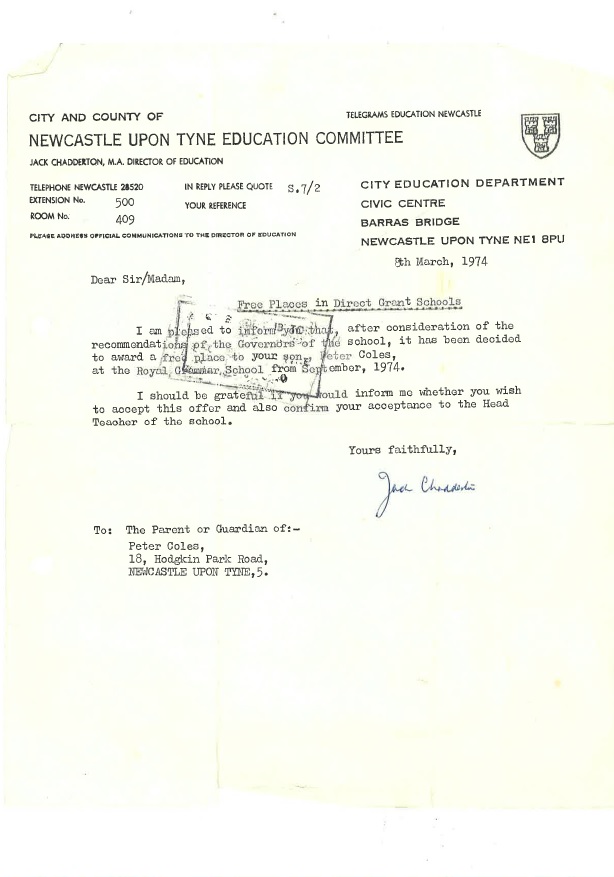
School PlaceSurprise turned to astonishment in March when the letter arrived (left) confirming that not only had I passed but I had been awarded the scholarship that I needed to allow me to go there. And before you ask why I kept the letter, I’ll admit that I also still have all my school reports from the RGS. Vanity is part of the reason, I suppose, but the other is to remind me of how lucky I’ve been with the opportunities that have come my way. I remain completely convinced that I got my place and scholarship as a result of some form of administrative error, but I vowed to make the best of the opportunity.

The UK education system has all changed (several times) since then, of course, and I often wonder how many youngsters far cleverer than me from working class backgrounds would nowadays have any chance of following a path like that which presented itself to me.

Hot News! Supernova in M82

Posted in The Universe and Stuff with tags , , , , , on January 22, 2014 by telescoper

Very exciting news today – a supernova has gone off in Messier 82. In fact, according to this sequence of images from Japan it actually started to brighten about a week ago:

psn-m82

Being arranged in Japanese fashion, you have to read these from top to bottom but starting at the right, so the supernova can be seen to be steadily brightening, i.e. decreasing in magnitude from 17.0 to 11.9. That means it’s now visible with binoculars and will have been seen already by many amateur astronomers. The exciting question this time is whether we’ll get any neutrinos from it!

UPDATE: I’m told that, close as it is, M82 is probably too far to detect neutrinos. Boo.

This is the nearest supernova since 1987a which was observed in, er, 1987. This is the nearest Type Ia supernova for a very long time (possibly 1937), so it’s of considerable interest for the use of such objects in cosmology. There have been other close ones since the nearest one I can remember, 1987a, which was observed in, er, 1987 but all have been Type II.

UPDATE: Thanks for the people who pointed out my error which I’ve left in to show that I don’t know much about supernovae so you shouldn’t phone me up to ask.

Tutorial 27: how to publish an open-access paper in a paywalled journal

Posted in Open Access on January 22, 2014 by telescoper

Some tips on how to get your paper published open-access despite a publisher’s paywall. Personally, I think you should go direct to Step 5…

Mike Taylor's avatarSauropod Vertebra Picture of the Week

I got in a conversation recently with a friend who is about to have his first paper published. It’s been through review and is now accepted at a well-respected old-school journal owned by a legacy publisher. It’s not an open-access journal, and he asked my advice on how he could make the paper open access.

We had a fruitful discussion, and we agreed that I’d write up the conclusions for this blog.

First, you can pay the publisher to open-access your paper. That’s a legitimate option at “hybrid OA” journals, which by this point is pretty much all paywalled journals. But even when the journal invites it, that’s not always possible. In this case, my friend has no institutional funds available, and really isn’t in a position to bung the publisher $3000 out of his own pocket.

The second option is to write to the journal saying that you select the…

View original post 623 more words

Aubade

Posted in Literature with tags , , on January 22, 2014 by telescoper

I work all day, and get half drunk at night.
Waking at four to soundless dark, I stare.
In time the curtain edges will grow light.
Till then I see what’s really always there:
Unresting death, a whole day nearer now,
Making all thought impossible but how
And where and when I shall myself die.
Arid interrogation: yet the dread
Of dying, and being dead,
Flashes afresh to hold and horrify.

The mind blanks at the glare. Not in remorse
– The good not used, the love not given, time
Torn off unused – nor wretchedly because
An only life can take so long to climb
Clear of its wrong beginnings, and may never:
But at the total emptiness forever,
The sure extinction that we travel to
And shall be lost in always. Not to be here,
Not to be anywhere,
And soon; nothing more terrible, nothing more true.

This is a special way of being afraid
No trick dispels. Religion used to try,
That vast moth-eaten musical brocade
Created to pretend we never die,
And specious stuff that says no rational being
Can fear a thing it cannot feel, not seeing
that this is what we fear – no sight, no sound,
No touch or taste or smell, nothing to think with,
Nothing to love or link with,
The anaesthetic from which none come round.

And so it stays just on the edge of vision,
A small unfocused blur, a standing chill
That slows each impulse down to indecision
Most things may never happen: this one will,
And realisation of it rages out
In furnace fear when we are caught without
People or drink. Courage is no good:
It means not scaring others. Being brave
Lets no-one off the grave.
Death is no different whined at than withstood.

Slowly light strengthens, and the room takes shape.
It stands plain as a wardrobe, what we know,
Have always known, know that we can’t escape
Yet can’t accept. One side will have to go.
Meanwhile telephones crouch, getting ready to ring
In locked-up offices, and all the uncaring
Intricate rented world begins to rouse.
The sky is white as clay, with no sun.
Work has to be done.
Postmen like doctors go from house to house.

by Philip Larkin (1922-1985).


Ivor Cutler: Walking to a Farm (past Jodrell Bank)

Posted in Music, Poetry with tags , , , , on January 21, 2014 by telescoper

For reasons not necessary to explain I just found this little video someone made to go with a rendition of Walking to a Farm by Ivor Cutler, who accompanies himself on harmonium, and was quite surprised to see a few images of Jodrell Bank on the way. That tenuous connection with astronomy, and the fact that I’ve been too busy today to think of anything else, convinced me that I should post it on this here blog:


R.I.P. Claudio Abbado

Posted in Music with tags , , , , on January 20, 2014 by telescoper

I’ve just heard the very sad news that the great Italian conductor Claudio Abbado has passed away at the age of 80. No words of mine can pay adequate tribute to his wonderful career. He leaves a rich legacy of recordings which can speak more eloquently than I could ever do and he will live on through them and through the memories of those who attended live performances he conducted. Here is a superb example, a recording of  a sublime performance one of the five Rückert-Lieder by Gustav Mahler (“Ich bin der Welt abhanden gekommen“) featuring the Lucerne Festival Orchestra under Abbado’s direction, and the gorgeous voice of mezzo-soprano Magdalena Kožená. Rest in peace, Maestro Claudio Abbado.

Cosmology and the Constants of Nature

Posted in The Universe and Stuff with tags , , , , on January 20, 2014 by telescoper

Just a brief post to advertise a very interesting meeting coming up in Cambridge:

–o–

Cosmology and the Constants of Nature

DAMTP, University of Cambridge

Monday, 17 March 2014 at 09:00 – Wednesday, 19 March 2014 at 15:00 (GMT)

Cambridge, United Kingdom

The Constants of Nature are quantities, whose numerical values we know with the greatest experimental accuracy – but about the rationale for those values, we have the greatest ignorance. We might also ask if they are indeed constant in space and time, and investigate whether their values arise at random or are uniquely determined by some deep theory.

This mini-series of talks is part of the joint Oxford-Cambridge programme on the Philosophy of Cosmology which aims to introduce philosophers of physics to fundamental problems in cosmology and associated areas of high-energy physics.

The talks are aimed at philosophers of physics but should also be of interest to a wide range of cosmologists.  Speakers will introduce the physical constants that define the standard model of particle physics and cosmology together with the data that determine them, describe observational programmes that test the constancy of traditional ʽconstantsʼ, including the cosmological constant, and discuss how self-consistent theories of varying constants can be formulated.

Speakers:

John Barrow, University of Cambridge

John Ellis, King’s College London

Pedro Ferreira, University of Oxford

Joao Magueijo, Imperial College, London

Thanu Padmanabhan, IUCAA, Pune

Martin Rees, University of Cambridge

John Webb, University of New South Wales, Sydney

Registration is free and includes morning coffee and lunch. Participants are requested to register at the conference website where the detailed programme of talks can be found:

http://www.eventbrite.co.uk/e/cosmology-and-the-constants-of-nature-registration-9356261831

For enquiries about this event please contact Margaret Bull at mmp@maths.cam.ac.uk

Sayonara, Nagoya

Posted in Biographical on January 19, 2014 by telescoper

So here I am, then, in Nagoya Airport (also known as Central Japan International Airport). Managed to get here via subway and train on my own and in good time, so I’m sitting having a coffee in the terminal building and wondering whether to buy any over-priced tat in the Duty Free shops.

Nagoya Airport is on an artificial island, actually, which means that I can see water all around from the departure lounge.

It’s been a fascinating and enjoyable trip. I’d like to thank my host, Chiaki Hikage, for all his help and hospitality.

It’s just after 9am here, which means just after midnight back in Blighty. The flight to Frankfurt arrives at 15.30, which means the whole 12 hour trip will be in daylight. Could be a bit strange!

Looking out I see that the incoming flight has just arrived, at the same time as the one that brought me here, and right on schedule. Travelling by a combination of Japanese and German transport definitely seems an efficient choice!

Signing off now. Hopefully my next post will be from Brighton!

The Falling Sky

Posted in Literature with tags , on January 18, 2014 by telescoper

thCAFHTTOSMy recent travels have at last given me the chance to finish reading the novel The Falling Sky by Pippa Goldschmidt. I actually started reading this some time ago, but absent-mindedly left the book in Cardiff during one of my occasional visits back to my Welsh residence. I remembered it when I was there over the New Year break and I brought it with me to Japan. I was indisposed with a tummy bug this morning so decided not to chance a trip to Kyoto, especially as I’m flying home tomorrow, but at least I got the chance to finish reading it.

Pippa Goldschmidt is now a professional writer, but she did a PhD in Astronomy and subsequently worked for some time as an astronomical researcher in London, in Imperial College to be precise, when I was working at the (then) Queen Mary & Westfield College. I remember her well from that time, although I hadn’t see her for ages until last year when we met in Edinburgh when I was visiting for a PhD examination.

Here’s the jacket blurb for The Falling Sky, which was shortlisted for the Dundee International Book Prize:

Jeanette is a young, solitary post-doctoral researcher who has dedicated her life to studying astronomy. Struggling to compete in a prestigious university department dominated by egos and incompetents, and caught in a cycle of brief and unsatisfying affairs, she travels to a mountaintop observatory in Chile to focus on her research. There Jeanette stumbles upon evidence that will challenge the fundamentals of the universe, drawing her into conflict with her colleagues and the scientific establishment, but also casting her back to the tragic loss that defined her childhood. As the implications of her discovery gather momentum, and her relationships spiral out of control, Jeanette’s own grip on reality is threatened, finally forcing her to confront the hidden past. This bittersweet debut novel blends black comedy, heartbreaking tragedy, and fascinatingly accessible science, in an intricate and beautiful examination of one woman’s disintegration and journey to redemption.

As the above description suggests, the plot weaves together two strands in the life and thoughts of the principal character, Jeanette. The initial reaction of most readers will be to find one strand immediately familiar and intelligible and the other obscure and difficult to understand. The first, more accessible, level of course comprises the straightforward world of cosmology and extragalactic astronomy, science politics and academic rivalry; the other concerns such unfamiliar and outlandish ideas as “emotions”, “sex” and “relationships”. Goldschmidt largely describes these latter concepts in language accessible to non-specialists such as myself, but I did tend to get lost when she touches upon female genitalia; those passages aren’t really in my comfort zone, and rather impenetrable to me for reasons that I’ve never been able to my finger on. Perhaps some form of glossary, or even a diagram, might be a useful addition to a future edition?

But, seriously, it’s really a very good novel with an interesting narrative structure involving flashbacks and other ingenious literary devices. It also offers many glimpses of a dark and rather quirky sense of humour. Amongst many other things it makes the point – that quite a few scientists themselves seem to deny – that science is something done by human beings, and the way we do our science is consequently greatly affected by our inner life (and vice-versa).

One of the games astronomers will play – and I know quite a few who have played it already – is to try to spot the real astronomers on whom some of the characters are based. I couldn’t possible comment myself, but I’ll offer the possibility below for others to offer suggestions…

Mental Health Bloggers Widen Their Support Systems on WordPress.com

Posted in Mental Health on January 18, 2014 by telescoper

Lots of interesting suggestions here on how to use blogging to help deal with mental health issues…