Archive for February, 2014

Big Trouble with Big G

Posted in The Universe and Stuff with tags , , on February 4, 2014 by telescoper

An Antonymous email correspondent this morning drew my attention to an interesting article in the latest Physics World about the trials and tribulations of groups of physicists trying to measure Newton’s Gravitational Constant,  G. This is probably the first physical constant that most of us encounter when we’re learning the subject so it might seem strange that it’s the one which is known to the lowest accuracy. That’s not for want of trying to make the measurements more precise, just that gravity is such a very weak force that it’s very difficult to eliminate systematic effects down to the necessary level.

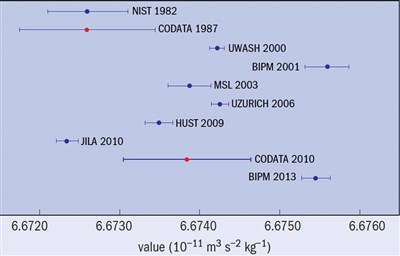
Just how difficult it is to measure Big G is demonstrated by the following graphic which shows the latest measurements:
Big_G

Here’s the caption, so you can identify the various groups responsible for the various measurements:

Disagreeing over “big G” This chart shows wildly differing values of the gravitational constant, G, as measured by various high-profile research groups (blue). The values do not agree even within their error bars. Also shown are two values of G adopted by the Committee on Data for Science and Technology (CODATA) as international standards (red). The groups are based at the National Institute of Standards and Technology (NIST), the University of Washington (UWASH), the International Bureau of Weights and Measures (BIPM), the Measurement Standards Laboratory of New Zealand (MSL), the University of Zurich (UZURICH), the Huazhong University of Science and Technology (HUST) and the Joint Institute for Astrophysics (JILA).

Clearly there’s quite a lot of disagreement between recent results, with some a long way outside each other’s error bars. They can’t all be right, but who’s most likely to be wrong? Answers on a postcard.

I’m by no means an expert on experimental gravity so I won’t attempt to suggest who is right and who is wrong. What I will say is that although this kind of research is clearly extremely important it is clearly also fiendishly difficult. I’m not really surprised that the pieces of the puzzle haven’t fallen into place yet. The dedicated teams who have been tackling this problem for many decades deserve the deep admiration as well as the continued support of the physics community. Theoretical physics is generally perceived to be more glamorous and exciting than its experimental counterpart, but the subject as a whole is nothing without its empirical foundations. That said, I’m glad it’s not my job to measure Big G. I have neither the practical skill nor the patience to cope with so many frustrations!

The super-compressible Cosmic Microwave Background

Posted in The Universe and Stuff with tags , , on February 3, 2014 by telescoper

I just came across this blog post, one of a series on cosmology from the African Institute for Mathematical Sciences, which is in Muizenberg near Cape Town, South Africa. I thought I’d reblog it, partly because it’s on a topic I often discuss in talks and partly because I wanted to draw your attention the site and the other interesting posts on it.

In this article Bruce Bassett explains just how much of the information we get from measurements of the Cosmic Microwave Background can be squeezed into precise estimates of just a few parameters. The only point I would add is that this does assume at the outset that all relevant information is contained within the angular power spectrum; that’s not necessarily the case, but we don’t have any compelling evidence that it’s a wrong assumption for the CMB; see here for a previous discussion of this.

Bruce Bassett's avatarCosmology at AIMS

One of the most striking features about the Cosmic Microwave Background (CMB) is that it is incredibly compressible from an information content point of view. The Planck satellite produced maps with of order a billion pixels whose information could be compressed almost perfectly into a power spectrum of order one thousand real numbers.

This already is a massive compression. But in addition, most of this information can be compressed further into just six of the parameters of the standard model, yielding a total compression of about one billion to one. This is both remarkable and annoying because we want to be surprised and find things that we can’t explain. And if there are things we can’t explain we want to have clear signals data about them, not just vague hints of their existence.

Anyway, to illustrate just how efficient the compression is, I took the binned WMAP 9 TT power spectrum…

View original post 520 more words

Irony 101

Posted in Uncategorized with tags , on February 3, 2014 by telescoper

birmingham_image

Scott Tremaine on “Astrohype”

Posted in Astrohype, The Universe and Stuff with tags on February 2, 2014 by telescoper

I recently came across a post by distinguished astrophysicist Scott Tremaine who works at the Institute for Advanced Study in Princeton. The piece is entitled “Overblown Statements in Press Releases Undermine Science”, something that exercised me so much that I invented the category Astrohype so I could post particularly egregious examples on this blog.

Soctt Tremaine’s piece is on the American Astronomical Society website, but I’m reposting the text here to give it wider circulation as I think it makes some very important points that we’d all do well to heed. And of course in the interest of full disclosure I should point out that I am a theoretical astrophysicist myself, so may be a bit biased…

–o–

In a recent column, AAS President David Helfand argued correctly that negative public messages about subfields within our own discipline, or even about other disciplines — “shooting inward at each other” — damage all of us.

Consider, then, the following public messages:

  • from a major research university, a press release titled “Astronomers Discover Planet that Shouldn’t Be There,”
  • from the European Southern Observatory, a press release titled “Turning Planetary Theory Upside Down,”
  • from the National Radio Astronomy Observatory, a press release containing the quote, “Much of what we thought we understood about the physics of pulsars and neutron stars may be wrong,”
  • from the Space Telescope Science Institute, a press release stating, “New observations from NASA’s Hubble Space Telescope challenge 30 years of scientific theory about quasars,” and
  • from a respected news organization, an interview with a prominent exoplanet researcher containing the quote, “Theory has struck out.”

The point is not whether these messages provide accurate characterizations of the state of theoretical understanding in their respective subject areas (though in most cases they do not). The point is that by belittling and trivializing the efforts of theoretical astrophysicists — who try to understand extremely complex processes in exotic environments, with limited clues from observations — they damage the public perception of the entire astronomy community. As just one example, statements from press releases such as those above are often repeated on creationist websites, where they carry extra weight because they have the imprimatur of NASA or a major observatory or university.

Advances in observational astronomy are spectacular enough to appeal to the public on their own merits, without “shooting inward” at efforts to understand these observations. Astronomers and press officers can provide a more realistic picture of the synergy between observation and theory, and in so doing would improve the public perception of astronomy research in particular and of the scientific enterprise more generally.

Mirror in February

Posted in Poetry with tags , , , on February 2, 2014 by telescoper

The day dawns with scent of must and rain,
Of opened soil, dark trees, dry bedroom air.
Under the fading lamp, half dressed – my brain
Idling on some compulsive fantasy-
I towel my shaven jaw and stop, and stare,
Riveted by a dark exhausted eye,
A dry downturning mouth.

It seems again that it is time to learn,
In this untiring, crumbling place of growth
To which, for the time being, I return.
Now plainly in the mirror of my soul
I read that I have looked my last on youth
And little more; for they are not made whole
That reach the age of Christ.

Below my window the awakening trees,
Hacked clean for better bearing, stand defaced
Suffering their brute necessities,
And how should the flesh not quail that span for span
Is mutilated more? In slow distaste
I fold my towel with what grace I can,
Not young and not renewable, but man.

by Thomas Kinsella (b. 1928)


A Partly Political Message

Posted in Politics on February 1, 2014 by telescoper

You may decide for yourself who this is aimed at!


One Year in Sussex

Posted in Biographical, Brighton with tags , on February 1, 2014 by telescoper

Well, it’s the First of February which means it’s a year to the day since I started my current job as Head of the School of Mathematical Sciences at the University of Sussex, or MPS for short.

It’s been an eventful year, and not really like I expected. What I mean is that I knew it would be hard work, but the hardest bits were not the things I’d imagined. The first half of the year was primarily involved with appointing new staff to the School. All the interviews and other activities associated with that took up a huge amount of time but I think it all went well in the end. The number of full-time staff in MPS has increased by more than 50% over this time; from 15 to 23 in Mathematics (including 3 new Professors) and from 23 to 38 in Physics & Astronomy. The primary motivation for this is growth in student numbers: the number of undergraduates in Physics & Astronomy has doubled in the last three years or so, and this year we had our biggest ever intake of over 140 students.

All that wasn’t my doing, of course. The expansion of staff numbers was planned before I arrived, and the increase in student numbers is down to hard work by the admissions team.

I spent the latter part of last year involved with planning further expansion of our research activity as the contribution of MPS to the University’s Strategic Plan and am looking forward to turning that into reality over the next year or so.

I’ve tried to ensure that MPS is a friendly and open place for all staff and students, where everyone has a say and everyone feels valued. It’s not for me to say how well I’ve succeeded in that, but I’ll carry on trying.

I should mention some of the frustrations. One is that I became an academic in the first place because I enjoy both teaching and research. When I became Head of School here I found I had so many administrative duties that I had very little time for either of those activities. I got especially depressed about not being involved in teaching because I didn’t see how I could properly understand how things work in MPS without working at the coalface.

Against the advice of several colleagues I decided to teach a full module this year on Theoretical Physics to a class of about 50 students. It’s been a struggle to find the time to prepare everything, as I’m doing this for the first time, but I’ll persevere. Hopefully the students will bear with me while I get my act together. I’m very impressed with their engagement with the material so far, but then they have chosen the Theoretical Physics option so are obviously the intellectual elite of MPS; obviously, that’s my theorist’s bias speaking!

Oh, and in my spare time I grew a beard:

me

I suppose that will have to do. I’ll be heading up to campus shortly to spend Saturday afternoon in the office. A Head of School’s work is never done..