Quite a few people have been asking me whether the UK’s cancelled B-mode experiment, Clover, could have detected what BICEP2 may have found; I’m still not convinced, by the way. It therefore seemed apt to do a quick post in order to direct you to relevant sources of information. If you’re interested in Clover’s capabilities you can find a nice summary on the ArXiv here. The abstract reads:
We describe the objectives, design and predicted performance of Clover, which is a ground-based experiment to measure the faint “B-mode” polarisation pattern in the cosmic microwave background (CMB). To achieve this goal, clover will make polarimetric observations of approximately 1000 deg^2 of the sky in spectral bands centred on 97, 150 and 225 GHz. The observations will be made with a two-mirror compact range antenna fed by profiled corrugated horns. The telescope beam sizes for each band are 7.5, 5.5 and 5.5 arcmin, respectively. The polarisation of the sky will be measured with a rotating half-wave plate and stationary analyser, which will be an orthomode transducer. The sky coverage combined with the angular resolution will allow us to measure the angular power spectra between 20 < l < 1000. Each frequency band will employ 192 single polarisation, photon noise limited TES bolometers cooled to 100 mK. The background-limited sensitivity of these detector arrays will allow us to constrain the tensor-to-scalar ratio to 0.026 at 3sigma, assuming any polarised foreground signals can be subtracted with minimal degradation to the 150 GHz sensitivity. Systematic errors will be mitigated by modulating the polarisation of the sky signals with the rotating half-wave plate, fast azimuth scans and periodic telescope rotations about its boresight. The three spectral bands will be divided into two separate but nearly identical instruments – one for 97 GHz and another for 150 and 225 GHz. The two instruments will be sited on identical three-axis mounts in the Atacama Desert in Chile near Pampa la Bola. Observations are expected to begin in late 2009.
The following points, gleaned from a very quick skimming of the above paper, are worth noting (but please note the important corrections and clarifications in the comments below from the first author of the above paper and also bear in mind that the Clover numbers are estimated rather than based on actual measurements):
- The sky coverage of Clover would have been 1000 square degrees, compared with 380 square degrees of BICEP2
- Clover measurements would have been made at three frequencies, 97 GHz, 150 GHz and 225 GHz. This would have enabled the possibility of foreground contamination to be rejected with much greater confidence than in BICEP2 (which only operates at 150 GHz)
- The sensitivity of Clover at 150 GHz (the frequency at which BICEP2 operates) would have been about 1.4 times better than BICEP2
- Had it gone ahead, Clover would have started taking data at around the same time as BICEP2 (perhaps even a bit earlier).
- Clover was originally intended to be positioned at the South Pole, where observing conditions are better than in Chile and where BICEP2 is placed, but this was in the middle of STFC’s financial crisis and running costs would have been much higher than the alternative location in Chile. This might have had a negative impact on its sensitivity.
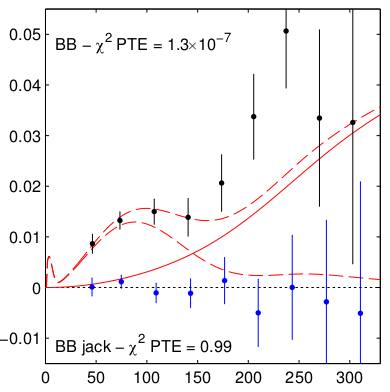
Here’s a plot from the above paper showing a the anticipated measurement if the tensor scalar ratio had been 0.1; BICEP2 detection (if real) corresponds to a signal twice this amplitude:

In other words, we don’t know whether Clover would have hit its target sensitivity and there are many other imponderables, but it’s a very great shame it never got the chance to try…
Follow @telescoper


 In the Dark