Archive for May, 2014

A Plug for Some Research…

Posted in The Universe and Stuff with tags , , , , on May 12, 2014 by telescoper

Very busy today so I just thought I’d give a bit of publicity to a paper that’s just been accepted for publication. I’m actually one of the authors, but the other guys (Dipak Munshi of Sussex, Bin Hu of Leiden, Alessandro Renzi of Rome, and Alan Heavens of South Kensington Technical Imperial College) did all the work! I’m posting it mainly to remind myself that there is a world outside of administration. If it weren’t for my inestimable (STFC-funded) postdoc, Dipak Munshi, I don’t know where my research would be!

Here is the abstract:

We use the optimised skew-spectrum as well as the skew-spectra associated with the Minkowski Functionals (MFs) to test the possibility of using the cross-correlation of the Integrated Sachs-Wolfe effect (ISW) and lensing of the cosmic microwave background (CMB) radiation to detect deviations in the theory of gravity away from General Relativity (GR). We find that the although both statistics can put constraints on modified gravity, the optimised skew-spectra are especially sensitive to the parameter B0   that denotes the the Compton wavelength of the scalaron at the present epoch. We investigate three modified gravity theories, namely: the Post-Parametrised Friedmanian (PPF) formalism; the Hu-Sawicki (HS) model; and the Bertschinger-Zukin (BZ) formalism. Employing a likelihood analysis for an experimental setup similar to ESA’s Planck mission, we find that, assuming GR to be the correct model, we expect the constraints from the first two skew-spectra, S(0)   and S(1), to be the same: B0 <0.45  at 95  confidence level (CL), and B0 <0.67  at 99  CL in the BZ model. The third skew-spectrum does not give any meaningful constraint. We find that the optimal skew-spectrum provides much more powerful constraint, giving B0 <0.071  at 95  CL and B0 <0.15  at 99  CL, which is essentially identical to what can be achieved using the full bispectrum.

It’s part of a long sequence of papers emanating from work done by Dipak (with various combinations of co-authors, including myself) which have been aimed at optimising the use of statistical techniques for detecting and quantifying possible departures from the standard model of cosmology using various kinds of data; in this case the paper is entitled Probing Modified Gravity Theories with ISW and CMB Lensing; `ISW means the Integrated Sachs-Wolfe Effect and CMB is the cosmic microwave background. This kind of work doesn’t have the glamour of some cosmological research – I don’t think we’ll be writing a press release when it gets published! – but it is the kind of preparatory analysis that is essential if cosmologists are to make the most of present and forthcoming observational data, which is why we keep plugging away…

A Victory for Diversity

Posted in Beards, LGBTQ+ with tags , , , , , on May 11, 2014 by telescoper

I didn’t watch the 2014 Eurovision Song Contest last night, but my Twitter feed was full of comments by people who did. That’s how I found out who won!

Conchita

Conchita Wurst, Winner of the 2014 Eurovision Song Contest

I don’t know what the song was like, but that doesn’t matter at all; the Eurovision Song Contest isn’t about the songs at all. What is important is that Conchita Wurst‘s victory sends out a clear message that there is a world out there that is happy to embrace diversity. Interviewed after the voting, Conchita said “I’m just a singer in a fabulous dress, with great hair and a beard”. That sums it all up, really.

I agree wholeheartedly with the official statement of the Beard Liberation Front:

The Beard Liberation Front the informal network of beard wearers has welcomed the win for Austria’s Conchita Wurst in the Eurovision Song Contest as a victory for a diverse Europe over transphobia and pogonophobia.

The BLF has long campaigned for the right of people to be able to dress and appear as they want.

There will no doubt be those who mock Conchita Wurst (original name Thomas Neuwirth), even within the gay community. But it’s important to remember that the Stonewall Riots of 1969 that galvanised the gay rights movement in the United States into action, paving the way for example to Equal Marriage, began as a  fightback against heavy-handed policing that was predominantly led by drag queens. It takes courage to stand up for the right to be different, and in that respect Conchita is an example to inspire us all.

UPDATE: Here’s the official video made in advance of the contest

P.S. I’m pretty sure that this means that Beard of the Year 2014 is now a foregone conclusion….


The Open Journal for Astrophysics Project

Posted in Open Access with tags , , , , on May 10, 2014 by telescoper

I owe many people various apologies for not posting anything for a while about the Open Journal for Astrophysics. For a start I have to admit that the call for test submissions last year was a bit premature. I should have been more patient and ensured that the system was complete before going public. I hope nobody has been too seriously inconvenienced by the ongoing delay.

The project has got stalled a bit largely because I have just had too many things to do to devote enough time to complete the final stages needed to go fully live and also one of the people helping with the project Arfon Smith moved to a new job. Arfon and Chris Lintott have posted an account of the project so far which gives a bit more detail about how we wanted to realize the project (hosted by GitHub); the code development has involved major work by Robert Simpson and Stuart Lynn in addition to Arfon and Chris.  In essence they say that the job is now about 80% complete. I would have said it was more like 75%, so the OJFA is in some sense just the OJF at the moment! Much of what remains is not actual programming stuff but administrative stuff involved with, e.g., arranging the assignment of  digital object identifiers (DOIs) and so on, all of which has been on my to-do list for several months now.

Anywhere, just to show you that the whole project isn’t just hot air here is a demonstration of the snazzy user interface which we plan to use to facilitate the online refereeing process:

However, in the spirit not only of open access publishing but also of open source programming, Arfon has made available all the codes that have been developed so far. One intention of this is that  these can be adapted  for other OJFs hence the construction of a generic website (theoj.org) as well as the hope that some folks out there might help us bright the OJFA itself to completion. Anyone out there with the requisite skills is welcome to volunteer, either through the comments box here or through the OJ repository. If we can get enough volunteers we can meet and put together a plan to bring this idea to completion at last.

Despite being forced to accept that my own workload makes it difficult for me to be as involved as I’d like to be in this project I’d still really love to get this project off the ground. I hope I can use the time freed up by no longer being a member of RAS Council to work on the OJFA. I no longer have a conflict of interest in that regard either; like many other learned societies the RAS currently makes a large fraction of its income from academic publishing!

As Arfon mentions in his piece, the recent BICEP2 episode in particular provides pretty strong motivation that we need a new concept of academic publishing. Practical difficulties may have intervened for now but the motivation for the project itself is stronger now than it has ever been.

RAS Council and after..

Posted in Biographical, Science Politics on May 9, 2014 by telescoper

Just time for a brief post as it’s quite late and I’ve just got back to Brighton after a day out in London. I’ve been too busy to blog until now.

Today was the last day of my year-long stint as an elected Member of the Council of the Royal Astronomical Society; the final Council meeting of the Society’s year is on the day of the Annual General Meeting at which new Council members and other Officers are elected. On this occasion the President, David Southwood, had also reached the end of his term so at the end of the AGM he stood down and was replaced by his successor, Martin Barstow.

There was quite a lot to discuss during today’s Council Meeting in advance of the AGM, but in the end we got through the business and it and the AGM went off quite smoothly.

There then followed the announcement of a major initiative Council has been working on (of which more anon) and a short but very interesting talk about BICEP2 by Stephen Feeney of Imperial College. Thereafter it was dinner at the Athenaeum with RAS Club.

All in all, a busy but pretty productive day. I’ll miss the days out of the office on RAS business, but I suppose the overall reduction in workload is not a bad thing! It just remains for me to wish the new members of Council well in their future endeavours.

On the way in to Burlington House I noticed the enclosed poster for an exhibition of “Renaissance Impressions” at the Royal Academy. I’m not sure of the identity of the bearded chap who is the subject of that particular impression. I’m no historian, but I think Karl Marx came after the Renaissance..

Illustris, Cosmology, and Simulation…

Posted in The Universe and Stuff with tags , , , , , , on May 8, 2014 by telescoper

There’s been quite a lot of news coverage over the last day or two emanating from a paper just out in the journal Nature by Vogelsberger et al. which describes a set of cosmological simulations called Illustris; see for example here and here.

The excitement revolves around the fact that Illustris represents a bit of a landmark, in that it’s the first hydrodynamical simulation with sufficient dynamical range that it is able to fully resolve the formation and evolution of  individual galaxies within the cosmic web of large-scale structure.

The simulations obviously represent a tremendous piece or work; they were run on supercomputers in France, Germany, and the USA; the largest of them was run on no less than 8,192 computer cores and took 19 million CPU hours. A single state-of-the-art desktop computer would require more than 2000 years to perform this calculation!

There’s even a video to accompany it (shame about the music):

The use of the word “simulation” always makes me smile. Being a crossword nut I spend far too much time looking in dictionaries but one often finds quite amusing things there. This is how the Oxford English Dictionary defines SIMULATION:

1.

a. The action or practice of simulating, with intent to deceive; false pretence, deceitful profession.

b. Tendency to assume a form resembling that of something else; unconscious imitation.

2. A false assumption or display, a surface resemblance or imitation, of something.

3. The technique of imitating the behaviour of some situation or process (whether economic, military, mechanical, etc.) by means of a suitably analogous situation or apparatus, esp. for the purpose of study or personnel training.

So it’s only the third entry that gives the meaning intended to be conveyed by the usage in the context of cosmological simulations. This is worth bearing in mind if you prefer old-fashioned analytical theory and want to wind up a simulationist! In football, of course, you can even get sent off for simulation…

Reproducing a reasonable likeness of something in a computer is not the same as understanding it, but that is not to say that these simulations aren’t incredibly useful and powerful, not just for making lovely pictures and videos but for helping to plan large scale survey programmes that can go and map cosmological structures on the same scale. Simulations of this scale are needed to help design observational and data analysis strategies for, e.g., the  forthcoming Euclid mission.

Silence

Posted in Poetry with tags , , , on May 7, 2014 by telescoper

There is a silence where hath been no sound,
There is a silence where no sound may be,
In the cold grave–under the deep, deep, sea,
Or in wide desert where no life is found,
Which hath been mute, and still must sleep profound;
No voice is hushed–no life treads silently,
But clouds and cloudy shadows wander free,
That never spoke, over the idle ground:
But in green ruins, in the desolate walls
Of antique palaces, where Man hath been,
Though the dun fox, or wild hyena, calls,
And owls, that flit continually between,
Shriek to the echo, and the low winds moan,
There the true Silence is, self-conscious and alone.

by Thomas Hood (1799-1845).


Planck versus BICEP2: Round One!

Posted in The Universe and Stuff with tags , , , , , , , on May 6, 2014 by telescoper

You may recall my scepticism about the recent announcement from the BICEP2 experiment about evidence from polarized microwave emission for the existence of primordial gravitational waves generated during a period of cosmic inflation.

Well, in between a couple of meetings this morning, I realised that there’s a paper just out onto the arXiv from the Planck Collaboration. Here’s the abstract:

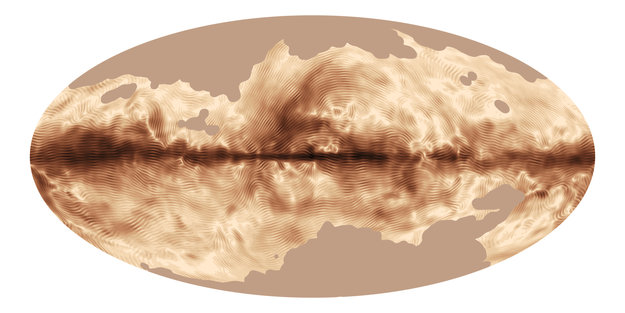
This paper presents the large-scale polarized sky as seen by Planck HFI at 353 GHz, which is the most sensitive Planck channel for dust polarization. We construct and analyse large-scale maps of dust polarization fraction and polarization direction, while taking account of noise bias and possible systematic effects. We find that the maximum observed dust polarization fraction is high (pmax > 18%), in particular in some of the intermediate dust column density (AV < 1mag) regions. There is a systematic decrease in the dust polarization fraction with increasing dust column density, and we interpret the features of this correlation in light of both radiative grain alignment predictions and fluctuations in the magnetic field orientation. We also characterize the spatial structure of the polarization angle using the angle dispersion function and find that, in nearby fields at intermediate latitudes, the polarization angle is ordered over extended areas that are separated by filamentary structures, which appear as interfaces where the magnetic field sky projection rotates abruptly without apparent variations in the dust column density. The polarization fraction is found to be anti-correlated with the dispersion of the polarization angle, implying that the variations are likely due to fluctuations in the 3D magnetic field orientation along the line of sight sampling the diffuse interstellar medium. We also compare the dust emission with the polarized synchrotron emission measured with the Planck LFI, with low-frequency radio data, and with Faraday rotation measurements of extragalactic sources. The two polarized components are globally similar in structure along the plane and notably in the Fan and North Polar Spur regions. A detailed comparison of these three tracers shows, however, that dust and cosmic rays generally sample different parts of the line of sight and confirms that much of the variation observed in the Planck data is due to the 3D structure of the magnetic field.

There’s also a press release from the European Space Agency which includes this nice picture:

Milky_Way_s_magnetic_fingerprint_large

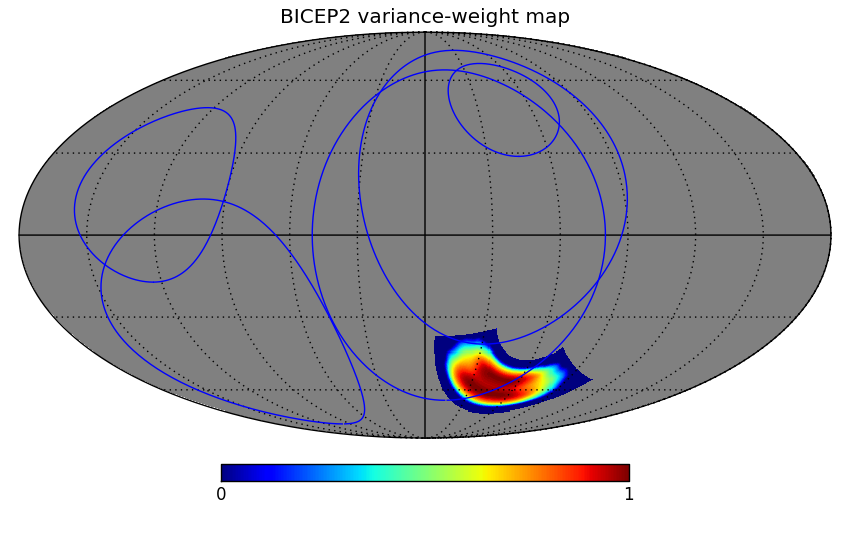
This study is at 353 GHz, compared to the 150 GHz of the BICEP2 measurements. Galactic dust emission increases with frequency so one would expect more of an effect in this Planck map than in BICEP2, but the fact that polarized foreground emission is so strong at these frequencies does give one pause for thought. The Planck data actually cover the whole sky, so the above map has clearly been censored; below you can see the actual region of the sky covered by BICEP2, so there is little or no direct overlap with what’s been released by Planck:

bicep2_loops

We’ll have to wait until later this year to see what’s going on in the masked regions (i.e. far above and below the Galactic Plane, where the dust emission is presumably weaker) and indeed at the 7 other frequencies measured by Planck. It’s all a bit of a tease so far!

Here’s what the press release says about BICEP2

In March 2014, scientists from the BICEP2 collaboration claimed the first detection of such a signal in data collected using a ground-based telescope observing a patch of the sky at a single microwave frequency. Critically, the claim relies on the assumption that foreground polarised emissions are almost negligible in this region.

Later this year, scientists from the Planck collaboration will release data based on Planck’s observations of polarised light covering the entire sky at seven different frequencies. The multiple frequency data should allow astronomers to separate with great confidence any possible foreground contamination from the tenuous primordial polarised signal.

P.S.  It’s gratifying to see the Planck Collaboration have used extragalactic Faraday Rotation measures to probe the Galactic Magnetic field as I suggested on this blog not long ago. The article that first advocated doing this with CMB maps can be found here.


The Rev. Eli Jenkins’ Prayer

Posted in Poetry with tags , , , , on May 5, 2014 by telescoper

Well, this Bank Holiday Monday is drawing to a close. I’ve spent a lot of it working, actually, but also occasionally listening to the wonderful celebration of Dylan Thomas Day on BBC Radio 3. Among other things, this actually made me feel a bit nostalgic for Wales (where I lived until last year)…

This is  the Reverend Eli Jenkins’ Prayer from Under Milk Wood, by Dylan Thomas which is also sometimes known as The Sunset Poem. It’s a different choir, though. This is the Dunvant Male Voice Choir and they’re filmed on the breezy clifftops overlooking the beautiful Rhossili Bay on the Gower Peninsula.

Dylan Thomas and a Male Voice Choir; what could be more Welsh than that?

Every morning when I wake,
Dear Lord, a little prayer I make,
O please do keep Thy lovely eye
On all poor creatures born to die

And every evening at sun-down
I ask a blessing on the town,
For whether we last the night or no
I’m sure is always touch-and-go.

We are not wholly bad or good
Who live our lives under Milk Wood,
And Thou, I know, wilt be the first
To see our best side, not our worst.

O let us see another day!
Bless us all this night, I pray,
And to the sun we all will bow
And say, good-bye – but just for now!

Poll: Have we reached ‘peak beard’?

Posted in Beards with tags , on May 5, 2014 by telescoper

Here’s a very important blog post about one of the great questions of the day. Please participate in the poll, as it could be crucial in shaping the fate of the nation.

charlieallenby's avatarBearded London

peak beard poll

We brought you news that we had apparently reached ‘peak beard’ – where the number of gentleman supporting beards has reached its capacity, and the facial haired fellow will soon go the way of the Dodo, retreating to the doldrums alongside the yoyo’s and Johnny Borrells of this world.

Not only did we bring you this news, but we also disproved the study with our very own Bearded London certified version, carried out on the streets of Shoreditch last week.

Now that the dust has settled, we want to put this matter to bed once and for all. Have we reached peak beard or is this all just a load of mumbo-jumbo?

Poll: Have we reached ‘peak beard’?

You can also tweet us your thoughts @beardedlondon using either #yes or #no. Speak up, vote and let your voices be heard. No one wants to be Johnny Borrell.

View original post

Your Chance to Influence UK Government Investment in Science

Posted in Education, Finance, Politics, Science Politics with tags , , , , on May 4, 2014 by telescoper

A recent piece of bloggery by esteemed Professor Jon Butterworth 0f the Grauniad reminded me that an important government consultation has just opened. In fact it opened on 25th April, but I neglected to post about it then as I was on my Easter break. I’m now passing it on to you via this blog, by way of a sort of community service.

Anyway, the consultation, which is being adminstered through the Department of Business Innovation and Skills, can be found here; there’s a large (110 page) document as well as information on how to respond. Basically about £5.8 billion in capital expenditure has been set aside for science research, and the government is asking how it should be divvied up. Such funds could be used to build big ticket items such as new telescopes, particle accelerators, lasers or other infrastructure including new laboratory buildings. It has to be capital, though, which means it can’t be used on staffing for such facilities that are funded. You might argue that this is a weakness (because ultimately science is done by people not by facilities) but, on the other hand if the government stumps up additional money for capital that might free up funds for more people to be employed.

Anyway, do read the consultation document and submit your responses. You could do a lot worse than reading Jon Butterworth’s commentary on it too. The deadline is some way off, July 4th to be exact, but this is very important so you should all get your thinking caps on right away.

One thing I’ll be including in my response concerns funding for university laboratories. The funding body responsible for English universities, the Higher Education Funding Council for England (HEFCE), is currently underfunding STEM subjects across the country. I’ve blogged about this before so I won’t repeat the argument in detail, but severe reductions in the unit of resource applied to laboratory-based subjects have meant that the new tuition fee regime does not provide anything like sufficient income to cover the costs of, say, physics undergraduate teaching. All students pay a flat-rate fee of £9K across all disciplines (including arts, humanities and science subjects) but science subjects only get £1.4K per student on top of this. The withdrawal of capital allowances has also made it very difficult for universities to invest in teaching laboratory space.

The cost of educating a physics student is actually about twice that of educating a student of, say, English, so this differential acts as a deterrent for universities to expand  STEM disciplines. Shortage of teaching laboratory space is a major factor limiting the intake of students in these areas, whereas other disciplines are able to grow without restriction.

So my vote will go for a sizeable chunk of the £5.8 billion capital  to be allocated to improving, refurbishing, expanding and building new teaching laboratories across all STEM disciplines to train the next generation of scientists and engineers that will be vital to sustain the UK’s economic recovery.

I’d be interested in people’s views about other aspects of the consultation (e.g. what big new facilities should be prioritized). Please therefore feel free to use the comment box, but not as a substitute for participating in the actual consultation.

Over to you!