Archive for June, 2014

A Great Test

Posted in Cricket with tags , , , on June 16, 2014 by telescoper

Just back to Brighton from a short break, part of which (Saturday) I spent at Lords Cricket Ground watching Day 3 of the First Test between England and Sri Lanka.

England had been put in to bat on the first morning and has wobbled early on, but had rallied strongy with young Joe Root scoring 200 not out as they reached 575 for 9 before declaring on Day 2. Sri Lanka batted, needing 375 to avoid the follow-on.

The morning of Day 3 found Sri Lanka resuming on 140-1. Conditions were a bit murky and it drizzled for much of the morning, but not to the extent that it interrupted play. Sri Lanka, especially the excellent Sangakkara, batted with resilience and resourcefulness, as the England bowlers struggled to take wickets on a flat and rather lifeless pitch. The swing of Anderson didn’t threaten as much as I expected in the overcast conditions. The all-rounder Ali was reasonably tidy as a bowler but didn’t cause many alarms, though he did take the wicket of Sangakkara. Broad and Plunkett were fast and aggressive but the latter was a bit unlucky only to take one wicket.

Fortunately at Lords there are plenty of distractions during the intervals or when the cricket is slow, including jazz from The Outswingers and a school band at lunchtime.
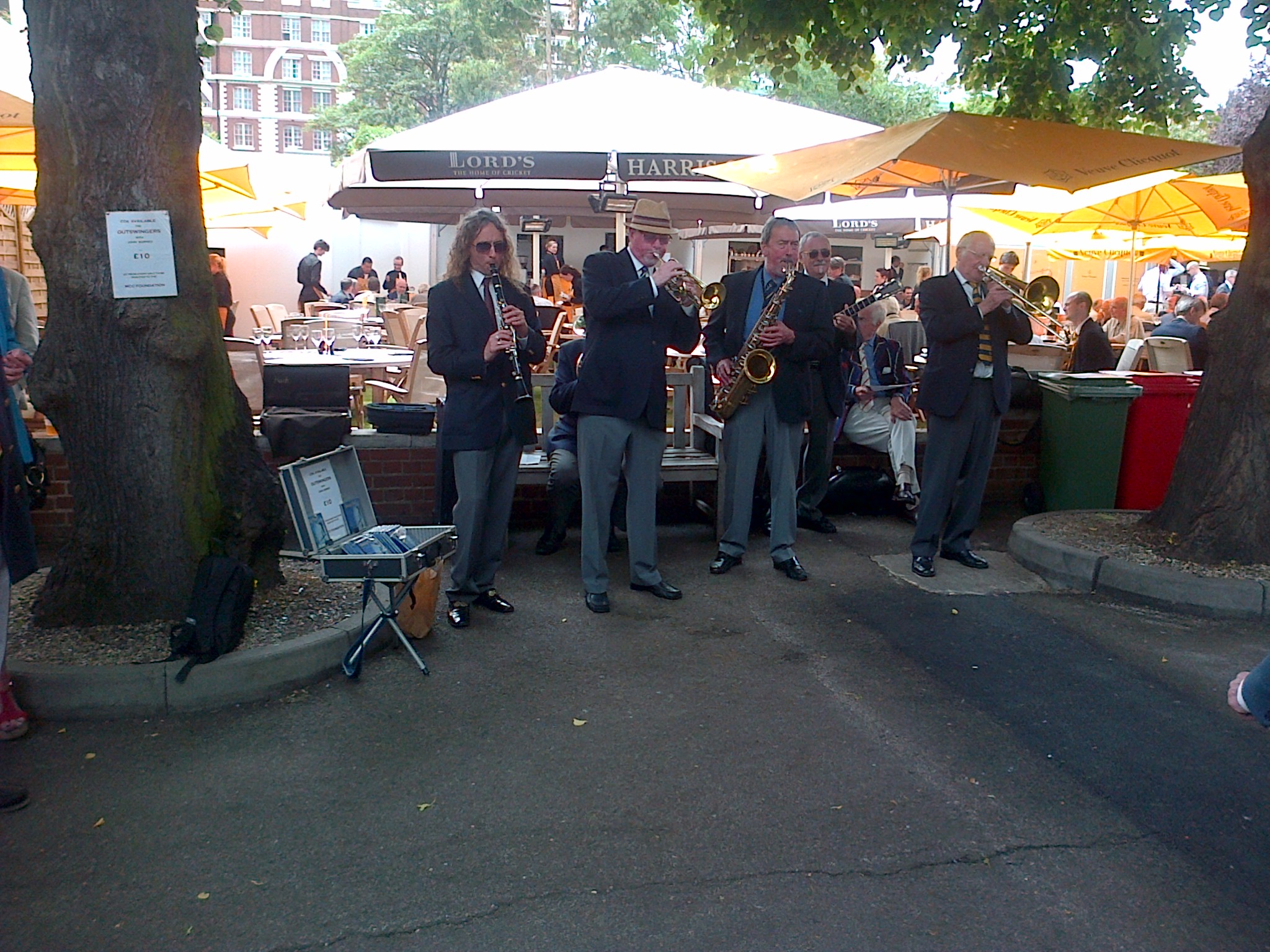
The batsman passed the follow-on target for the loss of only six wickets and as I headed from the ground the game seemed to be heading for a high-scoring draw.

Sri Lanka were eventually out for 453 on Day 4 and England, batting again, wobbled again, in deep trouble at 123 for 6. A fine hundred from Ballance and some good batting from the lower order took them to 267 for 8 at the close, a lead of 389. England declared overnight.

There was talk about Alastair Cook’s captaincy over this, some suggesting he should have declared earlier. For what it’s worth I would have done exactly what Cook did. Sri Lanka are a good batting side, and well capable of scoring 300 in a day on such a good pitch.

So Day 5 saw Sri Lanka needing 390 to win off the 90 overs to be bowled or, more realistically, to bat all day to draw the game. They showed no inclination to go for the runs but batted well defensively for most of the day. A draw looked inevitable in mid-afternoon.

But then, as is so often the case in Test cricket, there was a dramatic twist. Wickets started to fall. Suddenly Sri Lanka were 170 for 5, with both their best batsmen (Sangakkara and Jayawardene) out. More wickets fell, but time was ticking away. Then came the last over, with Sri Lanka on 201 for 8. After five relatively sedate days everything now hinged on the final six balls.

Broad struck with the first ball. Sri Lanka 201 for 9. Only one wicket needed for England to win. Could Sri Lanka hang on!

Broad bowled to the tailender Herath. There was an appeal for lbw. Up went the umpire’s finger. England had won with just a few balls left of the day’s play.

Or had they? No. Sri Lanka used a review. Herath had hit the ball. Not out. Sri Lanka survived. Match drawn.

It’s hard to explain to people who don’t know cricket how a game can last for five days and end in a draw, and that can be exciting. But great Test match like this one prove that it is true. Credit to both teams for playing their parts.

A Test Match is like a Symphony in which the slow movement is just as important as the finale. Without the five days preceding it, the drama of that final over wouldn’t have been anything like as intense.

Pass List Party

Posted in Biographical, Education with tags , , on June 13, 2014 by telescoper

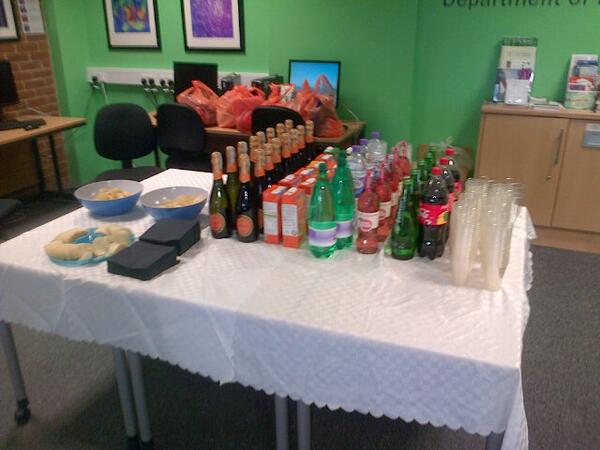
Well, as I mentioned yesterday the pass lists for students in the School of Mathematical and Physical Sciences at the University of Sussex went up at noon. Students and staff started to gather a bit in advance and we also made a few preparations for the celebration ..

Pass list prep

When the results were wheeled out there was an immediate scrum accompanied by plentiful popping of Prosecco corks.

Pass list party

I’d just like to congratulate all our students on their success. The results were truly excellent this year. Enjoy the moment and be proud of their achievement. I suspect that many will have been enjoying the day out in the sunshine perhaps even with a small intake of alcoholic refreshment. I on the other hand have been at Senate all afternoon. But I’m not bitter…

The Busyness of Examination Time

Posted in Biographical, Education with tags , , , , , on June 12, 2014 by telescoper

Just time this evening for the briefest of brief posts. This is probably the busiest week of the year at the University of Sussex, and it’s not over yet. The main reason for this busyness is the business of examinations, assessment and degree classification.

This morning we had our meeting of the School Progression and Award Board for Years 3 and 4 at which, among other things, we sorted out the classification for honours of our graduating students. This involves distilling the marks gained over several years of assessments down to a final “Grand Mean”. It’s not a trivial process but I’m glad to say it went off very smoothly.

The pass lists have now gone to be officially signed off by the University administration. They will be posted tomorrow at noon, at which time we’ll have a celebratory drink or several ready for those getting their results.

One of my duties as Head of School is to chair this meeting, but I don’t take credit for the successful running of the meeting because all the hard work of preparation was done by our excellent office staff, especially Oonagh and Chrystelle.

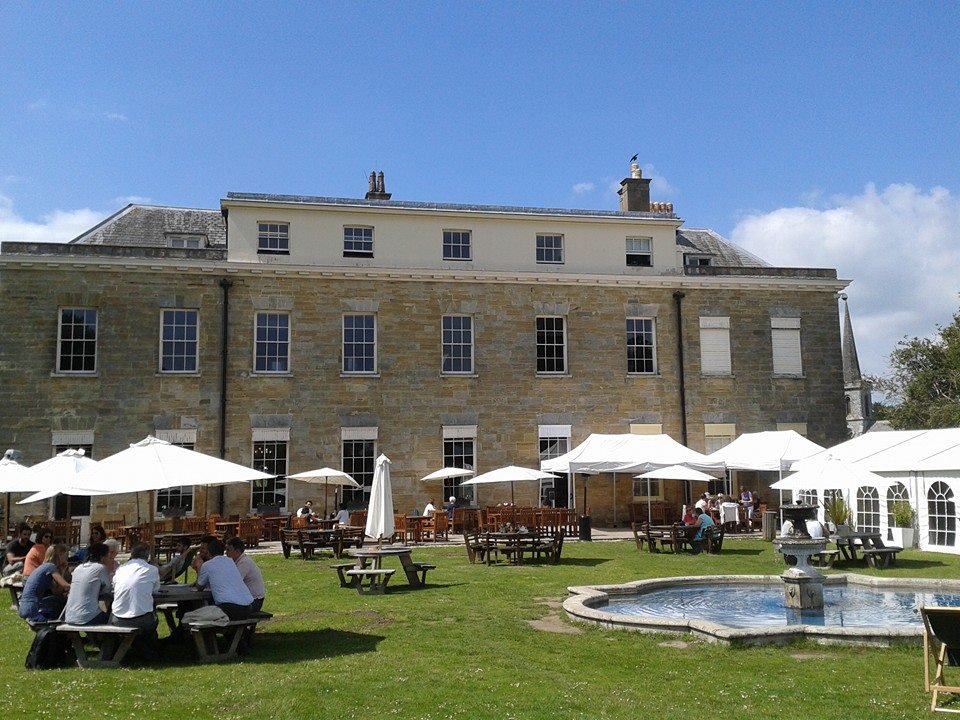
That done there was time for a quick sandwich lunch before heading off to Stanmer House for a teaching “away afternoon” for the Department of Physics & Astronomy, at which we discussed ideas for improvements to the way we teach and assess students.

Stanmer

I’m actually in the group sitting under the parasol in the left foreground.

Stanmer House is set in beautiful parkland just a short walk from Sussex University. I took the more strenuous route over the hill, but am glad I did so because the view was so nice in the glorious sunshine and it made be realise I don’t make as much of the opportunity for walking around the campus as I should.

Tomorrow is going to be another busy day but, if you’ll excuse me, I’m now going to have a glass of chilled white wine and a bite to eat.

Changing the framework for industrial policy

Posted in Finance, Science Politics with tags , , , on June 11, 2014 by telescoper

Here’s another one of the showcases of research from Sussex University. This one features Professor Mariana Mazzucato who debunks the myth of the state as a bureaucratic nanny that stifles creativity in industry, and instead recognizes the vital role of state-led investment in driving innovation and shaping and creating new markets from the internet to biotech to clean tech.

https://www.youtube.com/watch?v=PBFUwrBBnfY

For what it’s worth this gives me an excuse to a view that I’ve expressed before that “commercially useful” research should not be funded by the taxpayer through research grants. If it’s going to pay off in the short term it should be funded by private investors or venture capitalists of some sort. Dragon’s Den, even. When the public purse is so heavily constrained, it should only be asked to fund those things that can’t in practice be funded any other way. That means long-term, speculative, curiosity driven research. You know, things like science…

This is pretty much the opposite of what the Treasury thinks. It wants to concentrate public funds in projects that can demonstrate immediate commercial potential. Taxpayer’s money used in this way ends up in the pockets of entrepreneurs if the research succeeds and, if it doesn’t, the grant will have been wasted if the research does not have any long-term fundamental significance. My proposal, therefore, is to phase out research grants for groups that want to concentrate on commercially motivated research and replace them with research loans. If the claims they make to secure the advance are justified they should have no problem repaying it from the profits they make from patent income or other forms of exploitation. If not, then they will have to pay back the loan from their own funds (as well as being exposed as bullshit merchants). In the current economic situation the loans could be made at very low interest rates and still save a huge amount of the current research budget for higher education. Indeed after a few years – suggest the loans should be repayable in 3-5 years, it would be self-financing. I think a large fraction of research in the Applied Sciences and Engineering should be funded in this way.

The money saved by replacing grants to commercially driven research groups with loans could be re-invested in those areas where public investment is really needed, such as pure science and medicine. Here grants are needed because the motivation for the research is different. Much of it does, in fact, lead to commercial spin-offs, but that is accidental and likely to appear only in the very long term. The real motivation of doing this kind of research is to enrich the knowledge base of the UK and the world in general. In other words, it’s for the public good. Remember that?

If it’s fair to ask students to contribute to their teaching, it’s fair to ask commercial companies to pay for the research that they exploit. Just as student grants should be re-introduced for certain disciplines, so should research loans be introduced for others. You know it makes sense.

However, if you want to tell me why it doesn’t, via the comments box, please feel free!

Träume

Posted in Music with tags , , , on June 11, 2014 by telescoper

I know this old record is a bit crackly, but just listen to the voice! This is the wondrous Kirsten Flagstad, recorded in 1948 with Gerald Moore on piano, singing Träume, the last of the five Wesendonck Lieder by Richard Wagner.

As a person Wagner was definitely a complete shit, but you have to admit he wrote some beautiful music. Perhaps there really is some good in every person…

The Theatre – by Rik Mayall

Posted in Poetry with tags , , on June 10, 2014 by telescoper

Rest in Peace, Rik Mayall (1958-2014).

Mathematics and Meningococcal Meningitis

Posted in Education, Science Politics with tags , , , , on June 9, 2014 by telescoper

Last week I attended a very enjoyable and informative event entitled Excellence with Impact that showcased some of the research that the University of Sussex submitted to the 2014 Research Excellence Framework. One of the case studies came from the Department of Mathematics which is part of the School of Mathematical and Physical Sciences (of which I am Head) so I thought I would showcase it here too:

The description from Youtube reads

Meningococcal meningitis is a debilitating and deadly disease, causing an estimated 10,000 deaths annually in endemic areas of sub-Saharan Africa. A novel mathematical model developed by Sussex researcher Dr Konstantin Blyuss and colleagues has helped explain the patterns of the dynamics of meningococcal meningitis in endemic areas. This model is now being used by epidemiologists and clinical scientists to design and deliver efficient public-health policies to combat this devastating disease.

You can find out more by following this link.

Dialogues des Carmélites

Posted in Opera with tags , , , , , on June 8, 2014 by telescoper

I don’t usually blog about Opera unless it’s to do with a performance I’ve actually attended in person, but I couldn’t resist posting something about the live broadcast from the Royal Opera House in Covent Garden of Dialogues des Carmélites by Francis Poulenc that I heard last night on BBC Radio 3.

I’m basically a complete ignoramus when it comes to the music of Poulenc. With the exception of a few small chamber pieces of his that I’ve heard (and very much liked) I don’t know much about him as a composer at all. Last night’s performance however has inspired me to rectify that omission. To that end I’d be grateful of any recommendations through the comments box.

Anyway, back to Dialogues des Carmélites. This is based on the true story of the martyrdom of sixteen Carmelite nuns during the French Revolution. Not knowing what to expect I was completely stunned by the music, much more melodic than I had expected, and beautifully played by the Orchestra of the Royal Opera House under the direction of Sir Simon Rattle. There are so many references to other composers in this piece that my head was spinning, but the strongest influence I could hear was Giacomo Puccini. Indeed, at times it sounded more like Puccini than Puccini ever did! I was gripped by the whole performance, but the ending, with the nuns singing the Salve Regina as they walk one by one to the scaffold, the dread sound of the guillotine repeatedly falling was utterly horrific and utterly compelling. In fact it was such a powerful experience I was trembling at the finish. Perhaps the fact that it was an audio broadcast only made it even more intense, precisely because so much was left to the imagination. It wasn’t exactly easy listening, but as a piece of music drama it was a triumph.

The entire performance is available for the next seven days on the BBC iPlayer in High Definition sound via this link. If you make time to listen to it, I promise you won’t regret it – although the ending might give you nightmares!

Another thing worth mentioning was that this was the largest cast ever to appear on the stage of the Royal Opera House; no less than 167 people altogether. Among those involved were members of Streetwise Opera, a charitable organization quite new to me, which uses music to help homeless people make positive changes in their lives. This is such a brilliant idea that I sent a donation to support their work. I urge you to do likewise.

The Logistics of Scientific Growth in the 21st Century

Posted in Science Politics, The Universe and Stuff with tags , , on June 8, 2014 by telescoper

Interesting piece that argues that the recent growth in STEM PhD and postdocs is not sustainable.

caseybergman's avatarAn Assembly of Fragments

ResearchBlogging.org

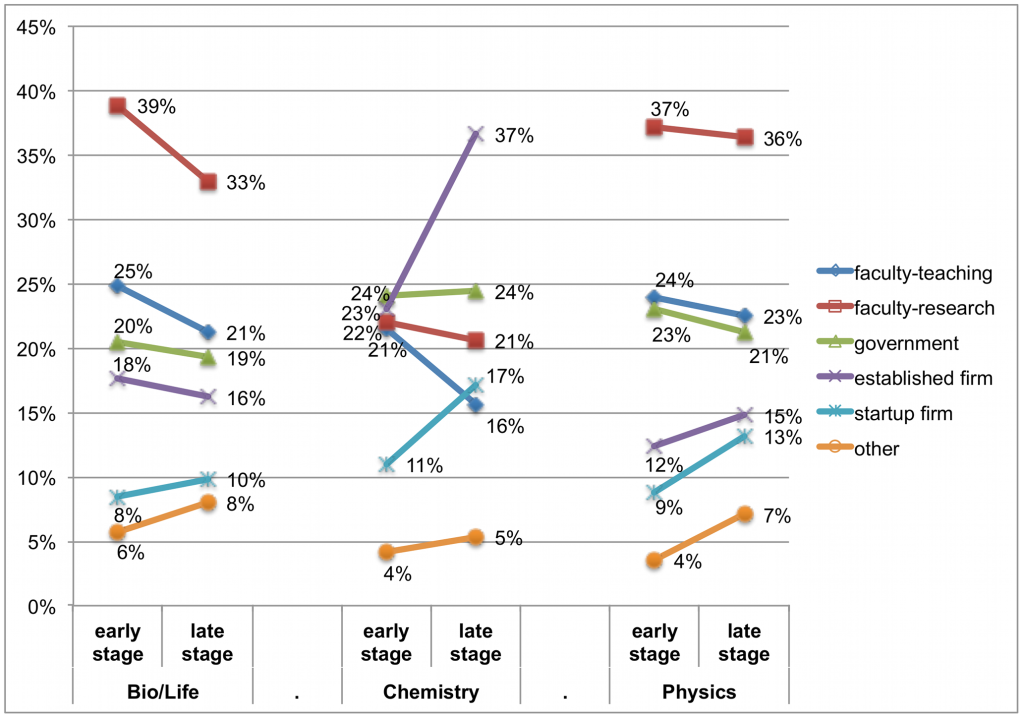
Over the last few months, I’ve noticed a growing number of reports about declining opportunities and increasing pressure for early stage academic researchers (Ph.D. students, post-docs and junior faculty). For example, the Washington Post published an article in early July about trends in the U.S. scientific job market entitled “U.S. pushes for more scientists, but the jobs aren’t there.” This post generated over 3,500 comments on the WaPo website alone and was highly discussed in the twittersphere. In mid July, Inside Higher Ed reported that an ongoing study revealed a recent, precipitous drop in the interest of STEM (Science/Technology/Engineering/Mathematics) Ph.D. students wishing to pursue an academic tenure-track career. These results confirmed those published in PLoS ONE in May that showed the interest to pursue an academic career of STEM students surveyed in 2010 showed evidence of a decline during the course of Ph.D. studies:

Figure 1. Percent of…

View original post 1,620 more words

Windows is shutting down

Posted in Poetry with tags , , on June 7, 2014 by telescoper

Windows is shutting down, and grammar are
On their last leg. So what am we to do?
A letter of complaint go just so far,
Proving the only one in step are you.

Better, perhaps, to simply let it goes.
A sentence have to be screwed pretty bad
Before they gets to where you doesnt knows
The meaning what it must of meant to had.

The meteor have hit. Extinction spread,
But evolution do not stop for that.
A mutant languages rise from the dead
And all them rules is suddenly old hat.

Too bad for we, us what has had so long
The best seat from the only game in town.
But there it am, and whom can say its wrong?
Those are the break. Windows is shutting down.

by Clive James (b 1939)