Archive for July, 2014

Awards Day at West Dean College

Posted in Art, Biographical, Education with tags , , , , , , on July 13, 2014 by telescoper

Last week was a very busy week at the University of Sussex (including the Graduation Ceremony for students in the School of Mathematical and Physical Sciences), and yesterday (Saturday) saw me attending another event on quasi-official business, this time at West Dean College, which is situated in West Sussex, a few miles North of Chichester.

The occasion for my visit there was Awards Day at the college, and I got the chance to go because one of our Pro-Vice Chancellors was unable to attend so I volunteered to go in her place. I didn’t know much about the College before yesterday, except that it is one of several institutions whose degree programmes are validated by the University of Sussex.

In fact, the College provides MA degrees, diplomas and short courses for students of all abilities, from the beginner to the advanced professional practitioner across a wide range of creative arts, design and conservation (including rare and old books, furniture, and clocks).  The various degree certificates, diplomas and other prizes were handed out to students of all ages, which was great to see. Before I go on I just like to congratulate them all again on their wonderful achievements, especially those creative arts students whose work we were able to view after the ceremony including prize-winning sculptures by Lotti V Closs. I even made a discreet inquiry about whether it was possible to buy some of the pieces…

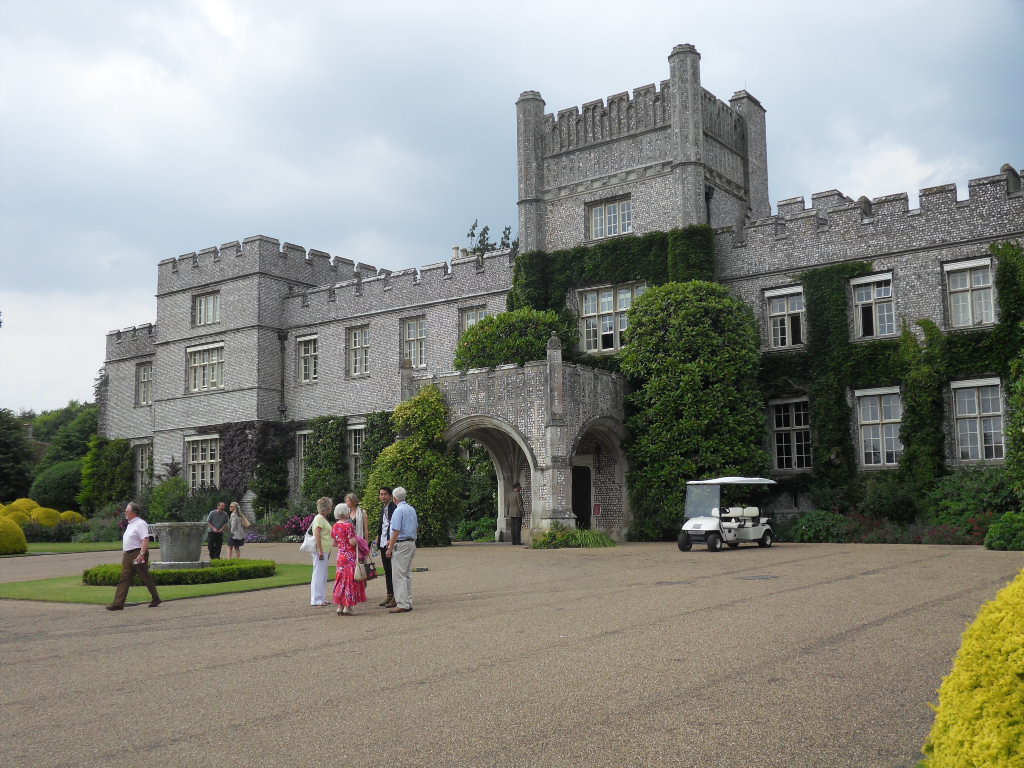
Anyway, West Dean College is based in West Dean House, part of an ancient estate that was eventually inherited by the poet Edward James, a notable patron of the arts particularly famous for his support of the surrealist movement. The house was extensively modified during the late around about the turn of the twentieth century which presumably accounts for the distinctive arts-and-crafts look of some of the exterior.
SAMSUNG DIGITAL CAMERA

The house is surrounded by an estate of 6000 acres in beautiful countryside. Ownership of the house, the estate and the art collection housed therein was transferred to the Edward James Foundation, a charitable educational trust, in 1964.

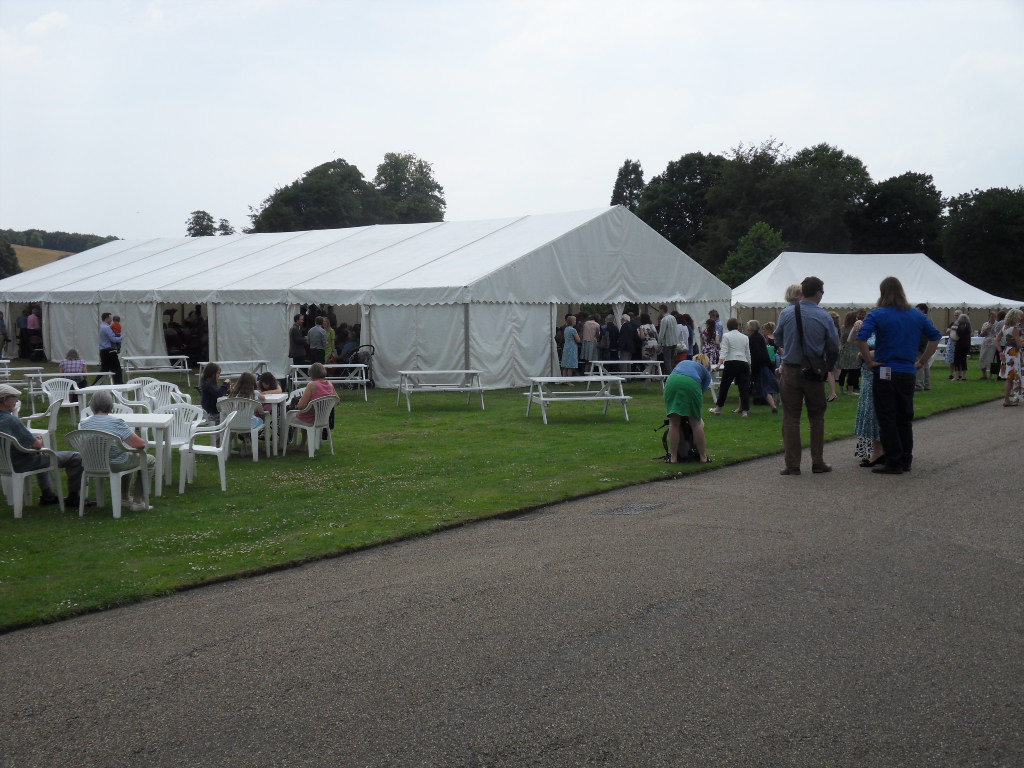
Many sheep were in attendance, although they didn’t come to the actual ceremony. To be honest, it was a much grander setting than I’d imagined it would be. In fact I think the last time I saw a place like West Dean House it was the site of a Country House Murder during an episode of Midsomer Murders or some such. The awards ceremony was held held in a Marquee on the lawns which, in the muggy weather, was a little uncomfortable though the programmes came in very useful as fans. Fortunately it all passed off peacefully without any murders although I did see a large group of crows in the fields, if that counts.
SAMSUNG DIGITAL CAMERA

The manner of my arrival was much less grand than the location seemed to require. I took the train from Brighton to Chichester and then got a bus to West Dean. Being about half an hour early for the kickoff, I had time to walk around the grounds of the house. There’s a beautiful walled garden with many lovely flowers.

SAMSUNG DIGITAL CAMERA

I recognized  Crocosmia Lucifer and Phlox among the following..

SAMSUNG DIGITAL CAMERASAMSUNG DIGITAL CAMERASAMSUNG DIGITAL CAMERASAMSUNG DIGITAL CAMERASAMSUNG DIGITAL CAMERA

These curious but beautiful lantern-shaped flowers evidently belong to some type of lily, but I don’t know what kind. Any offers? (UPDATE: I am reliably informed that these are examples of Erythronium Pagoda
..)

SAMSUNG DIGITAL CAMERA

The walled garden is just one small part of the estate, which also comprises workshops and studios used by the students, a very nice dining room and bar area plus rooms for meetings and conferences. I enjoyed a quick tour of the facilities after the Awards Ceremony, but must go back some other time to have a proper look. The other gardens are fine too:
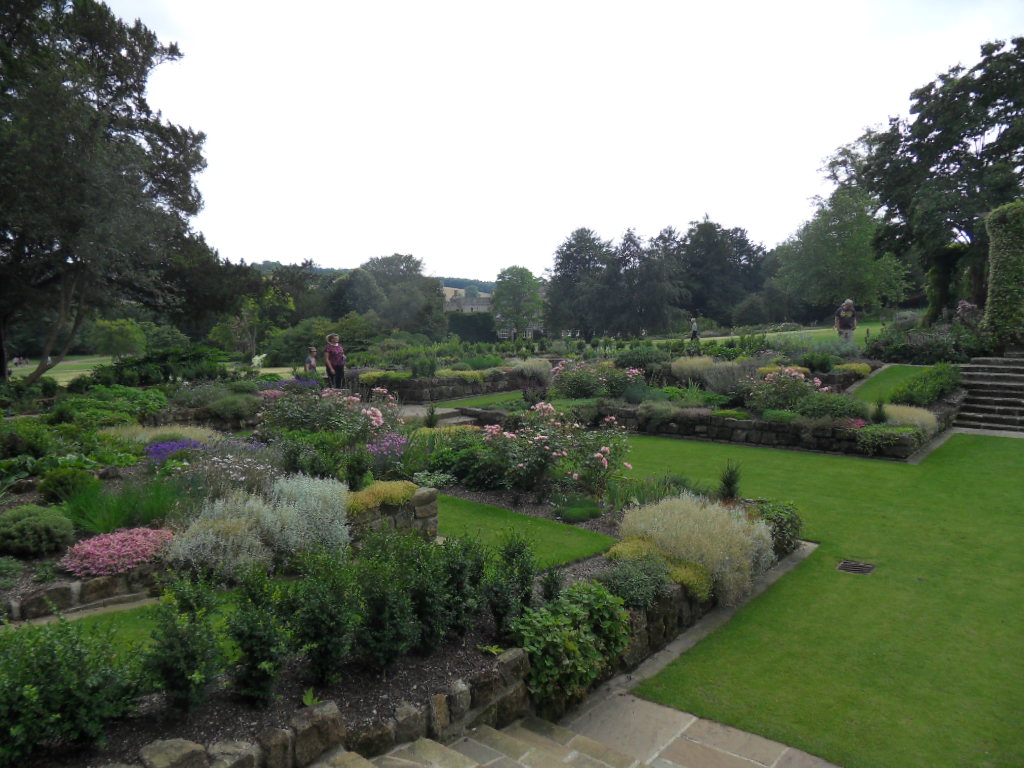
SAMSUNG DIGITAL CAMERA

And this pergola would put most garden varieties to shame!

SAMSUNG DIGITAL CAMERA

Anyway, since one of the Prizes presented yesterday was for blogging about conservation, I couldn’t resist advertising the West Dean College blogs. They have two, in fact, one for Conservation (here) and one for Visual Arts (here). These are both hosted on wordpress platforms, so if you’re following this blog on WordPress why not give them a follow too?

Come to the Edge

Posted in Education, Poetry with tags , , on July 12, 2014 by telescoper

Just back home after a very pleasant trip to West Sussex, about which I’ll blog tomorrow. During the course of the afternoon, however, I heard the following short but very effective poem which seems apt to dedicate to all the recent graduates of the School of Mathematical and Physical Sciences at the University of Sussex.

Come to the edge.
We might fall.
Come to the edge.
It’s too high!
COME TO THE EDGE!
And they came,
And we pushed,
And they flew.

by Christopher Logue (1926-2011)

This Land is Mine

Posted in Art, History, Politics with tags , , on July 11, 2014 by telescoper

Brilliant video by Nina Paley on the tragedy and absurdity of armed conflict…


Honoris Causa, Dr Chryssa Kouveliotou

Posted in Education, The Universe and Stuff with tags , , , , , on July 10, 2014 by telescoper

This morning I had the privilege of participating in a graduation ceremony at the University of Sussex. It was great to get to shake the hands of all the successful graduates as they crossed the stage to receive their degrees. I hope I’ll be able to collect a few pictures of the occasion and post them in due course.


Kouveliotou

I also had the privilege of being able to present an extremely distinguished honorary graduand, Dr Chryssa Kouveliotou. Here the oration I delivered, which I’m posting simply to record her amazing achievements and to underline that she is one of many people who have done the MSc in Astronomy at Sussex University and gone on to do great things…


Vice-Chancellor,

It is both a pleasure and an honour to present for the award of the degree of Doctor of Science, Dr Chryssa Kouveliotou.

Inspired by watching Neil Armstrong take his first step on the moon, Dr Kouveliotou always wanted to be an astronaut but, with no such opportunities apparently on offer in her native, she instead chose a career in astronomy. However, when she completed college Greece her astronomy professor (who shall remain nameless) advised her that there was no future for her in astrophysics. She has never known whether he really thought it was a poor choice or whether it was because she was a woman. Determined to follow her own path, she disregarded him completely and, even though her open-minded parents’ preference was for her to settle down and stay in her home country, she left to study for her Master’s degree in Astronomy at the University of Sussex; the topic of her dissertation was “The Sodium emission cloud around Io: mapping and correlation with Jupiter’s magnetic field”. She received the MSc in Astronomy in 1977. Although the topic of her subsequent research was rather different, the connection with magnetic fields remained strong.

Dr Kouveliotou then moved to Germany to do postgraduate research on the-then very new topic of gamma-ray bursts. Indeed, she may well have been the very first person to complete a thesis on this, which remains to this day an extremely active and exciting field of research. Gamma-ray bursts are considered to be the most powerful explosions in the universe, second only to the Big Bang itself.

After completing her PhD, Dr Kouveliotou returned to Greece to teach Physics and Astronomy at the University of Athens. All the while she knew that she really wanted to do research so spent her free time pursuing this goal. Every vacation and on her one-year sabbatical she went to the USA to undertake research at the National Aeronautics and Space Administration (NASA). Her work was on solar flares but she moonlighted during evenings, nights and weekends researching her ‘first love’ gamma-ray bursts. Because of the research she undertook outside her “day job”, she found a series of bursts which all came from the same part of the sky and, as a result, became part of the discovery team for a brand new phenomenon called a soft gamma-ray repeater.

By observing gamma rays produced in space, her team discovered an example of a new class of exotic astronomical object called a magnetar, an object which has a magnetic field trillions of times stronger than that of the Earth. A magnetar is now known to be a type of neutron star, a burnt-out relic resulting from the death of an ordinary star in a supernova explosion.

Dr Kouveliotou has always loved to ask big questions, to look at the universe and ask how nature expresses itself. By overcoming obstacles in her path she really has reached the stars. In January 2013 Dr Chryssa Kouveliotou was named the Senior Scientist for High Energy Astrophysics, Science and Research Office at NASA’s Marshall Space Flight Center in Hunstville, Alabama.

She has received many awards for her work, including the Dannie Heineman Prize for Astrophysics and the NASA Exceptional Service Medal in 2012 and the NASA Space Act Award in 2005. She was also named amongst Time Magazine’s 25 Most Influential People in Space in 2012. In 2003 she was honoured with the annual Rossi Prize by the High Energy Astrophysics division of the American Astronomical Society for a significant contribution to high-energy astrophysics. In 2002 she received the Descartes Prize which recognises scientific breakthroughs from European collaborative research in any scientific field. In the awards bestowed upon her she has also been recognised for her effectiveness at creating the sort of large collaboration needed to make effective use of multi-wavelength astronomical observations.

Dr Kouveliotou has published almost 400 papers in refereed scientific journals and has been amongst the top 10 most-cited space science researchers in the academic literature across the world. She has been elected chair of the Division of Astrophysics of the American Physical Society and is a member of the Council of the American Astronomical Society, of which she chairs the High Energy Astrophysics Division.

Vice-Chancellor, I present to you for the degree of Doctor of Science, honoris causa, Dr Chryssa Kouveliotou.


Commemorations

Posted in Biographical, Football, History with tags , , , , , , on July 9, 2014 by telescoper

This is a busy week in many ways and for many reasons, but the main activity revolves around Graduation at the University of Sussex. There are 7 ceremonies this week altogether; my School (Mathematical and Physical Sciences) is No. 4, which takes place tomorrow morning (Thursday).

Things are going to be a bit different this year. The Chancellor of the University, Sanjeev Bhaskar, is unable to preside owing to prior commitments (filming episodes of Doctor Who in Cardiff). This is sad because his informality and sense of humour usually brings an enormous amount to such occasions. After much discussion and debate it was eventually decided (on Monday) that the normal order of ceremonies would be changed so that the Head of the graduating School would stand in the centre of the platform, where the Chancellor would normally be situated, in order to shake hands with (and generally congratulate) the graduands as their names are read out and they cross the stage. Normally the Head of School simply reads out the list of names from a podium at one side, so it will be nice to be a bit more involved, although doubt that there will be as many students wanting to take selfies with me as there would have been had Sanjeev been there!

I also have the honour to present an honorary graduate at the ceremony, but I’ll probably say more about that in a future post.

This is a special graduation week for another reason too. It’s now fifty years since the first University of Sussex graduation ceremony in 1964. The University only received its Royal Charter in 1961 and there were only 38 graduates at the first ceremony. This week about 3000 will cross the stage.

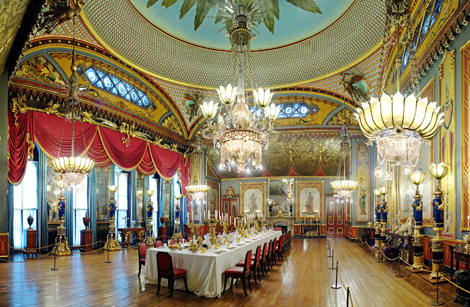
Anyway, last night there was a special Commemoration Dinner to mark the 50th Anniversary in the Dining Room of Brighton Pavilion:

Brighton_Pavilion_Dining_room

The decor is a little understated for my tastes, but apart from that it was a splendid occasion. We didn’t sit at the central table, which is covered with period crockery and cutlery, and was roped off; we sat at smaller tables situated in the space around it. Owing to some sort of administrative error I was accidentally seated at a Table 1, along with a host of important people and the Vice-Chancellor. This turned out well for me as I was seated near Asa Briggs (now Lord Briggs) a famous historian who was the second Vice-Chancellor of the University. He’s now 93 years young and a bit frail but wonderfully interesting conversation ensued. The opportunity to talk to a true Sussex legend added to the fine food and wine to make for a wonderful evening.

There’s another point worth commemorating in the light of the forthcoming centenary of the start of the First World War. One thing I didn’t know before this week was that during World War 1, Brighton Pavilion was commandeered for use as a hospital for wounded soldiers, many of them from India. In fact, the first ever recipient of the Victoria Cross from the British Indian Army, Khudadad Khan, recovered there from wounds sustained in action in Belgium in 1914:

In October 1914, the Germans launched a major offensive in northern Belgium, in order to capture the vital ports of Boulogne in France and Nieuport in Belgium. In what came to be known as the First Battle of Ypres, the newly arrived 129th Baluchis were rushed to the frontline to support the hard-pressed British troops. On 31 October, two companies of the Baluchis bore the brunt of the main German attack near the village of Gheluvelt in Hollebeke Sector. The out-numbered Baluchis fought gallantly but were overwhelmed after suffering heavy casualties. Sepoy Khudadad Khan’s machine-gun team, along with one other, kept their guns in action throughout the day; preventing the Germans from making the final breakthrough. The other gun was disabled by a shell and eventually Khudadad Khan’s own team was overrun. All the men were killed by bullets or bayonets except Khudadad Khan, who despite being badly wounded, had continued working his gun. He was left for dead by the enemy but despite his wounds, he managed to crawl back to his regiment during the night. Thanks to his bravery, and that of his fellow Baluchis, the Germans were held up just long enough for Indian and British reinforcements to arrive. They strengthened the line, and prevented the German Army from reaching the vital ports. For his matchless feat of courage and gallantry, Sepoy Khudadad Khan was awarded the Victoria Cross.

We were honoured last night by the presence at dinner of Sergeant Johnson Beharry who, in 2005, became the first recipient of the Victoria Cross for over thirty years for acts of extreme courage when serving as Lance Corporal in Iraq.

On 1 May 2004, Beharry was driving a Warrior tracked armoured vehicle that had been called to the assistance of a foot patrol caught in a series of ambushes. The Warrior was hit by multiple rocket propelled grenades, causing damage and resulting in the loss of radio communications. The platoon commander, the vehicle’s gunner and a number of other soldiers in the vehicle were injured. Due to damage to his periscope optics, Pte. Beharry was forced to open his hatch to steer his vehicle, exposing his face and head to withering small arms fire. Beharry drove the crippled Warrior through the ambush, taking his own crew and leading five other Warriors to safety. He then extracted his wounded comrades from the vehicle, all the time exposed to further enemy fire. He was cited on this occasion for “valour of the highest order”.

While back on duty on 11 June 2004, Beharry was again driving the lead Warrior of his platoon through Al Amarah when his vehicle was ambushed. A rocket propelled grenade hit the vehicle six inches from Beharry’s head, and he received serious shrapnel injuries to his face and brain. Other rockets then hit the vehicle, incapacitating his commander and injuring several of the crew. Despite his life-threatening injuries, Beharry retained control of his vehicle and drove it out of the ambush area before losing consciousness. He required brain surgery for his head injuries, and he was still recovering in March 2005 when he was awarded the Victoria Cross.

It’s humbling to be in the presence of such a courageous fellow. I only wish our mendacious politicians hadn’t engineered the conflict that made his actions necessary in the first place.  Resplendent in his dress uniform, I’m glad to say that Sergeant Beharry seems fully recovered from his injuries.

I had forgotten to take my Blackberry with me when I left my flat to walk to the dinner so was unable to keep up with the World Cup semi-final. This came up in the conversation at the table. Lord Briggs concurred with my prediction that Germany would win comfortably. It was only when I left the Pavilion and walked past a pub on the way to the bus-stop that I saw the scale of the thrashing that Germany had administered. It was 7-0 when I stopped to look at the screen just in time to see Brazil score. I wouldn’t even describe it as a consolation goal. This amazing result will now be forever linked in my mind with the other events of the evening.

Anyway, must finish now. I have to write my speech for tomorrow’s ceremony!


A Sketch to Make the Blood Run Cold

Posted in Television with tags , on July 8, 2014 by telescoper

I’m assuming that the writers of Not The Nine O’Clock News didn’t know in 1980 what we now know about Rolf Harris. The joke was really just about the BBC trying desperately to get kinds to participate in a crappy programme. But still..

Remembering the 7th of July

Posted in Biographical, History with tags , , on July 7, 2014 by telescoper

I was saddened and dismayed to read that the memorial for the victims of the terrorist attacks in London on 7th July 2005 has been defaced. We all know that Blair lied about the Iraq war but insulting the memories of the 52 innocent people who perished on that day doesn’t help one little bit to bring him to justice. Two wrongs don’t make a right. This is just sick.

I have my own reasons for remembering the 7th July. One summer morning in 2005 I rose early and left my house – I was living in Nottingham then – and took a train to London. I was quite excited. I was going to be interviewed later that day for a programme in the BBC TV series Horizon called The Hawking Paradox. The filming was to take place inside the Café de Paris near Piccadilly Circus, for the simple reason that it wasn’t used during the daytime, and would therefore be both quiet and cheap to hire. I was keen not to be late so I got a train that was due to arrive at St Pancras Station in London at about 9.30am.

On the train I dealt with a few bits of correspondence, filling in forms and writing out cheques to pay bills, so had a couple of  items of mail to post when I got to London. The train was on time, and it was a fine morning, so I decided to walk from the station down through Soho to the location of the shoot.

I crossed Euston Road and walked down towards Bloomsbury. Spying  a bright red Royal Mail postbox across the road  in Tavistock Square, I waited for a bus to go past, crossed the road and popped my letters into the box. I looked at my watch to see if I had time for coffee on the way to Piccadilly. It was exactly 9.45am, on July 6th 2005.

I enjoyed the filming, although it took quite a long time – as these things do. Breaking for lunch in a local pizzeria, we were surrounded by a hubbub of excitement when news broke that London had been awarded the right to stage the 2012 Olympics. We finished the filming and I headed back to Nottingham on the train. All in all it had been a very pleasant day.

The terrible events of 7th July 2005 took place the day after my trip. Here is a picture of the postbox in Tavistock Square taken on 7/7/2005. The bomb that tore the roof off the bus and killed 13 people went off at 9.47am, almost exactly 24 hours after I had been in precisely the same spot. What a difference a day makes.

BICEP2 Redux: How the Sausage is Made

Posted in The Universe and Stuff with tags , , , on July 6, 2014 by telescoper

I came across this (rather lengthy, but very good) discussion of the BICEP2 story so far so thought I would share it here. There’s a particularly useful collection of articles at the end for those who would like to read more.

I’ll also take this opportunity to refer you to a recent BBC News story which states that the BICEP2 and Planck teams are now in discussions about sharing data. About time, if you ask me. Still, it will take a considerable time to work out the ordering of the authors if they ever do write a paper!

Glen Mark Martin's avatarWhiskey...Tango...Foxtrot?

An ongoing problem with communicating science to the general public is the existence of widely-held misconceptions among the public regarding how science actually works. A case in point is the March 17 announcement by the BICEP2 Collaboration regarding the detection of B-Mode polarization in the Cosmic Microwave Background and the events which have unfolded since then.

All too often, news stories and blog posts will trumpet some announcement with sensational headlines like “Scientists Say Cheap, Efficient Solar Cells Just Around the Corner”, or “Scientists Close in on Cure for Cancer.” Many people take such announcements at face value and consider the case closed. The work has been done.  The reality of the situation, however, is that the initial announcement of a discovery or breakthrough is just the beginning of the hard work, breathlessly hyped headlines notwithstanding.

How Science Actually Works (or at least how it is supposed to work)

Once…

View original post 2,843 more words

One July Summer

Posted in Poetry with tags , , on July 5, 2014 by telescoper

What has happened to summer,
That’s what I want to know.
Is she on a vacation –
Who knows where did she go?
Tell, what was she wearing;
A zephyr breeze and rosebud
Or grass and wild berry?
Could she be honeymooning
With spring or early fall
Or has she gone so far away
She’ll not return at all?

by Dorothy Ardelle Merriam.

Does anyone know anything about this poet? I can’t find anything at all about her on the internet!

When David heard that Absalom was slain…

Posted in Music with tags , , , on July 4, 2014 by telescoper

I heard this beautiful music on Radio 3 this morning. It stopped me in my tracks and couldn’t do anything until it was finished. It’s by someone who’s quite new to me called Thomas Tomkins, a Welsh composer who lived from 1572 to 1656. This piece is setting of a biblical text from the 2nd Book of Samuel (Chapter 18 Verse 13) when David learns of the death of his son Absalom. In the King James version this reads

And the king was much moved, and went up to the chamber over the gate, and wept: and as he went, thus he said, O my son Absalom, my son, my son Absalom! would God I had died for thee, O Absalom, my son, my son!