Archive for August, 2014

Advice for Mathematics, Physics and Astronomy Students on Clearing!

Posted in Education with tags , , , , on August 14, 2014 by telescoper

Got your A-level results? Not made your first-choice University? My advice is:

1-dont-panic

We still some have places in the School of Mathematical & Physical Sciences at the University of Sussex. Whether you’re interested in Physics, Astrophysics, Astronomy or Mathematics (or even a combination of those subjects), why not just take a look at the University’s Clearing Page and give us a ring?

As a matter of fact, I’ll be around myself from 8am this morning to talk to interested students!

Click the relevant link for more information on our courses in Physics & Astronomy or for Mathematics!

Mathematics at Sussex: the videos!

Posted in Education on August 13, 2014 by telescoper

I recently posted a couple of videos illustrating some aspects of our undergraduate teaching in the Department of Physics & Astronomy here at the University of Sussex. Since I’m Head of the School of Mathematical and Physical Sciences, which encompasses Mathematics and Statistics as well as Physics & Astronomy, I thought I’d redress the balance with a couple of similar clips featuring mathematicians to give an idea of what students in the Department of Mathematics get up to.

First up is George Simpson, who graduated from Sussex this year with a (4-year) MMath and who is going to start a PhD here at the end of the summer:

And this is Hayley Wragg, a current MMath student, who is talking about her work as a Junior Research Associate in Mathematics:

Incidentally there is a vibrant and active Mathematics Society at Sussex, the University of Sussex Mathematics Society (SUMS). I’m not sure what the acronym is for Brighton University Mathematics Society…

O Captain! My Captain!

Posted in Film, Poetry with tags , , on August 12, 2014 by telescoper

O Captain! my Captain! our fearful trip is done,
The ship has weather’d every rack, the prize we sought is won,
The port is near, the bells I hear, the people all exulting,
While follow eyes the steady keel, the vessel grim and daring;
But O heart! heart! heart!
O the bleeding drops of red,
Where on the deck my Captain lies,
Fallen cold and dead.

O Captain! my Captain! rise up and hear the bells;
Rise up—for you the flag is flung—for you the bugle trills,
For you bouquets and ribbon’d wreaths—for you the shores a-crowding,
For you they call, the swaying mass, their eager faces turning;
Here Captain! dear father!
This arm beneath your head!
It is some dream that on the deck,
You’ve fallen cold and dead.

My Captain does not answer, his lips are pale and still,
My father does not feel my arm, he has no pulse nor will,
The ship is anchor’d safe and sound, its voyage closed and done,
From fearful trip the victor ship comes in with object won;
Exult O shores, and ring O bells!
But I with mournful tread,
Walk the deck my Captain lies,
Fallen cold and dead.

by Walt Whitman (1819-1892), posted in memoriam Robin Williams.

Genie, You’re Free..

Posted in Film with tags , , , on August 12, 2014 by telescoper

It’s been a hectic day so far but I couldn’t resist taking a little time out to post a little tribute to the enormous talent that was Robin Williams, who died last night having apparently taken his own life. Robin Williams was a unique comic talent, best displayed during his legendary stand-up routines, but also demonstrated to great effect on film, especially in Good Morning Vietnam and as the voice of the Genie in Disney’s Aladdin. These movies allowed him to express his remarkable spontaneous ability to connect ideas, characters and voices in a freewheeling improvised scenarios of breathtaking inventiveness; in both the films I mentioned his work was largely unscripted. In Good Morning Vietnam the cutaways to other actors while he did his bit in the radio studio clearly don’t show them acting, just cracking up as he cut loose his extraordinarily fertile imagination; and all the animators on Aladdin had to do to make a great film was to fill in images to match his free-flowing monologues, with celebrity impersonations and other funny voices thrown in for good measure.

Much has already been written about the sad circumstances of his death, and how he seems to have lost his long battle against depression. That a light that could shine so brightly has been lost to the darkness should be a cause of deep sadness, but no-one can really understand another person’s pain and it would be quite wrong to judge him selfish or weak because of the manner of his death. Instead, I shall remember him by the joy he gave – he was one of the comic actors who could reduce me to hysterics – and hope that in some way his loss might lead in some way to greater understanding of depression and other mental health problems.

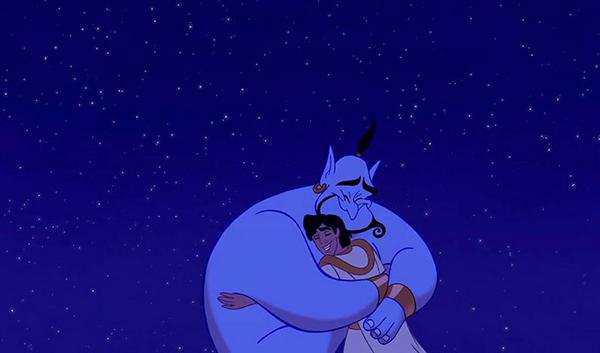
The most moving tribute of many I’ve seen today on Twitter was from the The Academy of Motion Picture Arts and Sciences. The Genie in Aladdin yearned to be free, and now he is. RIP Robin Williams.

genie

Supermoon Surgery

Posted in Biographical, The Universe and Stuff with tags , , , , , , , on August 11, 2014 by telescoper

I have a busy day today (including my Annual Appraisal) to kick off a very busy week dominated by the release of this years A-level results and consequent admissions business, so I’ll just post a quickie though one which is at least fairly topical.

Last night (10th August) I took a (not very good) picture of the Moon with my phone:


supermoon

This is a so-called “supermoon“, a not particularly rare phenomenon which takes place when there is a Full Moon that coincides with the Moon being at the point of its orbit which is closest to the Earth, i.e. its perigee. A much better name is “Perigee Full Moon”, but that somehow doesn’t seem to have caught on in the popular media. The Moon orbits the Earth in an ellipse rather than a circle and at its closest approach it is about 14% closer than at its furthest (apogee). It therefore looks about 14% bigger and about 30% brighter during a Perigee Full Moon than during an Apogee Full Moon.

The Moon was certainly looking very bright when I took the picture last night, at least compared to a few minutes later when it disappeared behind a supercloud.

The Moon’s proximity to Earth during this Full Moon does have a noticeable effect on terrestrial tides, but not a particularly strong one; certainly not enough to trigger the end of the world. Actually, the tides have an amplitude just a few inches higher than average during a Perigee Full Moon. In any case roughly one in 14 Full Moons is a supermoon so it’s actually quite a common event, and as far as I’m aware the world didn’t come to an end during the last one or the one before that or the one before that or…

Anyway, all this supermoon malarkey reminded me of something that happened about 15 years ago,  just after I had moved to Nottingham to take up the position of Professor of Astrophysics at the University of Nottingham. I was sitting in my office, working – blogs hadn’t been invented then – when the phone rang and the voice at the other end said May I speak to Professor Coles please? When I replied that I was he, the caller went on to explain that he was a surgeon who worked at Queen’s Medical Centre, a hospital located right next to the University of Nottingham, with teaching staff working for the University.

It turned out that news of the setting up of the new Astronomy group there had made it into the University newsletter which my caller had seen. He asked if I had a few moments to answer a question about astrophysics which had been bothering him for some time and which he had just been discussing with some of his colleagues.  I said yes, and he asked: Does the Moon rotate?

I paused a bit, thinking how best to explain, and he went on to clarify his point, which was that if the Moon always has the same face towards the Earth does that mean it’s not rotating?

Understanding his question, I went on to explain that, yes, the Moon does rotate and that the reason it always shows the same face to the Earth (more-or-less, ignoring libration) is that the period of its rotation is the same as the Moon’s orbital period around the Earth. I also explained how to demonstrate this with two coffee mugs, moving one in a circle around the other and rotating the outer one so as to keep the handle pointing towards the central mug. Moreover, I explained the physics of this phenomenon, which is called tidal locking, and pointed out other examples in astrophysics.

After this spiel the caller said that was all very interesting but he had to go  now. Assuming I had bored him, as I fear I tend to do rather a lot, I apologized for going on about it for too long. He said no he wasn’t at all bored by the detail I had put in, he found it all absolutely fascinating. The reason for him needing to go was that he had to go back to tell the answer to the colleagues he had been discussing it with  just before phoning me.  They were all  in the operating theatre,  standing around a patient lying on the operating table, waiting  for him to return and complete the operation he had left in order to make the call…

Doodlebug Summer

Posted in History with tags , , , , , , , , , , , on August 10, 2014 by telescoper

Yesterday’s post reminded me of another aspect of World War 2 that is worth mentioning. There’s a general impression that the defeat of Nazi Germany was more-or-less inevitable after the Normandy invasion of June 1944. However, as I mentioned yesterday, the Allied advance was much slower than expected and it was not until mid-August that the British, Canadian and American divisions really broke through. Morale back home wasn’t helped by this slow progress, but the most significant factor for the civilian population, especially in London, for the period June to August 1944 was the arrival of a new form of weapon; for many, the summer 1944 was “Doodlebug Summer”.

First came the V1 “Flying Bomb” (or “doodlebug”). The first of these to fall on London hit the railway bridge at Grove Road in Bow, East London, on 13th June 1944. This is just a few hundred yards North of Mile End tube station, and close to where I used to work at Queen Mary College, University of London. I don’t think people realize the scale of the threat these terror weapons posed. For a start they were launched in considerable numbers, usually over a hundred a day and over 8000 in total during the course of the summer. These weapons caused 22,892 (mainly civilian) casualties and causing widespread damage to the city’s infrastructure. Looking through the War Office minutes for the week corresponding to this one, seventy years ago, yields a typical statistic: 768 Flying Bombs were launched, 158 landed over London, 462 were destroyed.

These numbers however, convey only part of the picture. The doodlebug was primarily a terror weapon; it struck fear into the hearts of the population though the distinctive sound of its primitive jet engine – fear would immediately transform into alarm when the engine cut out, for that was when the device would fall to Earth and detonate. On the one hand, this did at least give some warning to those in its path but, on the other, it made it impossible for the authorities to disguise the nature of the threat. The V1 was relatively slow (640 km/h, i.e. about 400 mph) and flew at quite a low altitude, which meant that many were downed by ground-based anti-aircraft guns or fighter aircraft fast enough to intercept them, but sufficient numbers still got through to cause considerable panic. The onslaught was only halted in September 1944 when the advancing Allies overran the launch sites in France. Although attacks resumed in due course from other launch sites, the scale of the threat was greatly diminished.

Later on, from September 1944 onwards, the V2 rocket was introduced; this travelled on a ballistic trajectory and gave no warning whatsoever; no gun or aircraft could possibly shoot it down. To begin with the authorities attempted to explain the succession of mysterious explosions as being due to fault gas mains, etc. There never was an effective defence against the V2, but fortunately they were rather unreliable and the number of casualties they caused, though considerable, was not on the same scale as the V1.

Another interesting aspect of the doodlebug attacks was the deception campaign run by British Intelligence, which involved a famous double-agent code-named Garbo. This was the agent behind the audacious deception plan that led the Nazi High Command to believe that the Normandy landings were a decoy to draw attention away from the main landings which would happen in the Pas de Calais. As part of this ruse, Garbo (whom the Germans believed was working for them) actually sent news of the Normandy landings to his handlers by radio. This staggeringly risky gambit could have ended in disaster, but the Germans swallowed the bait: an entire division was kept away from Normandy, waiting for the expected assault in Pas de Calais, which of course never came.

In mid-June 1944 Garbo was asked by his handlers to report on the locations of V1 impacts. The guidance system on the doodlebug was very crude and the Germans had no real idea whether they were systematically overshooting or falling short of London. Could some form of deception plan be concocted that could work in this case? The obvious strategy would be to report that V1s falling on London were falling too far North; if the Germans believed this then they would adjust the settings so they fell further South, and would then miss London. However, some doodlebugs hit high-profile targets so there was little point lying about them – Garbo would immediately be exposed. Moreover, some V1s were fitted with radio transmitters and the Germans knew exactly where they were landing. In the end it was decided that Garbo would simply report (accurately) only those V1 impacts that happened to the North West of London, hoping that the selection bias in these reports would be misinterpreted as a systematic error in the aiming of the V1s. From Ultra decrypts from the code-breakers at Bletchley Park, the Allies knew what was believed by the Germans and what was not and adjusted the flow of information accordingly.

If 1944 seems sufficiently remote for this all just to be a fascinating piece of history, it is worth remembering that the V1 “Terror Weapon” was the forerunner of the modern US combat drones that have killed many hundreds of civilians in Pakistan, Yemen and Somalia in covert attacks as part of the so-called “War on Terror”. Think about the irony of that for a moment.

Solly’s Story

Posted in Biographical, Brighton, History, LGBTQ+ with tags , , , on August 9, 2014 by telescoper

I don’t know why I suddenly remembered a long-forgotten character I knew when I was in Brighton as a research student, but I thought I’d write a blog post so I don’t forget him again.

I moved to Brighton in late September 1985 to start my DPhil. I’d left it quite late looking for accommodation because I’d been working in Newcastle through the summer after my graduation. In the end I had to settle for a bedsit in Hove, quite a long way from central Brighton in a road called Goldstone Villas, not far from Brighton & Hove Albion’s old stadium, the Goldstone Ground.

Round the corner from my place was a pub – I’ve forgotten the name – which became my local. After a few visits there I became friendly with one of the regulars there, a man in his sixties who was known to everyone as Solly, short for Solomon. He was, as I soon came to realise, something of a local celebrity.

Solly was a tall man, always immaculately dressed, and (I would say) handsome for his years. He was also (quite obviously) gay and (also quite obviously) Jewish. He had a great sense of humour and was a wonderful raconteur, but at the same time very kindly and self-effacing; he was liked by everyone in the pub (which wasn’t a gay pub, by the way).

Like everyone else I took an immediate liking to Solly; I greatly enjoyed his company and we had dinner together quite a few times in addition to conversations in the pub. On one of these occasions he told me his life story, or at least some of it. It turns out he was of Anglo-Austrian extraction, with an English mother and an Austrian father, although he had no trace of an accent. He was born in Austria, but his parents sent him to live with relatives in England during the 1930s because they could see what was going to happen there as the power of Nazi Germany grew; he never saw either of them again.

Solly arrived in Brighton when he was about 11 and he was 17 when World War 2 broke out. He immediately tried to join up, but was refused because he was too young. When he reached 18 he tried again but was still refused. He went to London (at the height of the Blitz) to try enlisting there, but was also refused, possibly because of his German-sounding name (and also possibly because of his sexuality).

Having failed to join up he returned to Brighton in late summer 1940 and joined the Local Defence Volunteers (the “Home Guard”). Given his appearance in later life I imagine he would have looked at this time rather a lot like Private Pike from Dad’s Army.

I remember many of his hilarious stories of how shambolic the Home Guard actually was, as well as how they were largely engaged in helping the Police deal with crimes such as racketeering and looting, but there was one particular striking incident that has stuck in my memory.

On 7th September 1940 the War Office issued the following communique:

Message to all UK units: codeword CROMWELL. Home Defence forces to highest degree of readiness. Invasion of mainland UK expected at any time.

After being informed of this signal Solly and his comrades turned up to be issued with the equipment with which they were expected to stop the invasion. In his case it was an ancient pre-WW1 vintage rifle, three rounds of ammunition, and two improvised grenades. With these meagre supplies, they were supposed to hold their positions until reinforced, possibly for up to 7 days.

As they walked to their posts all the volunteers were certain that they had no chance and that none of them would survive the night. The talk was exclusively of the need to make all their shots count. If each man could kill at least one German before he himself was killed then the invasion might be thwarted. Solly certainly had no intention of allowing himself to be taken prisoner, as he knew all too well how he would be treated by the Nazis.
After an agonizing wait, and several false alarms, dawn broke. The Germans never came.

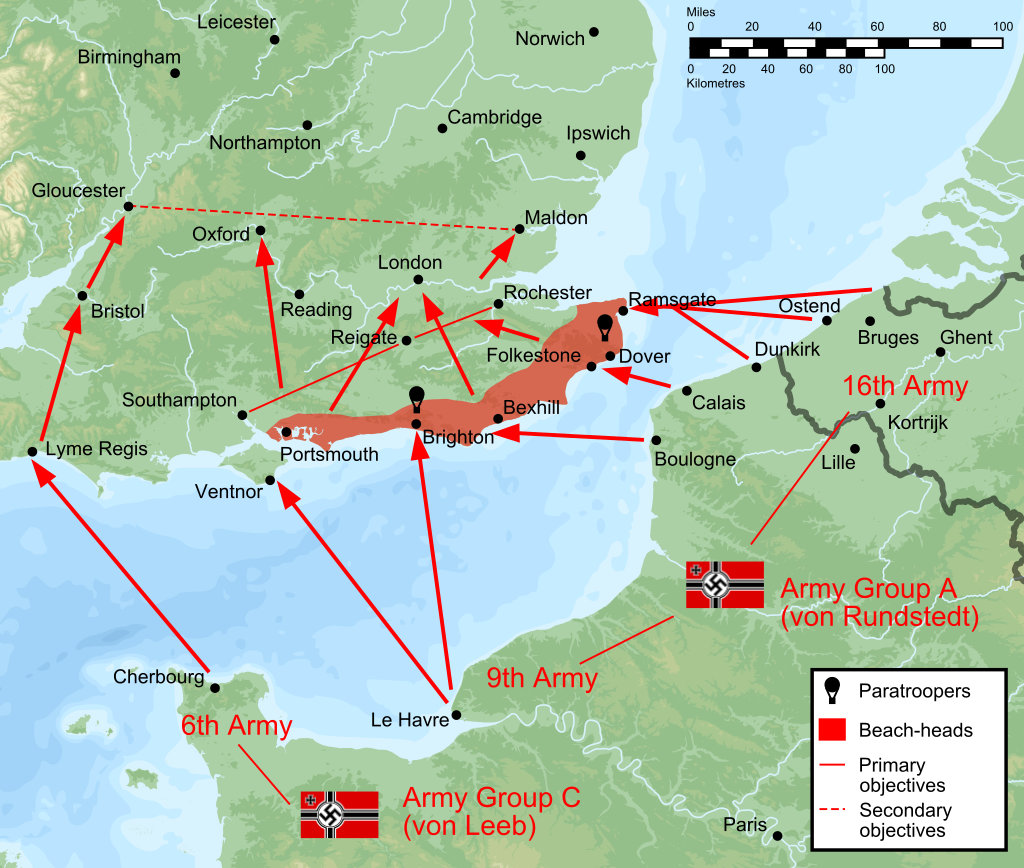
As it turns out, if they had come, Solly’s platoon would have been right in the front line: Operation Sealion (the planned invasion of England) involved the landing of paratroopers on the Downs just behind Brighton with the intention of securing the high ground behind the landings and the main road to London ahead of the invasion:

1024px-OperationSealion.svg

Solly did finally succeed in enlisting, but his good knowledge of the German language meant that he was given a desk job, translating documents and such, until the Normandy invasion when he finally got to fire a weapon in action, although he landed some weeks after the initial assault, when his unit was attacked south of Caen. He didn’t hit anyone.

Incidentally, the 70th anniversary of the D-Day landings passed in June 1944 but it’s worth noting that the German defensive lines were not really broken until August. In fact, on this day in 1944, British and Canadian forces were engaged in heavy fighting about 6 miles from Falaise, while the Americans were executing a wide encircling manoeuvre designed to surround and trap the German army.

Anyway, back to the 1980s. I didn’t stay long in the Hove bedsit and moved out early in 1986. About six months later I happened to be in the area so popped into the pub to see Solly. He wasn’t there; he had passed away suddenly of a heart attack in the Spring.

Higher Education Funding: A Modest Proposal

Posted in Education, Finance, Politics with tags , , , , , on August 8, 2014 by telescoper

With next year’s general election already looming there are signs that the higher education funding system is likely to be a hot topic. The Conservatives, for example, are reportedly considering removing the cap on tuition fees (currently set at £9K per annum) while Labour is talking about reducing the figure to £6K. Labour’s idea is likely to prove popular among potential students, it will result in a reduction of fee income to English universities of a third, potentially leading to wholesale redundancies and closures unless it is offset by an increased contribution from the taxpayer to offset this cut. Responsibility for higher education funding in Wales, Scotland and Northern Ireland is devolved, so Westminster policy does not apply directly there although the knock-on effect of changes in England would be considerable given the number of students who choose to study away from home.

The backdrop to these suggested policy changes is the obvious fact that the current system is unsustainable. Although there has not been a marked reduction in numbers of students applying to university since the introduction of tuition fees, it has become increasingly clear that the system of loans and deferred fees is actually costing the Exchequer more in terms of short-term borrowing than the old system. Moreover, there is a growing realization that the fraction of this cost that will actually be recouped in future is going to be much smaller than its advocates would like to admit. Recent estimates, likely to be revised upwards, suggest that 45% of student loans will never be repaid.

On top of this there is the problem that the so-called “elite” universities have not succeeded in “widening participation” (as the phrase goes). Oxford and Cambridge both continue to take about 40% of their pupils from private schools; many other institutions. My own institution, the University of Sussex, takes about 86% of its intake from state schools, which is about the average across the sector.

Although only a small fraction of pupils (about 7%) attend (private) independent schools, about 65% of those go on to University; only 24% from the state sector do. In my opinion, not all universities take widening participation seriously but even if they do (like we do at Sussex) it is difficult for higher education institutions to repair the divisions that arise much earlier in the education system.

The average fee per term for a day pupil at a private school in the UK is about £3400; this rises to about £7800 per term for boarding schools. Since there are three school terms per year this means that the average cost per year for day pupils is £10,200, well above the £9000 per year maximum fee for university tuition. That says a lot for how poorly funded UK universities really are, even with increased tuition fees, especially in STEM subjects which require expensive laboratories and other facilities. Moreover, private school fees are payable upfront while tuition fees for students in higher education are funded by heavily subsidized loans which do not need to be repaid until the student is earning more than a certain minimum salary (currently £21K pa).

When funding is tight it is particularly important that it should be targetted where it is needed most. For me that means to encourage more students from state schools to go to university. The principle I’d adopt here (and indeed in many other contexts) is encapsulated in the phrase “to each according to their need, from each according to their ability”.

Parents who have decided to send their offspring to private schools have, in my view, already demonstrated that they can afford to contribute to their education at a level considerably higher than the current tuition fee for university students. In such cases there is no need for a means test to determine whether they need support from the taxpayer; they have already done that calculation for themselves.

My proposal, therefore, is that students whose parents have decided to take their children out of the state school system should be deemed to be ineligible for state support for higher education. They should therefore pay the full fees upfront. I think there’s a case even for making such students pay for the full cost of their education which is not the £9K fee payable by Home/EU but the much higher fee charged to students from outside the EU, which is currently £17K at the University of Sussex. The money saved in this way should be used to provide better fee waivers and and maintenance grants for students from the state school system (on a means-tested basis). This could be accomplished by, e.g., a system of vouchers available to students from state schools in England; the rest of the UK could adopt a similar system if they wish. This would also be a step towards reducing the incentive for families to increase social divisions by taking their children out of the state system.

As well as driving greater equality and stimulating social mobility, my suggestion would also correct a number of anomalies in the existing system. One is that students attending English universities who went to Schools elsewhere in Europe (including Wales, Scotland and Northern Ireland) are entitled to the same financial support as English students. However, most students from outside the UK will return home after graduation and there is no effective means of making them pay back their fees and loans because these are currently recovered through the UK tax system. In effect, therefore, the taxpayer is providing free higher education for these students and it is one of the reason why the default rate on student loans is likely to be very high. In my proposal this loophole would be sealed; unless a student went to an English state school they would not have the means to access HEFCE support.

I have heard it said that this idea would remove choice. I don’t agree. Parents will still have the choice of sending their sons and daughters to private school if they wish. What it will do is remove part of the incentive for them to do that.

Across the UK over 80% of university students are from state schools, so the measure I suggest will not on its own solve the University funding crisis. On the other hand, I think it would at least be fairer than the current system. On the other hand, I’m not sure fairness counts for very much these days…

Combining Research and Teaching in Physics & Astronomy

Posted in Education, The Universe and Stuff with tags , , , , , on August 7, 2014 by telescoper

Among the distinctive things we do here in the School of Mathematical and Physical Sciences at the University of Sussex are our degree programmes that involve a Research Placement (RP). Students on these courses take the normal lectures, laboratory classes and workshops during the academic year, but they spend the summer vacation doing (paid) work with research groups in the School to get an experience of what the world of research is really like. Various combinations of Physics and Astronomy with a Research Placement have been around for some time. These courses have been so popular and successful that we’ve extended the idea to Mathematics for 2015 entry. We have also started extending the RP scheme to include placements in laboratories elsewhere, either in industry or in a university abroad; we even have two students currently doing their placements in China.

Here are a couple of videos we’ve made featuring two RP students who have been working in the Department of Physics & Astronomy this summer.

This is Ross Callaghan:

And this is Nathaniel Wiesendanger Shaw:

Both these students are in between their 2nd and 3rd years of a 4-year MPhys programme. As it happens, both survived the experience of being in my Theoretical Physics class last term too!

It’s an ongoing frustration of mine that so many influential people think that teaching and research are separate functions of a university and should not be mixed. I believe that the two go hand-in-hand and that you can’t really claim to be getting a real university education if it’s not informed by the latest developments in research. Moreover, some also imply that research-led teaching only happens in the Russell Group, which is not the case at all. In fact, I think we provide a much better environment for this in Sussex than either of the Russell Group universities in which I’ve previously worked.

Many Departments talk about how important it is that their teaching is based on state-of-the-art research, but here at Sussex we don’t just talk about research to undergraduates – we let them do it!

Rendezvous Rosetta!

Posted in The Universe and Stuff with tags , , on August 6, 2014 by telescoper

Just a quick post to remind you (as if you needed it) that, in about 5 minutes’ time at 10am BST, the ESA spacecraft Rosetta will begin its encounter with a comet (actually Comet 67P/Churyumov-Gerasimenko).

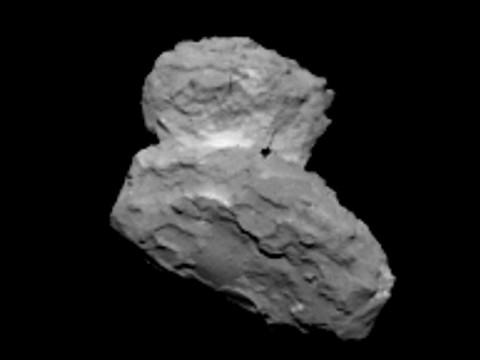
As it approached its target, Rosetta took this picture that revealed the comet to be a rather peculiar beast, rather like a rubber duck:

Comet

Here’s a more recent, closer, view:

Comet_close

Rosetta’s journey began on 2 March 2004 when Rosetta was launched on an Ariane 5 from Europe’s Spaceport in Kourou, French Guyana. Since then, the spacecraft has orbited around the Sun five times, picking up speed through three gravitational “slingshots” at Earth and one at Mars, to enter an orbit similar to that of its target, said comet 67P/Churyumov–Gerasimenko, which is in an elliptical 6.5-year solar orbit that takes it from beyond the orbit of Jupiter at its furthest point, and between the orbits of Mars and Earth at its closest to the Sun.

To perform its rendezvous Rosetta has to match the pace of the comet – currently about 55 000 km/h – and travel alongside it to within just 1 m/s between them. This has required a complex and delicate series of manoeuvres:

The spacecraft will then travel alongside the comet as it approaches the Sun. In November 2014 the Philae probe will be deployed and will land on the comet surface. Rosetta will follow the comet to its closest distance to the Sun on 13 August 2015 and as it moves back towards the outer Solar System. The nominal mission end is December 2015.

I bet there’s quite a lot of stress in the ESA control centre in Darmstad, Germany, as the probe’s epic journey nears its end, not least because telemetry is lost while the burn happens. Those ten years in space will count for little if something goes wrong now. Good luck everyone involved!

You can watch a live feed of the encounter here.

UPDATE: after an agonizing wait – it takes 23 minutes for telemetry to reach Earth from Rosetta – the spacecraft has entered orbit correctly. Well done everyone!

UPDATE: click here for an amazing collection of images of the comet.

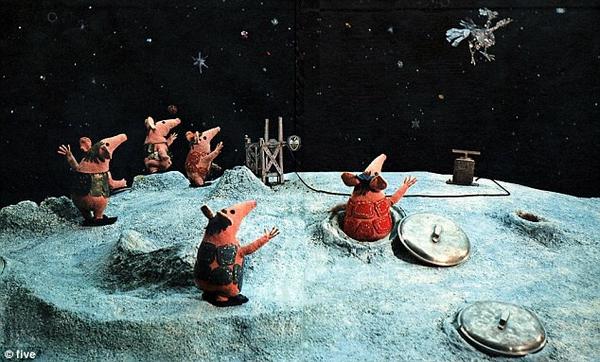
UPDATE: Relief at ESA HQ as The Clangers finally emerge to greet the Rosetta Spacecraft:

BuW-AFJIEAA6L3k