Archive for September, 2015

R.I.P. Brian Close

Posted in Cricket with tags , , on September 14, 2015 by telescoper

I heard today of the death, at the age of 84, of former Yorkshire and England cricketer Brian Close. Close was an abrasive character whose personality made him more than a few enemies, but he had a very successful playing career and was a tough but effective captain both on the field an in the dressing room. Above all, he was an exceptionally brave batsman. I can think of no better example than this video of him facing Michael Holding (“Whispering Death”) at Old Trafford in 1976. He struggles to lay bat on ball and is hit several times on the body but he always gets into line. This is from an era in which batsmen didn’t wear head protection; this nearly cost him serious injury, as you will see in the clip. Even with a helmet I would have been terrified. Cricket is not a game for faint hearts…

At the age of 45 Brian Close had been brought in to open the England batting earlier in the series in an attempt to stiffen their resistance to the West Indian attack. He wasn’t the greatest player in the world nor the cricketing world’s most agreeable character, and as you can tell he wasn’t in the first flush of youth in 1976 either, but there is no denying his courage and determination. Here he is enduring a vicious battering at the hands of Michael Holding. One short-pitched delivery in this sequence came within a whisker of hitting him on the head; had it done so the consequences would have been horrendous. As it was, he “only” had to take a succession of blows to his body. He scored 20 runs at Old Trafford, off 108 balls in 162 minutes, and was dropped for the next Test, as was his opening partner John Edrich, although both had stood their ground and defended their wickets (and themselves) manfully.

R.I.P. Brian Close (1931-2015)

Gamma-Ray Bursts and the Cosmological Principle

Posted in Astrohype, Bad Statistics, The Universe and Stuff with tags , , , on September 13, 2015 by telescoper

There’s been a reasonable degree of hype surrounding a paper published in Monthly Notices of the Royal Astronomical Society (and available on the arXiv here). The abstract of this paper reads:

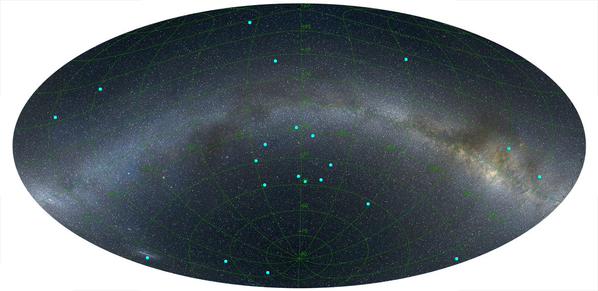
According to the cosmological principle (CP), Universal large-scale structure is homogeneous and isotropic. The observable Universe, however, shows complex structures even on very large scales. The recent discoveries of structures significantly exceeding the transition scale of 370 Mpc pose a challenge to the CP. We report here the discovery of the largest regular formation in the observable Universe; a ring with a diameter of 1720 Mpc, displayed by 9 gamma-ray bursts (GRBs), exceeding by a factor of 5 the transition scale to the homogeneous and isotropic distribution. The ring has a major diameter of 43° and a minor diameter of 30° at a distance of 2770 Mpc in the 0.78 < z < 0.86 redshift range, with a probability of 2 × 10⁻⁶ of being the result of a random fluctuation in the GRB count rate. Evidence suggests that this feature is the projection of a shell on to the plane of the sky. Voids and string-like formations are common outcomes of large-scale structure. However, these structures have maximum sizes of 150 Mpc, which are an order of magnitude smaller than the observed GRB ring diameter. Evidence in support of the shell interpretation requires that temporal information of the transient GRBs be included in the analysis. This ring-shaped feature is large enough to contradict the CP. The physical mechanism responsible for causing it is unknown.

The so-called “ring” can be seen here:
ring_Australia

In my opinion it’s not a ring at all, but an outline of Australia. What’s the probability of a random distribution of dots looking exactly like that? Is it really evidence for the violation of the Cosmological Principle, or for the existence of the Cosmic Antipodes?

For those of you who don’t get that gag, a cosmic antipode occurs in, e.g., closed Friedmann cosmologies in which the spatial sections take the form of a hypersphere (or 3-sphere). The antipode is the point diametrically opposite the observer on this hypersurface, just as it is for the surface of a 2-sphere such as the Earth. The antipode is only visible if it lies inside the observer’s horizon, a possibility which is ruled out for standard cosmologies by current observations. I’ll get my coat.

Anyway, joking apart, the claims in the abstract of the paper are extremely strong but the statistical arguments supporting them are deeply unconvincing. Indeed, I am quite surprised the paper passed peer review. For a start there’s a basic problem of “a posteriori” reasoning here. We see a group of objects that form a map of Australia ring and then are surprised that such a structure appears so rarely in simulations of our favourite model. But all specific configurations of points are rare in a Poisson point process. We would be surprised to see a group of dots in the shape of a pretzel too, or the face of Jesus, but that doesn’t mean that such an occurrence has any significance. It’s an extraordinarily difficult problem to put a meaningful measure on the space of geometrical configurations, and this paper doesn’t succeed in doing that.

For a further discussion of the tendency that people have to see patterns where none exist, take a look at this old post from which I’ve taken this figure which is generated by drawing points independently and uniformly randomly:

pointaI can see all kinds of shapes in this pattern, but none of them has any significance (other than psychological). In a mathematically well-defined sense there is no structure in this pattern! Add to that difficulty the fact that so few points are involved and I think it becomes very clear that this “structure” doesn’t provide any evidence at all for the violation of the Cosmological Principle. Indeed it seems neither do the authors. The very last paragraph of the paper is as follows:

GRBs are very rare events superimposed on the cosmic
web identified by superclusters. Because of this, the ring is
probably not a real physical structure. Further studies are
needed to reveal whether or not the Ring could have been
produced by a low-frequency spatial harmonic of the large-
scale matter density distribution and/or of universal star
forming activity.

It’s a pity that this note of realism didn’t make it into either the abstract or, more importantly, the accompanying press release. Peer review will never be perfect, but we can do without this sort of hype. Anyway, I confidently predict that a proper refutation will appear shortly….

P.S. For a more technical discussion of the problems of inferring the presence of large structures from sparsely-sampled distributions, see here.

Beard Liberation Front official statement on Jeremy Corbyn’s Labour leadership victory

Posted in Uncategorized on September 12, 2015 by telescoper

kmflett's avatarKmflett's Blog

Beard Liberation Front

Press release 12TH September

Contact Keith Flett 07803 167266

CAMPAIGNERS WELCOME THE AGE OF THE BEARD AS CORBYN ELECTED LABOUR LEADER

bed

The Beard Liberation Front, the informal network of beard wearers, has welcomed the Age of the Beard with the news that Jeremy Corbyn has been elected Labour leader

Jeremy Corbyn is five times winner of the Parliamentary Beard of the Year Award and was the winner of the original award in 2001 and while his beard may be a little more restrained these days, it has been a consistent presence on the Parliamentary backbenches for over 30 years.

The campaigners say that Corbyn has faced many comments about his beard and informal appearance during the Leadership campaign but his victory underlines the growing disenchantment that there is with clean shaven politicians in suits

The 2015 Parliamentary Beard of the Year Award poll will open on…

View original post 106 more words

I Puritani – Welsh National Opera

Posted in Opera with tags , , , , , on September 12, 2015 by telescoper

After spending yesterday in Cardiff at an External Advisory Panel meeting for the School of Physics & Astronomy, I’m now back on Sussex University campus to greet this year’s new new intake of students who begin arriving this weekend. Now, in between two Welcome Events this afternoon I just have time to do a quick review of last night’s entertainment in Cardiff. The meeting in Cardiff had been in my diary for a while but I only realised last week that Friday night was the opening performance of a new Welsh National Opera production of I Puritani by Vincenzo Bellini. Fortunately, I managed to get a last-minute ticket. I’m really glad I did because it was wonderful.

I Puritani is set in England during the Civil War and revolves around Elvira (soprano, sung by Rosa Feola), who is a Protestant, and in love with Arturo (tenor, Barry Banks), who is Catholic. The trouble is that Elvira’s father has already promised her hand in marriage to Riccardo (David Kempster). The thought of being unable to marry Arturo sends Elvira into a deep depression but, seeing this, her father relents and gives permission for her to marry her true love. She responds to this news in rapturous fashion; her future happiness seems assured.

Unfortunately events intervene. Arturo takes pity on a woman suspected of being a Stuart spy and about to be condemned to death. In fact it turns out that the “spy” is Queen Henrietta Maria, widow of Charles I. Arturo struggles with the conflict between love and duty (a familiar operatic theme) then, on the eve of his wedding, he leaves in order to take Henrietta Maria away to safety. The shock of discovering that her beloved has gone deranges Elvira’s mind, and the classic Bel Canto “Mad Scene” ensues. Arturo does return, eventually, but not until Act 3 by which time he has already been sentenced to death for treason and Elvira is beyond help. Riccardo, encouraged by a mob, prepares to carry out the execution. A herald appears, announcing victory for the Protestant side in the Civil War and declaring a general pardon on all Royalist prisoners. It is too late to save Arturo, although Elvira’s madness has deepened to such an extent she doesn’t even realised her would-be husband is dead.

That brief synopsis of the plot doesn’t do any justice to what I think is a consummate piece of music drama, and certainly one of the heights of the bel canto period. There’s a superb balance of the different vocal combinations and wonderfully expressive music throughout. There are trademark bel canto coloratura passages, but it never feels forced or showy in this opera. The momentum never flags, either. It might surprise those who don’t like bel canto opera that, for example, Richard Wagner was a particular admirer of Vicenzo Bellini. Incidentally, I Puritani was Bellini’s last Opera; he died suddenly in 1835, at the age of just 34, the year it was first performed. It was acclaimed by the critics way back then, and is a fitting swansong for a truly great operatic composer.

The new production is initially set in the Northern Ireland of 1970s, with Elvira dressed in a blue twin set reminiscent of Margaret Thatcher. The protestants were depicted as Ulsterman, complete with Orange regalia and bowler hats. But there is a surprise in store. As Elvira begans to lose her mind, an identically dressed (mute) doppelganger appears on stage. The real Elvira then leaves to return almost immediately dressed in 17th Century attire. The Orangemen also reappear dressed in the black clothes with white ruffs and cuffs of Puritans. Not only does this make a point about the three hundred years of sectarian madness in Northern Ireland, but it also manifests Elvira’s depersonalisation, i.e. her detachment from reality. The portrayal of Elvira’s madness in this Opera is sympathetic but unflinching, and deeply moving.

The principals were all excellent, but I can’t help singling out Rosa Feola, who sang and acted beautifully, and Barry Banks who tackled the immensely demanding tenor part with real gusto. The WNO chorus were magnificent, as they usually are in fact. Conductor Carlo Rizzi had the Orchestra of Welsh National Opera on top form too.

All in all, a wonderful night at the Opera. Congratulations to WNO for having the courage to put on this rare masterpiece. This is as good as anything I’ve seen at the Wales Millennium Centre, and that’s a pretty strong endorsement Do go and see it if you can!
Discrete Analysis — an arXiv overlay journal

Posted in Open Access with tags on September 11, 2015 by telescoper

Good to see this experiment getting under way. Announcements about a similar (though not identical) initiative for Astrophysics and Cosmology (currently under beta testing) will appear shortly…

gowers's avatarGowers's Weblog

This post is to announce the start of a new mathematics journal, to be called Discrete Analysis. While in most respects it will be just like any other journal, it will be unusual in one important way: it will be purely an arXiv overlay journal. That is, rather than publishing, or even electronically hosting, papers, it will consist of a list of links to arXiv preprints. Other than that, the journal will be entirely conventional: authors will submit links to arXiv preprints, and then the editors of the journal will find referees, using their quick opinions and more detailed reports in the usual way in order to decide which papers will be accepted.

Part of the motivation for starting the journal is, of course, to challenge existing models of academic publishing and to contribute in a small way to creating an alternative and much cheaper system. However, I hope that…

View original post 2,383 more words

Fish, Chips and Immigration

Posted in History, Politics with tags , , , , , , on September 10, 2015 by telescoper

I’m not the biggest fan of Simon Jenkins, especially when he goes off on one of his childish anti-science rants, but there’s a powerful piece by him in today’s Guardian  with which I agree totally. Reading the article on the bus, and especially the passage about the arrival of Huguenot refugees from France in the 18th Century, I decided to repost the content of an item from about 5 years ago, to demonstrate the importance of immigration to Britain’s culture and traditions, sometimes in very surprising ways.

Have you ever wondered where and when the traditional “British” dish of fish and chips originated? The answer is fascinating, and a little bit controversial too.

The practice of eating fried fish in batter started to appear in England during the fifteenth century; it was derived from the  Pescado Frito cooked by Portuguese Sephardic Jews – Marranos – who had moved to Britain to escape persecution in their homeland. By the Victorian era “Fish Fried in the Jewish Fashion” was extremely popular in the working class districts of London, particularly in the East End. Dickens refers to a “fried fish warehouse” in Oliver Twist, which was first published in 1837. It seems to have become available in large quantities with the rapid development of trawler fishing in the mid 19th century.

Incidentally, there is a prominent relic  of the Spanish and Portuguese Jews who settled in the East End right next to Queen Mary, University of London in Mile End (see left). The burial ground has, I think, recently been moved but it neverthless provides a timely reminder that immigration is by no means a new phenomenon as far as the East End is concerned.
The traditional way of frying the fish involved oil and I don’t know precisely when the practice of using lard – which is what is used in many modern shops – came on the scene, but it clearly would not have met with Jewish approval and must have been a more recent development.

The origin of chips is more controversial. The first occurence of this usage of the word chip according to the Oxford English Dictionary appears in Dickens’ novel A Tale of Two Cities, dated 1859, in the phrase

Husky chips of potatoes, fried with some reluctant drops of oil

Some say the practice of frying potatoes like this originated in Belgium or France, and that chips are a British version of pommes frites or french fries. This style of cooking potatoes could have been brought to London by the Huguenots (French Protestants who settled in the East End of London after being forced out of their homeland). However, there is some controversy about how and why chips became so popular throughout Britain. Some claim the practice of eating fried potatoes was already established in the North of England before 1859. It also seems that fried chipped potatoes were served in working class eating establishments throughout Victorian London. Many working people – especially single men living in lodging houses – lacked the facilities or the ability to cook anything substantial at home, so preferred to buy their food ready made. At an Irish Ordinary you could get a filling meal of beer, meat and fried potatoes for about tuppence (in old money). Such establishments proliferated all over London during the 19th Century as the number of navvies and other itinerant Irish labourers  grew in response to the demand for manual workers across the country.

I think it was most likely the presence of a nearby Irish Ordinary that led a Jewish londoner called Joseph Malin to hit upon the idea of combining fried fish with chipped potatoes. At any rate it’s reasonably well established that the very first commercial Fish-and-Chip Shop was opened by him in 1860 in Cleveland Street and business was so good that it was followed by many others across the East End of London and beyond.

There’s something rather inspiring about rediscovering that Britain is nation whose traditions and institutions have always been so reliant on foreign immigrants. Even Fish and Chips turns out to be from somewhere else. This is actually what makes me proud to be British.

Widening Participation in Physics

Posted in Education with tags , , , , on September 9, 2015 by telescoper

Following on from a provocative post I wrote a couple of weeks ago on this blog (which was subsequently reblogged by the Times Higher), I was contacted by Paul Crowther who sent me a copy of the slides used by Peter Main of the Institute of Physics in a talk in May 2015 on the subject of Widening Participation in Physics. With Peter Main’s permission I’m sharing those slides here as a service to the Physics community. There’s a lot of interesting information in these slides, which I think many UK physicists would be interested in.

Research Funding – A Modest Proposal

Posted in Education, Science Politics with tags , , , , , on September 9, 2015 by telescoper

This morning, the Minister for Universities, Jo Johnson, made a speech in which, among other things, he called for research funding to be made simpler. Under the current “dual funding” system, university researchers receive money through two main routes: one is the Research Excellence Framework (REF) which leads to so-called “QR” funding allocations made via the Higher Education Funding Council for England (HEFCE); and the other is through research grants which have to be applied for competitively from various sources, including the Seven Research Councils.

Part of the argument why this system needs to be simplified is the enormous expense and administrative burden of the Research Excellence Framework.  Many people have commented to me that although they hate the REF and accept that it’s ridiculously expensive and time-consuming, they didn’t see any alternative. I’ve been thinking about it and thought I’d make a suggestion. Feel free to shoot it down in flames through the box at the end, but I’ll begin with a short introduction.

Those of you old enough to remember will know that before 1992 (when the old `polytechnics’ were given the go-ahead to call themselves `universities’) the University Funding Council – the forerunner of HEFCE – allocated research funding to universities by a simple formula related to the number of undergraduate students. When the number of universities suddenly increased this was no longer sustainable, so the funding agency began a series of Research Assessment Exercises to assign research funds (now called QR funding) based on the outcome. This prevented research money going to departments that weren’t active in research, most (but not all) of which were in the ex-Polytechnics. Over the years the apparatus of research assessment has become larger, more burdensome, and incomprehensibly obsessed with short-term impact of the research. Like most bureaucracies it has lost sight of its original purpose and has now become something that exists purely for its own sake.

It is especially indefensible at this time of deep cuts to university core funding that we are being forced to waste an increasingly large fraction of our decreasing budgets on staff-time that accomplishes nothing useful except pandering to the bean counters.

My proposal is to abandon the latest manifestation of research assessment mania, i.e. the REF, and return to a simple formula, much like the pre-1992 system,  except that QR funding should be based on research student (i.e. PhD student) rather than undergraduate numbers. There’s an obvious risk of game-playing, and this idea would only stand a chance of working at all if the formula involved the number of successfully completed research degrees over a given period .

I can also see an argument  that four-year undergraduate students (e.g. MPhys or MSci students) also be included in the formula, as most of these involve a project that requires a strong research environment.

Among the advantages of this scheme are that it’s simple, easy to administer, would not spread QR funding in non-research departments, and would not waste hundreds of millions of pounds on bureaucracy that would be better spent actually doing research. It would also maintain the current “dual support” system for research, if that’s  a benefit.

I’m sure you’ll point out disadvantages through the comments box!


The Essence of Cosmology is Statistics

Posted in The Universe and Stuff with tags , , on September 8, 2015 by telescoper

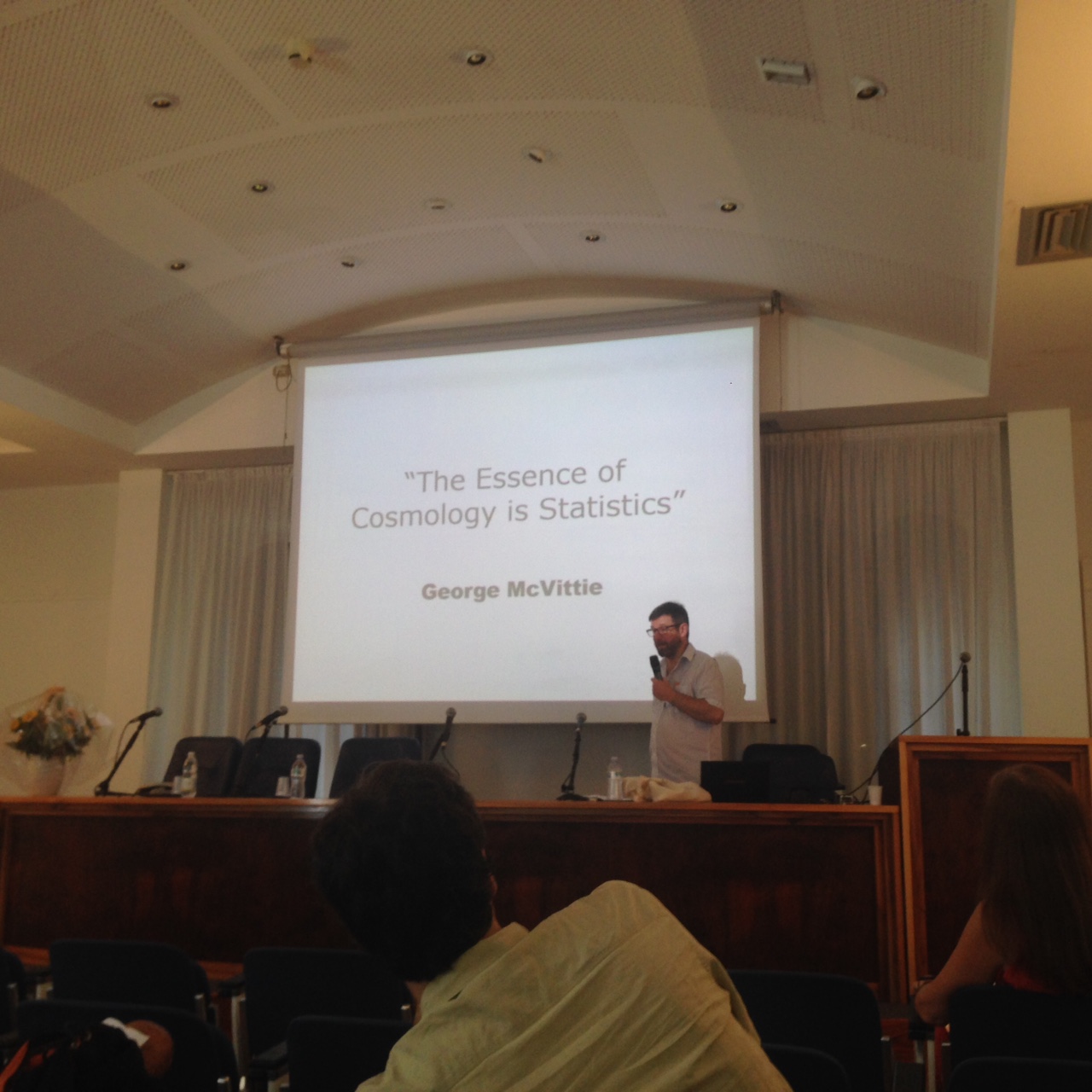
I’m grateful to Licia Verde for sending this picture of me in action at last week’s conference in Castiglioncello.

McVittie

The quote is one I use quite regularly, as the source is quite surprising. It is by George McVittie and appears in the Preface to the Proceedings of the Third Bekeley Symposium on Mathematical Statistics and Probability, which took place in 1956. It is surprising for two reasons. One is that McVittie is more strongly associated with theoretical cosmology than with statistics. In fact I have one of his books, the first edition of which was published in 1937:

DSC_0170

There’s a bit in the book about observational cosmology, but basically it’s wall-to-wall Christoffel symbols!

The other surprising thing is that way back in 1956 there was precious little statistical information relevant to cosmology anyway, a far cry from the situation today with our plethora of maps and galaxy surveys. What he was saying though was that statistics is all about making inferences based on partial or incomplete data. Given that the subject of cosmology is the entire Universe, it is obvious we will never have complete data (i.e. we will never know everything). Hence cosmology is essentially statistical. This is true of other fields too, but in cosmology it is taken to an extreme. George McVittie passed away in 1988, so didn’t really live long enough to see this statement fulfilled, but it certainly has been over the last couple of decades!

P.S. Although he spent much of his working life in the East End of London (at Queen Mary College), George McVittie should not be confused with the even more famous, or rather infamous, Jack McVitie.

Yo-Yo Ma and the Bach Suites for Solo Cello

Posted in Music with tags , , , , on September 7, 2015 by telescoper

I stayed in on Saturday night especially to listen to a very special promenade concert live on BBC Radio 3 during which renowned cellist Yo-Yo Ma played all six of the Suites for unaccompanied Cello by Johann Sebastian Bach. It was an absolutely brilliant concert which you can, if you missed it, or even if you didn’t,  download for the next month here. The whole thing runs for over two and a half hours, but I didn’t move from my seat once.

I’ve loved all these pieces from the moment I first heard them. How Bach manages to conjure up such a vast range of melodic and rhythmic possibilities using just the one instrument is almost miraculous. Despite using very few chords, they manage to explore the  harmonic domain too. Part of what makes them so special is the instrument itself – its earthy sound, complete with occasional growls and scrapes, emphasizes how this sublime music is somehow at the same time deeply human, somehow connecting the listener to something from far beyond the mundane world we normally inhabit. I’m not a religious man, but listening to music like this is a spiritual experience for me.

Do listen to the whole concert if you can, but if you can’t here’s a short taster (recorded elsewhere). This is the Prelude to the 1st Suite, the first page of which is here:

bach_cello

If you look at the sheet music you might be forgiven for thinking that it is just a dry exercise in playing across the strings. Listen to it come to life, however, and you’ll quickly realise that you were wrong. The ending of this prelude always sends shivers down my spine.

I know these suites have been transcribed for other solo instruments, such as the flute, but listening to them on Saturday I wondered if they had been transcribed for my favourite earthy and growly instrument, the tenor saxophone. In fact they have; you can hear an example here.  One problem that struck me immediately is that saxophonists have to pause for breath! Anyway,  I must get a copy of the transcription and have a go at learning it, though I think it would take a Sonny Rollins or John Coltrane to do them justice!