Archive for July, 2016

Return Journeys

Posted in Uncategorized on July 16, 2016 by telescoper

So here I am, then. Sitting in my hotel room in Ghent after breakfast. About to pack my belongings and start the journey back to England. The Ghent Festival didn’t interrupt my sleep too much. Although there were people around until the early hours of the morning the noise wasn’t enough to keep me awake.

It’s been a nice meeting, not least because they gave me a gift pack for doing my invited talk:

SAMSUNG DIGITAL CAMERA

GIFT PACK

I’m not sure what all the stuff is, but there’s definitely a bottle of a beer called Delirium Tremens which sounds promising and some chocolate which I’ll give to a good home. I don’t like chocolate. I will have to lug this back home on the train, but I’m sure I’ll cope.

So I’ll shortly be heading off to the railway station for the train to Brussels, whence to London and then Cardiff. Then I’m back in Brighton for most of next week, especially the Summer Graduation ceremony – my last official duty as Head of School.

It just remains to thank the organizers for inviting me to this meeting. It seems next year’s MaxEnt will be in Brazil!


Last Day of MaxEnt2016

Posted in Biographical, History, The Universe and Stuff with tags , , on July 15, 2016 by telescoper

This week has gone very quickly. It is already the last day of MaxEnt2016. Tomorrow I’m returning by train to the UK. Last night was a very nice conference dinner at a place called Parnassus (which is actually a deconsecrated church). That was after a very enjoyable afternoon of sightseeing through two guided tours, one on foot and the other by boat.

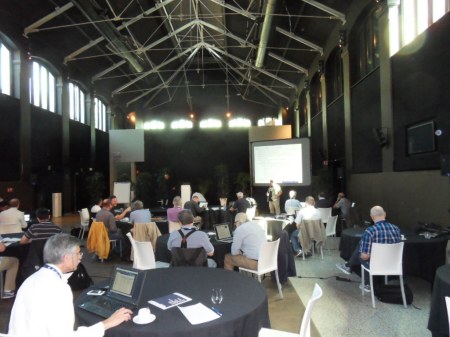
This morning is the last session in the conference venue Oude Vismijn. Here is a snap taken in between talks this morning:

SAMSUNG DIGITAL CAMERA

MaxEnt2016

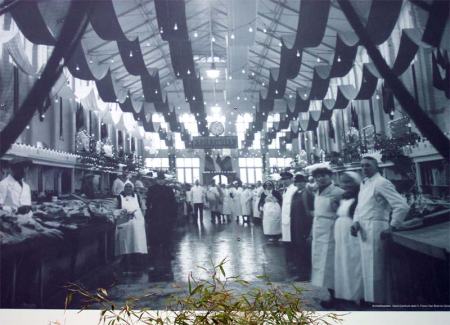
In olden days this hall looked more like this:

vismijn3

Given the location it’s a pity I didn’t think to put a joke in my talk about the Poisson distribution. Geddit?

Over the last few days the City of Ghent has been preparing for the annual Ghent Festival (Gentse Feesten) which has involved the construction of dozens of temporary structures including stages for the bands to play on, and many tents of various sizes for beer consumption). The Festival goes on for 10 days and the first night is tonight. I’m told it’s very noisy in the city centre, which is where my hotel is, so I’m not sure I’ll get much sleep tonight as the festivities go on round the clock!


Emily Dickinson’s Desk

Posted in History, Poetry with tags , on July 15, 2016 by telescoper

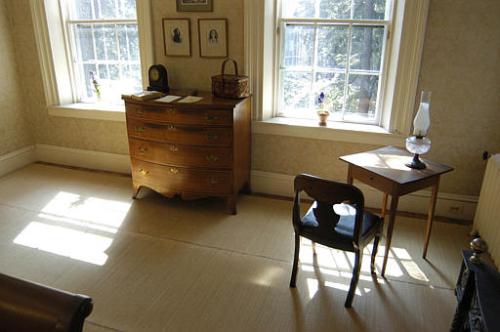
Here’s a fascinating post about the poet Emily Dickinson. Apparently she wrote all her poems sitting at that little square table!

malcolmguite's avatarMalcolm Guite

Emily's desk Emily’s Desk

Whilst I was speaking at a CS Lewis conference in Amherst I had the opportunity to visit Emily Dickinson’s house, now beautifully preserved as the Emily Dickinson Museum. And so I came to stand in that ‘mighty room’ where all the poems were written, and there, plain and simple and strangely, paradoxically, small was her little desk: a small square writing table.  I was filled with wonder at how much had flowed from so small a space, but then I thought about Dickinson’s characteristically concentrated and terse verse forms; those compact and concentrated little quatrains with the emphatic dashes linking and yet binding in the energy of her phrases, and it seemed to me the smallness of the desk was itself part of the form of the poetry, part of her gift.

Anyway the whole experience stirred me on to this: (as always you can hear…

View original post 88 more words

Cosmology: A Bayesian Perspective

Posted in Talks and Reviews, The Universe and Stuff with tags , , on July 14, 2016 by telescoper

For those of you who are interested, here are the slides I used in my invited talk at MaxEnt 2016 Maximum Entropy and Bayesian Methods in Science and Engineering, yesterday (13th July 2016) in Ghent (Belgium).

How They Brought the Good News from Ghent to Aix

Posted in Poetry with tags , , on July 13, 2016 by telescoper

I.
I sprang to the stirrup, and Joris, and he;
I galloped, Dirck galloped, we galloped all three;
‘Good speed!’ cried the watch, as the gate-bolts undrew;
‘peed!’ echoed the wall to us galloping through;
Behind shut the postern, the lights sank to rest,
And into the midnight we galloped abreast.

II.
Not a word to each other; we kept the great pace
Neck by neck, stride by stride, never changing our place;
I turned in my saddle and made its girths tight,
Then shortened each stirrup, and set the pique right,
Rebuckled the cheek-strap, chained slacker the bit,
Nor galloped less steadily Roland a whit.

III.
‘Twas moonset at starting; but while we drew near
Lokeren, the cocks crew and twilight dawned clear;
At Boom, a great yellow star came out to see;
At Dffeld,’twas morning as plain as could be;
And from Mecheln church-steeple we heard the half-chime,
So, Joris broke silence with, ‘Yet there is time!’

IV.
At Aershot, up leaped of a sudden the sun,
And against him the cattle stood black every one,
To stare thro’ the mist at us galloping past,
And I saw my stout galloper Roland at last,
With resolute shoulders, each hutting away
The haze, as some bluff river headland its spray:

V.
And his low head and crest, just one sharp ear bent back
For my voice, and the other pricked out on his track;
And one eye’s black intelligence,—ever that glance
O’er its white edge at me, his own master, askance!
And the thick heavy spume-flakes which aye and anon
His fierce lips shook upwards in galloping on.

VI.
By Hasselt, Dirck groaned; and cried Joris, ‘Stay spur!
‘Your Roos galloped bravely, the fault’s not in her,
‘We’ll remember at Aix’—for one heard the quick wheeze
Of her chest, saw the stretched neck and staggering knees,
And sunk tail, and horrible heave of the flank,
As down on her haunches she shuddered and sank.

VII.
So, we were left galloping, Joris and I,
Past Looz and past Tongres, no cloud in the sky;
The broad sun above laughed a pitiless laugh,
‘Neath our feet broke the brittle bright stubble like chaff;
Till over by Dalhem a dome-spire sprang white,
And ‘Gallop,’ gasped Joris, ‘for Aix is in sight!’

VIII.
‘How they’ll greet us!’—and all in a moment his roan
Rolled neck and croup over, lay dead as a stone;
And there was my Roland to bear the whole weight
Of the news which alone could save Aix from her fate,
With his nostrils like pits full of blood to the brim,
And with circles of red for his eye-sockets’ rim.

IX.
Then I cast loose my buffcoat, each holster let fall,
Shook off both my jack-boots, let go belt and all,
Stood up in the stirrup, leaned, patted his ear,
Called my Roland his pet-name, my horse without peer;
Clapped my hands, laughed and sang, any noise, bad or good,
Till at length into Aix Roland galloped and stood.

X.
And all I remember is—friends flocking round
As I sat with his head ‘twixt my knees on the ground;
And no voice but was praising this Roland of mine,
As I poured down his throat our last measure of wine,
Which (the burgesses voted by common consent)
Was no more than his due who brought good news from Ghent

by Robert Browning (1812-1889)


Egmont

Posted in History, Music with tags , , , on July 12, 2016 by telescoper

It was just brought to my attention that one of the historical landmarks of Ghent, the location of the conference I am currently at, is the home of Lamoral, Count of Egmont whose execution in 1568 sparked an uprising against Spanish occupation that eventually led to the independence of the Netherlands. The house itself is extremely old, being built in 1200 from roman bricks.

Egmont was also the inspiration behind Beethoven’s  famous overture played here in suitably dramatic style by the Berlin Philharmonic under the direction of Herbert von Karajan.


MaxEnt 2016: Norton’s Dome and the Cosmological Density Parameter

Posted in The Universe and Stuff with tags , , , on July 11, 2016 by telescoper

The second in my sequence of posts tangentially related to talks at this meeting on Maximum Entropy and Bayesian Methods in Science and Engineering is inspired by a presentation this morning by Sylvia Wenmackers. The talk featured an example which was quite new to me called Norton’s Dome. There’s a full discussion of the implications of this example at John D. Norton’s own website, from which I have taken the following picture:

dome_with_eqn

This is basically a problem in Newtonian mechanics, in which a particle rolls down from the apex of a dome with a particular shape in response to a vertical gravitational field. The solution is well-determined and shown in the diagram.

An issue arises, however, when you consider the case where the particle starts at the apex of the dome with zero velocity. One solution in this case is that the particle stays put forever. However it can be shown that there are other solutions in which the particle sits at the top for an arbitrary (finite) time before rolling down. An example could be for example if the particle were launched up the dome from some point with just enough kinetic energy to reach the top where it is momentarily at rest, but then rolls down again.

Norton argues that this problem demonstrates a certain kind of indeterminism in Newtonian Mechanics. The mathematical problem with the specified initial conditions clearly has a solution in which the ball stays at the top forever. This solution is unstable, which is a familiar situation in mechanics, but this equilibrium has an unusual property related to the absence of Lipschitz continuity. One might expect that an infinitesimal asymmetric perturbation of the particle or the shape of the surface would be needed to send the particle rolling down the slope, but in this case it doesn’t. This is because there isn’t just one solution that has zero velocity at the equilibrium, but an entirely family as described above. This is both curious and interesting, and it does raise the question of how to define a probability measure that describes these solutions.

I don’t really want to go into the philosophical implications of this cute example, but it did strike me that there’s a similarity with an interesting issue in cosmology that I’ve blogged about before (in different terms).

This probably seems to have very little to do with physical cosmology, but now forget about domes and think instead about the behaviour of the mathematical models that describe the Big Bang. To keep things simple, I’m going to ignore the cosmological constant and just consider how things depend on one parameter, the density parameter Ω0. This is basically the ratio between the present density of the matter in the Universe compared to what it would have to be to cause the expansion of the Universe eventually to halt. To put it a slightly different way, it measures the total energy of the Universe. If Ω0>1 then the total energy of the Universe is negative: its (negative) gravitational potential energy dominates over the (positive) kinetic energy. If Ω0<1 then the total energy is positive: kinetic trumps potential. If Ω0=1 exactly then the Universe has zero total energy: energy is precisely balanced, like the man on the tightrope.

A key point, however, is that the trade-off between positive and negative energy contributions changes with time. The result of this is that Ω is not fixed at the same value forever, but changes with cosmic epoch; we use Ω0 to denote the value that it takes now, at cosmic time t0, but it changes with time.

At the beginning, i.e. at the Big Bang itself,  all the Friedmann models begin with Ω arbitrarily close to unity at arbitrarily early times, i.e. the limit as t tends to zero is Ω=1.

In the case in which the Universe emerges from the Big bang with a value of Ω just a tiny bit greater than one then it expands to a maximum at which point the expansion stops. During this process Ω grows without bound. Gravitational energy wins out over its kinetic opponent.

If, on the other hand, Ω sets out slightly less than unity – and I mean slightly, one part in 1060 will do – the Universe evolves to a state where it is very close to zero. In this case kinetic energy is the winner  and Ω ends up on the ground, mathematically speaking.

In the compromise situation with total energy zero, this exact balance always applies. The universe is always described by Ω=1. It walks the cosmic tightrope. But any small deviation early on results in runaway expansion or catastrophic recollapse. To get anywhere close to Ω=1 now – I mean even within a factor ten either way – the Universe has to be finely tuned.

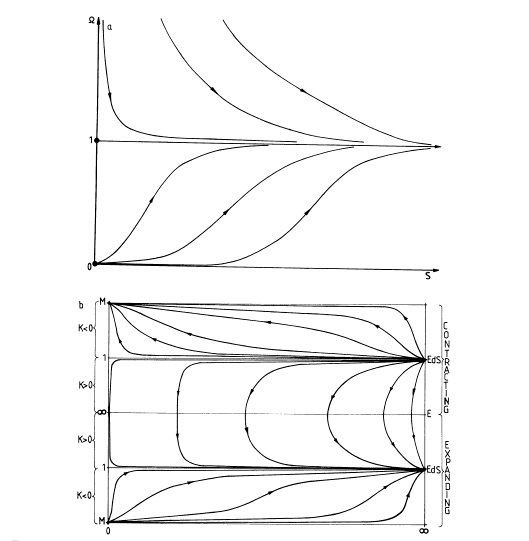
The evolution of Ω  is neatly illustrated by the following phase-plane diagram (taken from an old paper by Madsen & Ellis) describing a cosmological model involving a perflect fluid with an equation of state p=(γ-1)ρc2. This is what happens for γ>2/3 (which includes dust, relativistic particles, etc):

Phase_plane_crop

The top panel shows how the density parameter evolves with scale factor S; the bottom panel shows a completion of this portrait obtained using a transformation that allows the point at infinity to be plotted on a finite piece of paper (or computer screen).

As discussed above this picture shows that all these Friedmann models begin at S=0 with Ω arbitrarily close to unity and that the value of Ω=1 is an unstable fixed point, just like the situation of the particle at the top of the dome. If the universe has Ω=1 exactly at some time then it will stay that way forever. If it is perturbed, however, then it will eventually diverge and end up collapsing (Ω>1) or going into free expansion (Ω<1).  The smaller the initial perturbation,  the longer the system stays close to Ω=1.

The fact that all trajectories start at Ω(S=0)=1 means that one has to be very careful in assigning some sort of probability measure on this parameter, ust as is the case with the Norton’s Dome problem I started with. About twenty years ago, Guillaume Evrard and I tried to put this argument on firmer mathematical grounds by assigning a sensible prior probability to Ω based on nothing other than the assumption that our Universe is described by a Friedmann model.

The result we got was that it should be of the form

P(\Omega) \propto \Omega^{-1}(\Omega-1)^{-1}.

I was very pleased with this result, which is based on a principle advanced by physicist Ed Jaynes, but I have no space to go through the mathematics here. Note, however, that this prior has three interesting properties: it is infinite at Ω=0 and Ω=1, and it has a very long “tail” for very large values of Ω. It’s not a very well-behaved measure, in the sense that it can’t be integrated over, but that’s not an unusual state of affairs in this game. In fact it is what is called an improper prior.

I think of this prior as being the probabilistic equivalent of Mark Twain’s description of a horse:

dangerous at both ends, and uncomfortable in the middle.

Of course the prior probability doesn’t tell usall that much. To make further progress we have to make measurements, form a likelihood and then, like good Bayesians, work out the posterior probability . In fields where there is a lot of reliable data the prior becomes irrelevant and the likelihood rules the roost. We weren’t in that situation in 1995 – and we’re arguably still not – so we should still be guided, to some extent by what the prior tells us.

The form we found suggests that we can indeed reasonably assign most of our prior probability to the three special cases I have described. Since we also know that the Universe is neither totally empty nor ready to collapse, it does indicate that, in the absence of compelling evidence to the contrary, it is quite reasonable to have a prior preference for the case Ω=1.  Until the late 1980s there was indeed a strong ideological preference for models with Ω=1 exactly, but not because of the rather simple argument given above but because of the idea of cosmic inflation.

From recent observations we now know, or think we know, that Ω is roughly 0.26. To put it another way, this means that the Universe has roughly 26% of the density it would need to have to halt the cosmic expansion at some point in the future. Curiously, this corresponds precisely to the unlikely or “fine-tuned” case where our Universe is in between  two states in which we might have expected it to lie.

Even if you accept my argument that Ω=1 is a special case that is in principle possible, it is still the case that it requires the Universe to have been set up with very precisely defined initial conditions. Cosmology can always appeal to special initial conditions to get itself out of trouble because we don’t know how to describe the beginning properly, but it is much more satisfactory if properties of our Universe are explained by understanding the physical processes involved rather than by simply saying that “things are the way they are because they were the way they were.” The latter statement remains true, but it does not enhance our understanding significantly. It’s better to look for a more fundamental explanation because, even if the search is ultimately fruitless, we might turn over a few interesting stones along the way.

The reasoning behind cosmic inflation admits the possibility that, for a very short period in its very early stages, the Universe went through a phase where it was dominated by a third form of energy, vacuum energy. This forces the cosmic expansion to accelerate; this means basically that the equation of state of the contents of the universe is described by γ<2/3 rather than the case γ>2/3 described above. This drastically changes the arguments I gave above.

Without inflation the case with Ω=1 is unstable: a slight perturbation to the Universe sends it diverging towards a Big Crunch or a Big Freeze. While inflationary dynamics dominate, however, this case has a very different behaviour. Not only stable, it becomes an attractor to which all possible universes converge. Here’s what the phase plane looks like in this case:

Phase_plane+2_crop


Whatever the pre-inflationary initial conditions, the Universe will emerge from inflation with Ω very close to unity.

So how can we reconcile inflation with current observations that suggest a low matter density? The key to this question is that what inflation really does is expand the Universe by such a large factor that the curvature radius becomes infinitesimally small. If there is only “ordinary” matter in the Universe then this requires that the universe have the critical density. However, in Einstein’s theory the curvature is zero only if the total energy is zero. If there are other contributions to the global energy budget besides that associated with familiar material then one can have a low value of the matter density as well as zero curvature. The missing link is dark energy, and the independent evidence we now have for it provides a neat resolution of this problem.

Or does it? Although spatial curvature doesn’t really care about what form of energy causes it, it is surprising to some extent that the dark matter and dark energy densities are similar. To many minds this unexplained coincidence is a blemish on the face of an otherwise rather attractive structure.

It can be argued that there are initial conditions for non-inflationary models that lead to a Universe like ours. This is true. It is not logically necessary to have inflation in order for the Friedmann models to describe a Universe like the one we live in. On the other hand, it does seem to be a reasonable argument that the set of initial data that is consistent with observations is larger in models with inflation than in those without it. It is rational therefore to say that inflation is more probable to have happened than the alternative.

I am not totally convinced by this reasoning myself, because we still do not know how to put a reasonable measure on the space of possibilities existing prior to inflation. This would have to emerge from a theory of quantum gravity which we don’t have. Nevertheless, inflation is a truly beautiful idea that provides a framework for understanding the early Universe that is both elegant and compelling. So much so, in fact, that I almost believe it.

 

MaxEnt 2016: Some thoughts on the infinite

Posted in The Universe and Stuff with tags , , , on July 10, 2016 by telescoper

I thought I might do a few posts about matters arising from talks at this workshop I’m at. Today is devoted to tutorial talks, and the second one was given by John Skilling and in the course of it, he made some comments about the concept of infinity in science. These remarks weren’t really central to his talk, but struck me as an interesting subject for a few tangential remarks of my own.

Most of us – whether scientists or not – have an uncomfortable time coping with the concept of infinity. Physicists have had a particularly difficult relationship with the notion of boundlessness, as various kinds of pesky infinities keep cropping up in calculations. In most cases this this symptomatic of deficiencies in the theoretical foundations of the subject. Think of the ‘ultraviolet catastrophe‘ of classical statistical mechanics, in which the electromagnetic radiation produced by a black body at a finite temperature is calculated to be infinitely intense at infinitely short wavelengths; this signalled the failure of classical statistical mechanics and ushered in the era of quantum mechanics about a hundred years ago. Quantum field theories have other forms of pathological behaviour, with mathematical components of the theory tending to run out of control to infinity unless they are healed using the technique of renormalization. The general theory of relativity predicts that singularities in which physical properties become infinite occur in the centre of black holes and in the Big Bang that kicked our Universe into existence. But even these are regarded as indications that we are missing a piece of the puzzle, rather than implying that somehow infinity is a part of nature itself.

One exception to this rule is the field of cosmology. Somehow it seems natural at least to consider the possibility that our cosmos might be infinite, either in extent or duration, or both, or perhaps even be a multiverse comprising an infinite collection of sub-universes. If the Universe is defined as everything that exists, why should it necessarily be finite? Why should there be some underlying principle that restricts it to a size our human brains can cope with?

On the other hand, there are cosmologists who won’t allow infinity into their view of the Universe. A prominent example is George Ellis, a strong critic of the multiverse idea in particular, who frequently quotes David Hilbert

The final result then is: nowhere is the infinite realized; it is neither present in nature nor admissible as a foundation in our rational thinking—a remarkable harmony between being and thought.

This comment is quoted from a famous essay which seems to echo earlier remarks by Carl Friedrich Gauss which can be paraphrased:

Infinity is nothing more than a figure of speech which helps us talk about limits. The notion of a completed infinity doesn’t belong in mathematics.

This summarises Gauss’s reaction to Cantor’s Theory of Ininite Sets. But to every Gauss there’s an equal and opposite Leibniz

I am so in favor of the actual infinite that instead of admitting that Nature abhors it, as is commonly said, I hold that Nature makes frequent use of it everywhere, in order to show more effectively the perfections of its Author.

You see that it’s an argument with quite a long pedigree!

When I was at the National Astronomy Meeting in Llandudno a few years ago, I attended an excellent plenary session that featured a Gerald Whitrow Lecture, by Alex Vilenkin, entitled The Principle of Mediocrity. This was a talk based on some ideas from his book Many Worlds in One: The Search for Other Universese, in which he discusses some of the consequences of the so-called eternal inflation scenario, which leads to a variation of the multiverse idea in which the universe comprises an infinite collection of causally-disconnected “bubbles” with different laws of low-energy physics applying in each. Indeed, in Vilenkin’s vision, all possible configurations of all possible things are realised somewhere in this ensemble of mini-universes. An infinite number of National Astronomy Meetings, each with the same or different programmes, an infinite number of Vilenkins, etc etc.

One of the features of this scenario is that it brings the anthropic principle into play as a potential “explanation” for the apparent fine-tuning of our Universe that enables life to be sustained within it. We can only live in a domain wherein the laws of physics are compatible with life so it should be no surprise that’s what we find. There is an infinity of dead universes, but we don’t live there.

I’m not going to go on about the anthropic principle here, although it’s a subject that’s quite fun to write or, better still, give a talk about, especially if you enjoy winding people up! What I did want to say mention, though, is that Vilenkin correctly pointed out that three ingredients are needed to make this work:

  1. An infinite ensemble of realizations
  2. A discretizer
  3. A randomizer

Item 2 involves some sort of principle that ensures that the number of possible states of the system we’re talking about  is not infinite. A very simple example from  quantum physics might be the two spin states of an electron, up (↑) or down(↓). No “in-between” states are allowed, according to our tried-and-tested theories of quantum physics, so the state space is discrete.  In the more general context required for cosmology, the states are the allowed “laws of physics” ( i.e. possible  false vacuum configurations). The space of possible states is very much larger here, of course, and the theory that makes it discrete much less secure. In string theory, the number of false vacua is estimated at 10500. That’s certainly a very big number, but it’s not infinite so will do the job needed.

Item 3 requires a process that realizes every possible configuration across the ensemble in a “random” fashion. The word “random” is a bit problematic for me because I don’t really know what it’s supposed to mean. It’s a word that far too many scientists are content to hide behind, in my opinion. In this context, however, “random” really means that the assigning of states to elements in the ensemble must be ergodic, meaning that it must visit the entire state space with some probability. This is the kind of process that’s needed if an infinite collection of monkeys is indeed to type the (large but finite) complete works of shakespeare. It’s not enough that there be an infinite number and that the works of shakespeare be finite. The process of typing must also be ergodic.

Now it’s by no means obvious that monkeys would type ergodically. If, for example, they always hit two adjoining keys at the same time then the process would not be ergodic. Likewise it is by no means clear to me that the process of realizing the ensemble is ergodic. In fact I’m not even sure that there’s any process at all that “realizes” the string landscape. There’s a long and dangerous road from the (hypothetical) ensembles that exist even in standard quantum field theory to an actually existing “random” collection of observed things…

More generally, the mere fact that a mathematical solution of an equation can be derived does not mean that that equation describes anything that actually exists in nature. In this respect I agree with Alfred North Whitehead:

There is no more common error than to assume that, because prolonged and accurate mathematical calculations have been made, the application of the result to some fact of nature is absolutely certain.

It’s a quote I think some string theorists might benefit from reading!

Items 1, 2 and 3 are all needed to ensure that each particular configuration of the system is actually realized in nature. If we had an infinite number of realizations but with either infinite number of possible configurations or a non-ergodic selection mechanism then there’s no guarantee each possibility would actually happen. The success of this explanation consequently rests on quite stringent assumptions.

I’m a sceptic about this whole scheme for many reasons. First, I’m uncomfortable with infinity – that’s what you get for working with George Ellis, I guess. Second, and more importantly, I don’t understand string theory and am in any case unsure of the ontological status of the string landscape. Finally, although a large number of prominent cosmologists have waved their hands with commendable vigour, I have never seen anything even approaching a rigorous proof that eternal inflation does lead to realized infinity of  false vacua. If such a thing exists, I’d really like to hear about!

Ghent for MaxEnt

Posted in Biographical, Politics with tags , , , on July 9, 2016 by telescoper

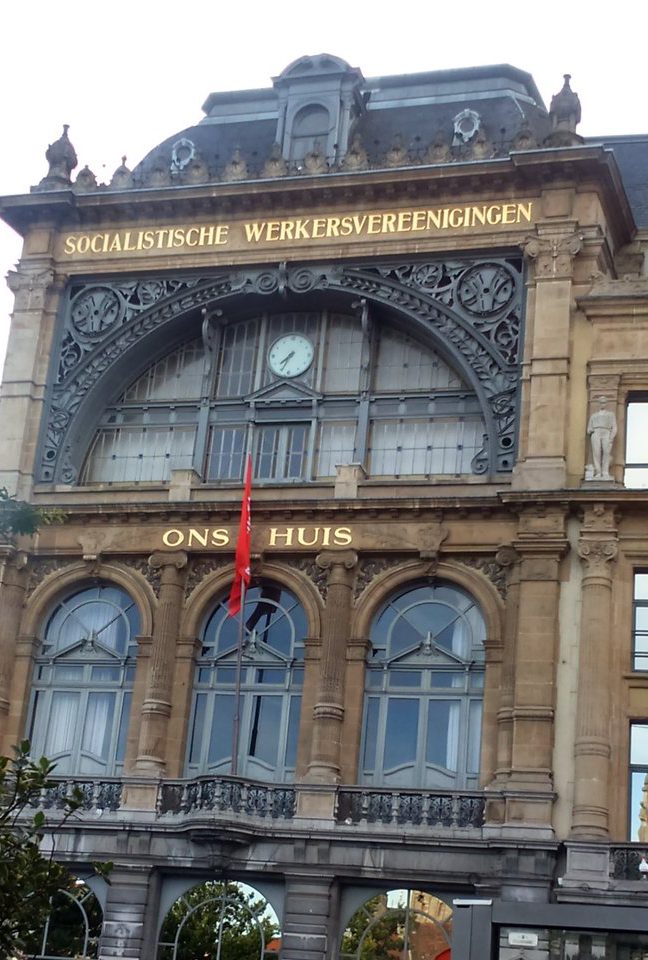
Just a quick post to mark the fact that I’ve arrived in the fine city of Ghent for the forthcoming MaxEnt 2016 (Bayesian Inference and Maximum Entropy Methods in Science and Engineering). The trip from Brighton was pleasant and disruption-free (Thameslink from Brighton to St Pancras, Eurostar t0 Brussels, and local train to Ghent, all components of which journey were on time).  In fact I travelled from London with a British contingent of the conference: John Skilling, Steve Gull and Anton Garrett (a regular commenter on this blog). We got here in time for dinner al fresco in a square near my hotel overlooked by an interesting local landmark:

Ghent


My Flemish isn’t marvellous but I translate the words at the top of the building as Socialist Workers’ Party, although it does seem a rather grandiose building for that!

Anyway, I hope to be able to do a bit of Bayesian blogging from Belgium while I’m here, during the next week. The meeting itself starts tomorrow..


The UK after the Referendum: All That Is Solid Melts Into Air…..

Posted in Uncategorized on July 8, 2016 by telescoper

This piece makes some important comments.

Prof. Colin R Talbot's avatarColin Talbot - my blog

The EU referendum result came as a shock to just about everyone, including the leaders of the “Leave” campaign (and me).

The aftershocks of this earthquake in British politics are still being felt.

Three of the central antagonists – the Prime Minister David Cameron, the leader of “Leave” Boris Johnson and leader of UKIP Nigel Farage – have all ‘resigned’. The leader of the Opposition is clinging onto office by his fingernails.

These individual dramas and excitements are, however, mere sideshows.

The real tragedy is the way the British constitution has been turned on its head.

View original post 743 more words