Archive for July, 2016

Farewell to the HOSG!

Posted in Biographical on July 8, 2016 by telescoper

As the date of my departure from the University of Sussex approaches, I find myself doing various things here for the last time. Last night’s valedictory event was a dinner at Pelham House in Lewes with some of the other Heads of School at the University of Sussex. There are 12 Schools altogether (including Brighton & Sussex Medical School, which belongs both to the University of Sussex and the nearby University of Brighton). The Heads of these Schools form a group, imaginatively called the Heads of Schools Group (or HOSG for short).

The Heads of School meet on a regular basis to discuss matters of mutual interest (and, more importantly to share juicy gossip). Once a term they meet for a dinner too, and the latest those events was last night.

As it happens two other Heads of School are stepping down at roughly the same time as me: Tom Healy (English) and Brian Hudson (Education and Social Work), so last night’s dinner was a leaving do of a sort, in which the nearly departed (including myself) were given gifts and made short speeches. More importantly, we had a sumptuous meal, excellent conversation in the very pleasant setting of the “Panelled Room”.

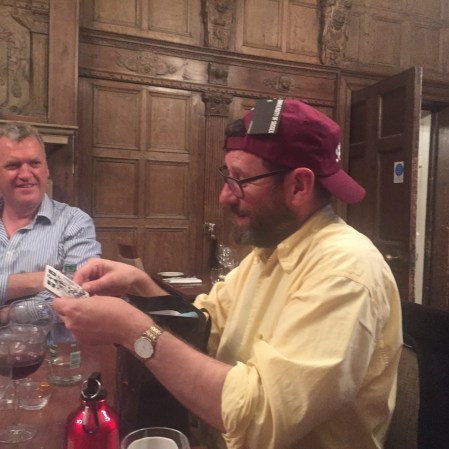
Here’s a picture of me unwrapping my gifts. The charming hat, which I am wearing in what I am told is the correct style, is one of the presents I got. That’s Tom Ormerod in the background.
IMG_7901

I won’t miss the administrative side of my current job and am looking forward to concentrating a bit more on the things I think I’m better at, i.e. teaching and research, but I will miss the chance to converse with academics from different fields and find out what happens on the other side of various disciplinary boundaries. A few weeks ago, for example, I was the independent Chair of an interview panel for lecturers in drama for the School of English, an opportunity that came my way because of my position as a Head of School. It was great fun, and I’m very glad that a couple of very good appointments were made.

More generally, it’s always been a pleasure to see things from the perspective of other academic fields through the Head of School’s group. Many of the difficulties we face are common to all disciplines, but sometimes changes in policy or process have a disproportionate effect on some subjects. When the HOSG has had to come together to support one another it has always done so, and long may that collegiate spirit continue.

I’d like therefore to end this piece by saying a very public “thank you” to Diane Mynors (Engineering & Informatics) who is currently Head of the Heads of Schools Group (Capo di Tutti Capi) for organizing last night’s dinner and to all those who came for making it such a pleasant evening.

I’d also like to thank all the Heads of School by name for being such great colleagues over the years: Tom Healy (English); Brian Hudson (ESW); Laurence Pearl (Life Sciences); Tom Ormerod (Psychology), Andrea Cornwall (Global Studies); Tim Jordan (Media Film & Music); Steven McGuire (Business, Management and Economics); Diane Mynors (Engineering and Informatics); Clive Webb (History, Art History & Philosophy); Andrew Sanders (Law, Politics and Sociology); and Malcolm Reed (BSMS).

Best wishes to you all for the future!


Winding Down?

Posted in Biographical on July 7, 2016 by telescoper

I’m not getting much time to blog these days because there’s so much to finish off before I step down from my position as Head of School for Mathematical and Physical Sciences at the University of Sussex.

Today I chaired my last Progression and Award Board. This is the meeting at which we check examination results against the criteria for awarding a degree (for graduating students) or students to progress to the next stage of their course (if they are continuing). Today’s was for students taught postgraduate programmes in Mathematics, Physics and Astronomy. In previous weeks I’ve done two other PABs: one for UG graduating students (Years 3 and 4) and another for progressing students (Years 1 and 2). That’s in addition to doing a similar job as external examiner at the University of Cambridge. Which reminds me, I need to write a report for that…

On top of that I’ve had three solid days of interviews for faculty positions in Mathematics and Statistics which are part of a strategic plan that involves expanding and diversifying the research and teaching in Mathematics, to go alongside similar expansion and diversification in Mathematics.

Oh, and this afternoon I have to chair my last meeting of the MPS Executive Group.

I’m glad I’ll be leaving the School when it’s doing well, with record student numbers, increasing faculty numbers, higher than ever research grant income and good league table positions for its two Departments. On the other hand, I have had enough of the enormous administrative workload and have no regrets about stepping down. I’ve tried my hand at management. I think I’ve done some good things here, and am definitely leaving the School in a better position than when I arrived. But it’s definitely time for me to move on.

I was at South Kensington Technical Imperial College on Monday to do a PhD Examination. After the viva someone asked me if I was enjoying “winding down” before my departure on 31st July. In fact it’s been even more intense than usual over the last few weeks. I’ve lost track of the number of times I’ve heard sentences that begin with the words “Before you go, can you just….”.

I’ll get a bit of a break next week to do focus a bit on science, as I’m off to a meeting in Ghent (Belgium) on Maximum Entropy and Bayesian Methods, known as MaxEnt for short.

When I get back my last main responsibility will be the Graduation Ceremony for Mathematical and Physical Sciences on 19th July. After that I may finally get “to wind down” a bit!


Dizzy Atmosphere

Posted in Jazz with tags , , , on July 6, 2016 by telescoper

Whenever I’m in dire need of inspiration – which happens a lot these days – I usually turn to music. I found this not long ago and decided to share it here because it’s not just inspirational, but awe-inspiring. I don’t have any information about the date or location of this  recording of Dizzy Atmosphere – except that it’s obviously live, and that it features the composer Dizzy Gillespie on trumpet after a great solo by the great Charlie Parker on alto saxophone. Bird is absolutely on fire in this performance!  In case you’re interested this is yet another bebop standard that’s built on rhythm changes though it is in an unusual key (A♭) for such pieces. Anyway, never mind about that, just listen to Bird flying through this!


Chilcot Reactions

Posted in History, Politics with tags , , , on July 6, 2016 by telescoper

At long last, the Chilcot Report on the UK’s involvement in the 2003 Iraq War has now been published. It’s a mammoth document which can obtain in full here. Even the Executive Summary is 150 pages long.

I’m going to put my cards on the table straight away. I opposed the invasion of Iraq in 2003 and have never wavered from that opposition. I would feel vindicated were I not so saddened by the agony the invasion unleashed.

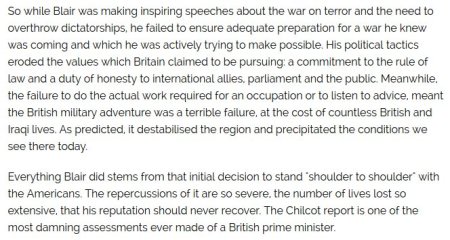
I’m not going to pretend to have read the whole document, or even all of the Executive Summary, but all the reaction I’ve seen suggest that it is unequivocal in its condemnation of the (then) Prime Minister, Tony Blair. Here is an example:

Chilcot

I sincerely hope that Blair’s reputation will not recover, and indeed hope that some form of legal redress can be sought against him. Attention in this country is focussing on the 179 service personnel who lost their lives in Iraq either during, or as a direct result of, the invasion of Iraq. However, let’s not lose sight of the fact that it was the Iraqi people who suffered most – over 150,000 are thought to have been killed, though such is the chaos of a country ruined by invasion and its aftermath that the true figure will never be known.

A few days ago we remembered the thousands who died on the Somme with the words “Lest we forget”. We shouldn’t forget Blair either…


Professor Anotida Madzvamuse

Posted in Uncategorized on July 5, 2016 by telescoper

Anotida_Madzvamuse

Just a quick post to mark a nice bit of news from the Department of Mathematics at the University of Sussex. It was announced last week that Anotida Madzvamuse (pictured above) has been promoted to the position of Professor in Mathematical and Computational Biology.

Anotida’s research  lies at the interface between fundamental disciplines (mathematics, numerical analysis, physics, scientific computing) and experimental sciences (developmental biology, biochemistry, cell biology, biomedicine, plant biology) and seeks to propose, develop, analyse and simulate new mathematical and computational approaches applied to experimental sciences.

Congratulations to Anotida Professor Madzvamuse, and here’s to a future no doubt filled with even more great research achievements!


Referendum pie

Posted in Uncategorized on July 5, 2016 by telescoper

Via distinguished mathematician Peter Cameron (no relation)…

Peter Cameron's avatarPeter Cameron's Blog

This is by Mike Grannell, and is published here with his permission. Enjoy!


It was 2025 when the trouble really began. There had been some muttering prior to this, but in July 2025, Microsoft introduced Windows 25. Every time users of Office-Infinity entered the consecutive characters pi, the system automatically started to produce the decimal digits of ? to unlimited accuracy. Previous versions had a similar bug, but this could be turned off with a simple expletive to the voice-recognition system. Windows 25 was different ? it had a mind of its own and would shout back in highly offensive terms.

At this point, demand began to grow for a referendum on the true value of ?. Older people seemed to prefer 22/7, but there were vigorous arguments in support of alternative values. The Sun newspaper was strongly in favour of taking the value to be 3 on grounds of…

View original post 631 more words

The Flowers in the Field: The Somme Remembered

Posted in Music, Poetry with tags , , , , , , on July 1, 2016 by telescoper

I’ve posted this at 7.20am on 1st July 2016. Precisely one hundred years ago, following a heavy artillery bombardment that had been going on for a week, an enormous mine was exploded  under a fortified position at Hawthorn Ridge near Beaumont Hamel on the River Somme in France. Here is footage of the actual explosion:

Ten minutes later, the first French and British troops went “over the top” on the first day of the Battle of the Somme. It was to be the bloodiest day in the history of the British Army.

Here is an edited version of a piece I wrote some time ago about this battle and its aftermath.

–0–

Twelve summers ago, in 2004, I spent an enjoyable day walking in the beautiful Peak District of Derbyshire followed by an evening at the opera in the pleasant spa town of Buxton, where there is an annual music festival. The opera I saw was A Turn of the Screw, by Benjamin Britten: a little incongruous for Buxton’s fine little Opera House which is decorated with chintzy Edwardiana and which was probably intended for performances of Gilbert & Sullivan light comic operettas rather than stark tales of psychological terror set to unsettling atonal music.

When Buxton’s theatre was built, in 1903, the town was a fashionable resort at which the well-to-do could take the waters and relax in the comfort of one of the many smart hotels.

Arriving over an hour before the opera started, I took a walk around the place and ended up on a small hill overlooking the town centre where I found the local war memorial. This is typical of the sort of thing one can see in small towns the length and breadth of Britain. It lists the names and dates of those killed during the “Great War” (1914-1918). Actually, it lists the names but mostly there is only one date, 1916.

The 1st Battalion of the Nottingham and Derbyshire Regiment (known as the Sherwood Foresters) took part in the Battle of the Somme that started on 1st July 1916. For many of them it ended that day too; some of their names are listed on Buxton’s memorial.

On the first day of this offensive, the British Army suffered 58,000 casualties as, all along the western front, troops walked slowly and defencelessly into concentrated fire from heavy machine guns that were supposed to have been knocked out by the artillery barrage that preceded the attack. The bombardment had been almost entirely ineffective, and it finished well before the British advance started, so the Germans had plenty of time to return to their positions and wait for the advancing British. It had also been believed that the artillery shells would have cut the barbed wire protecting German positions. It didn’t. British and French troops who got entangled were sitting ducks. Carnage ensued.

Rather than calling off the attack in the face of the horrific slaughter, the powers that be carried on sending troops over the top to their doom for months on end. By the end of the battle (in November that year) the British losses were a staggering 420,000, while those on the German side were estimated at half a million. The territory gained at such a heavy price was negligible.

These numbers are beyond comprehension, but their impact on places like Buxton was measurably real. Buxton became a town of widows. The loss of manpower made it impossible for many businesses to continue when peace returned in 1918 and a steep economic decline followed. It never fully recovered from the devastation of 1916 and its pre-war posterity never returned.

And the carnage didn’t end on the Somme. As the “Great War” stumbled on, battle after battle degenerated into bloody fiasco. Just a year later the Third Battle of Ypres saw another 310,000 dead on the British side as another major assault on the German defences faltered in the mud of Passchendaele. By the end of the War on 11th November 1918, losses on both sides were counted in millions.

–0–

I decided to end this piece with the following video featuring music by George Butterworth (A Shropshire Lad: Rhapsody for Orchestra, inspired by the poetry of A.E. Housman, and one of the few surviving complete works of this composer). Images of present-day Shropshire are interspersed with photographs taken on the Somme in 1916. I chose this because George Butterworth too lost his life in the Battle of the Somme (on 5th August 1916). Lest we forget.