Archive for August, 2016

Transitional Arrangements

Posted in Cardiff with tags on August 17, 2016 by telescoper

I hope you will excuse a short personal message.

I’ve noticed that quite a few people are emailing me at my Sussex address and are getting a message that I have left (which I have).

I am in fact currently on a month’s (unpaid) leave so that I can deal with a number of personal things. After that, from 1st September, I’ll be rejoining the School of Physics and Astronomy at Cardiff University.

My new email and other contact information should be set up shortly. In the meantime I am reading my email at Sussex, but only replying to very urgent messages. I am, after all, on leave.

I hope this clarifies the situation.

Anyway, it seems I picked a good time for for a holiday, as the weather in Cardiff is lovely!

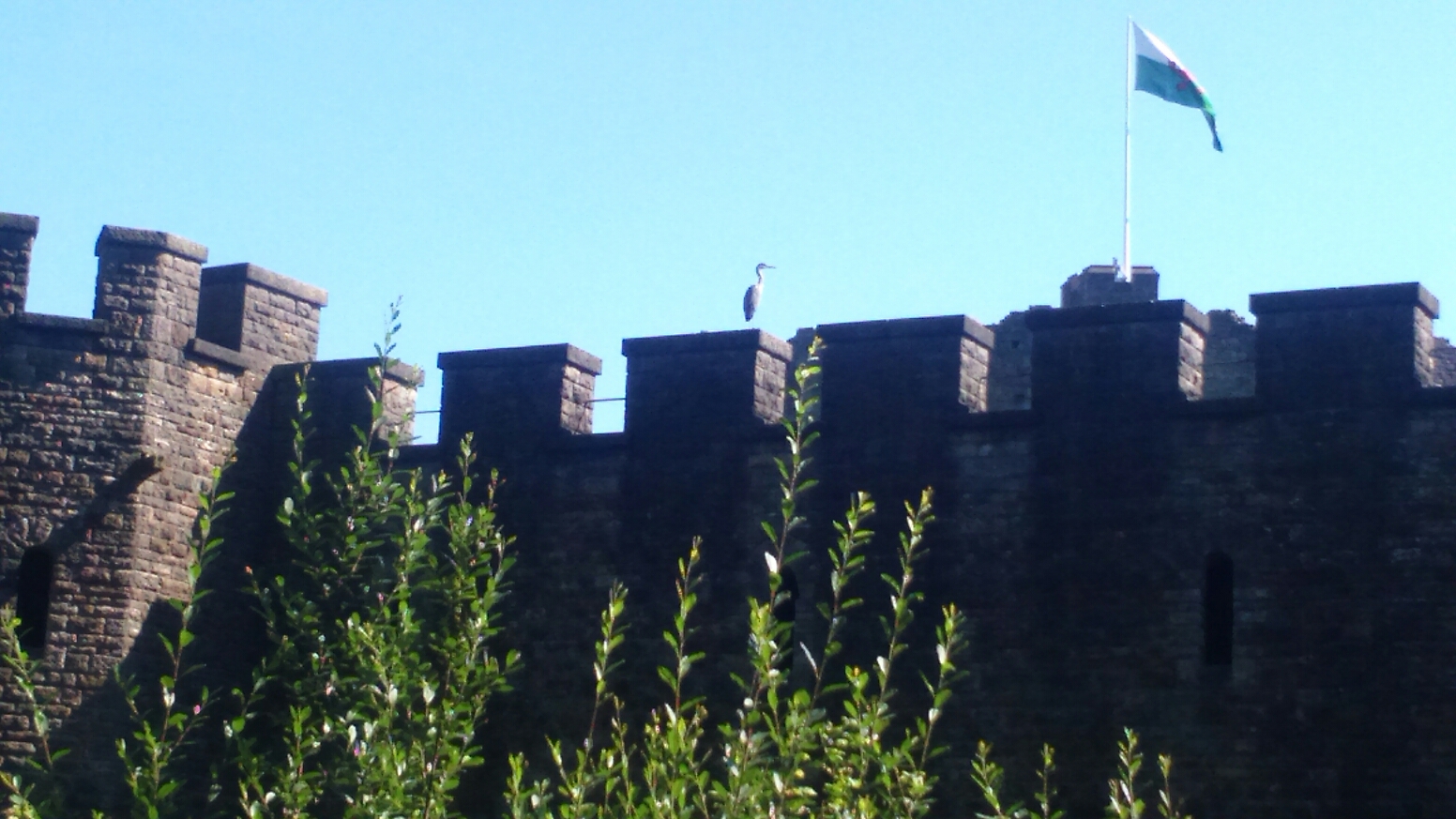
Here for no particular reason is a photograph I took of a heron on the battlements of Cardiff Castle.

image

The Integrated Bispectrum and Beyond [CEA]

Posted in Biographical, The Universe and Stuff on August 17, 2016 by telescoper

I just came across this wordpress site which automatically posts about new submissions to the arXiv. This has presented me with an opportunity to try it out with a reblog of a recent submission by yours truly!

arxiver's avatararXiver

http://arxiv.org/abs/1608.04345

The position-dependent power spectrum has been recently proposed as a descriptor of gravitationally induced non-Gaussianity in galaxy clustering, as it is sensitive to the “soft limit” of the bispectrum (i.e. when one of the wave number tends to zero). We generalise this concept to higher order and clarify their relationship to other known statistics such as the skew-spectrum, the kurt-spectra and their real-space counterparts the cumulants correlators. Using the {em Hierarchical Ansatz} (HA) as a toy model for the higher order correlation hierarchy, we show how in the soft limit, polyspectra at a given order can be identified with lower order polyspectra with the same geometrical dependence but with {em renormalised} amplitudes expressed in terms of amplitudes of the original polyspectra. We extend the concept of position-dependent bispectrum to bispectrum of the divergence of the velocity field $Theta$ and mixed multispectra involving $delta$ and $Theta$ in the 3D perturbative…

View original post 103 more words

Universities must do more to stop violence

Posted in Education, Uncategorized with tags , on August 15, 2016 by telescoper

I’ve thought very hard over the last couple of days about whether to comment on the shocking case reported by the Independent last week of a (male) senior lecturer (Dr Lee Salter) at Sussex University who beat up a (female) student with whom he had been having an affair. In the end I decided that I had to comment, as the case raises some very important questions.

I didn’t know anything about this until last week so I have nothing to add to the account of the events and subsequent criminal conviction given in the newspaper and suggest you read the details there. I will restrict my comments to the wider issues.

On Friday 12th August, shortly after the news broke of Lee Salter’s conviction, the University released a statement which I thought raised more questions than it answered. It  subsequently updated the statement to say that Dr Salter was no longer an employee of the University. Whether that means he was dismissed or that he resigned is not clear.

Among the statements made by the University in its press release is the following:

The University does not tolerate violence of any kind. However, in cases involving criminal charges, it is important that such matters are dealt with by the police and the courts, which take precedence over employment procedures. Pending the outcome of the criminal proceedings, the University kept the situation under review and monitored and assessed any risk to its students.

In my role as a Head of School at Sussex (a job I left just a couple of weeks ago), I had to deal with some disciplinary matters  so I’m very familiar with the content of the relevant procedures. In fact I did more of these than you’d probably imagine, though I can’t write about the details because they are bound by confidentiality.

It is indeed the case that if a disciplinary case involves criminal elements then the established practice is to let the courts decide first before continuing with the disciplinary investigation. For one thing, a conviction in a criminal case usually makes the subsequent internal investigation simpler.

Acquittal in a criminal case does not mean dropping the disciplinary, however, as the standard of proof in a criminal case (“beyond reasonable doubt”) is stronger than that of an internal investigation which is that of a civil court (“on the balance of the evidence”). It is quite possible for the latter standard to be met when the former is not. So it was reasonable for the University to wait for the outcome of the criminal trial before proceeding.

However, the University of Sussex’s own disciplinary procedure also states:

“The University will take disciplinary action in accordance with its procedures against anyone who behaves in a violent manner including, should it be necessary, the immediate exclusion of the perpetrator from the campus.

Based on the account given in the Independent I find it difficult to understand why the University did not take this course of action in this case.

Of course a suspect is innocent until proven guilty, but suspension (paid) and exclusion from campus would not, in my view, have been unnecessarily prejudicial given the seriousness of the charges. Salter would not have been able to do teaching, but could have carried on research from home. The University’s failure to take this step is extremely worrying as in my view it gives inadequate consideration to the effect on the victim of the continued presence of the perpetrator.

For the record I should state that I have very good reasons for having zero tolerance to any form of violence, whether committed by staff or students or political protestors or security guards. You can read why here.

I’ve blogged before about the difficulties surrounding confidentiality and other issues disciplinary procedures in the context of sexual harassment. In that piece – which was actually about science departments – I tried to stress the importance of sticking to proper procedure, but I also explained that dealing with such matters after the fact is never going to provide a fully satisfactory remedy. What is needed is to change campus culture to ensure that abusive harassing and violent behaviour doesn’t happen in the first place. But applying procedures properly would at least be a start…


Simone Manuel and the Racism of Fred Hoyle

Posted in Biographical, Politics, Sport, The Universe and Stuff with tags , , , , , , on August 14, 2016 by telescoper

Reading just now about Simone Manuel, the first black person to win an Olympic Gold medal in swimming, I suddenly remembered a bizarre event that has been lurking in the back of my mind since 1985.

In September of that year I attended a Summer School for new PhD students in Astronomy, held in Durham. I have posted about this before actually, primarily because it is interesting how many others who attended that School are still around, in senior academic positions.

Anyway, one evening during the course of this meeting there was a public lecture by non other than Sir Fred Hoyle, many of whose books on cosmology I had borrowed from the public library when I was at school and played a big part in encouraging me to study physics at university.

But Fred Hoyle’s talk that evening (to a packed lecture theatre) was not about physics but about his pet theories about the evolution of life, most of which are now generally regarded as nonsense.

At one point in his somewhat rambling discourse he digressed into the subject of the sporting abilities of different racial groups. His first assertion was that black people (by which he meant people of African origin) do not make good swimmers because their bones are too dense and the consequent lack of buoyancy is a significant disadvantage. “Have you ever seen a black swimmer in the Olympics?” he asked. None of us had, of course, but couldn’t that be because of other reasons such as lack of access to swimming pools? No. Fred was adamant. It was down to biology. I assumed he knew what he was talking about, so kept quiet.

He went on to argue that black people were also disadvantaged at tennis – not because of social factors limiting access to tennis courts – but for reasons of “poor hand-eye coordination” which he also asserted to be an inherited characteristic. This time I knew straight away he was talking drivel. The previous summer I had watched the brilliant West Indies cricketers thrash England 5-0 in a test series; their hand-eye coordination certainly wasn’t poor. And neither was that of Arthur Ashe who had  beaten Jimmy Connors in the Men’s Singles Final at Wimbledon a decade earlier,  nor the majestic Serena Williams who is probably the greatest female tennis player the world has ever seen.

These examples left me not only deeply suspicious of Hoyle’s racist attitudes but also staggered by his completely unscientific attitude to evidence. Great theoretical physicist he was – at least early in his career – but being expert about one thing doesn’t mean can’t make an utter fool of yourself if you blunder into another field. Sadly, theoretical physicists do have a greater tendency than most scientists to forget this.

I Journeyed from University to University

Posted in Poetry with tags , , on August 14, 2016 by telescoper

I journeyed from university to university, and I saw everywhere the past rebuilt before the eyes of young men and young women — Egypt, Greece, Rome; language, architecture, laws –saw the earth and sky explained, and the habits of mind and the habits of body —

Everywhere chairs of this and that, largely endowed.

But nowhere saw I a chair of the human heart.

by Max Ehrmann (1872-1945)

August, by Dorothy Parker

Posted in Poetry with tags , , on August 13, 2016 by telescoper

When my eyes are weeds,
And my lips are petals, spinning
Down the wind that has beginning
Where the crumpled beeches start
In a fringe of salty reeds;
When my arms are elder-bushes,
And the rangy lilac pushes
Upward, upward through my heart; 

Summer, do your worst!
Light your tinsel moon, and call on
Your performing stars to fall on
Headlong through your paper sky;
Nevermore shall I be cursed
By a flushed and amorous slattern,
With her dusty laces’ pattern
Trailing, as she straggles by.

by Dorothy Parker (1893-1967).

Everything is fucked: The syllabus

Posted in Uncategorized on August 12, 2016 by telescoper

The course to attend…

Sanjay Srivastava's avatarThe Hardest Science

PSY 607: Everything is Fucked
Prof. Sanjay Srivastava
Class meetings: Mondays 9:00 – 10:50 in 257 Straub
Office hours: Held on Twitter at your convenience (@hardsci)

In a much-discussed article at Slate, social psychologist Michael Inzlicht told a reporter, “Meta-analyses are fucked” (Engber, 2016). What does it mean, in science, for something to be fucked? Fucked needs to mean more than that something is complicated or must be undertaken with thought and care, as that would be trivially true of everything in science. In this class we will go a step further and say that something is fucked if it presents hard conceptual challenges to which implementable, real-world solutions for working scientists are either not available or routinely ignored in practice.

The format of this seminar is as follows: Each week we will read and discuss 1-2 papers that raise the question of whether something is fucked. Our focus…

View original post 544 more words

Uccello and the Problem of Space

Posted in Art, Television, The Universe and Stuff with tags , , , , on August 12, 2016 by telescoper

The other night I was watching an old episode of the detective series Lewis and it reminded me of something I wanted to blog about but never found the time. The episode in question, The Point of Vanishing, involves a discussion of a painting which can be found in the Ashmolean Museum in Oxford:
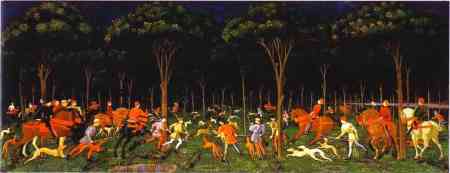
Uccello_TheHunt

I won’t spoil the plot by explaining its role in the TV programme, but this work – called “The Hunt in the Forest” or “The Night Hunt” or some other variation on that title –  is by one of the leading figures of the Early Renaissance, Paolo Uccello, who was born in Florence and lived from about 1396 until 1475. He was most notable for his explorations of the use of perspective in painting, and specifically in “The Problem of Space”, i.e. how to convey the presence of three dimensions when the paint is confined to only two. This picture accomplishes this not only by having a clear vanishing point in the centre of the composition, but also by the arrangement of the figures. Notice how the figures in the foreground are generally moving in the plane of the canvas, but towards the centre they are heading away from the observer. The composition thus acts like a funnel, drawing the viewer’s eye into the centre of the picture and then off into the distance, and the darkness.

Two other things are of interest here. One is that it’s not at all clear what is being hunted, or even whether there’s anything out there in the darkness at all. Is the hunt a metaphor for something else, perhaps the pursuit of something unattainable?

It’s also clear that Uccello wasn’t as interested in realism as he was in geometry and proportion. The horses, dogs and people are drawn in a rather primitive style reminiscent of mediaeval painting.  I think that suggests a metaphorical interpretation of the subject matter.

I see this painting as  a brilliant experiment in geometry rather than an attempt to depict a likeness of an actual event.  Reading about Uccello reveals him to have been somewhat obsessive about perspective – his  friend, the great artist Donatello, remarked that Uccello  spent too much time studying and not enough painting – but his contribution to the development of painting techniques during the Renaissance period was immense.

Although Uccello may have taken it to an extreme, interest in the formal, geometric, aspects of art wasn’t at all unusual in this period. I blogged a while ago about another favourite Renaissance artist, Piero della Francesca (c. 1415-1492) whose life overlapped with Uccello. He combined his work as an artist with a distinguished career as a Mathematician. It would be surprising if Uccello and Piero della Francesca never met, but a quick search didn’t find any definitive evidence that they did.

Another great example of Uccello’s art is this:

g013_uccello_rout

It is one of the three panels of The Battle of San Romano. Again, the living figures are simply drawn – the bodies, weapons and bits of armour on the ground look like they might be toys on a nursery floor – but the way the painting gives the impression that everything is receding into the distance is remarkably effective.

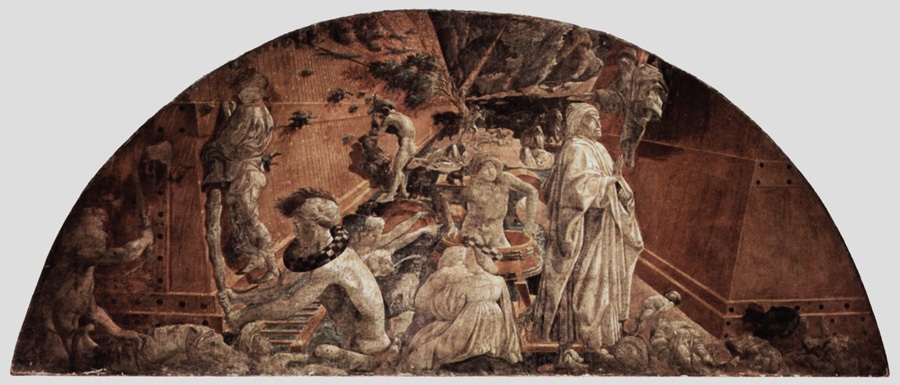
But the best example of Uccello’s work that I’ve seen in the flesh (so to speak) is this:
Paolo_Uccello_Deluge_web

This – Flood and Waters Subsiding –  is a fresco located in the Church of Santa Maria Novella in Florence. Unfortunately it’s quite badly damaged – not only have the colours faded badly but parts of the plaster have crumbled away entirely. Fresco is a notorious fragile medium and it’s sad that so many great Renaissance works of this type have been lost over the years. However, despite the disrepair, this is still an amazing piece. Perhaps helped by the semi-circular space into which it was designed to fit, this work manages to convey a sense of vorticity; There’s not so  much a vanishing point as a point of origin and the action seems to swirl around it as well as to emerge from it. Note also that in contrast to the previous two paintings, the figures in this one are very lifelike, although the fading of the colours gives them a rather ghostly appearance. It’s also interesting that this work pre-dates The Hunt in the Forest by at least twenty years so the movement away from realism was something that happened in later life.

I’ve often wondered why I feel so intrigued by Early Renaissance Art. Of course these works are beautiful or exciting or in some other way pleasurable to look at, but there’s much more to it than that. They inspire curiosity. What is going on? Who are these figures? What is being hunted? Why is everything arranged in that particular way? And the act of looking at a painting like that , and being curious, perhaps reminds us that curiosity is so important for its own sake.
 

Glamorgan versus Yorkshire

Posted in Cricket with tags , , , on August 11, 2016 by telescoper

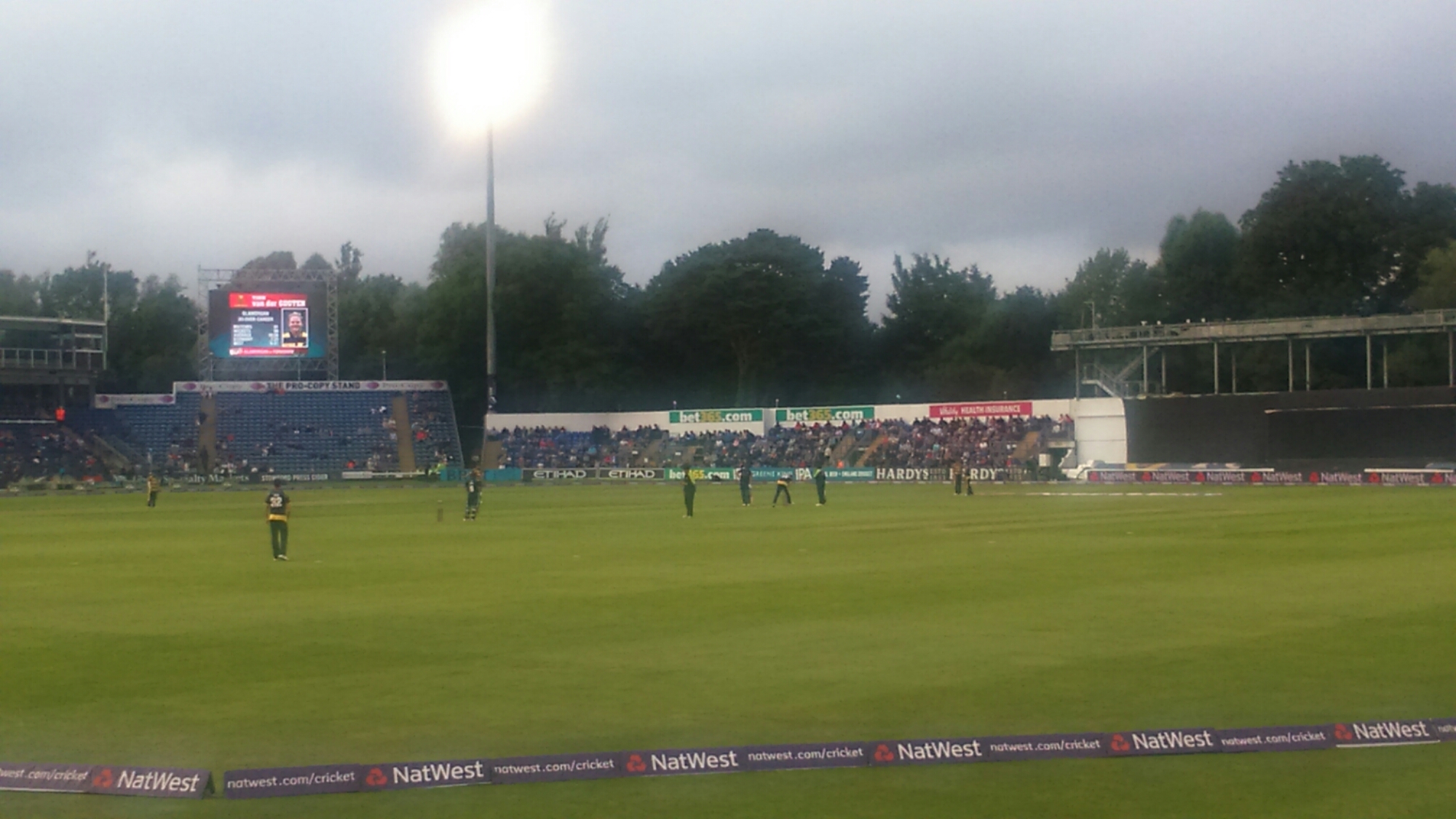
Following the Natwest T20 Blast between Sussex and Glamorgan a couple of weeks ago, I decided tonight to follow Glamorgan’s progress in the competition in their Quarter-final match in Cardiff against Yorkshire.

The SWALEC Stadium – just down the road from my house – wasn’t quite full for the match, but there was a healthy crowd of about 10,000, including lots of families with kids. Part of the reason for that must be the fact that tickets were cheap: £10 for adults and a fiver for kids. Adult tickets for the match at Hove were £26 each…

Anyway, although it was cloudy and not particularly warm, at least it stayed dry.

image

Yorkshire won the toss and batted, getting off to an excellent start largely thanks to the positive batting of David Willey. They reached 101 for 1 of just 9 overs, suggesting the  real possibility of a score of over 200. However, they lost wickets in quick succession – including that of top scorer Willey for 79 (off just 38 balls) and their innings stuttered, eventually closing on 180 for 8. That’s a good score, but Glamorgan were probably pleased to have restricted Yorkshire to nine an over.

Having watched Glamorgan’s batsmen struggle against Sussex I wasn’t exactly filled with confidence that they would reach Yorkshire’s total. They got off to a calamitous start, with opener Lloyd playing on to his first ball from Bresnan. From then on they  never looked like coping with the Yorkshire bowling and were eventually bowled out in 13 overs for 90, just half of Yorkshire’s score. And it could have been worse: at one point they were 37 for 6.

Anyway this leaves only four teams in the competition: Durham, Northants, Notts and Yorkshire. All – you will notice – from the Midlands.

Jonathan Agnew & Brian Johnston: 25 Years of the Legover – YouTube

Posted in Cricket with tags , on August 10, 2016 by telescoper

By the way, this wonderful moment in cricket history happened exactly 25 years ago today…