Archive for October, 2016

Paul Carr’s Lunchtime Concert at St David’s Hall

Posted in Music with tags , , , on October 12, 2016 by telescoper

Yesterday I went to my first-ever lunchtime event at St David’s Hall in Cardiff, which was a concert of organ music performed by Paul Carr. There wasn’t a very big crowd, which must have been quite unsettling for the soloist in such a big venue, but the recital was thoroughly enjoyable. The eclectic programme consisted of:

Alfred Hollins: Concert Overture No 2 in C minor

JS Bach: Trio Sonata No 5 in C, BWV 529 (3 movements)

Antonio Soler:  Concerto No 6 for two organs (Minué)

Hans-Martin Kiefer:  Die ganze Welt hast du uns überlassen (Blues Chorale)

Eric Coates, arr Edward Marsh:  The Dambusters March

Marco Enrico Bossi: Scherzo in G minor

Louis Vierne: Two movements from Symphony No. 1

The reason I attended – apart from just having the rare opportunity to hear the magnificent organ at St David’s Hall – was the Bach Trio Sonata. Bach wrote six of these and they’re all an absolute joy to listen to, so for me the concert was worth it just for that piece.  I have to admit that I was also intrigued to the music by Eric Coates for the 1955 film The Dam Busters played on an organ. Paul Carr actually pointed out that this piece is a nod in the direction of Elgar: its fanfare-like opening and big “very English sounding tune” is really reminiscent Pomp and Circumstance March No. 1. Indeed I gather the famous “bouncing bomb” melody has even been used for a hymn (“God is our strength and refuge”, based on Psalm 46). Anyway, the climactic ending of the piece, played on a huge organ like the one at St David’s Hall with all the stops out, is powerfully effective, and almost as noisy as I imagine flying in a Lancaster bomber must be.

The other pieces were completely unfamiliar to me before, but constituted a very pleasant menu for a lunchtime treat, all wonderfully served by Paul Carr. The only problem with lunchtime concerts, is that they don’t give you time for an actual lunch!


Thinking of Applying for a PhD Place in Physics or Astronomy?

Posted in Education with tags , , , , , , on October 12, 2016 by telescoper

This morning I am to give a short talk to interested students within the School of Physics & Astronomy here at Cardiff University about postgraduate research in which I aim to pass on some, hopefully useful,  information about how to go about applying for PhDs  in Physics  and Astronomy. Since I’ve finished writing the talk more than the usual few minutes before I have to deliver it, I thought I’d jot down here a few general remarks that might be useful to people elsewhere who are thinking of taking the plunge when they graduate. I’m aiming this primarily at UK students applying for places in the UK; special considerations apply for students wanting to do graduate research abroad.

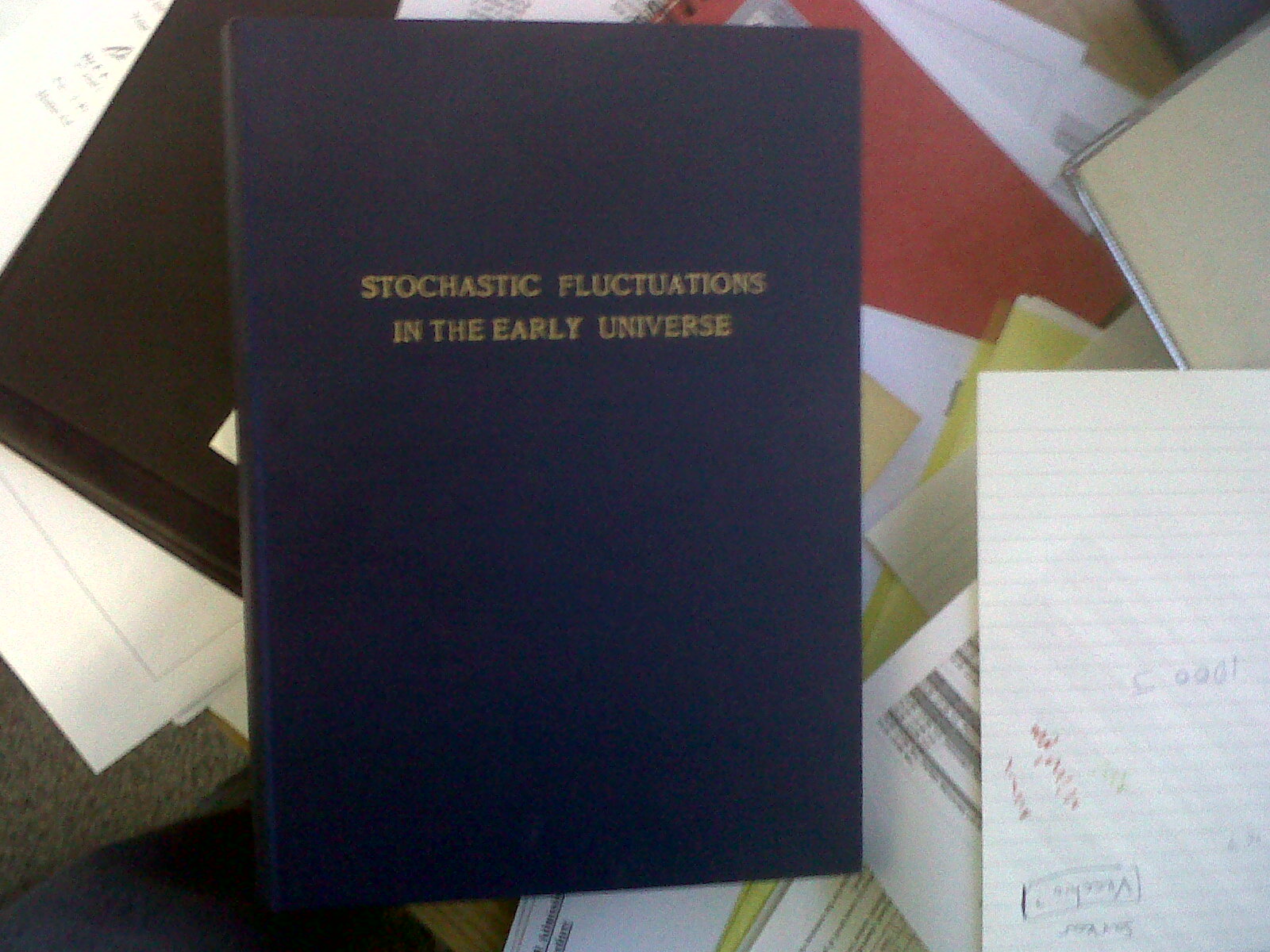
What is a PhD? The answer to that is relatively easy; it’s a postgraduate research degree. In order to obtain a PhD you have to present a thesis like that shown on the left (which happens to be mine, vintage 1988), typically in the range 100-250  pages long. A thesis has to satisfy two conditions for the award of the degree: it should contain original research, which is publishable in an academic journal; and it should present a coherent discussion of that original work within the context of ongoing work in the area of study. In Physics & Astronomy, the PhD is pretty much a prerequisite for any career in academic research, and it usually takes between 3 and 4 years to complete. After submission of the thesis you will have to undergo a viva voce examination conducted by two examiners, one internal and one external. This is quite a tough test, which  can last anywhere between about 2 and about 6 hours, during which you can be asked  detailed questions about your research and wide-ranging questions about the general area.

The Money Side. In the UK most PhDs are supported financially by the research councils, either EPSRC (most physics) or STFC (nuclear & particle physics, astronomy). These generally award quotas of studentships to departments who distribute them to students they admit. A studentship will cover your fees and pay a stipend, currently £14296 pa. That doesn’t sound like a lot, but you should at least remember that it is a stipend rather than a wage; it is therefore not taxed and there is no national insurance payable. There is a fee (currently £4121) payable for a PhD course, but that only comes into play if you are planning to fund yourself. If you receive a studentship it will normally cover the fee as an additional component. What I mean by that is you don’t need to pay it out of the stipend, it is separate. In top of that, research council funding also supplies a Research Training Grant which covers, e.g., travel and small items of equipment so you don’t need to pay for those out of your stipend either.

How do I choose a PhD? During the course of a postgraduate degree you are expected to become an expert in the area in which you specialize. In particular you should reach the point where you know more about that specific topic than your supervisor does. You will therefore have to work quite a lot on your own, which means you need determination, stamina and enthusiasm. In my view the most important criterion in your choice of PhD is not the institution where you might study but the project. You need to be genuinely excited by the topic in order to drive yourself to keep through the frustrations (of which there will be many). So, find an area that interests you and find the departments that do active research in that area by looking on the web. Check out the recent publications by staff in each department, to ensure that they are active and to have something to talk about at interview!

Qualifications. Most universities have a formal requirement that candidates for admission to the PhD should have a “good honours degree”, which basically means at least an Upper Second Class Honours degree. Some areas are more competitive than others, however, and in many disciplines you will find you are competing with a great many applicants with First Class degrees.

How to apply successfully. The application procedure at most universities is quite simple and can be done online. You will need to say something about the area in which you wish to do research (e.g. experiment/theory, and particular field, e.g. cosmology or star formation). You’ll also need a CV and a couple of references. Given the competition, it’s essential that you prepare. Give your curriculum vitae some attention, and get other people (e.g. your personal tutor) to help you improve it. It’s worth emphasizing particular skills (e.g. computing). If you get the chance, make use of your summer vacations by taking on an internship or other opportunity to get a taste of research; things like that will undoubtedly give your CV an edge.

The Interview. Good applicants will be invited for an interview, which is primarily to assess whether you have the necessary skills and determination, but also to match applicants to projects and supervisors. Prepare for your interview! You will almost certainly be asked to talk about your final-year project, so it will come across very badly if you’re not ready when they ask you. Most importantly, mug up about your chosen field. You will look really silly if you haven’t the vaguest idea of what’s going on in the area you claimed to be interested in when you wrote your  application!

Don’t be shy! There’s nothing at all wrong with being pro-active about this process. Contact academic staff at other universities by email and ask them about research, PhD opportunities. That will make a good impression. Also, don’t be afraid to ask for advice. Although we’re all keen to recruit good PhD students for our own departments, we academics are  conscious that it is also our job to give impartial advice. Ask your tutor’s opinion.

How many places should I apply for? Some research areas are more fashionable than others so the level of competition varies with field. As a general rule I would advise applying for about half-a-dozen places, chosen because they offer research in the right area. Apply to fewer than that and you might lose out to the competition. Apply to many more and you might not have time to attend the interviews.

What’s the timetable?  Most applications come in early in the new year for entry to the PhD in the following September/October. The Christmas break is therefore a pretty good time to get your applications sorted out. Interviews are normally held in February or March, and decisions made by late March. STFC runs a deadline system whereby departments can not force students to accept or decline offers before the end of March, so there should be ample time to visit all your prospective departments before having to make any decisions.

That’s all I can think of for now. I hope at least some of these comments are useful to undergraduates anywhere in the UK thinking of applying for a PhD. If there are any further questions, please feel free to ask through the comments box. Likewise if I’ve missed anything important, please feel free to suggest additions in the same manner…

Those “Light-Bulb” Moments..

Posted in Biographical, The Universe and Stuff with tags , , , , , on October 11, 2016 by telescoper

Last week I read a piece in the October edition of Physics World (which you can read here, but only if you have a subscription) about whether breakthroughs in physics occur through sudden “light-bulb moments”, or are more often the result of solid hard graft? The piece includes some interesting comments from distinguished scientists about their own “Eureka” moments, which I’m sure will resonate with many researchers, not only physicists. Incidentally, the article refers to such moments as “claritons”, a word I’ve never heard before, presumably a soliton of clarity…

I’m pretty sure that everyone who works in science – even the eminent individuals interviewed for the Physics World piece – has spent a large part of their time “stuck”. I know I have. In the long run it’s probably good to go through such periods as I think they’re essential for intellectual development, but they’re undoubtedly extremely frustrating at the time. How you get “unstuck” is a very mysterious process. I’m not a neuroscientist, but it seems to me that when you get really immersed in, say, a research problem, your subconscious brain gets drawn into what you think is a fully conscious process, to the extent that even when you’re apparently not thinking about something you really are. I’ve had ideas come to me in all kinds of weird situations: watching ducks paddling on a pond, listening to music, walking in a park, and even pushing a trolley around a supermarket. Often it seems that it’s precisely when you’re not thinking that you have your best ideas. It’s not always clear what acted as the trigger, but and when it is it is often something quite abstract. In the case I mentioned of the ducks on the pond it was just a question of thinking about reference frames. It was a nudge in the right direction, but I still had to do quite a lot of work to finish the calculation. Come to think of it, it’s usually at that conceptual level that such things happen rather than in the detailed working, at least in my case.

The Physics World piece also talks about ideas coming through dreams. That has happened to me too, but I think it’s basically the same phenomenon that I’ve just discussed. It seems to me that dreams are a product of your brain sorting through recent events or experiences and trying to make sense of them in terms of others it has filed away. This can help with a research problem by flagging up a connection with something else hidden away. I can remember at least two occasions when I’ve woken up from a dream with an exact understanding of what I’d been doing wrong and how I could fix it. It’s great to wake up in the morning with that kind of feeling!

I know it’s wrong to draw inferences about other people from one’s own particular experiences, but I do feel that there are general lessons. One is that if you are going to be successful at research you have to have a sense of determination that borders on obsession. You have to immerse yourself in it and be prepared to put long hours in. When things are going well you will be so excited that you will find it as hard to stop as it is when you’re struggling. I’m writing as a physicist, but I imagine it is the just same for other disciplines.

The other, equally important, lesson to be learned is that it is essential to do other things as well as doing science. Being “stuck” on a problem is an essential part of mathematics or physics research, but sometimes battering your head against the same thing for days on end just makes it less and less likely you will crack it. The human brain is a wonderful thing, but it can get stuck in a rut. One way to avoid this happening is to have more than one thing to think about.

I’ve lost count of the number of times I’ve been stuck on the last clue in a crossword. What I always do in that situation is put it down and do something else for a bit. It could even be something as trivial as making a cup of tea, just as long as I don’t think about the clue at all while I’m doing it. Nearly always when I come back to it and look at it afresh I can solve it. I have a large stack of prize dictionaries to prove that this works!

It can be difficult to force yourself to pause in this way. I’m sure that I’m not the only physicist who has been unable to sleep for thinking about their research. I do think however that it is essential to learn how to effect your own mental reboot. In the context of my research this involved simply turning to a different research problem, but I think the same purpose can be served in many other ways: taking a break, going for a walk, playing sport, listening to or playing music, reading poetry, doing a crossword, or even just taking time out to socialize with your friends. Time spent sitting at your desk isn’t guaranteed to be productive, and you should never feel guilty about taking a thinking break.

I’d be interested to receive examples of other “light-bulb” moments through the comments box. I’d also welcome comments from neuroscientists on my extremely naïve comments about how the brain works in such situations.

P.S. It’s interesting how the light-bulb has become so strongly associated with the sort of brainwave discussed in this piece. Here’s a short discussion.


World Mental Health Day

Posted in Mental Health on October 10, 2016 by telescoper

image

Today is World Mental Health Day 2016, so I made use of the part-time nature of my current employment to take the day off work and, among other things, go for a walk in the park in the autumn sunshine. That is all.

Brexit – The downside of pulling up the drawbridge is that you’re trapped inside

Posted in Uncategorized on October 9, 2016 by telescoper

As it happens, I went to school with the author of this piece and have had no contact with him for over thirty years. I agree wholeheartedly with what Jerry Hogg says, and am glad at least that these dark times have renewed an old acquaintance!

The Hallé at St David’s

Posted in Music with tags , , , , , , , , , on October 9, 2016 by telescoper

On Friday evening I kept up the concert-going, this time at St David’s Hall in Cardiff (which I haven’t been to for far too long). This was the first in the new season of concerto that will run until next summer.

On the bill on Friday was the Hallé Orchestra from Manchester (which is in the Midlands) under the direction of Sir Mark Elder.

The first half of the concert featured two works, the symphonic poem The Golden Spinning Wheel by Antonín Dvorak and Liszt’s Piano Concerto No. 2, with soloist Benjamin Grosvenor.

The Dvorak piece is full of energy and  colour and nice tunes, but I found it rather long for what it has to say. Still, it was a good workout with which to get the Hallé warmed up.

I’m not a huge fan of Liszt. I often find his compositions showily virtuosic but rather shallow. Liszt’s Second Piano Concerto is actually much less like that than I expected. Consisting of a single movement lasting just over 20 minutes, it certainly has its pyrotechnical passages, but the piano also takes a back seat too. It’s a very enjoyable work, dazzlingly played at this concert by youthful star soloist Benjamin Grosvenor.

The second half was devoted to a very well-known piece, Beethoven’s Sixth Symphony (“The Pastoral”). It was, however, played in an unusual way that gave it a very fresh sound. Instead of having the basses and cellos in one block, Sir Mark Elder divided them into two groups either side of the stage, one with the first violins and one with the second violins. This simple device managed to create a much more solid  sound from the orchestra, as well as seeming to lower its centre of gravity, as it were. This heightened the impact of the excellent Hallé strings and gave the whole orchestra a rich sonority that perfectly suited the elemental power expressed by Beethoven’s composition.

A very enjoyable concert. Next one, in a couple of weeks, will be Mahler’s Symphony No. 2 (“The Resurrection”). I can’t wait for that!

Variations on the Theme of Vegetables

Posted in Biographical with tags , , , , , , on October 7, 2016 by telescoper

When at school I had an English teacher who encouraged us to practice writing skills through a series of exercises that required us to write a piece that successfully connected two different events or ideas. I found those exercises very useful and I sometimes try the same thing when I’m stuck for something to write about on this blog. So here’s a hamfisted attempt to shoehorn two things that happened this week into one blog post.

One of the first things I did when I moved back to Cardiff in the summer was to reinstate weekly deliveries of fresh organically-gown vegetables direct from a farm via a company called Riverford. I blogged about the the reasons for doing this some years ago, including the following:

I have a standing order for a small box of vegetables every week costing about £10. The composition varies from week to week and with the time of year. The company does email and post on its website the contents of the following week’s boxes, but I generally don’t look at it. When the box arrives, it’s usually a mixture of staples (potatoes, carrots, onions, etc) plus things that are not so familiar, and often things that I’ve often never cooked before.  If it hadn’t been for the veggie box, I would probably never have found out about how to cook chard, romanesco, jerusalem artichokes and celeriac. I look forward to these surprises. Not knowing exactly what’s coming forces me to cook new things, and if I don’t know how to cook them there’s always google.

Here’s an example here from this week’s box:

romanesco

This extraordinary fractal object is Romanesco. It’s obviously related to the cauliflower, but has a much firmer texture and has a distinctive “nutty” flavour. I am looking forward to cooking and eating this at the weekend!

Another reason for resuming the veggie box service (still only £10, by the way) is that I’ve had medical advice to increase my consumption of fresh vegetables, especially those rich in Vitamin K (which includes the various Brassica that includes Romanesco, but also cabbages, broccoli, kale, spinach, chard and a host of other things that I really enjoy eating anyway.

This brings me to another topic that has been on my mind this week. A chance conversation with a friend who happens to be a GP revealed that she’s seen a worrying upturn in the number of (male) university students presenting with symptoms of scurvy, an extremely unpleasant and potentially life-threatening condition caused by a deficiency of Vitamin C. University students are not famed for their healthy eating habits, and the prevalence of fast-food outlets combined with inadequate knowledge of even basic cooking techniques among young men is probably responsible for this regrettable phenomenon. The human body is not able to make its own Vitamin C so we have to make sure we eat enough food containing it. However, the recommended daily intake is actually rather small and is easily met by a modest intake of fruit and vegetables. Sailors on a diet of hard tack and salt pork had an excuse for developing scurvy, but there’s no reason at all for anyone – even students – to suffer the same fate by living on crisps and kebabs.

Anyway, if you work in a university I hope you’ll consider passing this advice onto your students. Indeed if you’re at a proper university that still does small-group teaching in tutorials, why not offer your students some fresh fruit or orange juice? Just a thought.

Llŷr Williams plays Beethoven

Posted in Music with tags , , , , , , on October 7, 2016 by telescoper

Determined to enjoy civilisation as much as I can while we still have it, last night I went to a splendid concert at the Royal Welsh College of Music and Drama in Cardiff featuring acclaimed Welsh pianist Llŷr Williams in an all-Beethoven programme.

The first half of the recital consisted of the three piano sonatas (Opus 10), which are his fifth, sixth and seventh sonatas altogether. Although these are still early works by Beethoven you can already see him pushing back the restrictions of the sonata form. The first two sonatas of this set are of the standard three movement fast-slow-fast format – the first, to my mind, very reminiscent of Haydn – whereas the third has four movements and is looking ahead to what Beethoven would do in future compositions; the  second movement of this third Sonata is particularly beautiful, in a darkly sombre way. None of these pieces reach the heights of his later works, but there is much to enjoy in listening to them.

After the interval we had the Diabelli Variations (Opus 120). The amusing story behind this much later work was recounted by Llŷr Williams before he started to play it. In 1819 the music publisher and  composer Anton Diabelli hit on an idea for a kind of publicity stunt for his publishing business. He wrote a little tune (a waltz, in fact) and sent it to a number of prominent Viennese composers (Beethoven amongst them) with the invitation to write a variation on it. The plan was to parcel all the individual variations together and sell the work as a kind of advertising brochure for Austrian culture. Beethoven wasn’t keen at first – at least in part because he thought the tune was too dull – but he then he decided to turn the project on its head by writing a complete set of variations himself. He wrote the first 19 in quick succession in 1819 and wrote another 14 a few years later. The 33 variations he produced altogether cover an astonishing musical and emotional range: sometimes witty, sometimes tragic, always fascinating. Llŷr Williams aptly described this collection as “one of the pinnacles of the piano repertoire”. Being almost an hour long it must be a demanding work to play, but he clearly relished performing it.

As a Jazz fan it has often struck me how great musicians in that idiom can find inspiration in seemingly unpromising tunes, turning base metal into gold through their gifts for improvisation. Last night it struck me how similar that is to Beethoven’s use of a simple little tune as the basis for the Diabelli variations. Theme and variation, that’s what it’s all about!

Llŷr Williams is currently doing a concert series exploring all of Beethoven’s piano works at the Wigmore Hall in London and these are being recorded for broadcast by BBC Radio 3. In fact, next week (on Tuesday 11th October, at 7.30) you have the chance to hear exactly the same programme that we heard last night. I’ll certainly be listening!

P.S. I’ll leave the pronunciation of “Llŷr” as an exercise to the reader…


Lord Rees on the Threat to UK Science

Posted in Politics, Science Politics, The Universe and Stuff with tags , , , on October 6, 2016 by telescoper

In case you missed the comments by Lord Rees on Newsnight in the wake of the announcement of this year’s Nobel Prizes for Physics, here is a video.

Martin is always impeccably polite but I sense he must have been outraged by the statements made by Home Secretary Amber Rudd at the Conservative Party Conference this week, some of which seem to have been taking directly from Mein Kampf. Prior to this interview, the most extreme word I’ve ever hard Martin use was “reprehensible” – and that on an occasion when he was clearly angry. His use of the word “deplorable” here is very significant.

Quite apart the threat to science, I have to admit I’m extremely worried about the direction this country is taking. Perhaps someone should tell Prime Minister Theresa May that the referendum wasn’t about leaving the League of Nations and that this isn’t 1933. The parallels with Germany are striking. In that case it didn’t end with the identification and deportation of foreign workers. Yesterday Theresa May stated that anyone who describes themselves as a “Citizen of the World” is really a “Citizen of Nowhere”. I’ve never felt less at home in my own country than I do now.

A few days before the referendum a wrote a post that included this:

Of course I’m not saying that all those who want the UK to Leave the EU are fascists. Far from it. Many – indeed the majority – are reasonable, civilised people. But like it or not, if you vote Leave you’re voting the way the far right want you to vote. I for one will not take a single step in that direction. Fascism only needs a foot in the door. I fear that the domestic political consequences of BrExit will give it far more than that. Once they get hold of it, we’ll never get our country back.

My fear is even more real now than it was then.


A Day in Autumn – National Poetry Day

Posted in Poetry with tags , , , on October 6, 2016 by telescoper

It will not always be like this,
The air windless, a few last
Leaves adding their decoration
To the trees’ shoulders, braiding the cuffs
Of the boughs with gold; a bird preening

In the lawn’s mirror. Having looked up
From the day’s chores, pause a minute,
Let the mind take its photograph
Of the bright scene, something to wear
Against the heart in the long cold.

by R.S. Thomas (1913-2000)

Posted to mark National Poetry Day.