Archive for May, 2017

Polls Apart

Posted in Bad Statistics, Politics with tags , , , , , , , on May 9, 2017 by telescoper

Time for some random thoughts about political opinion polls, the light of Sunday’s French Presidential Election result.

We all know that Emmanuel Macron beat Marine Le Pen in the second round ballot: he won 66.1% of the votes cast to Le Pen’s 33.9%. That doesn’t count the very large number of spoilt ballots or abstentions (25.8% in total). The turnout was down on previous elections, but at 74.2% it’s still a lot higher than we can expect in the UK at the forthcoming General Election.

The French opinion polls were very accurate in predicting the first round results, getting the percentage results for the four top candidates within a percentage or two which is as good as it gets for typical survey sizes.

Nate Silver Harry Enten has written a post on Nate Silver’s FiveThirtyEight site claiming that the French opinion polls for the second round “runoff” were inaccurate. He bases this on the observation that the “average poll” in between the two rounds of voting gave Macron a lead of about 22% (61%-39%). That’s true, but it assumes that opinions did not shift in the latter stages of the campaign. In particular it ignores Marine Le Pen’s terrible performance in the one-on-one TV debate against Macron on 4th May. Polls conducted after that show (especially a big one with a sample of 5331 by IPSOS) gave a figure more like 63-37, i.e. a 26 point lead.

In any case it can be a bit misleading to focus on the difference between the two vote shares. In a two-horse race, if you’re off by +3 for one candidate you will be off by -3 for the other. In other words, underestimating Macron’s vote automatically means over-estimating Le Pen’s. A ‘normal’ sampling error looks twice as bad if you frame it in terms of differences like this.  The last polls giving Macron at 63% are only off by 3%, which is a normal sampling error…

The polls were off by more than they have been in previous years (where they have typically predicted the spread within 4%. There’s also the question of how the big gap between the two candidates may have influenced voter behaviour,  increasing the number of no-shows.

So I don’t think the French opinion polls did as badly as all that. What still worries me, though, is the different polls consistently gave results that agreed with the others to within 1% or so, when there really should be sampling fluctuations. Fishy.

By way of a contrast, consider a couple of recent opinion polls conducted by YouGov in Wales. The first, conducted in April, gave the following breakdown of likely votes:
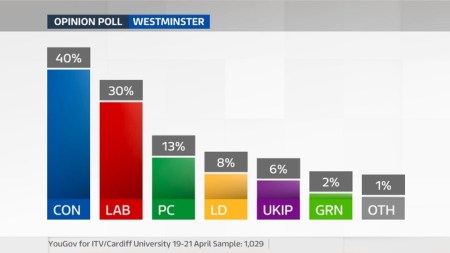
Poll

The apparent ten-point lead for the Conservatives over Labour (which is traditionally dominant in Wales) created a lot of noise in the media as it showed the Tories up 12% on the previous such poll taken in January (and Labour down 3%); much of the Conservative increase was due to a collapse in the UKIP share. Here’s the long-term picture from YouGov:

Wales-01

As an aside I’ll mention that ‘barometer’ surveys like this are sometimes influenced by changes in weightings and other methodological factors that can artificially produce different outcomes. I don’t know if anything changed in this regard between January 2017 and May 2017 that might have contributed to the large swing to the Tories, so let’s just assume that it’s “real”.

This “sensational” result gave various  pundits (e.g. Cardiff’s own Roger Scully) the opportunity to construct various narratives about the various implications for the forthcoming General Election.

Note, however, the sample sample size (1029), which implies an uncertainty of ±3% or so in the result. It came as no surprise to me, then, to see that the next poll by YouGov was a bit different: Conservatives on 41% (+1), but Labour on 35% (+5). That’s still grim for Labour, of course, but not quite as grim as being 10 points behind.

So what happened in the two weeks between these two polls? Well, one thing is that many places had local elections which resulted in lots of campaigning. In my ward, at least, that made a big difference: Labour increased its share of the vote compared to the 2012 elections (on a 45% turnout, which is high for local elections). Maybe then it’s true that Labour has been “fighting back” since the end of April.

Alternatively, and to my mind more probably, what we’re seeing is just the consequence of very large sampling errors. I think it’s likely that the Conservatives are in the lead, but by an extremely uncertain margin.

But why didn’t we see fluctuations of this magnitude in the French opinion polls of similar size?

Answers on a postcard, or through the comments box, please.

Isotropic Random Fields in Astrophysics – Workshop Announcement!

Posted in The Universe and Stuff with tags , , on May 8, 2017 by telescoper

We have a little workshop coming up in Cardiff at the end of June, sponsored via a “seedcorn” grant by the Data Innovation Research Institute.

This meeting is part of a series of activities aimed at bringing together world-leading experts in the analysis of big astrophysical data sets, specifically those arising from the (previous) Planck and (future) Euclid space missions, with mathematical experts in the spectral theory of scalar vector or tensor valued isotropic random fields. Our aim is to promote collaboration between mathematicians interested in probability theory and statistical analysis and theoretical and observational astrophysicists both within Cardiff university and further afield.

The workshop page can be found here. We have a great list of invited speakers from as far afield as Japan and California (as well as some from much closer to home) and we’re also open for contributed talks. We’ll be publishing the full programme of titles and abstracts soon. Registration is free of charge, but you do need to register so we can be sure we have enough space, enough coffee and enough lunch! That goes whether you want to give a contributed talk, or just come along and listen!

It’s only a short (two-day) meeting and are aiming for an informal atmosphere with plenty of time for discussions, with roughly a 50-50 blend of astrophysicists and mathematicians and to achieve that aim we’d particularly welcome a few more contributed talks from the mathematical side of the house, but we still have spaces for more astrophysics talks too! We’d also welcome more contributions from early career researchers, especially PhD students.

Please feel free to pass this around your colleagues.


Symphonie Fantastique

Posted in Music with tags , , , , , , , , on May 8, 2017 by telescoper

After a busy weekend I’m gradually trying to catch up on last week’s happenings. One thing I haven’t had time to mention yet is that on Thursday night I went to a concert at St David’s Hall in Cardiff that featured the BBC National Orchestra of Wales under the direction of Xian Zhang. The orchestra repeated the programme the following day (Friday) at the Brangwyn Hall in Swansea, so you can listen to it it for the next month on the BBC iPlayer.

The main item on the menu was the Symphonie Fantastique by Hector Berlioz. I have to confess that I’ve been a bit prejudiced about this piece since I was at school. I had a music teacher who adored Berlioz and wouldn’t shut up about him, basically telling us that he was the best composer ever. I didn’t buy it then, and despite a very fine performance on Thursday, I still don’t buy it now. It’s n0t that Berlioz is short of musical ideas or technical accomplishment: there are some memorable passages in this Symphonie, including the dance-like theme of the second movement, and the  “march to the scaffold” in the fourth movement.  I’m not at all averse to big loud symphonic works, either, as regular readers of this blog will know. My difficulty is that it’s all a bit too obvious. The BBC National Orchestra of Wales is a fine orchestra and I enjoyed their playing enormously. I particularly appreciated seeing the  percussion section get a good workout! I was also impressed by the conducting of Xian Zhang who gave a sense of shape where previously I’d heard only bombast. It’s the composition that’s the problem for me, though. Berlioz lays it on with a shovel, but I still think this is a rather superficial piece.

Before the Berlioz, in the first half, were two much more interesting pieces. The first, a piece called Internet Symphony No. 1 “Eroica” by Tan Dun is less than five minutes long is a hugely entertaining blend of Eastern and Western musical influences.

After that appetizer we had a dazzling performance of the Rhapsody on a Theme by Paganini by Sergei Rachmaninov with soloist Stephen Hough at the piano. This piece comprises a set of 24 variations on a them from one of Paganini’s caprices for solo violin.

Incidentally, the “theme by Paganini” used as the basis of this piece is the same one that was used for the musical introduction to the TV programme “South Bank Show“, although I think quite a lot of people know that.

The Rhapsody on a theme of Paganini is piece full of contrasts: sometimes pyrotechnical, sometimes lyrical. My favourite section is the 18th variation, in which a lovely romantic melody emerges and is picked up by the whole orchestra in a manner that’s very characteristic of Rachmaninov. It gets me every time, but then I am a terrible softy. You can hear this played by Stephen Hough at the Proms in 2013 here (about 20:20 into the video). Incidentally, this tune is just an inversion of the theme transposed into a different  key and slowed down.

The Rachmaninov alone was worth the cost of the ticket! It’s such a shame that he wrote so little music after emigrating from Russia to the United States in 1917. He made a living doing concert tours after that, and had little time to compose. Thank goodness he found time to write this, though!

We also had an encore by Stephen Hough that provided yet another contrast. Debussy’s Clair de Lune is a very familiar piece, but it provided an appropriately light and reflective epilogue to the first half.

I will persevere with Berlioz, I suppose, like I do with Brahms, but I think I’m going to be hard to convince. If anyone can suggest a piece by Hector Berlioz that they think will change my mind, please feel free to suggest it via the comments box!


A Good Day

Posted in Cricket, Football on May 7, 2017 by telescoper

I spent all day today at the SWALEC stadium in Sophia Gardens watching yet another one-day match, this time between Glamorgan and Essex.

It was overcast early on, as you can see from the picture (which for some reason has decided to rotate itself).

Glamorgan won the toss and batted, but lost both openers cheaply. Ingram and Bragg then dug in and slowly tried to build a decent total. By “slowly”, I mean very slowly. After 10 overs Glamorgan had crawled to 26 for 2. The batsmen gradually began to assert themselves but were prevented by good fielding and bowling from really cutting loose. Then Ingram decided to take the bull by the horns. He hit three towering sixes (including one over the top of the pavilion) on his way to a brilliant 142. Still, Glamorgan’s total of 281 for 7 off their 50 overs  didn’t really look enough…

Near the end of the Glamorgan innings I checked the football scores and discovered that Newcastle United had beaten Barnsley 3-0 while Brighton & Hove Albion let in a late equaliser at Aston Villa. That meant that Newcastle United won the Championship title. I celebrated in appropriate style in the Members bar between the innings.

Essex lost two very quick wickets – they were 2 for 2 at one point –  but captain Alastair Cook and Varun Chopra put together a century partnership. When Cook was out, Ravi Bopara joined Chopra for another 100 stand.

After 41 overs Essex were looking comfortable  on 214 for 3, needing just another 68 to win. Glamorgan’s bowlers had lost control at a similar point in their last match, so most of the spectators thought Essex would rattle off the runs without too much difficulty.

As so often happens in cricket, one incident turned the match. Chopra smashed a delivery from Meschede back at the bowler. It was a difficult chance and Meschede couldn’t hold on, but the ball ricocheted from his outstretched hand onto the stumps at the non-strikers end, with Bopara well out of his ground.

From that point the Essex batsmen came and went at regular intervals, as Glamorgan’s bowlers showed much greater discipline and common sense than on Friday. Aiming at the stumps has to be a good tactic in a situation when the batsman have to score at a reasonable rate: if the batsman misses going for a shot then the ball hits. Seems obvious, but it’s not what they did in the last game.

With 2 overs left, Essex had stuttered to 268 for 7 but were still favourites in my book. But with the first ball of the penultimate over De Lange clean bowled ten Doeschate (the last of four batsman to be bowled by full deliveries aimed at middle stump), making it 268 for 8. The pendulum had swung in Glamorgan’s favour. Or had it? Essex managed another 7 off the rest of the over.

Seven runs were then needed off the last over, with two wickets left. Hogan bowling,  the crowd buzzing. First ball: 2 runs. Groans from the crowd. Then two dot balls. Cheers. Then an awful mix-up and a run out. Five needed off two balls. One wicket left. Next ball: the batsmen ran a bye to the wicketkeeper. Four needed off the last ball..

…but they could only run two. Glamorgan won by one run.

It was a very exciting finale, and a much-needed  morale-boosting victory for Glamorgan. Well played both teams!

Oh, and when I got home I saw the news that France didn’t elect a fascist as President.

Yes, it’s been a good day. A very good day.

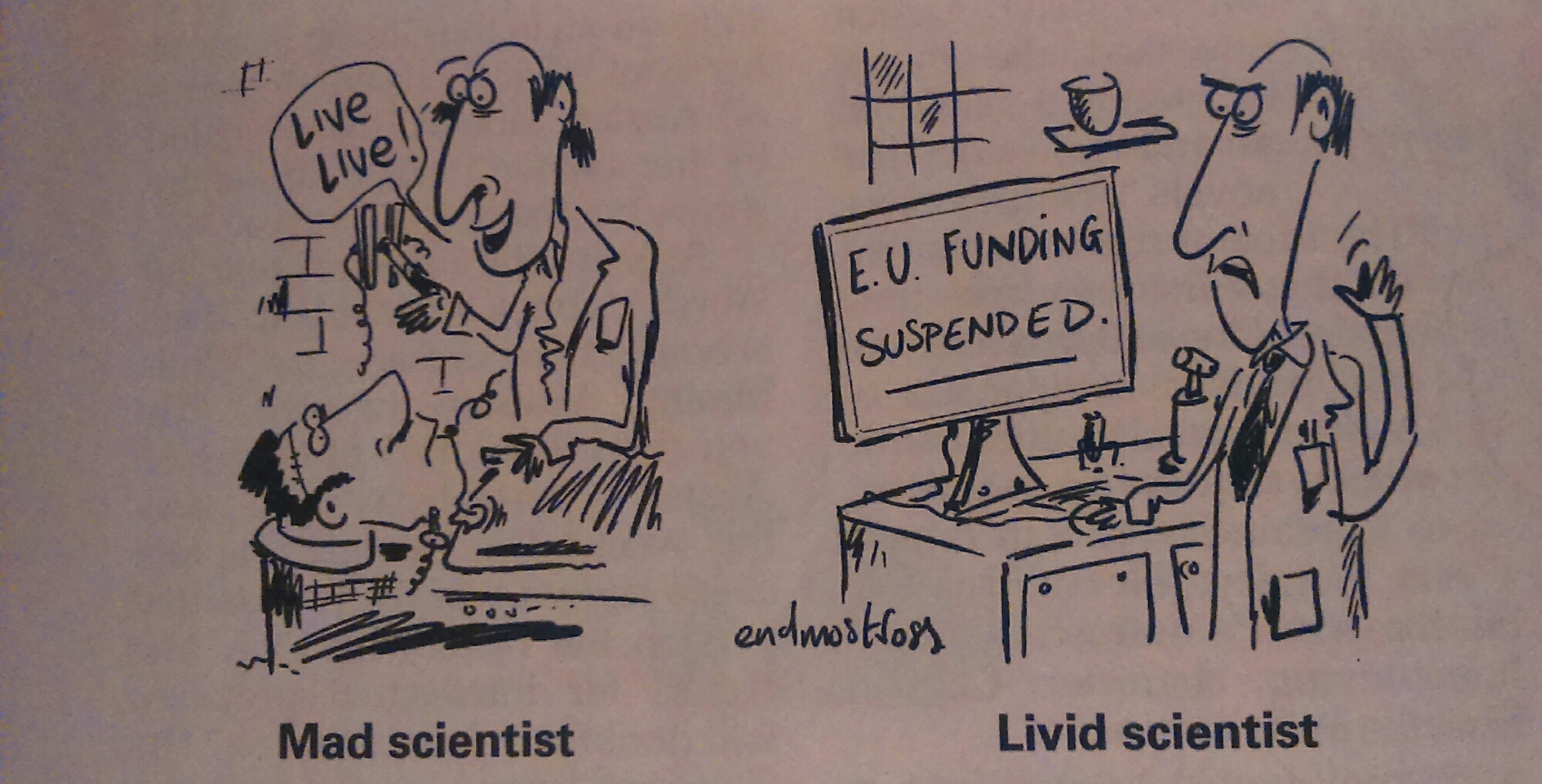
Livid Scientist

Posted in Uncategorized on May 6, 2017 by telescoper

Courtesy of the latest Private Eye:

Another One Day

Posted in Cricket on May 5, 2017 by telescoper

I had the day off today so I could watch Glamorgan play Somerset in the Royal London Cup.


It was a bright but very windy day at Sophia Gardens. Glamorgan won the toss and put Somerset in to bat. The home team’s bowlers did reasonably well, for 40 overs or so, at restricting the scoring but only took three wickets at a cost of 204. In the last ten overs, however, thanks to excellent strokeplay and (it has to be said) undisciplined bowling, Somerset pushed their total up to 338. By the end, Glamorgan looked a demoralised side.

I felt that total was going to be beyond Glamorgan’s batsmen, and so it proved. They crumbled rapidly and were all out for 168, not even halfway to their target.

While I was watching Glamorgan bat I realised that they’ve lost every game I’ve watched. Undaunted, I’ll be back on Sunday (weather permitting) to watch them try to maintain their unblemished record against Essex.

P.s As the match finished early, I headed over the river from Sophia Gardens and across Bute Park to the Royal Welsh College of Music and Drama to listen to the free Friday evening jazz, which was most enjoyable.

Local Election Issues

Posted in Biographical, Politics with tags , , , on May 4, 2017 by telescoper

Though very much overshadowed by the looming General Election, today sees important local elections in various locations across the United Kingdom including here in Cardiff where all seats on Cardiff City Council are up for grabs. This is an example of a unitary authority, unlike some areas where there are county and borough councils that operate on different levels.

Councillors are paid an `allowance’ which varies across the country but in Cardiff corresponds to a basic amount of £13,300k per annum. Not exactly a luxurious income, but it is essentially a part-time job. That doesn’t mean that it’s easy though, as many difficult choices have to be made when budgets are tight.

Since my current job at Cardiff University is part-time I did toy with the idea of putting myself forward as a Labour Party candidate, but in the end didn’t pursue it – largely because I’ve not had as much free time as I thought I would. In any case we have three very good prospective candidates in Iona Gordon, Kanaya Singh, and Caro Wild. I wish them all good luck!

When I first moved to Cardiff, in 2007, the Liberal Democrats were the largest party in the Council, a position they consolidated in the 2008 elections, where the administration that was formed consisted of a coalition between the Liberal Democrats and Plaid Cymru, the Welsh nationalist party. At the 2012 elections the Liberal Democrats crashed and burned and Labour regained the position as majority party it had lost to the LibDems in 2004. These local elections normally take place every four years, but were deferred by one year by the Welsh Government, which is why they are taking place now rather than in 2016.

Local elections return councillors for each of a number of wards within each area. Some wards return only one representative while others can have a number of councillors. My own ward, Riverside, for example, has three councillors. When I moved to my house in Pontcanna in 2008 all three councillors belonged to Plaid Cymru; at the 2012 elections all three were Labour. I think the past success of Plaid Cymru in Riverside may relate to the presence of Welsh language media organizations in the area. It’s a very mixed ward, actually, with some very posh areas in the North (towards Llandaff) and some very working-class areas to the South.

What will happen this time? I honestly have no idea. It is very difficult to predict local elections on the basis of national politics for a number of reasons. One is that turnout is very low – 30% is very high for this kind of poll. Seats in the council can be gained and lost by just a few hundred votes. There’s also the fact that those people who do vote tend to do so on the basis of very local matters, e.g. the efficiency of the refuse collection service, rather than the national and international issues that will dominate the General Election. Not that this will stop the pundits prattling on about the results.

I can see Plaid Cymru doing reasonably well, but would be surprised if either the Liberal Democrats made a substantial comeback or the Conservatives made big gains. We’ll just have to wait and see, though, as I’ve been massively wrong about such things before!

Anyway, I’m going to a concert tonight to take my mind of things and have no intention of waiting up until the early hours of the morning to hear the results come in, so I’ll update this with the results tomorrow morning.
UPDATE 8.30am, 5/5/2017: Riverside ward returned three labour councillors and Labour retained control of Cardiff City Council.

Unsquare Dance

Posted in Jazz with tags , , on May 4, 2017 by telescoper

By way of a small postscript to last week’s post about the great Joe Morello, here’s a piece that shows he was such a great drummer he didn’t even need a drum!

Dave Brubeck’s tune Unsquare Dance is basically a blues built around a single bass figure and played in 7/4 time, making it not inconsiderably difficult to dance to. Difficult, but not impossible! On top of that the tempo actually speeds up during this performance. It’s normally a cardinal sin for a rhythm section in jazz to speed up – the beat has to stay rock steady while the soloists push ahead or lag behind. That’s what generates the sort of dynamic tension that characterizes as swinging performance. In this tune Dave Brubeck was just playing a little joke on the `foot-tappers and finger-snappers’ so he can be forgiven for his trangression.

Listen out, though, for Joe Morello’s contribution. His solo consists entirely of rim shots (made by striking the rim rather than the skin of a snare drum). I believe it is Joe Morello who laughs out loud at the end, partly with relief that they managed to get through this tricky little piece without screwing up!

As you can see, this was released as a 45rpm single and it became quite a hit (by the standards of Jazz records), reaching No. 14 in the UK charts back in 1962.

Widening Participation Matters

Posted in Education with tags , , , , , on May 3, 2017 by telescoper

Time for a mini-rant about the failure of many universities to make any real attempt to make higher education more accessible to students from diverse backgrounds, especially those from underrepresented social groups.

I found this item on Twitter the other day. It’s from a local newspaper in York, and it was accompanied by an article that applauded the University of York (rightly) for being in the top three Russell Group universities for widening participation.

The list shows all 24 universities in the Russell Group, along with the fraction of their students that come from state schools and the fraction that come from geographical areas where participation in higher education is low; ‘POLAR3’ is the latest iteration of the Participation of Local Areas survey carried out by the Higher Education Funding Council for England (HEFCE).

I’m very pleased that my current employer, Cardiff University, leads the Russell Group by this measure, followed by the Universities of Liverpool and York, respectively.

What doesn’t please me is that so many of these institutions have such low participation rates from this group, and also such a small fraction of students who were educated at state schools. Over 90% of the total number of students at UK universities were educated at state schools, but the only Russell Group member to exceed 90% is Queens University, Belfast. However, the school system in Northern Ireland is very different from the rest of the UK, with relatively few private schools, so the situation there is not really comparable.

When tuition fees were increased in 2012, Universities were only allowed the charge the maximum (£9K per annum) if they produced an `Access Agreement‘  outlining measures to be introduced that would `improve access, student success and progression among people from under-represented and disadvantaged groups‘. The evidence of the last five years is that participation rates at many of the Russell Group institutions listed above have not changed at all. The reason for this is simple: the members of senior management at these institutions simply do not careabout widening participation.

I emphasize that it’s the members of senior management who don’t care because I honestly believe that the majority of academic staff in these institutions (and indeed the rest of the higher education sector) do care a very great deal. Nowadays however the gulf between academics and managers is greater than ever

Some time ago I was interviewed for a job in senior management at one of the institutions in the table above. During the course of the interview I was asked, among many other things, what I thought the University needed to do better. Without hesitation I said `widening participation’. The members of the panel stared at me as if I’d taken leave of my senses. The institution concerned was doing in well in league tables and recruiting students and saw no reason to try to make itself more open. When asked why I thought it was so important, I said I thought it was a moral responsibility. What I meant was that I think universities should be run for the public good, not just for the good of people who went to a posh school. That received even more uncomprehending stares than my original statement.

I didn’t get that job. I’m not saying it was because of the way I answered that question. I’m sure there were plenty of other reasons not to employ me, but that is the part of the interview I remember most vividly. I had prepared a list of ideas (including foundation programmes, measures to boost graduate employability, work placements, schools liaison, etc), some of which I’d borrowed from my (then) employer, the University of Sussex (which was – and is – very good at widening participation), but I had wasted my time. They weren’t interested.

The current system of ‘Access Agreements’ clearly isn’t working for these institutions and there is no effective sanction to force them even to try to broaden participation. Until there is, they will continue not to care.

Parliament has recently enacted the Higher Education and Research Act (2017). This presented a great chance to tackle the failures described above but, as far as I can see, none of the new arrangements is likely to do anything to widen participation in the so-called `elite’ universities, so it’s been a wasted opportunity.


Building Momentum Towards Inclusive Teaching and Learning

Posted in Education with tags , , on May 2, 2017 by telescoper

I’ve had a very full day back after the Bank Holiday (Long) Weekend so I only have time for a brief post today.

I was giving a revision lecture this morning so I wasn’t able to attend an event in London organized by the Institute of Physics to launch a new report with the title Building Momentum Towards Inclusive Teaching and Learning. It was a shame I couldn’t go, as I’m a member of the IOP Diversity and Inclusion Committee which oversaw this report, but the exam period is coming up and I couldn’t reschedule the lecture.

Anyway, to quote the IOP web page:

There are particular challenges in providing an inclusive learning environment in all the physical sciences and especially in physics, due to the wide range of activities involved, such as lab sessions, problem classes and fieldwork, and the use of mathematical and scientific notation. General good practice guidance on inclusive curricula do not normally contain specialist information on the particular accessibility challenges of courses with substantial mathematical content given its non-linear nature (ie the relative positioning of letters, symbols and numbers and their relative sizes) and the limitations of assistive technology in manipulating this content.

The Equalities Act (2010) requires HEIs to make `reasonable adjustments’ to make their courses accessible to disabled students, but there’s often no reason why these `adjustments’ should not simply be standard provision for all students. That’s what `inclusive’ means. If, for example, lecture recordings and/or printed notes are made available for students who have difficulty taking notes, then why not make them available for everyone? That’s what `inclusive’ actually means.

To quote again:

By moving towards a more inclusive learning environment many organisational, structural and cultural barriers to disabled students can be removed. The focus on inclusivity means that “individual interventions is the exception, not the rule” as set out in the Department for Education’s report Inclusive Teaching and Learning in Higher Education as a Route to Excellence. This requires all staff in higher education – academics, support staff and senior institutional managers – to consider the needs of disabled students in all that they do – including the design, delivery and assessment of all academic teaching and learning.

I therefore encourage anyone who’s involved in teaching physics to read this report, which you can download as a PDF file here, and think about its recommendations when you start to plan teaching activities, whatever form they take.