No time for a proper post today so here’s a picture of a Victorian lighthouse keeper and his cat.

No time for a proper post today so here’s a picture of a Victorian lighthouse keeper and his cat.
And now for something completely different.
Forty years ago today, on 11th August 1977, during the first day of Fourth Test against Australia at Headingley Geoffrey Boycott drove a delivery from Greg Chappell to the onside boundary to reach his century. He thus became the first player to reach one hundred first class hundreds in a Test Match at his home territory at Leeds (in the Midlands).
I wasn’t at the match but I did watch it on TV and I remember seeing that shot, which almost hit the non-striking batsman (Graham Roope), as it happened. It was an interesting experience looking back because few people were in doubt that Boycott would get a hundred that day. It seemed to be an historical inevitably.
Boycott went on to make 191 out of an England total of 436. As always for a Boycott innings, it was based around a solid defence and immense concentration, and he didn’t score quickly by modern standards, but he did hit 14 boundaries on the way to his century (and 22 in the innings overall) and I remember him playing some lovely shots.
The frustration of the Australians of having to bowl at Boycott for so long was almost palpable and when they came out to bat it was as if they had lost the will to live. They were all out for 103 in the first innings and, following on, could manage only 248. England won by an innings and 85 runs.
There’s been a lot of media coverage of Geoffrey Boycott’s hundredth hundred but for myself I’ll just say that it’s nice that the occasion reminded me of that wonderful summer of the Queen’s Silver Jubilee, during which Virginia Wade had won Wimbledon, and England regained the Ashes.
Follow @telescoperThis kind of crap is the reason I don’t listen to Radio 4 anymore. It’s bad for my blood pressure.
(not satire – it’s the Tories!)
I see climate-change deniers have brought out their big guns to deny the recent flooding and storms are anything to do with climate change.
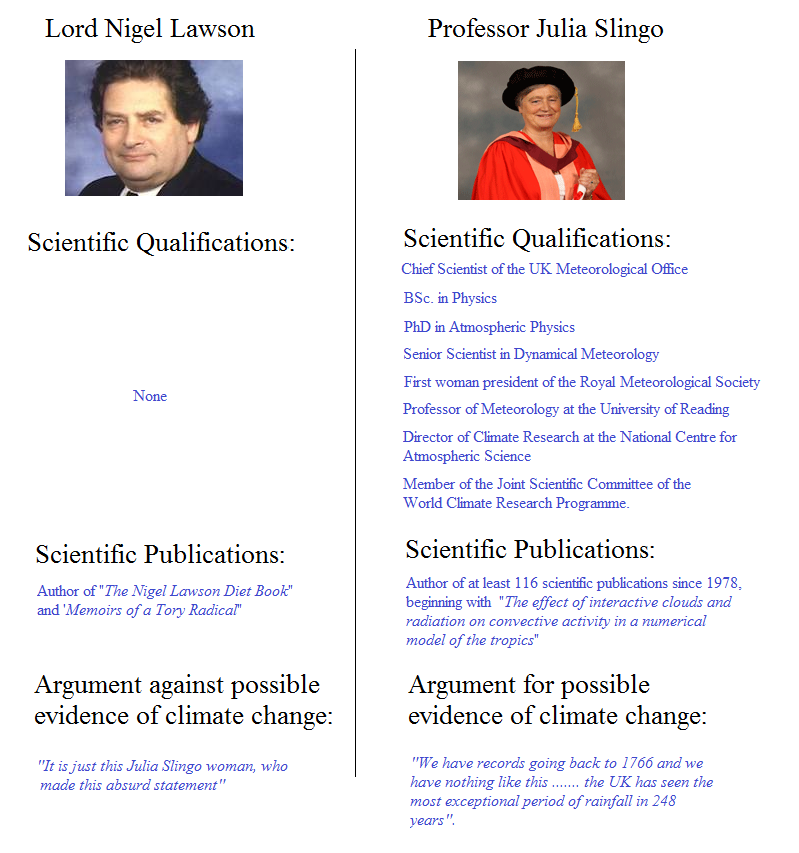
Former Thatcher chancellor Nigel Lawson went head-to-head with Met’ Office Chief Scientist Professor Julia Slingo – destroying her scientific assessments that the recent extreme weather conditions were almost certainly the result of climate change with the devastating scientific argument that she is just : “this Julia Slingo woman“.
Personally, I don’t know much about the science behind climate change. So let’s take a look at who is most likely to be right on the scientific arguments around climate in general:
.
You had me at “it’s just this woman” Nigel.
.
Please feel free to comment.
.
Related articles by Tom Pride:
Climate change sceptic Andrew Neil also once thought heterosexual AIDS was a myth
View original post 8 more words
It seems that a lot of rumours are flying around on social media and elsewhere about the discussions that have been going on here in Copenhagen between members of the Niels Bohr Institute and of the LIGO scientific collaboration concerning matters arising from the `Danish Paper‘. The most prominent among these appears to be the LIGO team and the Danish team have agreed on everything and that the Danish authors have conceded that they were mistaken in their claims. I have even been told that my recent blog posts gave the impression that this was the case. I’m not sure how, as all I’ve said is that the discussions reached agreement on some matters. I did not say what matters or whose position had changed.
I feel, therefore, that some clarification is necessary. Since I am a member of neither party to this controversy I have to tread carefully, and there are some things which I feel I should not discuss at all. I was invited to participate in the discussions as a neutral observer as a courtesy and I certainly don’t want to betray any confidences. On one thing, however, I can be perfectly clear. The Danish team (Cresswell et al.) have not retracted their claims and they reject the suggestion that their paper was wrong.
To reinforce this, I draw your attention to the fact that a revised version of `The Danish Paper’ has now been accepted for publication (in the Journal of Cosmology and Astroparticle Physics) and that this paper is now available on the arXiv. The referees raised a large number of queries, and in response to them all the revised version is almost double the length of the original.
Here is the arXiv entry page:
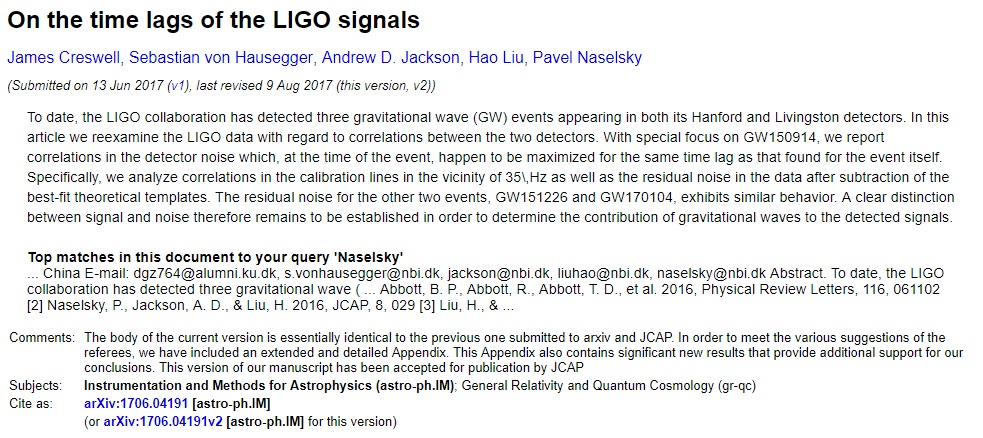
The main body of the paper has not been significantly modified and their main result – of an unexplained 7ms correlation in the background signal (referred to in the abstract as `noise’) – has not “gone away”. If you want to understand more, read the paper!
I’m sure there will be much more discussion of this and I will comment as appropriate when appropriate. In the meantime this remains very much a live issue.
P.S. In the interest of full disclosure I should mention that I did read over part of the revised version of the Danish paper and made some suggestions with regard to style and flow. I therefore have a mention in the acknowledgments of the final version. I was warned that I might expect some trouble for agreeing to be associated with the paper in this way but, as Sam Spade says in The Maltese Falcon `I don’t mind a reasonable amount of trouble’…
Follow @telescoper
Joe Orton, photographed on 1st March 1967.
The playwright and author Joe Orton died on August 9th 1967, which is exactly 50 years ago today. I couldn’t resist a short post in his memory.
Joe Orton’s career was very brief – he was only 34 when he died – but reached brilliant heights with a series of anarchic black comedies that both scandalised and entertained Sixties audiences. Such was his success that he is one of the few playwrights to have his name remembered in the English language, in the form of the adjective `Ortonesque’:
Relating to or characteristic of the English playwright Joe Orton or his works, especially in being unconventional and darkly comic.
My first experience of Orton’s plays was seeing an amateur dramatic society production of Loot when I was a student. I have to say it was a dreadful experience, but that was because of the performance not because of the script. Loot is basically a farce, and I think that must be the most difficult form of comedy to do successfully. The timing has to be perfect, the pace has to be relentless and everyone has to act as if all the absurd things going on make perfect sense. Those are tough requirements for amateurs, and even for professionals. The first, provincial, run of Loot was a flop even with an experienced cast. It was only when it was revived a couple of years later that it became a hit.
The circumstances of Joe Orton’s death were terrible: he was battered to death by his partner Kenneth Halliwell (with whom he lived in a small bedsit) who then committed suicide by taking an overdose of sleeping tablets. Orton and Halliwell had been in a relationship since 1951. Joe had never made any secret about his enjoyment of casual sexual encounters – his diaries are full of descriptions of his adventures – but I think it was the thought of living alone rather than sexual jealousy that Halliwell couldn’t handle.
I never met Joe Orton (I was only 4 when was murdered) but I have over the years met a number of older gay men who knew him (and Halliwell) in various ways (if you get my drift). They all described him in the same way: cute, funny and extremely flirtatious. Watch this clip of him on TV and I think you’ll see why so many people were attracted to his cheekily boyish manner:
Those who knew Halliwell also say that the usual cliché about him as a failure embittered by Joe’s success is not fair. They were an odd couple (for the time) but what they had seemed to work for them, both romantically and creatively. It makes the horrible end of their lives even more difficult to contemplate. Here’s an interview with Kenneth Williams (who was very repressed about his sexuality) talking about Orton (who was quite the opposite), that gives some insight into the relationship between the two:
Rest in peace, Joe Orton (1933-1967), author and gay icon.
Follow @telescoperI’ve just come from another meeting here at the Niels Bohr Institute between some members of the LIGO Scientific Collaboration and the authors of the `Danish Paper‘. As with the other one I attended last week it was both interesting and informative. I’m not going to divulge any of the details of the discussion, but I anticipate further developments that will put some of them into the public domain fairly soon and will comment on them as and when that happens.
I think an important aspect of the way science works is that when a given individual or group publishes a result, it should be possible for others to reproduce it (or not as the case may be). In normal-sized laboratory physics it suffices to explain the experimental set-up in the published paper in sufficient detail for another individual or group to build an equivalent replica experiment if they want to check the results. In `Big Science’, e.g. with LIGO or the Large Hadron Collider, it is not practically possible for other groups to build their own copy, so the best that can be done is to release the data coming from the experiment. A basic problem with reproducibility obviously arises when this does not happen.
In astrophysics and cosmology, results in scientific papers are often based on very complicated analyses of large data sets. This is also the case for gravitational wave experiments. Fortunately in astrophysics these days researchers are generally pretty good at sharing their data, but there are a few exceptions in that field. Particle physicists, by contrast, generally treat all their data as proprietary.
Even allowing open access to data doesn’t always solve the reproducibility problem. Often extensive numerical codes are needed to process the measurements and extract meaningful output. Without access to these pipeline codes it is impossible for a third party to check the path from input to output without writing their own version, assuming that there is sufficient information to do that in the first place. That researchers should publish their software as well as their results is quite a controversial suggestion, but I think it’s the best practice for science. In any case there are often intermediate stages between `raw’ data and scientific results, as well as ancillary data products of various kinds. I think these should all be made public. Doing that could well entail a great deal of effort, but I think in the long run that it is worth it.
I’m not saying that scientific collaborations should not have a proprietary period, just that this period should end when a result is announced, and that any such announcement should be accompanied by a release of the data products and software needed to subject the analysis to independent verification.
Now, if you are interested in trying to reproduce the analysis of data from the first detection of gravitational waves by LIGO, you can go here, where you can not only download the data but also find a helpful tutorial on how to analyse it.
This seems at first sight to be fully in the spirit of open science, but if you visit that page you will find this disclaimer:

In other words, one can’t check the LIGO data analysis because not all the data and tools necessary to do that are not publicly available. I know for a fact that this is the case because of the meetings going on here at NBI!
Given that the detection of gravitational waves is one of the most important breakthroughs ever made in physics, I think this is a matter of considerable regret. I also find it difficult to understand the reasoning that led the LIGO consortium to think it was a good plan only to go part of the way towards open science, by releasing only part of the information needed to reproduce the processing of the LIGO signals and their subsequent statistical analysis. There may be good reasons that I know nothing about, but at the moment it seems to me to me to represent a wasted opportunity.
I know I’m an extremist when it comes to open science, and there are probably many who disagree with me, so I thought I’d do a mini-poll on this issue:
Any other comments welcome through the box below!
Follow @telescoperAnd now for something completely different. I’m not sure what the Highway Code recommends a driver to do if confronted by an angry rhinoceros in the road, but the traffic ahead of this beast did the sensible thing of turning round and getting the hell out of there!
This was recorded in Assam, India, and the rhinoceros apparently escaped from Kaziranga National Park.
Follow @telescoperI’m abroad at the moment so failed to take my regular Sunday morning stroll to the local newsagent to pick up a copy of the Observer. I had to rely on Twitter, therefore, to tell me that I’ve won another prize in the Everyman competition.

It looks like I’ll be distributing some more dictionaries when I get back to Cardiff! Unfortunately, though, the books will probably arrive before I return so I’ll have to traipse off to the sorting office to collection them…
Incidentally, in the last Azed competition (No. 2351) I got a `Highly Commended’ for my clue for the (somewhat obscure) target word RHAGADES:
Root has a northern-style slash at ones not on cracks (8)
As usual, though, the winning clues were far better than mine! I won’t have time to do the latest competition puzzle, which is a shame because it involves a Playfair codeword, like the one I blogged about here.
P.S. The rubric for the latest Azed puzzle refers to `four clues in italics’ but I don’t see any clues in italics (at least in the online version)…
Follow @telescoperFollowing yesterday’s post, here’s a nice visualisation of how much (and indeed how little) of the Universe the latest galaxy surveys have mapped.
In this animation the Earth is at the centre, and the dots represent observed galaxies, with distances are estimated using redshifts Every blue dot in the animation is a galaxy measured by the Dark Energy Survey. Gold dots are galaxies in the DES supernova fields (measured by OzDES) and red dots are from the Sloan Digital Sky Survey. The dark space in between the surveys is yet to be mapped….
Follow @telescoperAt last the Dark Energy Survey has produced its first cosmological results. The actual papers have not yet hit the arXiv but they have been announced at a meeting in the USA and are linked to from this page.
I’ll jump straight to this one, which shows the joint constraints on S8 which is related to σ8 (a measure of the level of fluctuations in the cosmological mass distribution) via S8= σ8 (Ωm/0.3)0.5 against the cosmological density parameter, Ωm.

These constraints, derived using DES Y1 measurements of galaxy clustering, galaxy-galaxy lensing, and weak lensing cosmic shear are compared with those obtained from the cosmic microwave background using Planck data, and also combined with them to produce a joint constraint. Following usual practice, the contours are 68% and 95% posterior probability regions.
The central values of DES and Planck values are different, but the discrepancy is only marginal. Compare this with a an equivalent diagram from a paper I discussed last year.
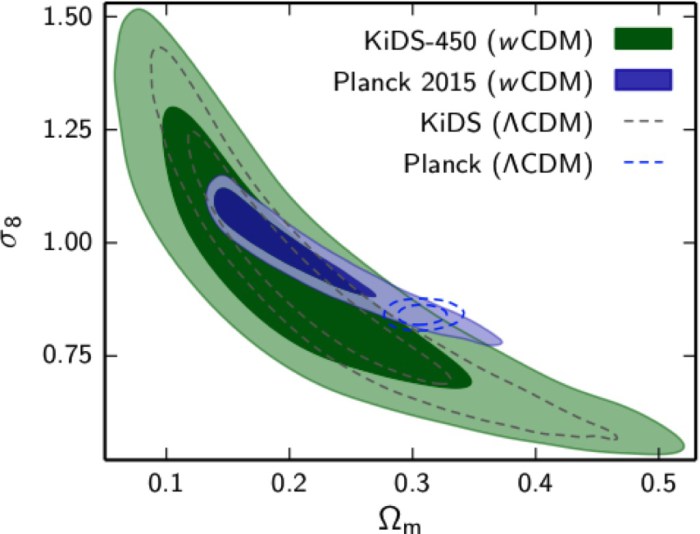
The KIDS analysis used to produce this plot uses only weak lensing tomography, so you can see that using additional measures reduces the viable region in this parameter space.
It’s great to see new data coming in, but at first sight it seems it is tending to confirm the predictions of the standard cosmological model, rather than providing evidence of departures from it.
Incidentally, this little video shows the extent to which the Dark Energy Survey is a global project, including some of my former colleagues at the University of Sussex!
Follow @telescoper


 In the Dark