Archive for 2017

The Anomaly of Research England

Posted in Politics, Science Politics with tags , , , , on August 16, 2017 by telescoper

The other day I was surprised to see this tweet announcing the impending formation of a new council under the umbrella of the new organisation UK Research & Innovation (UKRI):

These changes are consequences of the Higher Education and Research Act (2017) which was passed at the end of the last Parliament before the Prime Minister decided to reduce the Government’s majority by calling a General Election.

It seems to me that it’s very strange indeed to have a new council called Research England sitting inside an organisation that purports to be a UK-wide outfit without having a corresponding Research Wales, Research Scotland and Research Northern Ireland. The seven existing research councils which will henceforth sit alongside Research England within UKRI are all UK-wide.

This anomaly stems from the fact that Higher Education policy is ostensibly a devolved matter, meaning that England, Wales, Scotland and Northern Ireland each have separate bodies to oversee their universities. Included in the functions of these bodies is the so-called QR funding which is allocated on the basis of the Research Excellence Framework. This used to be administered by the Higher Education Funding Council for England (HEFCE), but each devolved council distributed its own funds in its own way. The new Higher Education and Research Act however abolishes HEFCE and replaces some of its functions into an organisation called the Office for Students, but not those connected with research. Hence the creation of the new `Research England’. This will not only distribute QR funding among English universities but also administer a number of interdisciplinary research programmes.

The dual support system of government funding consists of block grants of QR funding allocated as above alongside targeted at specific projects by the Research Councils (such as the Science and Technology Facilities Council, which is responsible for astronomy, particle physics and nuclear physics research). There is nervousness in England that the new structure will put both elements of the dual support system inside the same organisation, but my greatest concern is that by exlcuding Wales, Scotland and Northern Ireland, English universities will be given an unfair advantage when it comes to interdisciplinary research. Surely there should be representation within UKRI for Wales, Scotland and Northern Ireland too?

Incidentally, the Science and Technology Facilities Council (STFC) has started the process of recruiting a new Executive Chair. If you’re interested in this position you can find the advertisement here. Ominously, the only thing mentioned under `Skills Required’ is `Change Management’.

Return to Cardiff

Posted in Biographical with tags , , , on August 15, 2017 by telescoper

Well, I made it back to Cardiff on schedule last night, although that did involve getting home at 2am. I was pretty much exhausted by then so had a bit of a lie-in this morning. I think I’m getting too old for all this gallivanting about. I crashed out soon after getting home and had to spend an hour or so this morning sorting through the stack of mail that arrived while I was away (including some book tokens courtesy of another crossword prize).

I usually try to get to the airport plenty of time in advance when I’m flying somewhere, so got to Copenhagen airport yesterday a good three hours before my scheduled departure. I had checked in online before setting out so I could have left it later, but I’m obviously a creature of habit. As it happened I was able to leave my luggage at the bag drop immediately and it took no longer than 5 minutes to clear the security checks, which meant that I was left with time to kill but I had my iPod and plenty to read so it was all fine.

I was a little disturbed when I got to the departure gate to hear the announcement that `Tonight’s British Airways flight to London Heathrow is operated by Qatar Airways’, but at least it explained why it wasn’t a BA plane standing outside on the tarmac. As it happened the flight went smoothly and Qatar Airways do free food and drink for economy class passengers (unlike BA who nowadays sell expensive snacks and beverages supplied by Marks and Spencer). The only downside when we arrived at Heathrow was that we parked at a remote stand and had to wait 20 minutes or so for a bus to take us to Terminal 5.  I could hear the ground crew unloading luggage while we waited, however, so that meant less time waiting at the carousels…

On previous occasions I’ve been greeted at Heathrow by a packed passport control area, but this time it was virtually deserted. In fact I’ve never seen it so empty. My bag was waiting for me when I got to the reclaim area so I got to the Heathrow Express terminal and thence to Paddington in time for the 10.45pm train to Cardiff.

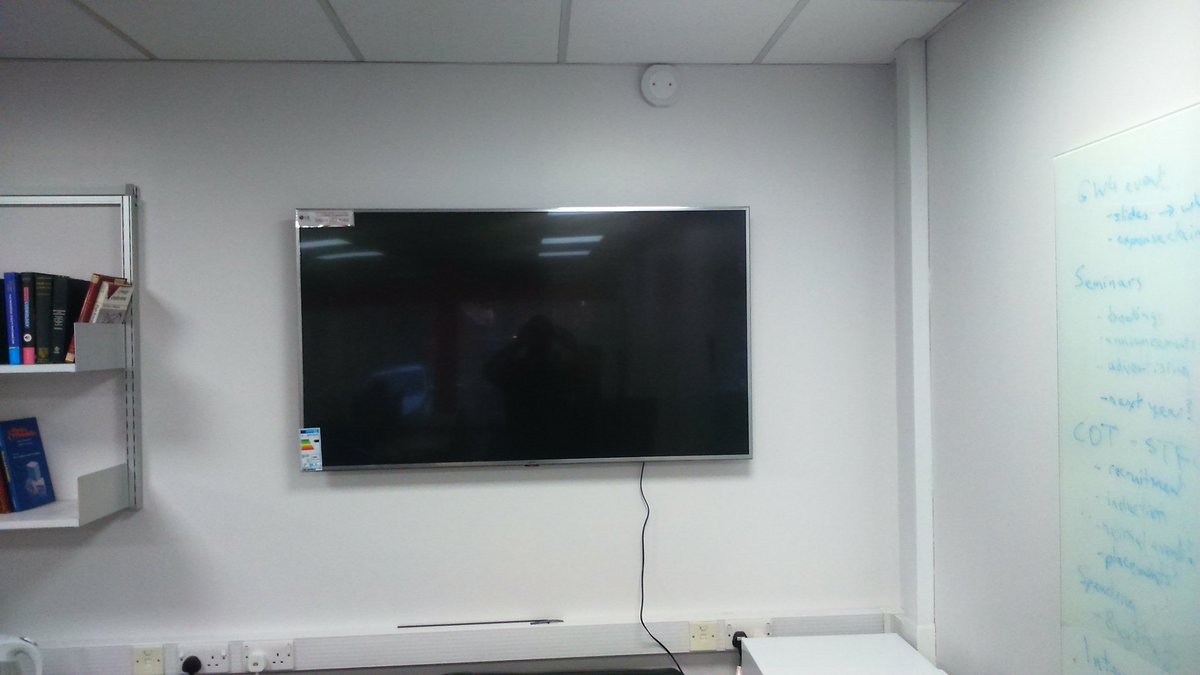
When I got back to the Data Innovation Research Institute office around lunchtime I discovered that our big screen TV has been installed.


This will of course be used exclusively for skype calls and video conferences and in no way for watching cricket or football or any other inappropriate activity.

Well, I’d better get on. Marking resit exams is the order of the day.


Farvel til NBI

Posted in Biographical with tags on August 14, 2017 by telescoper

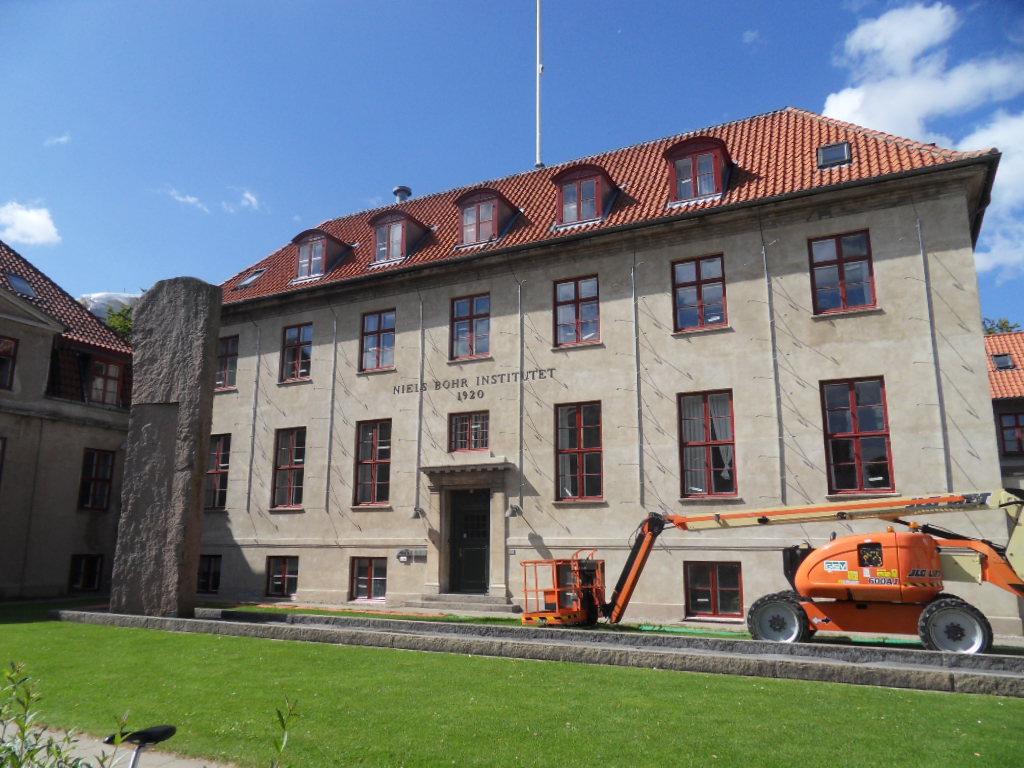
I just had my last lunch in the canteen in the Niels Bohr Institute and will shortly be heading off to the airport to begin the journey back to Blighty. It’s been a pretty intense couple of weeks but I’ve enjoyed it enormously and have learnt a lot, even though I’ve done hardly any of the things I originally planned to do!

I haven’t been staying in the building shown in the picture, but in one of the adjacent buildings not shown. In fact my office is directly above the canteen. I took this picture on the way home on Sunday, as I noticed that the main entrance has the date `1920′ written on it. I do hope they’re planning a 100th anniversary!

Anyway, farewell to everyone at the Niels Bohr Institute and elsewhere. I hope to return before too long.

A Picture of Peter Cvitanovic

Posted in Politics with tags , on August 14, 2017 by telescoper

The angry chap on the right (appropriately enough) on this image taken at the violent demonstration at Charlottesville Va at the weekend is a white nationalist  member of the alt-right white supremacist Nazi by the name of Peter Cvjetanovic.

Apparently Peter is unhappy that his picture is being shared so widely on the internet. Life is tough sometimes.

And, yes, I mean Nazi.

Grave Thoughts Again

Posted in Biographical, History, Literature with tags , , , , on August 13, 2017 by telescoper

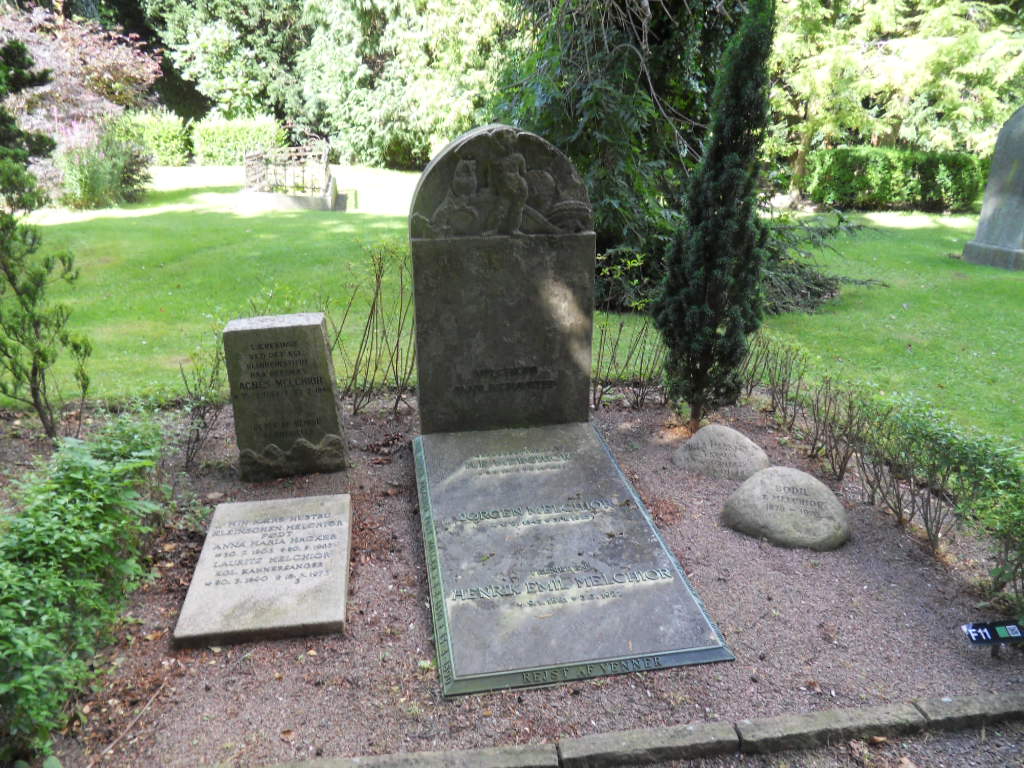
This is my last full day in Copenhagen before flying back tomorrow evening, so I decided to take care of some unfinished business by visiting the famous Assistens Kirkegård  in the Nørrebro district of the city. I went there five years ago (almost to the day) but on that occasion I didn’t find the memorial I was looking for, that of the great Heldentenor Lauritz Melchior.

I was surprised to find at the time that his name was absent from the main index, and still doesn’t appear on the maps displayed at the cemetery. Its location is however now on a guide you can find online so I had little difficulty locating it this time round. In case anyone is interested it is in section F, near the western end of the park. Lauritz Melchior was cremated, and his remains interred in a small family plot:

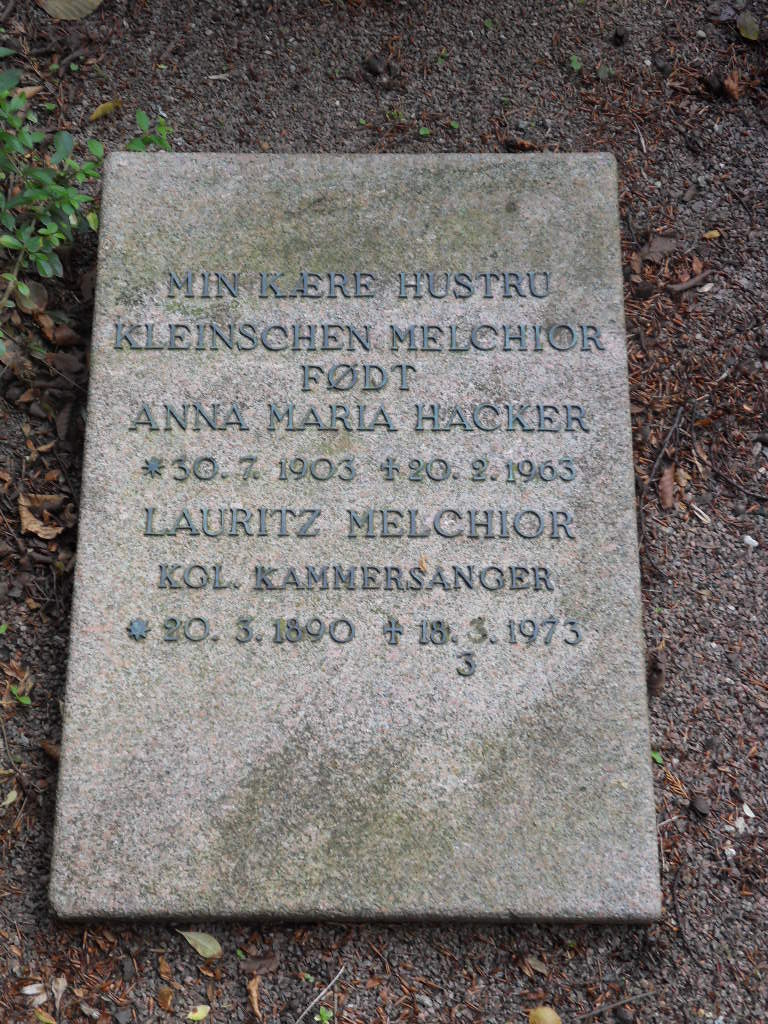
The small slab to the left marks the burial of Lauritz Melchior:

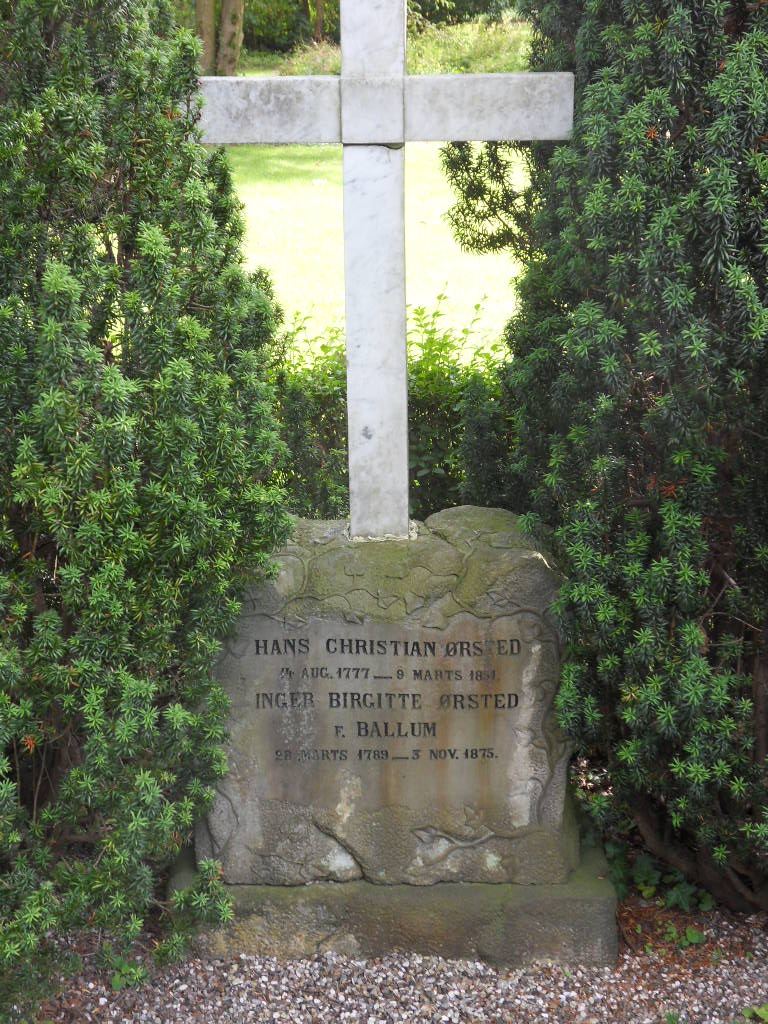
In fact this memorial is not far from that of another famous Dane I missed last time, pioneering physicist Hans Christian Ørsted:

The Hans Christian Ørsted Institute, part of the University of Copenhagen, is a short walk from the main buildings of the Niels Bpohr Institute. It houses Chemistry and Mathematical Sciences and some physicists of the Niels Bohr Institute.

You might think that a cemetery was a rather morbid choice of place to go for a stroll in the sunshine, but actually it’s not that way at all. It’s actually a rather beautiful place, a very large green space criss-crossed by pleasant tree-lined paths. These are poplars:

We British have a much more reserved attitude to cemeteries than the Danes seem to have, at least judging by  their behaviour in this place; joggers and cyclists pass through Assistens Cemetery at regular intervals, and many people were having picnics or just sitting and reading between the gravestones.  I find this matter-of-fact attitude to the dead rather refreshing, actually.

Part of the attraction of Assistens Kirkegård – the name derives from the fact that it was originally an auxiliary burial place, outside the main city, designed to take some of the pressure off the smaller cemeteries in the inner areas – is the large number of famous people buried there, many of whose graves I found last time. I didn’t however notice the large area devoted to common graves nor did I realise that there was a memorial to French and Belgian soldiers of World War 1. Most of these died in 1919, which puzzled me. It turns out that they had been prisoners of war and many of them were ill or injured and had been sent to Copenhagen to recuperate only to be struck down by the Spanish ‘flu epidemic of 1919.

It’s noticeable that some of the smaller graves are extremely well-tended whereas many of the more opulent memorials are in a state of considerable disrepair. I think there’s a moral in there somewhere. My ambition is to be forgotten as quickly as possible after my death so the idea of anyone erecting some grandiose marble monument on my behalf fills me with horror, but I have to say I do find graveyards are strangely comforting places. Rich and poor, clever and stupid, ugly and beautiful; death comes to us all in the end. At least it’s very democratic.

Cat and Beard

Posted in Beards, History on August 12, 2017 by telescoper

No time for a proper post today so here’s a picture of a Victorian lighthouse keeper and his cat.

beard

Boycott’s Hundredth Hundred

Posted in Cricket, History with tags , , , , on August 11, 2017 by telescoper

And now for something completely different.

Forty years ago today, on 11th August 1977, during the first day of Fourth Test against Australia at Headingley Geoffrey Boycott drove a delivery from Greg Chappell to the onside boundary to reach his century. He thus became the first player to reach one hundred first class hundreds in a Test Match at his home territory at Leeds (in the Midlands).

I wasn’t at the match but I did watch it on TV and I remember seeing that shot, which almost hit the non-striking batsman (Graham Roope), as it happened. It was an interesting experience looking back because few people were in doubt that Boycott would get a hundred that day. It seemed to be an historical inevitably.

Boycott went on to make 191 out of an England total of 436. As always for a Boycott innings, it was based around a solid defence and immense concentration, and he didn’t score quickly by modern standards, but he did hit 14 boundaries on the way to his century (and 22 in the innings overall) and I remember him playing some lovely shots.

The frustration of the Australians of having to bowl at Boycott for so long was almost palpable and when they came out to bat it was as if they had lost the will to live. They were all out for 103 in the first innings and, following on, could manage only 248. England won by an innings and 85 runs.

There’s been a lot of media coverage of Geoffrey Boycott’s hundredth hundred but for myself I’ll just say that it’s nice that the occasion reminded me of that wonderful summer of the Queen’s Silver Jubilee, during which Virginia Wade had won Wimbledon, and England regained the Ashes.

Climate-change denier Lord Lawson is an expert – he once wrote a book about dieting

Posted in Uncategorized on August 10, 2017 by telescoper

This kind of crap is the reason I don’t listen to Radio 4 anymore. It’s bad for my blood pressure.

Tom Pride's avatarPride's Purge

(not satire – it’s the Tories!)

I see climate-change deniers have brought out their big guns to deny the recent flooding and storms are anything to do with climate change.

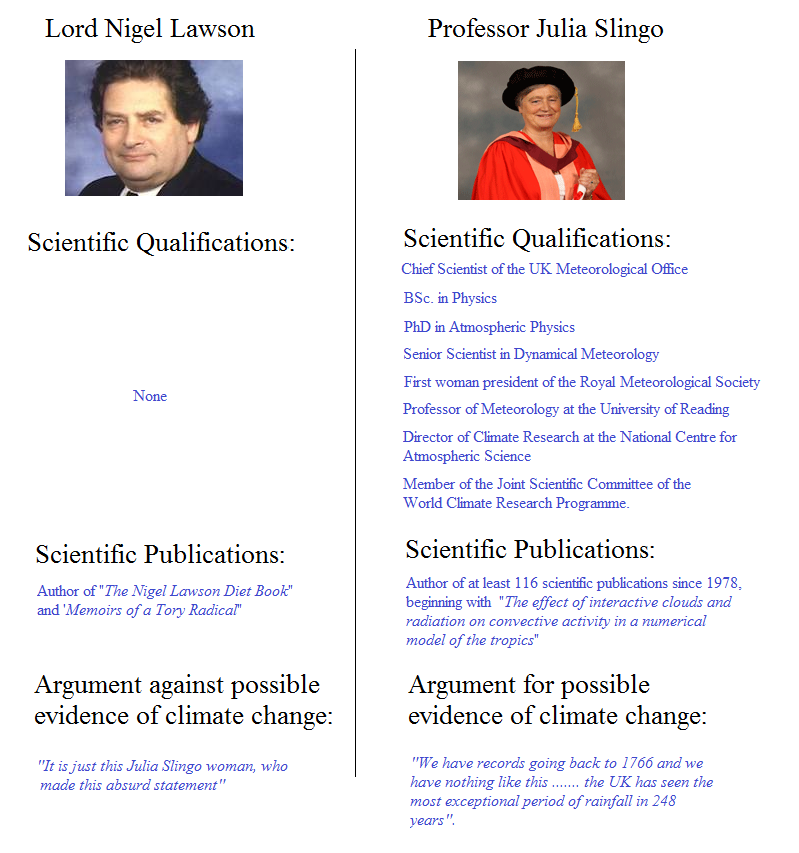
Former Thatcher chancellor Nigel Lawson went head-to-head with Met’ Office Chief Scientist Professor Julia Slingo – destroying her scientific assessments that the recent extreme weather conditions were almost certainly the result of climate change with the devastating scientific argument that she is just : “this Julia Slingo woman“.

Personally, I don’t know much about the science behind climate change. So let’s take a look at who is most likely to be right on the scientific arguments around climate in general:

Lawson vs Slingo

.

You had me at “it’s just this woman” Nigel.

.

Please feel free to comment.

.

Related articles by Tom Pride:

Climate change sceptic Andrew Neil also once thought heterosexual AIDS was a myth

Climate change deniers –…

View original post 8 more words

On the Time Lags of the LIGO signals

Posted in Bad Statistics, The Universe and Stuff with tags , , , on August 10, 2017 by telescoper

It seems that a lot of rumours are flying around on social media and elsewhere about the discussions that have been going on here in Copenhagen between members of the Niels Bohr Institute and of the LIGO scientific collaboration concerning matters arising from the `Danish Paper‘.  The most prominent among these appears to be the LIGO team and the Danish team have agreed on everything and that the Danish authors have conceded that they were mistaken in their claims. I have even been told that my recent blog posts gave the impression that this was the case. I’m not sure how, as all I’ve said is that the discussions reached agreement on some matters. I did not say what matters or whose position had changed.

I feel, therefore, that some clarification is necessary. Since I am a member of neither party to this controversy I have to tread carefully, and there are some things which I feel I should not discuss at all. I was invited to participate in the discussions as a neutral observer as a courtesy and I certainly don’t want to betray any confidences. On one thing, however, I can be perfectly clear. The Danish team (Cresswell et al.) have not retracted their claims and they reject the suggestion that their paper was wrong.

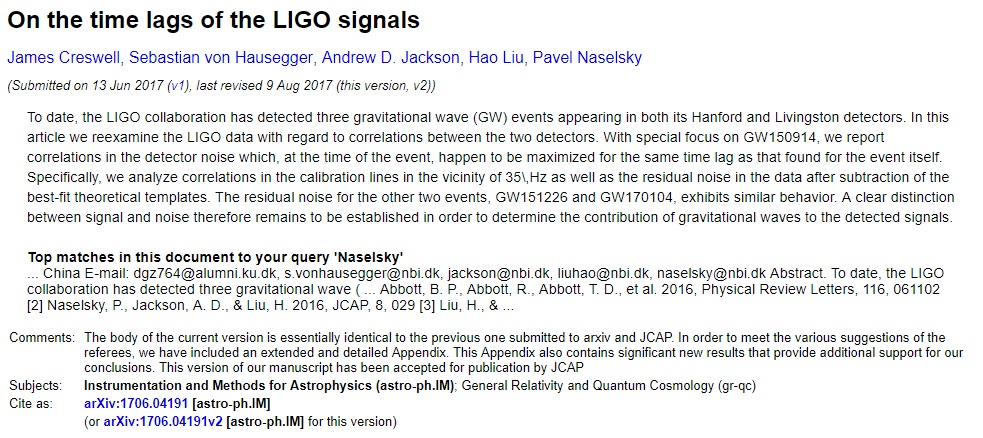
To reinforce this, I draw your attention to the fact that a revised version of `The Danish Paper’ has now been accepted for publication (in the Journal of Cosmology and Astroparticle Physics) and that this paper is now available on the arXiv. The referees raised a large number of queries, and in response to them all the revised version is almost double the length of the original.

Here is the arXiv entry page:

The main body of the paper has not been significantly modified and their main result – of an unexplained 7ms correlation in the background signal (referred to in the abstract as `noise’) – has not “gone away”. If you want to understand more, read the paper!

I’m sure there will be much more discussion of this and I will comment as appropriate when appropriate. In the meantime this remains very much a live issue.

P.S. In the interest of full disclosure I should mention that I did read over part of the revised version of the Danish paper and made some suggestions with regard to style and flow. I therefore have a mention in the acknowledgments of the final version. I was warned that I might expect some trouble for agreeing to be associated with the paper in this way but, as  Sam Spade says in The Maltese Falcon `I don’t mind a reasonable amount of trouble’…

Remembering Joe Orton

Posted in History, LGBTQ+ with tags , , , on August 9, 2017 by telescoper

Joe Orton, photographed on 1st March 1967.

The playwright and author Joe Orton died on August 9th 1967, which is exactly 50 years ago today. I couldn’t resist a short post in his memory.

Joe Orton’s career was very brief – he was only 34 when he died – but reached brilliant heights with a series of anarchic black comedies that both scandalised and entertained Sixties audiences. Such was his success that he is one of the few playwrights to have  his name remembered  in the English language,  in the form of the adjective `Ortonesque’:

Relating to or characteristic of the English playwright Joe Orton or his works, especially in being unconventional and darkly comic.

My first experience of Orton’s plays was seeing an amateur dramatic society production of Loot when I was a student. I have to say it was a dreadful experience, but that was because of the performance not because of the script. Loot is basically a farce, and I think that must be the most difficult form of comedy to do successfully. The timing has to be perfect, the pace has to be relentless and everyone has to act as if all the absurd things going on make perfect sense. Those are tough requirements for amateurs, and even for professionals. The first, provincial, run of Loot was a flop even with an experienced cast. It was only when it was revived a couple of years later that it became a hit.

The circumstances of Joe Orton’s death were terrible: he was battered to death by his partner Kenneth Halliwell  (with whom he lived in a small bedsit) who then committed suicide by taking an overdose of sleeping tablets. Orton and Halliwell had been in a relationship since 1951.  Joe had never made any secret about his enjoyment of casual sexual encounters – his diaries are full of descriptions of his adventures – but  I think it was the thought of living alone rather than sexual jealousy that Halliwell couldn’t handle.

I never met Joe Orton (I was only 4 when was murdered) but I have over the years met a number of older gay men who knew him (and Halliwell) in various ways (if you get my drift). They all described him in the same way: cute, funny and extremely flirtatious. Watch this clip of him on TV and I think you’ll see why so many people were attracted to his cheekily boyish manner:

Those who knew Halliwell also say that the usual cliché about him as a failure embittered by Joe’s success is not fair. They were an odd couple (for the time) but what they had seemed to work for them, both romantically and creatively. It makes the horrible end of their lives even more difficult to contemplate. Here’s an interview with Kenneth Williams (who was very repressed about his sexuality) talking about Orton (who was quite the opposite), that gives some insight into the relationship between the two:

Rest in peace, Joe Orton (1933-1967), author and gay icon.