Archive for 2017

Sexual Harassment at UK Universities

Posted in Uncategorized with tags on March 6, 2017 by telescoper

I only have time for a very short post today, but it seems important to point out an article about sexual harassment in UK universities which has just appeared that gives some measure of the scale of the problem. There’s also an accompanying piece that lists the number of cases in different institutions across the country over the past five years or so. If you work in UK university you might want to see how many sexual harassment cases have been reported there. In most institutions investigations into such matters are carried out confidentially, and the outcomes are generally not announced publicly. I think it is welcome that real information is starting to become available.

In most cases there are only a few reported instances per institution since 2011 – the most is 10 (at the University of Nottingham) – and very few seem to have led to persons leaving their job. These numbers represent a lower limit, of course, as not all cases are reported officially. I won’t comment on the general reliability of the figures, except to say that I doubt if all institutions have reported in the same way because their internal procedures may differ, which makes fair comparisons difficult.

Note that the report covers both harassment of students by staff and harassment of staff by other staff.

Anyway, in case you’re wondering what the legal definition of sexual harassment is, here is an excerpt from my current employer’s guidance:

Sexual Harassment has a specific definition under the Equality Act 2010. Sexual Harassment includes:

Conduct of a sexual nature that has the purpose or effect of (i) violating an individual’s dignity or (ii) creating an intimidating, hostile, degrading, humiliating or offensive environment; or

Unwanted conduct of a sexual nature or that is related to gender reassignment or sex that has the purpose or effect of (i) violating an individual’s dignity or (ii) creating an intimidating, hostile, degrading, humiliating or offensive environment and that the individual is treated less favourably because they have rejected or submitted to the conduct.


In deciding whether conduct has the effect referred to above each of the following must be taken into account:

the perception of the person claiming harassment and

the other circumstances of the case and

whether it is reasonable for the conduct to have that effect.[1]

Harassment which is related to a person’s sex, gender identity, race (including colour, nationality, ethnic or national origin), disability, sexual orientation, religion or belief, or age, can constitute unlawful discrimination for which staff and students can be held personally liable.

[1] In deciding if behaviour amounts to (unlawful) harassment, it is important to take into account all circumstances, including in particular the perception of the individual who feels that harassment has taken place and whether it can reasonably be considered that harassment has taken place. What the individual would determine to be offensive is a key issue in determining whether harassment has taken place, however there is also an element of whether a reasonable person would view the behaviour as offensive if they were in the same circumstances as the individual finding the behaviour offensive.


Vienna Tonkünstler Orchestra with Angela Hewitt

Posted in Music with tags , on March 4, 2017 by telescoper

Yesterday evening I rounded off a busy week with yet another visit to St David’s Hall in Cardiff for another in their international concert series featuring visiting orchestras.

This time it was the Vienna Tonkünstler Orchestra, under conductor Yutaka Sado.

They opened their programme with a piece which has been a favourite of mine since I first heard it as a schoolboy, the Hebrides Overture by Felix Mendelssohn, s piece which is evocative of the changing moods and colours of the sea. 

The orchestra was then joined by star piano soloist Angela Hewitt in the first half for Beethoven’s Piano Concerto No. 4, which she played with her customary poise and precision to rapturous applause from the audience. We even got an encore, in the form of a short solo piece by Bach (the composer with whose music her name is most closely associated). I couldn’t quite place it, but it might have been from one of the English suites, no Welsh suites being available.

After the break it was time for another very popular classic, the Symphony No. 9 by Antonín Dvořák (“From the New World”). It may be a well-known piece, but the performance was very fresh and invigorating. We got an encore in the second half too: the exuberant overture to Mozart’s The Marriage of Figaro.

It was rather conservative programme, perhaps, but hugely enjoyable nevertheless. These pieces are old favourites because they’re good, and stand up well to repeated listening especially when played by a top-notch orchestra like the Vienna Tonkünstler!

Maleem Mahmoud Ghania with Pharoah Sanders

Posted in Jazz with tags , , on March 3, 2017 by telescoper

And now for something completely different.

I heard this on Late Junction on BBC Radio 3 earlier this week and thought I’d share it here as I loved it so much for its infectious energy. It’s from an album called The Trance of Seven Colors by Moroccan-born Gnawa musician  Maleem Mahmoud Guinia in collaboration with the great American tenor saxophonist Pharaoh Sanders. You can listen to the whole album here, but the following is the track I heard a few days ago, which is called La Allah Dayim Moulenah. Enjoy!


St David’s Day at St David’s Hall

Posted in Music with tags , , , , , , on March 2, 2017 by telescoper

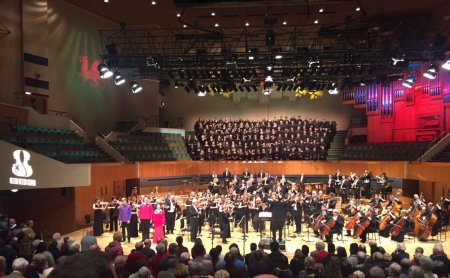
Just a quick post to mention that I celebrated St David’s Day yesterday by going, appropriately enough, to St David’s Hall in Cardiff for a special concert by the BBC National Orchestra and Chorus of Wales with soloists Rebecca Evans (soprano), Joshua Mills (tenor) and the very youthful Charlie Lovell-Jones (violin). The scheduled conductor, Gareth Jones, was indisposed so his place was taken by Adrian Partington (the Artistic Director of the BBC National Chorus of Wales).

The programme was entirely Welsh in origin and had a strong emphasis on vocal music, including many pieces I had never heard before, including songs by: Meirion Williams, Dilys Elwyn Edwards, R.S. Hughes, Idris Lewis, Joseph Parry, Evan Thomas Davies, Haydn Morris and, of course, Ivor Novello. There were also some instrumental pieces, including a cracking performance by 17-year old Charlie Lovell-Jones, of the Allegro movement from Sarakiz by Karl Jenkins.

The concert ended with a singalong, led by the chorus and soloists, of traditional Welsh favourites such as Sosban Fach, Calon Lân, Myfanwy and Cwm Rhonnda either side of a rare foray into the English language for We’ll Keep A Welcome In The Hillsides.  I was surprised to discover that Calon Lân is only a little over a hundred years old. I thought it was much older than that, but it’s still a lovely song (or hymn, really, as that’s what it is).

And of course no St David’s Day celebration would be complete without a rousing rendition of the Welsh National Anthem  Hen Wlad fy Nhadau (Land of my Fathers). Here’s a photograph of the closing scene. Note that the two vocal soloists had changed into Welsh Rugby Union shirts for the singalong part!

Here’s a picture of the closing stages, courtesy of the BBC National Orchestra of Wales twitter account.

st-davids

Four of us from the Cardiff University School of Physics & Astronomy attended the concert and we’re all in the picture. Bonus points if you can identify us!

Doris vs Robert Grosseteste

Posted in Books, Talks and Reviews, The Universe and Stuff on March 2, 2017 by telescoper

Here’s a repost of the blog of the School of Mathematics and Physics at the University of Lincoln about my (storm-delayed) talk there last week, complete with photographs!

Andrei Zvelindovsky's avatarMaths & Physics News

Poseidon has definitely sent storm Doris to  prevent establishing a new tradition in Lincoln – annual public lectures in Cosmology/Astrophysics. However, his efforts were in vain: in a truly heroic 9 hours trip, combining multiple trains and a taxi, our inaugural speaker Professor Peter Coles arrived from Cardiff to the waiting audience in Lincoln. Straight out of the car he delivered a most fascinating 1st Annual Robert Grosseteste Lecture in Astrophysics/Cosmology. The lecture series is named after a medieval bishop of Lincoln, Robert Grosseteste. Peter took us on a time journey of the formation of the Universe and the history of our knowledge about it from the medieval times to the modern research on the large web structures. His talk sparkled some questions, and you can see his slides in this link.

Thank you, Peter!

View original post

Barddoniaeth ar gyfer Dydd Gŵyl Dewi

Posted in History, Poetry with tags , , , , , , , on March 1, 2017 by telescoper

Well, today is St David’s Day so let me first offer a hearty “Dydd Gwŷl Dewi Sant hapus i chi gyd” (happy St David’s Day to you all).

Over the years, I seem to have established a tradition of posting a bit of poetry to mark this special day for Wales and the Welsh and I was looking for a piece of verse to put up this time round, when I came across a poem that seems very appropriate for a number of reasons. It was written in Welsh by Hedd Wyn (born Ellis Humphrey Evans) who lived from 1887 to 1917; Hedd Wyn was his bardic name and it translates (roughly) as “pure peace”.

Hedd Wyn was a non-conformist Christian and a pacifist who was conscripted into the British Army to serve in World War 1. He was posted to Flanders and was killed in action on the first day of the 3rd Battle of Ypres. He was hit in the stomach by a shell and died later of his wounds. The battle stumbled on for months of horrific slaughter as the planned Allied offensive foundered in the mud of Passchendaele and ended, as had the Battle of the Somme a year earlier, in a bloody stalemate.

A few weeks before his death, Hedd Wyn wrote a poem called Yr Arwr (‘The Hero’) which was submitted for the prestigious Bard’s Chair at that year’s National Eisteddfod. It was announced on 6th September 1917 that  he  had won the prize, posthumously. The bard not being able to sit in the the chair, it was draped in black cloth. The Prime Minister, David Lloyd George, was present at the ceremony.

The poem Yr Arwr is a very long work, running to 13 pages of manuscript, which is not practicable to post here, but here’s another poem by Hedd Wyn to mark the centenary of his death. This is called Rhyfel (‘War’). I only have a few words of Welsh, but because of the occasion,  it seems appropriate to post this in its original language. You can find English translations here and on the Wikipedia page here. Translating poetry is always very difficult, but the sense of the poem is of a world in chaos that has been abandoned by God.

Gwae fi fy myw mewn oes mor ddreng
A Duw ar drai ar orwel pell;
O’i ôl mae dyn, yn deyrn a gwreng,
Yn codi ei awdurdod hell.

Pan deimlodd fyned ymaith Dduw
Cyfododd gledd i ladd ei frawd;
Mae swn yr ymladd ar ein clyw,
A’i gysgod ar fythynnod tlawd.

Mae’r hen delynau genid gynt
Ynghrog ar gangau’r helyg draw,
A gwaedd y bechgyn lond y gwynt,
A’u gwaed yn gymysg efo’r glaw.

Go to the Mardi Gras!

Posted in Music with tags , , on February 28, 2017 by telescoper

I can’t believe I’ve let so many Fat Tuesdays go by without posting this classic from the brilliant Professor Longhair along with an absolutely terrific rhythm section!

Enjoy your pancakes!

The Cosmic Web – my Lincoln lecture slides…

Posted in Talks and Reviews, The Universe and Stuff with tags , on February 28, 2017 by telescoper

For those of you who are interested, here are the slides I used for the 1st Annual Robert Grosseteste Lecture on Astrophysics/Cosmology, given at the University of Lincoln on Thursday 23rd February 2017.

Tension in the Hubble constant

Posted in The Universe and Stuff with tags , , on February 28, 2017 by telescoper

A few months ago I blogged about the apparent “tension” between different measurements of the Hubble constant. Here is an alternative view of the situation, with some recent updates. The plot has thickened a bit, but it’s still unclear to me whether there’s really a significant discrepancy.

Anyway, here’s a totally unscientific poll on the issue! Do feel free to register your vote.

tritonstation's avatarTriton Station

There has been some hand-wringing of late about the tension between the value of the expansion rate of the universe – the famous Hubble constant, H, measured directly from observed redshifts and distances, and that obtained by multi-parameter fits to the cosmic microwave background. Direct determinations consistently give values in the low to mid-70s, like Riess et al. (2016): H = 73.24 ± 1.74 km/s/Mpc while the latest CMB fit from Planck gives H = 67.8 ± 0.9 km/s/Mpc. These are formally discrepant at a modest level: enough to be annoying, but not enough to be conclusive.

The widespread presumption is that there is a subtle systematic error somewhere. Who is to blame depends on what you work on. People who work on the CMB and appreciate its phenomenal sensitivity to cosmic geometry generally presume the problem is with galaxy measurements. To people who work on local galaxies, the CMB value is…

View original post 1,029 more words

On the Importance of School Experiments

Posted in Biographical, Education, The Universe and Stuff with tags , , on February 27, 2017 by telescoper

Twitter drew my attention this afternoon to a series of videos produced by the Royal Society designed to give teachers in schools some additional resources to encourage their pupils to do science experiments. They star the ubiquitous Professor Brian Cox, and they cover a wide range of science. You can see the whole playlist on Youtube here (although it is unfortunately back-to-front):

Although I ended up doing primarily theoretical work in my scientific career, there’s no question that ‘hands-on’ experiments played a big part in the development of my understanding of, especially, physics and chemistry. I remember vividly when I was about 12 years old doing a simple series of experiments in which we weighed out samples of chemical material of various types, then burned it somehow (usually over a bunsen burner) and weighed what was left. Commonsense based on experience with burning stuff like wood and paper is that the process reduces the amount of material so I expected the mass remaining at the end to be less than the initial mass. The first stuff that I did was a few grains of calcium. I couldn’t believe it when the residue turned out to weigh more than the stuff I started with. I was sure I was wrong and got quite upset for failing such an elementary practical exercise, but the same thing happened every time whatever the material.

Of course, the explanation is that the process going on was oxidation, and the calcium was actually combining with oxygen from the air to form an oxide. It did look as if some kind of destruction had happened, but the oxygen taken from the atmosphere had bonded to the calcium atoms and this increased the mass of the residue.

The teacher could have talked about this and explained it, but it wouldn’t have had anything like the impact on my understanding of discovering it for myself.

That’s a personal story of course, but I think it’s probably a widespread educational experience. These days few students seem to have the chance to do their own experience, either because of shortage of facilities or the dreaded ‘Health and Safety’ so I think any effort to encourage more teachers to allow their students to do more experiments is thoroughly worthwhile!