Archive for 2017

The Dipole Repeller

Posted in The Universe and Stuff with tags , , , , , , on February 2, 2017 by telescoper

An interesting bit of local cosmology news has been hitting the headlines over the last few days. The story relates to a paper by Yehuda Hoffman et al. published in Nature Astronomy on 30th January. The abstract reads:

Our Local Group of galaxies is moving with respect to the cosmic microwave background (CMB) with a velocity 1 of VCMB = 631 ± 20 km s−1and participates in a bulk flow that extends out to distances of ~20,000 km s−1 or more 2,3,4 . There has been an implicit assumption that overabundances of galaxies induce the Local Group motion 5,6,7 . Yet underdense regions push as much as overdensities attract 8 , but they are deficient in light and consequently difficult to chart. It was suggested a decade ago that an underdensity in the northern hemisphere roughly 15,000 km s−1 away contributes significantly to the observed flow 9 . We show here that repulsion from an underdensity is important and that the dominant influences causing the observed flow are a single attractor — associated with the Shapley concentration — and a single previously unidentified repeller, which contribute roughly equally to the CMB dipole. The bulk flow is closely anti-aligned with the repeller out to 16,000 ± 4,500 km s−1. This ‘dipole repeller’ is predicted to be associated with a void in the distribution of galaxies.

The effect of this “void in the distribution of galaxies” has been described in rather lurid terms as “Milky Way being pushed through space by cosmic dead zone” in a Guardian piece on this research.

If you’re confused by this into thinking that some sort of anti-gravity is at play, then it isn’t really anything so exotic. If the Universe were completely homogeneous and isotropic – as our simplest models assume – then it would be expanding at the same rate in all directions.  This would be a pure “Hubble flow“, with galaxies appearing to recede from an observer with a speed proportional to their distance:
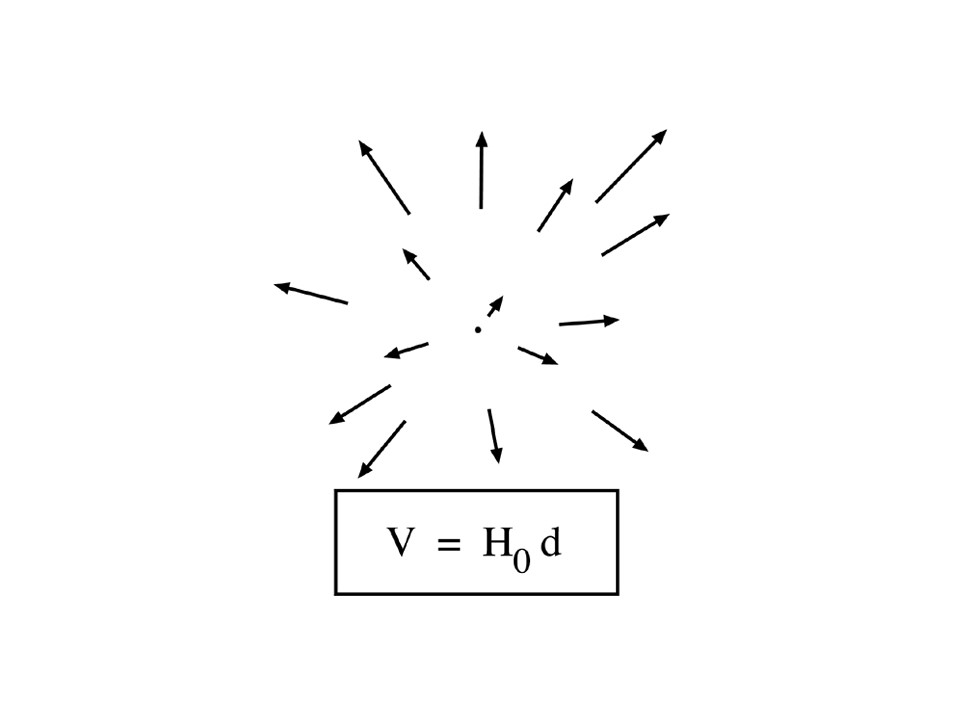
slide7

But the Universe isn’t exactly smooth. As well as the galaxies themselves, there are clusters, filaments and sheets of galaxies and a corresponding collection of void regions, together forming a huge and complex “cosmic web” of large-scale structure. This distorts the Hubble flow by inducing peculiar motions (i.e. departures from the pure expansion). A part of the Universe which is denser than average (e.g. a cluster or supercluster) expands less  quickly than average, a part which is less dense (i.e. a void) expands more quickly than average. Relative to the global expansion rate, clusters represent a “pull” and voids represent a “push”. That’s really all there is to it.

The difficult part about this kind of study is measuring a sufficient number of peculiar motions of galaxies around our own to make a detailed map of what’s going on in the local velocity field. That’s particularly hard for galaxies near the plane of the Milky Way disk as they tend to be obscured by dust. Nevertheless, after plugging away at this for many years, the authors of the Nature paper have generated some fascinating results. It seems that our Galaxy and other members of the Local Group lie between a dense supercluster (often called the Shapley concentration) and an underdense region, so the peculiar velocity field around us has an approximately dipole structure.

They’ve even made a nice video to show you what’s going on, so I don’t have to explain any further!


You have the power to change someone’s life – Time to Talk Day 2017

Posted in Mental Health with tags , , on February 2, 2017 by telescoper

time-to-talk-day

Today, 2nd February 2017, is Time to Talk Day, which means that it’s time for the nation’s biggest conversation about mental health.

One in four adults and one in ten young people will experience a mental health problem every year. Talking about it doesn’t have to be difficult but can make a big difference. It’s easy to have a conversation about mental health, and it could change someone’s life (including yours). You don’t have to be an expert to help: sometimes just asking  how they are is all you need to do to help someone who’s having a hard time.

Here’s a little video about Time to Talk Day:

For more information on how to get involved see here.

Fake News of the Holographic Universe

Posted in Astrohype, The Universe and Stuff with tags , , , , , , on February 1, 2017 by telescoper

It has been a very busy day today but I thought I’d grab a few minutes to rant about something inspired by a cosmological topic but that I’m afraid is symptomatic of malaise that extends far wider than fundamental science.

The other day I found a news item with the title Study reveals substantial evidence of holographic universe. You can find a fairly detailed discussion of the holographic principle here, but the name is fairly self-explanatory: the familiar hologram is a two-dimensional object that contains enough information to reconstruct a three-dimensional object. The holographic principle extends this to the idea that information pertaining to a higher-dimensional space may reside on a lower-dimensional boundary of that space. It’s an idea which has gained some traction in the context of the black hole information paradox, for example.

There are people far more knowledgeable about the holographic principle than me, but naturally what grabbed my attention was the title of the news item: Study reveals substantial evidence of holographic universe. That got me really excited, as I wasn’t previously aware that there was any observed property of the Universe that showed any unambiguous evidence for the holographic interpretation or indeed that models based on this model could describe the available data better than the standard ΛCDM cosmological model. Naturally I went to the original paper on the arXiv by Niayesh Ashfordi et al. to which the news item relates. Here is the abstract:

We test a class of holographic models for the very early universe against cosmological observations and find that they are competitive to the standard ΛCDM model of cosmology. These models are based on three dimensional perturbative super-renormalizable Quantum Field Theory (QFT), and while they predict a different power spectrum from the standard power-law used in ΛCDM, they still provide an excellent fit to data (within their regime of validity). By comparing the Bayesian evidence for the models, we find that ΛCDM does a better job globally, while the holographic models provide a (marginally) better fit to data without very low multipoles (i.e. l≲30), where the dual QFT becomes non-perturbative. Observations can be used to exclude some QFT models, while we also find models satisfying all phenomenological constraints: the data rules out the dual theory being Yang-Mills theory coupled to fermions only, but allows for Yang-Mills theory coupled to non-minimal scalars with quartic interactions. Lattice simulations of 3d QFT’s can provide non-perturbative predictions for large-angle statistics of the cosmic microwave background, and potentially explain its apparent anomalies.

The third sentence (highlighted) states explicitly that according to the Bayesian evidence (see here for a review of this) the holographic models do not fit the data even as well as the standard model (unless some of the CMB measurements are excluded, and then they’re only slightly better)

I think the holographic principle is a very interesting idea and it may indeed at some point prove to provide a deeper understanding of our universe than our current models. Nevertheless it seems clear to me that the title of this news article is extremely misleading. Current observations do not really provide any evidence in favour of the holographic models, and certainly not “substantial evidence”.

The wider point should be obvious. We scientists rightly bemoan the era of “fake news”. We like to think that we occupy the high ground, by rigorously weighing up the evidence, drawing conclusions as objectively as possible, and reporting our findings with a balanced view of the uncertainties and caveats. That’s what we should be doing. Unless we do that we’re not communicating science but engaged in propaganda, and that’s a very dangerous game to play as it endangers the already fragile trust the public place in science.

The authors of the paper are not entirely to blame as they did not write the piece that kicked off this rant, which seems to have been produced by the press office at the University of Southampton, but they should not have consented to it being released with such a misleading title.

Four Years On…

Posted in Biographical with tags , , on January 31, 2017 by telescoper

After the annual last-minute rush to file my tax return by the  deadline (which is midnight today, 31st January),  I can now relax not only because the job is finished, but also because it confirms that I am due a rebate (as indeed I was last year).

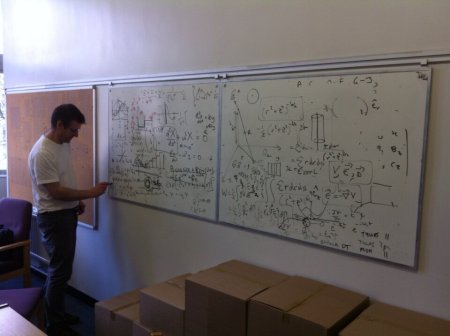
Anyway, thinking about the 31st January deadline made me remember that it was precisely four years ago, on 31st January 2013, that I left Cardiff University to take up a post at the University of Sussex. On that occasion I had to rush to finish marking a big stack of exams and finish packing the books in my office before signing the work of art I had left on my whiteboard and heading off.

I started at Sussex the following day.

I didn’t think then that in four years I would be back in Cardiff, but then I didn’t think a lot of things would happen that have happened in that time. I don’t regret my decision to resign, but I do find myself from time to time wondering how things are going back at Sussex and how things might be now had I decided to stay there. I’ve been so busy I’ve only been back once to Brighton since I left last summer. I must put that right. Perhaps I’ll have a holiday there in the spring.

The Trump Protest in Cardiff

Posted in Biographical, Politics with tags , , , , on January 31, 2017 by telescoper

Last night I joined in a protest in Cardiff against Donald Trump’s executive order curtailing the US refugee programme and suspending the right of entry to the USA to people with perfectly valid documentation who were born in Iran, Iraq, Libya, Somalia, Sudan, Syria and Yemen. In effect, it’s a Muslim Ban. Coincidentally, the Muslim countries exempted from the order include Saudi Arabia, Egypt and the United Arab Emirates are all places where Trump has business interests.

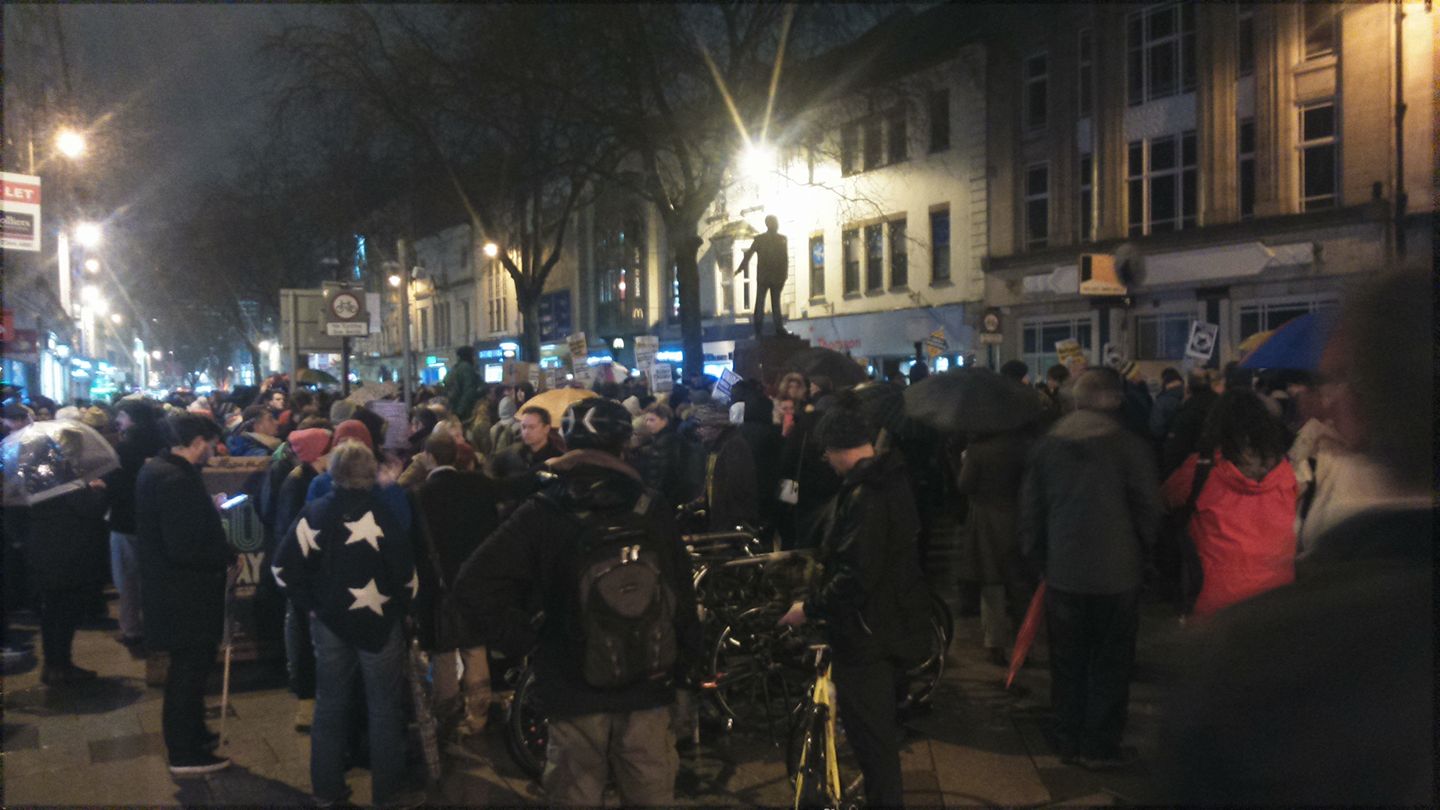
This unconscionable and unconstitutional order has led to detentions and forced deportations in clear violation of the Geneva convention. There’s a Nature piece giving some examples of scientists it has affected, to illustrate the damage done already. I find it a disgrace that our government has failed to voice its disapproval of this order, and I’m apparently not alone. Despite just a day’s notice, thousands turned out for protests across the United Kingdom, including Cardiff, where we assembled at about 6.30pm near the statue of Aneurin Bevan on Queen Street.

queen-street

Despite the pouring rain the numbers built up impressively until the street became very crowded. It wasn’t very easy to count the people there but I’m very confident that they numbered well over a thousand. That’s not as large as the demonstration in London that happened at the same time, but it’s a start.

There were some speeches and chanting and lots of witty signs and we marched up and down Queen Street making an enjoyable noise. It was all very good-humoured, but behind it all was a deep sense of alarm that the President of the United States of America has revealed himself to be nothing but a fascist. Yes, I mean a fascist -that’s precisely what he is. More and more people are going to come to that conclusion over the next few weeks and months and if and when he ever does come to the United Kingdom on a State Visit, there’ll be demonstrations against him. Our political masters may be prepared to sell this country to Trump, but I don’t think ordinary people will stand for it.

This is the Strangers’ Case

Posted in History, Literature with tags , , , on January 30, 2017 by telescoper

This speech, delivered by Sir Ian McKellen at the Cambridge Union a couple of years ago, is from the play Sir Thomas More  and is widely attributed to William Shakespeare. It’s from Act 2 Scene 4, at which point in the drama Thomas More (who was then London’s Deputy Sheriff) is called upon to put down an anti-immigration riot in the Parish of St Martin Le Grand, that took place on 1st May 1517. In reality  More’s intevention wasn’t effective, and it took the arrival of 5000 troops to disperse the mob.

As well as being powerful for many other reasons, this speech especially fascinating because a hand-written manuscript (thought to be by Shakespeare himself) survives and is kept in the British Library.

The backdrop to this story is that, between 1330 and 1550 about 64,000 immigrants from all across Europe came to England in search of better lives. Locals blamed them for taking their jobs and threatening their culture. Tensions reached breaking point in 1517 and a mob armed with stones, bricks, bats, boots and boiling water attacked the immigrants and looted their homes.  Five hundred years on, and we still haven’t learned.

Here is the text of the speech. As you will see, it basically amounts to the argument “do as you would be done by”, but it is much more powerful when performed by an actor, so do watch the clip too!

Grant them removed, and grant that this your noise
Hath chid down all the majesty of England;
Imagine that you see the wretched strangers,
Their babies at their backs and their poor luggage,
Plodding to the ports and coasts for transportation,
And that you sit as kings in your desires,
Authority quite silent by your brawl,
And you in ruff of your opinions clothed;
What had you got? I’ll tell you: you had taught
How insolence and strong hand should prevail,
How order should be quelled; and by this pattern
Not one of you should live an aged man,
For other ruffians, as their fancies wrought,
With self same hand, self reasons, and self right,
Would shark on you, and men like ravenous fishes
Would feed on one another….

Say now the king
Should so much come too short of your great trespass
As but to banish you, whither would you go?
What country, by the nature of your error,
Should give you harbour? go you to France or Flanders,
To any German province, to Spain or Portugal,
Nay, any where that not adheres to England,
Why, you must needs be strangers: would you be pleased
To find a nation of such barbarous temper,
That, breaking out in hideous violence,
Would not afford you an abode on earth,
Whet their detested knives against your throats,
Spurn you like dogs, and like as if that God
Owed not nor made not you, nor that the claimants
Were not all appropriate to your comforts,
But chartered unto them, what would you think
To be thus used? this is the strangers case;
And this your mountainish inhumanity.

La Bohème at WNO

Posted in Opera with tags , , , on January 30, 2017 by telescoper

So, to get away from the world for a short while I went on Saturday to the opening night of the new season by Welsh National Opera at the Wales Millennium Centre in Cardiff – a tale of poverty and doomed love, ending in a tragic death. Well, what did you expect from an Opera, a happy ending?

I suppose the story of La Bohème will be familiar to anyone with even a passing interest in Opera, but I’ll give a quick synopsis anyway.  It’s a boy-meets-girl love story, of course. The boy in this case is the poet Rodolfo (Dominick Chenes) and the girl, actually named Lucia but known  as Mimi (Marina Costa-Jackson).  The setting is Paris around 1830, and the poet and his painter friend Marcello (Gary Griffiths) are starving and freezing, as it is winter and they have no money.  Act I is set on Christmas Eve, but the two friends have nothing to eat and nowhere to go. Fortunately, their musician friend Schaunard (Gareth Brynmor John) turns up with money and provisions. After various comings and goings – including the arrival of philosopher Colline (Jihoon Kim) and an untimely visit from the landlord (Howard Kirk) everyone but Rodolfo leaves to spend Christmas Eve out on the town; Rodolfo has to finish a piece for a journal, and promises to join them when he is done. However, he is interrupted by the arrival of Mimi, who lives nearby and whose candle has gone out. It’s love at first sight…

The later stages of Act I are built around Rodolfo’s aria Che Gelida Manina (“your tiny hand is frozen”) and Mimi’s Mi Chiamano Mimi. These beautiful songs follow one another in quick succession, and are then rounded off with a wonderful duet O Soave Fanciulla  in a manner guaranteed to melt the stoniest of hearts. And, before you ask, yes I did cry again. Just a little bit. I don’t think anyone noticed.

But it’s not just the ravishing music that makes this passage so special, it’s also Puccini’s gift as a story-teller: after the two arias by Rodolfo and Mimi, the audience knows everything they need to know about these characters. It’s a great example of why I think Puccini is a far greater writer of Opera than, say, Wagner. Puccini understood much better than Wagner how to vary  pace and colour  without allowing the story to bogged down, and he knew exactly how to use his big tunes to maximum dramatic effect (i.e. without excessive repetition). In fact, La Bohème is in four acts, but its running time is just about 2 hours and 15 minutes, packed full of gorgeous music and compelling drama. It’s a supreme example of Puccini’s artistry as a composer of Opera.

Anyway, back to the plot. Act II finds Rodolfo and Mimi joining in the party started by Marcello and his buddies. There’s a huge contrast here between the dingy garret in which Act I is set, as this is set in the Latin Quarter of gay Paris (with a few drag queens in this production thrown in to make the point). Marcello gets off with the object of his desire, the coquettish Musetta (Lauren Fagan), and all seems well with the world as we go into the interval.

In Act III we find things have changed. Rodolfo’s love for Mimi has soured and, overcome by jealousy and suspicion, he has left her. Clearly unwell, Mimi wanders around looking for Rodolfo and he hears her coughing. They clearly still love each other, but find it difficult to live with each other. If Opera were Facebook they would both have “It’s complicated” on their status.

The last act finds us back in the garret, Rodolfo and Mimi having separated. But Mimi has been wandering the streets in the freezing cold and turns up, clearly gravely ill. Rodolfo’s friends quickly pawn some meagre possessions and Marcello and Musetta rush out to buy medicine and summon a doctor. They return with the medicine but, before the doctor arrives, Mimi dies.

People say that this is a romantic opera but it’s a pretty bleak story when you think about it. The lovers’ happiness is brief and it all ends in despair and death in surroundings of poverty and squalor. That’s what Opera Verismo is all about. In this production Mimi really does looks ill at the end, making the ending all the more heartbreaking.

All the principals were very good. I thought the voice of Dominick Chenes sounded a little thin at the start and was worried that he might have to force it during the big arias, but he warmed up magnificently. Lauren Fagan was a very sassy as the “tart-with-a heart” Musetta. The other person who deserves a particular mention was the bass Jihoon Kim as Colline, who has a superb voice.

And a word for the production. This revival of Annabel Arden’s design – slightly different from the last time I saw it, with a different case, five years ago – managed to bring fresh elements to what is basically a straightforward interpretation of the Opera. The visual effects, such as the animated snow,  were clever but not intrusive. There was no attempt to translate the action into a different period or location nor was there an attempt to preach about disease as a metaphor for moral failings. In this respect it’s very faithful to what I think Puccini’s intentions were, i.e. to let the audience make their own mind up about what message they want to take away. The only slight departure I spotted was that in Act I Mimi actually blows her own candle out deliberately in order to get Rodolfo to light it again. Methinks she’s a bit more forward than usual in this production.

This was the first performance of this run of La Bohème. If you love Opera and can get to Cardiff, then do go and see it. It’s very special.

P.S. I was a little amused by the image of the skyline of 19th Century Paris projected in front of the curtains before the show started. It did much to set the atmosphere, but I really don’t think those TV aerials should have been there…


Refugee Blues

Posted in Poetry, Uncategorized with tags , , , on January 29, 2017 by telescoper

Say this city has ten million souls,
Some are living in mansions, some are living in holes:
Yet there’s no place for us, my dear, yet there’s no place for us.

Once we had a country and we thought it fair,
Look in the atlas and you’ll find it there:
We cannot go there now, my dear, we cannot go there now.

In the village churchyard there grows an old yew,
Every spring it blossoms anew:
Old passports can’t do that, my dear, old passports can’t do that.

The consul banged the table and said,
“If you’ve got no passport you’re officially dead”:
But we are still alive, my dear, but we are still alive.

Went to a committee; they offered me a chair;
Asked me politely to return next year:
But where shall we go to-day, my dear, but where shall we go to-day?

Came to a public meeting; the speaker got up and said;
“If we let them in, they will steal our daily bread”:
He was talking of you and me, my dear, he was talking of you and me.

Thought I heard the thunder rumbling in the sky;
It was Hitler over Europe, saying, “They must die”:
O we were in his mind, my dear, O we were in his mind.

Saw a poodle in a jacket fastened with a pin,
Saw a door opened and a cat let in:
But they weren’t German Jews, my dear, but they weren’t German Jews.

Went down the harbour and stood upon the quay,
Saw the fish swimming as if they were free:
Only ten feet away, my dear, only ten feet away.

Walked through a wood, saw the birds in the trees;
They had no politicians and sang at their ease:
They weren’t the human race, my dear, they weren’t the human race.

Dreamed I saw a building with a thousand floors,
A thousand windows and a thousand doors:
Not one of them was ours, my dear, not one of them was ours.

Stood on a great plain in the falling snow;
Ten thousand soldiers marched to and fro:
Looking for you and me, my dear, looking for you and me.

written in 1939 by W.H. Auden (1907-1973)

R.I.P John Hurt (1940-2017)

Posted in Film, Television with tags , , on January 28, 2017 by telescoper

I just heard today of the death (on Wednesday 25th January, aged 77) of the great British actor John Hurt. 

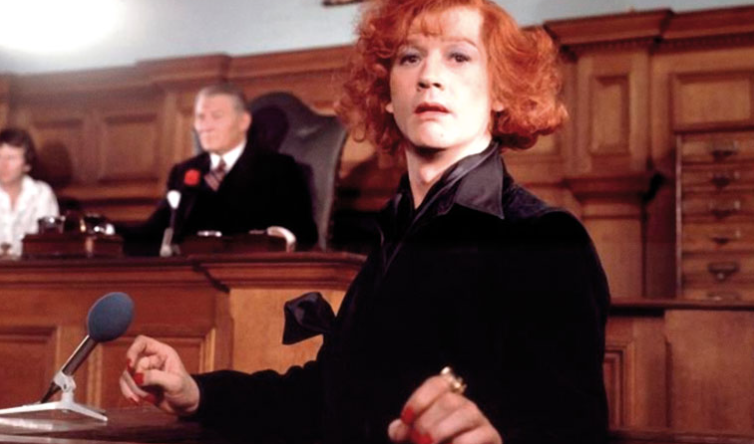
John Hurt was an extremely versatile actor who starred in many different roles, from Elephant Man to Alien, but I shall always remember him best as Quentin Crisp (above) in the 1975 television drama adapted from Crisp’s book The Naked Civil  Servant which I saw on TV when it was first broadcast.

Rest in peace, John Hurt (1940-2017).

Splitting from Euratom

Posted in Politics, Science Politics with tags , , , , on January 27, 2017 by telescoper

This week the government published a short bill in response to the Supreme Court’s decision, announced on Tuesday morning, that Parliament should be involved in the process of notifying the European Union if and when the United Kingdom decides to leave. The Supreme Court (by a majority of 8-3) upheld the earlier decision of the High Court that  the Executive could not take a decision of such magnitude (effectively using the Royal Prerogative) without explicit Parliamentary approval.

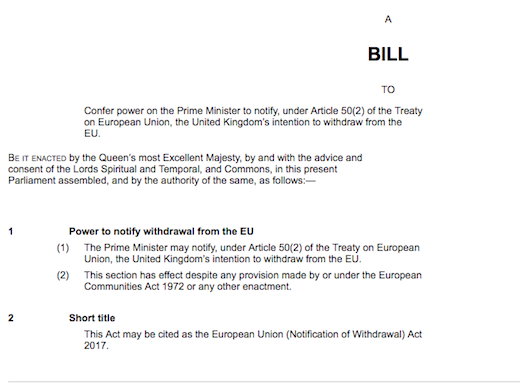
The Article 50 Bill is very short. In fact this is it in full:

billarticle50

The government plans to force this  through both the House of Lords and the House of Commons in five days, although will undoubtedly be attempts to amend it.  It has subsequently emerged that a White Paper concerning the process of negotiating the withdrawal will be published, but not until after the Article 50 Bill is enacted. It’s readily apparent that the government is merely playing grudging lip-service to the sovereignty of Parliament. Let’s hope Parliament shows some guts for once and stands up for the interests of the United Kingdom by refusing the give the Executive Carte Blanche and insisting on full Parliamentary scrutiny of the process, including giving MPs the chance to call off the whole fiasco when it becomes obvious that we’re better off not leaving the EU after all.

As another example of the contempt for open government, news broke today that in the explanatory notes for the Article 50 bill, the UK government indicates that it intends for the UK to leave the European Atomic Energy Community (Euratom). This organization has a number of regulatory roles concerning nuclear energy supply and distribution, but also has a major research focus on the International Thermonuclear Experimental Reactor (ITER), a project aimed at constructing a fusion reactor, which currently involves a significant number of UK scientists. This project is truly international: involving the EU, Russia, the USA, Japan, Korea and India.

Unlike, e.g. CERN and ESA, the organization of Euratom is legally linked to the European Union, so one can argue that withdrawal from the EU necessarily means leaving Euratom, but to announce this in the explanatory notes without any attempt to discuss it either in Parliament or with the organizations involved seems to me yet another manifestation of the UK government’s desire to avoid any consultation at all, wherever this is possible. The Supreme Court prevented them from excluding Parliament, but it is clear that they will continue to avoid due process whenever they think they can get away with it. This announcement now puts a big question mark over the futures of many scientists involved in nuclear research. You can find a blog post on this by a nuclear physicist, Paul Stevenson of the University of Surrey, here.

The decision to withdraw from Euratom poses very serious questions about our nuclear industry as well as nuclear physics and engineering research so it should be discussed and evaluated. Whatever you think about BrExit, trying to force through such important decisions without consultation is not the proper way for a government to carry on.