Archive for September, 2018

Breakthrough Prize for Dame Jocelyn Bell Burnell

Posted in The Universe and Stuff with tags , , , , , on September 6, 2018 by telescoper

I awoke this morning to find my Twitter feed full of news about the award of a special Breakthrough Prize to Dame Jocelyn Bell Burnell. To quote the press release:

The Selection Committee of the Breakthrough Prize in Fundamental Physics today announced a Special Breakthrough Prize in Fundamental Physics recognizing the British astrophysicist Jocelyn Bell Burnell for her discovery of pulsars – a detection first announced in February 1968 – and her inspiring scientific leadership over the last five decades.

Bell Burnell receives the Prize “for fundamental contributions to the discovery of pulsars, and a lifetime of inspiring leadership in the scientific community.” Pulsars are a highly magnetized, rapidly spinning form of the super-dense stars known as neutron stars. Their discovery was one of the biggest surprises in the history of astronomy, transforming neutron stars from science fiction to reality in a most dramatic way. Among many later consequences, it led to several powerful tests of Einstein’s Theory of Relativity, and to a new understanding of the origin of the heavy elements in the universe.

For the full citation and background information, see here.

The prize is not only prestigious but also substantial in cash terms: $3M no less. Jocelyn has made it clear however that she intends to use the money to set up a fund to encourage greater diversity in physics, through the Institute of Physics. That is a wonderful gesture, but if you know Jocelyn at all then you will not be at all surprised by it, as she is a person of enormous integrity who has for many years demonstrated a huge commitment to the cause of increasing diversity. I look forward to hearing more about how this initiative works out.

In an interview with the Guardian, Jocelyn said “Increasing the diversity in physics could lead to all sorts of good things.” I agree, and not just because an open and inclusive environment is a good thing in itself (which it is) but also because the fewer barriers there are to entry for a particular field, the broader the pool of talent from which it can recruit.

P.S. What would you do if you won a prize of $3M?

P. P. S. If I had $3M to spend, I think I’d spend it on whatever would most annoy all the miserable twerps complaining on Twitter about what Jocelyn Bell Burnell is doing with her Breakthrough Prize money.

On the Plural of Referendum

Posted in Pedantry, Politics with tags , , , , on September 5, 2018 by telescoper

Quite a few people are suggesting that one way out of the current Brexit fiasco is to have another referendum when the terms of the withdrawal agreement (if any) are known. Bafflingly, Theresa May has argued that a second plebiscite would be `a betrayal of democracy’ and has categorically ruled out that possibility. Given her U-turn about last year’s General Election one might reasonably infer that a second referendum is now a racing certainty, but she called the election because she was confident she would win. All the signs are now that if given a chance to vote again the UK would vote to remain in the European Union, so the PM will need a very hard push to allow a second referendum.  A smart politician would have used the evidence of electoral misconduct by the Leave campaigns as a way out, but we’re not dealing with smart politicians on either side of the House nowadays.

Whether or not there is a second referendum an important question arises from the possibility, i.e. what is the proper plural of “referendum”?

Regular readers of this blog know that I’m never pedantic about such matters. Well, maybe a little bit, sometimes. Latin was my best subject at O-level, though, so I can’t resist making a comment.

Any dictionary will tell you that “referendum” is obtained from the Latin verb referre which is itself formed as re- (prefix meaning “back”) + ferre (to carry), thus its literal meaning is “carry back” or, more relevantly to the current discussion, “to refer”. Ferre is actually an irregular verb, which complicates the discussion a bit, so I’ll use simpler examples of regular verbs below

Latin grammar includes two related concepts derived from a verb, the gerund and the gerundive.

The gerund is a verbal noun; such things exist in English in forms that mean `the act of something’, e.g. running, eating, loving.The word formed from a verb with the ending `ing’ can also function as a present participle in English, but we wont be going there. It may easy to muddle up gerunds with participles in English, but not in Latin as they are formed in distinctly different ways.

IAs an example, in the case of `loving’ the  relevant Latin verb is the first conjugation amare (amo amas amat and all that) and the appropriate gerund is amandus. You can this sort of Latin construction surviving in such English words as “graduand”. Note, however, that a gerund has no plural form because that would make no sense in Latin. There are plural forms in English such as `doings’ and `comings and goings’ but I don’t think these are relevant here as I interpret them as jocular, and pedantry is a very serious business. Moreover

Related to the gerund is the gerundive which, as its name suggests, is an adjectival form related to the gerund, specifically expressing necessity. In Latin, an adjective takes an ending that depends on the gender of the noun it describes; the gerundive also follows this pattern.

In the loving example above, the gerundive form is amandus in a masculine case or, if referring to a female entity, amanda, hence the name Amanda, which means “deserving or requiring love”, or amandum for a neuter noun. In cases where the noun is plural the forms would be amandi, amandae, and amanda. Endings for other gerundives formed from other verbs are constructed in a similar fashion depending on their conjugation.

From this discussion you can see that in Latin amandum could mean either “loving” (gerund) or “a thing to be loved” (gerundive). Latin grammar is sufficiently precise, however, that the actual meaning will be obvious from the context.

As an aside, based on my own experiences in mathematics and physics, the abbreviation `QED’ which is often placed at the end of a proof is short for `Quod Erat Demonstrandum’, meaning `which was required to be shown’ rather than `Quite Easily Done’.  I’m surprised how many people use QED without knowing what it means!

Now, back to referendum. It seems clear to me that this is a gerundive and thus means “a thing to be referred” (the thing concerned being of no gender, as is normal in such cases in Latin). So what should be the word for more than one referendum?

Think about it and you’ll realise that referenda would imply “more than one thing to be referred”. The familiar word agenda is formed precisely this way and it means “(a list of things) to be done”. But this is not the desired meaning we want, ie “more than one example of a thing being referred”.

I would therefore argue that referenda is clearly wrong, in that it means something quite different from that needed to describe more than one of what a single referendum is.

So what should we use? This is a situation where there isn’t a precise correspondence between Latin and English grammatical forms so it seems to me that we should just treat referendum as an English noun and give it the corresponding English plural. So “referendums” it is.

Any questions?

P.S. In a forthcoming post I shall give the full conjugation of the verb brexire, as brexit must be formed from that verb  in the same way that exit is formed from exire (i.e. third person singular in the active voice; exire is an irregular verb but basically similar to fourth conjugation). On this basis the gerund of brexire would be brexeundum and the gerundive brexeundus

Charles Kingsley on the Irish

Posted in Biographical, History, Politics with tags , , , , on September 4, 2018 by telescoper

I’ve been aware since my schooldays that there has been (and still is) a significant tendency among the English (especially their governing classes) to regard the Irish as lawless barbarians, but this quote which I found in a book I’ve been reading really took my breath away. It’s from a letter written by Charles Kingsley to his wife in 1861, while he was travelling through an Ireland still reeling from the devastation of the Great Famine:

But I am haunted by the human chimpanzees I saw along that hundred miles of horrible country. I don’t believe they are our fault, I believe that there are not only more of them than of old, but that they are happier, better, more comfortably fed and lodged under our rule than they ever were. But to see white chimpanzees is dreadful; if they were black, one would not feel it so much, but their skins, except where tanned by exposure, are as white as ours.

This passage is revolting in so many ways that I don’t think it needs any further comment, but it is worth mentioning that Charles Kingsley was, by the standards of his time, regarded as something of a progressive. As well as being a Church of England priest, Professor of History and a novelist (I read The Water-Babies when I was a child), he was also a social reformer involved in such initiatives as the working men’s college and labour cooperatives. Clearly his concern for the poor and oppressed didn’t extend much beyond his own people.

P.S. In the interest of full disclosure, I should also mention that Charles Kingsley did his undergraduate studies at Magdalene College, Cambridge, as did I (thought not at the same time).

Lines composed upon Hearing News of the Retirement of Mr Alastair Cook from International Cricket

Posted in Cricket, Poetry on September 3, 2018 by telescoper

So.
Farewell then,
Alastair
Cook.

I hear that
You are going
To retire from
Test Match
Cricket.

Does that mean
You will go
Back
To doing
Letter from
America?

by Peter Coles (aged 55 ¼)

EDGES and Foregrounds

Posted in Astrohype, The Universe and Stuff with tags , , , on September 3, 2018 by telescoper

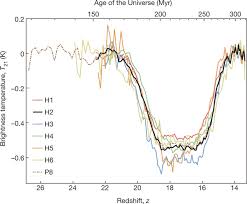
Earlier this year I wrote a brief post about paper by Bowman et al. from the EDGES experiment that had just come out in Nature reportining the detection of a flattened absorption profile in the sky-averaged radio spectrum, centred at a frequency of 78 megahertz, largely consistent with expectations for the 21-centimetre signal induced by early stars. It caused a lot of excitement at the time; see, e.g., here.
The key plot from the paper is this:

At the time I said that I wasn’t entirely convinced. Although the paper is very good at describing the EDGES experiment, it is far less convincing that all necessary foregrounds and systematics have been properly accounted for. There are many artefacts that could mimic the signal shown in the diagram.

I went on to say

If true, the signal is quite a lot larger than amplitude than standard models predict. That doesn’t mean that it must be wrong – I’ve never gone along with the saying `never trust an experimental result until it is confirmed by theory’ – but it’s way too early to claim that it proves that some new exotic physics is involved. The real explanation may be far more mundane.

There’s been a lot of media hype about this result – reminiscent of the BICEP bubble – and, while I agree that if it is true it is an extremely exciting result – I think it’s far too early to be certain of what it really represents. To my mind there’s a significant chance this could be a false cosmic dawn.

I gather the EDGES team is going to release its data publicly. That will be good, as independent checks of the data analysis would be very valuable.

Well, there’s a follow-up paper that I missed when it appeared on the arXiv in May the abstract of which reads:

We have re-analyzed the data in which Bowman et al. (2018) identified a feature that could be due to cosmological 21-cm line absorption in the intergalactic medium at redshift z~17. If we use exactly their procedures then we find almost identical results, but the fits imply either non-physical properties for the ionosphere or unexpected structure in the spectrum of foreground emission (or both). Furthermore we find that making reasonable changes to the analysis process, e.g., altering the description of the foregrounds or changing the range of frequencies included in the analysis, gives markedly different results for the properties of the absorption profile. We can in fact get what appears to be a satisfactory fit to the data without any absorption feature if there is a periodic feature with an amplitude of ~0.05 K present in the data. We believe that this calls into question the interpretation of these data as an unambiguous detection of the cosmological 21-cm absorption signature.

You can read the full paper here (PDF). I haven’t kept up with this particular story, so further comments/updates/references are welcome through the box below!

Sheila Tinney et al.

Posted in History, The Universe and Stuff with tags , on September 2, 2018 by telescoper

I came across the above picture via Twitter the other day. It was taken about 75 years ago, in 1943, the year that Erwin Schrödinger gave his famous lectures in Dublin on the topic What Is Life? Schrödinger is second from the right in the front row, next to Arthur Stanley Eddington (who is to his left as you look a the picture). Next but one to Eddington (to his left as you look at the picture)  is Éamon de Valera (who was Taioseach at the time; apparently he dragged all his cabinet along to Schrödinger’s lectures) and next to him (on the left as you look at the picture) is Paul Dirac. That’s quite a front row!

I’m afraid I don’t know the identity of most of the other people in the picture, apart from the lady on the far left who is Dr Sheila Tinney. She completed a PhD under the supervision of Max Born in just two years and was held in very high regard as a physicist, not least by Schrödinger himself. Sheila Tinney spent her academic career at University College Dublin and passed away in 2010 at the age of 92.

The gender balance in physics has improved a bit since 1943 but we still have a long way to go! Note also the numerous men in clerical garb.

There is a conference coming up in Dublin to mark the 75th anniversary of the What is Life lectures, and there has been quite a lot of interest in Schrödinger in the Irish media as a consequent, such as this piece in the Irish Times.

I guess most readers of this blog will know that Éamon de Valera set up the Dublin Institute for Advanced Studies (DIAS) in 1939 in order to create a position for Schrödinger, who was then basically a refugee from the Nazis. He had attempted to settle in Oxford but his unconventional domestic arrangements – he lived in the same house as his wife and his mistress – met with disapproval. Dublin was far more tolerant, and he took up the post of Director of Theoretical Physics at DIAS in 1940 and stayed in Ireland for 17 years.

If you ask me for a personal opinion about Schrödinger’s private life then I have to say two things. One is that all three members of his ménage à trois seemed quite happy with the arrangement as well as the affairs that Schrödinger had outside it. His wife also had numerous affairs, including one with physicist Hermann Weyl. Unconventional it may have been, but most conventions are pretty silly in my view.

On the other hand, there is a part of Schrödinger’s life that I do find entirely reprehensible, and that is the way he treated some of the women with whom he had affairs. As the Irish Times puts it

‘For Schrödinger, the mystical union of sexual love did not endure for long .. With Erwin it was never able to survive tidings of pregnancy.

The Schrödingers did (unofficially) adopt one of the children he fathered outside his marriage, but he strikes me as someone who wanted (or perhaps needed) the sexual and emotional fulfillment his lovers could give him, but wasn’t prepared to accept the responsibility that goes with human relationships. That strikes me as a very selfish attitude.

A Sign of Progress

Posted in Education, Maynooth on September 1, 2018 by telescoper

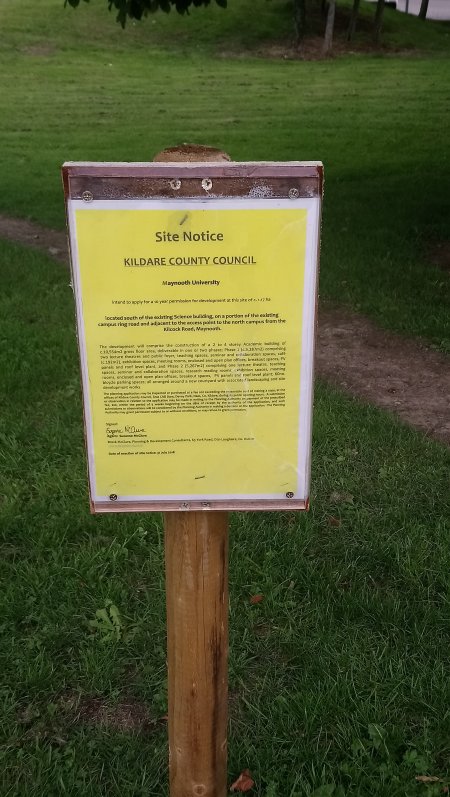
The other day I saw this sign on my way into work. It has been put up near the Science Building on Maynooth University campus, and is a planning notice that hopefully will start the process of constructing extra buildings for science in Maynooth. Among the facilities the new buildings will provide are new teaching laboratories.

Currently, most students doing Science subjects here enter on a four-year general science programme that involves doing four subjects in the first year, becoming increasingly specialised thereafter. That’s not unlike the Natural Sciences course I did at Cambridge, except that students can do both Theoretical Physics and Experimental Physics in the first year as separate choices.

I like this programme because it does not force the students to choose a specialism before they have had a taste of the subject, and that it is flexible enough to accommodate Joint Honours qualifications in, e.g., Theoretical Physics and Mathematics.

The problem we have in Maynooth is that this structure combines with the limited laboratory space in the existing Science Building to create a bottleneck in the first year. We can’t increase our intake without increasing capacity in the labs. This is especially true for Chemistry, which is taken alongside Physics by some students and Biology by others. Increasing laboratory space for chemistry will actually help other disciplines.

It will take several years to construct the new building, and there will probably be a great deal of disruption when the work starts, but in the long run I think it will be worth it.