Earlier this week the Irish Government made an announcement that has ruffled a few feathers: it aims to create a number of new senior positions at Professor level in Irish Universities that are open only to female candidates. I don’t know the details of how this scheme will work, but I understand that the positions will be targeted at subject (and perhaps geographical) areas in which there is a demonstrable gender imbalance and the scheme will cost about €6M.
Reactions to this among people I know have been very varied, so it seems a good topic on which to have a simplistically binary poll:
For the record, I should state that I am broadly in favour of the idea, but I’d like to know more about how these positions will be allocated to institutions, how they will be advertised and how the recruitment will be done. I’ll also add that my main worry about this initiative is that it might distract attention away from the need for Irish higher education institutions to have much better promotion procedures; see, e.g. here. There are plenty of female lecturers in Irish universities, but they seem to face ridiculous difficulties getting promoted to Professorships.
The Dublin Castle homosexual scandal of 1884 is a complex story. It involves more than a dozen characters that were introduced over a series of separate criminal trials. All sections of society were involved. The upper echelons of serving police detectives, eminent civil servants and British Army captains. Aspirational middle-class bank clerks and Trinity college graduates. Right down to the semi-blind brothel-keepers and young male prostitutes who were described as “persons of the lowest class of life”. All of these men were accused in newspapers and in court of having same-sex physical relationships. Irish society was shocked.
My main interest is in one specific aspect of the scandal – the backgrounds and post-prison lives of three men who were convicted of running homosexual brothels in the city in 1884.
But before that, a very brief background.
Tim Healy (Irish Nationalist MP) accused two high-ranking British establishment figures, of being homosexual in the United…
On this tumultuous day in British politics, this blog is proud to be able to show exclusive behind-the-scenes footage of the Cabinet discussions at Number 10 Downing Street:
Following my recent post about the claims and counter-claims concerning the detection (or otherwise) of gravitational waves, I have a couple of updates.
First, a few days ago there appeared a paper on the arXiv by Nielsen et al with the abstract (which I’ve slightly edited for formatting reasons):
We use the Pearson cross-correlation statistic proposed by Liu & Jackson (2016), and employed by Creswell et al. (2017), to look for statistically significant correlations between the LIGO Hanford and Livingston detectors at the time of the binary black hole merger GW150914. We compute this statistic for the calibrated strain data released by LIGO, using both the residuals provided by LIGO and using our own subtraction of a maximum-likelihood waveform that is constructed to model binary black hole mergers in general relativity. To assign a significance to the values obtained, we calculate the cross-correlation of both simulated Gaussian noise and data from the LIGO detectors at times during which no detection of gravitational waves has been claimed. We find that after subtracting the maximum likelihood waveform there are no statistically significant correlations between the residuals of the two detectors at the time of GW150914.
The four authors of this paper are, I believe, either present or former members of the LIGO Collaboration
Meanwhile, the NBI group behind the Cresswell et al. paper challenged by the above paper has issued a statement which you can read here. The group re-iterate points made in the New Scientist article discussed in my recent post. Although the Nielsen et al. paper is not explicitly mentioned in the NBI statement but I’m given to understand that the Danish group does not agree with the conclusions in that paper.
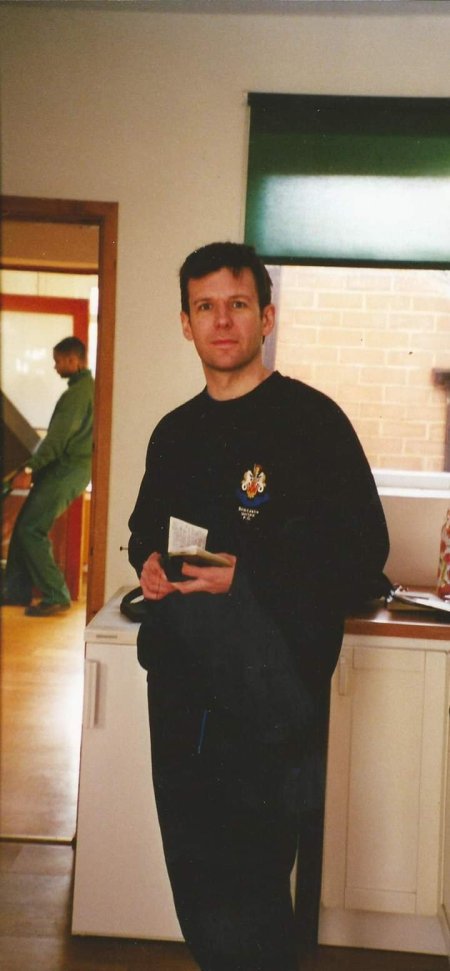
Yesterday evening I suddenly realized that today would be the anniversary of a significant milestone in my life. It was 20 years ago today (on 13th November 1998) that I moved from London to Beeston in Nottingham prior to starting as Professor of Astrophysics at Nottingham University on 1st January 1999. That means I’ve been a Professor for almost twenty years!
I remember it was Friday 13th November 1998 when I took possession of the house I’d bought in Marlborough Road. I picked that particular day to complete the purchase (and sale of my flat in Bethnal Green) because a removals firm offered me a very cheap deal: normally nobody wants to move house on Friday 13th, so they were happy when I turned out not to be superstitious. The move worked out very smoothly, in fact.
This picture taken in the Beeston residence that very day. You can see one of the removal men in the background:
I was still working at Queen Mary until the end of December 1998 so I had to commute to London and back for over a month after relocating, which wasn’t ideal, but bearable knowing that it wasn’t going to last forever, and that from the New Year I would be able to walk into work on the Nottingham University campus rather than trekking by train to London.
I did think leaving London would be a wrench, and that I would probably end up going back frequently to spend time with my old friends and visit regular haunts, but that didn’t really happen, and after living outside the Capital for a while I lost all inclination to ever return. Living in London is great fun when you’re young, but loses its attraction when you’re getting on a bit. That’s what I found, anyway.
It was exciting starting the new job in Nottingham. There wasn’t an Astronomy group as such prior to January 1999, but with the formation of a new group the School of Physics became the School of Physics & Astronomy, and the influx of astronomers helped the School both to expand its research portfolio and become more attractive to students. It was hard work helping to build that from scratch, but I’m glad that it worked out well. It is good to see the Astronomy group and indeed the whole School continuing to prosper, although some of my former colleagues there have now retired.
I moved to Cardiff in 2007 and eventually sold the Beeston house in 2008, after a long delay due to the Credit Crunch, and bought a house in Pontcanna which I still own.
It’s strange to think all that happened 20 years ago. I’ve just finished giving a lecture to our second-year students, most of whom weren’t even born in 1998! And I certainly never imagined back then than in twenty years I’d be living in Ireland!
I’m sorry that this blog is once again the bearer of bad news, but it is my sad duty to pass on the news that distinguished particle physicist James Stirling (pictured above) passed away yesterday at the age of 65.
Professor James Stirling was one of the leading lights of the Institute for Particle Physics Phenomenology in Durham (of which he was the first Director) and subsequently became Jacksonian Professor of Natural Philosophy and Head of the Cavendish Laboratory at the University of Cambridge. More recently he was Provost of Imperial College, a post from which he stepped down earlier this year. He was elected to a Fellowship of the Royal Society in 1999, and awarded a CBE in the New Years Honours List in 2006.
As well as being an eminent physicist, with over 300 publications to his name including fundamental contributions to the field of hadronic interactions and perturbative QCD, Professor Stirling also gave great service to the research community, by serving on numerous important committees, including the Science Board of the Science & Technology Facilities Council (STFC).
Not being a particle physicist myself I didn’t know James as a close colleague, but I met him on several occasions during visits to Durham. Most recently, he was the external member of the appointment panel when I was interviewed for the post of Head of School of Mathematical and Physical Sciences at the University of Sussex. It says a lot for his personality that what I expected to be a fierce grilling when he led the questions on my research, turned out to he a friendly (yet challenging) discussion of some of my publications which he had clearly read extremely carefully.
James Stirling was held in extremely high regard by the scientific community and he’ll be greatly missed.I send my deepest condolences to his family, friends and colleagues.
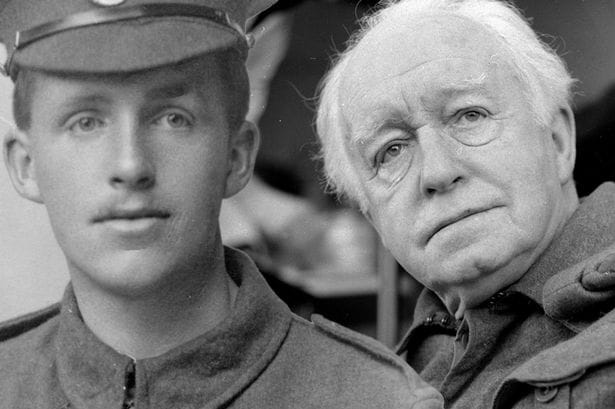
You probably recognize the elderly gentleman in the photograph on the right as Arnold Ridley who played Private Godfrey in the TV comedy series Dad’s Army. You might not have realized that the person on the left is also Arnold Ridley, photographed shortly after he enlisted in the Somerset Light Infantry in 1915. You also may not know that Ridley fought with great courage in the Battle of the Somme in 1916, during which he was very badly injured.
After being ordered to go `over the top’ near Gueudecourt as part of the Somme offensive, many of Ridley’s battalion were killed by machine gun fire as they advanced towards the enemy lines, but Ridley was among those who survived long enough to reach the German trenches.
In the desperate hand-to-hand struggle that ensued as he and the rest of unit fought their way along a trench, Ridley was knocked out by a blow from a rifle butt that turned out to have cracked his skull, and was bayonetted in the groin. His legs were riddled with shrapnel and he received a further bayonet wound to the hand, which left him permanently disabled. Somehow he survived, though for the rest of his life he suffered from blackouts and recurrent nightmares. He was discharged from the army on medical grounds in 1916, at the rank of Lance Corporal.
He never told anyone – not even his family – how he sustained his wartime injuries, and the facts only became known long after his death (in 1984, at the age of 88).
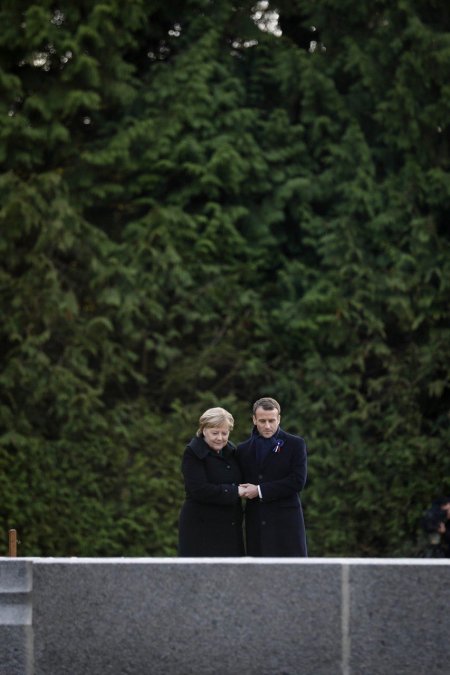
Among all the images produced during this weekend’s commemorations of the centenary of Armistice Day, this image of Angela Merkel and Emmanuel Macron struck me as particularly moving.
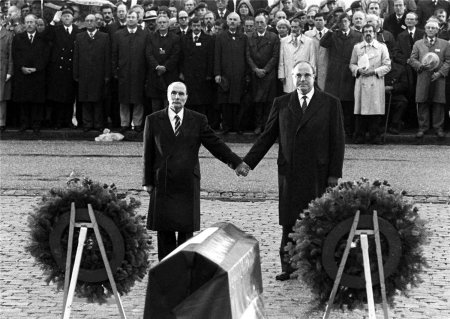
Part of the reasons is that it reminded me of this photograph, of President Mitterand and Chancellor Kohl, taken in 1984:
Exactly one hundred years after the truce that effectively ended the First World War, these images remind us how much suffering took place before Europe reached a point at which war between France and Germany became unthinkable. That peace now looks increasingly fragile as the forces of nationalism, spurred on by populist demagogues, and funded by greedy disaster capitalists, threaten to tear apart the institutions that have brought Europe together in a spirit of mutual cooperation for so long. All that has been achieved could so easily be lost.
As Fintan O’Toole has written in a long article in this weekend’s Irish Times, the First World War is, in many ways, still being fought. The Second World War was certainly very much a continuation of the First, after a break of just over twenty years, to which the short-sightedness of Western governments in their treatment of Germany was a contributing factor. The end of the First World War saw not only the disintegration of the German Empire (and the abdication of the Kaiser), but also the collapse of Tsarist Russia, and the end of the Austro-Hungarian and Ottoman Empires to boot. We are still living with the consequences of that upheaval.
All this reminds us – or should remind us – that the word `armistice’ means `a truce’ or `a suspension of hostilities’ rather than a lasting peace, and it is by no means impossible we could be sleepwalking to disaster once more. As President Macron put it in his speech today
Les démons anciens resurgissent : des idéologies nouvelles manipulent des religions, l’Histoire menace de reprendre son cours tragique. Faisons une fois de plus ce serment des Nations de placer la paix plus haut que tout, car nous en connaissons le prix.
Frankly, I fear very much for the future and take solace only in the fact that I am no longer young.
I have found the pomp and ceremony of this year’s official Armistice commemorations very difficult to endure. Perhaps there are some people, including some in high places, who have learned the lessons of history, but it is also clear that there are very many who have not.
Which brings me to the poppy. I have written quite a few pieces on this blog, around the time of Remembrance Sunday, about the wearing of a poppy, the last being in 2016. I have worn a poppy at this time of year for most of my adult life, but I decided last year to stop.
For one thing, there is no pressure to wear a poppy here in Ireland. Indeed, many Irish people see the poppy mainly as a symbol of British militarism and colonial oppression. Even at Friday’s concert to mark the Armistice I saw only a few audience members wearing a poppy, and most of them were the shamrock version commemorating the sacrifice of Irish soldiers during the Great War.
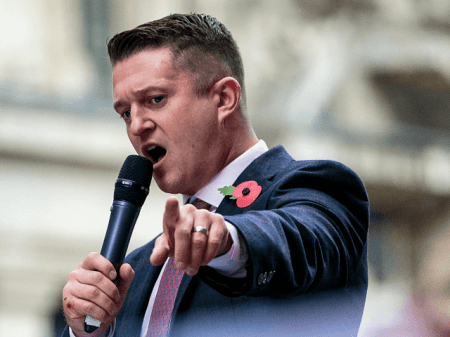
But I don’t think I’ve ever really been that susceptible to peer pressure, so that’s not the main reason for my not wearing a poppy. The main reason is that over the past couple of years the poppy has been appropriated by the likes of racist thug, career criminal and founder-member of the EDL, Stephen Yaxley-Lennon (also known as Tommy Robinson):
I simply cannot bring myself to wear the same badge as this creature, nor can I stand the hypocrisy of those politicians who make a show of wearing it while happily encouraging the rise of nationalism. Enough is enough. The message of the poppy is supposed to be `Lest We Forget’. I’m afraid far too many have already forgotten.
Last night I was back at the National Concert Hall in Dublin for an immensely powerful and moving performance of Benjamin Britten’s War Requiem. This vast work is composed for two orchestras (a standard symphony orchestra and a smaller chamber orchestra), two choirs (a chorus of adult voices and a boy’s choir) and three solo vocalists. Last night the soloists were Ailish Tynan (soprano), Gavan Ring (baritone) and Robin Tritschler (tenor), who performed with the combined forces of the RTÉ National Symphony Orchestra, the RTÉ National Concert Orchestra, the RTÉ Philharmonic Choir and the boy Choristers of St Patrick’s Cathedral in Dublin, all conducted by David Brophy.
You can see the members of the Philharmonia Choir in position in the above photograph, which I took about ten minutes before the performance began; the choristers were out of sight in the gallery above and behind me, near where the President of Ireland, Michael D Higgins, was sitting.
The War Requiem was commissioned for the consecration in 1962 of the new Coventry Cathedral built to replace the 14th century cathedral that was destroyed along with most of the city in a devastating air raid ion 1940. It’s a remarkable work that juxtaposes settings of traditional liturgical Latin texts against poems by Wilfred Owen. The idea of doing this may have originated with the first poem Britten uses, Anthem for Doomed Youth, which itself deploys words associated with religious services to emphasize the soulless brutality of warfare:
What passing-bells for these who die as cattle? -Only the monstrous anger of the guns. Only the stuttering rifles’ rapid rattle Can patter out their hasty orisons. No mockeries now for them; no prayers nor bells; Nor any voice of mourning save the choirs,- The shrill, demented choirs of wailing shells; And bugles calling for them from sad shires.
What candles may be held to speed them all? Not in the hands of boys but in their eyes Shall shine the holy glimmers of good-byes. The pallor of girls’ brows shall be their pall; Their flowers the tenderness of patient minds, And each slow dusk a drawing-down of blinds.
These settings are sung by soloists accompanied by the smaller chamber orchestra (positioned at the front of the stage) while the more traditional liturgical elements involve the larger forces arrayed behind.
I’ve known this work for many years largely through the classic 1963 recording conducted by Britten himself, with Galina Vishnevskaya, Peter Pears and Dietrich Fischer-Dieskau as soprano, tenor and baritone soloists respectively. I’m so familiar with that version that it was at first a little disconcerting to hear very different voices, but that very soon gave way into an appreciation of three very fine artists in their own right. All three were excellent last night, but I have to give extra special plaudits to Ailish Tynan, who sang with extraordinary passion in the Sanctus and Libera Me. The Latin text of the latter section includes:
Tremens factus sum ego, et timeo dum discussio venerit, atque ventura ira. Libera me, Domine, de morte aeterna. Quando coeli movendi sunt i terra. Dies illa, dies irae, calamitatis et miseriae, dies magna et amara valde. Libera me, Domine.
Ailish Tynan performed this not just as an evocation of the horrors of wars past but also with a sense of anguished foreboding about wars yet to come. It was deeply moving and clearly heartfelt. I found this from her on Twitter this morning:
1. Last night was a remarkable night for me in so many ways. I sang my first Britten Requiem in my home country. It was attended by our President and was greeted by a standing ovation in the National Concert Hall Dublin. In a world gone mad this felt incredible.
The first few bars of the War Requiem are enough to tell you right from the start this is music is coming from the same imagination that gave us Peter Grimes and a host of other masterpieces, and the quality of the music is sustained throughout the 85 minutes or so of its duration. There are some wonderful touches in the orchestration, such as the Dies Irae (with a definite nod in the direction of Verdi, but with tricky 7/8 rhythms). The Boys Choir was also used extremely effectively, the fact that they could not be seen (at least by me) adding to the ethereal quality of their voices. In all, it added up to an intense experience, I think for the musicians as well as the audience.
At the end of the music, David Brophy kept his arms (and baton) extended for a considerable time before gradually lowering them to signal the end of the performance. I really appreciated that several seconds of silence, which was immaculately observed by the audience. It’s good to have a time to reflect on what you’ve just heard before the applause begins. When the ovation had died down, the elderly lady sitting next to me (whom I’d never met before) turned to me and said `Wasn’t that wonderful?’. It was only then that I realised how powerfully I’d been affected. I tried to answer, but found I was a bit choked, and all I could get out was “Yes, it was”. I hope that didn’t come across as rude. It’s just that sometimes music expresses things that words can’t convey. Actually, come to think of it, that’s what it’s for.
Anyway, you don’t need to take my word for how good a concert it was, because you can watch the whole thing here:
(Please note that there are quite a few minutes of blank screen before it starts, but it is there!)
Congratulations to all the musicians involved last night for a tremendous performance, and thank you for a wonderful experience. It was a privilege to be there.
Just a quick post to point out the exciting news that this week a clutch of papers on cosmology using Type 1a Supernovae have been released by the Dark Energy Survey team. Naturally, all of them are on the arXiv. You can also read them here. For convenience I’ve provided links below to arXiv versions through their titles:
Here’s a plot showing some of the cosmological constraints:
The parameter plotted on the vertical axis is the dark energy equation of state parameter, w, and w=-1 corresponds to a cosmological constant.
For those of youparticularly interested in the Hubble constant, the headline value from Paper 6 is H0 = 67.77 +/- 1.30 km s-1 Mpc-1. This closer to the value obtained from Planck and in tension with other values as I’ve blogged about before, and gives me an excuse to continue my online poll:
The views presented here are personal and not necessarily those of my employer (or anyone else for that matter).
Feel free to comment on any of the posts on this blog but comments may be moderated; anonymous comments and any considered by me to be vexatious and/or abusive and/or defamatory will not be accepted. I do not necessarily endorse, support, sanction, encourage, verify or agree with the opinions or statements of any information or other content in the comments on this site and do not in any way guarantee their accuracy or reliability.




 In the Dark