Archive for May, 2019

Marking the End of Term

Posted in Maynooth with tags , , , , , on May 11, 2019 by telescoper

So here we are, then. The term is finally over. Lectures officially finished yesterday, and there’s now another week or so before examinations start (next Friday, 17th May). The examinations for my two modules take place on Tuesday 21st and Wednesday 22nd May, and after that I’ll be busy with marking for a while. In fact, I’ll probably be getting much busier in general pretty soon, but more of that in due course…


Marking doesn’t just mean written examinations. I have been teaching a module on Computational Physics to 3rd Year students here in Maynooth, and 40% of the assessment for that is a mini-project (usually done in groups of two or three). Early on the term, I put up a list of a dozen or so projects and ask them to pick first second and third choices so I can form groups in such a way that most students get to work on a project they like the look of. This year I made up a new set of projects, but I feel a bit sorry for one of them (`Scattering in a Spherical Potential’), which didn’t appear anywhere \at all on any student’s list of preferences. That’s a shame as I thought it was a well-rounded project, with lots of potential. Hopefully it will prove more popular next year…

Anyway, the deadline for projects to be handed in came yesterday so I’ve got a stack of those to mark which, you will realise, why I am indulging in a displacement activity by writing this blog post. My plan is to mark these next week so that they’re done before the written examinations come in.

Before I get on with what I should be doing I’ll just mention another thing that happened yesterday: the President of Ireland (Uachtarán na hÉireann), Michael D. Higgins visited Maynooth University yesterday:

That’s him at the front, on the right, of course. The reason for his visit was to attend a memorial service.

Dreaming and Screaming

Posted in Biographical with tags , on May 10, 2019 by telescoper

A few weeks ago I had a very bad dream and, unlike most dreams I have, I didn’t forget it immediately afterwards. In fact I keep thinking about it, although it hasn’t recurred. I’m not sure why I decided to share it here, but here goes..

In the dream I am giving a lecture using a blackboard in a lecture theatre to a group of students. The lecture theatre isn’t a specific room that I remember and the students in the audience are not people that I recognise at all.

Anyway, I’m busy talking when the door at one side of the front of the theatre opens to reveal not the standard corridor that you would expect alongside a lecture theatre a university building but a very long corridor leading off into the distance.

I pay little attention and carry on lecturing. A few moments later I look out along the corridor where, off in the distance, there is a very dark object. It’s very far aware and I can make out no details. I turn my attention back to the lecture.

This happens several times, and each time the shape is closer to the doorway to the lecture theatre. It remains indistinct in shape. No arms or legs or head, just a sort of black blob. It is not sharply delineated around the ages nor does it suggest any sense of depth. It’s like someone has painted something a very dense black into the air. It’s not obvious even how it moves as it does not appear to be on the ground and seems still every time I look at it, but each time I look away and look back it has moved closer. I am getting more and more frightened.

Eventually the shape is in the doorway, about to enter the room, and I’m now completely terrified. I look at the audience in the lecture theatre and they have all gone away. There’s just me and the thing.

As I watch, the thing enters the room. At this point I decide to run away, but I can’t move. I try again but I’m rooted to the spot. I scream, but I can make no sound. The thing moves closer. And closer.

Eventually, with the thing just a few feet away, my attempts to scream succeed. I screech at the top of voice.

At this point I woke up with a start. I’m pretty sure that I really did scream in my sleep and it was that noise that woke me up. I hope I didn’t wake up my neighbours! My heart was pounding and I was sweating. There being no possibility of going back to sleep, I got up and had a glass of water. It was about 4am. I didn’t sleep any more that night.

I’m by no means an expert in the interpretation of dreams but on the occasions when I can remember what I’ve dreamed about it always seems to be a weird juxtaposition of things I’ve experienced in the previous day or two.

My interpretation of this sort of thing is that during a dream the sleeping brain is sifting through recent experiences and relating them to others, including recent events and things lodged in long-term memory. If I’m right, then this kind of dream is basically a by-product of the workings of a sort of subconscious filing system.

There are other kinds of dream, of course, and they don’t always fit into this pattern. In my experience the majority don’t make any sense at all, so I won’t say any more about that class. I don’t know how many people have regular recurrent dreams, but I do; these are of two types. The first is a standard `anxiety’ dream. I could be sitting in an orchestra on the stage of a concert hall, or some similar situation. I have a musical instrument in my hands and am dressed for the part, like all the other musicians. It is shortly before the performance is due to start. The problem is that I don’t actually know how to play the instrument. Time is ticking away and I’m soon to be found out. How do I escape?

The second type of recurrent dream is harder to fathom. I’ve moved around quite a lot during my career. In this kind of dream I’m supposed to be back in one of the places I used to live, but it’s curiously different from what it was like in reality. One example involved me being back in my old flat in Bethnal Green. Exploring the place I took a nice walk through the French windows and into the garden. Trouble is, the flat didn’t actually have French windows or a garden. How could it? It wasn’t even on the ground floor…

Anyway it seems obvious that the black thing in the corridor represents some sort of anxiety, a kind of variation of the type I mentioned above, but I’m intrigued by the fact that it had no discernible form. It was just a pool of blackness. It wouldn’t have made a very impressive monster in a horror film, but it was certainly terrifying.

Now, would any psychoanalysts out there like to interpret this for me?

The 2019 Gruber Prize for Cosmology: Nick Kaiser and Joe Silk

Posted in The Universe and Stuff with tags , , , , , , , on May 9, 2019 by telescoper

I’ve just heard that the Gruber Foundation has announced the winners of this year’s Gruber Prize for cosmology, namely Nick Kaiser and Joe Silk. Worthy winners the both of them! Congratulations!

Here’s some text taken from the press release:

The recipients of the 2019 prize are Nicholas Kaiser and Joseph Silk, both of whom have made seminal contributions to the theory of cosmological structure formation and to the creation of new probes of dark matter. Though they have worked mostly independently of each other, the two theorists’ results are complementary in these major areas, and have transformed modern cosmology — not once but twice.

The two recipients will share the $500,000 award, and each will be presented with a gold medal at a ceremony that will take place on 28 June at the CosmoGold conference at the Institut d’Astrophysique de Paris in France.

The physicists’ independent contributions to the theory of cosmological structure formation have been instrumental in building a more complete picture of how the early Universe evolved into the Universe as astronomers observe it today. In 1967 and 1968, Silk predicted that density fluctuations below a critical size in the Cosmic Microwave Background, the remnant radiation “echoing” the Big Bang, would have dissipated. This phenomenon, later verified by increasingly high precision measurements of the CMB, is now called “Silk Damping”.

In the meantime, ongoing observations of the large-scale structure of the Universe, which evolved from the larger CMB fluctuations, were subject to conflicting interpretations. In a series of papers beginning in 1984, Kaiser helped to resolve these debates by providing statistical tools that would allow astronomers to separate “noise” from data, reducing ambiguity in the observations.

Kaiser’s statistical methodology was also influential in dark matter research; the DEFW collaboration (Marc Davis, George Efstathiou, Carlos Frenk, and Simon D. M. White) utilised it to determine the distribution and velocity of dark matter in the Universe, and discovered its non-relativistic nature (moving at a velocity not approaching the speed of light). Furthermore, Kaiser devised an additional statistical methodology to detect dark matter distribution through weak lensing — an effect by which foreground matter distorts the light of background galaxies, providing a measure of the mass of both. Today weak lensing is among cosmology’s most prevalent tools.

Silk has also been impactful in dark matter research, having proposed in 1984 a method of investigating dark matter particles by exploring the possibilities of their self-annihilations into particles that we can identify (photons, positrons and antiprotons). This strategy continues to drive research worldwide.

Both Kaiser and Silk are currently affiliated with institutions in Paris, Kaiser as a professor at the École Normale Supérieure, and Silk as an emeritus professor and a research scientist at the Institut d’Astrophysique de Paris (in addition to a one-quarter appointment at The John Hopkins University). Among their numerous significant contributions to their field, their work on the CMB and dark matter has truly revolutionised our understanding of the Universe.

I haven’t worked directly with either Nick Kaiser or Joe Silk but both had an enormous influence on me, especially early on in my career. When I was doing my PhD, Nick was in Cambridge and Joe was in Berkeley. In fact I think Nick was the first person ever to ask me a question during a conference talk – which terrified the hell out of me because I didn’t know him except by scientific reputation and didn’t realize what a nice guy he is! Anyway his 1984 paper on cluster correlations was the direct motivation for my very first publication (in 1986).

I don’t suppose either will be reading this but heartiest congratulations to both, and if they follow my advice they won’t spend all the money in the same shop!

P.S. Both Nick and Joe are so distinguished that each has appeared in my Astronomy Lookalikes gallery (here and here).

The New IOP Physics Technician Award

Posted in Education, The Universe and Stuff with tags , , , , on May 8, 2019 by telescoper

Picture Credit: Cardiff University School of Physics & Astronomy

I remember a few years ago one of my colleagues when I worked in the School of Physics & Astronomy at Cardiff University, Steven Baker, won an award for being the best STEM Technician in the category of Physical Sciences in the whole country! At the time this was a new award set up by the Higher Education Academy, so Steven was the inaugural winner of it.

Now there’s another new award, this time from the Institute of Physics and dedicated to Physics technicians (not necessarily in universities). I quote:

The IOP Technician Award enables the community to recognise and celebrate the skills and experience of technicians and their contribution to physics.

You can find full details of how to nominate an awardee here. The deadline is 14th June 2019. The prize is worth £1000, but more importantly it serves to encourage Physics departments to reflect on the vital role played by technicians. I feel very strongly that the contribution made by support staff in university departments is drastically undervalued.  No Physics department can run without a dedicated technical support team who apply their skills and expertise in both teaching and research laboratories. Even a department like mine dedicated purely to Theoretical Physics needs computing support, and there are many more people – including clerical staff, library staff, etc – without whom many of our activities would grind to a halt. None of these support staff gets the recognition they deserve; they are often poorly paid and lack an appropriate career structure that reflects the importance of the work they do.

As well as being a nice award this is an opportunity to remind us academics that we couldn’t do what we do without others doing all the difficult stuff!

So please get your nominations in!

What to do if you find yourself inside the horizon of a black hole

Posted in The Universe and Stuff with tags , , , on May 7, 2019 by telescoper

Consider how lucky you are that life has been good to you so far.

Alternatively, if life hasn’t been good to you so far – which, given your current circumstances seems more likely – consider how lucky you are that it won’t be bothering you much longer.

That was the advice given to Ford Prefect by The Hitchhikers Guide to the Galaxy when he looked up `What do if you find yourself in a crack in the ground underneath a giant boulder you can’t move with no hope of rescue’. It seems fairly general advice to me, though. If you want more specific advice on what to do if you find yourself inside the horizon of a black hole then you can find it in an interesting paper on the arXiv with the abstract:

In this methodological paper we consider two problems an astronaut faces with under the black hole horizon in the Schwarzschild metric. 1) How to maximize the survival proper time. 2) How to make a visible part of the outer Universe as large as possible before hitting the singularity. Our consideration essentially uses the concept of peculiar velocities based on the “river model”. Let an astronaut cross the horizon from the outside. We reproduce from the first principles the known result that point 1) requires that an astronaut turn off the engine near the horizon and follow the path with the momentum equal to zero. We also show that point 2) requires maximizing the peculiar velocity of the observer. Both goals 1) and 2) require, in general, different strategies inconsistent with each other that coincide at the horizon only. The concept of peculiar velocities introduced in a direct analogy with cosmology, and its application for the problems studied in the present paper can be used in advanced general relativity courses.

It is advertised as a `methodological paper’ and I don’t know if they are planning experimental studies of this problem. I imagine might be difficult to secure funding.

Is there a role for rote learning?

Posted in Education, Maynooth with tags , , , , , , , on May 7, 2019 by telescoper

So here we are, then, back to work here in Maynooth for the last week of teaching. Or, to be precise, the last four days – yesterday was a Bank Holiday. With university and school examinations looming, it is no surprise to find an article griping about the Irish Leaving Certificate examinations and the fact that teachers seem to encourage students to approach them by by rote learning. This is something I’ve complained about before in the context of British A-levels and indeed the system of university examinations.

Over my lifetime the ratio of assessment to education has risen sharply, with the undeniable result that academic standards have fallen – especially in my own discipline of physics. The modular system encourages students to think of modules as little bit-sized bits of education to be consumed and then forgotten. Instead of learning to rely on their brains to solve problems, students tend to approach learning by memorizing chunks of their notes and regurgitating them in the exam. I find it very sad when students ask me what derivations they should memorize to prepare for examinations because that seems to imply that they think their brain is no more than a memory device. It has become very clear to me over the years that school education in the UK does not do enough to encourage students to develop their all-round intellectual potential, which means that very few have confidence in their ability to do anything other than remember things. It seems the same malaise affects the Irish system too.

On the other hand, there’s no question in my mind that a good memory is undoubtedly an extremely important asset in its own right. I went to a traditional Grammar school that I feel provided me with a very good education in which rote learning played a significant part. Learning vocabulary and grammar was an essential part of their approach to foreign languages, for example. How can one learn Latin without knowing the correct declensions for nouns and conjugations for verbs? But although these basic elements are necessary, they are not sufficient. You need other aspects of your mental capacity to comprehend, translate or compose meaningful pieces of text. I’m sure this applies to many other subjects. No doubt a good memory is a great benefit to a budding lawyer, for example,  but the ability to reason logically must surely be necessary too.

The same considerations apply to STEM disciplines. It is important to have a basic knowledge of the essential elements of mathematics and physics as a grounding, but you also need to develop the skill to apply these in unusual settings. I also think it’s simplistic to think of memory and creative intelligence as entirely separate things. I seems to me that the latter feeds off the former in a very complex way. A good memory does give you rapid access to information, which means you can do many things more quickly than if you had to keep looking stuff up, but I think there’s a lot more to it than that. Our memories are an essential part of the overall functioning of our brain, which is not  compartmentalized in  a simple way.  For example, one aspect of problem-solving skill relies on the ability to see hidden connections; the brain’s own filing system plays a key role in this.

Recognizing the importance of memory is not to say that rote learning is necessarily the best way to develop the relevant skills. My own powers of recall are not great – and are certainly not improving with age – but I find I can remember things much better if I find them interesting and/or if I can see the point of remembering them. Remembering things because they’re memorably is far easier than remembering because you need to remember them to pass an examination!

But while rote learning has a role, it should not be all there is and my worry is that the teaching-to-the-test approach is diminishing the ability of educators to develop other aspects of intelligence. There has to be a better way to encourage the development of the creative imagination, especially in the context of problem-solving. Future generations are going to have to face many extremely serious problems in the very near future, and they won’t be able to solve them simply by remembering the past.

With Strings Attached?

Posted in Biographical, The Universe and Stuff with tags , on May 6, 2019 by telescoper

Image Credit: Flickr user Trailfan.

I was flicking through various posts on the interwebs this morning while I was having my breakfast and came across one that nearly made me choke on my muesli. What it’s like to be a theoretical physicist is a piece in Stanford University news. In it I found the following quote:

String theory feels like a little superpower that I have, this physical intuition that enables me to make connections and have insights into things that by rights I should not be able to say anything interesting about.

I’ve tried many times to read that in a way that doesn’t come across as arrogant, but I’m afraid I’ve failed – especially because (speaking as a physicist) I don’t think string theory has so far given us any profound insights into physics at all.

Now I’m mindful of the fact that many mathematicians think string theory is great. I’ve had it pointed out to me that it has a really big influence on for example geometry, especially non-commutative geometry, and even some number theory research in the past 30 years. It has even inspired work that has led to Fields medals. That’s all very well and good, but it’s not physics. It’s mathematics.

Of course physicists have long relied on mathematics for the formulation of theoretical ideas. Riemannian geometry was `just’ mathematics before its ideas began to be used in the formulation of the general theory of relativity, a theory that has since been subjected to numerous experimental tests. It may be the case that string theory will at some point provide us with predictions that enable it to be tested in the way that general relativity did. But it hasn’t done that yet and until it does it is not a scientifically valid physical theory.

I remember a quote from Alfred North Whitehead that I put in my PhD DPhil thesis many years ago. I wasn’t thinking of string theory at the time, but it seems relevant:

There is no more common error that to assume that, because prolonged and accurate mathematical calculations have been made, the application of the result to some fact of nature is absolutely certain.

My problem is not with string theory itself but with the fact that so many string theorists have become so attached to it that it has become a universe in its own right, with very little to do with the natural universe which is – or at least used to be – the subject of theoretical physics. I find it quite alarming, actually, that in the world outside academia you will find many people who think theoretical physics and string theory are more-or-less synonymous.

The most disturbing manifestation of this tendency is the lack of interest shown by some exponents of string theory in the issue of whether or not it is testable. By this I don’t mean whether we have the technology at the moment to test it (which we clearly don’t). Many predictions of the standard model of particle physics had to wait decades before accelerators got big enough to reach the required energies. The question is whether string theory can be testable in principle, and surely this is something any physicist worthy of the name should consider to be of fundamental importance?

P.S. This rant reminded me of the time I got severely told off by a very senior British physicist (who shall remain nameless) when I was quoted in Physics World as saying that I thought that in a hundred years time string theory would be of more interest to sociologists than physicists…

Maynooth University Library Cat Update

Posted in Maynooth with tags on May 5, 2019 by telescoper

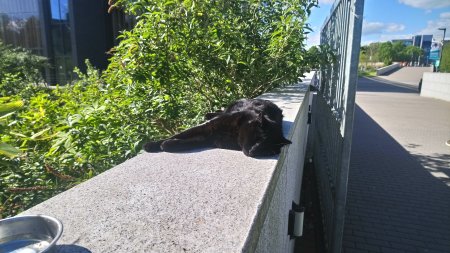
This Bank Holiday Weekend Maynooth University Library Cat is mainly operating in horizontal mode. I don’t blame him. Life must be exhausting for a feline celebrity.

The Astronomer and The Hat

Posted in Television with tags , , , , on May 4, 2019 by telescoper

There’s been a lot of activity recently on social media, and perhaps even between real people, relating to Game of Thrones (which is, apparently, a television fantasy drama series of some sort). I don’t have a television at home so I haven’t seen any of this series at all. I do have a laptop with a DVD player so I suppose I could watch it that way but I suspect I’d find it rather childish. Being more interested in serious programmes I have instead in recent evenings been watching a selection of episodes from my complete boxed set of Ivor the Engine, a gritty documentary series about life on and around the Merioneth and Llantisilly Railway Traction Company Limited, which operates in the `top left-hand corner of Wales’.

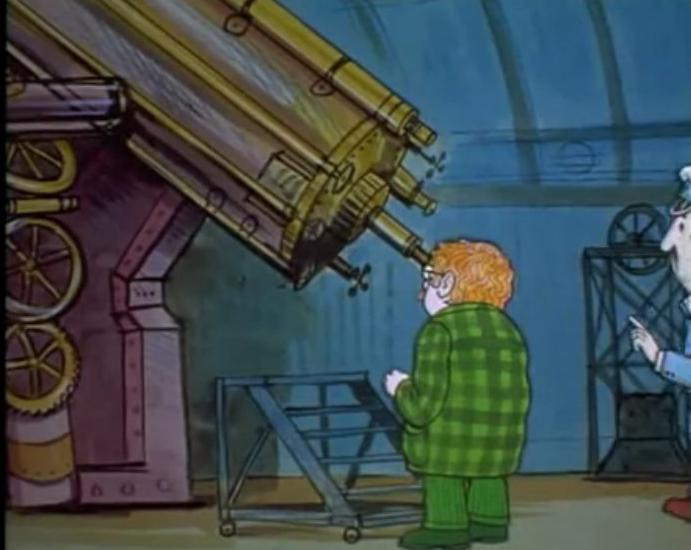
Not many people seem to know that there is an astronomical connection with Ivor the Engine, seen above in the form of Professor D. Longfellow. He lives in Observatory Villa, Llaniog, has his own personal telescope and is sometimes consulted for answers to various problems. He thus provides an excellent illustration of the wider impact of astronomy in everyday life. In the screen grab above he is being interrupted by Dai Station who needs to know the location of the nearest volcano as he has found some dragon eggs that need to be kept warm.

Professor Longfellow makes an extended appearance in the following Episode, entitled The Hat, the central character of which is Mrs Porty, who is rich – so rich, in fact, that she has new hats sent to her all the way from London. At the risk of upsetting people with a plot spoiler, Mrs Porty goes around with a telescope cover on her head because she collected the wrong box from the railway station thinking it was a new hat.

P.S. If anyone knows where I can buy an outfit like Professor Longfellow’s please let me know. I feel I could
advance my career in astronomy even further if I wore more appropriate clothing.

Local Election News

Posted in Maynooth, Politics with tags , , , on May 3, 2019 by telescoper

As results come in from the local elections held in the Disunited Kingdom yesterday, I see that the results have been so bad for the Conservative Party that one Tory MP has been reduced to tears. You’d have to have a heart of stone not to burst out laughing. It’s also rather hilarious to see various factions (including the BBC news) spin the big gains of the Liberal Democrats as a message to `get on with Brexit’, but at the same time it’s also sad to see a country so gripped by madness that it is reduced to such a state.

UPDATE: With 218 out of 248 English Councils having been counted, the Conservative Party has lost an impressive 1072 councillors, but not to Labour who have lost 110. The big winners are the Liberal Democrats (+582), the Greens (+152) and Independents (+505). UKIP are also down by 99 to just 29 councillors. Both Labour and Tories are still claiming that this sends a message to get on with Brexit. Bizarre. I wonder what they think a message to stop Brexit would look like?

Anyway there were no local elections in Wales yesterday so I didn’t vote. I am still eligible to do so, of course, as I pay Council Tax on my house in Cardiff. I would have had a tricky problem deciding what to do if I had. As a lifelong Labour voter (and member until recently) I can no longer support them because of their `policy’ on Brexit, so probably would have voted for Plaid Cymru. That’s who I would vote for in the European Parliament elections.

I am eligible to vote in both the United Kingdom (Wales) and Ireland for the forthcoming European Parliament elections (assuming they go ahead), but one is supposed to vote in one or the other rather than both so I’ve decided to vote here as this is the country in which I am `normally resident’. The European Parliament elections take place here in Ireland on Friday 24th May (three weeks from today) at the same time as the local council elections here.

Kildare County Council will have 40 councillors of which five are elected in Maynooth. For the purpose of the European Parliament elections, Ireland is divided into three multi-member constituencies: Dublin, Ireland South and Midlands North-West. Maynooth is in the last of these, which stretches from Kildare across to Galway and up to Donegal. It will elect four MEPs. The same voting method is used in both elections: the single transferable vote.

(The UK has multi-member constituencies for the European Parliament elections too, but uses the D’Hondt system in which one votes for a party list rather than an individual.)

I’m a relative newcomer to Irish politics, and am yet to decide who to vote for in these elections. I certainly won’t vote for either of the two leading neoliberal/conservative parties, Fine Gael or Fianna Fáil. Sinn Féin will probably be top of my list of preferences in both ballots. On the other extreme, tax-dodger, racist gobshite and failed Presidential candidate Peter Casey is sure to be bottom of my list for the MEP elections: he’s unfit for any kind of public office, in my opinion.

Apart from the different voting system(s) and dates, there is another noticeable difference between the UK and Ireland at election time:

Posters like this pop up everywhere on lampposts during election (and referendum) campaigns in Ireland, as opposed to the larger billboard-type posters that seem to be favoured in Britain. At least these show you what your candidates look like, which is not the case if you vote for a party list. Such posters are specifically permitted by law but most be taken down within a certain time after the election, otherwise the party responsible is fined.