Archive for August, 2020

Eye Solved Cyclops

Posted in Crosswords with tags , , , on August 21, 2020 by telescoper

I am a long-term subscriber to Private Eye but since I have moved to Ireland the issues occasionally get lost. This morning I found No. 1527, published on 31st July. It’s too late to send in the crossword for the £100 prize, but I did the puzzle anyway.

I remember a while ago staying with a friend of mine – also an Eye subscriber, but not a crossword fan – and with his permission I did the puzzle in the copy he had lying around. When I showed him the solution he said that even with the answers he didn’t understand it. I think this is not an uncommon reaction from people who don’t attempt cryptic crossword puzzles regularly, so I thought it might be fun to post my solution to this one along with the clues so perhaps you can see how they work. I don’t think the Eye puzzle is really all that difficult, as cryptic crosswords go, although there are some in-jokes and there is quite a lot of fairly coarse humour!

If anyone wants any of the answers explained then please let me know through the comments box.

Incidentally, the person who sets the crosswords for Private Eye under the pseudonym Cyclops is called Eddie James and he also sets crosswords for the Guardian under the pseudonym Brummie. Presumably he’s from the Midlands.

O-Level Latin Examinations, Vintage 1979

Posted in Biographical, Education with tags , , , , , , on August 20, 2020 by telescoper

Since I’ve just finished marking all my repeat examinations, and examinations are in the news for other reasons, I thought I’d fish out one of the GCE O-level examinations that I took way back in 1979 when I was 16. I have from time to time posted examinations in Mathematics and Science subjects at both O-level and A-level, but I thought it would be fun to share something quite different. In fact my best mark at O-level was in Latin. Latin was a compulsory subject at my (old-fashioned) Grammar School, by the way.

The first of the two Latin exams was basically about the language, and involved unseen translation and comprehension tests. The second involved parts of two set books. We did Book II of Virgil’s Aeneid, a verse epic in strict hexameter, and Book V of Caesar’s Gallic Wars De Bello Gallico. These formed Sections A and B of the same examination although they appear as separate papers. The bit of the Aeneid we did included the Trojan Horse (actually Greek Horse, obviously) and the famous line `Timeo Danaos et dona ferentes’…

The GCE O-levels were replaced by GCSEs a few years after I did mine and I’m not sure how many people do Latin at GCSE these days (or indeed at Leaving Certificate) but I’d be interested in any comments on how these exams compare with modern ones!

A Revolutionary Manhole Cover

Posted in Architecture, History, Maynooth with tags , , , , , on August 20, 2020 by telescoper

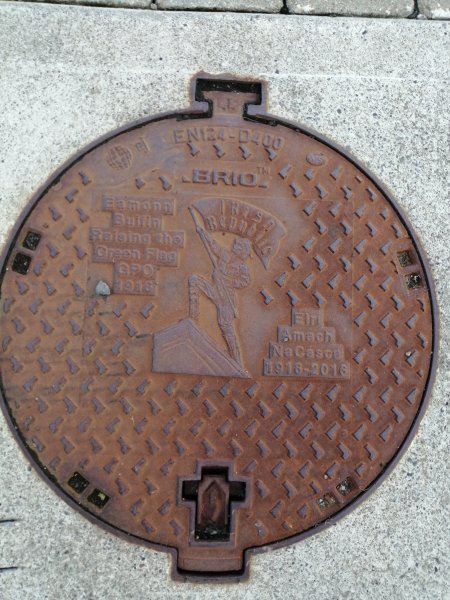
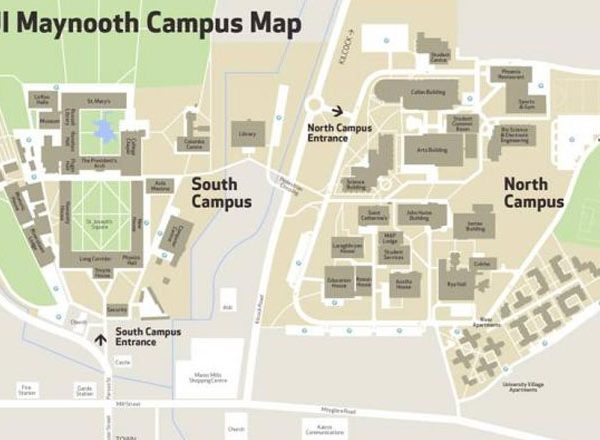
I must have walked dozens of times past the above manhole cover on Maynooth University’s North Campus without paying too much attention. Then I noticed a post on Twitter of another such cover in County Kerry, in the thread following which someone mentioned one on Maynooth campus so I thought I’d take a picture of it. They must have been made for the centenary commemorations in 2016. There’s more than a hint of Soviet-style design in the artwork.

The figure depicts Eamon Bulfin raising the flag of Irish Republic above the GPO on Easter Monday 1916, the start of the Easter Rising. After the end of the rising Bulfin was condemned to death, but his sentence was commuted and, after being imprisoned in Britain for a time, he was deported to Argentina. He returned to Ireland when the Irish Free State in 1922 where he lived until his death in 1968.


Storm Scenes

Posted in Film with tags , , , on August 19, 2020 by telescoper

Ireland, especially the South and West thereof, is bracing itself tonight for the arrival of Storm Ellen. It seems likely to reach Maynooth in the early hours of tomorrow morning but will probably have dissipated a bit by then.

Anyway, the thought of a storm battering the Irish coast reminded me of the memorable storm scenes in David Lean’s 1970 film Ryan’s Daughter. The film crew had to wait almost a year near the coast at Dingle for a sufficiently violent storm but when one arrived they caught its elemental power superbly. No CGI in these shots!

https://youtu.be/xjZ2VeaXGgs

I love the long shots of the people scurrying like ants on top of the cliff. Their movement makes them look terrified. I suspect they weren’t acting.

Update: it was indeed a very stormy night. I was woken up a few times by the gales, and there are lots of reports on the radio of fallen trees and debris, but I don’t know of any serious damage here in Maynooth.

Covid-19 in Ireland: No End in Sight

Posted in Covid-19, Maynooth with tags , , , on August 19, 2020 by telescoper

Yesterday the Irish Government put the brakes on the relaxation of the restrictions imposed because of the Covid-19 pandemic and tightened up some existing rules. The reason for this move is obvious when you look at the data:

After dropping to very low numbers of new cases a couple of months ago, the curve has been steadily rising. On Saturday 200 new cases were reported and yesterday the figure was 190. The average number of cases per day over the last 7 days is now over a hundred. The last time it was that high was in early May.

So what has gone wrong?

A large fraction of the cases appearing in the latest outbreaks is associated with either meat (or other food) processing plants and with direct provision centres. These are particularly vulnerable to outbreaks because of the difficulty of maintaining social distancing. Most of the people involved however are under the age of 40, so these outbreaks are not (yet) associated with a significant increase in mortality. Until recently it was hoped these localised `events’ could be contained by testing, contact-tracing and isolation.

Unfortunately these outbreaks are happening at a time when public adherence to Covid-19 restrictions has also been declining. I have noticed over the past few weeks that many people in Maynooth are congregating outside, especially in Courthouse Square, without any attempt at social distancing and with nobody wearing a face masks. Pubs in the area are serving drinks to take away and people are just taking them outside and treating the public areas as a big beer garden. The law it seems can do nothing about this, and pub landlords are doing nothing to discourage it.

The problem in this respect started back in June when the (then) Taoiseach Leo Varadkar decided to accelerate the stages of the Roadmap. I didn’t understand this at the time. The plan was carefully thought out and was working. Why change it? The answer is of course intensive lobbying from vested interests worried about the impact on their own finances.

Anyway, the effect of this change was immediately noticeable in that a sizeable contingent of the public clearly thought it was a signal that the Covid-19 outbreak was over and became complacent about the continuing risk of community transmission.

I think of the outbreaks in factories and direct provision centres as sparks that can hopefully be snuffed out quickly. The real risk to the public however is from these sparks spreading the conflagration into the general population. Social distancing acts like a sort of fire break – that’s what the new restrictions are trying to achieve.

What this means for the next month or so I can’t say, but I wouldn’t rule out a full lockdown being imposed again.I hope that doesn’t happen because I am looking forward to getting back to teaching, but it’s looking touch-and-go at the moment.


The U-turn and After …

Posted in Education, Politics with tags , , , on August 18, 2020 by telescoper

One of the many things that Winston Churchill never said (referring to Americans) is that they “…will always do the right thing – after exhausting all the alternatives”. Yesterday the UK Government performed a U-turn on its approach to A-level results but only after extensive protests and after causing immense stress to a great many students. All of this could have been avoided had the Secretary of State for Education bothered to look at the results of the downgrading algorithm. This morning he said that he “wasn’t aware” of what the outcomes would be and tried to put the blame on OfQual. Well, it’s actually his job to be aware of these things and that statement shows he’s not doing his job.

While many students will be mighty relieved that their official A-level grades will go up, that won’t be the end of this fiasco. Many students will find that their places have been already been filled through last week’s clearing process. The Government has lifted the number cap on places in imposed earlier this year, but that won’t help many departments, especially those in the sciences, who have severe constraints on, e.g., laboratory capacity (more so with social distancing in place).

I feel very sorry for friends and former colleagues in UK universities having to deal with this shambles. The Government will be quite happy that it has managed to throw this particularly hot potato into the hands of admissions tutors across the land. Ministers will be hoping that whatever blame now accrues will be attributed to universities being “inflexible” when it is entirely down to incompetence elsewhere. As always it’s the front-line staff who will have to deal with it, as if their job was not stressful enough having to deal with Covid-19.

Meanwhile, here in Ireland, the Government’s plan for “standardisation” of this year’s Leaving Certificate results looks alarmingly similar to the failed approach tried – and subsequently abandoned – in the United Kingdom. Minister for Education Norma Foley has been making statements about the accuracy and reliability of her Department’s plans that sound eerily similar to those issued by officials across the Irish Sea. I hope that I’m wrong about this – and that there’s some frantic activity going on behind the scenes to change the approach ahead of the release of this year’s Leaving Certificate grades (due on September 7th) – but I have a feeling that we’re going to see yet another slow-motion car crash. It wouldn’t be the first time that, having observed something truly shambolic happening in the UK Education system, an Irish Government then proceeds to do exactly the same thing…

Forgotten Fires at Maynooth

Posted in History, Maynooth with tags , , on August 17, 2020 by telescoper

I’m taking the liberty of reblogging this fascinating bit of local Maynooth history. I did know about the 1878 fire on South Campus, having read about it here, but for some reason I had imagined it happened elsewhere in the College. St Mary’s Square, which was designed by Augustus Pugin,  is actually behind St Patrick’s House as you look at it from the larger St Joseph’s Square.


The college chapel was not completed until 1891 so can’t be seen on the picture of the aftermath of the fire shown in the blog post; the spire wasn’t built until 1895. St Mary’s is part of the national seminary, as opposed to Maynooth University.

New House, site of the later fire in  1940 , forms the North side of the quadrangle enclosing St Joseph’s Square which is to your right as you look towards St Patrick’s House. It is home to the Law Department of Maynooth University.

Special Collections's avatarMU Library Treasures

by Sarah Larkin, Archivist, St Patrick’s College Maynooth

Dublin fire brigade attending the fire at New House, 29 March 1940.

This yearSt Patrick’s College, Maynooth celebrates 225years since its foundation in 1795. This blog post is the second in a series highlighting some of the interesting and lesser known events and facts of the College’s history. This postlooks attwo occasions when fire broke out in the College, and how tragedy was avoided.

On 1 November 1878, at 8am in the morning, fire broke out in St Mary’s inMaynooth College. The College fire engine proved to be inadequate. An attempt to summon help from the Dublin fire brigade failed, as the local telegraph failed to work and a message had to be sent from Celbridge. A special train was immediately laid on in Dublin to bring the fire engine to Maynooth. It was thendrawn to the College…

View original post 423 more words

To Fool the Faeries

Posted in History, Maynooth with tags , on August 16, 2020 by telescoper

I follow a fascinating little Facebook group which features old pictures of Maynooth. The above picture is not from there – it’s a private group – but I found it on the net after seeing one of the posts there on the same subject.

The point is that the little kids wearing skirts and dresses in that old photograph are all boys.

Apparently it was a tradition in some parts of rural Ireland until relatively recently (at least until the 1930s) to dress young boys (up to the age of about 12) as girls. The reason for this is both strange and sad.

In poorer communities infant mortality was high. The tragic and otherwise inexplicable deaths of young children were attributed to the malicious actions of the faeries – aos sí – supernatural beings believed in Gaelic tradition to be descendants of the people who built the burial mounds, tumuli and other prehistoric structures found all around Ireland. According to the tradition, the faeries prefer to make off with the souls of male rather than female children. Dressing boys as girls was an arrempt to protect them by fooling the faeries.

The sad fact behind this is that boys are significantly more likely to die young than girls, even in affluent societies where infant mortality is generally low, though it is probably more noticeable where infant mortality is high. The belief in faeries preferring to take boys reflects a kind of folk knowledge of this statistical fact. The reasons why boys are more likely than girls to die in infancy are complex and, as far as I know, not fully understood.

I find these traditional beliefs fascinating because they are not simply quaint superstitions – they are attempts to understand real phenomena.

The world of Gaelic mythology itself is, at least partly, built on folk memory of very ancient history. There were, after all, people in Ireland who built places like Newgrange, long before the arrival of Celtic people from somewhere in Iberia, and nobody really knows what happened to them. In mythology they turned into the little people and went underground, but are still here. Which, in a sense, they are…

R. I. P. Julian Bream – Homenaje

Posted in Music with tags , , , on August 15, 2020 by telescoper

More very sad news arrived yesterday with the death at the age of 87 of the brilliant guitarist and lute player Julian Bream. His influence on the classical guitar, through both playing and teaching, was enormous and he leaves a rich legacy of recordings covering a vast repertoire. I remember seeing and hearing him play and talk about music many times on TV when I was younger, and have quite a few recordings.

It’s difficult to pick an appropriate piece to pay homage to him, but I settled on this wonderful work Homenaje by Manuel de Falla. The full title of this, de Falla’s only piece for guitar, is Homenaje pour Le Tombeau de Claude Debussy and it was a tribute to Debussy. It also provided Benjamin Britten, when he heard Bream play it, with the inspiration to write a much longer piece for Bream, called Nocturnal, which uses a theme from Elizabethan composer John Dowland. Given these connections I thought it would be a nice tribute.

Anyway this is an older Bream playing Homenaje very beautifully and it’s beautifully filmed too!

R. I. P. Julian Bream (1933-2020)

The Great A-level Scandal

Posted in Education, Politics with tags , , on August 14, 2020 by telescoper

The full scale of the scandal of this year’s A-level results is now becoming clear and it is bad enough to bring down a Government. Unfortunately there are so many scandals surrounding the UK Government (e.g. corrupt procurement deals, collapsing economy, terrible Covid-19 mortality figures, fiddled Covid-19 testing statistics, not to mention Boris Johnson himself) that nobody seems to care about that one more probably won’t make much difference.

Yesterday Qfqual released its report on this year’s A-level results which reveals that in arriving at the final grades, the algorithm deployed was based on past performance of pupils at the candidate’s school. in many cases this has resulted in students being downgraded by several grades in a manner that is both arbitrary and cruel.

Update: I’ve just heard from a physics, in an institute in which I once worked, that a student with original grade A* in Physics A-level has been assigned a final grade E. Unbelievable.

That starting point of the Ofqual approach is indefensible. A student’s examination grade should be determined by the student’s own performance, not by the performance of previous generations of students who happened to go to the same school at some time in the past.

Not surprisingly, the Ofqual approach has benefited students who went to private schools and severely disadvantaged students at less privileged establishments. The rightwing media are justifying this on the grounds that teachers at some state schools have inflated their students’ estimated grades. The attitude is that working class kids can’t possibly deserve an A* so their teachers must have cheated! I can’t believe this bias is unintentional. The Tory message to the less privileged is that they need to know their place. You needn’t ask who is behind this deliberate demographic* profiling. It stinks of the unofficial Prime Minister Dominic Cummings

But even within its own flawed terms the Ofqual algorithm is garbage. Table E8 in the report shows that when applied to last year’s input data (mock exams and centre-based assessments), even in the best case subject (History) the prediction was only accurate for 67% of students; the figure falls to less than 50% for, e.g., Further Mathematics. When the Ofqual panel saw that they should have abandoned their algorithm immediately. The fact that they pursued it knowing how deeply problematic means that they are more interested in serving their political masters than the students whose prospects they have deliberately blighted.

In my view a system should be introduced that gives the student the benefit of the doubt. Grades should be awarded based on what the student has achieved. If that ends up being too generous to a few students then that’s surely better than the opposite? Whenever I’ve been involved in University examinations processes when emergency changes were required we have always implemented a `no detriment to the students’ policy. It’s the obvious fair thing to do.

Oh, and you might ask why universities don’t show some humanity and accept students whose grades have been reduced. The answer to that is simple. If they do, they will go down in the league tables. And for many senior managers that’s all that matters.

*which means, of course, (indirect) racial profiling too.