Archive for November, 2020

A Remnant Problem

Posted in Cute Problems, The Universe and Stuff with tags , , , on November 16, 2020 by telescoper


I haven’t posted any physics problems for a while so here’s  a quickie involving dimensional analysis. You have to assume that the supernova remnant mentioned in the question is roughly spherical, like the one shown above (SNR 0500-67.5):

As usual, answers and comments through the box below please!

Click on the `continue reading’ thing if you would like to see my worked solution:

Continue reading

Covid Questions for Ireland

Posted in Covid-19, Maynooth with tags , , on November 15, 2020 by telescoper

I’ve just done my daily update of Covid-19 numbers here and thought I’d show the latest figure:
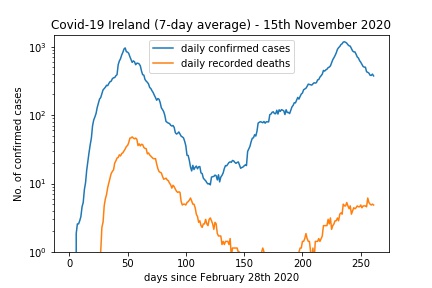
There are now 262 data points on these graphs. When I started doing the updates I thought it might carry on for two or three months -i t’s now been almost nine and there’s no end in sight.

As you can see the 7-day average of new cases has been falling steadily since entered the period of Level 5 restrictions that is now about half-way through. That, of course, is good news. The problem is that the rate of decrease is really quite slow. The number of new cases on each day for the last week (including today) were: 270, 270, 362, 395, 482, 456, and 378 (today). That is fairly flat, the steep downward trend of the previous week apparently faltering. As a rough guess I’d say that by the time we come out of the current period of restrictions (at the beginning of December) we’ll probably still be having over a hundred new cases per day.

I think that level is far too high for comfort, but the current government is probably going to find it difficult to resist the political pressure to exit the lockdown in time for Christmas. If that does happen, I can see another lockdown looming in January. My superiors at Maynooth University are talking about having on-campus teaching again next Semester, but I think that’s highly unlikely in the circumstances.

Things are even worse in Northern Ireland where the number of new cases announced today was 478. Daily cases have been running higher there than in the Republic for some time, despite the fact that the six counties of Northern Ireland have a population of just 1.9 million compared to the 4.9 million of the 26 counties  in the Republic.

That brings me to the issue of the Pfizer Covid-19 vaccine that everyone is getting excited about. Assuming that it passes the various tests needed for it to be approved, Ireland would get about 2 million doses from the stock procured by the European Union.  The population of Ireland is about 4.9 million, and each person would require two doses, which means that supply will only enable about 20% of the population to be vaccinated.

(Actually I don’t know whether the 2 million refers to people that can be vaccinated or individual doses, but even if it’s the former that still accounts for only 40% of the population.)

The question then is who should be prioritized? I think we’d all agree that all health care workers should be vaccinated ASAP but that’s only about 25,000 people (source). Who should get the other doses? Most people seem to be assuming that those at highest risk of mortality should be vaccinated, but there’s also a case to be argued that  it should it should be those groups within which the virus is most likely to spread that should get it, which is presumably the otherwise healthy population.

I don’t know the answer, but it will be interesting to see how this all develops. In any case as far as I can see it there’s very little prospect of high levels of population immunity being reached by this time next year. And that’s even if the vaccine is available soon, which is by no means clear will be the case. As a matter of fact I wouldn’t bet against me still having to do daily updates on Covid-19 statistics for most of next year.


Diversity in Physics – LGBTQ+ STEMDay

Posted in Biographical, Books, Talks and Reviews, Cardiff, LGBTQ+ with tags , , , , on November 14, 2020 by telescoper

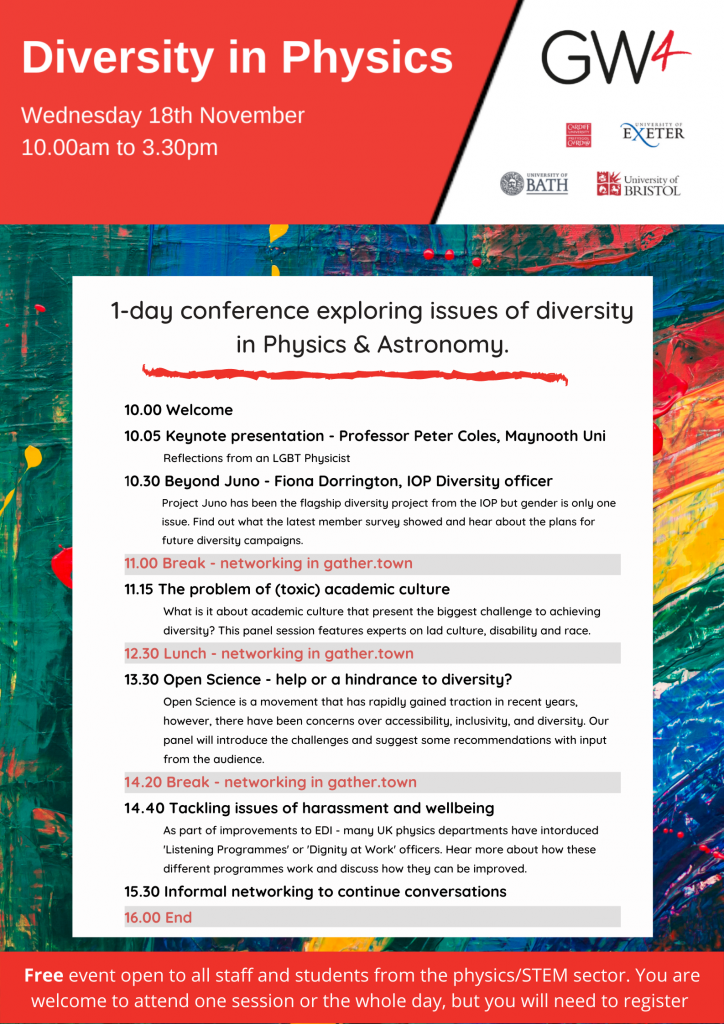
The nice people involved with Physics at Cardiff University, Prism Exeter and the GW4 group generally have organized a (virtual) event to celebrate Diversity and Inclusion for LGBTQ+ STEM Day 2020 which is to take place on November 18th (that’s next Wednesday). I’m very honoured to have been invited to give a keynote talk at this event, the poster for which is below, and am looking forward to it.

There’s a blog post here that gives more information about the event, including how to register in order to receive the Zoom connection.

I won’t be able to stay for the whole event as I am teaching later that day. I’d have been particularly interested in the session on Open Science…

Newton’s Laws in Words

Posted in History, Maynooth, The Universe and Stuff with tags , , , on November 13, 2020 by telescoper

I’ve been teaching my first-year Mathematical Physics students about Newton’s Laws of Motion so decided to record this little video as an aside discussing the history terminology and use of language.

Unfortunately the only microphone I have is the one built into my laptop and it tends to suffer sometimes from a crackle caused (I think) by the fan inside the machine interfering with the mike. I guess the noise appears when the CPU is working hard causing the machine to heat up so the fan works harder. The sound on video recordings I make this low budget way do break up from time to time, which is rather irritating. Obviously I need to buy an external microphone and when I do I might record this again but in the meantime you’ll just have to put up with it breaking up a couple of times!

Memories of Philae

Posted in History, The Universe and Stuff with tags , , , on November 12, 2020 by telescoper

It seems that today is the sixth anniversary of the day (November 12th 2014) that the probe Philae, having detached from its parent spacecraft Rosetta, and subsequently landed successfully (ish) on the Comet 67P/Churyumov-Gerasimenko.

I didn’t realise it was so long ago, but who could forget the feeling of intense excitement we felt on that day as Philae approached its objective?

A Vice-Chancellor on University Rankings

Posted in Education with tags , , on November 12, 2020 by telescoper

I couldn’t resist sharing this clip of Nobel Laureate and Vice Chancellor of the Australian National University, Brian Schmidt giving it to the university rankings system with both barrels. The whole video is quite long but the link hopeully takes you to the point where Brian takes aim:

If it doesn’t jump to about 23.28 please go there manually using the slider or try this link.

There are two important points to amplify here. One is a lesson I learned in my own brief time as sort of Senior Management at Sussex, which is that rankings are not just “important” in such circles: they are literally the only thing that drives decision-making. The reason for that is something Brian touches upon, namely that most Vice-Chancellors are driven by their own ambitions more than they are by the good of education and research. Those that think this way want to make sufficient impact on the league table position of their University so by the end of their period of tenure they will be in line for a more prestigious job with an even higher salary. Not every VC thinks like this of course – Brian for one certainly doesn’t – but those that do are in the majority. That’s why so many institutions are driven by short-term decision-making in a way that reminds me of a warship, forever steering towards the last fall of shot.

In my view the pathological obsession with rankings is at least in part a symptom. The underlying cause is this group of management types who know little about and care little for what the purpose of academia actually is. In my opinion the quickest way to improve universities worldwide is to eliminate these Leadership positions and instead have Vice Chancellors or Presidents or Whatever They’re Called and simply have leaders elected by the academics of the institution from among their ranks.

Cosmology Talks: Mateja Gosença & Bodo Schwabe on Simulating Mixed Fuzzy and Cold Dark Matter

Posted in The Universe and Stuff with tags , , , , , , on November 11, 2020 by telescoper

It’s been too long since I shared one of those interesting cosmology talks on the Youtube channel curated by Shaun Hotchkiss. This channel features technical talks rather than popular expositions so it won’t be everyone’s cup of tea but for those seriously interested in cosmology at a research level they should prove interesting.

Anyway, although I’ve been too busy to check out the talks much recently I couldn’t resist sharing this one not only because it’s on a topic I find interesting (and have worked on) but also because one of the presenters (Mateja Gosença) is a former PhD student of mine from Sussex! So before I go fully into proud supervisor mode, I’ll just say that the talk is about AxioNyx, which is a new public code for simulating both ultralight (or “Fuzzy”, so called because its Compton de Broglie wavelength is large enough to be astrophysically relevant) dark matter (FDM) and Cold dark matter (CDM) simultaneously. The code simulates the FDM using adaptive mesh refinement and the CDM using N-body particles.

P. S. The paper that accompanies this talk can be found on the arXiv here.

A Prima Ballerina

Posted in Biographical, Music with tags , , on November 10, 2020 by telescoper

It’s just over a year since my Mam passed away after several years of struggle with dementia. It seems like a century since I flew back to Newcastle to attend her funeral, so much has happened in the world since then. I got through the sad anniversary reasonably well until this morning I came across this video, which had me in pieces. It’s of a lady by the name of Marta C Gonzalez, a former ballet dancer, who passed away last year; the film was made at her care home in Valencia. A care worker plays her music from Tchaikovsky’s ballet Swan Lake and briefly she is a prima ballerina once more; the film is intercut with footage of herself dancing on stage in New York in the 1960s. It’s unbearably moving, bringing together the awful tragedy of dementia with the power of music if not to heal but at least to provide some measure of respite. Even when almost all is gone, music seems to remain in the deepest part of our being alongside our most cherished memories which it can bring back to life, if only briefly, before the darkness comes.

Dare we hope?

Posted in Covid-19, Poetry, Politics with tags , , , , , on November 9, 2020 by telescoper

A short passage from Seamus Heaney’s verse play The Cure at Troy: A Version of Sophocles’ Philoctetes has been much quoted recently. It even ended the RTÉ News last night:

The passage begins

History says, Don’t hope
On this side of the grave.

Well, there’s an additional reason for hope this morning, in the announcement of good progress in the search for a vaccine against Covid-19. The two pharmaceutical companies involved are Pfizer (USA) and BioNTech SE (Germany). The reported efficacy of the vaccine tested so far is over 90%, which is far higher than experts have predicted. Now these are preliminary results, not yet properly reviewed, based on a sample of only 94 subjects, and I’m not sure what motivated the press release so early in the process. I’m given to understand that the type of vaccine concerned here would also be challenging to manufacture and distribute, but we’re due for some good news on the Coronavirus front so let’s be (cautiously) optimistic.

On top of that it seems that Ireland at least is turning the tide against the second wave, with new cases falling every day for over a week:

Dare we hope?

An interview with Éamon de Valera

Posted in History with tags , on November 8, 2020 by telescoper

I thought I’d share this old film that I came across a few days ago. It dates from 1955, at which time Éamon de Valera was leader of the opposition. It is quite a strange film. Notice how the camera position keeps changing as does the placing of the interviewer (Professor Curtis Baker Bradford), who at one point is standing up near to the sitting interviewee in a way that looks very unnatural. Notices the frequent changes of camera angle too. I’m guessing they had to change reels quite frequently and the camera operator used those opportunities to change the set up. It all looks rather stilted with de Valera not at all relaxed but that might have been typical of him. He seems particularly uncomfortable, though, talking about the Easter Rising of 1916: notice how he skips from the Proclamation of the Republic directly to the surrender. I’ve heard it said that Éamon de Valera was not a particularly effective leader of the battalion at he commanded Boland’s Mill during the uprising (which would not be surprising because he had no real military training). Some even say that he had some sort of breakdown while under fire and couldn’t really function during the fighting. It may just be what his political opponents who spread that around, of course. Nobody who wasn’t there will ever really know.

P.S. Apart from anything else, this film shows what a great job Alan Rickman did at “doing” Éamon de Valera in the film Michael Collins