The full paper (i.e. author list plus a small amount of text) can be found here. Here are two plots from that work.
The first shows the constraints from the six loudest gravitational wave events selected for the latest work, together with the two competing measurements from Planck and SH0ES:
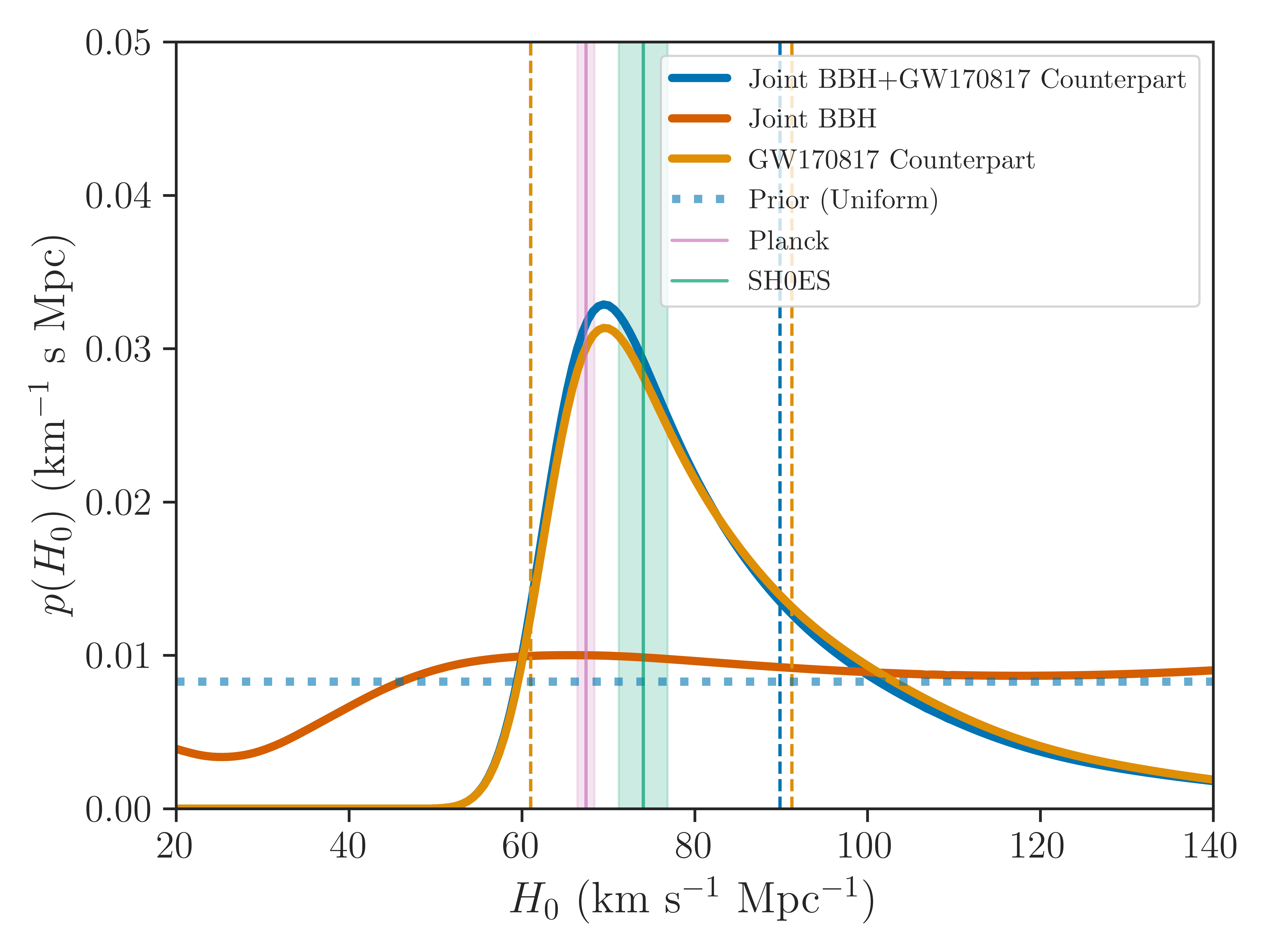
As you can see the individual measurements do not constrain very much. The second plot shows the effect of combining all relevant data, including a binary neutron star merger with an electromagnetic counterparts. The results are much stronger when the latter is included
Obviously this measurement isn’t yet able to resolve the alleged tension between “high” and “low” values described on this blog passim, but it’s early days. If LIGO reaches its planned sensitivity the next observing run should provide many more events. A few hundred should get the width of the posterior distribution shown in the second figure down to a few percent, which would be very interesting indeed!
Currently Ireland spends just 1.1% of its GDP on scientific research and development and SFI currently has a heavy focus on applied research (i.e. research aligned with industry that can be exploited for short-term commercial gain). This has made life difficult for basic or fundamental science and has driven many researchers in such areas abroad, to the detriment of Ireland’s standing in the international community.
The new strategy, which will cover the period from now to 2025, plans for 15% annual rises that will boost the agency’s grant spending — the greater part of the SFI budget — from €200 million in 2020 to €376 million by 2025. Much of this is focused in top-down manner on specific programmes and research centres but there is at least an acknowledgement of the need to support basic research, including an allocation of €11 million in 2021 for early career researchers.
The overall aim is to increase the overall R&D spend from 1.1% of gross domestic product, well below the European average of 2.2%, to 2.5% by 2025.
One of the jobs I had to do last week was to write the Annual Research Report for the Department of Theoretical Physics at Maynooth University. I am very pleased that despite the Covid-19 pandemic, over the last year we managed to score some notable successes in securing new grant awards (amounting to €1.3M altogether) as well as doubling the number of refereed publications since the previous year. This is of course under the old SFI regime. Hopefully in the next few years covered by the new SFI strategic plan we’ll be able to build on that growth still further, especially in areas related to quantum computing and quantum technology generally.
Anyway, it seems that SFI listened to at least some of the submissions made to the consultation exercise I mentioned a few months ago.
Study week is over and next week we return for the second half of Spring Semester. At least we do for about a fortnight, after which there is the Easter break (Good Friday plus the following week). I’ve just about caught up with what I should have done before the Study break started so I spent a big chunk of yesterday watching the Six Nations Rugby. Super Saturday would normally be the last day, with three matches determining the Championship, but that’s not quite how it worked out as France’s game against Scotland was postponed for Covid-related reasons.
The day started off with a 52-10 victory for Scotland over hapless Italy at Murrayfield. The visitors started well enough but soon melted away as Scotland got into gear, eventually scoring eight tries. A lot of people are asking what is going to happen about Italy. Although they have won the odd game in the Six Nations over the years they have never really been contenders and this year they have been consistently woeful. Despite millions being poured into Italian rugby from the competition they have got worse, not better.
One possibility would be to have a second division of the tournament, with promotion and relegation. One problem is finding teams to make up the other places, the European Championship includes such teams as Russia, Portugal, Spain, Romania, Germany and Belgium. One could add Georgia into that mix too. The greater problem is whether there would be enough of an audience to make this financially viable.
Anyway, the second match of the day was Ireland versus England in Dublin. I have to say that I thought England were strong favourites to win that match but what the heck do I know? Ireland put in their best performance of the tournament and ran out relatively comfortable winners against a lacklustre England by 32 points to 18. England, whom many thought would win the tournament, finish in fifth place out of six.
And then the pièce de résistance, France versus Wales. Wales were looking for a victory that would give them a Grand Slam, an outcome that looked very unlikely at the start of the competition. The game started at a frenetic pace with two tries each in the first 20 minutes or so. If they had kept up that rate of scoring the match could have ended 56-56!, but at half-time the score was 17-17.
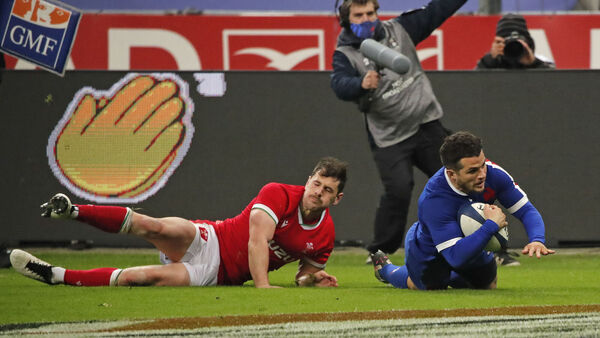
Wales gradually exerted their dominance and stretched their lead to 20-30. With Paul Willemse for sent off for France sticking his hand in an opponent’s eye with just 12 minutes to go the game looked over. The French disagreed and brought out some of their best attacking rugby against a tiring Welsh side who resorted to persistent infringement at the breakdown. A succession of penalties and two yellow cards ensued. France took full advantage, scoring a converted try to make it 27-30. Wales were still in front, and in possession of the ball in a good attacking position, with less than two minutes to go but then conceded a penalty. France kept the ball alive from the resulting lineout then used their extra player to score wide on the left wing with no time left to play. It finished 32-30.
The winning try, scored by Brice Dullin
Heartbreak for Wales, but a brilliant comeback by France. What a game of rugby!
Apart from everything else I don’t think I’ve ever seen a game of rugby with so many potential tries prevented by defensive players holding the ball up to prevent grounding in the in-goal area. I counted at least six, each of them just inches away from being a try.
At the risk of incurring the wrath of my Welsh friends I think France just deserved to win that game. Wales had the benefit of most of the marginal refereeing decisions and Wales should have had even more yellow cards near the end for persistent infringement. Above all, they deserved it for refusing to give up when all seemed lost. Magnifique!
The Six Nations is not yet over; there’s still France versus Scotland to come on Friday night (26th March). If France win that game heavily and get a bonus point they could still finish as Champions. France need to overturn a 20-point points difference though so they’ll have to win by 21 points or more and score four tries. I think that’s unlikely, but they’ll definitely go for it!
It is 9.37am Local Time in Ireland on Saturday 20th March 2021 which means that the Vernal Equinox or Spring Equinox (in the Northern hemisphere) is taking place right now!
The Spring Equinox jumped back a day last year because 2020 was a leap year and now is gradually moving forward again. Of course the actual date depends on where you are in the world. The date last year was 20th March (early in the morning) in Ireland, but 19th March (late at night) in New York.
People sometimes ask me how one can define the `equinox’ so precisely when surely it just refers to a day on which day and night are of equal length, implying that it’s a day not a specific time?
The answer is that the equinox is defined by a specific event, the event in question being when the plane defined by Earth’s equator passes through the centre of the Sun’s disk (or, if you prefer, when the centre of the Sun passes through the plane defined by Earth’s equator). Day and night are not necessarily exactly equal on the equinox, but they’re the closest they get. From now until the Autumnal Equinox days in the Northern hemisphere will be longer than nights, and they’ll get longer until the Summer Solstice before beginning to shorten again.
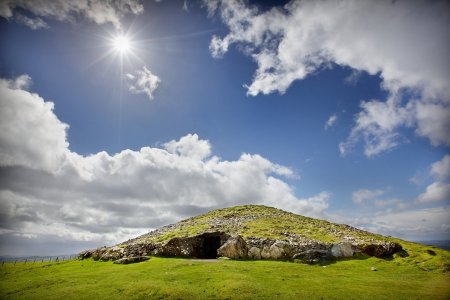
Loughcrew (County Meath), near Newgrange, an ancient burial site and a traditional place to observe the sunrise at the Equinox
Here in Ireland we celebrated Saint Patrick’s day on March 17th, the reputed date of his death in 461 AD. Nobody really knows where St Patrick was born, though, so it would be surprising if the when were any better known.
In any case, it wasn’t until the 17th Century that Saint Patrick’s feast day was placed on the universal liturgical calendar in the Catholic Church. In the thousand years that passed any memory of the actual date was probably lost, so the Equinox was perhaps rebranded for the purpose.
The early Christian church in Ireland incorporated many pre-Christian traditions that survived until roughly the 12th century, including the ancient festival of Ēostre (or Ostara), the goddess of spring associated with the spring equinox after whom Easter is named. During this festival, eggs were used a symbol of rebirth and the beginning of new life and a hare or rabbit was the symbol of the goddess and fertility. In turn the Celtic people of Ireland probably adapted their own beliefs to absorb much older influences dating back to the stone age. St Patrick’s Day and Easter therefore probably both have their roots in prehistoric traditions around the Spring Equinox, although the direct connection has long been lost.
Posted in Maynooth on March 19, 2021 by telescoper
Yesterday I was summoned to a meeting on Campus so on the way there I took the opportunity to check up on Maynooth University Library Cat who I haven’t seen for over a month.
I’m glad to report that he’s every bit as active and energetic as usual.
A rather pugnacious paper by George Efstathiou appeared on the arXiv earlier this week. Here is the abstract:
This paper investigates whether changes to late time physics can resolve the `Hubble tension’. It is argued that many of the claims in the literature favouring such solutions are caused by a misunderstanding of how distance ladder measurements actually work and, in particular, by the inappropriate use of distance ladder H0 priors. A dynamics-free inverse distance ladder shows that changes to late time physics are strongly constrained observationally and cannot resolve the discrepancy between the SH0ES data and the base LCDM cosmology inferred from Planck.
For a more detailed discussion of this paper, see Sunny Vagnozzi’s blog post. I’ll just make some general comments on the context.
One of the reactions to the alleged “tension” between the two measurements of H0 is to alter the standard model in such a way that the equation of state changes significantly at late cosmological times. This is because the two allegedly discrepant sets of measures of the cosmological distance scale (seen, for example, in the diagram below taken from the paper I blogged about a while ago here) differ in that the low values are global measures (based on observations at high redshift) while the high values of are local (based on direct determinations using local sources, specifically stars of various types).
That is basically true. There is, however, another difference in the two types of distance determination: the high values of the Hubble constant are generally related to interpretations of the measured brightness of observed sources (i.e. they are based on luminosity distances) while the lower values are generally based on trigonometry (specifically they are angular diameter distances). Observations of the cosmic microwave background temperature pattern, baryon acoustic oscillations in the matter power-spectrum, and gravitational lensing studies all involve angular-diameter distances rather than luminosity distances.
Before going on let me point out that the global (cosmological) determinations of the Hubble constant are indirect in that they involve the simultaneous determination of a set of parameters based on a detailed model. The Hubble constant is not one of the basic parameters inferred from cosmological observations, it is derived from the others. One does not therefore derive the global estimates in the same way as the local ones, so I’m simplifying things a lot in the following discussion which I am not therefore claiming to be a resolution of the alleged discrepancy. I’m just thinking out loud, so to speak.
With that caveat in mind, and setting aside the possibility (or indeed probability) of observational systematics in some or all of the measurements, let us suppose that we did find that there was a real discrepancy between distances inferred using angular diameters and distances using luminosities in the framework of the standard cosmological model. What could we infer?
Well, if the Universe is described by a space-time with the Robertson-Walker Metric (which is the case if the Cosmological Principle applies in the framework of General Relativity) then angular diameter distances and luminosity distances differ only by a factor of (1+z)2 where z is the redshift: DL=DA(1+z)2.
I’ve included here some slides from undergraduate course notes to add more detail to this if you’re interested:
The result DL=DA(1+z)2 is an example of Etherington’s Reciprocity Theorem. If we did find that somehow this theorem were violated, how could we modify our cosmological theory to explain it?
Well, one thing we couldn’t do is change the evolutionary history of the scale factor a(t) within a Friedman model. The redshift just depends on the scale factor when light is emitted and the scale factor when it is received, not how it evolves in between. And because the evolution of the scale factor is determined by the Friedman equation that relates it to the energy contents of the Universe, changing the latter won’t help either no matter how exotic the stuff you introduce (as long as it only interacts with light rays via gravity). In the light of this, the fact there are significant numbers of theorists pushing for such things as interacting dark-energy models to engineer late-time changes in expansion history is indeed a bit perplexing.
In the light of the caveat I introduced above, I should say that changing the energy contents of the Universe might well shift the allowed parameter region which may reconcile the cosmological determination of the Hubble constant from cosmology with local values. I am just talking about a hypothetical simpler case.
In order to violate the reciprocity theorem one would have to tinker with something else. An obvious possibility is to abandon the Robertson-Walker metric. We know that the Universe is not exactly homogeneous and isotropic, so one could appeal to the gravitational lensing effect of lumpiness as the origin of the discrepancy. This must happen to some extent, but understanding it fully is very hard because we have far from perfect understanding of globally inhomogeneous cosmological models.
Etherington’s theorem requires light rays to be described by null geodesics which would not be the case if photons had mass, so introducing massive photons that’s another way out. It also requires photon numbers to be conserved, so some mysterious way of making photons disappear might do the trick, so adding some exotic field that interacts with light in a peculiar way is another possibility.
Anyway, my main point here is that if one could pin down the Hubble constant tension as a discrepancy between angular-diameter and luminosity based distances then the most obvious place to look for a resolution is in departures of the metric from the Robertson-Walker form. The reciprocity theorem applies to any GR-based metric theory, i.e. just about anything without torsion in the metric, so it applies to inhomogeneous cosmologies based on GR too. However, in such theories there is no way of defining a global scale factor a(t) so the reciprocity relation applies only locally, in a different form for each source and observer.
All of this begs the question of whether or not there is real tension in the H0 measures. I certainly have better things to get tense about. That gives me an excuse to include my long-running poll on the issue:
Well, it’s St Patrick’s Day, which means I’m actually taking a day off and attempting not to read work emails or do work-related things for the day. It’s a lower-key St Paddy’s Day than usual but it’s nice to take a break.
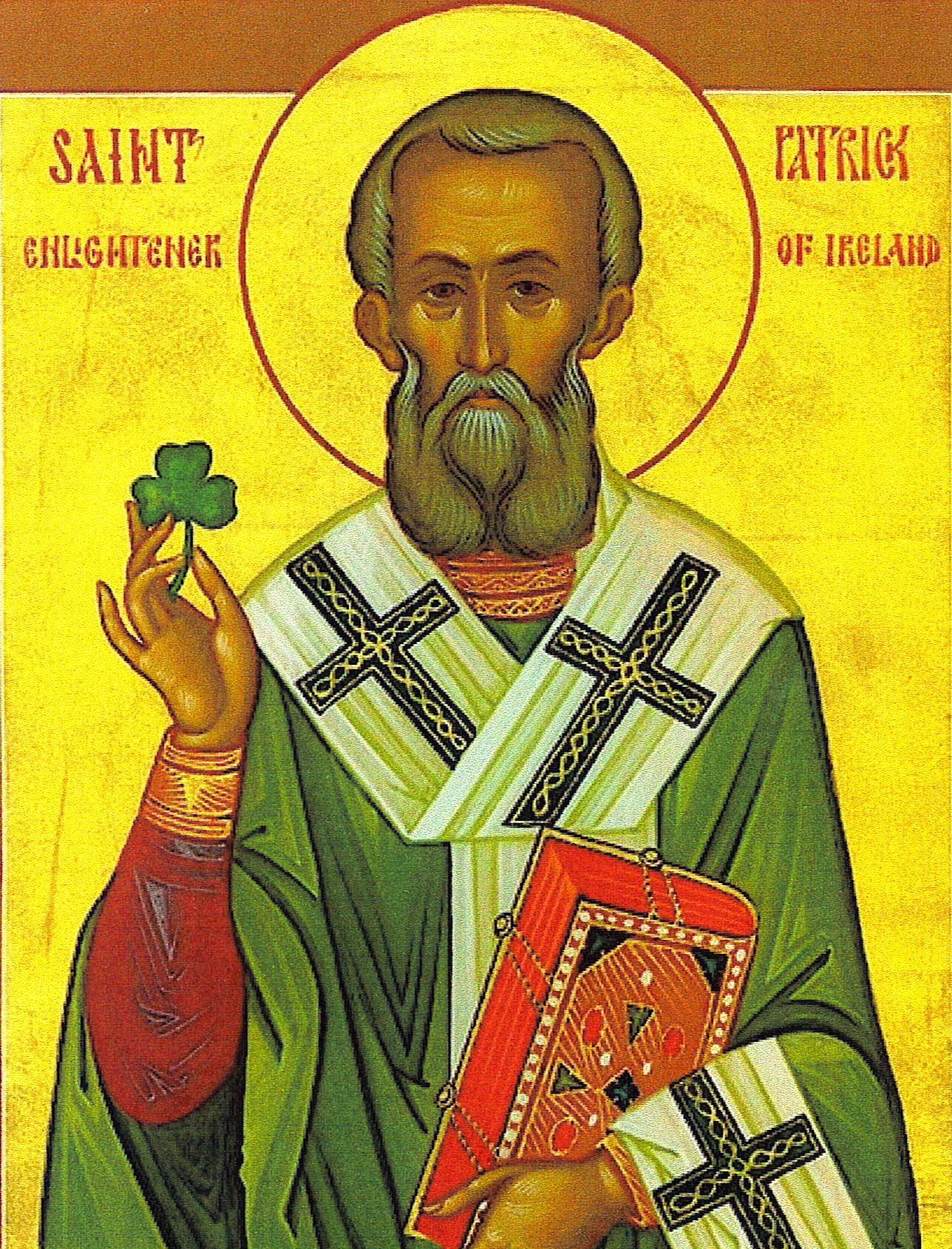
Not many facts are known about the life of St Patrick, but it seems he was born in Britain, probably in the late 4th Century AD, probably somewhere around the Severn Estuary and probably in Wales. It also appears that he didn’t know any Latin. When a young man, it seems he was captured by Celtic marauders coming up the River Severn and taken as a slave to Ireland. He eventually escaped back to Britain, but returned to Ireland as a missionary and succeeded somehow in converting the Irish people to Christianity.
Or did he? This interesting piece suggests his role was of lesser importance than many think.
However it happened, Ireland was the first country to be converted to Christianity that had never been part of the Roman Empire. That made a big difference to the form of the early Church here. The local Celtic culture was very loose and decentralized. There were no cities, large buildings, roads or other infrastructure. Life revolved around small settlements and farms. When wars were fought they were generally over livestock or grazing land. The early Irish Church that grew in this environment was quite different from that of continental Europe. It was not centralized, revolved around small churches and monasteries, and lacked the hierarchical structure of the Roman Church. Despite these differences, Ireland was quite well connected with the rest of the Christian world.
Irish monks – and the wonderful illuminated manuscripts they created – spread across the continent, starting with Scotland and Britain. Thanks to the attentions of the Vikings few of these works survive but the wonderful Lindisfarne Gospels, dating from somewhere in the 8th Century were almost certainly created by Irish monks. The Book of Kells was probably created in Scotland by Irish Monks.
The traffic wasn’t entirely one-way however. A few weeks ago I saw a fascinating documentary about the Fadden More Psalter. This is a leather-bound book of Psalms found in a peat bog in 2006, which is of similar age to the Lindisfarne Gospels. It took years of painstaking restoration work to recover at least part of the text (much of which was badly degraded), but the leather binding turned out to hold a particularly fascinating secret: it was lined with papyrus. The only other books from the same period with the same structure that are known are from the Coptic Church in Egypt.
That doesn’t mean that whoever owned the Fadden More Psalter had actually been to Egypt, of course. It is much more this book made its way to Ireland via a sort of relay race. On the other hand, it does demonstrate that international connections were probably more extensive than you might have thought.
Anyway, back to St Patrick’s Day.
Saint Patrick’s Day is celebrated on March 17th, the reputed date of his death in 461 AD. Nobody really knows where St Patrick was born, though, so it would be surprising if the when were any better known.
In any case, it wasn’t until the 17th Century that Saint Patrick’s feast day was placed on the universal liturgical calendar in the Catholic Church. Indeed, St Patrick has never been formally canonized. In the thousand years that passed any memory of the actual date of his birth was probably lost, so the choice of date was probably influenced by other factors, specifically the proximity of the Spring Equinox (which is this year on Saturday March 20th).
The early Christian church in Ireland incorporated many pre-Christian traditions that survived until roughly the 12th century, including the ancient festival of Ēostre (or Ostara), the goddess of spring associated with the spring equinox after whom Easter is named. During this festival, eggs were used a symbol of rebirth and the beginning of new life and a hare or rabbit was the symbol of the goddess and fertility. In turn the Celtic people of Ireland probably adapted their own beliefs to absorb much older influences dating back to the stone age. St Patrick’s Day and Easter therefore probably both have their roots in prehistoric traditions around the Spring Equinox, although the direct connection has long been lost.
The traditional St Patrick’s Day parades etc will not take place this year because of Covid-19 restrictions, but that doesn’t mean everyone is ignoring the day. Indeed here’s a picture of the spire of St Patrick’s College lit up in celebration:
I thought the following might be of general interest to readers of this blog. It’s a translation into English of an MSc thesis written by a certain Jon-Ivar Skullerud of the Department of Theoretical Physics at Maynooth University. I hasten to add that Dr Skullerud hasn’t just finished his MSc. It just appears that it has taken about 30 years to translate it from Norwegian into English!
Anyway, the English version is now available on the arXiv here. There isn’t really an abstract as such but the description on arXiv says:
This is a translation into English of my Masters thesis (hovedoppgave) from 1991. The main topic of the thesis is the relation between fundamental physics and philosophy, and a discussion of several possible ontologies of quantum field theory.
I note from here that hovedoppgave translates literally into English as “main task”.
I haven’t read this thesis from cover to cover yet – partly because it’s in digital form and doesn’t have any covers on it and partly because it’s 134 pages long – but I’ve skimmed a few bits and it looks interesting.
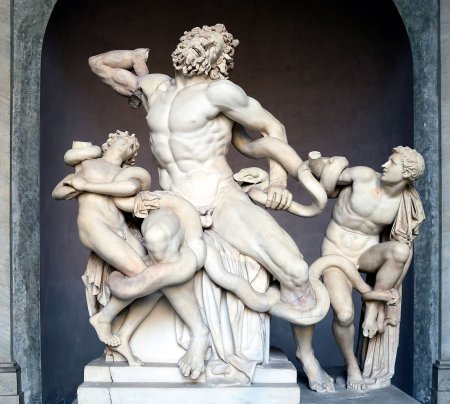
Yesterday I was remind of the above very famous statue which is on display in the Vatican. It dates from antiquity but was unearthed almost intact during an excavation in Rome in the 16th Century. It’s an extraordinary work that depicts a legendary episode in the Trojan wars of priest Laocoön and his sons Antiphantes and Thymbraeus being attacked by sea serpents. Evidently it was very cold that day…
This scene is described in Book II of Virgil‘s Aeneid which happens to be the text I studied for Latin O-level back in the day. Virgil’s verse takes the form of a strict (dactylic) hexameter which provides a rhythmic pulse perfectly designed for action sequences such as this. Before this part, Laocoön (whose name has to be spoken as four syllables – Lah-o-co-ohn – in order to scan correctly) warns the Trojans about their gift of a wooden horse using the most famous phrase in the entire Aeneid:
Primus ibi ante omnis magna comitante caterva 40
Laocoon ardens summa decurrit ab arce,
et procul: ‘O miseri, quae tanta insania, cives?
Creditis avectos hostis? Aut ulla putatis
dona carere dolis Danaum? Sic notus Ulixes?
Aut hoc inclusi ligno occultantur Achivi, 45
aut haec in nostros fabricata est machina muros,
inspectura domos venturaque desuper urbi,
aut aliquis latet error; equo ne credite, Teucri.
Quidquid id est, timeo Danaos et dona ferentis
Then, while about to sacrifice a bull to the god Neptune, he and his sons meet their grisly end:
Laocoon, ductus Neptuno sorte sacerdos,
sollemnis taurum ingentem mactabat ad aras.
ecce autem gemini a Tenedo tranquilla per alta
(horresco referens) immensis orbibus angues
incumbunt pelago pariterque ad litora tendunt;
pectora quorum inter fluctus arrecta iubaeque
sanguineae superant undas, pars cetera pontum
pone legit sinuatque immensa volumine terga.
fit sonitus spumante salo; iamque arva tenebant
ardentisque oculos suffecti sanguine et igni
sibila lambebant linguis vibrantibus ora.
diffugimus visu exsangues. illi agmine certo
Laocoonta petunt; et primum parva duorum
corpora natorum serpens amplexus uterque
implicat et miseros morsu depascitur artus;
post ipsum auxilio subeuntem ac tela ferentem
corripiunt spirisque ligant ingentibus; et iam
bis medium amplexi, bis collo squamea circum
terga dati superant capite et cervicibus altis.
ille simul manibus tendit divellere nodos
perfusus sanie vittas atroque veneno,
clamores simul horrendos ad sidera tollit:
qualis mugitus, fugit cum saucius aram
taurus et incertam excussit cervice securim.
The colour and energy of this verse, propelled by the remorseless rhythm, brings the horrific episode to life in truly compelling and typically gore-filled way. You don’t really have to be fluent in Latin to appreciate its quality. The line sibila lambebant linguis vibrantibus ora is particularly brilliant. It’s no surprise that Virgil is regarded as such a literary superstar.
My Latin teacher at school pointed out that epic poetry like this would probably have been performed in the Roman era by an actor as a dramatic recitation, probably with a drum pounding out the rhythm and with various sound and lighting effects to boot.
Anyway, today is the Ides of March so I thought I’d keep up classical theme by posting this priceless bit of British cultural history relevant to such a fateful day.
This is from the First Folio Edition of Carry On Cleo, and stars the sublime Kenneth Williams as Julius Caesar delivering one of the funniest lines in the whole Carry On series. The joke may be nearly as old as me, but it’s still a cracker…
The views presented here are personal and not necessarily those of my employer (or anyone else for that matter).
Feel free to comment on any of the posts on this blog but comments may be moderated; anonymous comments and any considered by me to be vexatious and/or abusive and/or defamatory will not be accepted. I do not necessarily endorse, support, sanction, encourage, verify or agree with the opinions or statements of any information or other content in the comments on this site and do not in any way guarantee their accuracy or reliability.






 In the Dark