Archive for January, 2023

The RAS Awards

Posted in Uncategorized on January 13, 2023 by telescoper

I’m sitting in the bar of the National Concert Hall in Dublin ahead of tonight’s concert but I have enough time to congratulate all the winners of this year’s Royal Astronomical Awards. The full list of awardees, announced this afternoon, can be found here.

In particular, I’d like to congratulate John Peacock on his Gold Medal!

John is an occasional commenter on this blog, and may even read it sometimes too!

Essays, Mills and ChatGPT

Posted in Education with tags , , , on January 13, 2023 by telescoper

I saw an article the other day about how “contract cheating” was endangering the integrity of Ireland’s universities. This refers to the problem of students outsourcing their assignments to professional essay mills. Given the enthusiasm that university managers have for outsourcing in other contexts I’d be surprised if they see this as a problem. Indeed, their response might well be to outsource the grading of assignments in a similar fashion. It does however raise questions about academic integrity for thus of us who care about such matters.

I have to admit that I’ve never really understood the obsession in some parts of academia with “the student Essay” as a form of assessment. I agree that writing skills are extremely important but they’re not the only skills it is important for students to acquire during the course of a degree. Of course I’m biased because I work in Theoretical Physics, an area in which student essays play a negligible role in assessment. Our students do have to write project reports, etc, but writing about something you yourself have done seems to me to be different from writing about what other people have done. While forms of assessment in science subjects have evolved considerably over the last 50 years, other domains still seem to concentrate almost exclusively on “The Essay”.

Whatever you think about the intrinsic value of The Essay (or lack thereof) it is clear that if it is not done in isolation (and under supervision) it is extremely vulnerable to cheating. The article I referred to above concentrates on the corrupting influence of “Essay Mills” who will produce – for a fee – an essay on a given topic.

I believe however that this is not the biggest threat to academic integrity. There is a lot of discussion going on these days about ChatGPT, an AI system that can produce text on demand using sources on the internet. This is not great at dealing with technically complex specialist topics but can produce plausible if somewhat superficial offerings in many circumstances where something less demanding is required. Indeed, the more banal the task the better ChatGPT does. For example, here is an AI version of a university Strategic Plan which captures the vacuous nature of such documents with uncanny accuracy:

According to a pilot programme of which I am aware, the present configuration of ChatGPT scores an average of about 70% on (short) student essay tasks. It won’t be long before it gets much better than that. I predict that something like it will soon put essay mills out of business as it will be far cheaper and its use far more widespread. This is the real threat to the viability of “The Essay” in a modern university. The response will need to be quick!

Update: piece from the Irish Times.

P.S. It’s worth mentioning that AI systems can also write simple computer code to a reasonable level of proficiency, so this vulnerability also affects programming tasks.

New Publication at the Open Journal of Astrophysics

Posted in OJAp Papers, Open Access, The Universe and Stuff with tags , , , on January 12, 2023 by telescoper

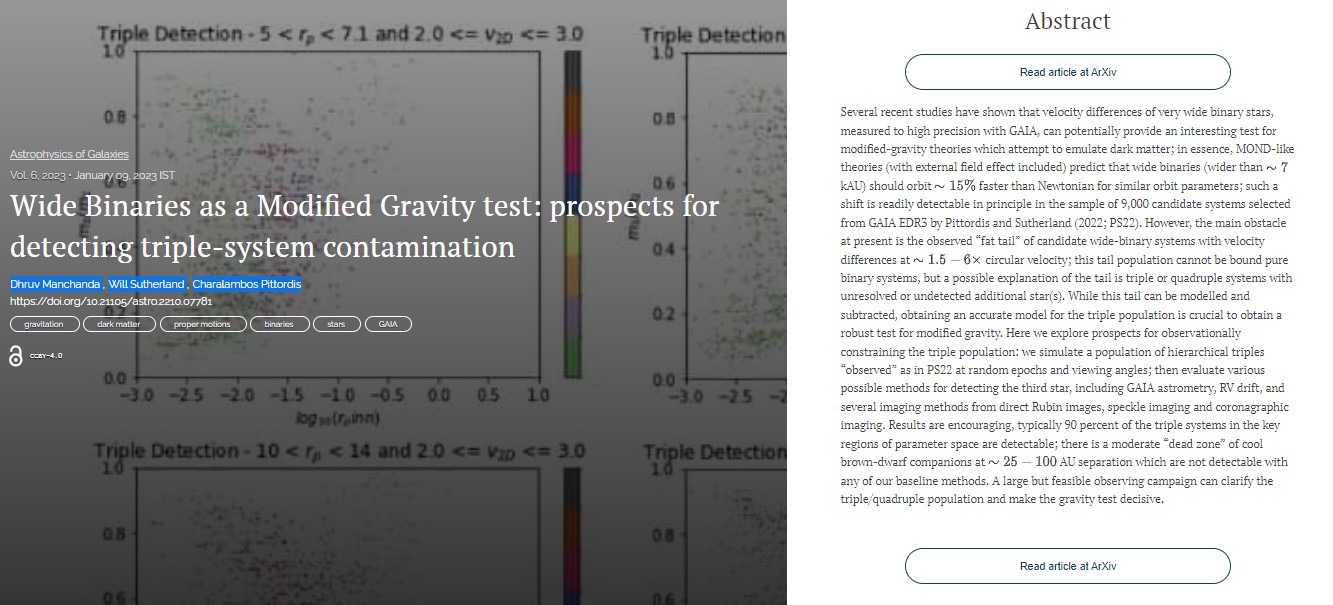
Time to announce another new paper at the Open Journal of Astrophysics. This one was published officially on 9th January 2023. The latest paper is the second paper in Volume 6 (2023) as well as the 67th in all. This one is in the Astrophysics of Galaxies folder.

The latest publication is entitled “Wide Binaries as a Modified Gravity test: prospects for detecting triple-system contamination” and the authors – Dhruv Manchanda, Will Sutherland Charalambos Pittordis – are all based at Queen Mary, University of London.

Here is a screen grab of the overlay which includes the  abstract:


You can click on the image to make it larger should you wish to do so. You can find the officially accepted version of the paper on the arXiv here.

R.I.P. David Duckham (1946-2023)

Posted in R.I.P., Rugby with tags , , , on January 11, 2023 by telescoper

I seem to be devoting a lot of this blog to R.I.P. posts these days but sadly I have to do it again because former England rugby union international David Duckham has passed away at the age of 76. With great poise and balance as well as a blistering turn of pace, Duckham was an oustanding player on the wing and his international career would have been even more memorable had he had better players around; the England team of the early 70s was rather weak, actually finishing bottom of the Five Nations in four of the seven years he played.

David Duckham was one of only three England players who made it into the Barbarians side that played New Zealand in Cardiff on 27th January 1973, a match many regard as the greatest game of rugby ever played. Can that really have been 50 years ago?

The Barbarians’ side on that day was packed with Welsh legends and the Welsh supporters after the game changed Duckham’s name from “David” to “Dai” because he was “good enough to be Welsh”. I regarded that great Welsh rugby team of the 70s in exactly the same light as the great Brazilian football team of the same period.

I remember commentator Cliff Morgan during that game describing Duckham as “a man who can really motor” and indeed he could. Here’s a short clip* of him in action:

http://www.youtube.com/clip/UgkxFupDdxcSqxaLxHJfSJ244OKl2hDV9y7k

I’m not sure why New Zealand scrum-half Sid Going decided to kick after controlling the scrum so well with all the Barbarians pack committed and knowing that the ball would probably end up in the hands of JPR Williams, a man who could very quickly turn defence into attack. On this occasion, however, Duckham was already coming in off his wing, so JPR just slipped him the ball and off he went in thrilling fashion. That amazing dummy even fooled the cameraman who nearly let Duckham go out of shot as he scythed through the All Blacks until stopped by Sid Going. Brilliant stuff.

R.I.P. David Duckham (1946-2023)

*Not sure why it won’t embed properly but you’ll just have to click on the link!

R.I.P. Richard Bower

Posted in Biographical, R.I.P., The Universe and Stuff with tags , , , , on January 10, 2023 by telescoper

I was shocked and saddened this weekend to hear of the death from cancer of Professor Richard Bower of Durham University. Richard was a leading light in the Institute for Computational Cosmology (ICC) at Durham, though his research interests spanned observational and theoretical studies of galaxy and cluster formation as well as numerical studies. 

I heard the sad news via social media and there have many tributes to and personal reminiscences of Richard have been circulated from friends, colleagues and former students, including this lovely one by Josh Borrow. I’m sure there will be official obituaries in due course that do justice to Richards personality and achievements in teaching and research; I’ll add links when I see them.

If I can add a personal note, I only worked on one project with Richard, about thirty years ago while I was still at Queen Mary & Westfield College in London. Doing the project was tremendous fun – so much so that the paper we ended up writing bears little relation to what we thought it would be like when we started. We were both young then – I think Richard was about a year younger than me – and both had a tendency to fly off at tangents, but fortunately we were working with two responsible adults (Carlos Frenk and Simon White) who kept us in order. I think the paper we wrote is a nice one, but the real point is that the whole experience was so enjoyable that it was not only formative experience for me from an intellectual point of view but also left me with very fond memories. Whenever we met subsequently, which happened fairly frequently and conferences and on panels and the like, we always talked about what a great time that was. It’s hard to accept we’ll never have that conversation again.

I send heartfelt condolences to Richard’s family, friends and colleagues, both past and present, and in Durham and elsewhere. was an irrepressible and irreplaceable character who will be greatly missed by the entire cosmological community.

Rest in peace, Richard Bower.

Putting girls off Physics

Posted in Education, mathematics, Maynooth, Politics with tags , , on January 9, 2023 by telescoper

I see that Katharine Birbalsingh has resigned from her job as UK Government commissioner for social mobility. Apparently she feels she was “doing more harm than good”. If only the rest of the Government had that level of self-awareness.

I wrote about Katharine Birbalsingh last year, and her departure gives me the excuse to repeat what I said then. Birbalsingh is Head of a school in which only 16% of the students taking physics A-level are female (the national average is about 23%) and tried to explain this by saying that girls don’t like doing “hard maths”.

..physics isn’t something that girls tend to fancy. They don’t want to do it, they don’t like it.

Gender stereotyping begins at school, it seems.

There is an easy rebuttal of this line of “reasoning”. First, there is no “hard maths” in Physics A-level. Most of the mathematical content (especially differential calculus) was removed years ago. Second, the percentage of students taking actual A-level Mathematics in the UK who are female is more like 40% than 20% and girls do better at Mathematics than boys at A-level. The argument that girls are put off Physics because it includes Maths is therefore demonstrably bogus.

An alternative explanation for the figures is that schools (especially the one led by Katharine Birbalsingh, where the take-up is even worse than the national average) provide an environment that actively discourages girls from being interested in Physics by reinforcing gender stereotypes even in schools that offer Physics A-level in the first place. The attitudes of teachers and school principals undoubtedly have a big influence on the life choices of students, which is why it is so depressing to hear lazy stereotypes repeated once again.

There is no evidence whatsoever that women aren’t as good at Maths and Physics as men once they get into the subject, but plenty of evidence that the system dissuades then early on from considering Physics as a discipline they want to pursue. Indeed, at University female students generally out-perform male students in Physics when it comes to final results; it’s just that there are few of them to start with.

Anyway, I thought of a way of addressing gender inequality in physics admissions about 8 years ago. The idea was to bring together two threads. I’ll repeat the arguments here.

The first is that, despite strenuous efforts by many parties, the fraction of female students taking A-level Physics has flat-lined at around 20% for at least two decades. This is the reason why the proportion of female physics students at university is the same, i.e. 20%. In short, the problem lies within the school system.

The second line of argument is that A-level Physics is not a useful preparation for a Physics degree anyway because it does not develop the sort of problem-solving skills or the ability to express physical concepts in mathematical language on which university physics depends. In other words it not only avoids “hard maths” but virtually all mathematics and, worse, is really very boring. As a consequence, most physics admissions tutors that I know care much more about the performance of students at A-level Mathematics than Physics, which is a far better indicator of their ability to study Physics at University than the Physics A-level.

Hitherto, most of the effort that has been expended on the first problem has been directed at persuading more girls to do Physics A-level. Since all UK universities require a Physics A-level for entry into a degree programme, this makes sense but it has not been very successful.

I believe that the only practical way to improve the gender balance on university physics course is to drop the requirement that applicants have A-level Physics entirely and only insist on Mathematics (which has a much more even gender mix). I do not believe that this would require many changes to course content but I do believe it would circumvent the barriers that our current school system places in the way of aspiring female physicists, bypassing the bottleneck at one stroke.

I suggested this idea when I was Head of the School of Mathematical and Physical Sciences at Sussex, but it was firmly rejected by Senior Management because we would be out of line with other Physics departments. I took the view that in this context being out of line was a positive thing but that wasn’t the view of my bosses so the idea sank.

In case you think such a radical step is unworkable, I give you the example of our Physics programmes in Maynooth. We have a variety of these, including Theoretical Physics & Mathematics, Physics with Astrophysics, and Mathematical Physics and/or Experimental Physics through our omnibus science programme. Not one of these courses requires students to have taken Physics in their Leaving Certificate (roughly the equivalent of A-level) though as I explained in yesterday’s post, Mathematics is a compulsory subject at Leaving Certificate. The group of about first-year 130 students I taught this academic year is considerably more diverse than any physics class I ever taught in the UK, and not only in terms of gender…

I contend that the evidence suggests it’s not Mathematics that puts female students off Physics, a large part of it is A-level Physics.

Mathematics for All?

Posted in Education, mathematics, Maynooth, Politics with tags , , on January 8, 2023 by telescoper
Random maths stuff to scare Simon Jenkins.

One of the things I noticed in the news from the UK last week was PM Rishi Sunak’s suggestion that all school students in England should study mathematics to age 18. I’ve emphasized in England because responsibility for education is devolved to the governments of Scotland, Wales and Northern Ireland so what the Prime Minister on this matter says has no bearing outside England.

Anyway, two of the obvious fundamental problems with Sunak’s proposal are:

  1. How will making mathematics a compulsory subject at age 16-18 fit within the current system of A-levels, in which most students study only three subjects?
  2. Who is going to teach all the extra lessons required when there is already a shortage of STEM teachers?

I’m not sure of the extent to which Sunak has thought through this plan. I suspect it’s nothing more than the usual sort of half-baked idea that his type of politician likes to float in order to distract attention away from serious problems elsewhere (e.g. NHS, the economy, strikes, etc). The suggestion has generated a wide range of responses, including from the Guardian’s resident idiot Simon Jenkins who, as usual, misses the point spectacularly when he writes:

Like many of my generation, I did basic and advanced maths to age 16. This embraced complex algebra, trigonometry, quadratic equations, differential calculus, the use of logarithms and old-fashioned slide rules. I cannot recall ever using one jot of it, all now forgotten. 

I’m tempted to suggest that if Simon Jenkins hadn’t forgotten what he’d learnt at school he might write less garbage, but I won’t. I also studied these things to age 16 and, because I chose a career in science, I have used all of them (except slide rules, which were obsolete, but including logarithms). Of course not everyone will feel the same.

I should however point out that as well as Mathematics and science subjects I also studied Geography, History, French, Latin, and English Literature to O-level (which I took at age 16). I don’t think I have ever “used” any of these since, but I do not for one minute regret having studied them. In my opinion education is not just about the acquisition of things to use, but represents a way of opening the mind up to a range of different ways of thinking. Mathematical reasoning is not the only way of thinking but it is important, as is the process involved in learning another language. As I have written on this blog many times before, education is not just about “skills training”: it’s about expanding the mind.

Putting most of Simon Jenkins’s childish rant to one side, there is a serious point buried in it. What Sunak seems to want to achieve is increased levels of basic numeracy which does not require the fluency in trigonometry or differential calculus. The question then is what has gone wrong with the education of a student who hasn’t acquired that knowledge by the age of sixteen? I’d suggest that indicates as significant failing of the pre-16 education system, which is therefore what needs to be fixed. Remedial action in post-16 education is at best a sticking-plaster solution, when more fundamental reform is required.

I feel obliged to point out, however, that here in Ireland, Mathematics is indeed a compulsory subject up to age 18 at least for those students who take the Leaving Certificate. This plays a role here similar to that of GCE A-levels in the UK, but most students take 7 subjects rather than just three. Mathematics is compulsory (as are English and Irish). All subjects can be taken at Ordinary or Higher level in the Leaving Certificate and Mathematics can also be taken at Foundation level (as can Irish).

Last Semester I was involved in teaching Mathematical Physics to a class of about 130 first-year students at Maynooth University. Most of these students are doing our General Science degree, entry to which requires just Ordinary level mathematics and one science subject at Leaving Cert.

The great strength of the Leaving Certificate, which it shares with the International Baccalaureate, is its breadth. I think having English as a compulsory subject for everyone is just as positive as the Mathematics requirement. The concentration of subjects at A-level can work very well for students who know what they want to do after School – as it did with me – but there are dangers involved in pigeonholing students at age 16. A broader education does not put so much pressure on students to decide so young.

Moving to something more like the Leaving Certificate addresses Item 1. at the start of this piece, but Item 2. remains an issue for England as it does in Ireland. In reality the choice for many students is restricted not by the examination system by the lack of specialist teachers in schools, especially (not not only) in STEM subjects. The problem there is that the pay and working conditions for teachers in state schools are not commensurate with their importance to society. I don’t see Sunak showing any inclination to change that situation.

New Publication at the Open Journal of Astrophysics

Posted in OJAp Papers, Open Access, The Universe and Stuff with tags , , , , on January 7, 2023 by telescoper

Continuing the process of catching up with business at the Open Journal of Astrophysics, here is the first paper of 2023. This one was accepted before Christmas but the final version only appeared on arXiv after the holiday and was published officially on 4th January 2023.

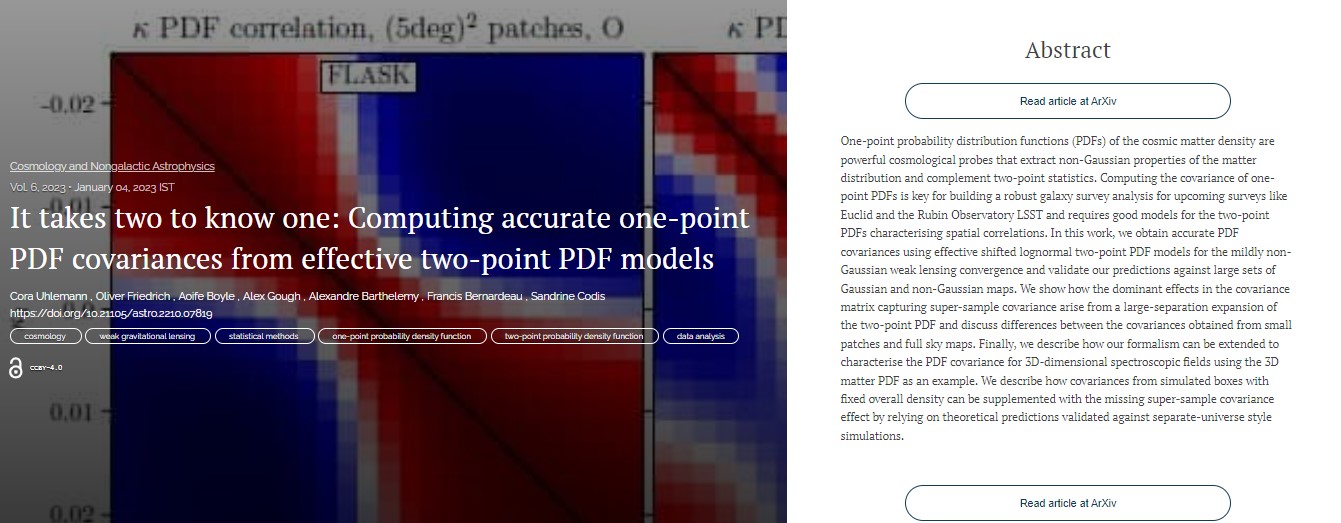
The latest paper is the first paper in Volume 6 (2023) as well as the 66th in all. It’s yet another in the Cosmology and Non-Galactic Astrophysics folder.

The latest publication is entitled “It takes two to know one: Computing accurate one-point PDF covariances from effective two-point PDF models“. This is a British-French-German collaboration led by Cora Uhlemann of Newcastle University with co-authors  Oliver Friedrich, Aoife Boyle, Alex Gough, Alexandre Barthelemy, Francis Bernardeau, and Sandrine Codis.

This is such an interesting paper that we discussed it at our cosmology journal club at Maynooth University a while ago when it first appeared on arXiv and reading it again since then has suggested a nice project to me!

Anyway, here is a screen grab of the overlay which includes the  abstract:


You can click on the image to make it larger should you wish to do so. You can find the officially accepted version of the paper on the arXiv here.

Nollaig na mBan

Posted in Irish Language, Literature with tags , , , on January 6, 2023 by telescoper

Today is January 6th, which is Epiphany in the Church calendar, Twelfth Night, usually the day the Christmas decorations came down when I was a kid, and here in Ireland a day known as Nollaig na mBan (Women’s Christmas).  You can read more about the origin of this Irish tradition here.

This allows me an excuse to be a grammar bore yet again. The Irish word for “woman” is bean, which has the plural form Ban; na  is the corresponding definite article. However, in the phrase  Nollaig na mBan, “women” is in the genitive case (Christmas of the women) and the B therefore undergoes lenition to become m. This sort initial consonant mutation is very common in the Irish language. Instead of being pronunced “ban” the word for women is therefore spoken as “man”. Fortunately, the written language is kind in that it leaves the unmodified consonant in place, hence mBan.

I was also reminded today that 6th January (in 1914) was the date of the gathering described in James Joyce’s wonderful short story The Deadthe last, the longest, and the best of the collection Dubliners, which I thoroughly recommend if you haven’t read it yet. It’s an ideal gateway into Joyce’s writing:

Nollaig na mBan shona daoibh go léir!

Fifty Years of Gravitation

Posted in The Universe and Stuff with tags , , on January 5, 2023 by telescoper

I was surprised to discover, a couple of days ago, that the classic textbook Gravitation by Misner, Thorne and Wheeler is 50 years old this year. MTW as it is usually known was first published in 1973, and has has now been reprinted 24 times. I bought my copy (shown above) about 30 years ago. I’ve often joked that this tome is so hefty that it not only allows one to read about Gravitation but also to experience its practical effects!

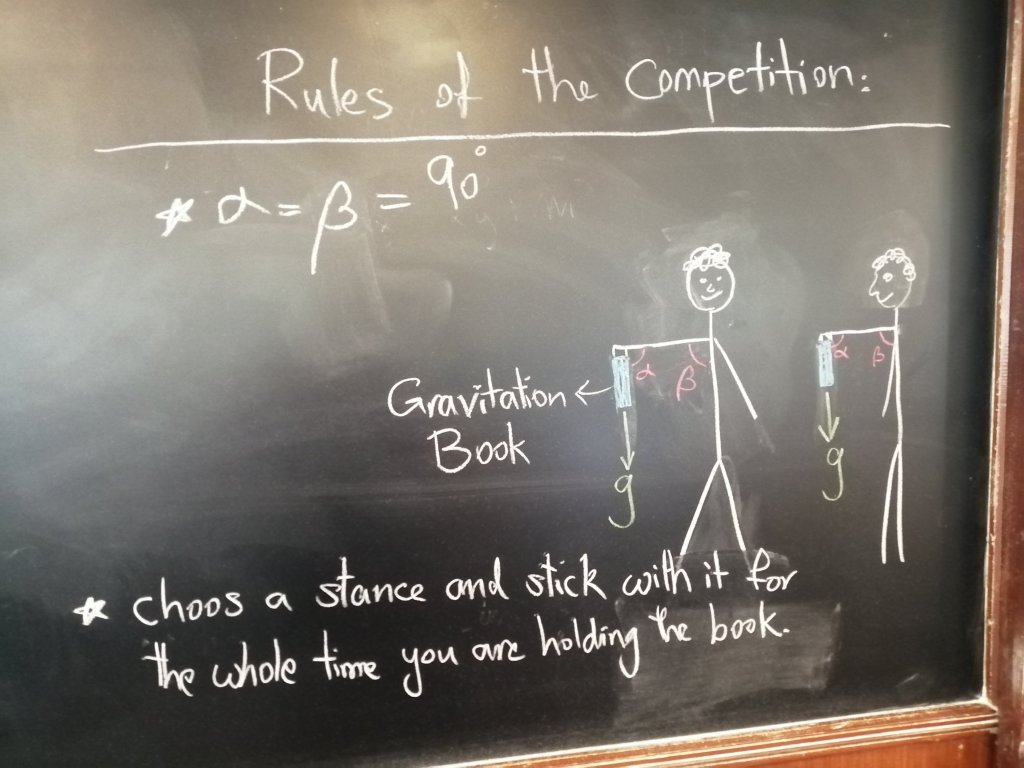
This anniversary reminds me that there was a competition running at ITP2022 last year that involved holding out a copy of the book  in one hand at arm’s length for as long as possible following the instructions below:

The winner of the competition was John Brennan of Maynooth University, with a time of 3 minutes and 29 seconds. If you can lay your hands on a copy of MTW you can try to do better!