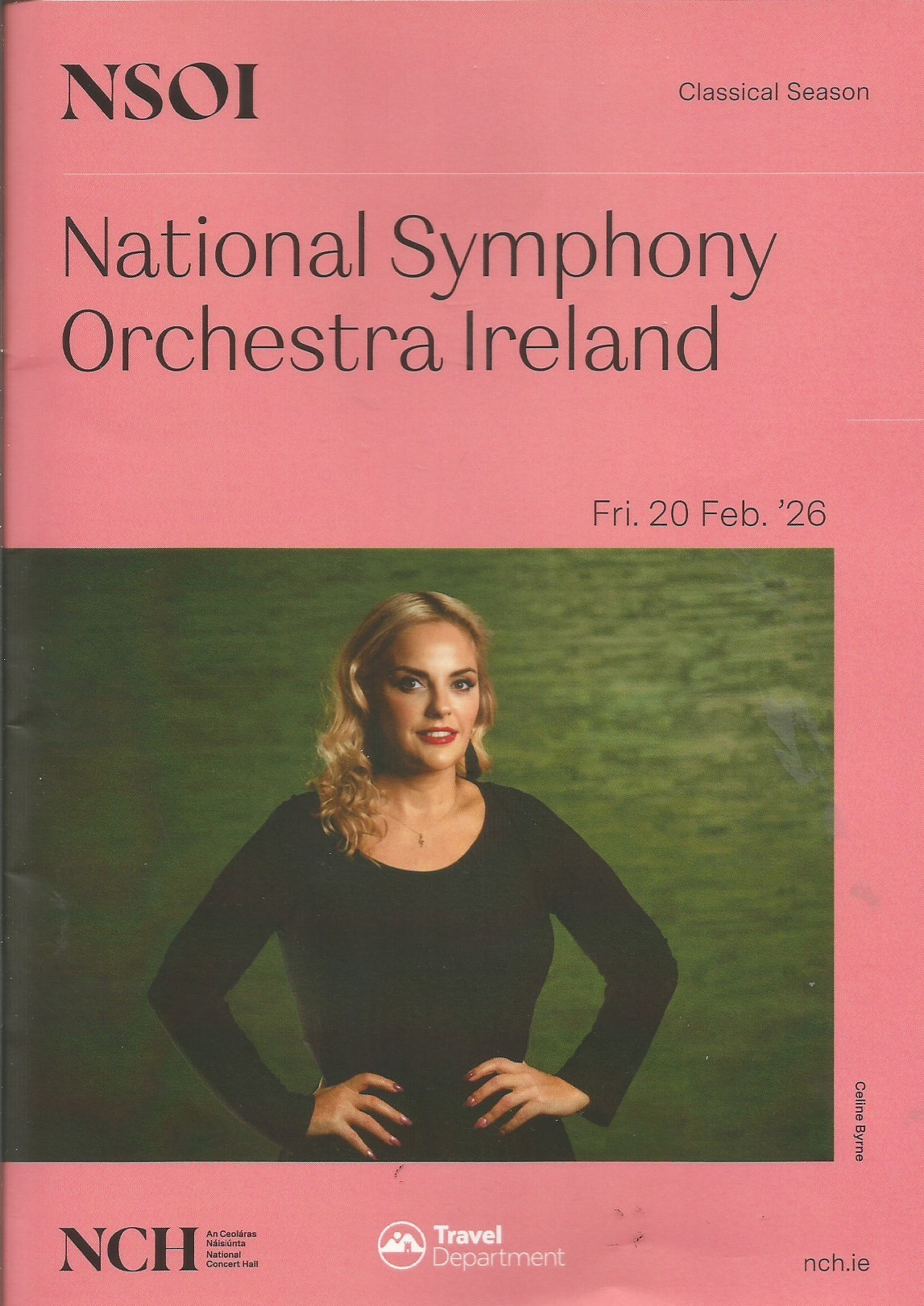
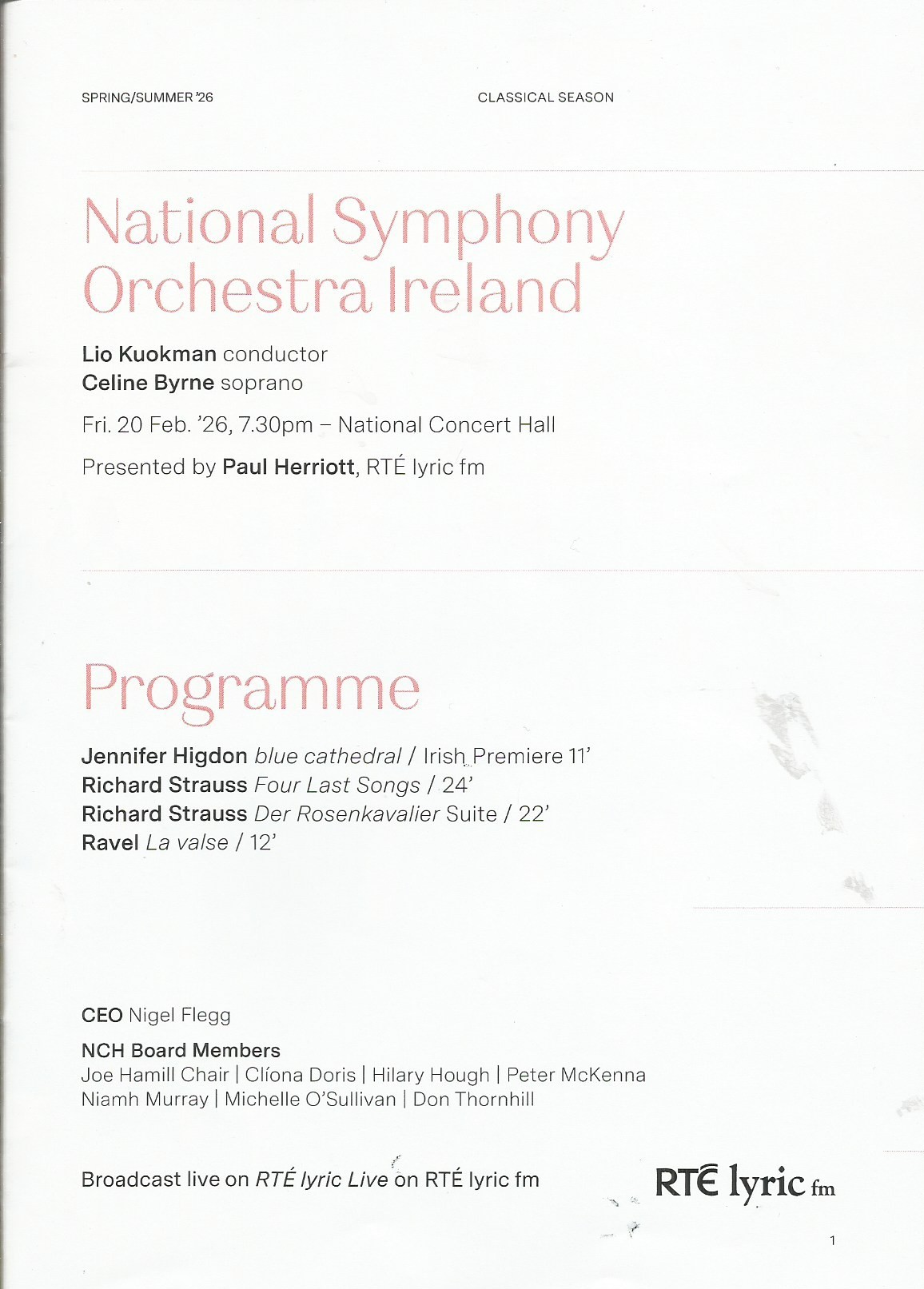
And so it came to pass that last night I went to the National Concert Hall in Dublin for another concert by National Symphony Orchestra Ireland, this time conducted by Lio Kuokman and joined, for a performance of the Strauss’s Four Last Songs, by the wonderful soprano Celine Byrne. Given the presence of an Irish favourite it was no surprise to find the concert hall very busy indeed.
The first item on the agenda was the Irish premier of blue cathedral by Jennifer Higdon, an elegaic piece she composed on the death of her younger brother. It’s an interesting piece which is quite easy on the ear as well as incorporating some very original effects. The string section, for example, use handbells to maje gentle tinkling noises near the end. I’ve never heard this piece before and I think it’s one that will bear repeated listening.
Next came the main item on the agenda. The Four Last Songs were published after the composer’s death, so Richard Strauss never heard them performed. The very first time they were performed was in 1950 at the Royal Albert Hall, by the London Philharmonia. One can only imagine what it must have been like for the orchestra making this music live for the very first time. Apparently the first time any of them had seen the score was when they turned up for the rehearsal. I’m sure they knew as soon as they started playing that it was a masterpiece.
Last night we heard these songs sung by Celine Byyne, who was born in Kildare. She arrived on stage resplendent in a black dress with red feathers around the shoulders. I don’t know how many times I’ve heard these songs and they never fail to move me. The opening of the first song, Frühling, is in the chest register for a soprano which is the most difficult to project over an orchestra, but Celine Byrne took it in her stride, as she did with the others. I must single out the leader of the National Symphony Orchestra Elaine Clark for her gorgeous playing of the lovely violin solo in the third song, Beim Schlafengehen. I don’t mind admitting that it brought a tear to my eye, as did the final Im Abendrot which is one of my very favourite pieces of music. I was sitting next to an elderly couple, and I coultn’t help noticing that they spontaneously held hands on the words “Hand in Hand”.
Incidentally, as far as I know the Four Last Songs were not specifically intended to be performed together as they inevitably are these days. Although the last is my favourite, I think the first three (all based on poems by Herman Hesse) have much more in common with each other than Im Abendrot (which is a poem by Joseph von Eichendorff).
After the wine break we continued with more Strauss, sort of, in the form of a suite from the Opera Der Rosenkavalier. Although Strauss allowed this to be assembled from his music as a concert work I don’t think he actually created it as such. It’s relatively brief ( just over 20 minutes in performance) that begin’s with the opera’s orchestral prelude, depicting the Marschallin’s and Octavian’s night of passion (vividly portrayed by whooping horns). Next comes the appearance of Octavian as the “Rosenkavalier”, depicted in tender gorgeous music; the sight of him looking so young makes the Marschallin realise that he will soon leave her for a younger woman. There follows the duet between Octavian and Sophie (oboe and horn) – in which their love for each other becomes ever more obvious, but this is abruptly interrupted by the discordant music associated with the clumsy arriva of the buffoonish Baron Ochsl. Next the violins tentatively introduce the first waltz, followed by another given out by the solo violin, before the whole orchestra settles into waltz mode. A general pause and a violin solo leads into the nostalgic music where the Marschallin sadly realises she has lost Octavian. Then comes its ecstatic climax. The work closes with another robust waltz, depicting Ochs at his most pompous, and a boisterous coda apparently composed for the suite. Listening to this is like a fast-forward through the opera, but it does lack the vocal parts, and I think Strauss was at his best writing for, especially female, voices.
And finally, picking up on the theme of waltzes prevalent in the preceding piece we had La Valse by Maurice Ravel. This is a great masterpiece, originally conceived as a tribute to the Viennese waltz, but not composed until after the First World War, and turned into a kind of tragic parody, starting out sombre and brooding, gradually building into a garish intensity and then into a brutal, almost chaotic, ending.
This was a very nice concert, with a varied programme and some fine playing throughout. The performance being relatively short, and wanting to avoid sitting in Pearse station for a long time waiting in Pearse Station for the 10.14 train, I broke with tradition and took a bus. I started out about 20 minutes earlier than I would have done had I waited for the train, but when I got to Maynooth at a bus stop next to the railway station, the train I would have got had just arrived….

 In the Dark