Archive for the Poetry Category

Belial Speaks…

Posted in Poetry, Television with tags , , , , , , on April 7, 2026 by telescoper

This is an excerpt from Book 2 of Paradise Lost by John Milton. Belial (a fallen angel) is speaking at a “Consultation” held in Pandemonium chaired by Satan (i.e. a meeting of the local Governing Authority):

I should be much for open war, O Peers,
As not behind in hate, if what was urged
Main reason to persuade immediate war
Did not dissuade me most, and seem to cast
Ominous conjecture on the whole success;
When he who most excels in fact of arms,
In what he counsels and in what excels
Mistrustful, grounds his courage on despair
And utter dissolution, as the scope
Of all his aim, after some dire revenge.
First, what revenge? The towers of Heaven are filled
With armed watch, that render all access
Impregnable: oft on the bordering Deep
Encamp their legions, or with obscure wing
Scout far and wide into the realm of Night,
Scorning surprise. Or, could we break our way
By force, and at our heels all Hell should rise
With blackest insurrection to confound
Heaven’s purest light, yet our great Enemy,
All incorruptible, would on his throne
Sit unpolluted, and th’ ethereal mould,
Incapable of stain, would soon expel
Her mischief, and purge off the baser fire,
Victorious. Thus repulsed, our final hope
Is flat despair: we must exasperate
Th’ Almighty Victor to spend all his rage;
And that must end us; that must be our cure—
To be no more. Sad cure! for who would lose,
Though full of pain, this intellectual being,
Those thoughts that wander through eternity,
To perish rather, swallowed up and lost
In the wide womb of uncreated Night,
Devoid of sense and motion? And who knows,
Let this be good, whether our angry Foe
Can give it, or will ever? How he can
Is doubtful; that he never will is sure.
Will he, so wise, let loose at once his ire,
Belike through impotence or unaware,
To give his enemies their wish, and end
Them in his anger whom his anger saves
To punish endless? “Wherefore cease we, then?”
Say they who counsel war; “we are decreed,
Reserved, and destined to eternal woe;
Whatever doing, what can we suffer more,
What can we suffer worse?” Is this, then, worst—
Thus sitting, thus consulting, thus in arms?
What when we fled amain, pursued and struck
With Heaven’s afflicting thunder, and besought
The Deep to shelter us? This Hell then seemed
A refuge from those wounds. Or when we lay
Chained on the burning lake? That sure was worse.
What if the breath that kindled those grim fires,
Awaked, should blow them into sevenfold rage,
And plunge us in the flames; or from above
Should intermitted vengeance arm again
His red right hand to plague us? What if all
Her stores were opened, and this firmament
Of Hell should spout her cataracts of fire,
Impendent horrors, threatening hideous fall
One day upon our heads; while we perhaps,
Designing or exhorting glorious war,
Caught in a fiery tempest, shall be hurled,
Each on his rock transfixed, the sport and prey
Or racking whirlwinds, or for ever sunk
Under yon boiling ocean, wrapt in chains,
There to converse with everlasting groans,
Unrespited, unpitied, unreprieved,
Ages of hopeless end? This would be worse.
War, therefore, open or concealed, alike
My voice dissuades; for what can force or guile
With him, or who deceive his mind, whose eye
Views all things at one view? He from Heaven’s height
All these our motions vain sees and derides,
Not more almighty to resist our might
Than wise to frustrate all our plots and wiles.
Shall we, then, live thus vile—the race of Heaven
Thus trampled, thus expelled, to suffer here
Chains and these torments? Better these than worse,
By my advice; since fate inevitable
Subdues us, and omnipotent decree,
The Victor’s will. To suffer, as to do,
Our strength is equal; nor the law unjust
That so ordains. This was at first resolved,
If we were wise, against so great a foe
Contending, and so doubtful what might fall.
I laugh when those who at the spear are bold
And venturous, if that fail them, shrink, and fear
What yet they know must follow—to endure
Exile, or ignominy, or bonds, or pain,
The sentence of their Conqueror. This is now
Our doom; which if we can sustain and bear,
Our Supreme Foe in time may much remit
His anger, and perhaps, thus far removed,
Not mind us not offending, satisfied
With what is punished; whence these raging fires
Will slacken, if his breath stir not their flames.
Our purer essence then will overcome
Their noxious vapour; or, inured, not feel;
Or, changed at length, and to the place conformed
In temper and in nature, will receive
Familiar the fierce heat; and, void of pain,
This horror will grow mild, this darkness light;
Besides what hope the never-ending flight
Of future days may bring, what chance, what change
Worth waiting—since our present lot appears
For happy though but ill, for ill not worst,
If we procure not to ourselves more woe.

I’ve posted this here not only because it seems topical, but also because it contains a phrase associated with a TV drama series that I’ve been watching on DVD. Feel free to offer a guess of the name of the series through the comments box.
The first Day’s Night had come – Emily Dickinson

Posted in Poetry with tags , , , , on April 1, 2026 by telescoper
The first Day's Night had come—
And grateful that a thing
So terrible—had been endured—
I told my Soul to sing—

She said her Strings were snapt—
Her Bow—to Atoms blown—
And so to mend her—gave me work
Until another Morn—

And then—a Day as huge
As Yesterdays in pairs,
Unrolled its horror in my face—
Until it blocked my eyes—

My Brain—begun to laugh—
I mumbled—like a fool—
And tho' 'tis Years ago—that Day—
My Brain keeps giggling—still.

And Something's odd—within—
That person that I was—
And this One—do not feel the same—
Could it be Madness—this?

by Emily Dickinson (1830-1886)

(A discussion of the connection between this poem and an April Fool’s Day prank that went terribly wrong, can be found here.)

March – William Cullen Bryant

Posted in Maynooth, Poetry with tags , , on March 27, 2026 by telescoper
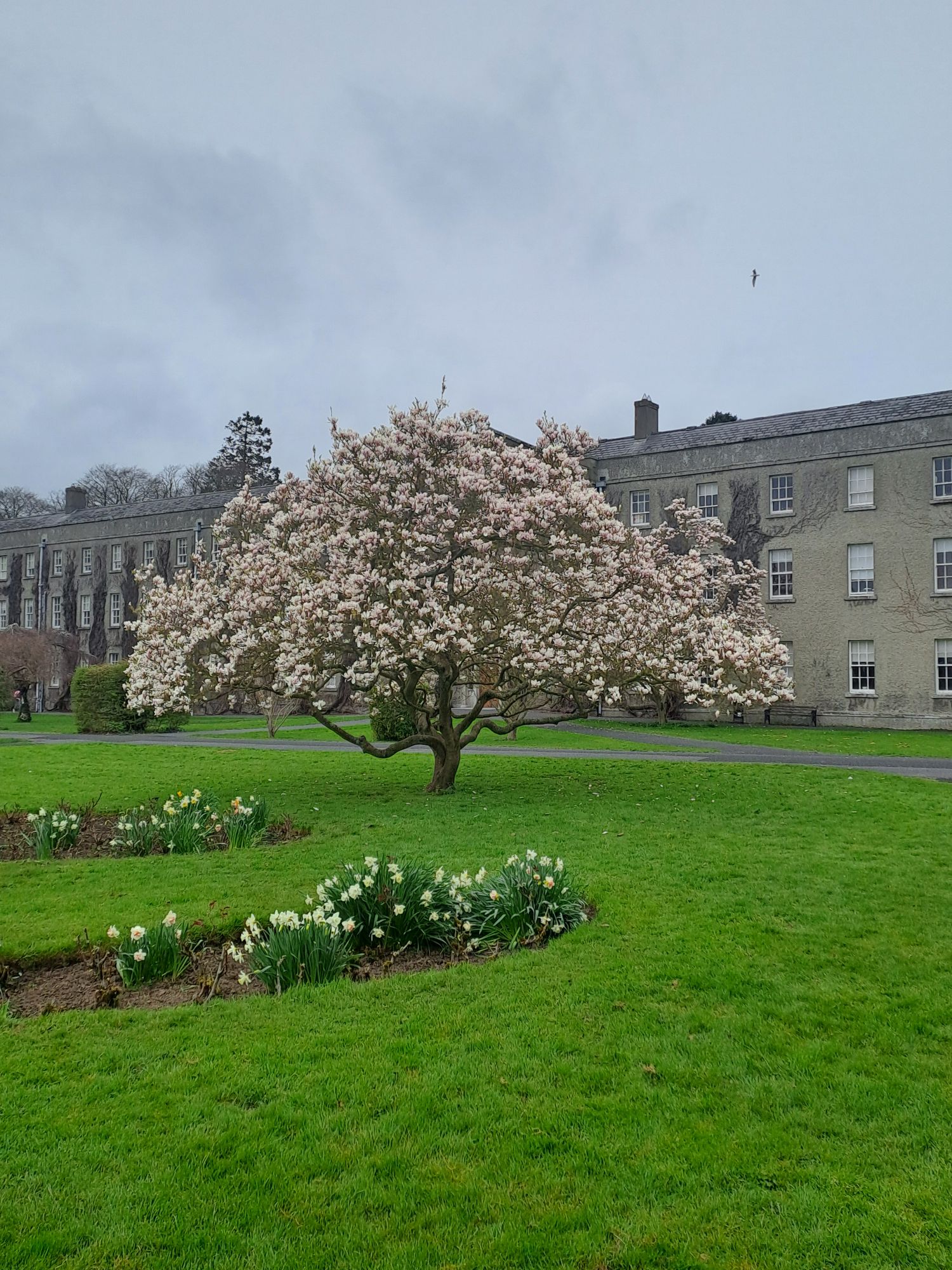
Magnolia and Daffodils in St Joseph’s Square Maynooth
The stormy March is come at last, 
With wind and cloud, and changing skies,
I hear the rushing of the blast,
That through the snowy valley flies.

Ah, passing few are they who speak,
Wild stormy month! in praise of thee;
Yet, though thy winds are loud and bleak,
Thou art a welcome month to me.

For thou, to northern lands, again
The glad and glorious sun dost bring,
And thou hast joined the gentle train
And wear’st the gentle name of Spring.

And, in thy reign of blast and storm,
Smiles many a long, bright, sunny day,
When the changed winds are soft and warm,
And heaven puts on the blue of May.

Then sing aloud the gushing rills
And the full springs, from frost set free,
That, brightly leaping down the hills,
Are just set out to meet the sea.

The year’s departing beauty hides
Of wintry storms the sullen threat;
But in thy sternest frown abides
A look of kindly promise yet.

Thou bring’st the hope of those calm skies,
And that soft time of sunny showers,
When the wide bloom, on earth that lies,
Seems of a brighter world than ours.

by William Cullen Bryant (1794-1878)

From the Study Break…

Posted in Biographical, Education, Maynooth, Poetry with tags , , , , , on March 22, 2026 by telescoper

So now after a half-term mid-semester study break, including one day of actual holiday, that was both pleasant and eventful it will soon be time to return to the fray, at least for 9 working days. A full week of lectures, labs and tutorials starts tomorrow but the following week end a day early, on Thursday 2nd April, because 3rd April is Good Friday. Campus is closed then, as it is on Easter Monday and there are no lectures for the rest of that week. I’ll miss a lecture on Good Friday. I’m sure the students will be distraught, but that’s the way of things.

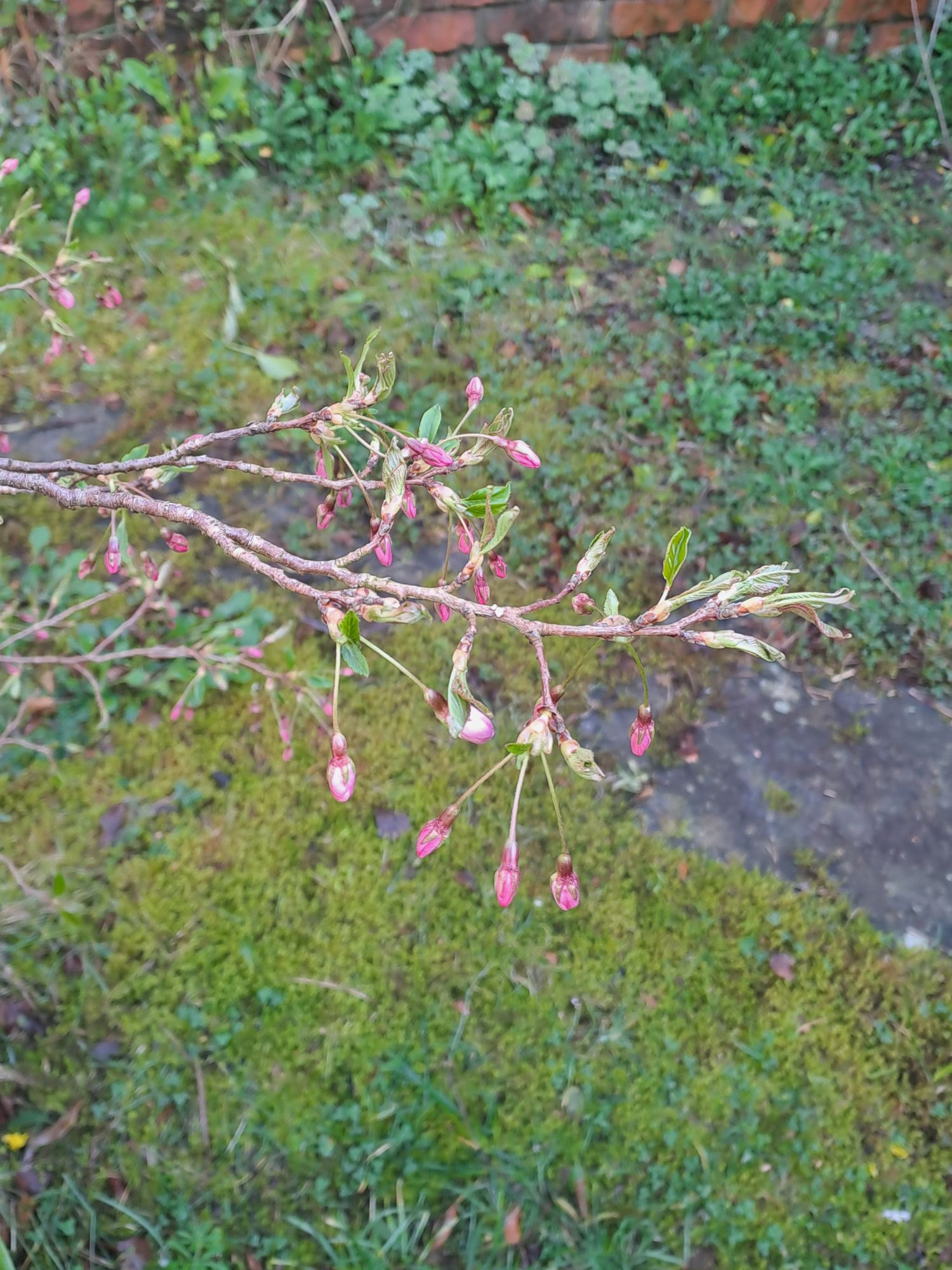
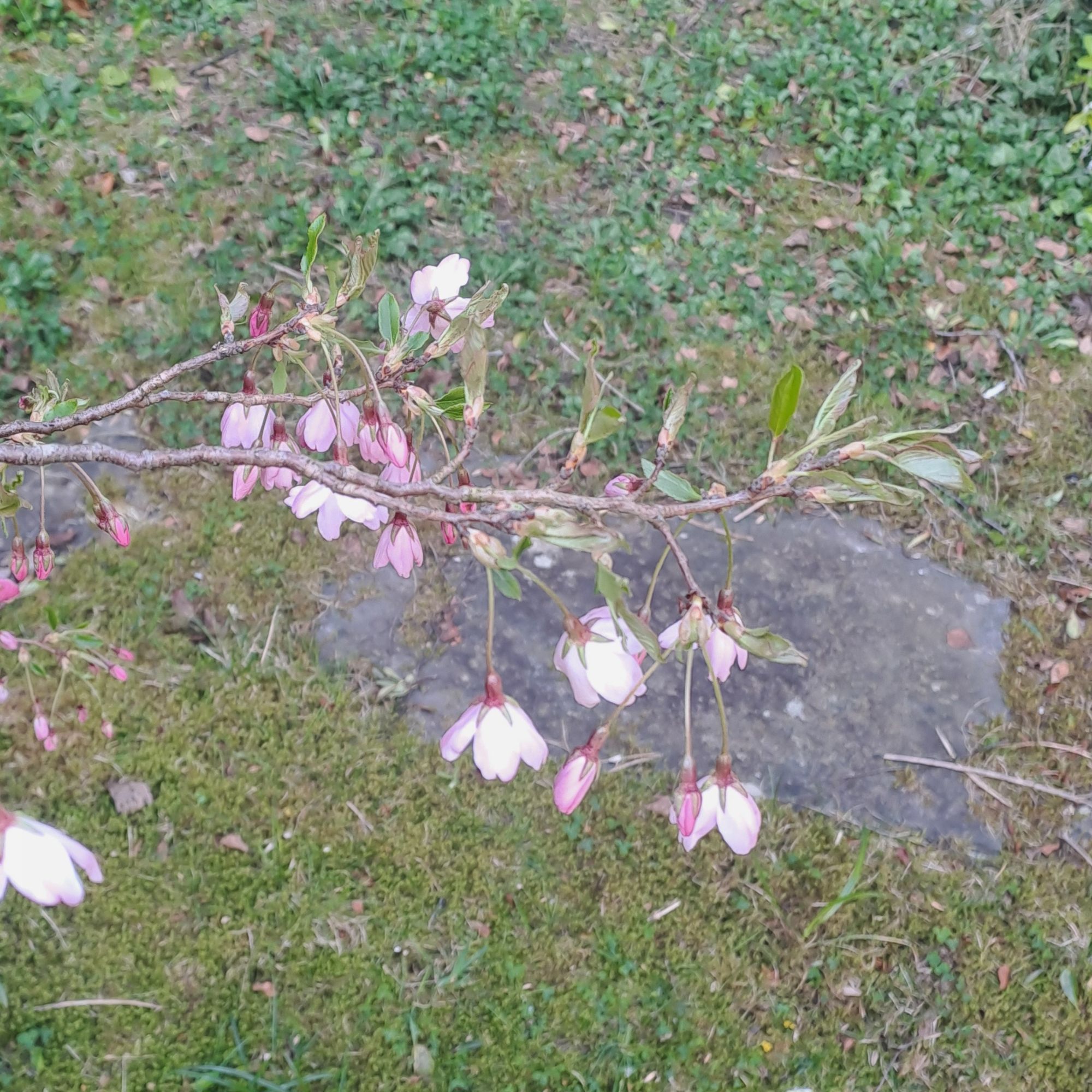
Anyway, with the Eastertide coming in and yesterday being World Poetry Day I thought I’d share a couple of pictures (taken two days apart) of the Japanese cherry trree in my back garden along with this haiku on a theme by A.E. Housman:

Loveliest of trees?
Not yet, but soon there will be
Bloom along the bough...

A Dream of the Unknown – Percy Bysshe Shelley

Posted in Poetry with tags , , , , on March 19, 2026 by telescoper
I dreamed that, as I wandered by the way,
Bare Winter suddenly was changed to Spring,
And gentle odours led my steps astray,
Mixed with a sound of waters murmuring
Along a shelving bank of turf, which lay
Under a copse, and hardly dared to fling
Its green arms round the bosom of the stream,
But kissed it and then fled, as thou mightest in dream.

There grew pied wind-flowers and violets,
Daisies, those pearled Arcturi of the earth,
The constellated flower that never sets;
Faint oxlips; tender bluebells, at whose birth
The sod scarce heaved; and that tall flower that wets—
Like a child, half in tenderness and mirth—
Its mother's face with Heaven's collected tears,
When the low wind, its playmate's voice, it hears.

And in the warm hedge grew lush eglantine,
Green cowbind and the moonlight-coloured may,
And cherry-blossoms, and white cups, whose wine
Was the bright dew, yet drained not by the day;
And wild roses, and ivy serpentine,
With its dark buds and leaves, wandering astray;
And flowers azure, black, and streaked with gold,
Fairer than any wakened eyes behold.

And nearer to the river's trembling edge
There grew broad flag-flowers, purple pranked with white,
And starry river buds among the sedge,
And floating water-lilies, broad and bright,
Which lit the oak that overhung the hedge
With moonlight beams of their own watery light;
And bulrushes, and reeds of such deep green
As soothed the dazzled eye with sober sheen.

Methought that of these visionary flowers
I made a nosegay, bound in such a way
That the same hues, which in their natural bowers
Were mingled or opposed, the like array
Kept these imprisoned children of the Hours
Within my hand,—and then, elate and gay,
I hastened to the spot whence I had come,
That I might there present it!—Oh! to whom?

by Percy Bysshe Shelley (1792-1822)

(This poem, also known as The Question, was first published in 1822 (the year of Shelley’s death) although it was probably written earlier, probably in 1820, while the poet was living in Italy.)

Crows in Spring – John Clare

Posted in Poetry with tags , , , on March 6, 2026 by telescoper
Four Hooded Crows; Photo by Sound Designer S.K Pramanik on Pexels.com
The Crow will tumble up and down
At the first sight of spring
And in old trees around the town
Brush winter from its wing

No longer flapping far away
To naked fen they fly,
Chill fare as on a winter’s day,
But field and valley nigh;

Where swains are stirring out to plough
And woods are just at hand,
They seek the upland’s sunny brow
And strut from land to land,

And often flap their sooty wing
And sturt to neighbouring tree,
And seem to try all ways to sing
And almost speak in glee.

The ploughman hears and turns his head
Above to wonder why;
And there a new nest nearly made
Proclaims the winter by.

by John Clare (1793-1864)

Barddoniaeth ar gyfer Dydd Gŵyl Dewi

Posted in History, Poetry with tags , , , , , , , on March 1, 2026 by telescoper

Well, today is St David’s Day so let me first offer a hearty “Dydd Gwŷl Dewi Sant hapus i chi gyd” (Happy St David’s Day to you all). Here is a picture of some daffodils amid the undergrowth in my garden:

Over the years, I seem to have established a tradition of posting a bit of poetry to mark this special day for Wales and the Welsh and given current events I chose this one which I have posted before, about 9 years ago. It was written in Welsh by Hedd Wyn (born Ellis Humphrey Evans) who lived from 1887 to 1917; Hedd Wyn was his bardic name and it translates (roughly) as “pure peace”.

Hedd Wyn was a non-conformist Christian and a pacifist who was conscripted into the British Army to serve in World War 1. He was posted to Flanders and was killed in action on 31st July 1917, the first day of the 3rd Battle of Ypres. He was hit in the stomach by a shell and died later of his wounds. The battle stumbled on for months of horrific slaughter as the planned Allied offensive foundered in the mud of Passchendaele and ended, as had the Battle of the Somme a year earlier, in a bloody stalemate.

A few weeks before his death, Hedd Wyn wrote a poem called Yr Arwr (‘The Hero’) which was submitted for the prestigious Bard’s Chair at that year’s National Eisteddfod. It was announced on 6th September 1917 that  he  had won the prize, posthumously. The bard not being able to sit in the the chair, it was draped in black cloth. The Prime Minister, David Lloyd George, was present at the ceremony.

The poem Yr Arwr is a very long work, running to 13 pages of manuscript, which is not practicable to post here, but here’s another poem by Hedd Wyn. This is called Rhyfel (‘War’). I only have a few words of Welsh, but because of the occasion,  it seems appropriate to post this in its original language. You can find English translations here and on the Wikipedia page here. Translating poetry is always very difficult, but the sense of the poem is of a world in chaos that has been abandoned by God.

Gwae fi fy myw mewn oes mor ddreng
 A Duw ar drai ar orwel pell;
 O'i ôl mae dyn, yn deyrn a gwreng,
 Yn codi ei awdurdod hell.

Pan deimlodd fyned ymaith Dduw
 Cyfododd gledd i ladd ei frawd;
 Mae swn yr ymladd ar ein clyw,
 A'i gysgod ar fythynnod tlawd.

Mae'r hen delynau genid gynt
 Ynghrog ar gangau'r helyg draw,
 A gwaedd y bechgyn lond y gwynt,
 A'u gwaed yn gymysg efo'r glaw.

Via Negativa, by R.S. Thomas

Posted in Poetry with tags , , , , , on February 23, 2026 by telescoper
Why no! I never thought other than
That God is that great absence
In our lives, the empty silence
Within, the place where we go
Seeking, not in hope to
Arrive or find. He keeps the interstices
In our knowledge, the darkness
Between stars. His are the echoes
We follow, the footprints he has just
Left. We put our hands in
His side hoping to find
It warm. We look at people
And places as though he had looked
At them, too; but miss the reflection.

by R.S. Thomas (1913-2000)

Although he was an Anglican minister, the poems of R.S. Thomas – most famously The Absence – often speak of God as absent rather than present, and the religious experience as being one of negation rather than affirmation. These views seem strange and rather comfortless coming from a priest, but as an atheist what do I know? None of that detracts from the austere beauty of his verse.

Man was Made to Mourn – Robert Burns

Posted in Poetry with tags , , , , on January 25, 2026 by telescoper
When chill November's surly blast 
Made fields and forests bare,
One ev'ning, as I wander'd forth
Along the banks of Ayr,
I spied a man, whose aged step
Seem'd weary, worn with care;
His face was furrow'd o'er with years,
And hoary was his hair.

"Young stranger, whither wand'rest thou?"
Began the rev'rend sage;
"Does thirst of wealth thy step constrain,
Or youthful pleasure's rage?
Or haply, prest with cares and woes,
Too soon thou hast began
To wander forth, with me to mourn
The miseries of man.

"The sun that overhangs yon moors,
Out-spreading far and wide,
Where hundreds labour to support
A haughty lordling's pride; -
I've seen yon weary winter-sun
Twice forty times return;
And ev'ry time has added proofs,
That man was made to mourn.

"O man! while in thy early years,
How prodigal of time!
Mis-spending all thy precious hours-
Thy glorious, youthful prime!
Alternate follies take the sway;
Licentious passions burn;
Which tenfold force gives Nature's law.
That man was made to mourn.

"Look not alone on youthful prime,
Or manhood's active might;
Man then is useful to his kind,
Supported in his right:
But see him on the edge of life,
With cares and sorrows worn;
Then Age and Want - oh! ill-match'd pair -
Shew man was made to mourn.

"A few seem favourites of fate,
In pleasure's lap carest;
Yet, think not all the rich and great
Are likewise truly blest:
But oh! what crowds in ev'ry land,
All wretched and forlorn,
Thro' weary life this lesson learn,
That man was made to mourn.

"Many and sharp the num'rous ills
Inwoven with our frame!
More pointed still we make ourselves,
Regret, remorse, and shame!
And man, whose heav'n-erected face
The smiles of love adorn, -
Man's inhumanity to man
Makes countless thousands mourn!

"See yonder poor, o'erlabour'd wight,
So abject, mean, and vile,
Who begs a brother of the earth
To give him leave to toil;
And see his lordly fellow-worm
The poor petition spurn,
Unmindful, tho' a weeping wife
And helpless offspring mourn.

"If I'm design'd yon lordling's slave,
By Nature's law design'd,
Why was an independent wish
E'er planted in my mind?
If not, why am I subject to
His cruelty, or scorn?
Or why has man the will and pow'r
To make his fellow mourn?

"Yet, let not this too much, my son,
Disturb thy youthful breast:
This partial view of human-kind
Is surely not the last!
The poor, oppressed, honest man
Had never, sure, been born,
Had there not been some recompense
To comfort those that mourn!

"O Death! the poor man's dearest friend,
The kindest and the best!
Welcome the hour my aged limbs
Are laid with thee at rest!
The great, the wealthy fear thy blow
From pomp and pleasure torn;
But, oh! a blest relief for those
That weary-laden mourn!"

by Robert Burns (1759-1796); in case you hadn’t realised, tonight is Burns Night, marking the Poet’s birthday on 25th January 1759.

Greenland’s Icy Mountains – William Topaz McGonagall

Posted in Poetry with tags , , , on January 9, 2026 by telescoper
Photo by Jean-Christophe Andru00e9 on Pexels.com
Greenland's icy mountains are fascinating and grand,
And wondrously created by the Almighty's command;
And the works of the Almighty there's few can understand:
Who knows but it might be a part of Fairyland?

Because there are churches of ice, and houses glittering like glass,
And for scenic grandeur there's nothing can it surpass,
Besides there's monuments and spires, also ruins,
Which serve for a safe retreat from the wild bruins.

And there's icy crags and precipices, also beautiful waterfalls,
And as the stranger gazes thereon, his heart it appals
With a mixture of wonder, fear, and delight,
Till at last he exclaims, Oh! what a wonderful sight!

The icy mountains they're higher than a brig's topmast,
And the stranger in amazement stands aghast
As he beholds the water flowing off the melted ice
Adown the mountain sides, that he cries out, Oh! how nice!

Such sights as these are truly magnificent to be seen,
Only that the mountain tops are white instead of green,
And rents and caverns in them, the same as on a rugged mountain side,
And suitable places, in my opinion, for mermaids to reside.

Sometimes these icy mountains suddenly topple o'er
With a wild and rumbling hollow-starting roar;
And new peaks and cliffs rise up out of the sea,
While great cataracts of uplifted brine pour down furiously.

And those that can witness such an awful sight
Can only gaze thereon in solemn silence and delight,
And the most Godfearless man that hath this region trod
Would be forced to recognise the power and majesty of God.

Oh! how awful and grand it must be on a sunshiny day
To see one of these icy mountains in pieces give way!
While, crack after crack, it falls with a mighty crash
Flat upon the sea with a fearful splash.

And in the breaking up of these mountains they roar like thunder,
Which causes the stranger no doubt to wonder;
Also the Esquimaux of Greenland betimes will stand
And gaze on the wondrous work of the Almighty so grand.

When these icy mountains are falling, the report is like big guns,
And the glittering brilliancy of them causes mock-suns,
And around them there's connected a beautiful ring of light,
And as the stranger looks thereon, it fills his heart with delight.

Oh! think on the danger of seafaring men
If any of these mighty mountains where falling on them;
Alas! they would be killed ere the hand of man could them save
And, poor creatures, very likely find a watery grave!

'Tis most beautiful to see and hear the whales whistling and blowing,
And the sailors in their small boats quickly after them rowing,
While the whales keep lashing the water all their might
With their mighty tails, left and right.

In winter there's no sunlight there night or day,
Which, no doubt, will cause the time to pass tediously away,
And cause the Esquimaux to long for the light of day,
So as they will get basking themselves in the sun's bright array.

In summer there is perpetual sunlight,
Which fill the Esquimaux's hearts with delight;
And is seen every day and night in the blue sky,
Which makes the scenery appear most beautiful to the eye.

During summer and winter there the land is covered with snow,
Which sometimes must fill the Esquimaux' hearts with woe
As they traverse fields of ice, ten or fifteen feet thick,
And with cold, no doubt, their hearts will be touched to the quick.

And let those that read or hear this feel thankful to God
That the icy fields of Greenland they have never trod;
Especially while seated around the fireside on a cold winter night,
Let them think of the cold and hardships Greenland sailors have to fight.

by William Topaz McGonagall (1825-1902)