Author Archive

Foirmlí agus Táblaí

Posted in Education, Maynooth with tags , , on April 1, 2023 by telescoper

I’ve written on here before about Log Tables but since I’ve recently acquired a set of my own I thought I’d celebrate by mentioning them again. This is what the term “Log Tables” refers to in Ireland:
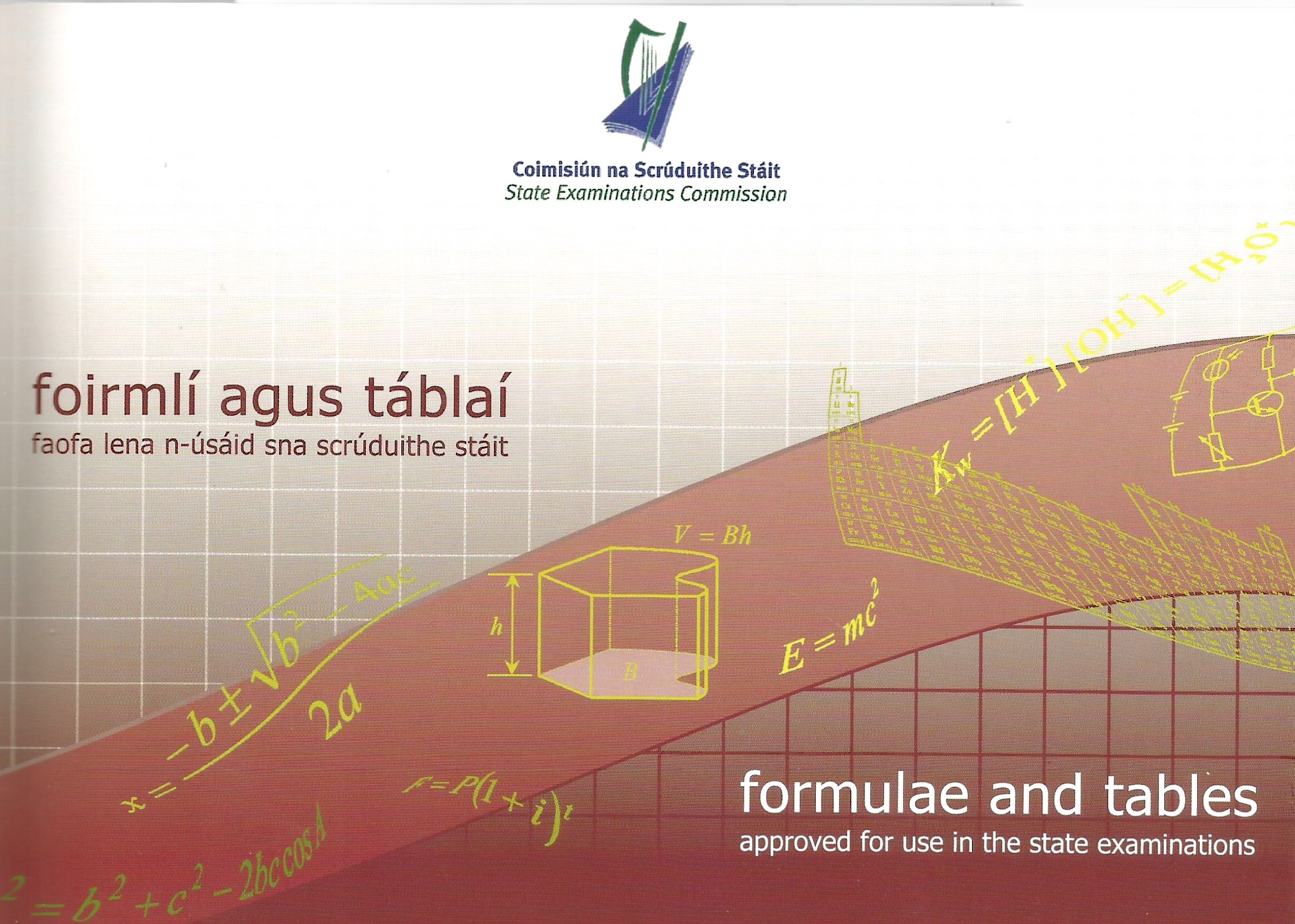
This book is in regular use in schools and colleges throughout Ireland, but that the term is a shorthand for a booklet containing a general collection of mathematical formulae, scientific data and other bits of stuff that might come in useful to students. There are a lot more formulae than tables, but everyone has calculators now so those aren’t really necessary. There is no table of logarithms in the Log Tables, actually. I suppose much older versions did have more tables, but as these were phased out the name just stuck and they’re still called Log Tables.

The official book costs €4. I bought it in Maynooth’s excellent local independent bookshop. The man who served me knew exactly what I meant when I asked for Log Tables.

I’m old enough to remember actually using tables of logarithms (and other mathematical tables  of such things as square roots and trigonometric functions, in the form of lists of numbers) extensively at school. These were provided in this book of four-figure tables (which you can now buy for 1p on Amazon, plus p&p).
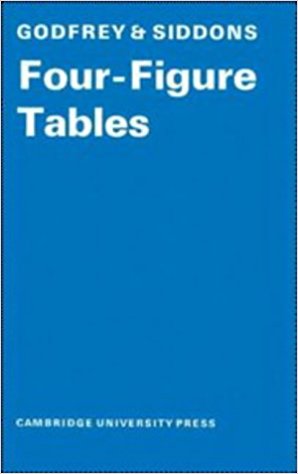
As a historical note I’ll point out that I was in the first year at my school that progressed to calculators rather than slide rules (in the third year) so I was never taught how to use the former. My set of four-figure tables which was so heavily used that it was falling to bits anyway, never got much use after that and I threw it out when I went to university despite the fact that I’m a notorious hoarder.

Students in Theoretical Physics at Maynooth are allowed to ask for Log Tables in any formal examination. The formulae contained therein are elementary in terms of physics, so won’t help very much with more advanced examinations, but I have no problem with students consulting the Log Tables if their mind goes a bit blank.  It seems to me that an examination shouldn’t be a memory test, and giving students the basic formulae as a starting point if anything allows the examiner to concentrate on testing what matters much more, i.e. the ability to formulate and solve a problem. The greatest challenge of science education at University level is, in my opinion, convincing students that their brain is much more than a memory device.

Here’s an example page that shows some elementary formulae for Mechanics with explanations as Gaeilge in English.

These formulae come up in Physics and/or Applied Mathematics at Leaving Certificate but we don’t require students taking Mechanics in the first year to have done either of those subjects so many students find pages such as this very helpful.

I was interested to learn that colleagues in the Department of Mathematics and Statistics here in Maynooth do not allow the use of Log Tables in examinations. I don’t know why.
Test Piece

Posted in Biographical, Jazz with tags on March 31, 2023 by telescoper

The newly enhanced version of this blog, improved at great expense, enables me to upload audio files. I thought I’d check out that facility by sharing this rendition of the tune Petite Fleur which was written in 1952 by the great Sidney Bechet but made famous by Monty Sunshine by a recording with Chris Barber’s band in 1959. The version here was performed in the 1990s in a little recording studio in Gateshead. Can you identify the clarinet player? (Hints: (i) it is not Sidney Bechet; (ii) nor is it Monty Sunshine; and (iii) it was my Dad playing the drums…)

Advanced Electromagnetism Theory Lecture Notes

Posted in Education, Maynooth, The Universe and Stuff with tags , , on March 31, 2023 by telescoper

As a member of academic staff who teaches in a publicly funded University, and in the spirit of the Open Access movement, I think that as far as possible I should put the content of my lectures in the public domain. I’ve decided today to do this with my final-year module on Advanced Electromagnetism. Here you go.

Any questions?

If you think that isn’t much for the 17 lectures I’ve given so far, just look at what I started with:

I reckon I’ve made quite a lot of progress!

Blogging Matters

Posted in Biographical with tags , , on March 30, 2023 by telescoper

A recent post about how much this blog may or may not be worth made me think about the fact that I’ve been writing this blog since September 2008 and for all that time I’ve used the very basic free version of WordPress. That version has quite a low limit on storage (1GB) but after all this time I’ve still only used 75% of that, so at the current rate of use it should last another 5 years or thereabouts. The downside of the free version however is the plethora of advertisements plasters all over the place as punishment for daring to use the free version. I don’t know if that bothers other readers as much as it bothers me, but it is a problem that is definitely become much worse recently.

Today, therefore, I decided to upgrade this site to a paid ‘plan’. Being a cheapskate I’ve gone for the minimum possible plan – called “Personal” – but it does increase my storage to 6GB, which is more than I’ll ever use, gives me a free email address, and removes all the ads from the site. This latter feature is the most important and I hope it makes for a more pleasant reading experience for my regular readers, Sid and Doris Bonkers.

I’d be grateful if readers could confirm that the advertisements no longer appear.

Another feature of the paid plan is that I can register a new domain name, which is telescoper.blog. My new email address is telescoper@telescoper.blog, so henceforth you can contact me there with matters relating to this blog (although I suppose I’ll get mainly spam…)

Apparently under the new arrangements I can also make podcasts, although I’m not sure I want to…

P.S. Don’t worry if you have bookmarked the address telescoper.wordpress.com, which will continue to work.

In Praise of Drag Queens

Posted in Biographical, History, LGBTQ+, Politics with tags , , , on March 29, 2023 by telescoper
The late Paul O’Grady in Lily Savage persona

I was very sad to hear this morning of the death at the age of 67 of Paul O’Grady, who was best known (to me) in the form of Lily Savage, the best of the drag acts to be found in London when I lived there years ago. I remember seeing Lily Savage many times, including one memorable night at the old Drill Hall near Tottenham Court Road, which was a hilarious occasion enjoyed by everyone there (including a smattering of celebrities in the audience). The best bit of the best drag shows is always how the performer deals with hecklers. Paul O’Grady had a ready wit and a very acerbic tongue which made Lily Savage a must-see act. I wasn’t the only one to be surprised when Lily Savage got her own mainstream television show in the 90s, as much of her material was very “blue”, and I wondered how she would fare with the inevitable toning down of the material. The transition to Telly, however, turned out to be a great success.

Paul O’Grady “retired” Lily Savage some years ago, but still appeared on TV as himself to great popular acclaim. I never knew him personally but some old friends of mine from London got to know him very well, including going on holiday with Paul and his partner Andre (whom he married in 2017). They all said Paul was a lovely and friendly person and just as funny in private as he was on stage or on television. I send my condolences to his friends and family.

Drag has of course been around for centuries. Cross-dressing in the theatre, in film, and in opera, where it plays a central role in many plots especially in comedies. Who can forget the wonderful Alastair Sim in the St Trinian’s movies? More recently, Danny La Rue (who, incidentally, was born in Cork) was a regular performer on television in my youth and was for a time Britain’s highest paid entertainer.

But Paul O’Grady was a bit different. He successfully navigated a tricky journey to bring Lily Savage from the underground world of gay bars and clubs into the realm of popular culture at a time overshadowed by Section 28 and the AIDS crisis. Paul O’Grady was a powerful advocate for LGBTQ+ rights. His visibility and humour made the world a better place for many of us. His was a life well lived.

It is especially sad that Paul O’Grady’s death coincides with widespread and growing hostility to drag queens from far right bigots, who are intent on attacking anyone associated in any way with the LGBTQ+ community. The banning of drag shows – which has already happened in some States of the USA- is just part of this agenda; transphobia is another, as is the anti-migrant movement. It’s all about manufacturing hostility to distract attention away from the real problems of society. The list of targets is growing. Before long, any lifestyle perceived to be unconventional in any way will come under attack. The wave of bigotry sweeping across the world is intended to sweep diversity aside and leave in its wake a bleak landscape of dreary uniformity.

The career of Ireland’s own Rory O’Neill (aka Panti Bliss), who was a popular contestant on Dancing with the Stars, mirrors that of Paul O’Grady. I recently went to an event featuring Rory O’Neill. He had left Panti at home for the occasion but it was extremely interesting and enjoyable – and a bit sweary! – to hear him talk about his life and experiences, especially why he became an activist and how he started out as a drag performer. I have the same sort of admiration for Rory as I had for Paul. We need more like them.

I also have personal reasons for being grateful for drag queens. When I was a youngster (still at School) I occasionally visited a gay bar in Newcastle called the Courtyard. I was under age for drinking alcohol let alone anything else – the age of consent was 21 in those days – but I got a kick out of the attention I received and flirted outrageously with the much older clientele. I never took things further but never had to buy my own drinks, let’s put it that way.

Anyway, one evening I left the pub to get the bus home – the bus station was adjacent to the pub – but was immediately confronted by a young bloke who grabbed hold of me and asked if I was a “poof”. Before I could answer, a figure loomed up behind him and shouted “Leave him alone!”. My assailant let go of me and turned round to face my guardian angel, or rather guardian drag queen. No ordinary drag queen either. This one, at least in my memory, was enormous: about six foot six and built like a docker, but looking even taller because of the big hair and high heels. The yob laughed sneeringly, whereupon he received the immediate and very muscular response of a powerful right jab to the point of the chin, like something out of a boxing manual. His head snapped back and hit the glass wall of a bus shelter. Blood spurted from his mouth as he slumped to the ground.

I honestly thought he was dead, and so apparently did my rescuer who told me in no uncertain terms to get the hell away. Apart from everything else, the pub would have got into trouble if they’d known I had even been in there. Instead of waiting around in Marlborough Crescent, I ran to the next stop where I got a bus after a short wait.

When I got home I was frightened there would be something on the news about a violent death in the town centre, but that never happened. It turns out the “gentleman” concerned had bitten his tongue when the back of his head hit the bus shelter. It must have been painful, but not life-threatening. My sympathy remains limited. I stayed away from the pub after that.

I think there’s a moral to this story, but I’ll leave it up to you to decide what it is.

Spectroscopy of High Redshift Galaxies

Posted in The Universe and Stuff with tags , , , , , on March 28, 2023 by telescoper

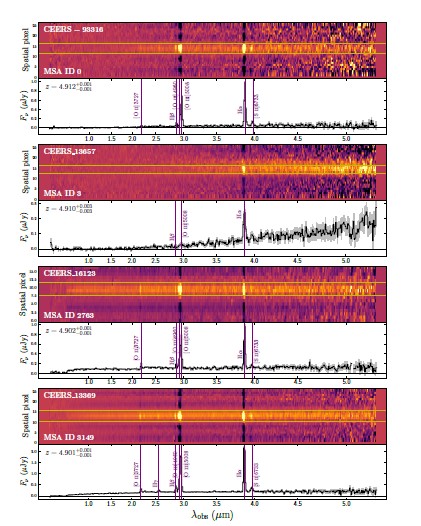
The tentative identifications of a number of galaxies at high redshift using JWST on the basis of photometric measurements (see, e.g., here and here) have initiated a huge amount of activity in the extragalactic community trying to establish spectroscopic redshifts for these galaxies. Results of this endeavour have started to appear on the arXiv here with this abstract:

During the first 500 million years of cosmic history, the first stars and galaxies formed and seeded the cosmos with heavy elements. These early galaxies illuminated the transition from the cosmic “dark ages” to the reionization of the intergalactic medium. This transitional period has been largely inaccessible to direct observation until the recent commissioning of JWST, which has extended our observational reach into that epoch. Excitingly, the first JWST science observations uncovered a surprisingly high abundance of early star-forming galaxies. However, the distances (redshifts) of these galaxies were, by necessity, estimated from multi-band photometry. Photometric redshifts, while generally robust, can suffer from uncertainties and/or degeneracies. Spectroscopic measurements of the precise redshifts are required to validate these sources and to reliably quantify their space densities, stellar masses, and star formation rates, which provide powerful constraints on galaxy formation models and cosmology. Here we present the results of JWST follow-up spectroscopy of a small sample of galaxies suspected to be amongst the most distant yet observed. We confirm redshifts z > 10 for two galaxies, including one of the first bright JWST-discovered candidates with z = 11.4, and show that another galaxy with suggested z ~ 16 instead has z = 4.9, with strong emission lines that mimic the expected colors of more distant objects. These results reinforce the evidence for the rapid production of luminous galaxies in the very young Universe, while also highlighting the necessity of spectroscopic verification for remarkable candidates.

arXiv:2303.15431

As the abstract explains, the spectroscopic measurements confirm some – but not all – of the galaxies studied to be at high redshift. One galaxy – the one discussed here (known to its friends as 93316) which appeared to have a redshift of 16.6 ± 0.1 now seems to have a much lower redshift of 4.91. Here’s an image of this object:

The redshift 16.6 object was of some interest to cosmologists because an object of large stellar mass at such a large distance is difficult to reconcile with the standard theory of galaxy formation. That is now apparently out of the way, and the remaining high-z galaxies are not as extreme as this one and pose less of a problem.

While this result may disappoint some, and indeed delight others, it is also interesting to note that there are three similar objects at much the same redshift, which may indicate the presence of some sort of group or cluster:

Fascinating!

P.S. It struck me, after writing this, that waiting for spectroscopic confirmation of photometric redshifts is a lot like waiting for VAR to check whether or not to rule out a goal for offside…

The Value of Blogging

Posted in Biographical with tags on March 27, 2023 by telescoper

As a blogger I am often asked “What is the value of blogging?”. Until yesterday this was a question I couldn’t answer. Then I stumbled across a thing called SiteIndices where I found the answer, at least for this blog. Here is what SiteIndices says:

Obviously I’m delighted with the spectacular achievement of being in the top two million websites globally.

I was initially surprised that they had arrived at the value of $8,865 but I then realized that this is just based on the revenue it generates through advertising.

Of course the true value of this blog must also include the intrinsic worth of the scientific and cultural insights it offers, as well as the wit and wisdom displayed by its author. When those factors are included, the estimated worth would not be $8,885, but something substantially lower.

Two New Publications at the Open Journal of Astrophysics

Posted in OJAp Papers, The Universe and Stuff with tags , , , , , , , , on March 26, 2023 by telescoper

I just realized that I forgot to advertise on here a couple of recent publications at the Open Journal of Astrophysics – the papers are coming in at quite a rate now – so I’ll catch up with them both in one post.

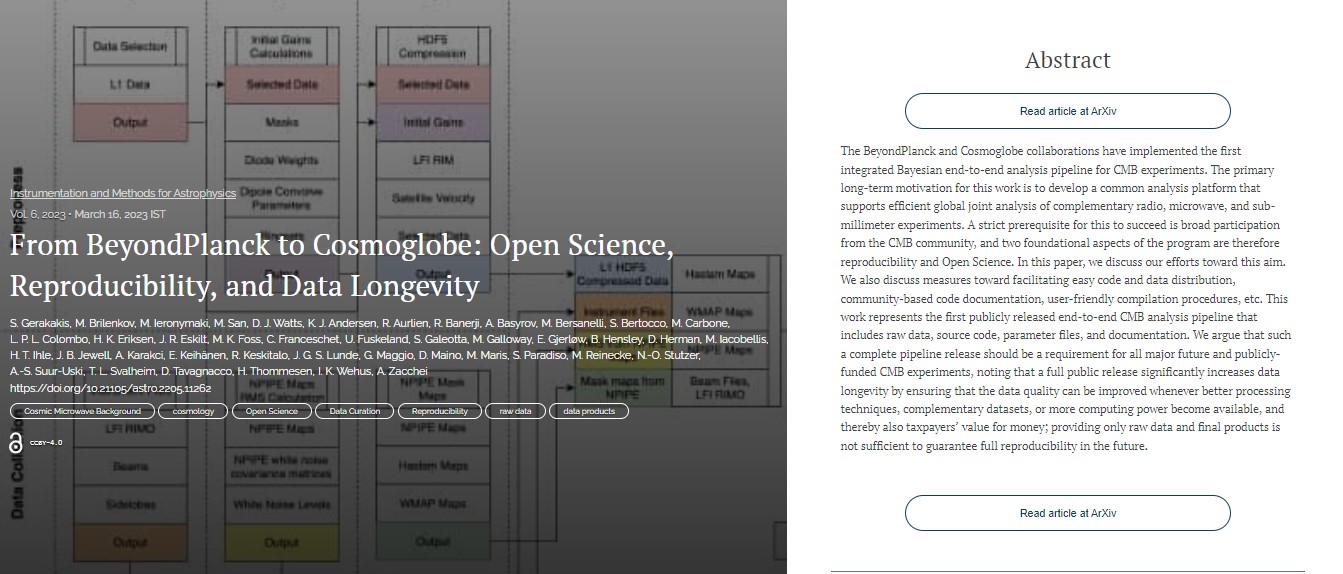
The first paper of the two is the 10th paper in Volume 6 (2023) and the 75th in all; it was published on 16th March 2023. This one is  in the folder marked Instrumentation and Methods for Astrophysics. The title is “From BeyondPlanck to Cosmoglobe: Open Science, Reproducibility, and Data Longevity” and it is a discussion of the importance of reproducibility and Open Science in CMB science including measures toward facilitating easy code and data distribution, community-based code documentation, user-friendly compilation procedures, etc.  You can find out more about the BeyondPlanck collaboration here and about Cosmoglobe here.

The first author is S. Gerakakis and there are 42 authors in all. This is too many to list individually here but they come from Greece, Norway, Finland, Germany, Italy, and the USA.

Here is a screen grab of the overlay which includes the  abstract:

You can click on the image of the overlay to make it larger should you wish to do so. You can find the officially accepted version of the paper on the arXiv here.

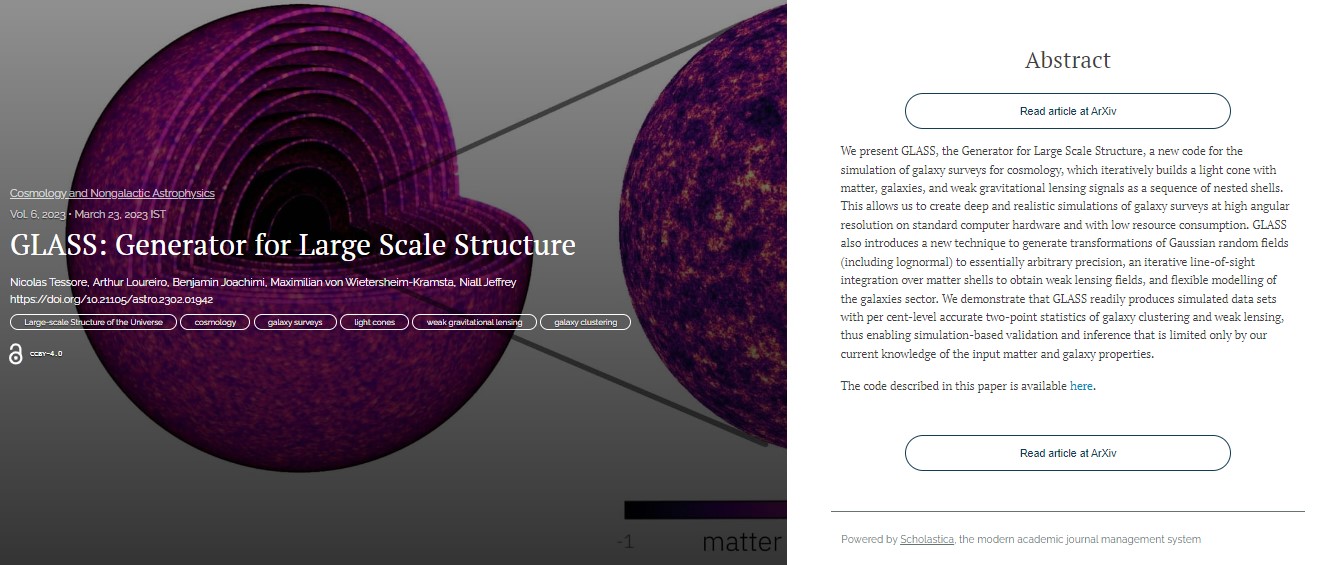
The second paper is the 11th paper in Volume 6 (2023) as well as the 76th in all; this one was published last Thursday (23rd March). This is another for the folder marked Cosmology and Nongalactic Astrophysics. The title is “GLASS: Generator for Large Scale Structure” and the paper is about a new code for the simulation of cosmological observables obtainable from galaxy surveys in a realistic yet computationally inexpensive manner. The code can be downloaded here. This is an interesting approach that contrasts with the “brute force” of full numerical simulations like those I discussed a few days ago.

The authors are Nicolas Tessore (University College London), Arthur Loureiro (UCL, Edinburgh and Imperial College), Benjamin Joachimi (UCL), Maximilian von Wiestersheim-Kramsta (UCL) and Niall Jeffrey (UCL).

Here is a screen grab of the overlay which includes the  abstract:


You can click on the image of the overlay to make it larger should you wish to do so. You can find the officially accepted version of the paper on the arXiv here.

The Alteration of Time

Posted in History on March 26, 2023 by telescoper

It’s that time of year again. The clocks went forward at 1am on 26th March, when I was in bed.  I  scheduled this post for exactly that time to see what would happen. By the time I get up tomorrow morning I’ll be on Irish Summer Time and it will probably take me most of the day to work out how to change the clock on my oven again. Still, at least there will be a slight reduction in the amount of confusion over the timing of next week’s batch of telecons.

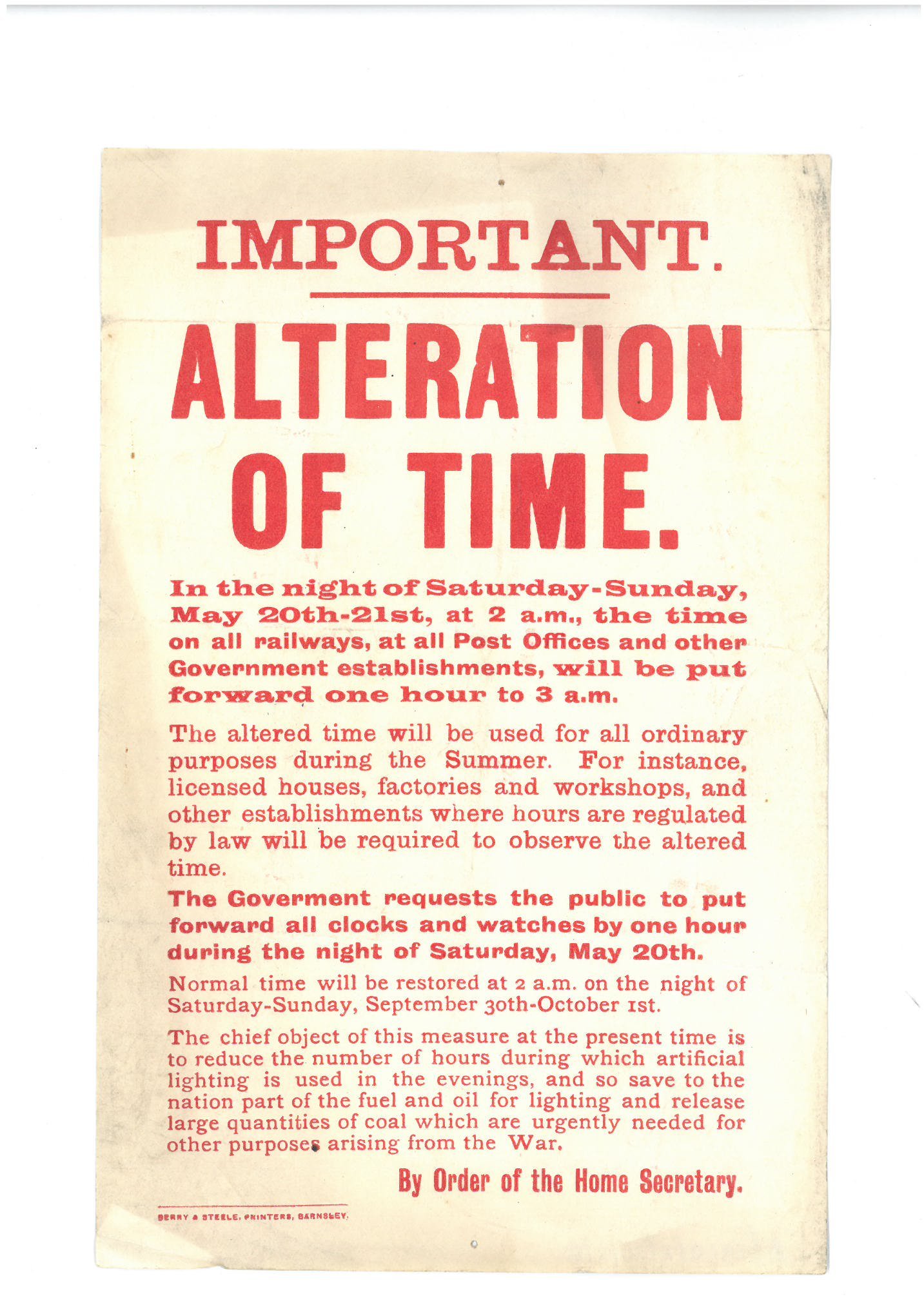
Among the many sensible decisions made recently by the European Parliament was to approve a directive that will abolish `Daylight Saving Time’. I’ve long felt that the annual ritual of putting the clocks forward in the Spring and back again in the Autumn was a waste of time effort, so I’ll be glad when this silly practice is terminated. It would be better in my view to stick with a single Mean Time throughout the year. This was supposed to happen in 2021 but has been delayed and I gather there are no plans to make it happen in the foreseeable future.

The  splendid poster above is from 1916, when British Summer Time was introduced. You might be surprised to learn that the practice of changing clocks backwards and forwards is only about a hundred years old, in the United Kingdom. To be honest I’m also surprised that the practice persists to this day, as I can’t see any real advantage in it. Any institution or organization that really wants to change its working hours in summer can easily do so, but the world of work is far more flexible nowadays than it was a hundred years ago and I think few would feel the need.

Anyway, while I am on about Mean Time, here is a another poster from 1916.

Until October 1916, clocks in Ireland were set to Dublin Mean Time, as defined at Dunsink Observatory, rather than Mean Time as defined at Greenwich. The adoption of GMT in Ireland was driven largely by the fact that the British authorities found that the time difference between Dublin and London had confused telegraphic communications during the Easter Rising earlier in 1916. Its imposition was therefore, at least in part, intended to bring Ireland under closer control of Britain. Needless to say, this did not go down well with Irish nationalists.

Ireland had not moved to Summer Time with Britain in May 1916 because of the Easter Rising. Dublin Mean Time was 25 minutes 21 seconds behind GMT but the change was introduced at the same time as BST ended in the UK, hence the alteration by one hour minus 25 minutes 21 seconds, i.e. 34 minutes and 39 seconds as in the poster.

R.I.P. Gordon Moore (1929-2023)

Posted in Open Access, R.I.P., The Universe and Stuff with tags , , , on March 25, 2023 by telescoper
Gordon Moore, photographed in 1981. Picture credit: Intel corporation.

I was saddened this morning to see news of the passing of scientist, inventor, entrepreneur and philanthropist Gordon Moore at the age of 94. Moore was a co-founder in 1968 of semiconductor company Intel, which has an enormous manufacturing facility at Leixlip, just a few miles from Maynooth, which employs almost 5000 people and contributes hugely to the local economy.

Gordon Moore also gave his name to Moore’s Law which relates to the rate of growth of transistors in integrated circuits and hence to the growth of computing power that gave rise to microprocessors, personal computers and supercomputers. I had reason to refer to Moore’s Law on this blog just a couple of days ago.

Moore made a huge personal fortune from business, and in 2000, he and his wife Betty established the Gordon and Betty Moore Foundation, with a gift worth about $5 billion. Through the Foundation, and as individuals, they have funded projects in science in fields as diverse as materials science and physics to genomics, data science and astronomy, in particular they have funded including the Thirty Metre Telescope project.

I have personal reasons for being grateful for the generosity of Gordon and Betty Moore Foundation. When we were try to set up the Open Journal of Astrophysics some years ago we were awarded a small grant from them. It wasn’t a large amount of money but it was essential in allowing us to develop the idea into the working journal it is today. The Open Journal of Astrophysics is just one of many projects that would not have been possible without philanthropic giving of this sort.

I send my condolences to Betty (whom he married in 1950) and to the rest of his family, as well as all his friends and colleagues.

Rest in peace Gordon Moore (1929-2023)