Author Archive

On the Colours of Stars

Posted in The Universe and Stuff with tags , , , on January 20, 2021 by telescoper

There’s an interesting paper on the arXiv by Harre & Heller with the title Digital Color Codes of Stars. Here’s the abstract:

Publications in astrophysics are nowadays mainly published and read in digitized formats. Astrophysical publications in both research and in popular outreach often use colorful representations of stars to indicate various stellar types, that is, different spectral types or effective temperatures. Computer generated and computer displayed imagery has become an integral part of stellar astrophysics communication. There is, however, no astrophysically motivated standard color palette for illustrative representations of stars and some stars are actually represented in misleading colors. We use pre-computed PHOENIX and TLUSTY stellar model spectra and convolve them with the three standard color matching functions for human color perception between 360nm and 830nm. The color matching functions represent the three sets of receptors in the eye that respond to red, green, and blue light. For a grid of main sequence stars with effective temperatures between 2300K and 55,000K of different metallicities we present the red-blue-green and hexadecimal color codes that can be used for digitized color representations of stars as if seen from space. We find significant deviations between the color codes of stars computed from stellar spectra and from a black body radiator of the same effective temperature. We illustrate the main sequence in the color wheel and demonstrate that there are no yellow, green, cyan, or purple stars. Red dwarf stars (spectral types M0V – M9V) actually look orange to the human eye. Old white dwarfs such as WD1856+534, host to a newly discovered transiting giant planet candidate, occur pale orange to the human eye, not white. Our freely available software can be used to generate color codes for any input spectrum such as those from planets, galaxies, quasars etc.

This reminded me of a post I wrote in 2011 about why you never see any green stars. They say a picture paints a thousand words so here’s an illustration from the above paper:
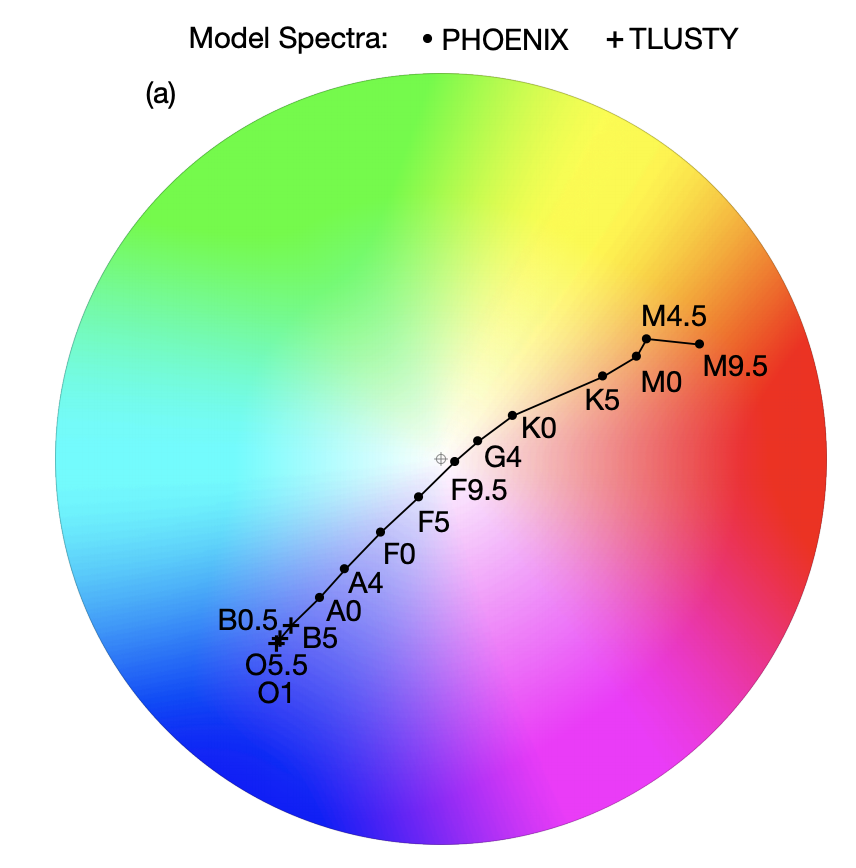
This shows that although there are stars in the Main Sequence whose spectra peak at wavelengths corresponding to green light, none of them look green. The paper also claims that there are no yellow stars either. The Sun can look yellow when viewed from Earth but that is to do with scattering in the atmosphere: from space, the Sun looks white.

For another discussion of the use of colour representations in cosmology, see here.


It’s raining…

Posted in Biographical, Maynooth, Poetry with tags , , , , , , on January 19, 2021 by telescoper

Taking a short break from examination marking I had a look outside. I’m not sorry to be cooped up indoors given that it’s pouring with rain. In fact it rained all night and morning and is set to continue in the same vein until tomorrow.

While I was waiting for my coffee to brew I was thinking about some idiomatic expressions for heavy rain. The most familiar one in English is Raining Cats and Dogs which, it appears, originated in a poem by Jonathan Swift that ends with the lines:

Drowned puppies, stinking sprats, all drenched in mud,
Dead cats and turnip tops come tumbling down the flood.

My French teacher at school taught me the memorable if slightly indelicate Il pleut comme vache qui pisse, although there are other French expressions involving, among other things nails, frogs and halberds.

One of my favourites is the Welsh Mae hi’n bwrw hen wragedd a ffyn which means, bizarrely, “It’s raining old ladies and sticks”. There is also Mae hi’n bwrw cyllyll a ffyrc – “It’s raining knives and forks”.

Related idiomatic expressions in Irish are constructed differently. There isn’t a transitive verb meaning “to rain” so there is no grammatical way to say “it rains something”. The way around this is to use a different verb to represent, e.g., throwing. For example Tá sé ag caitheamh sceana gréasaí which means “It’s throwing cobblers’ knives”.

Talking (of) cobblers, I note that in Danish there is Det regner skomagerdrenge – “It’s raining shoemakers’ apprentices” and in Germany Es regnet Schusterjungs – “It’s raining cobblers’ boys”.

Among the other strange expressions in other languages are Está chovendo a barba de sapo (Portuguese for “It’s raining toads’ beards”), Пада киша уби миша (Serbian for “It’s raining and killing mice”),  Det regner trollkjerringer (Norwegian for “It’s raining female trolls”) and Estan lloviendo hasta maridos (Spanish for “It is even raining husbands”).

No sign of any husbands outside right now so I’ll get back to correcting exams.

Cosmology Talks: Marika Asgari on Kids 1000

Posted in Cardiff, Maynooth, The Universe and Stuff with tags , , , , on January 18, 2021 by telescoper

It’s time I shared another one of those interesting cosmology talks on the Youtube channel curated by Shaun Hotchkiss. This channel features technical talks rather than popular expositions so it won’t be everyone’s cup of tea but for those seriously interested in cosmology at a research level they should prove interesting. Since I haven’t posted any of these for a while I’ve got a few to catch up on – this one is from September 2020.

In this talk Marika Asgari tells us about the recent Kilo-Degree Survey (KiDS) cosmological results. These are the first results from KiDS after they have reached a sky coverage of 1000 square degrees. Marika first explains how they know that the results are “statistics dominated” and not “systematics dominated”, meaning that the dominant uncertainty comes from statistical errors, not systematic ones. She then presents the cosmological results, which primarily constrain the clumpiness of matter in the universe, and which therefore constrain Ωm and σ8. In the combined parameter “S8“, which is constrained almost independently from Ωm by their data they see a more than 3σ tension with the equivalent parameter one would infer from Planck.

P. S. The papers that accompany this talk can be found here and here.

Be My Baby – The Ronettes and Phil Spector

Posted in Music with tags , , , , on January 17, 2021 by telescoper

I heard this afternoon of the death in prison of convicted murderer and music producer Phil Spector. He was 81 years old and was suffering from Covid-19. I have to say I have found a lot of the reporting of his demise has been reprehensible, talking about how his career was “marred” by the fact that he murdered actress Lana Clarkson. I’m surely the family and loved ones of Lana Clarkson have a different opinion about whose lives were “marred” …

Nevertheless, Phil Spector’s legacy as a record producer is undeniably immense. He produced over a hundred hit singles many of them having a trademark sound that others tried and failed to copy.

When Spector started out as a producer a normal recording session involved having the band and vocalists perform together in the studio. Spector adopted the approach of having very large backing groups – often with double or treble instruments and backing vocals – which he recorded separately, adding the lead vocals later. That is the way pop records have been made for a very long time now but it was quite unusual in the early sixties. The arrangements weren’t very complicated: many musicians just played in unison for some or all of the track. When it was all mixed (often with a lot of reverb) the layering effect was to make it difficult identify individual instruments – hence the term “Wall of Sound“. In classic Spector tracks you will find that it’s often in the chorus or when a big key change occurs that the full force of this wall appears. It’s a tremendously effective device, even if you know it’s coming.

Phil Spector came onto the music scene at about the same time as the pioneering British record producer Joe Meek. I’ve heard it said that they influenced each other or even that Spector stole Meek’s ideas. I don’t think that’s true at all. Both were very original but they worked in very different ways and Spector never favoured the distortions that Meek frequently exploited.

When I heard Phil Spector had died two tracks sprang immediately to mind. One was You’ve Lost That Loving Feeling by the Righteous Brothers and the other was this one. I searched for it on Youtube and found this fascinating recording from the session that created it. The track is Be My Baby by the Ronettes. The lead singer Veronica Bennett later married Phil Spector and became Ronnie Spector. They separated in 1972 amid allegations of psychological abuse by her husband.

In this video you can hear several takes of the relatively simple backing track (without backing vocals or lead singer or the string section that appears in the final mix heard right at the end) and there’s some interesting discussion between the producer and drummer (the excellent Hal Blaine). Spector liked to use unusual percussion – tambourines and castanets feature prominently on this track – but he wanted the drums to be simpler to begin with. Later on he asks Blaine to “make me an ending”. He promptly produces lots of great work, most of it sadly doomed to be faded out. If you’re interested the tune is based on two chord progressions: I – ii – V7 and the I – vi – IV – V progression that was ubiquitous in music from the 1950s. The completed track is less than three minutes in duration, but it’s a classic.

You’re probably wondering why I picked this one. Well for one thing it’s almost exactly as old as me! The other reason is that I hadn’t heard it for a while and it struck me very hard just how much of an influence it must have been on Amy Winehouse…

R.I.P. Lana Clarkson (1962-2003).

For the Birds..

Posted in Biographical, Maynooth with tags , , , on January 17, 2021 by telescoper

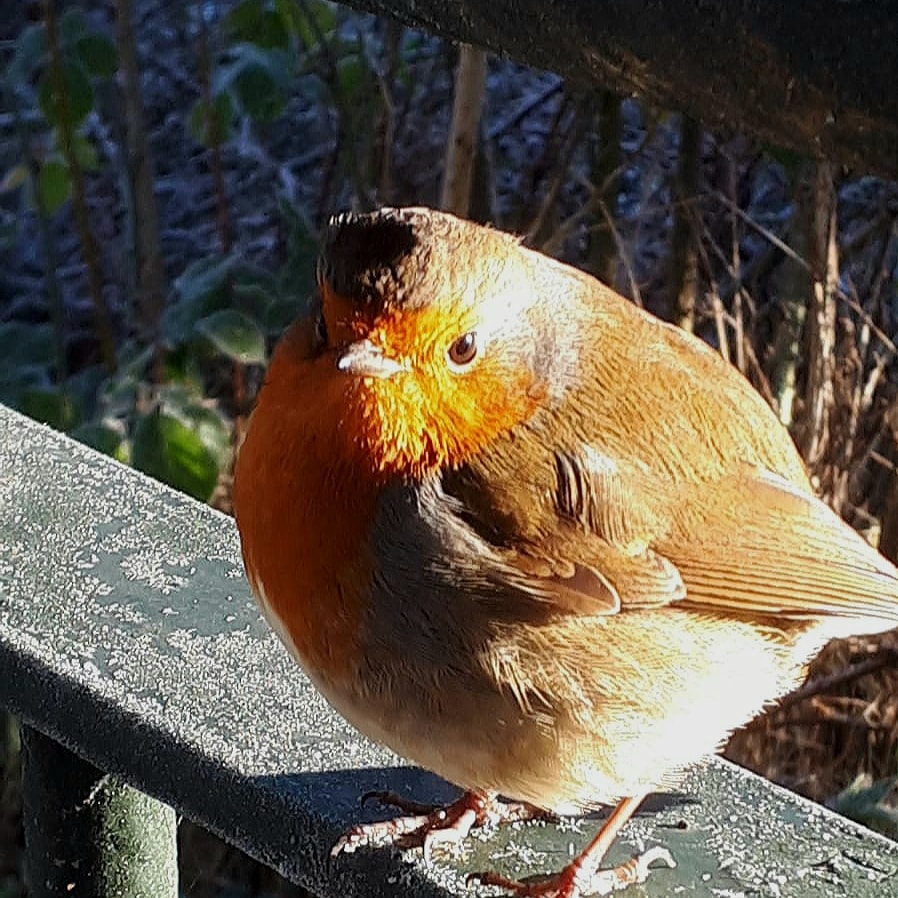
The Giant Robin of Newgrange

I saw the above picture of a robin on Twitter the other day and it reminded me of the one that visits my garden. I’ve never been quick enough to take a picture of him, but he’s every bit as plump as the one in the picture. If he were taller he’d be spherical.

The robin situation in my garden has seen an important development: another robin has arrived. The new one is smaller than the first and the first time I saw it I only noticed it because it was having a squabble with the plump one. I assumed it was a younger rival, but on subsequent days I saw the two of them together quite peacefully. Since male and female robins are virtually indistinguishable I wonder if they might be a husband and wife team? The fact that I saw them having a row lends support to this theory.

Another interesting thing concerned niger seed. I bought some of this a while ago, together with a feeder that purported to be designed for dispensing it. Niger seed is a fine oily seed very good for the smaller birds. Unfortunately the mesh in the feeder is too coarse and the seed just poured out as I filled it. I put the bag of seed away and filled the feeder with other stuff. Last week I remembered the bag of niger seed and decided to try putting some loose in the bird table. In no time a group of four chaffinches were tucking in. These were definitely two males and two females – the females are notably different in colour. Anyway, they love it – as do a number of other birds, including the robin(s) – and I’ve had to replenish the supply twice.

I usually wait until there don’t seem to be any birds present before going out to check the food supply, but this is a waste of time. Even if the garden appears empty, as soon as I go out there’s a whooshing sound and lots of chirps as birds that had secreted themselves in various trees and hedges take to the air to escape the scary human.

The birds provide a welcome distraction when I take a break from exam marking, as does writing a blog, but I guess I should get back to it now.

Wales from Ireland

Posted in History with tags , on January 16, 2021 by telescoper

Snowdon in North Wales, from Howth, Co Dublin. Picture Credit: Niall O’Carroll

I couldn’t resist sharing this wonderful picture that appeared in yesterday’s Irish Independent. On what must have been an exceptionally clear day it shows the mountains of Wales including Snowdon, which had been snowed on, from Howth in County Dublin. The picture was taken from the Ben of Howth, which is about 171m above sea level, giving a view over local houses across the Irish Sea.

The distance from Howth to Snowdon is about 140 km as the crow flies, so it’s surprising that the mountains appear so clearly. On the other hand a colleague from Dunsink Observatory sent me this:

… the Welsh mountains are distinctly visible, particularly that ridge of hills which runs S. W. to point Braich-y-pwll, and bounds Caernarvon bay …

That quote is from Henry Ussher, founding astronomer of Dunsink Observatory, writing in the first paper of The Transactions of the Royal Irish Academy in 1787.

If you fly into Dublin from the East, the flight path takes you almost directly over Howth with Malahide to your right. It’s a very historic place, well worth a visit if you’re in the Dublin area.

P. S. Thanks to Geraint Jones for this view in the other direction. Looking in the opposite direction from Mynydd Parys: Bethel Hen chapel in Llanrhuddlad, Ynys Môn, with the summit of Kippure (with the transmitter on top), south of Dublin, on the border with Co. Wicklow, 134 km away. Taken from Mynydd Parys.

Picture Credit: Geraint Jones

Happy Birthday Wikipedia!

Posted in Biographical, History with tags on January 15, 2021 by telescoper

Not a lot of people – well, probably quite a lot of people actually – know that it was twenty years ago today, on January 15th 2001, that Wikipedia first went online. I know this is true as I read it on Wikipedia:

Wikipedia was launched on January 15, 2001, by Jimmy Wales and Larry Sanger. Sanger coined its name as a portmanteau of “wiki” and “encyclopedia”.

I don’t remember the launch of Wikipedia itself but I do recall when students started using Wikipedia links in project reports and the like. Unfortunately at the beginning many of the articles on scientific topics were very poor – often laughably so – and I discouraged students from using them. Now, twenty years and the efforts of many volunteer editors later, they are generally very good. I now encourage students to use Wikipedia as a resource, but I still discourage them from including references to it in formal reports. The best way to use it is to get an overview but then dig down into the references which most articles lists.

I find Wikipedia an excellent resource for things outside science of course, especially music, and link to articles there very often from this blog.

Somewhere along the line somebody even set up a Wikipedia page about me. It began as “just a stub” but has been updated from time to time. I don’t know who set it up or who has updated it, but it’s now a bit out of date. It still says that I work part-time between Cardiff and Maynooth, for example. No doubt someone will fix this at some point.

I’ve edited a few articles there myself, actually, mostly on cosmology but also on Jazz. Some of my blog posts are linked from there too but it would seem inappropriate for me to edit my own Wikipedia page.

Anyway, if you’re a fan of Wikipedia then please consider making a donation.

Update: it seems that the elves have been at work already and my Wikipedia page has been partially updated. It still says I live in Cardiff, however…

Abide with me

Posted in Biographical, Music with tags , , , on January 14, 2021 by telescoper

I’ve had a very busy day today so haven’t had time to write anything significant, but I just remembered this piece that I heard a few weeks ago and thought I’d take the opportunity to share it. The hymn Abide with Me sung to the tune Eventide by William Henry Monk is a piece that makes me quite nostalgic as I remember it coming up quite frequently during Evensong when I sang in the Church choir in Benwell when I was little. It’s also well known as the hymn that was always sung before the start of the FA Cup Final.

Anyway, I’m not really a huge fan of brass bands, but I think this arrangement of Eventide for brass instruments by Welsh composer Karl Jenkins is very beautiful. On this recording it’s played by the Cory Band.

Thought For The Year

Posted in Education, Maynooth with tags , , on January 13, 2021 by telescoper

In the midst of the January examination period I’ve been thinking about how tough this year has been nd will continue to be for all students in third-level institutions, but especially the cohort currently in the first year of their course. I think it’s now fairly clear that nearly all their study this year will be done remotely. We on the teaching side have all tried to make the best of this situation but there’s no question that the learning experience we have been able to offer is not as good this year as in other years. On top of that the students – especially in the first year – have been denied the chance to get to know other students through personal interactions, clubs & societies, or through joint interests. Those of us who went to University in more normal times know that many of the friendships we made when we first arrived at college stayed with us for the rest of our lives.

Thinking about this I want to make a suggestion. It is that every student currently in their first year of study at a third-level institution should be offered the chance to start again in the autumn and repeat the whole academic year, regardless of how well they do this time round. Not all students will want to do this, and not all will be able to because of personal circumstances, but I feel we should at least offer them the possibility and back it up with funding for the repeated year. My own suspicion is that it would be a minority, but probably a significant minority, that would opt for this. It would cost money, but I think it would mean a lot to a considerable number of students.

I can anticipate an objection that students repeating their first year will take up places that would normally go to next year’s new intake. That depends on how many would take up the repeat offer, of course. Extra capacity may be needed for some but not all courses. But it also seems to me that this year’s Leaving Certificate students will have had their studies affected too. Perhaps final-year school students should be offered the chance to repeat their year too?

Would starting and/or finishing college a year later really be such a problem given the extraordinary nature of the Covid-19 crisis?

P.S. I’ve talked about the situation in Ireland, but everything I’ve said will apply elsewhere too.

SARS-Cov-2 Vaccine strategy: One Jab or Two?

Posted in Covid-19 with tags , , , , , on January 13, 2021 by telescoper

I’ve been thinking quite a lot about the issue of the Coronavirus vaccination programmes currently underway and have had some interesting and informative exchanges on Twitter about it. This morning’s news that AstraZeneca has finally applied to the European Commission for permission to market its vaccine within the European Union reminded me of those discussions so I thought I’d post a question here. I genuinely don’t know the answer, incidentally, so there’s no agenda here!

As you probably know all SARS-COV-2 vaccines (Moderna, Pfizer/Biontech and AstraZeneca) require two doses, administered about three weeks apart, for maximum efficacy. It’s worth saying before going on that the scientists involved deserve high praise for developing these highly effective vaccines at a speed that has exceeded all expectations.

At the moment however supplies of these vaccines are fairly limited and it’s early days for immunization programmes so there are serious logistical problems to be solved before we get anywhere near full vaccination. I grabbed this from Twitter yesterday showing the state of play in various countries:

Note, incidentally, that Denmark is doing particularly well within the EU but France, Netherlands, Luxembourg and Belgium have started very slowly. Ireland is about mid-table.

At the top of the league is Israel, though  they are not offering vaccination to the Palestinian people whose lands they occupy. Israel has just reported that after 12 days the Pfizer/BioNTech vaccine has about 50% efficacy after one dose based on results from its own programme. That number is roughly consistent with initial estimates of from trials this vaccine but the statistics aren’t great and there is a considerable margin of error on these figures.

Now the question I am asking myself is that given the limited supply is it better at this stage to give as many people as possible one dose of the vaccine, or follow the manufacturers’ original plan and give two doses to half as many people? There are reports that the UK has been deferring the second dose beyond the recommended interval, where there is no data on its efficacy. Perhaps I’m being excessively cynical but it seems to me that the UK Government’s approach is more driven by public relations than by public health considerations.

I understand that there are difficult issues here, not least the ethical one of having people sign up for a specific two-dose vaccination only to find that’s not what they get. Another issue is the speed with which doses are being made available relative to the size of the population. Yet another issue is who you prioritize.

Above all, though, there is the question of what you mean by “better”. One criterion would be to save as many lives as possible. Another might be to slow the rate of infections as much as possible. Another might be to allow the economy to open up as early as possible. These are all different and would lead to different decisions, particularly with regard to who should get the vaccine. Saving lives obviously means protecting the vulnerable and the people who care for them (e.g. health workers). Economic considerations would however lead you to prioritize those on whom the economy depends most directly, which would include workers who can’t easily work from home (many of whom are in low-paid manual jobs).

The following poll is therefore going to be very unscientific, but I’m interested to find out what people think. In  order to keep it simple, lets suppose you have a batch of two million doses of a vaccine (say the Pfizer one) and the next batch is due in three months.

You have to decide between the following two options:

  1.  Give 1,000,000 people one dose now and another dose in three weeks’ time
  2.  Give 2,000,000 people one dose now and hope that it is effective for three months (or that additional supplies appear more quickly than anticipated).

Vote now!

A similar poll I did on Twitter a while ago can be found here: there are some quite interesting comments in the ensuing thread.

Comments are of course welcome through the Comments Box!

P.S. I’m quite low down the pecking order in Ireland so it’s unlikely I’ll get vaccinated before the summer.