Author Archive

Time for Resilience?

Posted in Education, Maynooth with tags , on December 8, 2020 by telescoper

I’ve just received an invitation to a two-hour seminar on Resilience for Heads of Department. I post the description here:

Sadly I don’t have time to attend this, as it is right in the middle of a teaching day in the last week of an absurdly busy term and it clashes with a previous commitment. I can’t see yet another two hour meeting on Zoom doing much for my wellbeing anyway, especially when I’ve already been running on empty for weeks.

I will be “taking the time to renew and refresh” after December 18th, when I’ll have the first proper holiday I’ve been able to take since March. I’ll probably spend most of that asleep. Or maybe “resilience” is all about adapting to life without any time off?

“We know we’re working you into the ground, but if you learn how to be *resilient* we might might get a few more months out of you before you crack.”

Sharpening the Saw seems like an interesting book. I wonder what the sequel is,  Wielding the Axe?


Einstein’s Universe

Posted in The Universe and Stuff with tags , , on December 7, 2020 by telescoper

I’ve just started teaching about special relativity and for some reason I suddenly remembered this blast from the past (in 1979) which I saw when I was still at School. It is now available in fully remastered form on YouTube. It’s a feature-length film (2 hours long) but I think it’s worth sharing in its entirety. Here is the description from YouTube, with a few additions:

Based on Nigel Calder’s book Einstein’s Universe, this fascinating and rare film going by the same title has been re-mastered and digitally enhanced to bring Einstein fans a priceless experience. Narrated by the charismatic Peter Ustinov and hosted by Nigel Calder, the film was first broadcast on the centenary of Albert Einstein’s Birth; March 14th, 1979. Ustinov takes the viewer on a wonderful experience through the McDonald Observatory at the University of Texas-Austin where he is thoroughly enlightened on the great physicist’s theories, especially General Relativity, by a renowned team of scientists including Dennis Sciama, Roger Penrose, John Wheeler, Wallace Sergeant, Irwin Shapiro, Sidney Drell, and Ken Brecher.

Included in Ustinov’s experience at the McDonald Observatory are experiments to help understand gravity, warped space, how light responds to gravity, the “Doppler effect” and how radio waves, as used in police radar, are an unbeatable way of measuring speed. From these simpler experiments much larger concepts are drawn, such as the discovery of a Binary Pulsar, the nature of black holes and how they are created, and the ultimate theory of how the universe was formed. Other demonstrations measure the speed of light, how time passes more slowly for people traveling in an airplane, the incredible accuracy of the Atomic Clock in Washington, DC and how time itself would appear to stop at the surface of a black hole. The conclusion of the program portrays Einstein as a great humanitarian. Although known as the “father of the Atomic Bomb”, his greatest concern was for the potentially devastating effects splitting the atom could have on the future of mankind. His famous letter to President Franklin Roosevelt warned that although the splitting of the atom to detonate an atomic bomb could be used to end World War II, it could also potentially be used for far more deadly ends.

It’s a great chance to see and hear some of the greats of physics as they were over forty years ago, some of whom make remarkably prescient comments about the future (now our present) including about gravitational waves!

The Darkling Thrush

Posted in Poetry with tags , , , on December 7, 2020 by telescoper
I leant upon a coppice gate
When Frost was spectre-grey,
And Winter's dregs made desolate
The weakening eye of day.
The tangled bine-stems scored the sky
Like strings of broken lyres,
And all mankind that haunted nigh
Had sought their household fires.

The land's sharp features seemed to be
The Century's corpse outleant,
His crypt the cloudy canopy,
The wind his death-lament.
The ancient pulse of germ and birth
Was shrunken hard and dry,
And every spirit upon earth
Seemed fervourless as I.

At once a voice arose among
The bleak twigs overhead
In a full-hearted evensong
Of joy illimited;
An aged thrush, frail, gaunt, and small,
In blast-beruffled plume,
Had chosen thus to fling his soul
Upon the growing gloom.

So little cause for carolings
Of such ecstatic sound
Was written on terrestrial things
Afar or nigh around,
That I could think there trembled through
His happy good-night air
Some blessed Hope, whereof he knew
And I was unaware.

by Thomas Hardy (1840-1928)

The Song of the Dunnock

Posted in Uncategorized with tags , on December 6, 2020 by telescoper

It’s very cold and foggy today and there was a hard frost overnight, all of which wintriness made me go out and replenish the bird feeders. No sooner had I refilled and replaced the one that holds peanuts when I had a visitation from starlings, blue tits and even a jackdaw. There was a blackbird too, but that remained at ground level pecking at the frozen earth.

I was hoping to see my favourite garden visitor, whom I last saw a few days ago. This is the Dunnock (sometimes called a hedge sparrow, though it’s not a member of the sparrow family).

The Dunnock is a fairly drab-looking bird easily mistaken at for a House Sparrow at a quick glance. A quick glance is all you’re likely to get, in fact, because, although they’re not at all uncommon in Ireland, they are very shy. The one – I think it’s the same one – that visits my garden darts out from a hedge from time to time, grabs something from the lawn (presumably a bug of some sort), then darts back again and vanishes. It probably pays to be wary when you’re a bird that feeds on the ground. I’ve never seen it on any of the bird feeders, which contain seeds and nuts.

Anyway, I do enjoy seeing this critter when it makes an appearance. Although I don’t it very often I know it’s around as I hear its song very often. For a small bird it’s very loud indeed, and very distinctive. Here’s a recording:

That rapid-fire jumble of notes is very different from the song of a House Sparrow which is much simpler, consisting of a series of single notes at the same pitch.

Wrens are even smaller but are also very loud. As far as I know I haven’t had one of those in my garden yet.

Vaccination in Ireland

Posted in Covid-19 with tags , , , , , , , on December 5, 2020 by telescoper

A very interesting twitter thread from Dr Ronan Glynn (Ireland’s Deputy Chief Medical Officer) inspired me to write something in response to the very positive recent developments with regard to a SARS-CoV2 (Covid-19 vaccine). In Switzerland the regulator does not feel that there is enough data yet for approval to be granted yet, so I have some reservations about the fast-tracking of the process in the United Kingdom. Nevertheless there has to be a tradeoff between the risk of potential reactions or side-effects of a vaccination and the immediate danger to public health arising from Covid-19. As someone recently said to me on Twitter: “if you’re not going to fast-track during a global pandemic, when would you?”.

Here in Ireland it is likely that a vaccination programme will commence early in the New Year. To answer a question I posed a few weeks ago, priority will be given to front-line health care workers, especially those working in care homes, and the elderly. If all goes to plan there will be something like full vaccination of the population by September 2021.

I am not in a priority group so will have to wait a while for my jabs, but I will certainly take the vaccine as soon as it is available to me.

No doubt there are some people out there who for various reasons will refuse to be vaccinated. I doubt anything I say here will persuade them but it is I think valuable to look at the history of vaccination programmes in Ireland for various illnesses, which is what Dr Glynn’s thread does.

To give a few examples:

  • Smallpox. In 1863 vaccination against smallpox was made compulsory for all children born in Ireland. Deaths fell from 7,550 for the decade to 1880 to the last reported death from smallpox here in 1907. Smallpox was declared eradicated in 1979 – this one vaccine saved 100s of millions of lives globally.
  • Diptheria. Diphtheria was a very common cause of death among children until the 1940s – there were 318 deaths from it reported in Ireland  1938. With the introduction of a vaccine, the number of deaths fell year on year with 5 deaths in 1950; the last death notified from diphtheria was in 1967.
  • Poliomyelitis. In Ireland, polio infection (mainly affecting young children causing long term paralysis) became more common after 1920 with major epidemics during the 1940s & 1950s. A vaccine was introduced in 1957. The last reported case of polio here in Ireland 1984.
  • Measles. The number of cases of measles declined dramatically after introduction of measles vaccine in 1985, from 10,000 cases in 1985 to 201 cases in 1987.
  • Meningococcal Meningitis. In 1999, there were 536 cases of meningococcal meningitis in Ireland The meningitis C vaccine was introduced in 2000, with the meningitis B vaccine introduced in 2016. Cases of meningococcal meningitis have dropped more than 80% since these vaccines were introduced.

These are of course wonderful advances in public health, but none of them provided total relief immediately. It will be the same with Covid-19. The availability of a vaccine will not end the pandemic overnight, but at least it will enable us to plan for a phased return to normal.


While there is great cause for long-term optimism, there are still reasons to be anxious in the short term. There will be many months before a full vaccination programme is in place and in that time cases (and, sadly, deaths) could rise substantially. There is a real danger will think that it’s all over, that they can let down their guard and ignore social distancing.

Ireland is currently relaxing its Covid-19 restrictions for the Christmas period, but it is doing so from a level of over 260 new cases per day. The Coronavirus is currently circulating in the community at a far higher rate than it was in the summer and if it increases at a similar rate to August then we could be in for a huge surge. I fear that by the New Year we might be in real trouble again. It would be tragic if people lost their lives owing to complacency with safety so nearly in sight.


Another Week Ending

Posted in Biographical, Covid-19, Education, GAA, Maynooth, The Universe and Stuff on December 4, 2020 by telescoper

As this term staggers on I once again arrive at a weekend in a state of exhaustion. Still there are just two teaching weeks left for this term so soon it will be the Christmas break. At least there won’t be any teaching then, though there will be other things to do before the examinations start in January.

I’ve managed to keep a reasonable pace up in both sets of lectures. The last one due this term is for Vector Calculus and Fourier Series, on Friday 18th December, but I think I may be able to complete the module content on the Tuesday lecture which means the students will be able to have a bit more time to relax before Christmas or, alternatively, a bit more time for revision. I hope it’s the former, as I imagine the students are at least as tired as we staff are. This has been a difficult year for everyone.

At Maynooth University, lectures for Semester 2 start on February 1st 2020. That will give us a bit of time to see how the Covid-19 pandemic progresses before deciding exactly how we’re going to approach teaching. Other universities that resume earlier have less time to make this decisions. I fear that the number of cases may rise rapidly over the three weeks remaining before Christmas, even before the Christmas break itself, and we therefore might have to go fully online next term. What I don’t want to happen is what happened in September, namely that we made elaborate plans for lecture rotations and tutorial groups that were then ditched because the Coronavirus situation changed. That was quite demoralizing because it involved a great deal of effort that was wasted.

Being a Department of Theoretical Physics we don’t have the problems facing the more experimental subjects that require extensive laboratory classes which are difficult to do under social distancing. Next term however we do have Computational Physics, which has laboratory classes, so I’ll have to decide how much of that we can do in person and how much students will have to do online using their laptops. I hope we can return to full in-person lab sessions, but we can’t be that will be possible right now. In any case computer labs are far easier to run online that practical chemistry or physics labs, so I think we will be able to do a reasonable job whatever the circumstances.

For added fun, next term I’ll be teaching a new module; 4th Year Advanced Electromagnetism. Although there’s always a lot of work required to teach a module for the first time, I am actually looking forward to doing this one as there’s some interesting physics in it (especially relativistic electrodynamics). I may try to squeeze a bit of plasma physics in too. But will it be online or on campus, or a mixture of both? Time alone will tell.

Anyway I’m looking forward to this weekend being as stress-free as possible. There’s a good start tonight, as Newcastle’s game against Aston Villa has been postponed due to Covid-19 so no anxious looking at the score this evening. The rest of the weekend will be dominated, for me, by the two semi-finals of the All Ireland Gaelic Football Championship (Cavan versus Dublin tomorrow and Mayo versus Tipperary on Sunday). It seems to be written in the stars that the final should be Dublin versus Tipperary, the two teams that played on Bloody Sunday, but time will tell on that one too.

Update: Dublin did indeed comfortably beat Cavan on Saturday but Mayo beat Tipperary in a high scoring game in a foggy Croke Park on Sunday (Mayo 5-20 Tipperary 3-13). The final will therefore not be a rerun of the 1920 final.

That’s enough rambling. Have a good weekend.

The Arecibo collapse as it happened…

Posted in Uncategorized with tags on December 3, 2020 by telescoper

The Arecibo Observatory has released this dramatic footage of the recent collapse of the instrument platform on the telescope. Credit: Arecibo Observatory and the National Science Foundation.

The Arecibo Telescope is 57 years old. It suddenly occurred to me that so am I…

Our Solar Neighbourhood

Posted in The Universe and Stuff with tags , , , on December 3, 2020 by telescoper

Here’s a very nice movie showing the stars in the Solar neighbourhood (defined to be within 100 parsecs of the Sun) with positions and colours mapped by the European Space Agency’s Gaia mission.

P.S. The video is timed to coincide with Gaia’s third data release: for more information about DR3 see here.

Cosmology Talks: Eiichiro Komatsu & Yuto Minami on Parity Violation in the Cosmic Microwave Background

Posted in Cardiff, Maynooth, The Universe and Stuff with tags , , , , , , , , on December 2, 2020 by telescoper

It’s time I shared another one of those interesting cosmology talks on the Youtube channel curated by Shaun Hotchkiss. This channel features technical talks rather than popular expositions so it won’t be everyone’s cup of tea but for those seriously interested in cosmology at a research level they should prove interesting.

In this video, Eiichiro Komatsu and Yuto Minami talk about their recent work, first devising a way to extract a parity violating signature in the cosmic microwave background, as manifested by a form of birefringence. If the universe is birefringent then E-mode polarization would change into B-mode as electromagnetic radiation travels through space, so there would be a non-zero correlation between the two measured modes. They  try to measure this correlation using the Planck 2018 data, getting  a 2.4 sigma `hint’ of a result.

A problem with the measurement is that systematic errors, such as imperfectly calibrated detector angles,  could mimic the signal. Yuto and Eiichiro’s  idea was to measure the detector angle by looking at the E-B correlation in the foregrounds, where light hasn’t travelled far enough to be affected by any potential birefringence in the universe. They argue that this allows them to distinguish between the two types of measured E-B correlation. However, this is only the case if there is no intrinsic correlation between the E-mode and B-mode polarization in the foregrounds, which may not be the case, but which they are testing. The method can be applied to any of the plethora of CMB experiments currently underway so there will probably be more results soon that may shed further light on this issue.

Incidentally this reminds me of Cardiff days when work was going on about the same affect using the Quad instrument. I wasn’t involved with Quad but I do remember having interesting chats about the theory behind the measurement or upper limit as it was (which is reported here). Looking at the paper I realize that paper involved researchers from the Department of Experimental Physics at Maynooth University.

P. S. The paper that accompanies this talk can be found here.

Arecibo Collapse

Posted in Uncategorized with tags on December 1, 2020 by telescoper

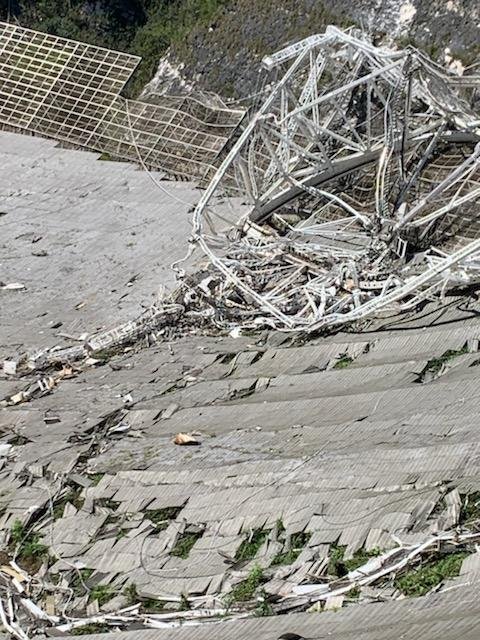
I posted recently about the decision to close the iconic radio telescope at Arecibo. Well it seems the end has come more quickly than anticipated.

The instrument platform (which weighed 820 tonnes), normally suspended at a height of 150m, has crashed down into the dish causing catastrophic destruction.

Fortunately nobody was hurt. The telescope is however a goner.

P. S. For bonus marks, calculate the energy released by the collapse.