Author Archive

Der Rosenkavalier at WNO

Posted in Opera with tags , , , , , , , on June 5, 2017 by telescoper

I’m in London attending a cosmology meeting (of which more, perhaps, anon) but I couldn’t resist posting a quick review of yesterday’s birthday treat: the first performance of a new production of Der Rosenkavalier by Richard Strauss. It wasn’t exactly a first night as such because it was a 3pm start. In fact it was still daylight when I got home..

Der Rosenkavalier is superficially a comic opera but it also moments of great depth and poignancy, dealing with the passage of time and the nature of love. The libretto contains some lovely passages, such as this:

Die Zeit, die ist ein sonderbar Ding.
Wenn man so hinlebt, ist sie rein gar nichts.
Aber dann auf einmal, da spürt man nichts als sie.
Sie ist um uns herum, sie ist auch in uns drinnen.
In den Gesichtern rieselt sie,
im Spiegel da rieselt sie,
in meinen Schläfen fliesst sie.
Und zwischen mir und dir da fliesst sie wieder,
lautlos, wie eine Sanduhr.

Most of the comedy is supplied by an intrigue involving the boorish Baron Ochs, played brilliantly by bass Brindley Sherrat, who wishes to marry the innocent Sophie (largely to acquire the property of Sophie’s father). The Baron engages dashing young Octavian to deliver a ceremonial silver rose to Sophie as a wedding gift. Octavian arrives with the gift but falls in love at first sight with Sophie and his feelings are reciprocated. When the Baron turns out to be the horrible git that he is, Octavian engineers a plot to discredit him, rescue Sophie from a potentially disastrous marriage and claim her for himself. The cunning plan, which proves successful, involves Octavian dressing as a maid in order to catch the Baron in flagrante.

It’s worth mentioning that the part of 17-year old Octavian is played by a female singer – in this production the excellent Lucia Cervoni – who at one point has to be a girl playing a boy playing a girl, rather like Cherubino in the Marriage of Figaro. Sounds silly? Well, it is but it was beautifully done and gloriously funny.

Octavian (right) presents Sophie with the silver rose..

Octavian is a `trouser role’ but in this production the character begins with trousers off, having a bit of rumpy-pumpy with the Marschallin (played by the wonderful Rebecca Evans), who is much older than Octavian. At the start of the Opera they are in a passionate relationship, but the Marschallin is conscious of the passage of time and that her relationship with Octavian can’t last. At the end of Act I, she points out to Octavian that their relationship can’t go on and he storms out, shortly to meet young Sophie (in Act II).

In this production the Marschallin is often accompanied on stage by the silent and solitary figure of an old lady, who it turns out is a representation of herself in later life. It’s a clever device and would have been even more effective had the old lady not reminded me so much of Madge Allsop

The staging is in period, and for the most part pleasantly straightforward but there is a rather gimmicky element of steadily encroaching sand, presumably ‘the sands of time’ referred to in the last line of the excerpt quoted above. I felt this was neither necessary nor convincing. The theme of time’s inexorable progress is clear enough. There’s no need to labour it.

Near the end of Act III, after much coming and going, and the odious Baron’s entrapment and humiliation, the Marschallin  is left alone with her former lover Octavian and his intended bride Sophie, we arrive at the Opera’s emotional high point, and indeed one of the most sublime moments in the entire operatic repertoire, the sumptuous trio Hab Mir’s Gelobt,  in which the Marschallin comes to terms with the loss of Octavian and blesses the relationship between him and Sophie. This is one of the pieces of music that really affects me very powerfully, and I am not too proud to admit that I did let go a tear or two. Maybe more. Not because it is especially sad, but because it’s so very beautiful the way the three voice blend together and with the orchestra.

I don’t give star ratings but from a vocal point of view this is definitely one of the finest performances I’ve ever seen on the Opera stage. All four principals: Rebecca Evans, Lucia Cervoni, Brindley Sherratt and Louise Alder (Sophie) rose to the challenges of their roles in great style. All were superb so it would be wrong to single out one, but I will say that I was surprised to discover that this was Rebecca Evan’s debut as the Marschallin – she was just about perfect in the role.

The Orchestra of Welsh National Opera directed by Tomas Hanus played Strauss’s lush score with great precision and passion,  holding together a wonderful afternoon at the Wales Millennium Centre. An altogether excellent way to spend a birthday afternoon!

In case you were wondering….

Posted in Biographical, Politics with tags , , on June 3, 2017 by telescoper

Simulation of the binary black-hole coalescence GW170104

Posted in The Universe and Stuff with tags , , , on June 2, 2017 by telescoper

Via the Cardiff University news website, I found this video of a computer simulation of the binary black-hole coalescence that gave rise to the gravitational wave event GW170104 whose detection was announced yesterday, so I thought I’d share it here.

Here’s the  blurb accompanying the video:

The video shows a numerical simulation of a binary black-hole coalescence with masses and spins consistent with the GW170104 observation. The strength of the gravitational wave is indicated by elevation as well as color, with blue indicating weak fields and yellow indicating strong fields. We rescale the amplitude of the gravitational wave during the simulation to show the signal during the entire animation not only close to merger, where it is strongest. The sizes of the black holes are increased by a factor of two to improve visibility. The bottom panel in the video shows the gravitational waveform starting at frequency of 25Hz. The fade in of the video corresponds to a frequency of about 30Hz.

© Numerical-relativistic simulation: S. Ossokine, A. Buonanno (Max Planck Institute for Gravitational Physics) and the Simulating eXtreme Spacetimes project; scientific visualization: T. Dietrich (Max Planck Institute for Gravitational Physics), R. Haas (NCSA).

The colour scheme gives me a headache, and there’s no sountrack, but it’s quite instructive nonetheless.


Captain SKA – Liar Liar

Posted in Music, Politics with tags , on June 2, 2017 by telescoper

I don’t know why, but every time I go onto Youtube these days I get a horrible Conservative Party propaganda video. Obviously some sort of algorithm has decided to inflict this crap on me because I’m deemed to be likely to be persuaded to vote for the Tories. I can promise them that this is not the case. The Tories may win next week’s election, but this campaign has revealed Theresa May as thoroughly cowardly and dishonest, despite her best efforts to hide from public scrutiny. I will be voting for Welsh Labour.

Anyway, I’ve decided to retaliate by posting this: it’s Liar Liar by Captain SKA. It’s in the top ten of the UK singles chart, but the BBC refuses to play it. I can’t compete with the Beeb, but every little helps….

New Astronomy at the New Year (GW170104)

Posted in The Universe and Stuff with tags , on June 1, 2017 by telescoper

The inside story of the detection of gravitational wave event announced earlier today..

Shane L. Larson's avatarWrite Science

by Shane L. Larson

Newton’s portrait.

January 4 holds a special place in the hearts of scientists — it is Isaac Newton’s birthday (*). Newton stood at the crossroads that led to modern science, and astronomy in particular. He was the first person to build a workable reflecting telescope, a design that now bears his name and for the past 4 centuries has been the dominant type of telescope used by amateurs and professionals alike. Newtonian telescopes have revealed much about the Cosmos to our wondering minds. Newton was also responsible for the first formulation of a physical law that describes the working of gravity, called the Universal Law of Gravitation. Today we use the Universal Law to launch satellites, send astronauts into orbit, convert the force of your feet on the bathroom scale into your “weight“, and a thousand other applications.  There is much to celebrate…

View original post 1,623 more words

Newsflash: another LIGO detection!

Posted in The Universe and Stuff with tags , , , on June 1, 2017 by telescoper

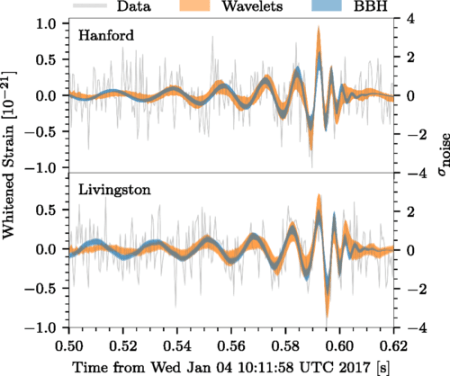
I’ve just heard the news that  LIGO has just announced the detection of another gravitational-wave signal, which has been given the identifier GW170104; it was detected on 4th January 2017.

The event was the merger of a black-hole binary system a redshift z=0.2, which is a proper distance of about 800 Mpc in the standard cosmological model, the most distant event yet detected. There are also tantalising hints that at least one of the black holes had spin opposite the orbital angular momentum, which implies it may have originated in a globular cluster. For more details please see the refereed paper.

If you’d rather just look at the plot here is the evidence for the event, in the form of coincident signals at the two components of LIGO:

 
LIGO

I reckon there’s a good chance of seeing members of the Cardiff University Gravitational Physics group celebrating in the pub later this evening!

It’s also a reasonable inference given the rate of detection of these events so far that we’re going to see many more in the very near future!

Cose da sapere su Cardiff

Posted in Bute Park, Cardiff, Football with tags , , , , , , on June 1, 2017 by telescoper

Cardiff is gearing up for the UEFA Champion’s League final between Real Madrid and Juventus which takes place in the Principality Stadium on Saturday night. Cardiff University has produced this nice video featuring some students from Italy telling visitors about `things to know about Cardiff’, which I thought I’d share here:

There’s also a Spanish version here.

As you can imagine there’s quite a lot of disruption going on in the City ahead of this event, which is expected to attracted over 200,000 visitors. Last night one of the main roads was closed to allow the construction of a temporary footbridge to help manage the flow of people from Bute Park into the Stadium in the period just before the kickoff. There is only one small exit from the Park opposite the ground, which would probably cause considerable congestion, so the bridge will provide another route out, over the famous Animal Wall.

Cowbridge road was closed to vehicles and pedestrians for this operation, which I assumed would mean a bit detour for me on my walk home from the pub last night. Nevertheless, out of curiosity, I followed my normal route until I reached the construction site. A small group of people and a couple of very friendly policemen were there. I asked nicely if there was any possibility of getting past the road block rather than walking all the way around by side streets, and one of the officers said that if I waited for about 5 minutes they were going to open it up temporarily and let people through, which they did.

Cardiff Castle and Bute Park are being used to host a few thousand `Corporate VIP Guests’ during the weekend of the Final. For that a huge part of Bute Park – the entire area of Coopers Field – is closed to the public. Not only that, but the temporary buildings that have been erected there will cause so much damage to the grass that it will have to be completely re-seeded. This area will not be re-opened to the public until September at the earliest. This seems a very heavy price for the ordinary folk of Cardiff to pay for an event very few will be able to attend.

As well as congestion and crowd control, there is also the threat of terrorist activity (especially in the wake of the Manchester bomb). This morning as I walked into work I saw several groups of armed police officers. I’m not sure if they are intended to make people feel more secure, but they just made me feel nervous.

Road_Closure_Map_A3-Preparing-Cardiff-

It’s quite easy to infer what the biggest concern is for the security services. The presence of vehicle barriers all round the city and the suspension of all vehicle traffic within a wide perimeter of the various fan zones suggests that they are worried about potential attacks involving cars or lorries running amok among the huge numbers of pedestrians. It’s sad that we have to think of such things, but these precautions seem entirely necessary.

I was toying with the idea of taking photographs of some of the security measures but on reflection thought that might not be a wise thing to do in case I was mistaken for someone plotting an atrocity!

My own plan for the Final is to shut myself in my house, batten down the hatches, cook myself a nice dinner and drink a nice bottle of wine. I’m completely neutral as far as the match is concerned. Whether it’s Real Madrid of Italy or Juventus of Spain, may the best team win!

The Bright Field, by R.S. Thomas

Posted in Poetry with tags , , , on May 31, 2017 by telescoper

I heard this recording of R.S. Thomas reading one of his most famous poems on Private Passions on BBC Radio 3 this Sunday. It was only later that I realised that although I’ve posted quite a few poems by R.S. Thomas over the years, I’ve never posted this one so I’m correcting that omission now. The poem is called The Bright Field:

I have seen the sun break through
to illuminate a small field
for a while, and gone my way
and forgotten it. But that was the pearl
of great price, the one field that had
treasure in it. I realize now
that I must give all that I have
to possess it. Life is not hurrying

on to a receding future, nor hankering after
an imagined past. It is the turning
aside like Moses to the miracle
of the lit bush, to a brightness
that seemed as transitory as your youth
once, but is the eternity that awaits you.

Here is R.S. Thomas himself reading it. The comments made about this reading on the radio programme weren’t entirely complimentary, but I rather like it. Notice, however, that in the spoken version he adds a `the’ between `had’ and `treasure’, which isn’t there in my printed copy of the poem.

http://www.dailymotion.com/video/xuohy0_r-s-thomas-the-bright-field_creation

Module Evaluation

Posted in Biographical, Education with tags , , on May 31, 2017 by telescoper

It’s always with a measure of trepidation that I look at the feedback that students give on a module that I’ve been teaching, and this nervousness is considerably enhanced when it’s the first time I’ve lectured that material. This morning I grasped the nettle and clicked on the link to take me to my questionnaire results for my module Physics of the Early Universe. I was relieved that it was all fairly positive.

In the old days these things were done on paper, which meant quite a big job collecting and collating the results. Nowadays it’s all done online, which means not receiving any drawings or other artistic contributions that some students were wont to scribble on the questionnaires. Past experience has been that the response rate is lower for on-line surveys, but the response rate I got this time was pretty high – over 80%. Perhaps students are getting more accustomed to doing everything on line?

I never find the numerical scores particularly useful as one has no idea how to calibrate them, but the textual comments made by students are often interesting and helpful. They’re all anonymous, of course, to encourage students to be frank.

One thing that clearly went down very well was the use of Cardiff’s new lecture-capture system (called Panopto), which allows the lecturer to record everything – powerpoint, data visualizer, whiteboard and live action – for posterity. I recorded all my lectures and exercise classes in toto and put them up on our Virtual Learning Environment (called Learning Central) for the students to view at their leisure. It’s a significantly more sophisticated and flexible lecture capture system than the one we used when I was at Sussex, and the questionnaire responses showed that the students really appreciated the availability of the recordings; a representative comment can be found below.

Not all my colleagues are keen on the idea of lecture capture, but I like it a lot and am very happy to do it with my own lectures. It does seem that some university staff are wary of this innovation, but opinion may be changing. Please let me know what you think via the poll thatr I’ve been running on this for a few years:

It’s always difficult when you give a new set of lectures judging the pace appropriately. I spent more time on introductory material than I should perhaps have done, and also – as a number of students made clear in the module evaluation – should have done some more worked examples. I’ll try do better next time, and I am very grateful to those who took the time to complete the survey pointing out how I might improve. I always take constructive criticism very seriously.

It is of course the negative comments that are the most helpful in a practical sense, but it is always nice to find comments like these:

The lecturer is very passionate about the subject and that really helps as you can ask any question and he’ll be able to answer it. Furthermore, his enthusiasm helps to keep you engaged. I also found it helpful that the lectures were recorded, so I could look over them while working on coursework.

Before you accuse me of doing so, I admit that I have cherry-picked one of the good ones to show myself in a good light.

I’m less sure how to interpret this one:

The lectures were incredible.

Anyway, the students on this module have now finished the exam and will be waiting for the results which come out in a couple of weeks. If any happen to be reading this blog then thanks for your comments and

Fake Authors in Physics

Posted in The Universe and Stuff with tags , , , on May 30, 2017 by telescoper

Back to work – and exam business – after the Bank Holiday weekend (during most of which I was a bit under the weather), I thought I’d try to get back into the swing of blogging with a brief post about fake authorship.

What provoked me to write this was a strange news item about a Caltech professor who apparently created a fictitious female collaborator called `Ursula C. T. Gamma’ and got her name added as author on scientific papers as well as official email lists on the Caltech website; she also appears in an acknowledgement:

Finally, we thank Ursula C. T. Gamma for continued inspiration.

The professor responsible for all this was none other than Christian Ott, whom I’ve mentioned in a blog post before, because he was placed on unpaid leave by Caltech for harassing two female colleagues.

I don’t know what Ott hoped to gain by inventing a female co-worker. Was it just for a joke, or was there some ulterior motive? I’m not going to speculate here.

If you’ll excuse a bit of frivolity this episode reminded me that a few years ago I toyed with the idea of adding my cat, Columbo, under the pseudonym `Felix Columbo’, as a co-author on a paper I was writing. That would have been for my own amusement – and also because I thought Felix Columbo was a cool name for a physicist, but in the end I didn’t do it largely because I heard about F.D.C. Willard:

The American physicist and mathematician Jack H. Hetherington, Michigan State University, in 1975 wanted to publish some of his research results in the field of low–temperature physics in the scientific journal Physical Review Letters. A colleague, to whom he had given his paper for review, pointed out that Hetherington had used the first person plural in his text, and that the journal would reject this form on submissions with a sole author. Rather than take the time to retype the article to use the singular tense, or to bring in a co-author, Hetherington decided to invent one.

The co-author he invented was his cat, whose name was Chester. The cat’s father was called Willard and the letters F.D.’ stand for `Felis Domesticus’ (the species name for a a house cat).

Other physicists have done similar things. For example, Nobel laureate Andre Geim has written a paper with a hamster as a co-author.

More famously, George Gamow added the name of Hans Bethe to a paper he was writing with his PhD student Ralph Alpher, simply so its authors would be Alpher, Bethe and Gamow. Bethe did subsequently work on the topic discussed in the paper – nucleosynthesis – but hadn’t significantly to the paper. It is reported that Alpher was upset by Gamow’s actions. The paper was published in the Physical Review in 1948 and is a classic in the field of physical cosmology.

As well as being an outstanding physicist, George Gamow was a very colourful and amusing fellow. I’m sure his decision to add Bethe to this paper was just meant as a bit of fun. Likewise with the cat and the hamster. These days, however, authorship of scientific papers is taken far more seriously than it was, as a means to assess research activity and distribute resources. You could argue that this emphasis on authorship is an unhealthy development, but nevertheless that’s the way things. A responsible senior scientist should know that. Adding a phoney author – even if intended as a joke – could well be construed by some institutions as a form of research misconduct.

And how are your real co-workers (especially students and postdocs) supposed to feel if you decide they haven’t contributed enough to merit authorship of a collaborative paper, when they see you adding names of people who don’t even exist?