Author Archive

The Impact of Impact

Posted in Science Politics with tags , on February 18, 2015 by telescoper

Interesting analysis of the 2014 REF results by my colleague Seb Oliver. Among other things, it shows that Physics was the subject in which “Impact had the greatest impact”..

sebboyd's avatarSeb Boyd

 The Impact of Impact

I wrote the following article to explore how Impact in the Research Excellence Framework 2014 (REF2014) affected the average scores of departments (and hence rankings). This produced a “league table” of how strongly impact affected different subjects. Some of the information in this article was used in a THE article by Paul Jump due to come out 00:00 on 19th Feb 2015.  I’ve now also produced ranking tables for each UoA using the standardised weighting I advocate below (see Standardised Rankings).

UoAUnit of AssessmentEffective Weight of GPA

ranking in each sub-profile as %

OutputsImpactEnvir.
9Physics37.938.623.5
23Sociology34.138.627.3
10Mathematical Sciences37.637.524.9
24Anthropology and Development Studies40.235.024.8
6Agriculture, Veterinary and Food Science42.033.025.0
31Classics43.332.624.0
16Architecture, Built Environment and Planning48.631.120.3

View original post 1,558 more words

50 Years of A Love Supreme

Posted in Jazz with tags , , , , on February 17, 2015 by telescoper

A very busy day at work has just ended without time to do a blog post, so before I go home I’ll just do a quickie about the classic album A Love Supreme made by the John Coltrane quartet in late 1964 and released in February 1965. The 50th anniversary of the release of this record has been marked by an extremely interesting programme on BBC Radio 4, broadcast a few days ago but still available on the BBC iPlayer.

A Love Supreme is one of my favourite jazz albums, not only because it’s glorious music to listen to but also for its historical importance. Shortly after making this record Coltrane comprehensively changed his musical direction, abandoning many of the structures that underpinned his earlier work and adopting an approach heavily influenced by the free jazz of the likes of Ornette Coleman and, especially, Albert Ayler. Not everyone likes the music Coltrane made after he made that transition (in 1965) but having taken his earlier style to such a high peak as A Love Supreme he and the rest of the band no doubt felt they couldn’t go any further in that direction.

There are glimpses of the later freer approach in the third track, Pursuance, when the drum and saxophone interchanges between Elvin Jones and Coltrane threaten to break the regular tempo apart, and on this (the second) track Resolution, when McCoy Tyner abandons his usual single-note lines in favour of much more complex chordal improvisations. I think Coltrane’s solo on the last track, Psalm, is entirely improvised and , accompanied by Jones’ rising and falling drum rolls, it acquires a hauntingly solemn atmosphere which makes the hairs stand up on the back of my neck every time I hear it. What a fantastic drummer Elvin Jones was.

But I haven’t got time to analyse the whole album – another’s words are in any case no substitute for listening to this masterpiece yourself – so I’ll just mention that Resolution is based on an 8-bar theme that’s very reminiscent of the theme Africa featured on Africa/Brass made a couple of years earlier. To me it sounds like Coltrane is just itching to cut loose on this track. His saxophone tone has a harder edge than usual for that period, giving the piece an anguished, pleading feel. Elvin Jones is also magnificent, his polyrhythmic accents spurring Coltrane to a climactic solo.

The intensity of Resolution ignites an even more dramatic onslaught on the next track, Pursuance, basically a blues taken at a very fast tempo, before the mood changes completely for the final part, Psalm. And all this builds from the opening track, Acknowledgement, which closes with the whole group chanting the words A Love Supreme in unison to a simple four-note figure stated at the opening of the piece.

Four tracks amounting to just over 30 minutes of music, but a masterpiece by any standards. If you’re thinking of starting a jazz collection, put it straight on your list! You could also listen to the whole thing via Youtube

A First Author Paper

Posted in The Universe and Stuff with tags , , , , , on February 16, 2015 by telescoper

I thought I’d take a few minutes to celebrate the fact that the first first-author paper by my PhD student here at the University of Sussex, Mateja Gosenca, has just hit the arXiv. The abstract reads:

We explore the dynamical behaviour of cosmological models involving a scalar field (with an exponential potential and a canonical kinetic term) and a matter fluid with spatial curvature included in the equations of motion. Using appropriately defined parameters to describe the evolution of the scalar field energy in this situation, we find that there are two extra fixed points that are not present in the case without curvature. We also analyse the evolution of the effective equation-of-state parameter for different initial values of the curvature.

There has been a lot of interest recently in treating cosmological models as dynamical systems, and the class of models we studied has been analysed before (see the references in the paper) but this paper addresses them in a different (and perhaps slightly more elegant) way and in the context of quintessence models for dark energy. It also contains some very pretty multi-dimensional phase portraits, like this:

Mateja

Of course these figures are self-explanatory, so I’ll say no more about them…

Left Bank Two, for Tony Hart

Posted in Music, Television with tags , , , on February 16, 2015 by telescoper

Yesterday Twitter was awash with comments about the sad death of the pioneering children TV’s presenter Tony Hart. The trouble is that he died six years ago, thus demonstrating what I suspected for some time, i.e. that most users of social media have a very short attention span.

Now, where was I?

Oh yes.

When he actually died The newspapers and television were filled with suitably glowing tributes to Tony Hart, because he was not only a superb presenter but also a warm and generous person. That’s quite a rare combination in the world of television, so I’m told. Anyway, I’m not at all sorry to have the excuse to play tribute to him again as he is still greatly missed.

I knew of him primarily through Vision On, a programme which I watched avidly as a child, and only found out much later on that it was intended to be for deaf children. The show involved comedy sketches and cartoons, as well as Tony Hart’s contributions which involved creating works of art live in front of the camera. He hardly ever spoke and used only the simplest of materials to create very beautiful things with the idea that this would inspire his audience to get in touch with their artistic side without making it look too much like a lesson. He did it brilliantly.

My favourite bit of the programme was The Gallery, accompanied by a piece of music which is almost as redolent with nostalgia for me as the theme from Doctor Who. The track concerned is called Left Bank Two and was performed by the Noveltones, just a trio of vibraphone, guitar and drums played with brushes, I think it’s a masterpiece of relaxed simplicity. Nobody got his collar wet playing it, that’s for sure. It’s the sort of music you might have expected to hear in a smart cocktail bar in the early 60s but is now inextricably linked to The Gallery.

Brighton Seafront in Wartime

Posted in Brighton, History with tags , , , on February 15, 2015 by telescoper

Yesterday I stumbled across a collection of old photographs of Brighton seafront. Most of the pictures are charming images of everyday life Brighton, made all the more fascinating by the fact that the city has changed relatively little and all the locations are immediately recognizable. However, in the middle of a sequence of such photographs I saw this:

Brighton_lawns_east

The view is from the Hove side of the city, with Hove lawns to the left and the West Pier in the distance. Notice that there’s a gap in the Pier. All piers along the south coast of England were cut during the Second World War to prevent them being used as landing  jetties by the enemy. I didn’t know that until I saw the gap in this picture and found out more.

There’s no date on the original, so I initially guessed that it must have been taken in 1940 when the threat of invasion during World War 2 was at its height. However, as Bryn Jones pointed out to me on Twitter, the presence of the white star on the vehicle in the foreground marks it out belonging to the US military. I did a little bit of research (via Google) and discovered that the plain white cross was only used by US troops exercising in Britain in 1942. The symbol was subsequently replaced by a white cross surrounded by a white circle, which is the marking used on all US vehicles in Normandy from 1944 onwards. The photograph must therefore have been taken some time in 1942, although the static defences were presumably put in place much earlier in the war. At a guess I’d say that it seems quite likely that US troops stationed in this area may well have used Brighton beach to train for the eventual Normandy landings

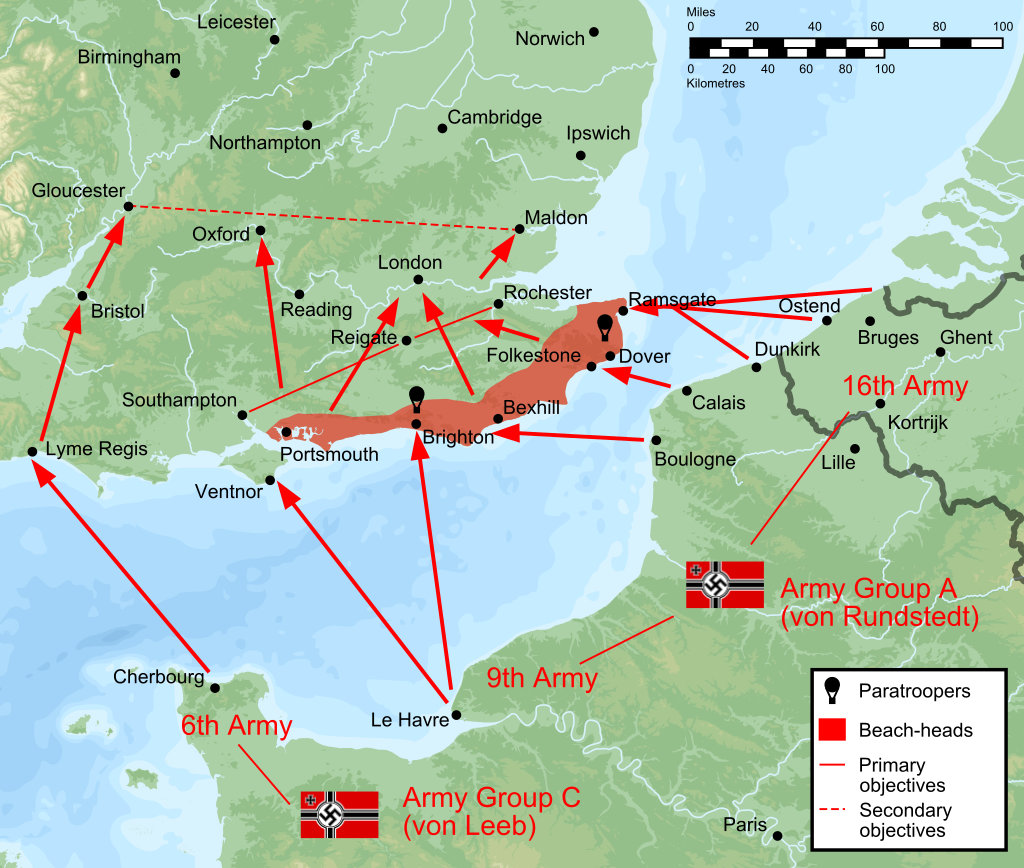
As it turns out, Brighton would have been in the front line had the Germans tried to invade England, as the following plan of Operation Sealion makes clear:

1024px-OperationSealion.svg

The shore defences in the photograph look pretty fierce, but the planned amphibious assault would have been preceded by parachute landings, so they  may have been seized and rendered ineffective by the time the landings began.

Here is a picture of the same general area looking to the West with Hove Lawns on the right:

Brighton_lawns_west

The beaches were out of bounds to the general public for most of the war, primarily because they were covered in mines, but in any case they would have been pretty inaccessible through all the barbed wire and other obstacles.

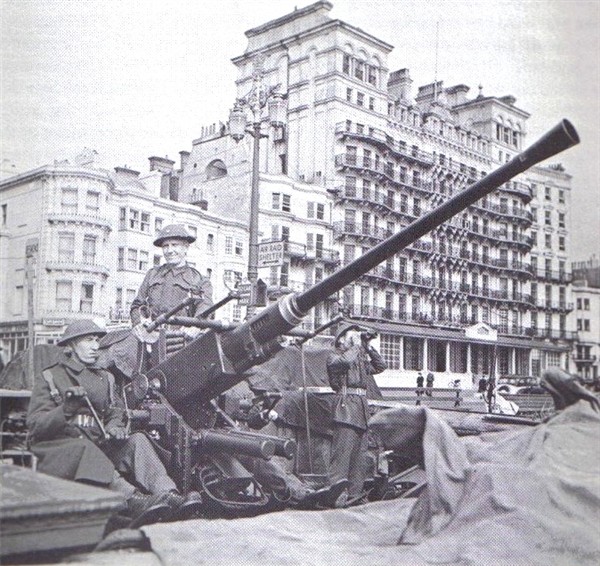
Although the immediate threat of invasion had receded by 1942, Brighton remained on high alert. Here is a picture I found elsewhere on the net, taken in 1943, showing a 40mm Bofors anti-aircraft gun stationed on the seafront not far from the Grand Hotel seen clearly in the background:

Brighton_bofors

The juxtaposition of the comfortingly familiar with the shockingly unfamiliar gives these images tremendous power. It’s hard to imagine what life must have been like under the constant threat of invasion and air raids, but these pictures at least give an idea of how grim it must have been to those of us who are fortunate enough to have never been forced to experience anything like it.


My Mathematical Valentines Message

Posted in Cute Problems with tags , on February 14, 2015 by telescoper

Here’s a little mathematical exercise with a Valentines theme:

Sketch the curve in the x-y plane described by the equation

\left(x^2 +y^2  + 2ay \right)^2 = 4a^2 \left( x^2 + y^2 \right)

for

x<3.

Geddit?

Answer: the equation is that of a cardioid:

cardioid-2

Is the 2015 General Election being rigged?

Posted in Brighton, Politics with tags , , , , on February 14, 2015 by telescoper

Just a few months ahead of the 2015 General Election (and some council elections, including here in Brighton) there’s something very worrying going on with the whole electoral process. For the 2014 European Parliament Elections last year I was on the electoral roll and used my vote as normal. However, last last year I discovered to my horror that I had been removed from the register here in Brighton. When I asked why, I was told by Brighton and Hove City Council (local councils oversee the election process) that I had to register afresh if I wanted to vote this May and that to do this I would have to supply personal details such as my National Insurance Number. This despite the fact that I have been resident at the same address in Brighton and have paid Council Tax at that address for two years.  I had received no communication from anyone to warn me that I was being removed from the elctoral roll and, as far as I’m aware, had I not asked I simply would not have been able to vote in the forthcoming elections.

I assumed that this was just some sort of administrative error, but I have since heard from many other people who have similarly been summarily kicked off the electoral roll for no obvious reason. One has to be wary of anecdotal evidence about things like this, but the issue seems to be a national one, related to a botched attempt to move to individual voter registration, as opposed to registration associated with a residential address. People move around much more than houses do, so there is much more information to track. The new system has been rushed through without the resources needed to support the vastly increased complexity of keeping track of individuals. For the 2015 elections over a million people who should be eligible to vote will will be absent from the electoral register, and this will mostly be the young and mobile (including students) and those in private rented accommodation in urban areas. The potential inlfluence of this effective disenfranchisement on the election result is obvious.

The more I read about this the more alarmed I have become. I am really starting to believe that this is a cynical attempt by vested interests to manipulate the outcome of the General Election, which will hinge on a relatively small number of key marginal seats where the votes of students and other young people could be crucial. It looks very sinister.

Anyone else had trouble getting on the Electoral Register? Please let me know through the Comments Box.

Yesterday

Posted in Music with tags , , on February 13, 2015 by telescoper

I’ve been running this blog for over six years now and although I’ve posted quite a lot of music in that time I’ve never included anything by the Beatles. I  decided to post it this morning just because I was listening to it last night and it struck me again how clever it is as a composition. Ostensibly in a major key (F Major) established by the opening chord, it almost immediately shifts into a minor tonality through a series of chord changes taking it to the relative minor (D Minor). The opening chord is therefore a bit of a decoy but it’s certainly a very effective hook to switch so rapidly from major to minor. It’s also (I think) the first Beatles track to be performed by Paul McCartney on his own (with strings on the original single). Paul McCartney actually wrote the tune and the lyrics. In my opinion it’s a true classic.


The real decline of UK research funding..

Posted in Science Politics with tags , , on February 12, 2015 by telescoper

I saw a news item the other day about a report produced by the Royal Society, the British Academy, the Royal Academy of Engineering and the Academy of Sciences calling for a big uplift in research spending. Specifically,

A target for investment in R&D and innovation of 3% of GDP for the UK as a whole – 1% from the government and 2% from industry and charities – in line with the top 10 OECD research investors. The government currently invests 0.5% of GDP; with 1.23% from the private sector.

For reference here is the UK’s overall R&D spending as a fraction of GDP since from 2000 to 2012 as a fraction of GDP:


PublicFunding2000_2012

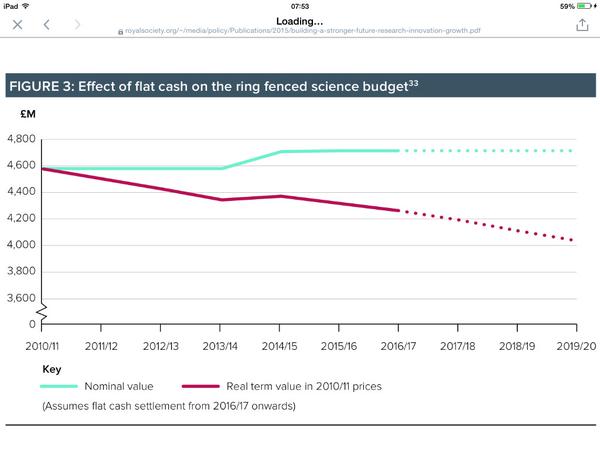
Some people felt that scientific research funding has done relatively well over the past few years in an environment of deep cuts in government funding in other areas. Iit has been protected against a steep decline in funding by a “ring fence” which has kept spending level in cash terms. Although inflation as measured by the RPI has been relatively low in recent years, the real costs of scientific research have been much faster than these measures. Here is a figure that shows the effective level of funding since the last general election that shows the danger to the UK’s research base:

flatcash

As a nation we already spend far less than we should on research and development, and this figure makes it plain that we are heading in the wrong direction. It’s not just a question of government funding either. UK businesses invest far too little in developing products and services based on innovations in science and technology. Because of this historic underfunding, UK based research has evolved into a lean and efficient machine but even such a machine needs fuel to make it work and the fuel is clearly running out…

Funding for Masters in Science

Posted in Education with tags , , , , , , , , on February 11, 2015 by telescoper

My recent post about postgraduate scholarships at the University of Sussex has generated quite a lot of interest so I thought I’d spend a few moments today trying to answer some of the questions I’ve been asked recently, by current and prospective students (or parents thereof).

I’ll start by explaining what the difference is between the different forms of Masters degrees in science that you can get in the United Kingdom, chiefly the distinction between an MSc  and one of the variations on the MPhys or MMath we have here in the School of Mathematical and Physical Sciences here at the University of Sussex. I have to admit that it’s all very confusing so here’s my attempt to explain.

The main distinction is that the MSc “Master of Science” is a (taught) postgraduate (PG) degree, usually of one (calendar) year’s duration, whereas the MPhys etc are undergraduate (UG) degrees usually lasting 4 years. This means that students wanting to do an MSc must already have completed a degree programme (and usually have been awarded at least Second Class Honours)  before starting an MSc whereas those doing the MPhys do not.

Undergraduate students wanting to do Physics in the Department of Physics & Astronomy at the University of Sussex, for example, can opt for either the 3-year BSc or the 4-year MPhys programmes. However, choosing the 4-year option does not lead to the award of a BSc degree and then a subsequent Masters qualification;  graduating students get a single qualification usually termed an “integrated Masters”.

It is possible for a student to take a BSc and then do a taught MSc programme afterwards, perhaps at a different university, but there are relatively few MSC programmes for Physics  in the UK because the vast majority of students who are interested in postgraduate study will already have registered for 4-year undergraduate programmes. That’s not to say there are none, however. There are notable MSc programmes dotted around, but they tend to be rather specialist; examples related to my own area include Astronomy and Cosmology at Sussex and Astrophysics at Queen Mary. Our own MSc in Frontiers in Quantum Technology is the only such course in the United Kingdom.

To a large extent these courses survive by recruiting students from outside the UK because the market from home students is so small. No department can afford to put on an entire MSc programme for the benefit of just one or two students. Often these stand-alone courses share modules with the final year of the undergraduate Masters, which also helps keep them afloat.

So why does it matter whether one Masters is PG while the other is UG? One difference is that the MSc lasts a calendar year (rather than an academic year). In terms of material covered, this means it contains 180 credits compared to the 120 credits of an undergraduate programme. Typically the MSc will have 120 credits of taught courses, examined in June as with UG programmes, followed by 60 credits worth of project work over the summer, handed in in September, though at Sussex some of our programmes are split 90 credits coursework and 90 credits of project.

The reason why this question comes up so frequently nowadays is that the current generation of applicants to university (and their parents) are facing fees of £9K per annum. The cost of doing a 3-year BSc is then about £27K compared to £36K for an MPhys. When rushing through the legislation to allow universities to charge this amount, the Powers That Be completely forgot about PG programmes, which have accordingly maintained their fees at a relatively low level, despite the fact that these are not controlled by government. For example, the MSc Astronomy at Sussex attracts a fee of about £6K for home students and £17K for overseas students. These levels are roughly consistent with the UG fees paid by  home students on the previous fee regime (approx £3.5K per annum, bearing in mind that you get 1.5 times as much teaching on an MSc compared to a year of an MPhys).

Being intelligent people, prospective physicists look at the extra £9K they have to pay for the 4th year of an MPhys and compare it with the current rate for an entire MSc and come to the conclusion that they should just do a BSc then switch. This seems to be not an unreasonable calculation to make.

However, there are some important things to bear in mind. Firstly, unlike UG programmes, the fee for PG programmes is basically unregulated. Universities can charge whatever they like and can increase them in the future if they decide to. See, for example, the list at Sussex University which shows that MSc fees already vary by more than a factor of four from one school to another. Incidentally, that in itself shows the absurdity of charging the same fee for UG degrees regardless of subject…

Now the point is that if one academic year of UG teaching costs £9K for future students, there is no way any department can justify putting on an entire calendar of advanced courses (i.e. at least 50% more teaching at an extremely specialist level) for less than half the  income per student. Moreover undergraduate courses in laboratory-based sciences attract an additional contribution of around £1.4K (“the unit of resource”) paid by the government to the University concerned via HEFCE.  The logical fee level for MSc programmes is mininum of about 1.5 times the UG fee, plus the unit of resource applied to full calendar year, which is a whopping £15.6K (similar to the current whopping amount already paid by overseas students for these programmes). It’s therefore clear that you cannot take the current MSc fee levels as a guide to what they will be in three years’ time, when you will qualify to enter a taught PG programme. Prices will certainly have risen by then. I doubt if there will be a sudden step-change, but they will rise.

The picture has changed significantly since the Chancellor of the Exchequer announced in the Autumn Statement last year that loans of up to £10,000 would be made available to students on postgraduate (Masters) courses from 2016/17 onwards.  Welcome though this scheme may be it does not apply to students wanting to start a Masters programme this September (i.e. for Academic Year 2015/16).

I’d say that, contrary to what many people seem to think,  if you take into the full up-front fee and the lack of student loans etc, the cost of a BSc + MSc is  already significantly greater than doing an MPhys, and in future the cost of the former route will inevitably increase. I therefore don’t think this is a wise path for most Physics undergraduates to take, assuming that they want their MSc to qualify them for a career in Physics research, either in a university or a commercial organization, perhaps via the PhD degree, and they’re not so immensely rich that money is no consideration.

The exception to this conclusion is for the student who wishes to switch to another field at Masters level,  to do a specialist MSc in a more applied discipline such as medical physics or engineering. Then it might make sense, as long as you can find a way to deal with the need to pay up-front for such courses.

Now comes the plug for Sussex. Last week the University of Sussex unveiled a huge  boost to the University’s flagship Chancellor’s Masters Scholarships means that 100 students graduating this summer with a first-class degree from any UK university will be eligible to receive a £10,000 package (non-repayable)  to study for a Masters degree at Sussex. There are also specific schemes to support students who are already at Sussex; see here.

I’m drawing this to the attention of readers of this blog primarily to point out that the Department of Physics & Astronomy at the University of Sussex is one of relatively few UK universities to have a significant and well-established programme of Masters (MSc) courses, including courses in Physics, Particle Physics,  Cosmology, and Astronomy. In particular, as I mentioned above, we are the only Department in the United Kingdom to have an MSc in Quantum Technology, an area which has just benefitted from a substantial cash investment from the UK government.

Wisely, the University of Sussex has introduced special measures to encourage current Integrated Masters students to stay on their degree rather than bailing out into a BSc and taking a Masters. However, this scheme is a great opportunity for high-flying physics graduates from other universities to get a funded place on any of our MSc programmes to start later this year. Indeed, the deal that is being offered is so good that I would recommend students who are currently in the third year of 4-year MPhys or MSci integrated Masters programmes, perhaps at a dreary University in the Midlands, to consider ditching  your current course, switching to a BSc and graduating in June in order to take up this opportunity. The last year of an integrated Masters consists of 120 credits of material for which you will have to be a further £9K of fees; a standalone Masters at Sussex would involve 180 credits and be essentially free if you get a scholarship.

Think about it, especially if you are interested in specializing in Quantum Technology. Sussex is the only university in the UK where you can take an MSc in this subject! This is a one-off opportunity, since (a) this scheme will be replaced by loans from 2016/17 and (b) the fees will almost certainly have risen by next year for the reasons I outlined above.

In conclusion, though, I have to say that, like many other aspects of Higher Education in the Disunited Kingdom, this system is a mess. I’d prefer to see the unified system of 3 year UG Bachelor degrees, 2-year Masters, and 3-year PhD that pertains throughout most of continental Europe.

P.S. In the interest of full disclosure, I should point out an even worse anomaly. I did a 3-year Honours degree in Natural Science at Cambridge University for which I was awarded not a BSc but a BA (Bachelor of Arts). A year or so later this – miraculously and with no effort on my part – turned into an MA. Work that one out if you can.