Author Archive

Arrival in L’Aquila

Posted in Biographical, The Universe and Stuff with tags , on October 7, 2014 by telescoper

If you were baffled by yesterday’s post then I hope today’s will explain. Yesterday, after an early morning meeting at the University of Sussex, I took the train to Gatwick Airport and thence a flight to Rome; hence volare. The British Airways Flight to Fiumicino Airport I was on arrived about 8 minutes ahead of schedule at 18.12, and I managed to get my luggage and clear passport control and all that in time to catch the 7pm coach to my present location, the city of L’Aquila, which is in the Abruzzo region, about 65 miles East of Rome. I’ve never made this trip before so I was a bit anxious about finding my way here and indeed it would have been a pain had I not caught the 7pm bus, because that would have meant either waiting for the next one (not until 9.30) or going by an alternative route involving a train and a different coach. As it happened, I needn’t have worried.

I’m here to attend a meeting entitled Multiple Messengers and Challenges in Astroparticle Physics, which is taking place at the Gran Sasso Science Institute. As well as the cosmology sessions, which are directly related to my own research, I’m hoping over the next ten days or so to take the opportunity to catch up on the  wider developments in astroparticle physics.

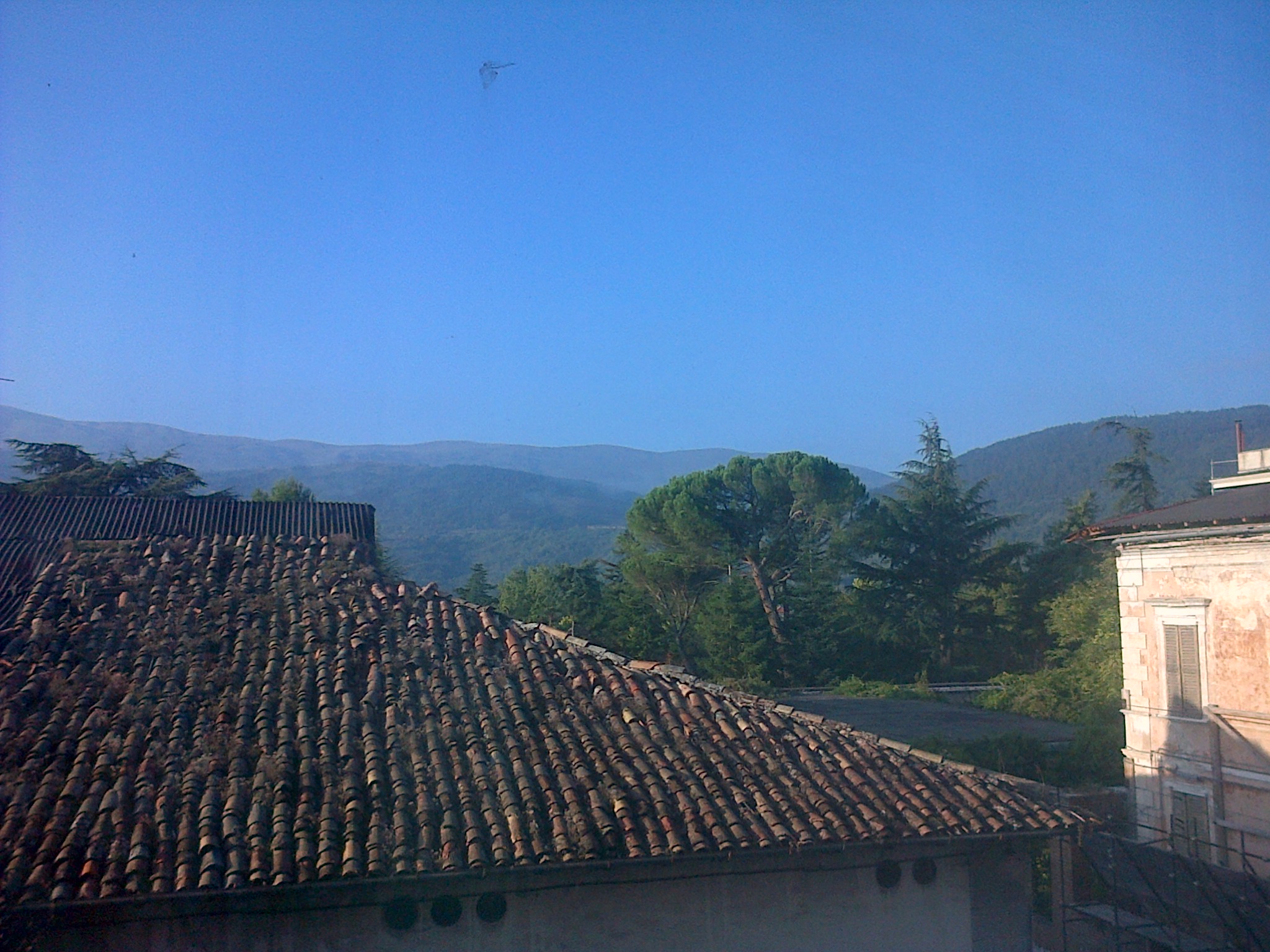
L’Aquila was badly damaged by an earthquake in 2009 and there was plenty of evidence of repair and reconstruction work still going on. I’ll take a few pictures here and there, but for the time being I’ll just share the view from my hotel window for the enjoyment of any readers back in rainy England…

IMG-20141007-00420

Volare

Posted in Music with tags , on October 6, 2014 by telescoper


A Problem of Wires on the Rails

Posted in Cute Problems with tags , , , on October 5, 2014 by telescoper

It’s been a long time since I posted a cute physics problem so here’s one about magnetism for your edification and/or amusement.

Two long wires are laid flat on a pair of parallel rails perpendicular to the wires. The spacing d between the rails is large compared with x, the distance between the wires. Both wires and rails are made of material which has a resistance ρ per unit length. A magnetic flux density B is applied perpendicular to the rectangle formed by the rails and the wires. One wire is moved along the rails with uniform speed v while the other is held stationary. Derive a formula to show how the force on the stationary wire varies with x and use it to show that the force vanishes for a value of x approximately equal to μ0v/4πρ.

Give a physical interpretation of this result.

HINT: Think about the current induced in the wires…


Mathematical and Physical Sciences Open Day at Sussex

Posted in Biographical, Education with tags , , , , on October 4, 2014 by telescoper

It’s another open day at the University of Sussex so I’m on campus again to help out as best I can, although I have to admit that all the hard work is being done by others! It’s been extremely busy so far; in fact, I’m told that about 6000 visitors are on campus today. This a good sign for the forthcoming admissions round, probably buoyed by the improved position of the University of Sussex in the latest set of league tables and in excellent employment prospects for graduates.

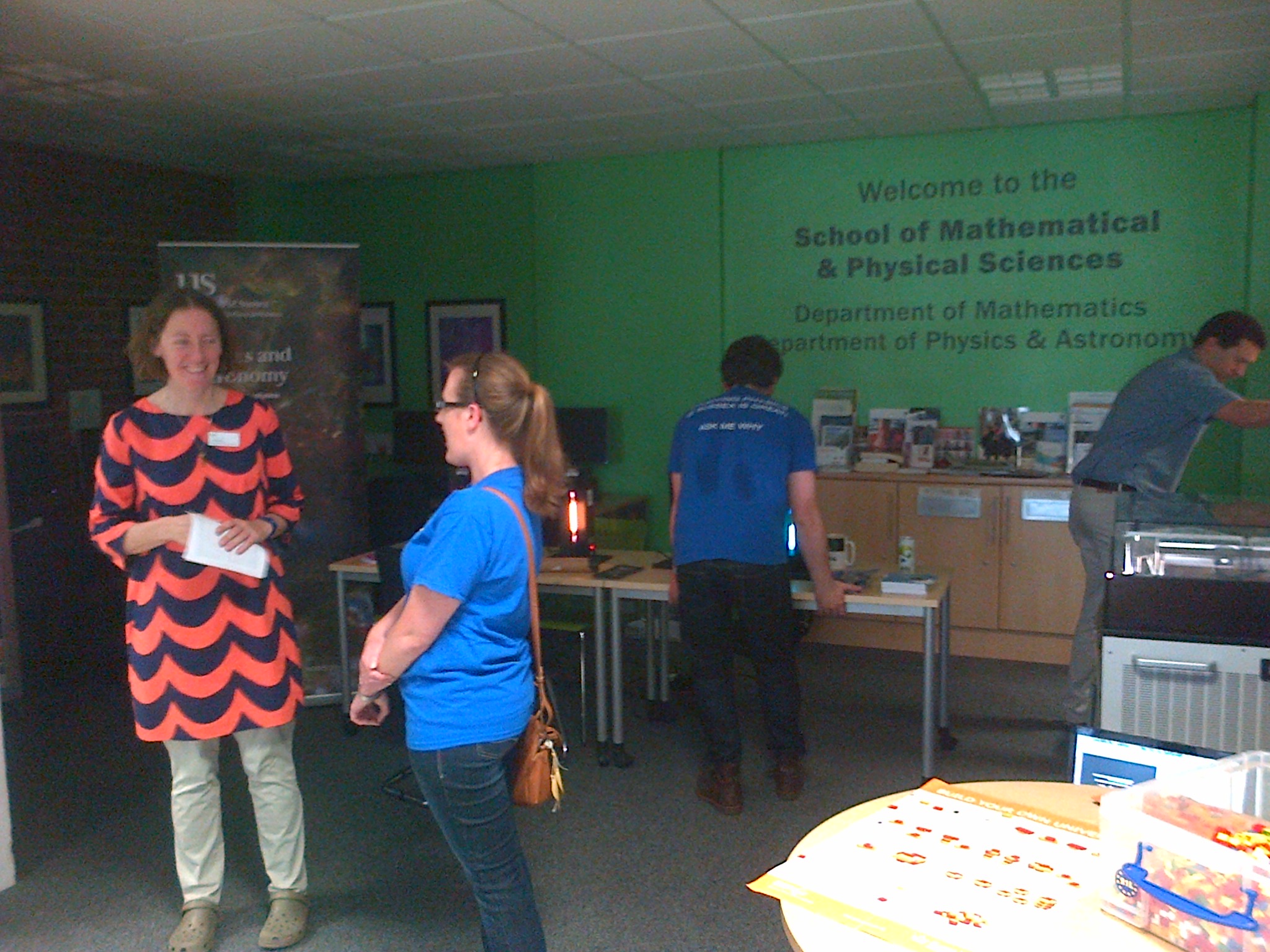
Anyway the good folks of  the Department of Physics & Astronomy  and Department of Mathematics were here bright and early to get things ready:

IMG-20141004-00413

IMG-20141004-00414

All morning we’ve had a steady stream of visitors to the School of Mathematical and Physical Sciences (which comprises both Departments mentioned above). While I’m at it let me just give a special mention to Darren Baskill’s Outreach Team (seen in the team photograph below).
outreachThey have had absolutely amazing year, running a huge range of events and activities that have reached a staggering 14,000 people of all ages (including 12,000 of school age).

Anyway, I think I’ll toddle off and see if I can sit in on one of today’s lectures. It’s about time I learned something.


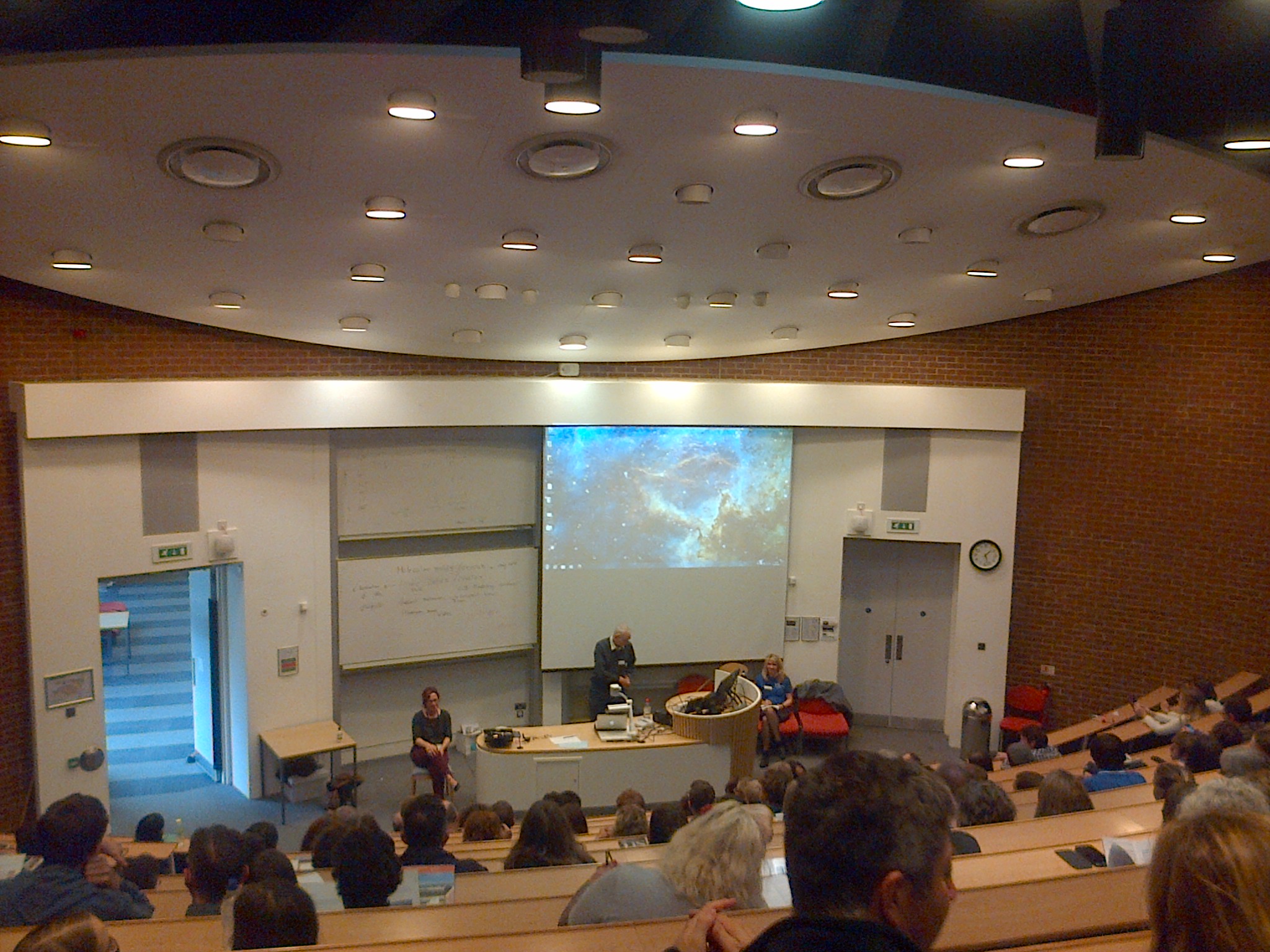
UPDATE: Here is Mark Hindmarsh about to get started on his lecture.

IMG-20141004-00415

You could have knocked me down with a feather when I saw that he had included a quote from this blog in his talk:

I’ve worked in some good physics departments in my time, but the Department of Sussex is completely unique both for the level of support it offers students and the fact that so many of the undergraduates are so highly motivated.

And, yes, I did mean every word of that.

Signore, ascolta!

Posted in Opera with tags , , , , on October 3, 2014 by telescoper

Time for a Friday lunchtime end-of-the-week kind of a post. This is the great Montserrat Caballé singing the beautiful aria Signore, ascolta! from the Opera Turandot by Giacomo Puccini. As the title suggests, you should listen to the whole thing because it’s lovely, but be prepared for something truly astonishing from about 2.16 onwards as the singer demonstrates unbelievable control by holding that final high note in a way that doesn’t seem humanly possible..

The Curse of Assessment-led Teaching

Posted in Education with tags , , on October 2, 2014 by telescoper

Yesterday I took part in a University Teaching and Learning Strategy meeting that discussed, among other things, how to improve the feedback on student assessments in order to help them learn better. It was an interesting meeting, involving academics, administrative staff and representatives of the Students Union, that generated quite a few useful ideas. Looking through my back catalogue I realise that around this time year I was at a similar event based in the School of Mathematical and Physical Sciences at the University of Sussex of which I am Head.

Positive though yesterday’s discussion was, it didn’t do anything to dissuade me from a long-held view that the entire education system holds back the students’ ability to learn by assessing them far too much. One part of the discussion was about trying to pin down essentially what is meant by “Research-led Teaching” which is what we’re supposed to be doing at universities. In my view too much teaching is not really led by research at all, but mainly driven by assessment. The combination of the introduction of modular programmes and the increase of continuously assessed coursework has led to a cycle of partial digestion and regurgitation that involves little in the way of real learning and certainly nothing like the way research is done.

I’m not going to argue for turning the clock back entirely, but for the record my undergraduate degree involved no continuous assessment at all (apart from a theory project I opted for in my final year. Having my entire degree result based on the results of six three-hour unseen examinations in the space of three days is not an arrangement I can defend, but note that despite the lack of continuous assessment I still spent less time in the examination hall than present-day students.

That’s not to say I didn’t have coursework. I did, but it was formative rather than summative; in other words it was for the student to learn about the subject, rather for the staff to learn about the student. I handed in my stuff every week, it was marked and annotated by a supervisor, then returned and discussed at a supervision.

People often tell me that if a piece of coursework “doesn’t count” then the students won’t do it. There is an element of truth in that, of course. But I had it drummed into me that the only way really to learn my subject (Physics) was by doing it. I did all the coursework I was given because I wanted to learn and I knew that was the only way to do it.

The very fact that coursework didn’t count for assessment made the feedback written on it all the more useful when it came back because if I’d done badly I could learn from my mistakes without losing marks. This also encouraged me to experiment a little, such as using a method different from that suggested in the question. That’s a dangerous strategy nowadays, as many seem to want to encourage students to behave like robots, but surely we should be encouraging students to exercise their creativity rather than simply follow the instructions? The other side of this is that more challenging assignments can be set, without worrying about what the average mark will be or what specific learning outcome they address.

I suppose what I’m saying is that the idea of Learning for Learning’s Sake, which is what in my view defines what a university should strive for, is getting lost in a wilderness of modules, metrics, percentages and degree classifications. We’re focussing too much on those few aspects of the educational experience that can be measured, ignoring the immeasurable benefit (and pleasure) that exists for all humans in exploring new ways to think about the world around us.

Bayes, Laplace and Bayes’ Theorem

Posted in Bad Statistics with tags , , , , , , , , on October 1, 2014 by telescoper

A  couple of interesting pieces have appeared which discuss Bayesian reasoning in the popular media. One is by Jon Butterworth in his Grauniad science blog and the other is a feature article in the New York Times. I’m in early today because I have an all-day Teaching and Learning Strategy Meeting so before I disappear for that I thought I’d post a quick bit of background.

One way to get to Bayes’ Theorem is by starting with

P(A|C)P(B|AC)=P(B|C)P(A|BC)=P(AB|C)

where I refer to three logical propositions A, B and C and the vertical bar “|” denotes conditioning, i.e. P(A|B) means the probability of A being true given the assumed truth of B; “AB” means “A and B”, etc. This basically follows from the fact that “A and B” must always be equivalent to “B and A”.  Bayes’ theorem  then follows straightforwardly as

P(B|AC) = K^{-1}P(B|C)P(A|BC) = K^{-1} P(AB|C)

where

K=P(A|C).

Many versions of this, including the one in Jon Butterworth’s blog, exclude the third proposition and refer to A and B only. I prefer to keep an extra one in there to remind us that every statement about probability depends on information either known or assumed to be known; any proper statement of probability requires this information to be stated clearly and used appropriately but sadly this requirement is frequently ignored.

Although this is called Bayes’ theorem, the general form of it as stated here was actually first written down not by Bayes, but by Laplace. What Bayes did was derive the special case of this formula for “inverting” the binomial distribution. This distribution gives the probability of x successes in n independent “trials” each having the same probability of success, p; each “trial” has only two possible outcomes (“success” or “failure”). Trials like this are usually called Bernoulli trials, after Daniel Bernoulli. If we ask the question “what is the probability of exactly x successes from the possible n?”, the answer is given by the binomial distribution:

P_n(x|n,p)= C(n,x) p^x (1-p)^{n-x}

where

C(n,x)= \frac{n!}{x!(n-x)!}

is the number of distinct combinations of x objects that can be drawn from a pool of n.

You can probably see immediately how this arises. The probability of x consecutive successes is p multiplied by itself x times, or px. The probability of (n-x) successive failures is similarly (1-p)n-x. The last two terms basically therefore tell us the probability that we have exactly x successes (since there must be n-x failures). The combinatorial factor in front takes account of the fact that the ordering of successes and failures doesn’t matter.

The binomial distribution applies, for example, to repeated tosses of a coin, in which case p is taken to be 0.5 for a fair coin. A biased coin might have a different value of p, but as long as the tosses are independent the formula still applies. The binomial distribution also applies to problems involving drawing balls from urns: it works exactly if the balls are replaced in the urn after each draw, but it also applies approximately without replacement, as long as the number of draws is much smaller than the number of balls in the urn. I leave it as an exercise to calculate the expectation value of the binomial distribution, but the result is not surprising: E(X)=np. If you toss a fair coin ten times the expectation value for the number of heads is 10 times 0.5, which is five. No surprise there. After another bit of maths, the variance of the distribution can also be found. It is np(1-p).

So this gives us the probability of x given a fixed value of p. Bayes was interested in the inverse of this result, the probability of p given x. In other words, Bayes was interested in the answer to the question “If I perform n independent trials and get x successes, what is the probability distribution of p?”. This is a classic example of inverse reasoning, in that it involved turning something like P(A|BC) into something like P(B|AC), which is what is achieved by the theorem stated at the start of this post.

Bayes got the correct answer for his problem, eventually, but by very convoluted reasoning. In my opinion it is quite difficult to justify the name Bayes’ theorem based on what he actually did, although Laplace did specifically acknowledge this contribution when he derived the general result later, which is no doubt why the theorem is always named in Bayes’ honour.


This is not the only example in science where the wrong person’s name is attached to a result or discovery. Stigler’s Law of Eponymy strikes again!

So who was the mysterious mathematician behind this result? Thomas Bayes was born in 1702, son of Joshua Bayes, who was a Fellow of the Royal Society (FRS) and one of the very first nonconformist ministers to be ordained in England. Thomas was himself ordained and for a while worked with his father in the Presbyterian Meeting House in Leather Lane, near Holborn in London. In 1720 he was a minister in Tunbridge Wells, in Kent. He retired from the church in 1752 and died in 1761. Thomas Bayes didn’t publish a single paper on mathematics in his own name during his lifetime but was elected a Fellow of the Royal Society (FRS) in 1742.

The paper containing the theorem that now bears his name was published posthumously in the Philosophical Transactions of the Royal Society of London in 1763. In his great Philosophical Essay on Probabilities Laplace wrote:

Bayes, in the Transactions Philosophiques of the Year 1763, sought directly the probability that the possibilities indicated by past experiences are comprised within given limits; and he has arrived at this in a refined and very ingenious manner, although a little perplexing.

The reasoning in the 1763 paper is indeed perplexing, and I remain convinced that the general form we now we refer to as Bayes’ Theorem should really be called Laplace’s Theorem. Nevertheless, Bayes did establish an extremely important principle that is reflected in the title of the New York Times piece I referred to at the start of this piece. In a nutshell this is that probabilities of future events can be updated on the basis of past measurements or, as I prefer to put it, “one person’s posterior is another’s prior”.


The Origin of CERN

Posted in History, The Universe and Stuff with tags , , , , on September 30, 2014 by telescoper

Since  CERN, the Geneva home of the Large Hadron Collider, is currently celebrating its 60th Anniversary, I thought I would use this organ to correct a widespread misapprehension concerning the the true historical origin of that organization. I have to say the general misunderstanding of the background to CERN is not helped by the information produced locally which insists that CERN is an acronym for Conseil Européen pour la Recherche Nucléaire and that it came into being in 1954. This may be the date at which the Geneva operation commenced, but the organization has a far older origin than that.

CERN is in fact named after the Dorset village of Cerne Abbas, most famous for a prehistoric hill figure called the Cerne Abbas Giant. The following aerial photograph of this outstanding local landmark proves that the inhabitants of Dorset had the idea of erecting a large hardon facility hundreds of years ago…

Poetic Words: Dannie Abse

Posted in Poetry with tags , , on September 30, 2014 by telescoper

I don’t usually post about poetry two days running, but circumstances seem to justify reblog of the poem Three Street Musicians by wonderful Welsh poet Dannie Abse, who died on Sunday.

House on a Cliff

Posted in Poetry with tags , , , on September 29, 2014 by telescoper

Indoors the tang of a tiny oil lamp. Outdoors
The winking signal on the waste of sea.
Indoors the sound of the wind. Outdoors the wind.
Indoors the locked heart and the lost key.

Outdoors the chill, the void, the siren. Indoors
The strong man pained to find his red blood cools,
While the blind clock grows louder, faster. Outdoors
The silent moon, the garrulous tides she rules.

Indoors ancestral curse-cum-blessing. Outdoors
The empty bowl of heaven, the empty deep.
Indoors a purposeful man who talks at cross
Purposes, to himself, in a broken sleep.

by Louis MacNeice (1907-1963).