Author Archive

House on a Cliff

Posted in Poetry with tags , , , on September 29, 2014 by telescoper

Indoors the tang of a tiny oil lamp. Outdoors
The winking signal on the waste of sea.
Indoors the sound of the wind. Outdoors the wind.
Indoors the locked heart and the lost key.

Outdoors the chill, the void, the siren. Indoors
The strong man pained to find his red blood cools,
While the blind clock grows louder, faster. Outdoors
The silent moon, the garrulous tides she rules.

Indoors ancestral curse-cum-blessing. Outdoors
The empty bowl of heaven, the empty deep.
Indoors a purposeful man who talks at cross
Purposes, to himself, in a broken sleep.

by Louis MacNeice (1907-1963).

Sunday Diversions

Posted in Biographical, Brighton with tags , , , on September 28, 2014 by telescoper

Remind me never again to travel on a Sunday. Needing to get back for some important meetings tomorrow I set out from Cardiff this lunchtime leaving plenty of time for the journey. Just as well.

For a start, First Great Western trains were disrupted by “planned engineering work”. Not very well planned, obviously. The train I got on was to be diverted via Bath Spa, adding about an hour to the usual journey time. But that wasn’t the main cause of vexation.

When it arrived at a crowded platform at Cardiff Central, the 12.53 consisted of just seven coaches, three of which were First Class. To add to the chaos and consternation, Coach B, in which several people standing beside me had reserved seats, did not exist.

Not having a reservation in a real or imaginary coach, rather than stand for 3 hours I went and sat in any empty First Class carriage and when the guard arrived I paid the £15 upgrade to Weekend First, congratulating First Great Western on a cleverly-worked scam. Deliberately running a short train on a busy route to increase revenue this way is cynical and exploitative but that’s what it means to run a train company these days.

Anyway, the weather being quite nice when I arrived in Paddington I walked through Kensington Gardens and along the Serpentine before heading down to Victoria.

Stage two of my journey via Southern Railways turned out to be no better. More “planned engineering works” meant all Victoria to Brighton trains were diverted through Littlehampton. A replacement bus from Three Bridges was offered as an alternative “possibly a little quicker” but having no confidence at all that a bus would actually materialise I stayed on the train as it trundled through rural Sussex.

I got to Brighton Station around 7pm, about 6 hours after leaving Cardiff Central, but at least I got a bus straight away.

I hope the rest of the week isn’t as exasperating as today, but something tells me that it might be..

Autumn Leaves In Cardiff

Posted in Biographical, Cardiff with tags , on September 27, 2014 by telescoper

Back in Cardiff for a couple of days to get some more writing done, I took a break to have a cup of tea in the garden. All the signs that summer is now over have now shown themselves: the start of undergraduate lectures (Monday); the Autumnal Equinox (Tuesday); the end of the County Championship on Friday; and so on.

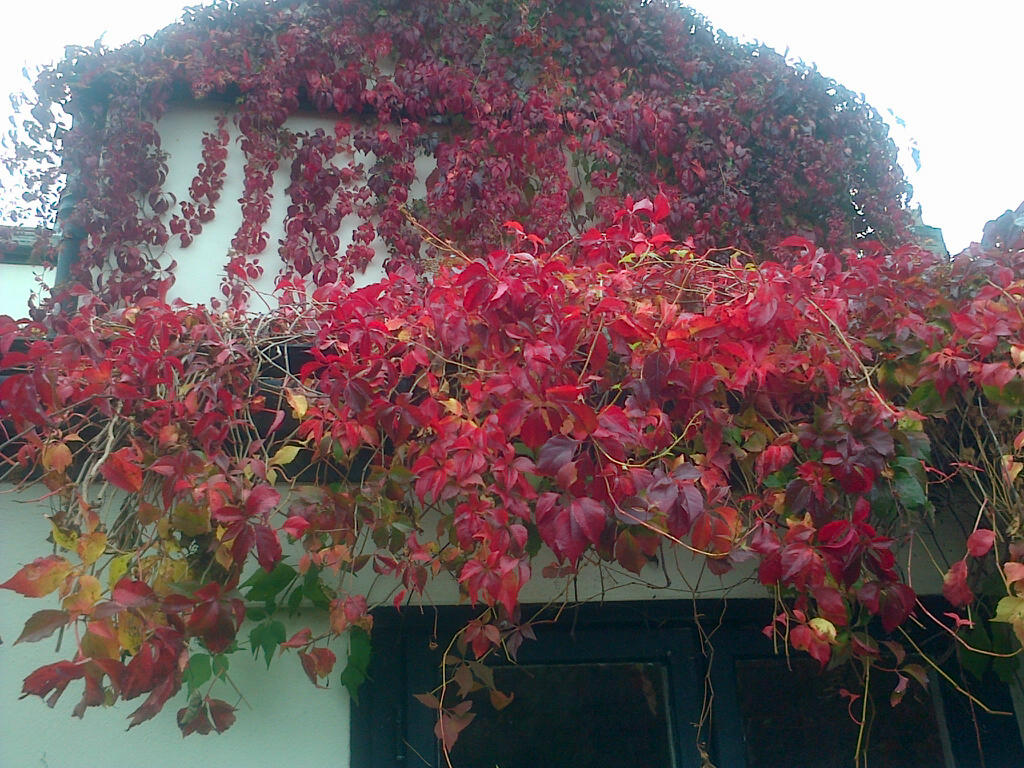
Here in Cardiff the weather is still warm, but the leaves are turning brown and starting to fall. Conkers too. And, most spectacularly, the Virginia Creeper growing at the back of my house has turned blood red. It does look pretty, but I’m sure it’s not good for the gutters or the chimney stack above..

I told you once, I told you twice..

Posted in Jazz with tags , on September 26, 2014 by telescoper

I thought I’d wind things down for the weekend by posting a little bit of British jazz history. It’s perhaps not very well known that the great Sidney Bechet came to England in 1949 and did a concert and a recording session with Humphrey Lyttelton’s band while he was here. What’s also not very well known is how controversial this was, as in the immediate post-war years the Musician’s Union had persuaded the UK government to ban American artists from performing over here. Humph was having none of it, thank goodness, and here we have the legacy. Here is the unmistakeable Sidney Bechet on soprano sax, playing a traditional blues called I told you once, I told you twice with Humph on trumpet, Wally Fawkes on clarinet and, stealing the show, the absolutely superb Keith Christie on trombone. The only problem is that the youtube version cuts out a bit early…

After the concert they played together, Bechet summoned Humph in order to deliver a kind of end-of-term report on the band in which he pointed out little criticisms of their playing and so on. Bechet was a forceful character and often a harsh critic but when he got to Keith Christie he expressed nothing but unqualified admiration. There’s not much higher praise than that in the world of jazz.


Athena SWAN Bronze for Physics & Astronomy at Sussex

Posted in Education with tags , , , , , , on September 25, 2014 by telescoper

Athena Swan

Only  time for the quickest of quickies today, but I have some very good news to pass on so, without further ado, here we go. Today we learned that the Department of Physics & Astronomy at the University of Sussex has received a the Athena SWAN Bronze Award in recognition of our commitment to advancing women’s careers in science, technology, engineering, maths and medicine (STEMM) employment in higher education and research. The Athena SWAN charter has been running since 2005, recognising the commitment of the higher education sector to address gender inequalities, tackle the unequal representation of women in science and to improve career progression for female academics.

This award has been the result of a huge effort led by Dr Kathy Romer but also involving many other members of staff in the Department and across entire  the School of Mathematical and Physical Sciences generally. The Department scored at or above the national average in all key areas: student intake (UG, PGT, PGR), research staff, academic staff, REF submissions and so on. That said, the Athena SWAN process has highlighted several areas where improvements can be made, such as in the mentoring of female postdoctoral researchers, and enhanced levels of training in equality and diversity matters such as the influence of unconscious bias. We are very pleased to have received the bronze award, but there is still a very great deal to do. Many other institutions and departments have already progressed to the Silver or even Gold award, but our Bronze is at least a start!


Beloved Dust

Posted in Poetry with tags , , , on September 24, 2014 by telescoper

And you as well must die, beloved dust,
And all your beauty stand you in no stead,
This flawless, vital hand, this perfect head,
This body of flame and steel, before the gust
Of Death, or under his autumnal frost,
Shall be as any leaf, be no less dead
Than the first leaf that fall, —this wonder fled.
Altered, estranged, disintegrated, lost.
Nor shall my love avail you in your hour.
In spite of all my love, you will arise
Upon that day and wander down the air
Obscurely as the unattended flower,
It mattering not how beautiful you were,
Or how beloved above all else that dies.

by Edna St. Vincent Millay (1892-1950)

Astronomy Look-alikes, No. 94

Posted in Astronomy Lookalikes with tags , on September 23, 2014 by telescoper

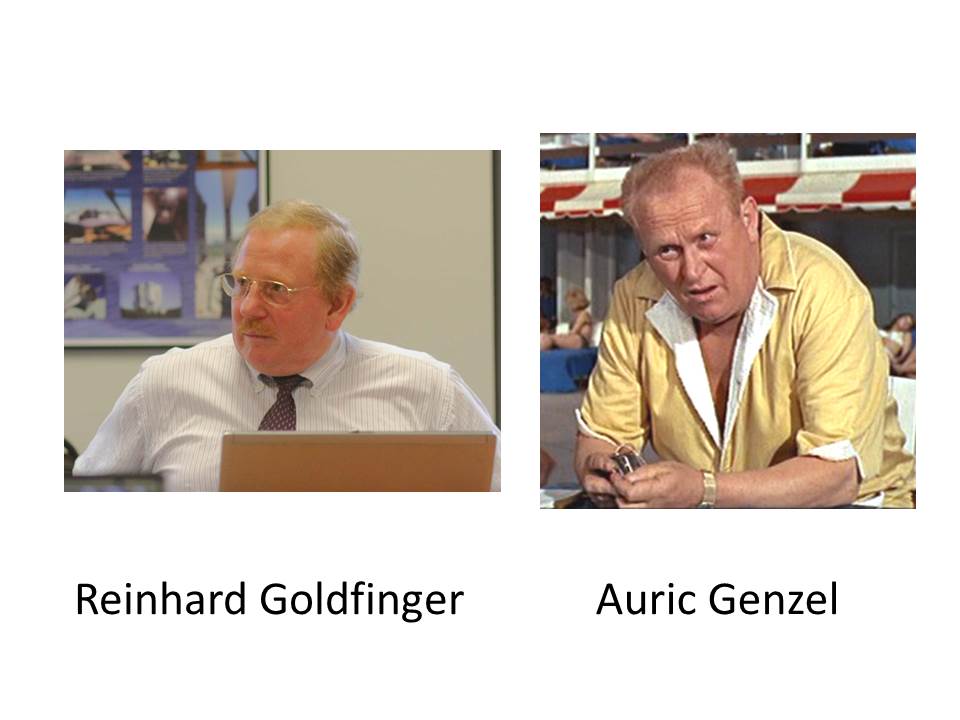
I’m struck by the similarity in visual appearance between distinguished astrophysicist Herr Professor Dr Auric Goldfinger and infamous Bond villain Reinhard Genzel. I wonder if by any chance they might be related?

Lookagzenzel

BICEP2 bites the dust.. or does it?

Posted in Bad Statistics, Open Access, Science Politics, The Universe and Stuff with tags , , , , , , , , on September 22, 2014 by telescoper

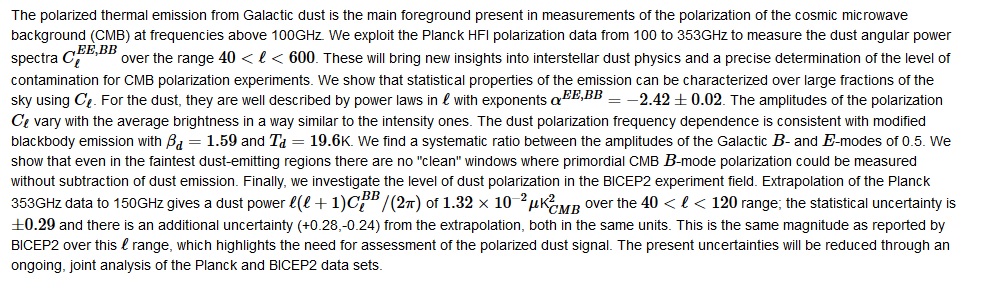
Well, it’s come about three weeks later than I suggested – you should know that you can never trust anything you read in a blog – but the long-awaited Planck analysis of polarized dust emission from our Galaxy has now hit the arXiv. Here is the abstract, which you can click on to make it larger:

PlanckvBICEP2

My twitter feed was already alive with reactions to the paper when I woke up at 6am, so I’m already a bit late on the story, but I couldn’t resist a quick comment or two.

The bottom line is of course that the polarized emission from Galactic dust is much larger in the BICEP2 field than had been anticipated in the BICEP2 analysis of their data (now published  in Physical Review Letters after being refereed). Indeed, as the abstract states, the actual dust contamination in the BICEP2 field is subject to considerable statistical and systematic uncertainties, but seems to be around the same level as BICEP2’s claimed detection. In other words the Planck analysis shows that the BICEP2 result is completely consistent with what is now known about polarized dust emission.  To put it bluntly, the Planck analysis shows that the claim that primordial gravitational waves had been detected was premature, to say the least. I remind you that the original  BICEP2 result was spun as a ‘7σ’ detection of a primordial polarization signal associated with gravitational waves. This level of confidence is now known to have been false.  I’m going to resist (for the time being) another rant about p-values

Although it is consistent with being entirely dust, the Planck analysis does not entirely kill off the idea that there might be a primordial contribution to the BICEP2 measurement, which could be of similar amplitude to the dust signal. However, identifying and extracting that signal will require the much more sophisticated joint analysis alluded to in the final sentence of the abstract above. Planck and BICEP2 have differing strengths and weaknesses and a joint analysis will benefit from considerable complementarity. Planck has wider spectral coverage, and has mapped the entire sky; BICEP2 is more sensitive, but works at only one frequency and covers only a relatively small field of view. Between them they may be able to identify an excess source of polarization over and above the foreground, so it is not impossible that there may a gravitational wave component may be isolated. That will be a tough job, however, and there’s by no means any guarantee that it will work. We will just have to wait and see.

In the mean time let’s see how big an effect this paper has on my poll:


Note also that the abstract states:

We show that even in the faintest dust-emitting regions there are no “clean” windows where primordial CMB B-mode polarization could be measured without subtraction of dust emission.

It is as I always thought. Our Galaxy is a rather grubby place to live. Even the windows are filthy. It’s far too dusty for fussy cosmologists, who need to have everything just so, but probably fine for astrophysicists who generally like mucking about and getting their hands dirty…

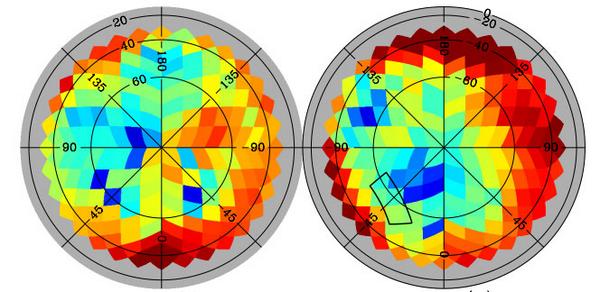
This discussion suggests that a confident detection of B-modes from primordial gravitational waves (if there is one to detect) may have to wait for a sensitive all-sky experiment, which would have to be done in space. On the other hand, Planck has identified some regions which appear to be significantly less contaminated than the BICEP2 field (which is outlined in black):

Quieter dust

Could it be possible to direct some of the ongoing ground- or balloon-based CMB polarization experiments towards the cleaner (dark blue area in the right-hand panel) just south of the BICEP2 field?

From a theorist’s perspective, I think this result means that all the models of the early Universe that we thought were dead because they couldn’t produce the high level of primordial gravitational waves detected by BICEP2 have no come back to life, and those that came to life to explain the BICEP2 result may soon be read the last rites if the signal turns out to be predominantly dust.

Another important thing that remains to be seen is the extent to which the extraordinary media hype surrounding the announcement back in March will affect the credibility of the BICEP2 team itself and indeed the cosmological community as a whole. On the one hand, there’s nothing wrong with what has happened from a scientific point of view: results get scrutinized, tested, and sometimes refuted.  To that extent all this episode demonstrates is that science works.  On the other hand most of this stuff usually goes on behind the scenes as far as the public are concerned. The BICEP2 team decided to announce their results by press conference before they had been subjected to proper peer review. I’m sure they made that decision because they were confident in their results, but it now looks like it may have backfired rather badly. I think the public needs to understand more about how science functions as a process, often very messily, but how much of this mess should be out in the open?


UPDATE: Here’s a piece by Jonathan Amos on the BBC Website about the story.

ANOTHER UPDATE: Here’s the Physics World take on the story.

ANOTHER OTHER UPDATE: A National Geographic story

Life, Work and Postgraduate Research

Posted in Biographical, Crosswords, Education with tags , , , , on September 21, 2014 by telescoper

A very busy Freshers’ Week at the University of Sussex is now behind us and lectures proper start tomorrow morning. As far as I was concerned all the Freshers’ events were superimposed on a week that was already filled with other things, some good (of which more anon), and some not so good (of which I will say nothing further).

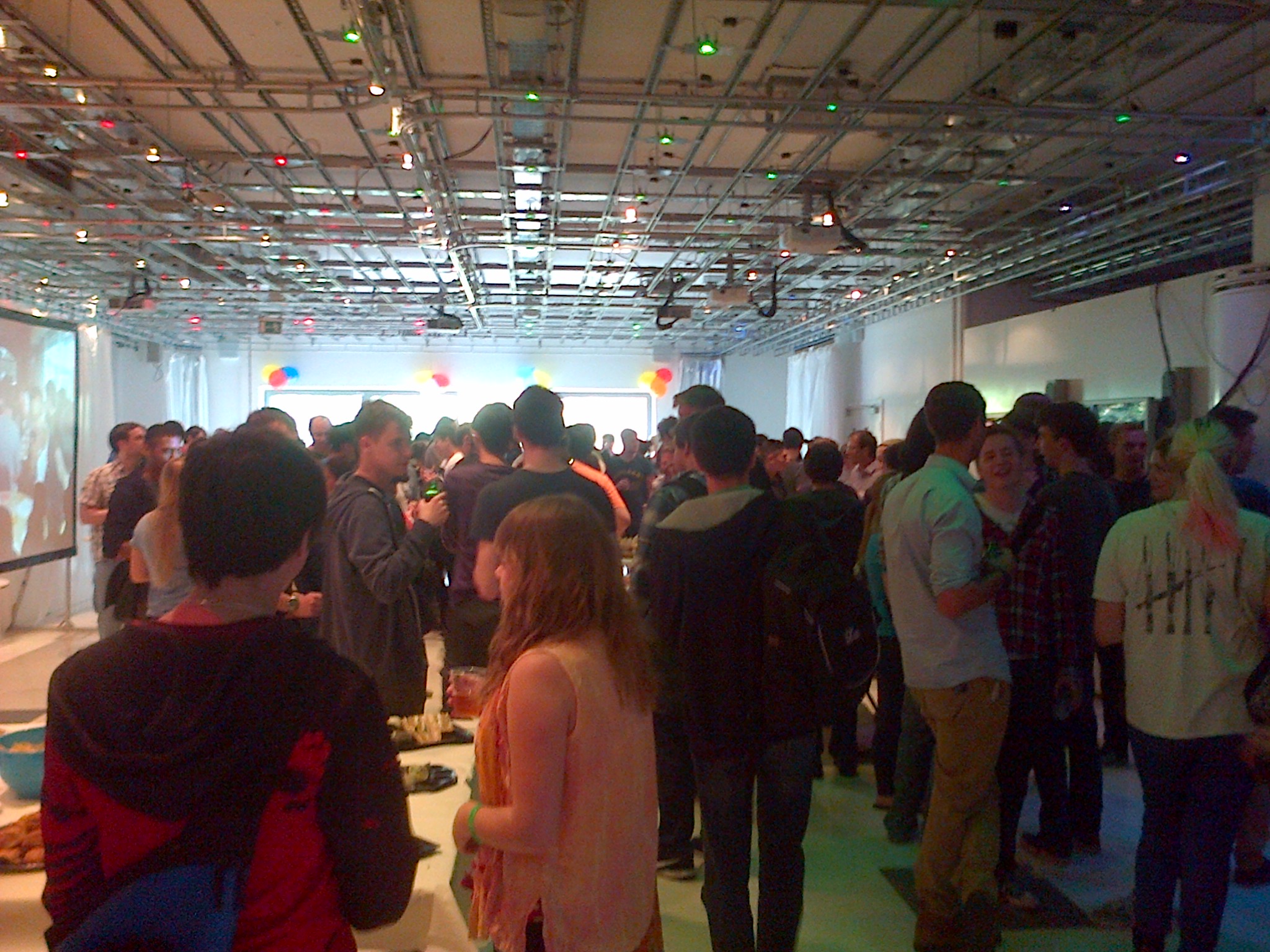
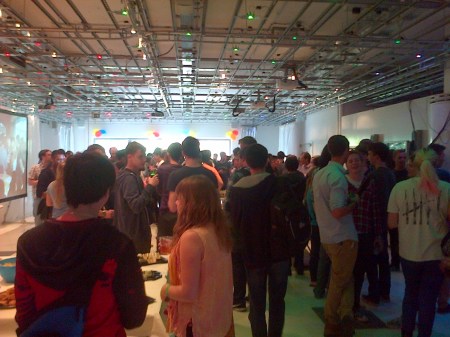
After welcome receptions at the weekend, Freshers’ Week for me began with an induction lecture with all the new students in the School of Mathematical and Physical Sciences (MPS) or at least as many as could rouse themselves for a 10am start the day after a big welcome party. In the event, the turnout was good. I then gave another little speech at a much less formal event in the Creativity Zone (which is situated in the building occupied by MPS. I then had to dash off to a couple of meetings but when I returned a couple of hours later the party was still going, so I helped myself to a beer and rejoined the socializing.
IMG-20140915-00402

Welcome to the new students in MPS!

And so it was for the rest of the week, dominated by meetings of one sort or another including one in London, until Friday and my last formal induction task in the form of a session for new postgraduate students in MPS. Since this happened at the end of Induction Week there wasn’t much of a practical nature say to the students that they hadn’t already heard during the School-based induction sessions that preceded it, so I decided to scrap the Powerpoint I had planned to use and just give a general pep talk. Doing so was quite an interesting experience because it reminded me of the time I started my own postgraduate education, here at Sussex.

As a matter of fact it was on the corresponding day in 1985 (Sunday 22nd September) that I moved down to Brighton in advance of starting my DPhil (as Sussex doctorates were called in those days). It’s hard to believe that was 29 years ago. As it turned out, I finished my thesis within three years and stayed on here at Sussex as a postdoctoral research fellow in the Astronomy Centre until 1990, whereupon I left to take up a teaching and research position at what is now Queen Mary, University of London. That was the start of a mini-tour of UK universities that ended up with me returning to Sussex last year as Head of the same school in which I started my research career.

This morning I noticed a story in the Times Higher about the loneliness and sense of isolation often faced by postgraduate research students which often leads to a crisis of confidence. I can certainly attest to that, for reasons I will try to explain below, so tried to reassure the students about it in the induction session on Friday.

The point is that a postgraduate research degree is very different from a programme of undergraduate study. For one thing, as a research student you are expected to work on your own a great deal of the time. That’s because nobody else will be doing precisely the same project so, although other students will help you out with some things, you’re not trying to solve the same problems as your peers as is the case with an undergraduate. Your supervisor will help you of course and make suggestions (of varying degrees of helpfulness), but a PhD is still a challenge that you have to meet on your own. I don’t think it is good supervisory practice to look over a research student’s shoulder all the time. It’s part of the purpose of a PhD that the student learns to go it alone. There is a balance of course, but my own supervisor was rather “hands off” and I regard that as the right way to supervise. I’ve always encouraged my own students to do things their own way rather than try to direct them too much.

That loneliness is tough in itself, but there’s also the scary fact that you do not usually know whether your problem has a solution, let alone whether you yourself can find it. There is no answer at the back of the book; if there were you would not be doing research. A good supervisor will suggest a project that he or she thinks is both interesting and feasible, but the expectation is that you will very quickly be in a position where you know more about that topic than your supervisor.

I think almost every research student goes through a phase in which they feel out of their depth. There are times when you get thoroughly stuck and you begin to think you will never crack it. Self-doubt, crisis of confidence, call it what you will, I think everyone who has done a postgraduate degree has experienced it. I certainly did. A year into my PhD I felt I was getting nowhere with the first problem I had been given to solve. All the other research students seemed much cleverer and more confident than me. Had I made a big mistake thinking I could this? I started to panic and began to think about what kind of job I should go into if I abandoned the idea of pursuing a career in research.

So why didn’t I quit? There were a number of factors, including the support and encouragement of my supervisor, staff and fellow students in the Astronomy Centre, and the fact that I loved living in Brighton, but above all it was because I knew that I would feel frustrated for the rest of my life if I didn’t see it through. I’m a bit obsessive about things like that. I can never leave a crossword unfinished either.

What happened was that after some discussion with my supervisor I shelved that first troublesome problem and tried another, much easier one. I cracked that fairly quickly and it became my first proper publication. Moreover, thinking about that other problem revealed that there was a way to finesse the difficulty I had failed to overcome in the first project. I returned to the first project and this time saw it through to completion. With my supervisor’s help that became my second paper, published in 1987.

I know it’s wrong to draw inferences about other people from one’s own particular experiences, but I do feel that there are general lessons. One is that if you are going to complete a research degree you have to have a sense of determination that borders on obsession. I was talking to a well-known physicist at a meeting not long ago and he told me that when he interviews prospective physics students he asks them “Can you live without physics?”. If the answer is “yes” then he tells them not to do a PhD. It’s not just a take-it-or-leave-it kind of job being a scientist. You have to immerse yourself in it and be prepared to put long hours in. When things are going well you will be so excited that you will find it as hard to stop as it is when you’re struggling. I’d imagine it is the just same for other disciplines.

The other, equally important, lesson to be learned is that it is essential to do other things as well. Being “stuck” on a problem is part-and-parcel of mathematics or physics research, but sometimes battering your head against the same thing for days on end just makes it less and less likely you will crack it. The human brain is a wonderful thing, but it can get stuck in a rut. One way to avoid this happening is to have more than one thing to think about.

I’ve lost count of the number of times I’ve been stuck on the last clue in a crossword. What I always do in that situation is put it down and do something else for a bit. It could even be something as trivial as making a cup of tea, just as long as I don’t think about the clue at all while I’m doing it. Nearly always when I come back to it and look at it afresh I can solve it. I have a large stack of prize dictionaries to prove that this works!

It can be difficult to force yourself to pause in this way. I’m sure that I’m not the only physicist who has been unable to sleep for thinking about their research. I do think however that it is essential to learn how to effect your own mental reboot. In the context of my PhD research this involved simply turning to a different research problem, but I think the same purpose can be served in many other ways: taking a break, going for a walk, playing sport, listening to or playing music, reading poetry, doing a crossword, or even just taking time out to socialize with your friends. Time spent sitting at your desk isn’t guaranteed to be productive.

So, for what it’s worth here is my advice to new postgraduate students. Work hard. Enjoy the challenge. Listen to advice from your supervisor, but remember that the PhD is your opportunity to establish your own identity as a researcher. Above all, in the words of the Desiderata:

Beyond a wholesome discipline,
be gentle with yourself.

Never feel guilty about establishing a proper work-life balance. Having more than one dimension to your life is will not only improve your well-being but also make you a better researcher.
No referenda, please..

Posted in Pedantry, Politics with tags , , , on September 20, 2014 by telescoper

One of the most interesting topics under discussion after the announcement of the results of Thursdays Referendum on Scottish independence is whether there will be another one which, in turn, leads to the question what is the proper plural of “referendum”?

Regular readers of this blog know that I’m never pedantic about such matters. Well, maybe a little bit, sometimes. Latin was my best subject at O-level, though, so I can’t resist making a comment.

Any dictionary will tell you that “referendum” is obtained from the Latin verb referre which is itself formed as re- (prefix meaning “back”) + ferre (to carry), thus its literal meaning is “carry back” or, more relevantly, “to refer”. Ferre is actually an irregular verb, so I’ll use simpler examples of regular verbs below

Latin grammar includes two related concepts derived from a verb, the gerund and the gerundive. The gerund is a verbal noun; such things exist in English in forms that mean the act of something, eg running, eating, loving. In the last case the relevant Latin verb is the first conjugation amare and the gerund is amandus. You can find a similar construction surviving in such English words as “graduand”. Note however that a gerund has no plural form because that would make no sense.

Related to the gerund is the gerundive which, as its name suggests, is an adjectival form related to the gerund, specifically expressing necessity.

In Latin, an adjective takes an ending that depends on the gender of the noun it describes; the gerundive also follows this pattern. In the example given above, the gerundive form is amandus in a masculine case or, if referring to a female entity, amanda, hence the name, which means “deserving or requiring love”, or amandum for a neuter noun. In cases where the noun is plural the forms would be amandi, amandae, and amanda. Endings for other verbs are formed in a similar fashion depending on their conjugation.

From this example you can see that in Latin amandum could mean either “loving” (gerund) or “a thing to be loved” (gerundive). Latin grammar is sufficiently clear, however, that the actual meaning will be clear from the context.

Now, to referendum. It seems clear to me that this is a gerundive and thus means “a thing to be referred” (the thing concerned being of no gender, as is normal in such cases in Latin). So what should be the word for more than one referendum?

Think about it and you’ll realise that referenda would imply “more than one thing to be referred”. The familiar word agenda is formed precisely this way and it means “(a list of things) to be done”. But this is not the desired meaning we want, ie “more than one example of a thing being referred”.

I would therefore argue that referenda is clearly wrong, in that it means something quite different from that needed to describe more than one of what a referendum is.

So what should we use? This is a situation where there isn’t a precise correspondence between Latin and English grammatical forms so it seems to me that we should just treat referendum as an English noun and give it the corresponding English plural. So “referendums” it is.

Any questions?