Author Archive

Sussex and the World Premier League of Physics

Posted in Education, The Universe and Stuff with tags , , , , , on August 16, 2014 by telescoper

In the office again busy finishing off a few things before flying off for another conference (of which more anon).

Anyway, I thought I’d take a short break for a cup of tea and a go on the blog.

Today is the first day of the new Premiership season and , coincidentally, last week saw some good news about the Department of Physics and Astronomy at the University of Sussex in a different kind of league table.

The latest (2014) Academic Rankings of World Universities (often called the “Shanghai Rankings”) are out so, as I suspect many of my colleagues also did, I drilled down to look at the rankings of Physics departments.

Not surprisingly the top six (Berkeley, Princeton, MIT, Harvard, Caltech, & Stanford) are all based in the USA. The top British university is, also not surprisingly, Cambridge in 9th place. That’s the only UK university in the top ten for Physics. The other leading UK physics departments are: Manchester (13th), Imperial (15th), Edinburgh (20th), Durham (28th), Oxford (39th) and UCL (47th). I don’t think there will be any surprise that these all made it into the top 50 departments worldwide.

Just outside the top 50 in joint 51st place in the world is the Department of Physics & Astronomy at the University of Sussex. For a relatively small department in a relatively small university this is a truly outstanding result. It puts the Department  clear in 8th place in the UK, ahead of Birmingham, Bristol, Leicester, Queen Mary, Nottingham, Southampton,  St Andrews, Lancaster, Glasgow, Sheffield and Warwick, all of whom made the top 200 in the world.

Incidentally, two of the other departments tied in 51st place are at Nagoya University in Japan (where I visited in January) and Copenhagen University in Denmark (where I’m going next week).

Although I have deep reservations about the usefulness of league tables, I’m not at all averse to using them as an excuse for a celebration and to help raise the profile of Physics and Astronomy at Sussex generally.  I’d therefore like to take the opportunity to offer hearty congratulations to the wonderful staff of the Department of Physics & Astronomy on their achievement. 

With the recent investments we’ve had and further plans for growth I hope over the next few years we can move even further up the rankings. Unless of course the methodology changes or we’re subect to a “random” (ie downward) fluctuation…


Fiery Fred

Posted in Cricket with tags , , on August 15, 2014 by telescoper

Since there’s a Test Match going on right now at the Oval and I’ve got a few minutes before my next task, I thought I’d just do a brief post to mark the anniversary of a very special cricketing moment. On this day in 1964, also at the Oval, Sir Fred Trueman became the first bowler to take 300 wickets in test matches. In his test career overall he took 307 wickets at an astonishingly low average of 21.57. He twice bowled spells in Test matches in which he took five wickets without conceding a run.

Here’s a short video to remind us all of what a superb action Fiery Fred Trueman had:

p.s. Fred Trueman was born in Yorkshire which, as you all know, is part of the Midlands.

Do-It-Yourself Supernova Explosion

Posted in Education, The Universe and Stuff with tags , , , , on August 15, 2014 by telescoper

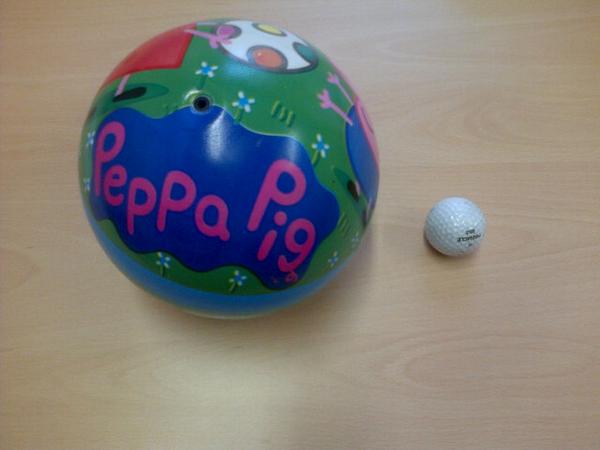
Visitors to the office of the Head of the School of Mathematical and Physical Sciences at the University of Sussex often remark upon the presence of these two objects and inquire as to their purpose:

Supernova

Since I don’t play golf and am a bit long in the tooth to be a fan of Peppa Pig, most assume that it must be for some strange astrophysical reason. I tried asking on Twitter what people think I use them for, and the most common answer was to demonstrate the relative size of the Earth and Moon. As Roy Walker would have said, “That’s a good answer, but it’s wrong”.

In fact I use the objects concerned to demonstrate what goes on when a star goes supernova.

The point is that a supernova explosion begins with gravitational collapse of the progenitor star, so why does that manifest itself as an explosion? The point is that the outer layers are blown off while the core collapses into a compact object such as a neutron star or, perhaps, a black hole.

The way to demonstrate this is first to balance the golf ball (representing the outer layers) on top of the beach ball; the air hole in the latter is a useful place to do this. You then lift the conjoined objects to a reasonable height and drop them onto the table or bench provided for such a purpose in a lecture theatre. The objects fall together under gravity until the beach ball hits the surface. You will find that the beach ball (representing the core) stops still while the golf ball (representing the outer shells) shoots upwards as most of the kinetic energy of the system is transferred to it during the bounce.

I think this is quite an effective demonstration, but I’d encourage inexperienced lecturers to note that there is a Health and Safety Issue, so it is necessary to carry out a risk assessment before attempting it. When I first did this during a lecture many years ago, I used a ball bearing rather than a golf ball and a fully-inflated and much larger beach ball instead of the more manageable (and slightly deflated) Peppa Pig one I now use. I told the students in the audience to watch carefully what happened and then dropped them as described above…

What happened in that case was that the ball bearing rocketed up so fast that it reached the ceiling and smashed into the lights above the lecturer’s bench, whereupon there was a very loud bang and I was showered with broken glass and other debris. I have to say that got the loudest round of applause I’ve ever had while lecturing, but it wasn’t exactly the effect I’d been hoping for.

But the real reason for posting today is to wish a very happy 65th birthday to supernova expert extraordinaire and occasional reader of this blog, Robert Kirshner of Harvard University, who has celebrating along with a number of my astro-chums at a conference in Australia.

Many happy returns, Bob!

An American doctor experiences an NHS emergency room

Posted in Politics on August 14, 2014 by telescoper

Interesting perspective on our wonderful National Health Service…

Dr. Jen Gunter's avatarDr. Jen Gunter

You know it’s going to be one of those days when one of the first tweets on vacation inquires about the closest hospital.

IMG_8896Victor, one of my 11-year-olds, had something in his eye courtesy of a big gust of wind outside of Westminster Abby. He was complaining enough to let me flip his eyelid and irrigate his eye on the square in front of Big Ben. (I’m sure several people thought I was torturing him).  Despite an extensive search and rinse mission no object or relief was to be found. I fretted about going to the hospital. It wasn’t the prospect of navigating a slightly foreign ER, but simply the prospect of the wait. While I am a staunch supporter of the British NHS in the back of my mind I envisioned a paralyzingly full emergency room and an agonizing 18 hour wait only to find he had nothing in his…

View original post 823 more words

Advice for Mathematics, Physics and Astronomy Students on Clearing!

Posted in Education with tags , , , , on August 14, 2014 by telescoper

Got your A-level results? Not made your first-choice University? My advice is:

1-dont-panic

We still some have places in the School of Mathematical & Physical Sciences at the University of Sussex. Whether you’re interested in Physics, Astrophysics, Astronomy or Mathematics (or even a combination of those subjects), why not just take a look at the University’s Clearing Page and give us a ring?

As a matter of fact, I’ll be around myself from 8am this morning to talk to interested students!

Click the relevant link for more information on our courses in Physics & Astronomy or for Mathematics!

Mathematics at Sussex: the videos!

Posted in Education on August 13, 2014 by telescoper

I recently posted a couple of videos illustrating some aspects of our undergraduate teaching in the Department of Physics & Astronomy here at the University of Sussex. Since I’m Head of the School of Mathematical and Physical Sciences, which encompasses Mathematics and Statistics as well as Physics & Astronomy, I thought I’d redress the balance with a couple of similar clips featuring mathematicians to give an idea of what students in the Department of Mathematics get up to.

First up is George Simpson, who graduated from Sussex this year with a (4-year) MMath and who is going to start a PhD here at the end of the summer:

And this is Hayley Wragg, a current MMath student, who is talking about her work as a Junior Research Associate in Mathematics:

Incidentally there is a vibrant and active Mathematics Society at Sussex, the University of Sussex Mathematics Society (SUMS). I’m not sure what the acronym is for Brighton University Mathematics Society…

O Captain! My Captain!

Posted in Film, Poetry with tags , , on August 12, 2014 by telescoper

O Captain! my Captain! our fearful trip is done,
The ship has weather’d every rack, the prize we sought is won,
The port is near, the bells I hear, the people all exulting,
While follow eyes the steady keel, the vessel grim and daring;
But O heart! heart! heart!
O the bleeding drops of red,
Where on the deck my Captain lies,
Fallen cold and dead.

O Captain! my Captain! rise up and hear the bells;
Rise up—for you the flag is flung—for you the bugle trills,
For you bouquets and ribbon’d wreaths—for you the shores a-crowding,
For you they call, the swaying mass, their eager faces turning;
Here Captain! dear father!
This arm beneath your head!
It is some dream that on the deck,
You’ve fallen cold and dead.

My Captain does not answer, his lips are pale and still,
My father does not feel my arm, he has no pulse nor will,
The ship is anchor’d safe and sound, its voyage closed and done,
From fearful trip the victor ship comes in with object won;
Exult O shores, and ring O bells!
But I with mournful tread,
Walk the deck my Captain lies,
Fallen cold and dead.

by Walt Whitman (1819-1892), posted in memoriam Robin Williams.

Genie, You’re Free..

Posted in Film with tags , , , on August 12, 2014 by telescoper

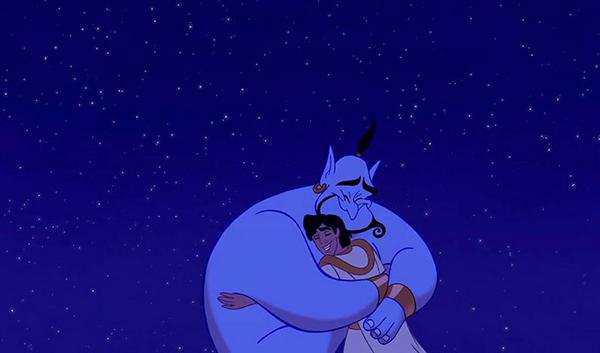
It’s been a hectic day so far but I couldn’t resist taking a little time out to post a little tribute to the enormous talent that was Robin Williams, who died last night having apparently taken his own life. Robin Williams was a unique comic talent, best displayed during his legendary stand-up routines, but also demonstrated to great effect on film, especially in Good Morning Vietnam and as the voice of the Genie in Disney’s Aladdin. These movies allowed him to express his remarkable spontaneous ability to connect ideas, characters and voices in a freewheeling improvised scenarios of breathtaking inventiveness; in both the films I mentioned his work was largely unscripted. In Good Morning Vietnam the cutaways to other actors while he did his bit in the radio studio clearly don’t show them acting, just cracking up as he cut loose his extraordinarily fertile imagination; and all the animators on Aladdin had to do to make a great film was to fill in images to match his free-flowing monologues, with celebrity impersonations and other funny voices thrown in for good measure.

Much has already been written about the sad circumstances of his death, and how he seems to have lost his long battle against depression. That a light that could shine so brightly has been lost to the darkness should be a cause of deep sadness, but no-one can really understand another person’s pain and it would be quite wrong to judge him selfish or weak because of the manner of his death. Instead, I shall remember him by the joy he gave – he was one of the comic actors who could reduce me to hysterics – and hope that in some way his loss might lead in some way to greater understanding of depression and other mental health problems.

The most moving tribute of many I’ve seen today on Twitter was from the The Academy of Motion Picture Arts and Sciences. The Genie in Aladdin yearned to be free, and now he is. RIP Robin Williams.

genie

Supermoon Surgery

Posted in Biographical, The Universe and Stuff with tags , , , , , , , on August 11, 2014 by telescoper

I have a busy day today (including my Annual Appraisal) to kick off a very busy week dominated by the release of this years A-level results and consequent admissions business, so I’ll just post a quickie though one which is at least fairly topical.

Last night (10th August) I took a (not very good) picture of the Moon with my phone:


supermoon

This is a so-called “supermoon“, a not particularly rare phenomenon which takes place when there is a Full Moon that coincides with the Moon being at the point of its orbit which is closest to the Earth, i.e. its perigee. A much better name is “Perigee Full Moon”, but that somehow doesn’t seem to have caught on in the popular media. The Moon orbits the Earth in an ellipse rather than a circle and at its closest approach it is about 14% closer than at its furthest (apogee). It therefore looks about 14% bigger and about 30% brighter during a Perigee Full Moon than during an Apogee Full Moon.

The Moon was certainly looking very bright when I took the picture last night, at least compared to a few minutes later when it disappeared behind a supercloud.

The Moon’s proximity to Earth during this Full Moon does have a noticeable effect on terrestrial tides, but not a particularly strong one; certainly not enough to trigger the end of the world. Actually, the tides have an amplitude just a few inches higher than average during a Perigee Full Moon. In any case roughly one in 14 Full Moons is a supermoon so it’s actually quite a common event, and as far as I’m aware the world didn’t come to an end during the last one or the one before that or the one before that or…

Anyway, all this supermoon malarkey reminded me of something that happened about 15 years ago,  just after I had moved to Nottingham to take up the position of Professor of Astrophysics at the University of Nottingham. I was sitting in my office, working – blogs hadn’t been invented then – when the phone rang and the voice at the other end said May I speak to Professor Coles please? When I replied that I was he, the caller went on to explain that he was a surgeon who worked at Queen’s Medical Centre, a hospital located right next to the University of Nottingham, with teaching staff working for the University.

It turned out that news of the setting up of the new Astronomy group there had made it into the University newsletter which my caller had seen. He asked if I had a few moments to answer a question about astrophysics which had been bothering him for some time and which he had just been discussing with some of his colleagues.  I said yes, and he asked: Does the Moon rotate?

I paused a bit, thinking how best to explain, and he went on to clarify his point, which was that if the Moon always has the same face towards the Earth does that mean it’s not rotating?

Understanding his question, I went on to explain that, yes, the Moon does rotate and that the reason it always shows the same face to the Earth (more-or-less, ignoring libration) is that the period of its rotation is the same as the Moon’s orbital period around the Earth. I also explained how to demonstrate this with two coffee mugs, moving one in a circle around the other and rotating the outer one so as to keep the handle pointing towards the central mug. Moreover, I explained the physics of this phenomenon, which is called tidal locking, and pointed out other examples in astrophysics.

After this spiel the caller said that was all very interesting but he had to go  now. Assuming I had bored him, as I fear I tend to do rather a lot, I apologized for going on about it for too long. He said no he wasn’t at all bored by the detail I had put in, he found it all absolutely fascinating. The reason for him needing to go was that he had to go back to tell the answer to the colleagues he had been discussing it with  just before phoning me.  They were all  in the operating theatre,  standing around a patient lying on the operating table, waiting  for him to return and complete the operation he had left in order to make the call…

Doodlebug Summer

Posted in History with tags , , , , , , , , , , , on August 10, 2014 by telescoper

Yesterday’s post reminded me of another aspect of World War 2 that is worth mentioning. There’s a general impression that the defeat of Nazi Germany was more-or-less inevitable after the Normandy invasion of June 1944. However, as I mentioned yesterday, the Allied advance was much slower than expected and it was not until mid-August that the British, Canadian and American divisions really broke through. Morale back home wasn’t helped by this slow progress, but the most significant factor for the civilian population, especially in London, for the period June to August 1944 was the arrival of a new form of weapon; for many, the summer 1944 was “Doodlebug Summer”.

First came the V1 “Flying Bomb” (or “doodlebug”). The first of these to fall on London hit the railway bridge at Grove Road in Bow, East London, on 13th June 1944. This is just a few hundred yards North of Mile End tube station, and close to where I used to work at Queen Mary College, University of London. I don’t think people realize the scale of the threat these terror weapons posed. For a start they were launched in considerable numbers, usually over a hundred a day and over 8000 in total during the course of the summer. These weapons caused 22,892 (mainly civilian) casualties and causing widespread damage to the city’s infrastructure. Looking through the War Office minutes for the week corresponding to this one, seventy years ago, yields a typical statistic: 768 Flying Bombs were launched, 158 landed over London, 462 were destroyed.

These numbers however, convey only part of the picture. The doodlebug was primarily a terror weapon; it struck fear into the hearts of the population though the distinctive sound of its primitive jet engine – fear would immediately transform into alarm when the engine cut out, for that was when the device would fall to Earth and detonate. On the one hand, this did at least give some warning to those in its path but, on the other, it made it impossible for the authorities to disguise the nature of the threat. The V1 was relatively slow (640 km/h, i.e. about 400 mph) and flew at quite a low altitude, which meant that many were downed by ground-based anti-aircraft guns or fighter aircraft fast enough to intercept them, but sufficient numbers still got through to cause considerable panic. The onslaught was only halted in September 1944 when the advancing Allies overran the launch sites in France. Although attacks resumed in due course from other launch sites, the scale of the threat was greatly diminished.

Later on, from September 1944 onwards, the V2 rocket was introduced; this travelled on a ballistic trajectory and gave no warning whatsoever; no gun or aircraft could possibly shoot it down. To begin with the authorities attempted to explain the succession of mysterious explosions as being due to fault gas mains, etc. There never was an effective defence against the V2, but fortunately they were rather unreliable and the number of casualties they caused, though considerable, was not on the same scale as the V1.

Another interesting aspect of the doodlebug attacks was the deception campaign run by British Intelligence, which involved a famous double-agent code-named Garbo. This was the agent behind the audacious deception plan that led the Nazi High Command to believe that the Normandy landings were a decoy to draw attention away from the main landings which would happen in the Pas de Calais. As part of this ruse, Garbo (whom the Germans believed was working for them) actually sent news of the Normandy landings to his handlers by radio. This staggeringly risky gambit could have ended in disaster, but the Germans swallowed the bait: an entire division was kept away from Normandy, waiting for the expected assault in Pas de Calais, which of course never came.

In mid-June 1944 Garbo was asked by his handlers to report on the locations of V1 impacts. The guidance system on the doodlebug was very crude and the Germans had no real idea whether they were systematically overshooting or falling short of London. Could some form of deception plan be concocted that could work in this case? The obvious strategy would be to report that V1s falling on London were falling too far North; if the Germans believed this then they would adjust the settings so they fell further South, and would then miss London. However, some doodlebugs hit high-profile targets so there was little point lying about them – Garbo would immediately be exposed. Moreover, some V1s were fitted with radio transmitters and the Germans knew exactly where they were landing. In the end it was decided that Garbo would simply report (accurately) only those V1 impacts that happened to the North West of London, hoping that the selection bias in these reports would be misinterpreted as a systematic error in the aiming of the V1s. From Ultra decrypts from the code-breakers at Bletchley Park, the Allies knew what was believed by the Germans and what was not and adjusted the flow of information accordingly.

If 1944 seems sufficiently remote for this all just to be a fascinating piece of history, it is worth remembering that the V1 “Terror Weapon” was the forerunner of the modern US combat drones that have killed many hundreds of civilians in Pakistan, Yemen and Somalia in covert attacks as part of the so-called “War on Terror”. Think about the irony of that for a moment.