Author Archive

Solly’s Story

Posted in Biographical, Brighton, History, LGBTQ+ with tags , , , on August 9, 2014 by telescoper

I don’t know why I suddenly remembered a long-forgotten character I knew when I was in Brighton as a research student, but I thought I’d write a blog post so I don’t forget him again.

I moved to Brighton in late September 1985 to start my DPhil. I’d left it quite late looking for accommodation because I’d been working in Newcastle through the summer after my graduation. In the end I had to settle for a bedsit in Hove, quite a long way from central Brighton in a road called Goldstone Villas, not far from Brighton & Hove Albion’s old stadium, the Goldstone Ground.

Round the corner from my place was a pub – I’ve forgotten the name – which became my local. After a few visits there I became friendly with one of the regulars there, a man in his sixties who was known to everyone as Solly, short for Solomon. He was, as I soon came to realise, something of a local celebrity.

Solly was a tall man, always immaculately dressed, and (I would say) handsome for his years. He was also (quite obviously) gay and (also quite obviously) Jewish. He had a great sense of humour and was a wonderful raconteur, but at the same time very kindly and self-effacing; he was liked by everyone in the pub (which wasn’t a gay pub, by the way).

Like everyone else I took an immediate liking to Solly; I greatly enjoyed his company and we had dinner together quite a few times in addition to conversations in the pub. On one of these occasions he told me his life story, or at least some of it. It turns out he was of Anglo-Austrian extraction, with an English mother and an Austrian father, although he had no trace of an accent. He was born in Austria, but his parents sent him to live with relatives in England during the 1930s because they could see what was going to happen there as the power of Nazi Germany grew; he never saw either of them again.

Solly arrived in Brighton when he was about 11 and he was 17 when World War 2 broke out. He immediately tried to join up, but was refused because he was too young. When he reached 18 he tried again but was still refused. He went to London (at the height of the Blitz) to try enlisting there, but was also refused, possibly because of his German-sounding name (and also possibly because of his sexuality).

Having failed to join up he returned to Brighton in late summer 1940 and joined the Local Defence Volunteers (the “Home Guard”). Given his appearance in later life I imagine he would have looked at this time rather a lot like Private Pike from Dad’s Army.

I remember many of his hilarious stories of how shambolic the Home Guard actually was, as well as how they were largely engaged in helping the Police deal with crimes such as racketeering and looting, but there was one particular striking incident that has stuck in my memory.

On 7th September 1940 the War Office issued the following communique:

Message to all UK units: codeword CROMWELL. Home Defence forces to highest degree of readiness. Invasion of mainland UK expected at any time.

After being informed of this signal Solly and his comrades turned up to be issued with the equipment with which they were expected to stop the invasion. In his case it was an ancient pre-WW1 vintage rifle, three rounds of ammunition, and two improvised grenades. With these meagre supplies, they were supposed to hold their positions until reinforced, possibly for up to 7 days.

As they walked to their posts all the volunteers were certain that they had no chance and that none of them would survive the night. The talk was exclusively of the need to make all their shots count. If each man could kill at least one German before he himself was killed then the invasion might be thwarted. Solly certainly had no intention of allowing himself to be taken prisoner, as he knew all too well how he would be treated by the Nazis.
After an agonizing wait, and several false alarms, dawn broke. The Germans never came.

As it turns out, if they had come, Solly’s platoon would have been right in the front line: Operation Sealion (the planned invasion of England) involved the landing of paratroopers on the Downs just behind Brighton with the intention of securing the high ground behind the landings and the main road to London ahead of the invasion:
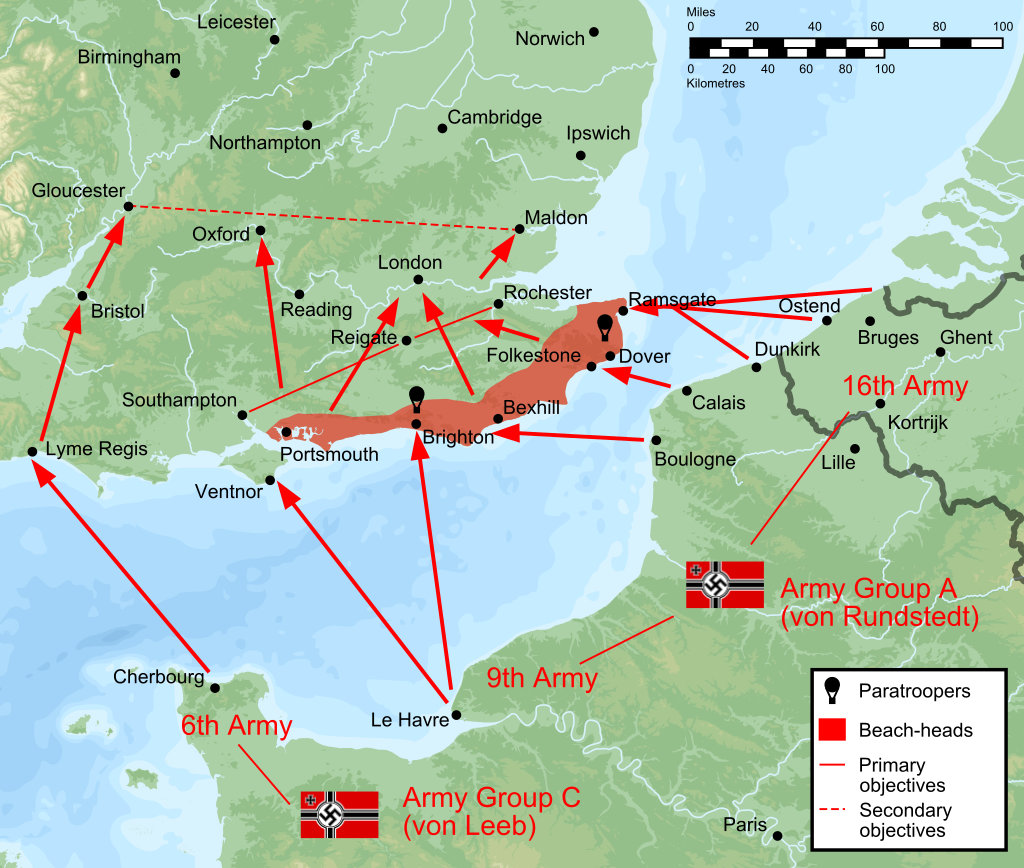
1024px-OperationSealion.svg

Solly did finally succeed in enlisting, but his good knowledge of the German language meant that he was given a desk job, translating documents and such, until the Normandy invasion when he finally got to fire a weapon in action, although he landed some weeks after the initial assault, when his unit was attacked south of Caen. He didn’t hit anyone.

Incidentally, the 70th anniversary of the D-Day landings passed in June 1944 but it’s worth noting that the German defensive lines were not really broken until August. In fact, on this day in 1944, British and Canadian forces were engaged in heavy fighting about 6 miles from Falaise, while the Americans were executing a wide encircling manoeuvre designed to surround and trap the German army.

Anyway, back to the 1980s. I didn’t stay long in the Hove bedsit and moved out early in 1986. About six months later I happened to be in the area so popped into the pub to see Solly. He wasn’t there; he had passed away suddenly of a heart attack in the Spring.

Higher Education Funding: A Modest Proposal

Posted in Education, Finance, Politics with tags , , , , , on August 8, 2014 by telescoper

With next year’s general election already looming there are signs that the higher education funding system is likely to be a hot topic. The Conservatives, for example, are reportedly considering removing the cap on tuition fees (currently set at £9K per annum) while Labour is talking about reducing the figure to £6K. Labour’s idea is likely to prove popular among potential students, it will result in a reduction of fee income to English universities of a third, potentially leading to wholesale redundancies and closures unless it is offset by an increased contribution from the taxpayer to offset this cut. Responsibility for higher education funding in Wales, Scotland and Northern Ireland is devolved, so Westminster policy does not apply directly there although the knock-on effect of changes in England would be considerable given the number of students who choose to study away from home.

The backdrop to these suggested policy changes is the obvious fact that the current system is unsustainable. Although there has not been a marked reduction in numbers of students applying to university since the introduction of tuition fees, it has become increasingly clear that the system of loans and deferred fees is actually costing the Exchequer more in terms of short-term borrowing than the old system. Moreover, there is a growing realization that the fraction of this cost that will actually be recouped in future is going to be much smaller than its advocates would like to admit. Recent estimates, likely to be revised upwards, suggest that 45% of student loans will never be repaid.

On top of this there is the problem that the so-called “elite” universities have not succeeded in “widening participation” (as the phrase goes). Oxford and Cambridge both continue to take about 40% of their pupils from private schools; many other institutions. My own institution, the University of Sussex, takes about 86% of its intake from state schools, which is about the average across the sector.

Although only a small fraction of pupils (about 7%) attend (private) independent schools, about 65% of those go on to University; only 24% from the state sector do. In my opinion, not all universities take widening participation seriously but even if they do (like we do at Sussex) it is difficult for higher education institutions to repair the divisions that arise much earlier in the education system.

The average fee per term for a day pupil at a private school in the UK is about £3400; this rises to about £7800 per term for boarding schools. Since there are three school terms per year this means that the average cost per year for day pupils is £10,200, well above the £9000 per year maximum fee for university tuition. That says a lot for how poorly funded UK universities really are, even with increased tuition fees, especially in STEM subjects which require expensive laboratories and other facilities. Moreover, private school fees are payable upfront while tuition fees for students in higher education are funded by heavily subsidized loans which do not need to be repaid until the student is earning more than a certain minimum salary (currently £21K pa).

When funding is tight it is particularly important that it should be targetted where it is needed most. For me that means to encourage more students from state schools to go to university. The principle I’d adopt here (and indeed in many other contexts) is encapsulated in the phrase “to each according to their need, from each according to their ability”.

Parents who have decided to send their offspring to private schools have, in my view, already demonstrated that they can afford to contribute to their education at a level considerably higher than the current tuition fee for university students. In such cases there is no need for a means test to determine whether they need support from the taxpayer; they have already done that calculation for themselves.

My proposal, therefore, is that students whose parents have decided to take their children out of the state school system should be deemed to be ineligible for state support for higher education. They should therefore pay the full fees upfront. I think there’s a case even for making such students pay for the full cost of their education which is not the £9K fee payable by Home/EU but the much higher fee charged to students from outside the EU, which is currently £17K at the University of Sussex. The money saved in this way should be used to provide better fee waivers and and maintenance grants for students from the state school system (on a means-tested basis). This could be accomplished by, e.g., a system of vouchers available to students from state schools in England; the rest of the UK could adopt a similar system if they wish. This would also be a step towards reducing the incentive for families to increase social divisions by taking their children out of the state system.

As well as driving greater equality and stimulating social mobility, my suggestion would also correct a number of anomalies in the existing system. One is that students attending English universities who went to Schools elsewhere in Europe (including Wales, Scotland and Northern Ireland) are entitled to the same financial support as English students. However, most students from outside the UK will return home after graduation and there is no effective means of making them pay back their fees and loans because these are currently recovered through the UK tax system. In effect, therefore, the taxpayer is providing free higher education for these students and it is one of the reason why the default rate on student loans is likely to be very high. In my proposal this loophole would be sealed; unless a student went to an English state school they would not have the means to access HEFCE support.

I have heard it said that this idea would remove choice. I don’t agree. Parents will still have the choice of sending their sons and daughters to private school if they wish. What it will do is remove part of the incentive for them to do that.

Across the UK over 80% of university students are from state schools, so the measure I suggest will not on its own solve the University funding crisis. On the other hand, I think it would at least be fairer than the current system. On the other hand, I’m not sure fairness counts for very much these days…

Combining Research and Teaching in Physics & Astronomy

Posted in Education, The Universe and Stuff with tags , , , , , on August 7, 2014 by telescoper

Among the distinctive things we do here in the School of Mathematical and Physical Sciences at the University of Sussex are our degree programmes that involve a Research Placement (RP). Students on these courses take the normal lectures, laboratory classes and workshops during the academic year, but they spend the summer vacation doing (paid) work with research groups in the School to get an experience of what the world of research is really like. Various combinations of Physics and Astronomy with a Research Placement have been around for some time. These courses have been so popular and successful that we’ve extended the idea to Mathematics for 2015 entry. We have also started extending the RP scheme to include placements in laboratories elsewhere, either in industry or in a university abroad; we even have two students currently doing their placements in China.

Here are a couple of videos we’ve made featuring two RP students who have been working in the Department of Physics & Astronomy this summer.

This is Ross Callaghan:

And this is Nathaniel Wiesendanger Shaw:

Both these students are in between their 2nd and 3rd years of a 4-year MPhys programme. As it happens, both survived the experience of being in my Theoretical Physics class last term too!

It’s an ongoing frustration of mine that so many influential people think that teaching and research are separate functions of a university and should not be mixed. I believe that the two go hand-in-hand and that you can’t really claim to be getting a real university education if it’s not informed by the latest developments in research. Moreover, some also imply that research-led teaching only happens in the Russell Group, which is not the case at all. In fact, I think we provide a much better environment for this in Sussex than either of the Russell Group universities in which I’ve previously worked.

Many Departments talk about how important it is that their teaching is based on state-of-the-art research, but here at Sussex we don’t just talk about research to undergraduates – we let them do it!

Rendezvous Rosetta!

Posted in The Universe and Stuff with tags , , on August 6, 2014 by telescoper

Just a quick post to remind you (as if you needed it) that, in about 5 minutes’ time at 10am BST, the ESA spacecraft Rosetta will begin its encounter with a comet (actually Comet 67P/Churyumov-Gerasimenko).

As it approached its target, Rosetta took this picture that revealed the comet to be a rather peculiar beast, rather like a rubber duck:

Comet

Here’s a more recent, closer, view:

Comet_close

Rosetta’s journey began on 2 March 2004 when Rosetta was launched on an Ariane 5 from Europe’s Spaceport in Kourou, French Guyana. Since then, the spacecraft has orbited around the Sun five times, picking up speed through three gravitational “slingshots” at Earth and one at Mars, to enter an orbit similar to that of its target, said comet 67P/Churyumov–Gerasimenko, which is in an elliptical 6.5-year solar orbit that takes it from beyond the orbit of Jupiter at its furthest point, and between the orbits of Mars and Earth at its closest to the Sun.

To perform its rendezvous Rosetta has to match the pace of the comet – currently about 55 000 km/h – and travel alongside it to within just 1 m/s between them. This has required a complex and delicate series of manoeuvres:

The spacecraft will then travel alongside the comet as it approaches the Sun. In November 2014 the Philae probe will be deployed and will land on the comet surface. Rosetta will follow the comet to its closest distance to the Sun on 13 August 2015 and as it moves back towards the outer Solar System. The nominal mission end is December 2015.

I bet there’s quite a lot of stress in the ESA control centre in Darmstad, Germany, as the probe’s epic journey nears its end, not least because telemetry is lost while the burn happens. Those ten years in space will count for little if something goes wrong now. Good luck everyone involved!

You can watch a live feed of the encounter here.

UPDATE: after an agonizing wait – it takes 23 minutes for telemetry to reach Earth from Rosetta – the spacecraft has entered orbit correctly. Well done everyone!

UPDATE: click here for an amazing collection of images of the comet.

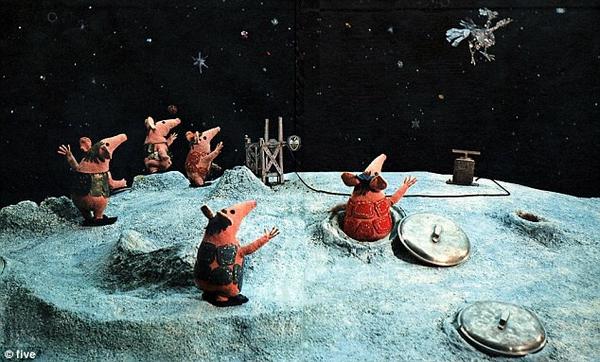
UPDATE: Relief at ESA HQ as The Clangers finally emerge to greet the Rosetta Spacecraft:

BuW-AFJIEAA6L3k

How Horses Communicate

Posted in Uncategorized with tags , , on August 5, 2014 by telescoper

Meanwhile, researchers from the School of Psychology at the University of Sussex have revealed how horses communicate:

horses

JULY 1914, by Anna Akhmatova

Posted in History, Poetry with tags , , , on August 5, 2014 by telescoper

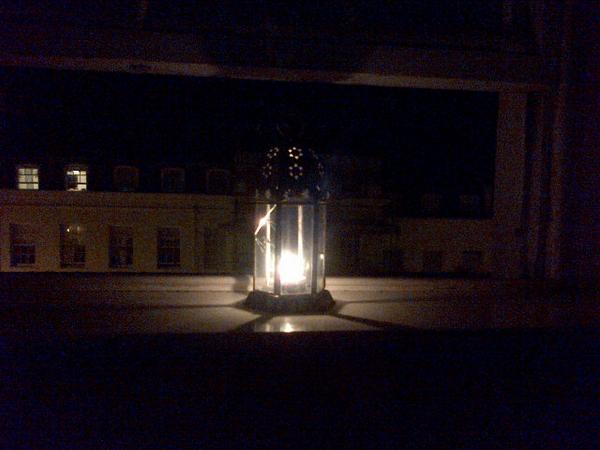
I heard a great poem on Radio 3 last night. It was part of a programme that preceded a late night promenade concert during which, at 10pm, people across the country were invited to turn their lights out and place a candle in their window as an act of remembrance. From what I could see, not many in my street bothered, but I did…

LightsOut


The poem I heard was written by Russian poet Anna Akhmatova on the eve of her country’s entry into World War 1. It’s actually just the first part of a poem called JULY 1914 (the capitalization is deliberate). It perfectly captures that sense of foreboding she felt as the clouds gathered, and the hot weather we’ve been having made it all the more effective:

It smells of burning. For four weeks
The dry peat bog has been burning.
The birds have not even sung today,
And the aspen has stopped quaking.

The sun has become God’s displeasure,
Rain has not sprinkled the fields since Easter.
A one-legged stranger came along
And all alone in the courtyard he said:

“Fearful times are drawing near. Soon
Fresh graves will be everywhere.
There will be famine, earthquakes, widespread death,
And the eclipse of the sun and the moon.

But the enemy will not divide
Our land at will, for himself;
The Mother of God will spread her white mantle
Over this enormous grief.”

by Anna Akhmatova (1889-1966).


The Statistics of the “Great War”

Posted in Music, Poetry with tags , , , , , on August 4, 2014 by telescoper

Since today, 4th August 2014, is the centenary of Britain’s entry into the First War I thought I’d repost an edited version of a piece I wrote some time ago which says very clear what I feel about the War that some people insist on calling “Great”…

–0–

Ten summers ago, in 2004, I spent an enjoyable day walking in the beautiful Peak District of Derbyshire followed by an evening at the opera in the pleasant spa town of Buxton, where there is an annual music festival. The opera I saw was A Turn of the Screw, by Benjamin Britten: a little incongruous for Buxton’s fine little Opera House which is decorated with chintzy Edwardiana and which was probably intended for performances of Gilbert & Sullivan comic operettas rather than stark tales of psychological terror.

When Buxton’s theatre was built, in 1903, the town was a fashionable resort at which the well-to-do could take the waters and relax in the comfort of one of the many smart hotels.

Arriving over an hour before the opera started, I took a walk around the place and ended up on a small hill overlooking the town centre where I found the local war memorial. This is typical of the sort of thing one can see in small towns the length and breadth of Britain. It lists the names and dates of those killed during the “Great War” (1914-1918). Actually, it lists the names but mostly there is only one date, 1916.

The 1st Battalion of the Nottingham and Derbyshire Regiment (known as the Sherwood Foresters) took part in the Battle of the Somme that started on 1st July 1916. For many of them it ended that day too; some of their names are listed on Buxton’s memorial.

On the first day of this offensive, the British Army suffered 58,000 casualties as, all along the western front, troops walked slowly and defencelessly into concentrated fire from heavy machine guns that were supposed to have been knocked out by the artillery barrage that preceded the attack. The bombardment had been almost entirely ineffective, and it finished well before the British advance started, so the Germans had plenty of time to return to their positions and wait for the advancing British.

Rather than calling off the attack in the face of the slaughter, the powers that be carried on sending troops over the top to their doom for months on end. By the end of the battle in November that year the British losses were a staggering 420,000, while those on the German side were estimated at half a million. The territory gained at such a heavy price was negligible.

These numbers are beyond comprehension, but their impact on places like Buxton was measurably real. Buxton became a town of widows. The loss of manpower made it impossible for many businesses to continue when peace returned in 1918 and a steep economic decline followed. It never fully recovered from the devastation of 1916 and its pre-war posterity never returned.

And the carnage didn’t end on the Somme. As the “Great War” stumbled on, battle after battle degenerated into bloody fiasco. Just a year later the Third Battle of Ypres saw another 310,000 dead on the British side as another major assault on the German defences faltered in the mud of Passchendaele. By the end of the War on 11th November 1918, losses on both sides were counted in millions.

I thank my lucky stars that I never had to live through conflict on the scale my grandparents’ generation had to face and curse those who have inflicted that fate on others. I quote a great First World War poet, Siegfried Sassoon (writing here in prose) whose words are as apt today as they were ninety years ago:

I have seen and endured the sufferings of the troops, and I can no longer be a party to prolonging these sufferings for ends which I believe to be evil and unjust. On behalf of all those who are suffering now I make this protest against the deception that is being practised on them; also I believe that I may help to destroy the callous complacency with which the majority of those at home regard the continuance of agonies which they do not share, and which they have not sufficient imagination to realize.

That could just as easily have been written about Iraq or Afghanistan or Ukraine or Gaza as Flanders (1917).

Last night I listened to a broadcast of the Mozart Requiem on BBC Radio 3. Mozart  left this piece unfinished at his death. The performance was preceded by an interesting discussion about the subsequent completion by his student, Süssmayr, and the various alternatives including the one by Robert Levin we heard last night. Of course nobody will know exactly how Mozart intended this work to be completed because Mozart died before he was able to finish it. We’ll never know what the millions that died before their time during World War 1 would have achieved either. Among the lists of the dead and maimed  were great poets, artists, musicians, scientists and engineers but we’ll never know what they might have created because death had the last word.

I thought I’d end with a poem by, Wilfred Owen. This is his Anthem for Doomed Youth, the references in the poem to church services adding tragic irony to his already powerful verse.

What passing-bells for these who die as cattle?
-Only the monstrous anger of the guns.
Only the stuttering rifles’ rapid rattle
Can patter out their hasty orisons.
No mockeries now for them; no prayers nor bells;
Nor any voice of mourning save the choirs,-
The shrill, demented choirs of wailing shells;
And bugles calling for them from sad shires.

What candles may be held to speed them all?
Not in the hands of boys but in their eyes
Shall shine the holy glimmers of good-byes.
The pallor of girls’ brows shall be their pall;
Their flowers the tenderness of patient minds,
And each slow dusk a drawing-down of blinds.

Wilfred Owen died in battle in 1918, aged 25, just a week before the armistice was signed. Another statistic.


From Brighton Pride to Sussex Pride

Posted in Biographical, Brighton, LGBTQ+ with tags , , , , , , , , on July 31, 2014 by telescoper

Brighton Pride is coming up this weekend. I heard some people on the train the other day saying that they didn’t think such events were needed any more because “gays have everything they need, especially in Brighton”. Although I was tempted, I didn’t interrupt, though I did disagree. Things have indeed changed a lot over the last twenty years, but they could easily change back if we get complacent and Brighton has its fair share of intolerance and bigotry still.

I was myself beaten up on Brighton’s seafront many years ago, during my previous existence at the University of Sussex as a PhD student and a postdoctoral researcher. There was no doubt why I was attacked: the four young men who surrounded me and punched and kicked me to the ground were shouting just one word over and over again, “faggot”. It’s still a word I hate to hear used, even if purportedly in jest. That event left me with deep psychological scars that contributed to a breakdown I had as recently as two years ago.

Thirty or so years after my encounter with the queerbashers, attitudes have definitely changed, and so has the law. Certain types of criminal offence are now officially recognized as hate crimes: the list treats sexual orientation as equivalent to race, gender, religious belief and disability in such matters. The Police are now obliged to treat these with due seriousness, and penalties for those found guilty of crimes exacerbated by homophobia are consequently more severe. All Police forces now have special units for dealing with them; here is an example.

These changes are mirrored in other aspects of life too. For example, employment law relating to discrimination or harassment in the workplace now puts sexual orientation on the same footing as race, gender, disability and religious belief. In many universities in the UK, staff have been required to attend training in Equality and Diversity matters not only to raise awareness of the legal framework under which we all have to work, but also to promote a sensitivity to these issues in order to improve the working environment for both staff and students. Now we have equal marriage too.

This training isn’t about over-zealous busybodies. Under the law, employers have a vicarious liability for the conduct of their staff with regard to harassment and discrimination. This means that a University can be sued if, for example, one of its employees commits harassment, and it can be shown that it did not make appropriate efforts to ensure its staff did not engage in such activities.

Of course not everyone approves of these changes. Some staff  have refused point-blank to attend Equality and Diversity training, even though it’s compulsory. Others attend grudgingly, muttering about “political correctness gone mad”. You may think all this is a bit heavy handed, but I can tell you it makes a real difference to the lives of people who, without this legal protection, would be victimised, harassed or discriminated against.  It is, also, the law.

I think the efforts that have been made to improve the legal situation have been (at least partly) responsible for the changes in society’s attitudes over the last twenty years, which have been extremely positive. I’m old enough to remember very different times. That’s not to say that there’s no bigotry any more. Even in this day and age, violent crimes against gay men are still disturbingly common and police attitudes not always helpful even though many police forces do now have Lesbian and Gay teams, something that was just unthinkable 25 years ago.

Although relatively few universities appear in the list of gay-friendly employers compiled by the campaigning organisation Stonewall,  my experience generally, having worked in a number of UK universities (Sussex, Queen Mary, Nottingham and Cardiff), is that they are  generally friendly and comfortable places for an openly gay person to work. So much so, in fact, that there’s no real need to make a big deal of one’s sexual identity. It doesn’t really have much to do with the way you do your work – certainly not if it’s astrophysics – and work-related social events are, as a rule, very inclusive.

However, even in the supposedly enlightened environment of a University there do remain islands of bigotry, and not just about gay or lesbian or bisexual or transgender staff.  Sexism is a major problem, at least in science subjects, and will probably remain so until the gender balance improves, which it slowly doing, despite the actions of certain professors who actively block attempts to encourage more female applicants to permanent positions. Universities still do not seem to me to treat sexual orientation with the same seriousness as, say, race or gender discrimination. I’ve had plenty of experiences to back that up.

I recently took part in an interesting meeting involving various staff from the University of Sussex with a representative of Stonewall. The topic was how we could work with Stonewall to make it more gay-friendly. If I remember correctly, there are 78 UK Universities currently taking part in Stonewall’s programmes. It is a matter of some  embarrassment to me that the University of Sussex is not among them. Perhaps the attitude is that because there is such a large and visible gay population in Brighton it’s not necessary for the University of Sussex to take any steps in this direction. I disagree, and am absolutely convinced that there are many Lesbian, Gay, Bisexual or Transgender members of the University of Sussex staff who would love to see some action taken to make their workplace just a little bit friendlier and more inclusive, even if that just amounts to acknowledging their existence.  There is a visible and active LBGT student society on campus, but no such entity exists for staff – an absence that is truly glaring. I don’t even think the University has any idea what fraction of its staff identify themselves as LGBT.

No doubt there’ll be many members of the University of Sussex staff on the Pride Parade on Saturday and at the various parties being held around Brighton afterwards. Perhaps it’s time to start some sort of network so that for staff at the University of Sussex, Pride doesn’t just come once a year…?

If you’re interested in this idea please let me know, either through the comments box or by email.

Jimmy Anderson & Moeen split hairs in England cricket team Beard Index

Posted in Beards, Cricket with tags , , on July 30, 2014 by telescoper

Important poll on the Beard Index for England’s cricketers..

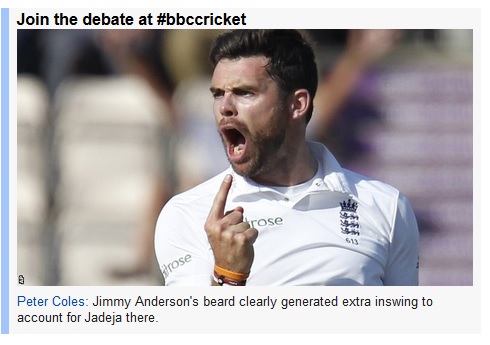
My own vote went to Jimmy Anderson, a remark on whose performance yesterday by me on Twitter also led to me featuring on the BBC Sports Website:

Anderson

Today is the 4th Day and England have just declared on 205-4, leaving India to score 445 to win in approximately 132 overs…

..and India close on 112-4. The ball is starting to turn and with another 331 to win off 90 overs (3.67 an over) the odds are firmly on England’s side.

UPDATE: And so it came to pass that England took India’s last 6 wickets for 66 runs in the first session of the final day to win by 266 runs.

kmflett's avatarKmflett's Blog

Beard Liberation Front
Press release 29th July contact Keith Flett 07803 167266

Jimmy Anderson & Moeen split hairs in England Cricket Team Beard Index

The Beard Liberation Front, the informal network of beard wearers, has issued an update to its England cricket Beard Index which shows Moeen Ali and Jimmy Anderson tied with Ian Bell and Alastair Cook moving up the rankings

Hirsute England players have only recently been a significant factor in the team’s performance but the campaigners say that facial hair on the pitch can have several, sometimes combined, impacts:

1] Beards can add gravitas and presence. Moeen is known as ‘the beard that’s feared’
2] Beards can influence aerodynamics both with bat and ball as a movement of the facial hair can cause subtle changes to air currents

Beard Index [combining factors 1 & 2] out of 10

Moeen 9
Anderson 9
Bell 6
Cook 6
Broad…

View original post 40 more words

Politics, Polls and Insignificance

Posted in Bad Statistics, Politics with tags , , , , , on July 29, 2014 by telescoper

In between various tasks I had a look at the news and saw a story about opinion polls that encouraged me to make another quick contribution to my bad statistics folder.

The piece concerned (in the Independent) includes the following statement:

A ComRes survey for The Independent shows that the Conservatives have dropped to 27 per cent, their lowest in a poll for this newspaper since the 2010 election. The party is down three points on last month, while Labour, now on 33 per cent, is up one point. Ukip is down one point to 17 per cent, with the Liberal Democrats up one point to eight per cent and the Green Party up two points to seven per cent.

The link added to ComRes is mine; the full survey can be found here. Unfortunately, the report, as is sadly almost always the case in surveys of this kind, neglects any mention of the statistical uncertainty in the poll. In fact the last point is based on a telephone poll of a sample of just 1001 respondents. Suppose the fraction of the population having the intention to vote for a particular party is p. For a sample of size n with x respondents indicating that they hen one can straightforwardly estimate p \simeq x/n. So far so good, as long as there is no bias induced by the form of the question asked nor in the selection of the sample, which for a telephone poll is doubtful.

A  little bit of mathematics involving the binomial distribution yields an answer for the uncertainty in this estimate of p in terms of the sampling error:

\sigma = \sqrt{\frac{p(1-p)}{n}}

For the sample size given, and a value p \simeq 0.33 this amounts to a standard error of about 1.5%. About 95% of samples drawn from a population in which the true fraction is p will yield an estimate within p \pm 2\sigma, i.e. within about 3% of the true figure. In other words the typical variation between two samples drawn from the same underlying population is about 3%.

If you don’t believe my calculation then you could use ComRes’ own “margin of error calculator“. The UK electorate as of 2012 numbered 46,353,900 and a sample size of 1001 returns a margin of error of 3.1%. This figure is not quoted in the report however.

Looking at the figures quoted in the report will tell you that all of the changes reported since last month’s poll are within the sampling uncertainty and are therefore consistent with no change at all in underlying voting intentions over this period.

A summary of the report posted elsewhere states:

A ComRes survey for the Independent shows that Labour have jumped one point to 33 per cent in opinion ratings, with the Conservatives dropping to 27 per cent – their lowest support since the 2010 election.

No! There’s no evidence of support for Labour having “jumped one point”, even if you could describe such a marginal change as a “jump” in the first place.

Statistical illiteracy is as widespread amongst politicians as it is amongst journalists, but the fact that silly reports like this are commonplace doesn’t make them any less annoying. After all, the idea of sampling uncertainty isn’t all that difficult to understand. Is it?

And with so many more important things going on in the world that deserve better press coverage than they are getting, why does a “quality” newspaper waste its valuable column inches on this sort of twaddle?